Carbon Market Network


Carbon now has a price tag. Every tonne of it, traded, capped, and increasingly, invested in.
If you have ever wondered how ordinary investors can get exposure to this fast-growing market without becoming a compliance expert, you are in the right place.
Carbon credit ETFs make that possible. They let you invest in carbon allowance prices the same way you would invest in gold or oil, through a simple brokerage account.
This guide breaks down everything you need to know about carbon credit ETFs. We cover how they work, which funds lead the space, what risks to watch for, and how to decide if they belong in your portfolio.
Let’s get into it.
What Is a Carbon Credit ETF?
A carbon credit ETF is an exchange-traded fund that tracks the price of carbon allowances or carbon credit futures contracts.
Instead of buying individual carbon credits yourself, you buy shares of the ETF. The fund does the heavy lifting behind the scenes.
These funds typically track compliance carbon markets. These are government-regulated cap-and-trade systems, also called Emissions Trading Systems (ETS).
In simple terms, a carbon credit ETF gives you a way to invest in the rising or falling cost of polluting.
Carbon Market Insider Newsletter
Weekly insights on carbon markets, climate policy, carbon credits, and sustainability.
How Carbon Credit ETFs Differ from Carbon Offset Investments
This distinction trips up a lot of new investors, so let’s clear it up early.
Carbon offsets come from voluntary projects like forest conservation, renewable energy, or methane capture. Companies buy these credits to claim they have balanced out their emissions.
Carbon allowances, on the other hand, are issued by governments under mandatory cap-and-trade programs. Companies in regulated industries must hold enough allowances to cover their actual emissions.
Most carbon credit ETFs track allowances, not voluntary offsets. This matters because:
- Allowance markets are regulated, transparent, and highly liquid.
- Voluntary offset markets are more fragmented and harder to standardize into a tradable index.
- Allowance prices react directly to government policy, making them more predictable in some ways.
So when people search for “carbon credit ETFs,” they are usually talking about funds tracking compliance allowance markets like the EU ETS, California’s Cap-and-Trade Program, or the Regional Greenhouse Gas Initiative (RGGI) in the northeastern United States.
How Do Carbon Credit ETFs Work?
Carbon credit ETFs do not usually hold physical carbon credits. Instead, most of them hold futures contracts.
Futures Contracts Explained
A futures contract is an agreement to buy or sell an asset at a set price on a future date.
For carbon credit ETFs, the underlying asset is a carbon allowance, such as a European Union Allowance (EUA) or a California Carbon Allowance (CCA).
Here is a simplified version of how it works:
- The ETF provider selects an index that tracks the most heavily traded carbon allowance futures contracts.
- The fund buys futures contracts to match that index as closely as possible.
- As futures contracts near expiration, the fund “rolls” them into new contracts further out.
- The fund’s share price rises and falls based on the value of those contracts.
This structure is similar to how many commodity ETFs work for oil, natural gas, or agricultural products.
Compliance Markets vs Voluntary Markets
Here is a quick side-by-side comparison to keep things clear.
| Feature | Compliance Carbon Market | Voluntary Carbon Market |
|---|---|---|
| Who participates | Regulated industries under law | Companies and individuals by choice |
| Price driver | Government-set caps and auctions | Supply and demand for offset projects |
| Regulation | Strict, government-mandated | Voluntary standards and registries |
| ETF availability | Common (KRBN, KCCA, and similar funds) | Very limited |
| Liquidity | Generally high | Often lower and more fragmented |
Carbon credit ETFs sit almost entirely in that compliance market column.
A Quick Look at the World’s Major Compliance Carbon Markets
Since carbon credit ETFs track real cap-and-trade programs, it helps to understand the biggest markets behind them.
The European Union Emissions Trading System (EU ETS)
The EU ETS is the world’s largest and longest-running cap-and-trade program. It covers power generation, heavy industry, and aviation within the European Union.
Companies receive or purchase European Union Allowances (EUAs), and the total supply of allowances shrinks on a set schedule each year.
Because of its size and trading volume, EUA prices are often the single biggest driver behind global carbon credit ETF performance.
California’s Cap-and-Trade Program
California runs one of the most established carbon markets in North America. It covers a large share of the state’s industrial and utility emissions.
The program is linked with Quebec, meaning allowances from both jurisdictions can be used interchangeably in a shared market.
California Carbon Allowances (CCAs) tend to trade with somewhat different dynamics than European allowances, since local energy mix, wildfire policy, and state-level rules all play a role.
The Regional Greenhouse Gas Initiative (RGGI)
RGGI covers power plants across a group of northeastern and mid-Atlantic US states. It was one of the first mandatory cap-and-trade programs for carbon dioxide in the United States.
RGGI allowances tend to trade at lower prices and lower volumes compared to EUAs, which is why global carbon ETFs often give RGGI a smaller weighting.
The United Kingdom Emissions Trading Scheme (UK ETS)
After departing the EU ETS, the United Kingdom launched its own emissions trading scheme covering similar sectors.
UK Allowances (UKAs) trade separately from EUAs, though the two markets are often compared closely by analysts given their shared origins.
Other Emerging Compliance Markets
Beyond these established programs, a growing number of countries and regions are building out their own emissions trading systems, including markets across parts of Asia and various national and sub-national programs around the world.
As these markets mature and gain trading volume, fund providers may eventually build new carbon credit ETFs or expand existing indexes to include them.
How Carbon Allowance Prices Are Actually Determined
Understanding what moves carbon allowance prices helps you interpret why a carbon credit ETF might rise or fall on any given day.
1. The declining cap
Most cap-and-trade programs reduce the total number of allowances available each year. As the cap shrinks, scarcity tends to build, which can support higher prices over time.
2. Auction supply
Governments periodically auction new allowances. The pace and volume of these auctions directly affects available supply in the market.
3. Industrial demand
When factories, power plants, and other regulated industries operate at higher output, they need more allowances, pushing demand up.
4. Energy prices
Natural gas, coal, and oil prices heavily influence emissions levels. Cheaper natural gas relative to coal, for example, can reduce emissions from power generation and soften demand for allowances.
5. Weather and seasonal demand
Colder winters or hotter summers can increase energy demand for heating and cooling, indirectly affecting emissions and allowance demand.
6. Policy announcements
Any signal that a government might loosen, tighten, delay, or expand its cap-and-trade rules can move prices immediately, sometimes sharply.
Why Carbon Credit ETFs Exist
Carbon credit ETFs did not appear out of nowhere. They exist because cap-and-trade programs created a real, tradable commodity out of pollution limits.
Here is the basic policy logic behind it:
- Governments set a maximum limit, or cap, on total emissions for certain industries.
- Companies receive or buy allowances that let them emit a certain amount.
- If a company pollutes less than its allowance, it can sell the extra allowances.
- If a company pollutes more, it must buy additional allowances.
- The cap shrinks over time, which tends to push prices upward as allowances become scarcer.
This scarcity mechanism is exactly why carbon allowances behave like a tradable financial asset, and why fund managers built ETFs around them.
Investors are drawn to this because it offers a way to bet on climate policy tightening over time, without needing to trade futures contracts directly.
Types of Carbon Credit ETFs
Not all carbon credit ETFs are built the same way. Broadly, they fall into a few categories.
Global or Diversified Carbon ETFs
These funds spread exposure across multiple cap-and-trade programs at once. A single fund might hold contracts tied to the EU, California, and RGGI markets together.
The benefit here is diversification. If one region’s carbon prices dip, the others may hold steady or rise, smoothing out returns.
Regional Carbon ETFs
These funds focus on a single carbon market, such as:
- The European Union Emissions Trading System (EU ETS), the largest and oldest cap-and-trade market in the world.
- California’s Cap-and-Trade Program, which also links with Quebec’s carbon market.
- The Regional Greenhouse Gas Initiative (RGGI), covering power plants across several US northeastern states.
Regional funds appeal to investors who have a strong view on a specific market’s policy direction.
Carbon Credit ETNs
Some products in this space are structured as Exchange-Traded Notes (ETNs) rather than true ETFs.
An ETN is a debt instrument issued by a bank that promises to pay a return based on an index, rather than holding the underlying assets directly.
ETNs carry an added layer of risk: if the issuing bank runs into financial trouble, note holders could be affected, separate from the performance of the carbon index itself.
Popular Carbon Credit ETFs and ETNs to Know
Here is a snapshot of the main products investors typically research in this space. Always check current fund details directly with the provider before investing, since fund lineups and terms can change.
| Fund Type | Focus Area | Structure | Key Trait |
|---|---|---|---|
| Global carbon strategy fund | EU, California, and RGGI combined | ETF | Broad diversification across major compliance markets |
| California-focused carbon fund | California Cap-and-Trade allowances | ETF | Direct bet on one of the most active US carbon programs |
| European carbon allowance fund | EU ETS allowances | ETF or ETN | Concentrated exposure to Europe’s carbon policy |
| Carbon allowance note | EU ETS allowances | ETN | Bank-issued note tracking carbon futures, not a fund |
A few practical notes worth remembering:
- Global, diversified funds tend to weight their holdings heavily toward whichever market is most actively traded at the time, often Europe.
- Regional funds carry more concentrated risk, since a single policy decision in one jurisdiction can swing the entire fund.
- Not every carbon ETF survives long term. Some regional carbon funds have been liquidated after failing to attract enough trading volume or investor interest. This is a real structural risk in a still-maturing niche market, and it is worth checking a fund’s assets under management and average trading volume before buying in.
Benefits of Investing in Carbon Credit ETFs
Carbon credit ETFs offer a few genuine advantages that explain their growing popularity.
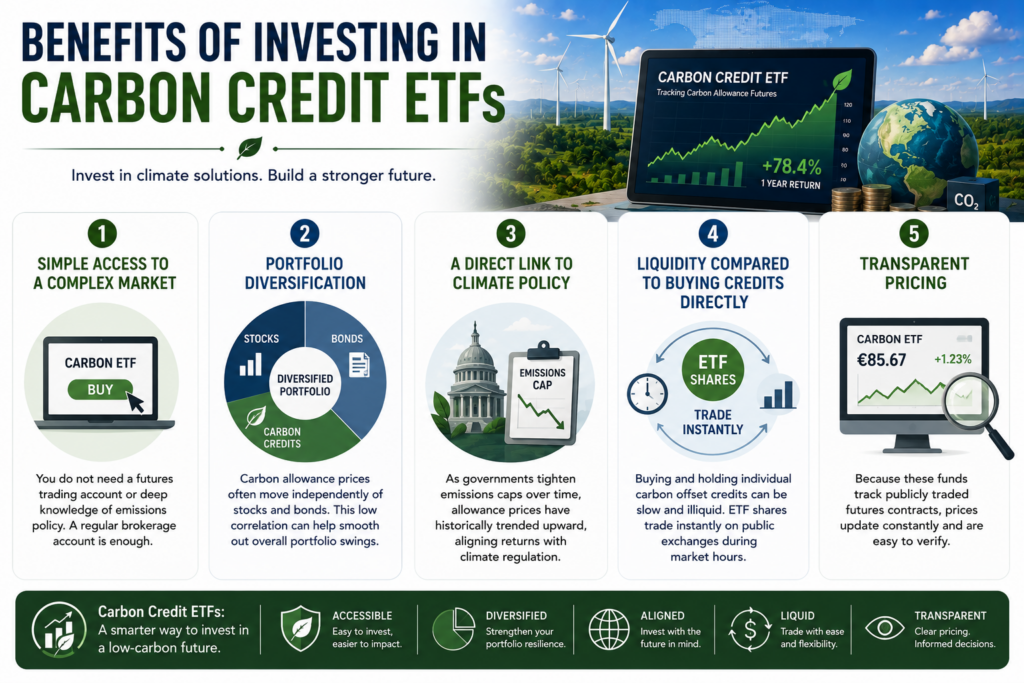
1. Simple access to a complex market
You do not need a futures trading account or deep knowledge of emissions policy. A regular brokerage account is enough.
2. Portfolio diversification
Carbon allowance prices often move independently of stocks and bonds. This low correlation can help smooth out overall portfolio swings.
3. A direct link to climate policy
As governments tighten emissions caps over time, allowance prices have historically trended upward, giving investors a way to align returns with climate regulation.
4. Liquidity compared to buying credits directly
Buying and holding individual carbon offset credits can be slow and illiquid. ETF shares trade instantly on public exchanges during market hours.
5. Transparent pricing
Because these funds track publicly traded futures contracts, prices update constantly and are easy to verify.
Risks and Challenges of Carbon Credit ETFs
No investment is risk-free, and carbon credit ETFs come with some specific challenges worth understanding before you invest.
Price Volatility
Carbon allowance prices can swing sharply based on:
- Energy prices, especially natural gas and coal.
- Economic slowdowns, which reduce industrial output and emissions.
- Sudden policy announcements, such as cap adjustments or new allowance auctions.
This volatility can work in your favor or against you, often within short time frames.
Regulatory Risk
Carbon markets exist because of government policy. That means policy is also their biggest risk factor.
A government could:
- Loosen emissions caps.
- Delay planned cap reductions.
- Change auction rules or allowance supply.
Any of these actions can move allowance prices quickly, in either direction.
Liquidity Risk and Fund Closures
Carbon credit ETFs are still a niche corner of the ETF world. Smaller or regional funds sometimes struggle to attract enough assets to stay open.
When that happens, fund providers may liquidate the ETF, forcing investors to sell or accept a cash payout, often at an inconvenient time.
Before investing, it helps to check:
- Assets under management (AUM).
- Average daily trading volume.
- How long the fund has been operating.
No Dividend Income
Carbon credit ETFs generally do not pay dividends. Returns come purely from price appreciation or decline in the underlying carbon futures.
If you are investing for regular income, this is not the right tool for that goal.
Contango and Roll Costs
Because these funds hold futures contracts, they must periodically roll expiring contracts into new ones.
If future-dated contracts are priced higher than current ones (a situation called contango), rolling contracts can quietly erode returns over time, even if the spot price of carbon stays flat.
Carbon Credit ETFs vs Other Ways to Invest in Carbon Markets
Carbon credit ETFs are not the only route into this space. Here is how they stack up against alternatives.
| Investment Route | How It Works | Best For | Main Drawback |
|---|---|---|---|
| Carbon credit ETF | Tracks futures on carbon allowances | Investors wanting simple, liquid exposure | Volatility, no income, possible fund closure |
| Direct futures trading | Buy and sell futures contracts yourself | Experienced traders | Requires margin, higher complexity |
| Carbon offset credits | Buy voluntary project-based credits directly | Companies offsetting emissions | Illiquid, hard to trade for profit |
| Clean energy stocks | Shares of renewable energy or climate companies | Long-term climate-themed investing | Indirect exposure to carbon prices |
| Carbon-themed mutual funds | Actively managed funds with climate mandates | Investors wanting professional management | Higher fees, less direct carbon exposure |
If your goal is straightforward exposure to carbon allowance prices with easy buying and selling, an ETF is usually the simplest option.
How to Invest in Carbon Credit ETFs: Step by Step
Getting started is more straightforward than most people expect.
Step 1: Open or use an existing brokerage account
Most major brokerages that offer US or European-listed ETFs will carry carbon credit ETFs, since they trade on standard stock exchanges.
Step 2: Research the specific fund
Look up the fund’s:
- Index it tracks.
- Which carbon markets it covers.
- Expense ratio.
- Historical volatility.
- Assets under management and trading volume.
Step 3: Decide on your allocation
Given the volatility of carbon credit ETFs, many financial commentators suggest treating them as a small satellite position, often in the range of a few percentage points of a diversified portfolio, rather than a core holding.
Step 4: Place your order
Buy shares the same way you would buy any other stock or ETF, using a market or limit order through your brokerage platform.
Step 5: Monitor policy news, not just price charts
Because these funds are policy-driven, keep an eye on announcements from regulators overseeing the markets the fund tracks.
Step 6: Review your position periodically
Carbon markets evolve as governments update caps, expand programs, or link markets together. Revisit your thesis regularly rather than treating it as a “buy and forget” holding.
Who Should Consider Carbon Credit ETFs?
Carbon credit ETFs are not for everyone. They tend to suit a fairly specific type of investor.
Good fit if you:
- Want targeted exposure to climate policy and emissions markets.
- Are comfortable with meaningful price swings.
- Are looking for a portfolio diversifier rather than a core holding.
- Have a medium to long time horizon and can tolerate short-term volatility.
Probably not a fit if you:
- Need steady income from your investments.
- Prefer low-volatility, conservative holdings.
- Are uncomfortable with regulatory or policy-driven risk.
- Are looking for a short-term trading vehicle without doing ongoing research.
Tips for Evaluating a Carbon Credit ETF Before You Buy
Use this checklist before adding any carbon credit ETF to your portfolio.
- Check the underlying index. Understand exactly which carbon markets and contracts the fund tracks.
- Compare expense ratios. Carbon credit ETFs often carry higher expense ratios than broad market index funds, so factor that cost in.
- Look at fund size and volume. Smaller funds carry higher closure risk and can have wider bid-ask spreads.
- Understand the structure. Confirm whether it is a true ETF or an ETN, since the risk profile differs.
- Review historical volatility. Carbon allowance prices can move sharply within days, so know what you are signing up for.
- Read the fund’s own risk disclosures. Providers are usually clear about the specific risks tied to futures-based commodity funds.
The Future of Carbon Credit ETFs
Carbon markets are expanding, not shrinking. More countries and regions continue to roll out or strengthen cap-and-trade systems as part of broader climate commitments.
A few trends worth watching:
- Market linkages. Some regional carbon markets are exploring or have pursued links with each other, which could deepen liquidity in future ETFs.
- Tightening caps. As emissions caps decline over time in most established programs, scarcity of allowances could support long-term price trends, though short-term volatility will likely remain.
- New compliance markets. As more regions introduce their own emissions trading systems, fund providers may launch new ETFs to track them.
- Consolidation among existing funds. As seen with past fund closures, the space may continue to consolidate around a smaller number of well-traded, liquid products.
For investors interested in the intersection of climate policy and financial markets, carbon credit ETFs remain one of the more accessible entry points available today.
Conclusion
Carbon credit ETFs give everyday investors a direct, liquid way to gain exposure to the price of carbon without needing to trade futures contracts or buy offset credits directly.
They track real, government-regulated cap-and-trade markets like the EU ETS (website), California’s Cap-and-Trade Program, and RGGI, turning climate policy into an investable asset class.
That said, these funds carry real risks. Price volatility, regulatory shifts, fund closures, and the absence of dividend income all deserve careful consideration before you invest.
Used thoughtfully, as a smaller, diversifying slice of a broader portfolio, carbon credit ETFs can offer a genuine way to align your investments with the direction of global climate policy.
As always, do your own research, check each fund’s current holdings and disclosures directly with the provider, and consider speaking with a licensed financial advisor before making investment decisions.
Frequently Asked Questions
What is a carbon credit ETF?
A carbon credit ETF is a fund that tracks the price of carbon allowances or carbon allowance futures contracts, letting investors gain exposure to compliance carbon markets through a standard brokerage account.
Are carbon credit ETFs the same as carbon offset investments?
No. Carbon credit ETFs typically track regulated compliance allowances from cap-and-trade programs, while carbon offsets come from voluntary, project-based credits. These are different markets with different structures.
Do carbon credit ETFs pay dividends?
Generally, no. Returns come from the price movement of the underlying carbon futures contracts, not from dividend income.
Are carbon credit ETFs risky?
Yes, they can be quite volatile. Prices are sensitive to energy markets, economic activity, and government policy changes, so they suit investors comfortable with short-term price swings.
Can a carbon credit ETF shut down?
Yes. Some carbon credit ETFs have closed after failing to attract enough trading volume or assets. Checking a fund’s size and liquidity before investing is an important step.
How much of my portfolio should go into carbon credit ETFs?
There is no universal answer, but many investors treat these funds as a small satellite position rather than a core holding, given their volatility and policy-driven nature.
Which carbon markets do most carbon credit ETFs track?
Most track major compliance markets such as the European Union Emissions Trading System, California’s Cap-and-Trade Program, and the Regional Greenhouse Gas Initiative in the United States.
Is a carbon credit ETF the same as an ETN?
Not always. Some carbon products are structured as Exchange-Traded Notes rather than true ETFs, which changes the risk profile since ETNs depend on the credit strength of the issuing bank.
Do carbon credit ETFs help the environment directly?
Not directly. Buying shares of a carbon credit ETF does not retire allowances or reduce emissions. It simply gives investors financial exposure to the price of carbon within regulated markets.
Are carbon credit ETFs a good long-term investment?
They can play a role in a diversified portfolio for investors who believe climate policy will continue tightening over time, but they are generally better suited as a supplementary holding rather than a primary long-term investment.
For more updates, guides, and resources on carbon markets, explore Carbon Market Network.