Carbon Market Network


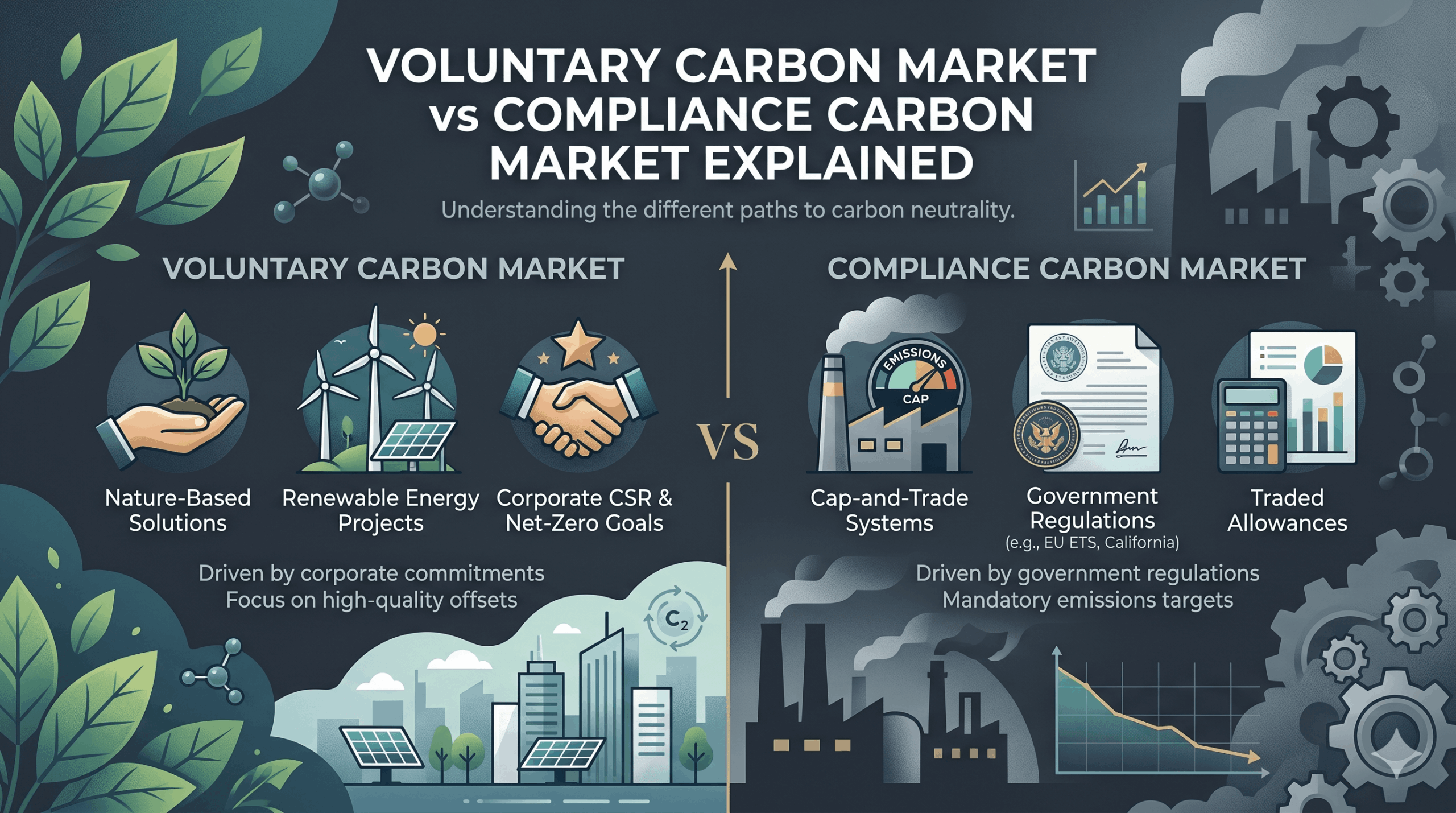
Two Markets, One Climate Goal
Carbon markets are one of the most talked-about tools in the fight against climate change.
But here is the thing: not all carbon markets are the same.
There are two very different types of carbon markets operating in the world today, and they work in completely different ways.
One is driven by law. The other is driven by choice.
These are the voluntary carbon market (VCM) and the compliance carbon market (also called the regulated carbon market).
If you have ever searched for terms like “carbon credits,” “cap-and-trade,” or “net zero,” you have probably bumped into both these markets without knowing it.
This article breaks down everything you need to know about the voluntary carbon market vs compliance carbon market. How they work, who uses them, what drives them, how they differ, and why understanding both matters if you care about climate change, sustainability, or carbon finance.
Whether you are a student, a business owner, a sustainability professional, or simply someone trying to understand climate policy better, this guide is written for you.
Let’s start from the beginning.
What Is a Carbon Market?
Before diving into the differences, it helps to understand what a carbon market actually is.
A carbon market is a system where carbon dioxide (CO2) emissions are given a price.
The core idea is simple: if polluting has a cost, companies will work harder to pollute less.
In a carbon market, emissions are measured in tonnes of CO2 equivalent (tCO2e). One carbon credit or carbon allowance represents one tonne of CO2 equivalent.
Companies can either reduce their own emissions or buy carbon credits to “offset” the emissions they cannot yet reduce.
There are two broad types of carbon markets:
- Compliance carbon markets (also called regulated or mandatory markets)
- Voluntary carbon markets (market driven by choice)
Both are built on the same core principle: put a price on carbon to reduce emissions.
But they work very differently in practice.
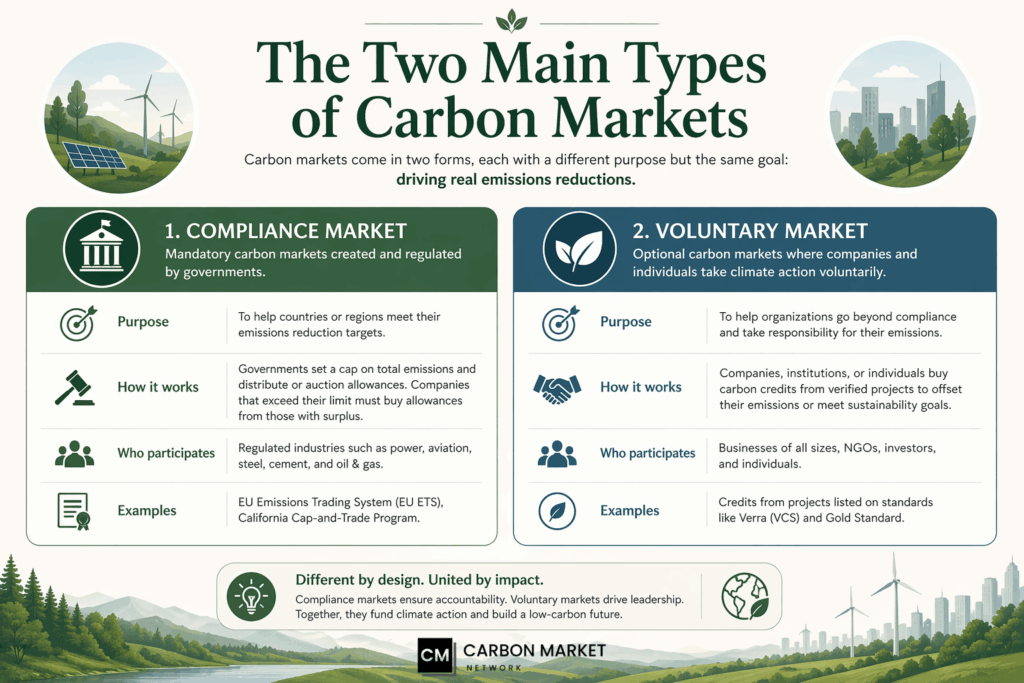
Carbon Market Insider Newsletter
Weekly insights on carbon markets, climate policy, carbon credits, and sustainability.
What Is the Compliance Carbon Market?
The compliance carbon market is a legally mandated system.
In this market, governments or international bodies set rules that force certain companies or industries to account for their carbon emissions.
If you emit carbon dioxide beyond a certain limit, you are legally required to pay for it. You do not get a choice.
How Compliance Carbon Markets Work
The most common mechanism used in compliance markets is called cap-and-trade.
Here is how it works, step by step:
Step 1: The government sets a “cap” A regulatory authority (like a government or an intergovernmental body) sets a maximum total limit on how much CO2 a particular sector or set of industries can emit in a given year. This is called the “cap.”
Step 2: Companies receive or buy allowances Each company covered under the system receives (or purchases) a set number of emission allowances. One allowance equals one tonne of CO2.
Step 3: Companies emit carbon At the end of each compliance period, companies must surrender allowances equal to their actual emissions.
Step 4: Trading happens If a company emits less than its allowance, it can sell the leftover allowances to companies that have exceeded their limit.
If a company emits more than its allowance, it must buy additional allowances from the market.
Step 5: The cap comes down over time Each year (or each compliance period), the total cap is lowered. This means fewer allowances are available, which pushes up the price of carbon and forces companies to clean up faster.
This is why it is called “cap-and-trade”: there is a cap on total emissions, and allowances can be traded.
Real-World Example: The EU Emissions Trading System (EU ETS)
The most well-known compliance carbon market in the world is the European Union Emissions Trading System (EU ETS).
Launched in 2005, the EU ETS covers power plants, industrial facilities, and airlines operating within Europe.
It covers over 10,000 installations across 30 countries.
Companies covered by the EU ETS must surrender one European Union Allowance (EUA) for every tonne of CO2 they emit.
The EU ETS has gone through several reforms over the years. In recent years, carbon prices under the EU ETS have climbed significantly, sometimes exceeding 80 to 100 euros per tonne, making it one of the most expensive compliance systems in the world.
Other Examples of Compliance Carbon Markets Around the World
California Cap-and-Trade Program (USA) Launched in 2013, this covers large industrial facilities, power plants, and fuel distributors in California. It is linked with Quebec, Canada’s cap-and-trade system.
China National ETS Launched in 2021, China’s national emissions trading scheme is now the largest carbon market in the world by volume. It currently covers the power sector but plans to expand to other industries.
Korea Emissions Trading Scheme (KETS) Launched in 2015, South Korea’s system covers over 600 entities across multiple industries.
UK ETS The United Kingdom launched its own ETS after Brexit. It covers power generation, heavy industry, and aviation.
India’s Carbon Credit Trading Scheme (CCTS) India launched its Carbon Credit Trading Scheme in 2023 under the Energy Conservation (Amendment) Act 2022. Administered by the Bureau of Energy Efficiency (BEE), CCTS will create a domestic compliance market in India covering energy-intensive industries. It builds on existing frameworks like the Perform Achieve and Trade (PAT) scheme and the Renewable Energy Certificate (REC) mechanism.
The Role of Carbon Taxes in Compliance Markets
Some countries prefer a carbon tax over cap-and-trade.
A carbon tax is simpler: instead of setting a cap and letting companies trade, the government simply taxes every tonne of CO2 emitted above a certain threshold.
Sweden, Canada, and Singapore all have carbon tax systems.
The key difference is that with cap-and-trade, you control the quantity of emissions but not the price. With a carbon tax, you control the price but not the quantity.
Both tools are considered compliance mechanisms because participation is mandatory.
What Is the Voluntary Carbon Market?
The voluntary carbon market (VCM) is completely different.
Here, no law forces you to participate. Companies, governments, organizations, and even individuals choose to buy carbon credits on their own.
Why would anyone do that?
Because they want to take responsibility for their emissions beyond what the law requires.
A company might set a net zero target for 2040. To get there, they reduce their emissions as much as possible. But for the emissions they cannot yet eliminate, they buy carbon credits from projects that remove or avoid an equivalent amount of CO2.
This is voluntary carbon offsetting.
How the Voluntary Carbon Market Works
Step 1: A project developer creates a carbon project Someone, somewhere, creates a project that either reduces or removes CO2 emissions. This could be a forest conservation project, a clean cookstove project in rural India, a methane capture project at a landfill, or a direct air capture facility.
Step 2: The project is verified by a third-party standard The project goes through a rigorous process to prove that it genuinely reduces emissions. It must prove that the reductions are:
- Real (they actually happened)
- Additional (they would not have happened without the carbon credit funding)
- Measurable (the amount of CO2 reduced or removed can be accurately calculated)
- Permanent (the reductions will last over time)
- Verifiable (an independent third party can confirm all of the above)
Step 3: Credits are issued Once the project is verified, carbon credits are issued. Each credit represents one tonne of CO2 reduced or removed.
Step 4: Credits are sold on the voluntary market Companies or individuals buy these credits to offset their emissions. Once a credit is used to offset emissions, it is “retired” so it cannot be sold or used again.
Who Participates in the Voluntary Carbon Market?
The buyers in the voluntary carbon market include:
- Corporations with net zero commitments or sustainability goals (like Microsoft, Apple, Amazon, and thousands of others)
- Airlines offering carbon offset programs to passengers
- Small businesses wanting to market themselves as carbon neutral
- Individuals who want to offset their personal carbon footprint
- Governments (sometimes, for specific projects or goals beyond their compliance obligations)
The sellers are typically:
- Project developers
- Carbon project aggregators
- Indigenous communities running forest conservation programs
- Renewable energy developers
- Technology companies running carbon removal solutions
Key Standards and Registries in the Voluntary Carbon Market
Because there is no government mandate enforcing quality in the VCM, third-party standards play a critical role.
The most widely used standards include:
Verra’s Verified Carbon Standard (VCS) Verra is the largest carbon standard in the world. It issues Verified Carbon Units (VCUs). Thousands of projects are registered under Verra globally, including in India, Brazil, Kenya, and Indonesia.
Gold Standard Founded with support from WWF and other NGOs, Gold Standard emphasizes not just carbon reduction but also sustainable development co-benefits. Projects certified under Gold Standard must demonstrate positive impacts on local communities and biodiversity.
American Carbon Registry (ACR) One of the oldest carbon registries in the US, ACR covers a wide range of project types.
Climate Action Reserve (CAR) US-focused standard with rigorous protocols for forestry, livestock, and industrial projects.
Architecture for REDD+ Transactions (ART TREES) Specifically designed for jurisdictional-level REDD+ (Reducing Emissions from Deforestation and Forest Degradation) programs.
CORSIA (Carbon Offsetting and Reduction Scheme for International Aviation) While technically linked to an international compliance framework, CORSIA uses voluntary carbon market credits for offsetting aviation emissions.
Voluntary Carbon Market vs Compliance Carbon Market: Key Differences
Now that you understand both markets individually, let’s put them side by side.
1. Participation: Mandatory vs Optional
Compliance market: Participation is required by law. If your company falls under a regulated sector in a jurisdiction with a carbon market, you must comply. There is no opt-out.
Voluntary market: Participation is entirely your choice. No law forces you to buy voluntary carbon credits. You do it because you want to, because your customers expect it, because investors demand it, or because your corporate values lead you there.
2. Who Regulates Them
Compliance market: Regulated by governments, environmental agencies, or international bodies. The EU ETS is overseen by the European Commission. India’s CCTS is managed by BEE. The California program is managed by the California Air Resources Board (CARB).
Voluntary market: No single government controls the VCM. Instead, it is governed by independent standards bodies (like Verra and Gold Standard), industry coalitions, and market participants themselves.
This difference in governance has major implications for accountability and consistency.
3. The Unit of Trade
Compliance market: The primary unit is called an allowance or permit (e.g., European Union Allowance, or EUA). These represent a permission to emit one tonne of CO2.
Voluntary market: The primary unit is a carbon credit or carbon offset. These represent a verified reduction or removal of one tonne of CO2.
The distinction matters: allowances are a permission to emit; credits represent actual reductions made somewhere else.
4. Price Formation
Compliance market: Prices are largely set by supply and demand within the regulated system, but the government influences price heavily through the cap level, the pace of reduction, and policy decisions.
EU ETS carbon prices have ranged from under €5 per tonne in 2013 to over €90 per tonne in 2022-2023.
Voluntary market: Prices vary enormously depending on the type of project, the co-benefits offered, the vintage year of the credit, and the standard used.
Nature-based solutions (like forest conservation) may trade at $5 to $20 per tonne. High-quality tech-based removals like biochar or direct air capture (DAC) can cost $100 to $1,000+ per tonne. Prices in the VCM are far less standardized.
5. The Goal
Compliance market: The goal is to meet a regulatory emissions reduction target. Companies buy allowances to stay compliant with the law.
Voluntary market: The goal is typically to meet a corporate sustainability pledge, achieve carbon neutrality, or support specific climate projects. It is driven by values, reputation, and stakeholder pressure rather than legal obligation.
6. Scale and Volume
Compliance market: Much larger in terms of financial volume. The global compliance carbon market was valued at over $900 billion in 2022, driven largely by the EU ETS and China’s ETS.
Voluntary market: Smaller but growing fast. The voluntary carbon market was valued at approximately $2 billion in 2021 and has been projected to grow to $50 billion or more by 2030. However, it also faced credibility challenges in 2023 due to scrutiny of some project methodologies.
7. Quality and Integrity Concerns
Compliance market: Stricter regulation means less room for fraud or “greenwashing,” though not zero risk. Governments audit compliance closely.
Voluntary market: Quality can be inconsistent. Some voluntary credits have been criticized for being over-credited, non-additional, or failing to deliver real environmental benefits. This has led to calls for stronger oversight, and bodies like the Integrity Council for the Voluntary Carbon Market (ICVCM) have been created to raise the bar.
8. Co-Benefits
Compliance market: Focused primarily on emission reduction numbers. Less emphasis on what else the emission reduction achieves.
Voluntary market: Often emphasizes co-benefits: biodiversity preservation, job creation for local communities, women’s empowerment, access to clean energy. These additional social and environmental impacts are a major selling point for voluntary credits.
Detailed Comparison Table
| Feature | Compliance Carbon Market | Voluntary Carbon Market |
|---|---|---|
| Participation | Mandatory | Optional |
| Who drives it | Government / regulators | Corporations / NGOs / individuals |
| Legal basis | Law or treaty | Corporate policy / ethics |
| Main unit | Allowance / permit | Carbon credit / offset |
| Pricing mechanism | Cap-and-trade or tax | Market forces, buyer-seller negotiation |
| Price range | Varies (EU ETS: €10-€100+) | $1-$1,000+ per credit |
| Examples | EU ETS, China ETS, India CCTS, California | Verra VCU, Gold Standard, ACR |
| Quality oversight | Government agencies | Independent standards (Verra, Gold Standard) |
| Primary goal | Legal compliance | Sustainability commitments |
| Scale | Hundreds of billions USD | Billions USD, growing fast |
| Co-benefits focus | Limited | Often central |
How Compliance and Voluntary Markets Interact
Here is something many people do not realize: these two markets are not completely separate.
They interact in several important ways.
Compliance Markets Sometimes Allow Voluntary Credits
In some compliance systems, companies are allowed to use a limited number of voluntary carbon credits (called “offsets”) to fulfill part of their compliance obligation.
For example, the California cap-and-trade system allows companies to use offset credits generated under its own offset protocols (which function like voluntary market standards) to cover up to 4-8% of their compliance obligation.
CORSIA, the international aviation scheme, allows airlines to use approved voluntary carbon credits to offset their emissions growth.
India’s CCTS may also allow linkages with the voluntary market, especially through internationally recognized standards like Verra.
Voluntary Markets Can Feed Into Compliance Systems
As more countries develop compliance markets, voluntary market infrastructure (registries, methodologies, MRV systems) often provides the foundation.
India is a strong example. The existing Renewable Energy Certificate (REC) mechanism and the PAT scheme have provided the groundwork for CCTS.
Many projects that previously generated voluntary credits in India may transition into compliance-linked instruments.
Article 6 of the Paris Agreement
Article 6 of the Paris Agreement is perhaps the most significant point of interaction between the two markets.
Article 6 sets rules for how countries can trade emissions reductions with each other internationally. It creates two mechanisms:
Article 6.2: Bilateral trading between countries using “internationally transferred mitigation outcomes” (ITMOs).
Article 6.4: A new centralized UN-supervised carbon crediting mechanism that will replace the old Clean Development Mechanism (CDM) from the Kyoto Protocol.
The Article 6.4 mechanism will create what many call a “Paris-aligned” voluntary carbon market.
Credits generated under this mechanism will need to meet strict rules, including corresponding adjustments (so that the selling country does not count the same emission reduction toward its own national target).
This is a major development because it blurs the line between voluntary and compliance markets at the international level.
Who Should Participate in Each Market?
Who Must Participate in the Compliance Market?
If your company operates in a jurisdiction with a mandatory carbon pricing scheme and falls under the covered sectors, you have no choice. You must participate.
Sectors commonly covered by compliance markets include:
- Power generation (coal, gas, oil-fired power plants)
- Iron and steel production
- Cement manufacturing
- Aluminum production
- Chemical production
- Oil refining
- Aviation (domestic and/or international, depending on the scheme)
- Waste management (in some jurisdictions)
If your company operates in India, for example, and falls under the designated energy-intensive sectors covered by PAT and the new CCTS, you will eventually be subject to compliance obligations.
Who Benefits Most From the Voluntary Market?
The voluntary carbon market is most relevant for:
Companies with net zero commitments: Thousands of companies have pledged to reach net zero by 2040, 2045, or 2050. The VCM is a key tool for offsetting residual emissions that cannot yet be eliminated.
Consumer brands in competitive markets: If your customers care about sustainability, a verified carbon neutral claim backed by voluntary credits can be a powerful differentiator.
Companies in sectors not yet covered by compliance markets: Many small and mid-size businesses are not legally required to offset anything. But voluntary action can build brand equity and investor confidence.
Startups and tech companies: Companies like Stripe, Shopify, and Airbnb have made significant voluntary carbon purchases, especially for permanent removals through DAC or biochar.
Project developers in developing countries: Voluntary carbon projects in India, Kenya, Brazil, and Indonesia provide livelihoods, clean energy, and forest protection alongside carbon credits. The VCM channels climate finance to the Global South.
Types of Carbon Credits: What Are You Actually Buying?
Whether in the voluntary market or as part of an offset provision in a compliance market, it helps to understand what types of carbon credits exist.
Avoidance/Reduction Credits
These credits represent emissions that were avoided or reduced.
Examples:
- Preventing deforestation (REDD+ projects)
- Replacing fossil-fuel cookstoves with clean cookstoves
- Capturing methane from coal mines or landfills
- Distributing energy-efficient LED bulbs in rural areas
These are the most common type of voluntary credits, especially in the nature-based and community development space.
Removal Credits
These credits represent carbon that was actively removed from the atmosphere and stored.
Examples:
- Afforestation and reforestation (planting new forests)
- Soil carbon sequestration (improved agricultural practices that lock carbon in soil)
- Biochar (burning agricultural waste in low-oxygen conditions to create stable carbon)
- Enhanced weathering (spreading crushed silicate rocks on farmland to absorb CO2)
- Direct air capture (machines that literally suck CO2 from the air and store it underground)
- Bioenergy with carbon capture and storage (BECCS)
Removal credits, especially from technology-based solutions, are gaining prestige because they are considered more permanent and easier to measure than avoidance credits.
Nature-Based Solutions (NBS)
Nature-based solutions are a special category that spans both avoidance and removal.
They include:
- Forest conservation (avoided deforestation)
- Reforestation
- Wetland and mangrove restoration
- Agroforestry
- Blue carbon (ocean and coastal ecosystems like seagrass and mangroves)
Nature-based solutions are popular because they are relatively affordable and deliver strong co-benefits like biodiversity and community welfare.
However, they face scrutiny around permanence (forests can burn) and additionality (would the forest have been protected anyway?).
The Concept of Additionality: Why It Matters in Both Markets
Additionality is one of the most important concepts in carbon markets, especially the voluntary one.
A carbon credit is “additional” if the emission reduction or removal would NOT have happened without the revenue from the carbon credit.
Think of it this way: if a forest was already legally protected and had no risk of being cut down, a REDD+ project protecting that forest does not generate “additional” reductions. The forest was going to survive anyway.
For a credit to be credible, the project it funds must be additional.
In compliance markets: Additionality is less of an issue because you are dealing with emission allowances (permissions to emit) rather than offset credits. But it becomes important when compliance systems allow offsets.
In the voluntary market: Additionality is absolutely central. The entire credibility of a voluntary credit depends on whether the underlying project is genuinely additional.
Weak additionality claims have been at the heart of major controversies around voluntary carbon credits in recent years.
Greenwashing and the Credibility Crisis in Voluntary Carbon Markets
In 2023, several investigative journalism pieces raised serious questions about voluntary carbon credits.
Some REDD+ projects were found to have over-credited their emission reductions.
Forests that were supposedly being protected were found to face little or no real threat of deforestation. Others faced questions about how baseline emissions were calculated.
Major corporations that had claimed to be “carbon neutral” faced reputational damage when the credits they used were challenged.
This does not mean the voluntary carbon market is inherently broken. But it does mean that quality matters enormously.
How the Industry Is Responding
The Integrity Council for the Voluntary Carbon Market (ICVCM) was established to set global benchmark standards for high-quality carbon credits. It published its Core Carbon Principles (CCPs) in 2023, which set out criteria for what makes a credible voluntary credit.
The Voluntary Carbon Markets Integrity Initiative (VCMI) published guidance for companies on how to make legitimate carbon claims. It introduced categories like “Provisional Mitigation Contribution” labels.
Verra launched a review of its REDD+ methodology in response to the criticism and has committed to updating its forest carbon accounting frameworks.
The Science Based Targets initiative (SBTi) has issued guidance discouraging companies from using offsets to meet near-term emissions reduction targets. They argue that offsetting should not replace actual emissions cuts.
The message is clear: if you are going to use voluntary carbon credits, use high-quality ones from credible projects verified under rigorous standards.
Carbon Markets in India: A Closer Look
India occupies a unique position in global carbon markets.
On one hand, India has historically been one of the largest sellers of carbon credits, especially under the Clean Development Mechanism (CDM) of the Kyoto Protocol.
On the other hand, India is now building its own domestic compliance carbon market.
India’s Carbon Credit Trading Scheme (CCTS)
The CCTS was notified in June 2023 by the Ministry of Power under the Energy Conservation (Amendment) Act 2022.
Key features of India’s CCTS:
Two types of entities will exist under CCTS:
- Obligated entities: Companies in energy-intensive sectors that will receive emission intensity targets. They must meet these targets or buy carbon credits.
- Non-obligated entities: Companies or projects that can generate carbon credits by going beyond what is required and sell those credits to obligated entities.
The Bureau of Energy Efficiency (BEE) will act as the administrator and the Central Electricity Regulatory Commission (CERC) will oversee the trading of Carbon Credit Certificates (CCCs).
Sector coverage: The initial sectors covered include aluminum, cement, chlor-alkali, fertilizers, iron and steel, petrochemicals, petroleum refineries, pulp and paper, textiles, and thermal power plants.
Connection to PAT and REC: India’s existing PAT scheme (which already trades Energy Saving Certificates or ESCerts) and the REC mechanism (which already trades renewable energy certificates) will be integrated into the CCTS framework.
India and the Voluntary Carbon Market
India has hundreds of active voluntary carbon projects registered under Verra and Gold Standard.
These include:
- Solar energy projects (replacing coal-based power)
- Clean cookstove programs in rural India
- Biogas projects in agriculture
- Avoided deforestation projects
- Industrial energy efficiency projects
India’s voluntary market has historically been a major supplier to global buyers.
As the CCTS develops, some of these voluntary credits may transition into compliance instruments, or there may be rules about whether Indian voluntary credits can be sold internationally under Article 6.2.
The key challenge for India is to align its domestic compliance market with international frameworks while continuing to attract global climate finance through its voluntary carbon sector.
The Future of Carbon Markets: Where Are We Headed?
Carbon markets, both voluntary and compliance, are at an inflection point.
Here is what the future looks like:
Compliance Markets Are Growing
More countries are introducing or expanding compliance carbon markets.
The EU is expanding the EU ETS to include buildings and road transport (ETS2) from 2027. The EU is also introducing a Carbon Border Adjustment Mechanism (CBAM) which will put a carbon price on imported goods from countries without equivalent carbon pricing.
India’s CCTS is expected to become fully operational in the next few years.
The US does not have a federal carbon market but several state-level programs (California, RGGI in the northeast) continue to operate and expand.
Southeast Asian nations like Thailand, Vietnam, and Indonesia are developing their own compliance frameworks.
Voluntary Markets Are Maturing
Despite the credibility challenges of 2023, the voluntary carbon market is not disappearing.
Demand from corporations with net zero commitments continues to grow.
The market is moving toward higher quality.
Buyers are increasingly willing to pay more for credits with strong additionality, permanence, and co-benefits rather than buying the cheapest credits available.
Carbon removal credits are gaining in importance. Microsoft, Stripe, Shopify, and others have committed to buying millions of tonnes of permanent removal credits over the next decade. This is pushing innovation in direct air capture, biochar, and enhanced weathering.
Article 6 Will Shape Everything
The finalization and implementation of Article 6 rules under the Paris Agreement will be one of the most important developments in carbon markets in the next decade.
Article 6 has the potential to create a global carbon market that links compliance and voluntary activities under a unified set of rules.
Key questions being resolved include:
- How will corresponding adjustments work to prevent double counting?
- What minimum quality standards will Article 6.4 credits need to meet?
- How will developing countries participate without compromising their own climate targets?
How Companies Can Use Both Markets Strategically
Understanding both markets is not just academic. It has practical strategic value for businesses.
Here is how companies can think about using both:
Step 1: Know your legal obligations first
Find out whether your industry and jurisdiction is covered by a compliance carbon market.
If you are in India, check whether your sector falls under CCTS. If you operate in Europe, check if you are covered by the EU ETS. Compliance comes first.
Step 2: Set science-based emissions reduction targets
Use frameworks like the Science Based Targets initiative (SBTi) to set credible, Paris-aligned reduction targets. These targets should focus primarily on reducing your own emissions, not just buying offsets.
Step 3: Reduce emissions first, offset what remains
The general principle endorsed by most credible frameworks is: reduce what you can, offset what you cannot. Do not use voluntary credits as a substitute for decarbonizing your operations.
Step 4: Buy high-quality voluntary credits
If you are going to offset, invest in quality. Look for credits that are:
- Verified under reputable standards (Verra, Gold Standard)
- From projects with strong co-benefits
- Independently audited and verified
- From recent vintages (not decades-old credits)
- From project types you understand and trust
Step 5: Be transparent in your climate claims
Do not call yourself “carbon neutral” without explaining how.
Customers, investors, and regulators increasingly want to see the details. Use frameworks like VCMI’s claim classifications to make credible, honest public claims.
Step 6: Monitor regulatory changes
Carbon markets are evolving fast. Regulations in your home market, as well as global rules under Article 6, will affect the value and validity of the credits you hold. Stay informed.
Common Misconceptions About Carbon Markets
Let’s clear up some of the most common misunderstandings.
Misconception 1: “Buying carbon credits means you don’t have to reduce emissions.” This is wrong. Buying credits is meant to complement emissions reductions, not replace them. Most credible frameworks require companies to reduce their own emissions first.
Misconception 2: “All voluntary carbon credits are low quality.” Not true. While some credits have faced valid criticism, many projects generate genuine, high-quality reductions with significant co-benefits. The issue is differentiation: not all credits are equal, and buyers need to do their homework.
Misconception 3: “Compliance markets are always more effective than voluntary markets.” Not necessarily. Some compliance markets have had weak caps and very low carbon prices (below $5 per tonne for years), which provides little incentive for companies to actually reduce emissions. Price level, ambition of the cap, and enforcement all determine effectiveness.
Misconception 4: “Carbon markets are just a license to pollute.” This is a common criticism but overlooks the mechanism. The cap in cap-and-trade systems declines over time, so total pollution cannot stay the same. Carbon markets are meant to be a transition tool, not a permanent way to pollute without consequences.
Misconception 5: “The voluntary carbon market is unregulated and lawless.” While there is no single government body regulating the VCM globally, it is governed by rigorous third-party standards, independent auditing, and a growing set of integrity frameworks. The level of scrutiny applied to projects like those under Verra or Gold Standard is considerable.
FAQ: Voluntary Carbon Market vs Compliance Carbon Market
Q1: What is the main difference between the voluntary and compliance carbon market?
The compliance carbon market is mandatory. If your company is covered by a government-mandated carbon pricing system, you must participate. The voluntary carbon market is optional. Companies, organizations, and individuals choose to buy voluntary carbon credits to offset their emissions beyond what the law requires.
Q2: Can a company participate in both markets at the same time?
Yes, absolutely. A large industrial company might be covered by a compliance market (like the EU ETS) for its regulated emissions, while also purchasing voluntary credits to offset its non-covered emissions or to meet a corporate net zero target.
Q3: Which market has higher carbon prices?
Compliance markets generally have higher and more consistent prices because legal enforcement drives demand. The EU ETS has seen prices exceed €90 per tonne. Voluntary market prices vary widely, ranging from under $5 for low-quality credits to over $1,000 per tonne for technology-based carbon removal.
Q4: Are voluntary carbon credits reliable?
Quality varies. Credits verified under stringent standards like Verra or Gold Standard go through rigorous third-party auditing. However, not all voluntary credits are equal. The market is in the process of raising standards through bodies like the ICVCM. Buyers should research the project, standard, and verification history before purchasing.
Q5: What is the voluntary carbon market used for?
Companies and individuals use the voluntary carbon market to offset emissions they cannot yet eliminate, meet net zero or carbon neutral targets, support climate projects in developing countries, meet investor or customer expectations, and contribute to global climate action beyond regulatory requirements.
Q6: Is India part of the global voluntary carbon market?
Yes. India has hundreds of active voluntary carbon projects registered under international standards like Verra and Gold Standard. India is also developing its own domestic compliance market through CCTS, which may interact with international voluntary market infrastructure.
Q7: What is the future of the voluntary carbon market?
The voluntary carbon market is expected to grow significantly as more companies commit to net zero. However, it will face increasing quality pressure. Low-quality avoidance credits are likely to lose favor while high-quality removal credits and projects with strong co-benefits will gain in value. Article 6 of the Paris Agreement will also bring new rules that shape how voluntary credits interact with national climate targets.
Q8: What does “retiring a carbon credit” mean?
Retiring a carbon credit means permanently canceling it so it can never be traded or used again. Retirement happens when a company uses a credit to offset its emissions. It is recorded in the registry to prevent double counting.
Q9: Can individuals participate in the voluntary carbon market?
Yes. Individuals can buy carbon credits through platforms like Gold Standard’s marketplace, Terrapass, or airline offset programs. These allow you to offset the emissions from your flights, home energy use, or lifestyle.
Q10: What is “carbon neutrality” and how does it relate to these markets?
Carbon neutrality means that an entity’s total emissions equal the amount of emissions it offsets through carbon credits. It is different from “net zero,” which typically requires deeper, more comprehensive emissions reductions across the full value chain. Companies often use voluntary carbon credits to claim carbon neutrality, but credibility depends heavily on the quality of those credits and the entity’s underlying reduction efforts.
Conclusion: Two Markets, One Shared Purpose
The voluntary carbon market and compliance carbon market are two very different tools, but they share the same ultimate goal: reducing the amount of carbon dioxide in our atmosphere.
The compliance market uses the force of law to ensure that the biggest polluters pay a real price for their emissions.
The voluntary market channels private investment into climate projects around the world, from forest conservation in the Amazon to clean cookstoves in rural Maharashtra.
Understanding how both markets work gives you a major advantage, whether you are a business owner navigating carbon strategy, a sustainability professional building a net zero plan, a student entering the carbon finance field, or a policymaker shaping the future of climate regulation in India or anywhere else.
The world needs both markets. It needs the certainty of compliance markets to guarantee systemic emissions reductions. And it needs the flexibility and innovation of the voluntary market to fund climate solutions that governments alone cannot deliver.
The line between the two will continue to blur, especially as Article 6 frameworks develop and countries like India build compliance markets that learn from voluntary market experience.
If there is one thing to take away from this guide, it is this: carbon markets are not perfect, but they are one of the most powerful economic tools we have to make climate action real, scalable, and financially viable.
And understanding them, as you now do, puts you ahead of the curve.