Carbon Market Network


Forests are the lungs of our planet. They absorb billions of tonnes of carbon dioxide every single year.
But protecting and restoring them requires money, technology, and expertise. That is exactly what forest carbon companies bring to the table.
These companies develop, verify, and sell forest carbon credits that businesses around the world use to offset their emissions. Some restore degraded land. Others protect standing forests from being cleared. And some use satellite data and artificial intelligence to monitor every tree in a project area.
In this article, you will find the most important forest carbon companies active globally today. You will also learn what makes each one stand out, how the market works, and what to look for when evaluating these companies.
What Is a Forest Carbon Company?
A forest carbon company is an organization that generates carbon credits from forest-based activities.
These credits represent verified reductions or removals of carbon dioxide from the atmosphere. Companies with net-zero goals then buy these credits to compensate for emissions they cannot yet eliminate internally.
There are several ways forest carbon companies create credits:
- REDD+ (Reducing Emissions from Deforestation and Forest Degradation): Protecting standing forests in developing countries from being cut down.
- Afforestation and Reforestation (ARR): Planting trees on land that previously had no forest cover or lost it long ago.
- Improved Forest Management (IFM): Changing how existing forests are managed to store more carbon, such as extending timber harvest cycles.
- Agroforestry: Integrating trees into agricultural land to create new carbon sinks.
- Blue Carbon: Protecting mangroves and coastal ecosystems that store large amounts of carbon.
Each approach has different levels of permanence, additionality, and cost.
Carbon Market Insider Newsletter
Weekly insights on carbon markets, climate policy, carbon credits, and sustainability.
Why the Forest Carbon Market Matters
The forest carbon market is one of the fastest-growing segments of the voluntary carbon market.
The global voluntary carbon offsets market for forestry is growing rapidly, with projections pointing to a compound annual growth rate of around 29% through the next decade. Forests currently represent a major share of all nature-based carbon credit issuances globally.
This growth is being driven by three key forces.
First, corporations around the world are making net-zero pledges. They need high-quality credits while they transition their operations.
Second, global buyers have become far more selective. They want credits that are verifiable, additional, and backed by rigorous science. This pushes companies to raise the bar.
Third, new government policies in Brazil, Colombia, the United States, and the European Union are creating formal frameworks that tie voluntary markets to national climate strategies.
The result is a forest carbon sector that is maturing quickly, with several major companies emerging as global leaders.
Types of Forest Carbon Credits at a Glance
| Credit Type | Certification Standards | What It Does | Key Co-Benefits |
|---|---|---|---|
| REDD+ | Verra VCS, ART TREES | Avoids deforestation in developing countries | Biodiversity, community livelihoods |
| Afforestation / Reforestation | Verra VCS, Gold Standard | Plants trees on degraded or barren land | Soil health, water quality, jobs |
| Improved Forest Management | Verra VM0045, ACR IFM v2.1 | Changes how managed forests are harvested | Sustainable timber, water security |
| Agroforestry | Plan Vivo, CCB Standards | Integrates trees into farmland | Food security, soil regeneration |
| Blue Carbon | Verra VCS, Gold Standard | Protects mangroves and coastal ecosystems | Coastal protection, fisheries |
Top Forest Carbon Companies in the World
1. re.green (Brazil)
re.green is one of the most ambitious forest carbon companies operating today.
Founded in 2021 and headquartered in Rio de Janeiro, re.green focuses on large-scale ecological restoration of Brazil’s Amazon and Atlantic Forests. Its goal is to restore one million hectares of degraded tropical land while capturing 15 million tonnes of carbon per year.
What makes re.green stand out is its technology-first approach. The company uses satellite imagery, drones, and cloud-based machine learning models to identify degraded land, design restoration plans, and monitor carbon sequestration over time. It grows native seedlings at its own nursery, Bioflora, which has a capacity of approximately two million seedlings per year.
re.green partners with private landowners and farmers, either buying degraded land outright or securing long-term leases of 50 years or more. It then restores native forest, generates verified carbon removal credits, and sells them to corporations.
Major buyers include Microsoft, Nestlé, and Novo Nordisk. The company’s deal with Microsoft involves restoring over 16,000 hectares and delivering approximately 3 million tonnes of carbon removal credits over 15 years. A separate agreement signed with Novo Nordisk will generate 87,000 carbon removal credits from 500 hectares of degraded Amazon land in Pará, Brazil.
re.green also received Brazil’s first Amazon reforestation concession, covering approximately 145,000 acres within the Bom Futuro National Forest. Under this groundbreaking agreement, the company restores native vegetation and shares 0.7% of its carbon credit revenue with the state, generating an estimated $2 million annually for public coffers.
The company was named the winner of the Earthshot Prize in the “Protect and Restore Nature” category, bringing it international recognition as a model for what large-scale tropical restoration can look like.
At a glance:
| Detail | Information |
|---|---|
| Founded | 2021 |
| HQ | Rio de Janeiro, Brazil |
| Focus | Amazon and Atlantic Forest restoration |
| Credit Type | Carbon removal (ARR) |
| Key Buyers | Microsoft, Nestlé, Novo Nordisk |
| Notable Milestone | Brazil’s first Amazon reforestation concession |
2. Mombak (Brazil)
Mombak is a Brazilian reforestation company on a mission to become the world’s largest carbon removal organization.
It focuses entirely on the Amazon basin, restoring degraded cattle pasture and farmland by planting diverse native tree species. Unlike REDD+ projects that protect existing forests, Mombak generates credits from active restoration, which many buyers now prefer because they represent real carbon removal rather than avoided emissions.
The company has planted nearly 15 million native trees across 12 restoration sites in the Brazilian state of Pará, using more than 80 native Amazon species and committing to permanence periods of 100 years. It has raised over $200 million in capital and signed approximately $150 million in carbon removal agreements with corporate buyers.
In August 2026, Mombak delivered its first Amazon carbon removal credits more than two years ahead of schedule. The early delivery gave credits to Google, McKinsey & Company, McLaren Racing, Bain & Company, Climeworks, Commons, and Union Square Ventures. The initial issuance totalled over 21,000 verified carbon removal credits, with a further 55,000 credits expected before the end of that same year.
The early delivery was significant. Many carbon projects have historically struggled to deliver on time, damaging trust in the market. Mombak’s early issuance demonstrated that large-scale forest restoration can deliver at commercial scale and meet commitments ahead of schedule.
The company’s credits were issued via the Isometric registry, making it the first Isometric supplier to list both nature-based and engineered carbon removal projects. Its delivery also marked the first completed credit issuance under the Symbiosis Coalition, a corporate buyers’ group aiming to contract over 20 million tonnes of nature-based removals by 2030.
At a glance:
| Detail | Information |
|---|---|
| Founded | 2022 |
| HQ | São Paulo, Brazil |
| Focus | Amazon reforestation on degraded land |
| Credit Type | Carbon removal (ARR) |
| Key Buyers | Google, McKinsey, McLaren Racing |
| Total Capital Raised | $200 million+ |
3. Chestnut Carbon (United States)
Chestnut Carbon is a New York-based carbon removal developer focused entirely on the United States.
Founded in 2022, the company creates and maintains forestry projects on family-owned land and marginal cropland or pasture across the US. Its approach is to grow biodiverse forest ecosystems that reduce carbon emissions over the long term while also improving air and water quality and supporting rural communities.
Chestnut Carbon uses proprietary technology and data to identify optimal land parcels, accelerate carbon credit development, and secure long-term conservation easements that protect the land against future clearing.
The company has raised over $450 million in total funding, with investors including CPP Investments and Kimmeridge Energy. It has around 60 employees and operates as a Series B company.
In early 2026, Chestnut Carbon became the first US company to issue Improved Forest Management (IFM) carbon credits with Verra’s Removals Tag, a designation that signals higher quality and additionality. It also became the first US IFM project verified for biodiversity conservation impacts under the Forest Stewardship Council, adding an independent layer of ecological credibility.
Chestnut Carbon also operates Forest Carbon Works, a Minneapolis-based subsidiary that provides forest carbon project services to landowners who want to participate in carbon markets.
Microsoft secured 7 million tonnes of forest carbon from Chestnut Carbon in one of the largest known forest carbon offtake deals, reflecting the company’s ability to deliver volume at scale.
At a glance:
| Detail | Information |
|---|---|
| Founded | 2022 |
| HQ | New York, United States |
| Focus | US-based afforestation and IFM |
| Credit Type | Carbon removal (ARR + IFM) |
| Key Buyers | Microsoft |
| Total Funding | $450 million+ |
4. Rubicon Carbon (United States)
Rubicon Carbon describes itself as a next-generation carbon solutions provider.
Founded in 2022 and based in Marina del Rey, California, it operates as a vertically integrated platform that channels institutional capital into at-scale decarbonization projects. Its team has deep expertise in markets, sustainability, and carbon finance, with early leadership drawn from banking and financial services backgrounds.
Rubicon Carbon works across nature-based emissions reductions, industrial emissions reductions, and carbon removals. It specializes in sourcing enterprise-grade carbon credits for large corporate buyers and managing carbon portfolios with rigorous quality standards.
In June 2025, Microsoft announced an 18 million tonne offtake agreement with Rubicon Carbon, the largest publicly disclosed forest carbon deal of that period. This deal pushed Rubicon Carbon onto the global stage as one of the most important forest carbon aggregators in the world.
The company has since expanded its physical presence to Singapore, signaling a strategic push into Asian carbon markets. It also partnered with Bio-Logical for biochar credits and Deep Sky for Direct Air Capture offtake, diversifying its project pipeline beyond pure forest carbon.
Rubicon Carbon participates in the ARC Coalition and is actively building relationships with large enterprises that want scalable, end-to-end emissions reduction solutions.
At a glance:
| Detail | Information |
|---|---|
| Founded | 2022 |
| HQ | Marina del Rey, California, USA |
| Focus | Carbon credit sourcing and portfolio management |
| Credit Type | Nature-based + removals |
| Key Buyers | Microsoft |
| Notable Deal | 18 million tonne agreement with Microsoft |
5. Finite Carbon (United States)
Finite Carbon is one of the longest-standing and most experienced forest carbon developers in North America.
The company specializes in Improved Forest Management (IFM) projects, where it works with private landowners, timber companies, and conservation organizations to change how their forests are managed. By extending harvest rotations and reducing logging intensity, these projects store significantly more carbon than conventional forestry approaches.
Finite Carbon operates primarily in the eastern United States and is now part of the broader Anew Climate ecosystem. In April 2026, the company announced the registration and issuance of forest carbon credits for its Northeast Carry Woodlands project in Maine, covering 212,806 acres. This project was registered under the American Carbon Registry’s updated IFM v2.1 methodology, which imposes stricter baseline evaluation and monitoring requirements than older standards.
The project is one of the largest private forest landscapes in the eastern United States and is structured to deliver CCP-labeled credits, meaning it has passed the Core Carbon Principles review by the Integrity Council for the Voluntary Carbon Market (ICVCM). This is widely regarded as one of the highest available quality benchmarks in the voluntary market.
Finite Carbon’s work has helped demonstrate that IFM is not just commercially viable but also measurable, verifiable, and defensible under the latest regulatory scrutiny.
At a glance:
| Detail | Information |
|---|---|
| HQ | Philadelphia, Pennsylvania, USA |
| Focus | Improved Forest Management (IFM) |
| Credit Type | IFM carbon credits |
| Key Standard | ACR IFM v2.1 (CCP-labeled) |
| Notable Project | Northeast Carry Woodlands (212,806 acres, Maine) |
6. South Pole Group (Switzerland)
South Pole is one of the oldest and most globally recognized names in carbon project development.
Founded in 2006 and headquartered in Zurich, Switzerland, South Pole has developed over 1,000 climate action projects across more than 50 countries. Its portfolio covers forest protection (REDD+), afforestation and reforestation, renewable energy, clean cookstoves, methane capture, and marine carbon removal.
The company operates as both a project developer and a climate consultancy. For large corporations that need an end-to-end partner to build a net-zero strategy, South Pole provides advisory services, portfolio management, and carbon credit procurement in one package. It is particularly strong in Asia, Africa, and Latin America.
South Pole has faced scrutiny. Investigative reporting in late 2023 found that its flagship Kariba REDD+ project in Zimbabwe had potentially overstated avoided deforestation. South Pole ended its role as the project’s carbon asset developer and its co-founder stepped down as CEO. The company has since worked to rebuild its processes and quality standards, introducing more conservative accounting approaches.
Despite the controversy, South Pole remains one of the most active developers of nature-based carbon projects globally and continues to serve large corporate clients that need access to diverse, multi-million-tonne portfolios.
At a glance:
| Detail | Information |
|---|---|
| Founded | 2006 |
| HQ | Zurich, Switzerland |
| Focus | Global climate project developer and advisor |
| Project Types | REDD+, ARR, renewable energy, IFM |
| Scale | 1,000+ projects, 50+ countries |
| Clients | Mid-to-large enterprises and institutions |
7. Anew Climate (United States)
Anew Climate is one of the most influential environmental commodity platforms in North America.
Formed from the merger of Bluesource (founded 2001) and Element Markets, Anew Climate combines a large portfolio of nature-based projects with expertise in environmental markets. It is backed by TPG Rise, a major institutional investor, giving it substantial capital to develop and manage large-scale forest carbon projects.
In June 2025, Microsoft announced a 4.8 million tonne agreement with Anew Climate and Aurora Sustainable Lands for next-generation IFM credits registered under ACR. This deal marked one of the largest IFM purchases ever disclosed and reflected growing buyer confidence in the newer, stricter IFM methodologies that address past concerns about additionality.
Anew Climate also works across renewable energy, methane, and agriculture, making it a diversified environmental commodity platform rather than a forest-only player. Its sister company, Finite Carbon, leads the forest carbon side of this broader ecosystem.
At a glance:
| Detail | Information |
|---|---|
| HQ | United States |
| Focus | Environmental commodity development |
| Forest Credit Type | IFM, REDD+, ARR |
| Key Buyer | Microsoft (4.8 million tonnes) |
| Backing | TPG Rise (institutional) |
8. Pachama (United States, acquired by Carbon Direct)
Pachama pioneered the use of satellite data and artificial intelligence for forest carbon monitoring and verification.
Founded in 2018 and headquartered in San Francisco, Pachama built a technology platform that uses remote sensing to measure forest carbon storage and deforestation risk across large landscapes. Its tools allow project developers, buyers, and verifiers to assess forest health and credit quality at scale.
In November 2025, Pachama was acquired by Carbon Direct, a science-backed carbon management company. The acquisition brought Pachama’s monitoring technology into Carbon Direct’s broader advisory and procurement platform.
Before the acquisition, Pachama had partnered with Verra on a digital measuring, reporting, and verification (DMRV) platform that became one of the first operational tools for automating credit assessment under the Verified Carbon Standard. This work is widely credited with helping shift the industry toward more data-driven and less paper-based verification approaches.
Even as a subsidiary of Carbon Direct, Pachama’s technology continues to influence how forest carbon projects are monitored globally.
At a glance:
| Detail | Information |
|---|---|
| Founded | 2018 |
| HQ | San Francisco, USA |
| Focus | AI and satellite-based forest monitoring |
| Acquired By | Carbon Direct (November 2025) |
| Notable Partnership | Verra DMRV platform |
9. Terrasos (Colombia)
Terrasos is a Colombian company operating at the intersection of forest carbon and biodiversity finance.
Founded in 2013 by Mariana Sarmiento, Terrasos specializes in the structuring and operation of environmental investments, with a focus on biodiversity compensation and habitat banking. It pioneered Colombia’s first habitat bank project and has become the leading organization in Colombia in terms of the number of Habitat Banks it manages.
Terrasos creates Voluntary Biodiversity Credits (VBCs), where each unit represents 10 square meters of threatened ecosystem preserved or restored for at least 20 years. The protocol requires traceability, permanence, scientific rigor, and community engagement. Projects protect hundreds of species, including endangered birds and mammals in the Colombian Andes and Cloud Forests.
Although Terrasos focuses primarily on biodiversity credits rather than pure carbon credits, its work is deeply intertwined with forest carbon. Its projects cover ecosystems that also sequester significant carbon, and it has received support from the Inter-American Development Bank and the British government’s Partnership for Forests program.
Terrasos has sold over $1.8 million in credits in Colombia and actively contributes to international standards development through the Biodiversity Credit Alliance. It has also partnered with blockchain platforms to bring transparency and traceability to credit trading.
For global buyers looking to address both carbon and biodiversity goals through forest investments, Terrasos represents a model that other markets are trying to replicate.
At a glance:
| Detail | Information |
|---|---|
| Founded | 2013 |
| HQ | Colombia |
| Focus | Habitat banking and biodiversity credits |
| Credit Type | Voluntary Biodiversity Credits (VBC) |
| Key Backers | IDB, UK Partnership for Forests |
| Notable Milestone | First Habitat Bank in Colombia |
10. EFM (United States)
EFM, short for Ecotrust Forest Management, is a US-based forest investment and carbon development firm focused on sustainable timber and carbon from working forests.
EFM manages hundreds of thousands of acres of commercial forestland in the Pacific Northwest and other regions of the United States. Its approach bridges forest carbon credits with sustainable timber production, showing that the two goals are not mutually exclusive.
In 2025, both Microsoft and Meta signed agreements with EFM for forest carbon credits. Microsoft secured 3 million tonnes and Meta purchased 660,000 tonnes, reflecting strong institutional buyer demand for working-forest credits that integrate both conservation and economic activity.
EFM’s model is particularly relevant for forest landowners who want to continue managing their forests for timber but also want to monetize the carbon that a more conservative management approach creates. This “carbon plus timber” model is becoming increasingly important as IFM methodologies mature.
At a glance:
| Detail | Information |
|---|---|
| HQ | United States (Pacific Northwest focus) |
| Focus | Sustainable timber and IFM carbon |
| Credit Type | IFM carbon credits |
| Key Buyers | Microsoft, Meta |
| Approach | Carbon plus sustainable timber |
What Sets the Best Forest Carbon Companies Apart
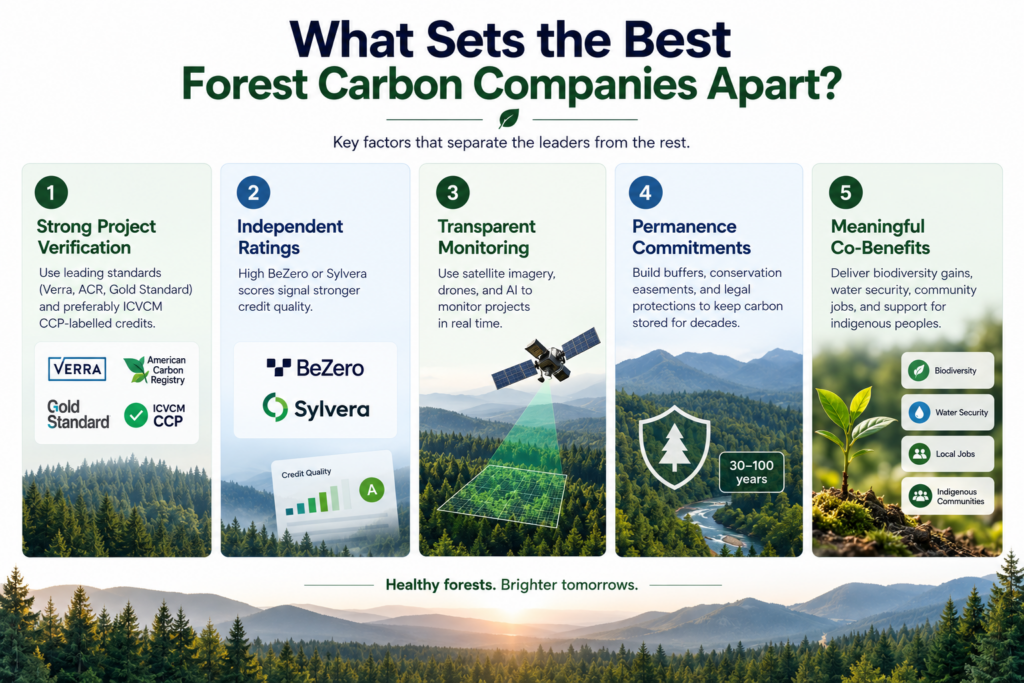
Not all forest carbon companies are equal. Here is what separates the leaders from the rest.
Strong Project Verification
Top companies use leading standards such as Verra’s Verified Carbon Standard (VCS), the American Carbon Registry (ACR), Gold Standard, or the newer ACR IFM v2.1 methodology. Credits that also carry the ICVCM’s Core Carbon Principles (CCP) label have passed one of the most rigorous quality reviews available.
Independent Ratings
Third-party ratings from BeZero Carbon and Sylvera help buyers assess credit quality independently. Projects with high BeZero or Sylvera scores are more defensible under corporate sustainability frameworks like the Science Based Targets initiative (SBTi) and the EU’s Corporate Sustainability Reporting Directive (CSRD).
Transparent Monitoring
The best companies use satellite imagery, drone technology, and AI to monitor projects in real time. This reduces the risk of over-crediting and increases confidence that the carbon being sold actually exists in the ground.
Permanence Commitments
Forest carbon is only meaningful if the carbon stays stored. Leading companies build permanence buffers, conservation easements, and legal land protections that lock in sequestration for 30, 50, or even 100 years.
Meaningful Co-Benefits
Beyond carbon, top projects deliver biodiversity gains, water security, jobs for local communities, and support for indigenous peoples. These co-benefits are increasingly important to buyers who want to tell a credible sustainability story.
How Forest Carbon Credits Are Verified: A Quick Overview
Understanding how credits are verified helps you evaluate any forest carbon company more critically.
Step 1: Project Design The company defines the project boundaries, baseline scenario (what would happen without the project), and the methodology it will follow.
Step 2: Third-Party Validation An independent auditor validates the project design against the chosen standard (Verra, ACR, Gold Standard, etc.).
Step 3: Implementation The project begins. Trees are planted, forests are protected, or management practices are changed.
Step 4: Monitoring and Measurement Carbon stocks are measured using field surveys, satellite data, and drone imagery. This data feeds into carbon accounting models.
Step 5: Independent Verification A separate auditor verifies that the carbon sequestration or emissions reduction claimed actually happened.
Step 6: Credit Issuance Verified credits are issued on a registry (Verra, ACR, Isometric, etc.) and become tradeable units that buyers can retire against their emissions.
The Biggest Forest Carbon Deals in Recent Years
Some of the most significant forest carbon transactions give a clear picture of where the market is heading and which companies are winning the largest mandates.
| Buyer | Seller | Volume | Type |
|---|---|---|---|
| Microsoft | Rubicon Carbon | 18 million tonnes | Nature-based |
| Microsoft | Chestnut Carbon | 7 million tonnes | ARR / IFM |
| Microsoft | re.green | 6.5 million tonnes | ARR |
| Microsoft + Anew + Aurora | Anew Climate | 4.8 million tonnes | IFM |
| Microsoft | EFM | 3 million tonnes | IFM |
| Mombak | 200,000 tonnes | ARR (removal) | |
| Netflix | American Forest Foundation | Undisclosed | IFM |
| Meta | EFM | 660,000 tonnes | IFM |
| Nestlé | re.green | 880,000 tonnes | ARR |
Microsoft stands out as the dominant buyer in the forest carbon market. By any public measure, the company sat behind the majority of the largest forest carbon offtake agreements in recent years, both by number of agreements and by total expected volume. This concentration also highlights a challenge: the diversity of buyers operating at scale remains limited, and broadening buyer participation will be critical for the market’s long-term health.
Forest Carbon Companies and the Role of Technology
Technology is transforming how forest carbon projects are developed and monitored.
Companies like Pachama, re.green, and Mombak all use satellite imagery and AI to assess land quality, monitor forest growth, and verify that carbon sequestration is happening as planned. This reduces the time and cost of traditional field-based surveys and increases the frequency of monitoring.
Some companies are also using blockchain to bring transparency to credit issuance and transfer. Rubicon Carbon, Terrasos, and others are exploring how distributed ledgers can create traceable records for every credit from issuance to retirement.
The emergence of digital MRV (measuring, reporting, and verification) platforms is arguably the most important technological shift in the forest carbon market. Verra’s partnership with Pachama to develop a digital MRV platform was an early signal that the industry was moving away from paper-based assessments toward real-time, satellite-driven monitoring.
Common Challenges in the Forest Carbon Sector
The forest carbon market is growing fast, but it faces real challenges that any informed buyer or investor should understand.
1. Additionality A credit is only meaningful if the carbon would not have been sequestered or protected without the project. Some older projects have struggled to prove that their forests were genuinely at risk of being cleared, raising questions about whether the credits they sold represented real climate benefits.
2. Permanence Forests can burn, be logged, or die from disease. If a forest project that generated credits is later destroyed, the carbon it stored is released. Good projects use buffer pools, insurance, and legal protections to manage this risk, but permanence remains a genuine challenge.
3. Leakage Protecting one area of forest sometimes just shifts deforestation to a neighboring area. This “leakage” can significantly reduce the real climate benefit of a project if it is not properly accounted for in the methodology.
4. Baseline Uncertainty Carbon credit calculations depend on estimating what would have happened without the project. If baselines are set too generously, a project can generate far more credits than the actual climate benefit it delivers. Newer methodologies like ACR IFM v2.1 and Verra VM0045 aim to address this with more conservative approaches.
5. Quality Variation The voluntary carbon market includes projects of wildly varying quality. Independent ratings from BeZero Carbon and Sylvera have become essential tools for buyers who want to avoid low-quality credits that could expose them to reputational risk.
How to Evaluate a Forest Carbon Company
If you are a buyer, investor, or simply curious about the space, here are the key questions to ask about any forest carbon company.
What methodology do they use? Look for projects verified under Verra VCS, Gold Standard, ACR (preferably the updated IFM v2.1), or other recognized standards. Bonus points for CCP-labeled credits from ICVCM.
Has the project been independently rated? Check whether BeZero Carbon or Sylvera has assessed the project. A rating of A or AA from BeZero is a strong signal of quality.
What is the permanence mechanism? Ask how the company ensures carbon stays stored. Conservation easements, buffer pools, and legal protections are all good signs.
Who verifies the monitoring data? Look for companies that use satellite data and AI alongside field surveys, and that publish transparent monitoring reports.
What co-benefits does the project deliver? Strong projects protect biodiversity, support local communities, and contribute to water quality. These benefits should be documented and independently verified.
How does the company handle project failure or reversals? Even the best projects face unexpected events. A credible company has a clear protocol for what happens if carbon is lost through fire, drought, or other causes.
The Future of Forest Carbon Companies
The forest carbon sector is at a turning point.
Buyer expectations have risen sharply. The era of cheap, low-quality credits is ending. Large corporations, guided by SBTi frameworks and CSRD regulations, now demand credits that can withstand independent scrutiny.
At the same time, removal-based credits are gaining ground over avoidance-based credits. Companies like Mombak, re.green, and Chestnut Carbon, which generate credits from actual reforestation rather than protected forests, are attracting premium prices and long-term offtake agreements.
New methodologies are raising the floor on quality. ACR IFM v2.1 and Verra VM0045 both introduce more rigorous approaches to baseline-setting and ongoing monitoring, making it harder for projects to over-credit while giving buyers more confidence in what they are purchasing.
The integration of forest carbon with biodiversity markets, pioneered by companies like Terrasos, also points toward a future where buyers can address multiple environmental goals through a single project investment.
Finally, the geographic diversification of the market is underway. While Brazil and the United States dominate current deal flow, Southeast Asia, Central Africa, and the Congo Basin are emerging as the next major frontiers for large-scale forest carbon development.
Frequently Asked Questions
What are forest carbon companies?
Forest carbon companies develop, verify, and sell carbon credits generated from forest protection, reforestation, or improved forest management. They provide a way for businesses to offset emissions while protecting and restoring natural ecosystems.
Which is the largest forest carbon deal ever signed?
The largest publicly known forest carbon deal is Microsoft’s 18 million tonne agreement with Rubicon Carbon, announced in 2025. Microsoft has also signed major deals with Chestnut Carbon, re.green, Anew Climate, EFM, Mombak, and others.
What is the difference between REDD+ and reforestation credits?
REDD+ credits come from protecting existing forests that are at risk of being cleared. Reforestation or ARR credits come from actively planting new forests on degraded land. Removal credits from reforestation are generally preferred by buyers who want to demonstrate that carbon was physically removed from the atmosphere, while REDD+ avoids emissions that would otherwise have occurred.
How are forest carbon credits verified?
Credits are verified through a multi-step process involving third-party auditors, recognized standards (Verra, ACR, Gold Standard), and ongoing monitoring using satellite data and field surveys. Independent rating agencies like BeZero Carbon and Sylvera also assess projects on quality criteria like additionality, permanence, and methodology rigor.
Are forest carbon credits high quality?
Quality varies significantly. Older projects under legacy methodologies have faced credibility challenges. Newer credits under updated methodologies (ACR IFM v2.1, Verra VM0045) and with independent ratings tend to be far more defensible. Always check the standard, the verifier, and independent ratings before buying.
What is Improved Forest Management (IFM)?
IFM is a type of forest carbon project where the management of an already-existing commercial forest is changed to store more carbon. This includes extending the time between harvests, reducing logging intensity, and restoring degraded stands. IFM credits have surged in popularity as buyers look for working-forest solutions that balance carbon storage with continued sustainable timber production.
Can forest carbon credits replace actual emissions reductions?
No. Leading frameworks like SBTi make clear that carbon credits should complement, not replace, deep emissions reductions. Companies should prioritize cutting emissions from their own operations and supply chains, using credits only to address residual emissions that cannot yet be eliminated.
Which country has the most forest carbon projects?
Brazil leads in terms of total volume, driven by the sheer scale of its Amazon and Atlantic Forest ecosystems. The United States is the largest market for IFM-type forest carbon credits. Colombia, Indonesia, Cambodia, and Peru are also significant sources of REDD+ credits.
Conclusion
The top forest carbon companies in the world are playing a genuinely important role in the fight against climate change.
Companies like re.green, Mombak, Chestnut Carbon, Rubicon Carbon, and Finite Carbon are showing that large-scale forest restoration and protection can be financially viable, scientifically rigorous, and measurably impactful.
The market is maturing. Buyers are more selective. Standards are stricter. And the technology for monitoring and verifying forest carbon has advanced dramatically.
For anyone navigating this space, whether as a buyer, investor, policy maker, or simply a curious learner, the key takeaway is this: quality matters more than ever in the forest carbon market. The companies that will lead this sector in the years ahead are those that prioritize scientific rigor, transparent monitoring, meaningful co-benefits, and the trust of the communities in whose lands these forests grow.
Forests are one of our most powerful tools for addressing climate change. The companies in this article are working to make sure that tool is used well.
Explore more resources on carbon markets, carbon credits, and nature-based solutions at carbonmarketnetwork.com.