Carbon Market Network


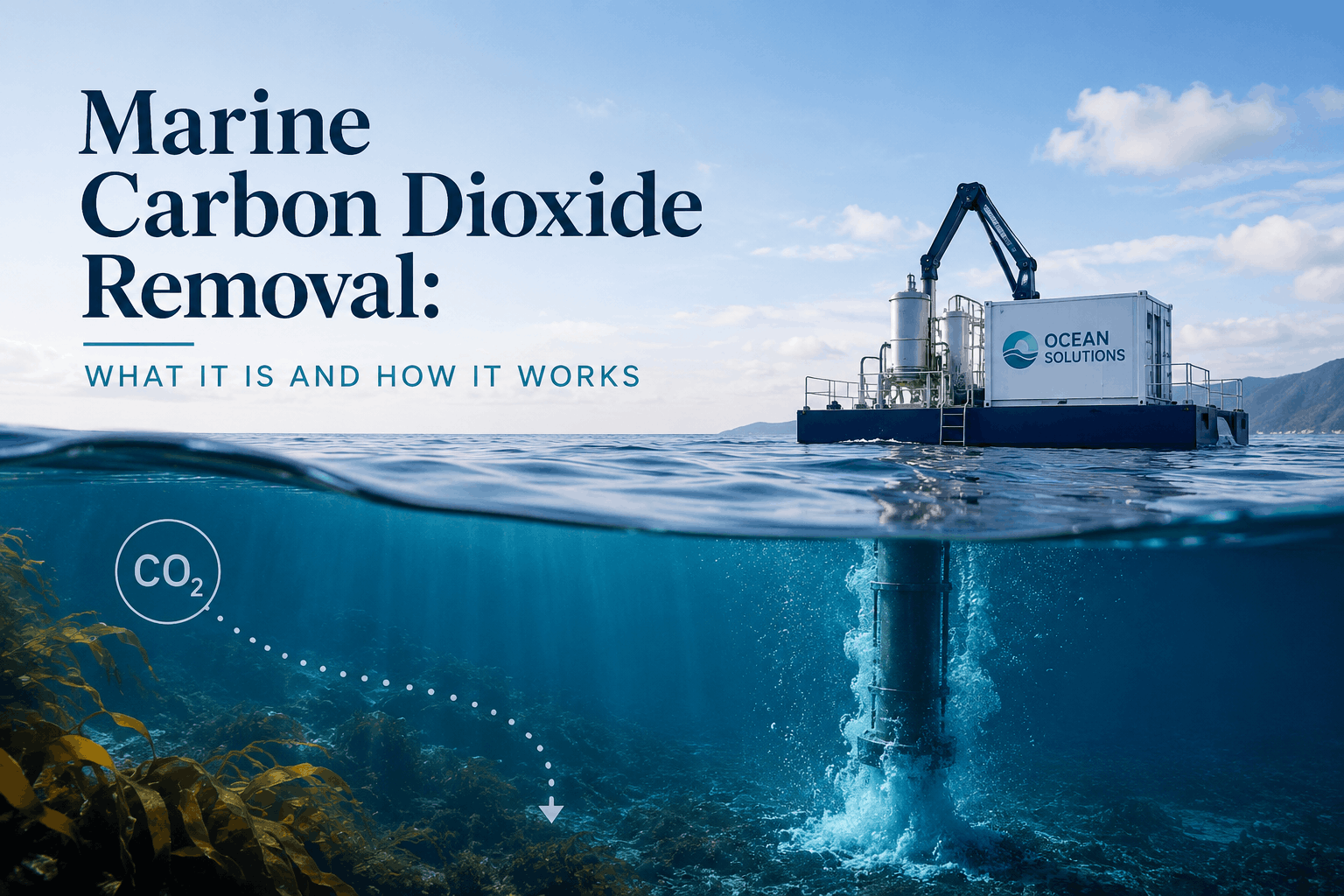
The ocean is quietly doing some of the heaviest lifting in the fight against climate change.
Right now, as you read this, it is absorbing roughly 25 to 30 percent of all the carbon dioxide (CO2) humans release into the atmosphere every single year.
That is billions of tonnes of CO2 pulled from the air and dissolved into seawater before it ever gets a chance to warm the planet further.
But here is the uncomfortable truth: the ocean is already working near its natural limits. And even with deep cuts to emissions, scientists agree we now need to actively remove CO2 from the atmosphere to avoid the worst climate outcomes.
That is exactly where marine carbon dioxide removal comes in.
Marine carbon dioxide removal, also called mCDR or ocean-based CDR, refers to a set of approaches that use the ocean to pull more CO2 out of the atmosphere and store it safely for decades, centuries, or even thousands of years.
It is one of the most exciting, rapidly evolving, and critically important areas of climate science today.
This guide will walk you through everything you need to know: what mCDR is, how each method works, who is doing it, what the challenges are, and why it matters for our collective future.
What Is Marine Carbon Dioxide Removal?
Marine carbon dioxide removal (mCDR) is the process of enhancing the ocean’s natural ability to absorb and store CO2 from the atmosphere.
The ocean is Earth’s largest carbon reservoir. It holds more carbon than the atmosphere and all of Earth’s land ecosystems combined. Naturally, it absorbs CO2 through two main pathways:
- The physical-chemical pump: CO2 dissolves directly into surface seawater because of pressure and temperature differences between the air and sea.
- The biological pump: Marine organisms like phytoplankton absorb CO2 during photosynthesis. When they die, some of that carbon sinks to the deep ocean.
mCDR approaches work by supercharging one or both of these natural pathways, or by creating entirely new ocean-based mechanisms to capture and store carbon.
The goal is not just to neutralize current emissions. The goal is to achieve net negative emissions, meaning we remove more CO2 than we release, and begin to reverse the accumulation of greenhouse gases that has built up since the Industrial Revolution.
Carbon Market Insider Newsletter
Weekly insights on carbon markets, climate policy, carbon credits, and sustainability.
Why Do We Need Marine Carbon Dioxide Removal?
You might wonder: if we just stop burning fossil fuels, won’t things be okay?
The science says: not entirely.
Even if all fossil fuel emissions stopped tomorrow (which is not realistic), there is already so much CO2 in the atmosphere that temperatures would continue rising for decades.
The Intergovernmental Panel on Climate Change (IPCC) has made it clear that limiting warming to 1.5°C requires not just cutting emissions but actively removing billions of tonnes of CO2 per year by mid-century.
That is a staggering amount. Land-based methods like tree planting and direct air capture play a role, but they cannot do the job alone. Trees need land, water, and decades to mature.
Direct air capture is expensive and energy-intensive. The ocean, by contrast, covers over 70 percent of the Earth’s surface and already has the infrastructure in place to store carbon at scale.
This is why mCDR is receiving growing attention from scientists, governments, and investors around the world. The question is no longer whether we need it.
The question is how to do it safely, effectively, and at the scale required.
The Main Methods of Marine Carbon Dioxide Removal
There is no single way to remove CO2 from the ocean. Researchers and companies are exploring a wide range of approaches, each with its own mechanism, potential, and set of challenges.
These methods broadly fall into two categories: biotic (biology-based) and abiotic (chemistry or physics-based).
1. Ocean Alkalinity Enhancement (OAE)
Ocean alkalinity enhancement is currently one of the most talked-about mCDR approaches. And for good reason.
How it works:
When you increase the alkalinity (the basicity) of seawater, you shift the chemical balance in a way that allows seawater to absorb more CO2 from the air. The added alkalinity converts dissolved CO2 into bicarbonate ions, a stable form of carbon that can remain stored in the ocean for around 10,000 years.
Think of it like this: alkalinity acts as a sponge, and the more alkaline the seawater, the bigger the sponge.
The most common approach involves adding alkaline minerals, such as crushed olivine, limestone, or basalt, directly to the ocean. These minerals dissolve and release alkalinity naturally.
Another approach uses electrochemical processes to generate alkalinity from seawater itself without adding minerals.
Real-world examples:
- Planetary Technologies has completed the first independently verified ocean alkalinity enhancement project. In 2025, they achieved a milestone by issuing 625.6 verified tonnes of CO2 removal credits through the Isometric registry, using a wastewater treatment plant outfall in Nova Scotia, Canada.
- Ebb Carbon, based in the US, signed a landmark deal with Microsoft in October 2024 for the removal of 350,000 tonnes of CO2 over 10 years, making it the largest mCDR deal signed to date at the time.
Why it matters:
OAE has the potential to store carbon permanently, which gives it a significant advantage over many other CDR approaches. The chemistry is well understood, which is why it attracts serious commercial interest.
As of late 2025, around 600,000 tonnes of CO2 removal had been contracted through OAE-related agreements, though only a few hundred tonnes had been independently verified.
2. Blue Carbon: Protecting and Restoring Coastal Ecosystems
Blue carbon is one of the most nature-friendly and co-benefit-rich approaches in the mCDR toolkit.
What is blue carbon?
Blue carbon refers to the carbon captured and stored by coastal and marine ecosystems, particularly mangroves, seagrass meadows, and tidal salt marshes.
These ecosystems are extraordinary carbon sinks. Even though they cover less than 2 percent of the total ocean area, they account for roughly half of all the carbon sequestered in ocean sediments each year.
How does it work?
These coastal plants absorb CO2 from both the atmosphere and the ocean during photosynthesis. When they die, their biomass and roots become buried in waterlogged, oxygen-poor sediments where decomposition is extremely slow.
This means the carbon they stored can remain locked away for hundreds to thousands of years.
Here are some remarkable numbers:
- Mangroves can sequester up to five times more carbon per unit area than tropical rainforests.
- Mangroves and salt marshes take up carbon 10 times faster than terrestrial forests.
- In seagrass meadows, over 95 percent of the carbon is stored in the soils below ground.
- Carbon deposits in these soils can reach up to six meters deep.
The urgency of protection:
These ecosystems are disappearing fast. Mangroves are being lost at a rate of around 2 percent per year. Seagrasses have lost approximately 30 percent of their historical global coverage.
Tidal marshes have lost more than 50 percent of their historical extent.
When these ecosystems are destroyed, all that stored carbon gets released back into the atmosphere, turning a carbon sink into a carbon source.
Blue carbon in the carbon market:
As of late 2025, there were around 81 blue carbon projects worldwide. The market is dominated by mangrove projects.
While only a small number are actively issuing carbon credits today, the development pipeline shows potential for enormous growth, with an estimated 5.8 billion tonnes of CO2 in projected removals by 2075.
Co-benefits beyond carbon:
Blue carbon projects do not just remove CO2. They also:
- Protect coastlines from storms and sea-level rise
- Support biodiversity by providing habitat for fish, birds, and marine mammals
- Improve water quality
- Support food security for coastal communities
- Provide livelihoods for millions of people living near the coast
3. Macroalgae Cultivation and Sinking (Seaweed Farming)
Seaweed grows fast. Really fast. Some species can grow 30 to 60 centimetres per day under ideal conditions. This makes macroalgae cultivation an intriguing approach for carbon removal.
How it works:
Macroalgae, such as kelp and other large seaweeds, absorb CO2 from the surrounding water during photosynthesis.
As the seaweed grows, it pulls down dissolved CO2, which in turn draws down more CO2 from the atmosphere into the surface ocean.
There are several ways the captured carbon can be stored:
- Sink it to the deep ocean: Mature seaweed biomass is sunk to depths below 1,000 metres, where pressure and cold temperatures slow decomposition significantly. The carbon remains locked away for centuries.
- Use it for biomass energy with carbon capture: Convert the seaweed into biogas or biofuel, capture the CO2 released during combustion, and store it underground.
- Incorporate it into products: Use dried seaweed as building materials, animal feed supplements, or soil amendments to keep the carbon out of the atmosphere.
Real-world example:
The New York-based company Gigablue has developed a substrate technology that mimics ocean processes. Their substrate attracts local phytoplankton, grows them to a critical mass, then triggers a controlled sinking mechanism that takes the substrate and attached carbon to the ocean floor.
In early 2025, Gigablue signed the largest mCDR deal in the sector at that time, agreeing to remove 200,000 tonnes of CO2 for aviation sustainability company SkiesFifty.
Key uncertainties:
The main question with seaweed sinking is permanence. If the biomass decomposes in the mid-ocean before reaching stable deep-sea conditions, much of the CO2 could eventually return to the surface through ocean circulation.
More research is needed to understand how much carbon actually stays stored and for how long.
4. Ocean Iron Fertilization (OIF)
Ocean iron fertilization is one of the oldest ideas in the mCDR playbook, dating back to the 1980s.
How it works:
Large areas of the ocean, particularly the Southern Ocean and parts of the Pacific, have plenty of nutrients like nitrogen and phosphorus but very little iron.
Iron is a critical micronutrient for phytoplankton. Adding small amounts of iron to these iron-limited regions can trigger massive phytoplankton blooms.
As the phytoplankton population explodes, they absorb enormous amounts of CO2 through photosynthesis. When the bloom eventually dies off, some of that carbon sinks to the ocean floor through what scientists call the biological carbon pump.
The deeper the carbon sinks, the longer it stays out of the atmosphere.
The challenges:
Despite decades of research, ocean iron fertilization has not gained traction commercially. The core issues are:
- Unpredictable efficiency: Not all the carbon sinks deep enough to stay stored. A significant portion gets recycled back into the surface ocean by bacteria.
- Ecosystem risks: Large phytoplankton blooms can disrupt local food webs, deplete oxygen in deeper waters, and trigger harmful algal blooms.
- Permanence concerns: The long-term storage of carbon from OIF is difficult to verify.
- Governance barriers: Most ocean iron fertilization experiments are conducted under international law, and the London Protocol largely restricts large-scale OIF experiments.
For these reasons, OIF is considered a non-starter for compliance carbon markets today, though it remains an active area of scientific study.
To learn more about carbon market check – Carbon Market Network
5. Direct Ocean Capture (DOC)
Direct ocean capture is the most technologically intensive mCDR approach, and in many ways, it is the most directly analogous to direct air capture on land.
How it works:
DOC systems pump seawater through a reactor where CO2 is physically or chemically extracted from the water. Once the CO2 is removed, the treated water is returned to the ocean, where it quickly draws down more CO2 from the atmosphere to restore equilibrium. The captured CO2 can then be:
- Compressed and stored in geological formations underground
- Incorporated into long-lived materials like concrete or other carbon-negative products
Why the ocean matters here:
Seawater contains about 150 times more dissolved CO2 per litre than the air above it. This makes it far more efficient to extract CO2 from seawater than directly from the air. The ocean does the initial concentrating work for free.
Real-world example:
Equatic, a carbon removal company that spun out of UCLA’s Institute for Carbon Management, uses an electrochemical process to remove CO2 from seawater and simultaneously produce carbon-negative hydrogen as a bonus product.
Equatic has two operational pilot plants: one in Singapore and one in Los Angeles, both of which were actively removing CO2 as of early 2025.
Current stage:
Direct ocean capture is still in the early commercial phase. The technology works, but costs remain high and scaling requires significant investment.
However, the long-term potential is enormous because DOC can deliver highly durable, verifiable removals with a small physical footprint.
6. Artificial Upwelling and Downwelling
This is a more experimental approach that works by physically moving water between different layers of the ocean.
How it works:
Artificial upwelling pumps nutrient-rich water from the deep ocean to the surface, stimulating phytoplankton growth. More phytoplankton means more CO2 absorbed.
Artificial downwelling works the opposite way: it pushes carbon-rich surface water into the deep ocean before the carbon can return to the atmosphere, effectively speeding up the ocean’s natural carbon pump.
The challenge:
Both approaches are technically complex. Pumping large volumes of cold, deep water to the surface can disrupt local temperature regimes and affect marine species that depend on stable conditions.
Scaling these systems to sizes that would make a meaningful difference to atmospheric CO2 would require enormous infrastructure investments.
7. Electrochemical Methods
Electrochemical approaches represent a newer frontier in mCDR. They use electricity to drive chemical reactions in seawater that either remove CO2 directly or increase alkalinity.
How it works:
Researchers at Northeastern University, for example, have developed a system that uses electrolysis to simultaneously:
- Release iron into the water, stimulating phytoplankton growth (like a controlled version of ocean iron fertilization)
- Increase seawater pH, enhancing its capacity to absorb CO2
This combined approach, called electrochemical ocean iron fertilization (EOIF), can increase iron concentrations and raise seawater pH significantly.
The beauty of this method is that electricity can regulate the entire process, making it more controllable and measurable than releasing minerals or nutrients directly.
Current status:
Electrochemical methods are still largely in the laboratory and early pilot phase. They hold significant promise, especially as the cost of renewable electricity continues to fall.
If powered by solar or wind energy, these systems could deliver carbon removal with a very low carbon footprint.
How mCDR Compares to Land-Based Carbon Removal
It is helpful to understand how marine carbon dioxide removal stacks up against other approaches.
| Approach | Scale Potential | Permanence | Cost | Ecosystem Risk |
|---|---|---|---|---|
| Ocean Alkalinity Enhancement | Very High | Very High (10,000 yrs) | Medium | Low to Medium |
| Blue Carbon (Mangroves etc.) | Medium | High (centuries) | Low | Very Low (co-benefits) |
| Macroalgae Sinking | High | Medium (uncertain) | Medium | Medium |
| Direct Ocean Capture | Very High | Very High | High | Low |
| Direct Air Capture | High | Very High | Very High | Very Low |
| Reforestation | Medium | Medium | Low | Very Low |
The key advantage of ocean-based methods is scale. The ocean can physically accommodate far more CO2 than any forest or land-based storage site.
The challenge is doing it safely, verifiably, and cost-effectively.
The Role of Monitoring, Reporting, and Verification (MRV) in mCDR
One of the most critical challenges facing marine carbon dioxide removal is MRV: how do you actually prove that the carbon has been removed, and that it will stay removed?
This is a harder question than it sounds. On land, you can count trees and measure soil carbon relatively simply.
In the ocean, you are dealing with a dynamic, constantly moving system where carbon can be redistributed by currents, upwelling, and biological activity across thousands of kilometres.
The key challenges in mCDR MRV include:
- Spatial complexity: Carbon removed in one location may travel far before it is sequestered, making attribution difficult.
- Temporal uncertainty: How do you measure whether carbon stored today will still be there in 100 years?
- Ecosystem interactions: mCDR methods affect not just carbon chemistry but also temperature, pH, nutrient levels, and biodiversity.
- Cost: Comprehensive ocean monitoring using ships, buoys, sensors, and satellites is expensive, particularly in the early stages of a project.
Progress being made:
Scientists are developing innovative solutions. Researchers in the SEAO2-CDR project are testing autonomous “lab-on-chip” sensor systems that can measure dissolved carbon, alkalinity, and nutrients in real time directly from the ocean.
These systems have the potential to dramatically reduce the cost of MRV while improving accuracy.
On the commercial side, Planetary Technologies released an open-source OAE MRV protocol in 2023, now in its third version, that offers a standardized way to calculate carbon removal, estimate storage duration, and assess ecological impacts.
In June 2025, this protocol enabled the first-ever independently verified OAE carbon credits.
The broader field agrees: robust MRV is not just a regulatory box to check. It is the foundation of trust for the entire mCDR sector.
Real-World mCDR Projects Making Progress
The mCDR sector has grown from essentially no startups before 2017 to more than 45 active companies by 2025. Here is a snapshot of some notable real-world efforts:
Ebb Carbon (USA) Ebb Carbon uses an electrochemical process to add alkalinity to seawater by removing acid at desalination plant outfalls.
Their system requires no new infrastructure beyond what is already in place. The Microsoft deal, signed in late 2024, put them firmly on the global map.
Equatic (USA/Singapore) Equatic’s electrochemical process removes CO2 from seawater and generates hydrogen as a byproduct.
With operational pilots in Los Angeles and Singapore, they are one of the most advanced DOC companies in the world.
Planetary Technologies (Canada) A pioneer in ocean alkalinity enhancement. Their collaboration with the Isometric registry to issue the first verified OAE credits in 2025 was a watershed moment for the industry.
Gigablue (USA) Their substrate-based approach activates the ocean’s biological carbon pump in a controlled, measurable way.
Their record deal in early 2025 signaled that buyers in hard-to-abate sectors like aviation are taking mCDR seriously.
Woods Hole Oceanographic Institution (USA) One of the world’s leading ocean research institutions, Woods Hole has been at the forefront of mCDR science for decades.
Their researchers have studied iron fertilization, ocean alkalinity, seaweed cultivation, and blue carbon extensively.
The Science Behind Why the Ocean Is Such a Powerful Carbon Sink
To understand mCDR more deeply, it helps to understand the ocean’s natural carbon chemistry.
The carbonate system:
When CO2 dissolves in seawater, it reacts with water to form carbonic acid. This then dissociates into bicarbonate ions and carbonate ions.
Most of the carbon in the ocean exists as bicarbonate. This transformation is critical because bicarbonate is chemically stable and does not readily escape back into the atmosphere.
Alkalinity is essentially the ocean’s capacity to neutralize acid and form these stable bicarbonate ions. The more alkalinity, the more CO2 the ocean can absorb and hold.
The solubility pump:
Cold water dissolves more CO2 than warm water. Near the poles, cold surface water sinks into the deep ocean, carrying dissolved CO2 with it.
This is the solubility pump, and it moves enormous quantities of carbon into the deep ocean every year.
The biological pump:
Phytoplankton near the ocean surface absorb CO2 through photosynthesis just like land plants do. When they die, some of their biomass sinks to the deep ocean in a rain of organic particles called “marine snow.”
If this organic matter reaches depths below about 1,000 metres, the carbon it contains is effectively locked away from the atmosphere for centuries.
mCDR approaches work by enhancing one or more of these existing mechanisms, or by creating new chemical pathways for carbon storage.
Environmental Risks and Considerations
mCDR is not without risk. Any large-scale intervention in the ocean must be approached with caution and rigorous scientific oversight.
Potential ecosystem impacts include:
- Changes in ocean pH and chemistry: Adding alkalinity or removing CO2 alters the chemical environment that marine organisms have adapted to over millions of years.
- Nutrient imbalances: Adding iron or other nutrients to stimulate phytoplankton can disrupt existing food webs.
- Oxygen depletion: Large phytoplankton blooms can cause oxygen-depleted dead zones when the bloom dies and decomposes.
- Unintended consequences downstream: Ocean currents can carry the effects of a local mCDR intervention far away, affecting ecosystems in regions that had no say in the decision.
The scientific community’s response:
More than 400 scientists worldwide have signed an open letter advocating for responsible mCDR research and development. The emphasis is on “responsible.” The scientific consensus is that mCDR needs to be studied rigorously in controlled field trials before being deployed at scale, with proper environmental impact assessments and community engagement at every stage.
Most researchers agree that no single mCDR method is ready for gigaton-scale deployment today. We are still in the critical research and early commercialization phase.
Governance: Who Regulates mCDR?
Because the ocean covers vast areas of international water, mCDR governance is a complex, multi-stakeholder challenge.
Key governance frameworks include:
- The London Protocol: An international treaty governing dumping at sea. It restricts large-scale ocean iron fertilization experiments and requires permitting for any large-scale ocean interventions.
- UNCLOS (UN Convention on the Law of the Sea): Sets out the rights and responsibilities of nations with respect to the ocean, including environmental protection duties.
- The Paris Agreement (Article 6.4): In late 2024, new guidelines were approved for carbon removal credits under the Article 6.4 mechanism, opening a pathway for mCDR projects to generate internationally recognized credits. However, these guidelines attracted criticism for being rushed and for potential loopholes.
- US Policy: In mid-2024, the US Department of Energy and NOAA signed a memorandum of agreement to accelerate ocean carbon removal research. In January 2025, a bipartisan group of Congress members proposed legislation to advance mCDR in the United States.
- EU Carbon Removal Certification Framework (CRCF): The EU is developing standards for carbon removals, though critics argue the initial framework lacks sufficient integrity provisions for mCDR.
The governance landscape is moving fast, but the consensus among researchers and companies is clear: clear, workable regulations are urgently needed to give mCDR developers the certainty they need to invest, scale, and operate responsibly.
The Potential Scale of Marine Carbon Dioxide Removal
Just how much of a difference can mCDR make?
Scientists at Yale’s Center for Natural Carbon Capture and other institutions are working toward gigaton-scale mCDR by midcentury. One gigatonne equals one billion tonnes. The world currently emits about 40 billion tonnes of CO2 per year.
To meet the Paris Agreement’s 1.5°C target, the IPCC estimates we may need to remove somewhere between 5 and 10 gigatonnes of CO2 per year by 2050, across all CDR methods combined.
The ocean’s theoretical capacity to store carbon is many times larger than that. But reaching practical, verifiable gigaton-scale mCDR will require:
- Decades of continued research and field trials
- Massive investment in technology and infrastructure
- Robust international governance frameworks
- Strong demand signals from governments and corporations
- Public trust built through transparent, responsible practices
Today, most mCDR approaches are operating at the pilot or early commercial scale, measured in thousands to hundreds of thousands of tonnes.
The journey to gigatons is real, but it will not happen overnight.
Who Is Funding Marine Carbon Dioxide Removal?
Funding for mCDR has grown substantially in recent years. Here is where the money is coming from:
Government funding:
- The US Inflation Reduction Act (IRA) and Bipartisan Infrastructure Law (BIL) provided historic levels of funding for CDR research and scaling, including ocean-based approaches.
- In April 2025, NOAA announced a $24.3 million investment in mCDR research, funding projects across ocean alkalinity enhancement, electrochemical approaches, and seaweed cultivation.
- The US Department of Energy has funded programs through its Office of Fossil Energy and Carbon Management and the Water Power Technologies Office for electrolysis-based ocean carbon removal.
Private and corporate investment:
- Corporate buyers like Microsoft have signed long-term offtake agreements directly with mCDR companies, providing the revenue certainty needed to scale.
- Aviation companies, shipping firms, and other hard-to-abate industries are increasingly looking at mCDR as a high-quality offset option.
Philanthropic funding:
Organizations like Ocean Visions, a nonprofit dedicated to ocean-climate restoration, have invested heavily in research coordination, road mapping, and technology development.
How Marine Carbon Dioxide Removal Connects to the Carbon Market
mCDR projects can generate carbon credits that companies and governments can buy to offset their residual emissions. This creates a financial incentive for developing and scaling mCDR technologies.
Types of mCDR credits:
- Blue carbon credits from mangrove and seagrass restoration projects, verified under standards like the Verified Carbon Standard (VCS) or Plan Vivo.
- OAE credits from ocean alkalinity enhancement projects, now verifiable through protocols like the Planetary/Isometric joint methodology.
- Direct ocean capture credits from electrochemical removal projects, verified through registries like Puro.earth.
The quality question:
Not all mCDR credits are equal. High-quality credits require:
- Rigorous quantification of actual carbon removed
- Demonstrated permanence (the carbon stays removed)
- Independent third-party verification
- Transparent reporting of environmental impacts
- Additionality (the removal would not have happened without the project)
As the sector matures, buyers are increasingly willing to pay a premium for credits from projects with strong, independently verified MRV, particularly for approaches with very high permanence like OAE and direct ocean capture.
What Makes a High-Quality mCDR Project?
If you are a buyer, policymaker, or researcher evaluating mCDR projects, here are the key criteria to look for:
1. Additionality Would the carbon removal have happened anyway, without the project? The answer must be no.
2. Permanence How long will the carbon stay stored? OAE stores carbon as bicarbonate for around 10,000 years. Blue carbon stores it for centuries. Seaweed sinking has more uncertainty. The longer, the better.
3. Measurability Can the project accurately measure, report, and verify how much carbon it removes? This requires a rigorous MRV protocol.
4. Environmental integrity Does the project avoid or minimize harm to marine ecosystems? Does it include ecosystem monitoring, not just carbon monitoring?
5. Co-benefits Does the project deliver additional benefits beyond carbon removal, such as protecting biodiversity, supporting coastal communities, or reducing ocean acidification?
6. Transparency Does the project openly share its data, methodology, and results for independent review?
The Future of Marine Carbon Dioxide Removal
The mCDR field is at an inflection point.
The science has advanced enough to know that several approaches can work in principle. The first commercial transactions have happened.
The first independently verified credits have been issued. Governments are beginning to build policy frameworks.
What happens next depends on several factors:
Scaling technology: Costs for approaches like direct ocean capture and OAE need to come down through engineering innovation and economies of scale.
Building trust: Every project that delivers on its promises builds credibility for the whole sector. Every project that fails to verify its claims sets it back.
Developing regulation: Clear, credible, internationally consistent rules for mCDR will unlock the investment needed to scale.
Creating demand: Corporate buyers, governments, and financial markets need to create durable demand signals that justify the long-term investment in mCDR infrastructure.
Advancing MRV: The development of affordable, accurate, real-time ocean monitoring systems will reduce the cost and uncertainty of carbon accounting.
The ocean has been a silent climate partner for millions of years. Marine carbon dioxide removal is humanity’s attempt to work with that partnership more intentionally, more intelligently, and at the scale the climate crisis demands.
Key Takeaways
Here is a quick summary of the most important things to know about marine carbon dioxide removal:
- The ocean absorbs about 25 to 30 percent of annual human CO2 emissions naturally. mCDR aims to significantly increase this.
- There are multiple mCDR approaches, ranging from nature-based (blue carbon) to geochemical (OAE) to technological (direct ocean capture).
- Ocean alkalinity enhancement is currently the most commercially advanced abiotic mCDR approach, with verified credits now in circulation.
- Blue carbon through mangrove and seagrass protection is the most mature and widely deployed mCDR category, with strong co-benefits.
- MRV is the biggest challenge facing the sector. Accurate, affordable, independent verification of ocean carbon removal is essential to credibility.
- More than 45 companies are now working in the mCDR space globally.
- Gigaton-scale deployment is the ultimate goal, but we are currently at the pilot and early commercial stage.
- Governance frameworks are developing, but clear international regulations are still needed.
- mCDR is not a substitute for emissions cuts. It is an essential complement to them.
Frequently Asked Questions (FAQ)
Q: What is marine carbon dioxide removal in simple terms?
Marine carbon dioxide removal (mCDR) is the use of ocean-based methods to pull CO2 out of the atmosphere and store it safely in or through the ocean. It works by enhancing the ocean’s natural carbon-absorbing processes.
Q: What is the difference between mCDR and carbon capture?
Carbon capture usually refers to capturing CO2 at the point of emission, such as at a power plant, before it enters the atmosphere. mCDR removes CO2 that has already entered the atmosphere by using the ocean as both a medium and a storage system.
Q: Is ocean alkalinity enhancement safe?
Research to date suggests that ocean alkalinity enhancement is likely to be safe at small and medium scales. Scientists are continuing to study potential ecosystem impacts, particularly effects on marine organisms sensitive to changes in pH and chemistry. Responsible OAE projects include extensive ecosystem monitoring alongside carbon monitoring.
Q: How long does marine carbon dioxide removal last?
It depends on the method. Ocean alkalinity enhancement stores carbon as bicarbonate for around 10,000 years. Blue carbon ecosystems can store carbon for centuries or millennia in their soils. Macroalgae sinking has more uncertain permanence, ranging from decades to centuries depending on sink depth.
Q: Can marine carbon dioxide removal replace cutting emissions?
No. mCDR is an essential tool, but it is not a substitute for dramatically reducing fossil fuel emissions. Scientists are clear that we need deep emissions cuts alongside carbon removal to meet climate goals.
Q: What is the biggest challenge facing mCDR today?
The biggest challenges are measurement, reporting, and verification (MRV); the development of clear governance frameworks; and scaling costs. Accurately quantifying how much carbon the ocean has removed and verifying that it will stay removed is technically complex and expensive.
Q: What is blue carbon?
Blue carbon refers to the carbon captured and stored by coastal marine ecosystems, particularly mangroves, seagrass meadows, and tidal salt marshes. These ecosystems are highly efficient carbon sinks and also provide biodiversity, coastal protection, and livelihood benefits.
Q: Are there companies working on marine carbon removal?
Yes. As of early 2025, more than 45 companies globally are working on mCDR, including Ebb Carbon, Equatic, Planetary Technologies, Gigablue, and many others. Major corporations like Microsoft have signed long-term purchase agreements for ocean-based carbon removal credits.
Q: What is ocean iron fertilization and why is it controversial?
Ocean iron fertilization involves adding iron to iron-limited parts of the ocean to stimulate phytoplankton growth, which absorbs CO2. It is controversial because of unpredictable ecosystem effects, permanence concerns, and governance restrictions under international maritime law.
Q: How does mCDR connect to carbon credits?
mCDR projects can generate carbon credits that represent verified tonnes of CO2 removed from the atmosphere. Companies and governments can buy these credits to offset residual emissions they cannot yet eliminate. High-quality mCDR credits require rigorous, independent verification.
This article reflects the state of knowledge as of April 2026. The mCDR field is evolving rapidly. For the most current developments, follow leading research institutions like Woods Hole Oceanographic Institution, Yale Center for Natural Carbon Capture, and organizations like Ocean Visions and the Carbon to Sea Initiative.