Carbon Market Network


If you’ve ever tried to sell carbon credits, or even just researched the process, you’ve probably asked yourself: how long is this actually going to take?
The honest answer? It depends. But “it depends” isn’t very helpful when you’re planning a project or managing cash flow. So let’s break it down properly.
The timeline to sell carbon credits ranges from as little as a few weeks to over 15 months. Where you land on that spectrum depends on whether you’re selling already-verified spot credits or entering into a long-term offtake agreement, what type of project you have, and how well-prepared your documentation is.
This guide covers the full journey, from the moment a project is conceived to the moment payment clears, so you know exactly what to expect at every stage.
What Does “Selling Carbon Credits” Actually Mean?
Before we talk timelines, let’s be clear about what we’re measuring.
Selling carbon credits can refer to two very different things:
- Selling already-verified, registry-issued credits on the spot market (fast)
- Developing a project from scratch, getting it certified, and then selling the credits (much slower)
Most beginner guides collapse these two into one, which creates enormous confusion. This article separates them clearly so you can find the timeline that actually applies to your situation.
Carbon Market Insider Newsletter
Weekly insights on carbon markets, climate policy, carbon credits, and sustainability.
The Two Main Scenarios: Quick Reference
| Scenario | Who It Applies To | Typical Timeline |
|---|---|---|
| Spot sale of existing, verified credits | Sellers who already hold issued credits | 1 day to 5 months |
| Full project development + sale | New project developers | 2 to 5+ years total |
| Offtake agreement negotiation | Developers selling future credits to corporate buyers | 12 to 18 months to close |
Let’s now go through each phase in detail.
Phase 1: Project Development and Certification (6 Months to 3+ Years)
If you do not yet have verified carbon credits in a registry account, you need to go through the project development and certification process first. This is the longest phase, and it’s the one most people underestimate.
Step 1: Project Concept and Feasibility (1 to 3 Months)
Everything starts with an idea. You identify a potential project – a reforestation initiative, a renewable energy installation, a methane capture operation, or an improved cookstove program.
During this phase, you:
- Assess whether the project qualifies under an existing methodology
- Choose the right carbon standard (Verra VCS, Gold Standard, ACR, Plan Vivo, etc.)
- Conduct a preliminary feasibility study
- Estimate potential credit volumes
This step can move quickly if you have the right expertise. But if you’re working across multiple methodologies or comparing standards, it can stretch to three months or more.
Step 2: Project Design and Documentation (2 to 6 Months)
Once you decide on a methodology and standard, you need to prepare the Project Design Document (PDD). This is a detailed technical document that describes:
- The project boundaries
- The baseline emissions scenario
- How the project reduces or removes emissions
- The monitoring plan
- Additionality arguments (proof the project would not happen without carbon finance)
Writing a good PDD takes time. If you hire an experienced consultant, this phase can run two to four months. If you’re doing it in-house without prior experience, budget more.
Step 3: Validation by a Third-Party Auditor (1 to 4 Months)
After your PDD is ready, you submit it to an accredited Validation and Verification Body (VVB). The auditor reviews your project design, visits the site if required, and issues a validation opinion.
Validation confirms that the project design meets the chosen standard’s requirements before implementation begins.
Factors that affect how long this takes:
- Auditor availability: Popular VVBs often have backlogs
- Project complexity: Larger or more novel projects require more scrutiny
- Documentation quality: Incomplete PDDs get sent back for revision, which adds weeks
Realistically, allow two to four months for this step.
Step 4: Registry Registration (1 to 2 Months)
Once validated, the project applies for registration with the relevant registry (Verra, Gold Standard, ACR, etc.). The registry reviews the validation report and formally registers the project.
This step is administrative but not instant. Budget four to eight weeks.
Step 5: Project Implementation (Ongoing)
After registration, the project runs its activities. Reforestation projects plant trees. Renewable energy projects generate clean power. Methane capture projects install equipment and start operations.
This is not a passive waiting period. You must collect monitoring data throughout this phase according to your approved monitoring plan.
Step 6: Verification and Credit Issuance (1 to 3 Months, Recurring)
After the first monitoring period – typically one year – you submit monitoring data to a VVB for verification. The verifier audits your data, confirms the actual emission reductions or removals, and issues a verification report.
The registry then uses this report to issue carbon credits into your account. Each issued credit represents one tonne of CO2 equivalent reduced or removed.
This verification cycle repeats annually or biannually throughout the project’s life, which can span 10 to 30 years or more.
Summary of Development Timeline
| Phase | Approximate Duration |
|---|---|
| Feasibility and concept | 1 to 3 months |
| Project design (PDD) | 2 to 6 months |
| Validation | 1 to 4 months |
| Registry registration | 1 to 2 months |
| Implementation (first monitoring period) | 6 to 12 months |
| Verification and issuance | 1 to 3 months |
| Total from idea to first credits issued | ~12 months to 3+ years |
Phase 2: The Actual Sale – How Long Does It Take to Sell Carbon Credits Once You Have Them?
This is where things get more precise. Once credits are in your registry account, how long does it actually take to find a buyer and complete the transaction?
Research published by Ecosystem Marketplace and Carbon Capital Lab based on a survey of 48 carbon project developers and intermediaries, provides some of the clearest real-world data available on this question.
The findings are illuminating:
- Spot credit sales took an average of five months to close, from first buyer contact to completed transaction
- Offtake agreements took an average of 15 months to close, roughly three times as long as spot sales
- Two-thirds of all sales conversations ended before formal due diligence even began
These are not slow outliers. These are averages from active market participants.
Why Spot Sales Take Five Months
Five months might sound long for what feels like a simple transaction. But spot sales are rarely simple, even when the credits already exist.
Here is what typically happens during those five months:
- Initial buyer discovery – Finding the right buyer takes weeks or months. Most carbon credit sales still happen through personal networks and relationships formed at industry events, not through open marketplaces.
- Buyer education – Many corporate buyers are new to the market and need significant hand-holding before they feel confident enough to commit. Sellers often spend weeks educating potential buyers on credit types, pricing, and how verification works, at their own cost and with no guarantee of a sale.
- Price negotiation – Buyers frequently arrive with price expectations that do not match market reality. Resolving this mismatch takes time.
- Due diligence – Even for spot credits, buyers will review documentation, registry records, and methodology details before committing.
- Contract finalization – Terms, payment structure, and transfer logistics all need to be agreed in writing.
Only after all of this does the actual credit transfer happen, which itself takes minutes on modern registries.
Why Offtake Agreements Take 15 Months
Offtake agreements are contracts where a buyer commits to purchasing future carbon credits over multiple years, typically five to fifteen years. They are increasingly popular for carbon removal credits (reforestation, direct air capture, biochar), where buyers want to lock in future supply.
The 15-month average closing time reflects how complex these deals are:
- Deep project due diligence – Buyers scrutinize every aspect of the project, including site data, permanence risk, monitoring methodology, and developer track record. Some buyers send their own technical teams or hire third-party assessors.
- Contract negotiation – Offtake agreements are bespoke legal documents. Negotiating price escalation clauses, delivery schedules, quality assurance provisions, and force majeure terms can take months.
- Regulatory and compliance alignment – Corporate buyers often need internal legal and sustainability approvals before committing to a multi-year contract.
- Financial review – For large offtakes, buyers assess the project developer’s financial health and project feasibility.
Some offtake negotiations collapse entirely because due diligence requests become so data-intensive that the project developer cannot afford to continue the process. This is a documented problem in the current market.
The Biggest Factors That Affect How Long It Takes to Sell Carbon Credits
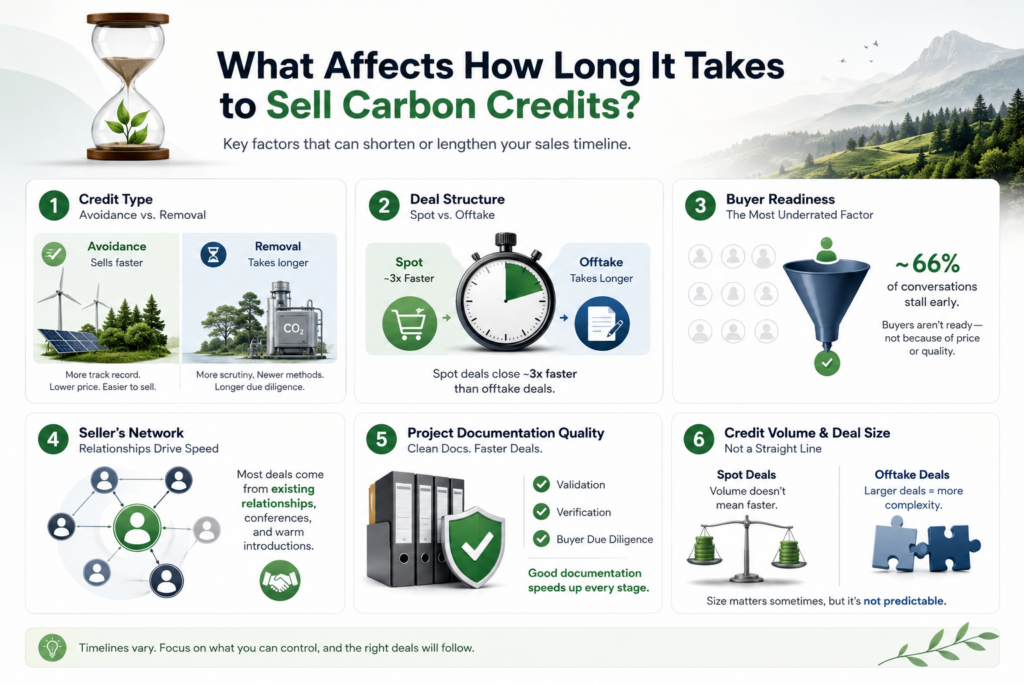
The five-month and 15-month averages mask a huge amount of variation. Here are the factors that push your timeline shorter or longer.
Credit Type: Avoidance vs. Removal
Avoidance credits (REDD+ deforestation prevention, renewable energy, methane capture) generally sell faster than removal credits (reforestation, direct air capture, biochar, enhanced rock weathering).
Why? Avoidance credits have a longer market track record, more standardized methodologies, and lower price points that more buyers can access quickly.
Removal credits attract more scrutiny because buyers want long-term durability guarantees, and the methodologies are often newer and less tested.
REDD+ credits, for example, are predominantly sold to intermediaries who can move them quickly. ARR (Afforestation, Reforestation, Revegetation) credits are more commonly sold directly to end-buyers through offtake agreements, which extends the timeline.
Deal Structure: Spot vs. Offtake
As shown above, this is the single biggest predictor of how long a deal takes to close. Spot deals are three times faster than offtake deals on average.
If you need revenue quickly, spot sales of already-verified credits are your fastest route.
Buyer Readiness
This is the most underrated factor in the entire timeline.
Two-thirds of carbon credit sales conversations stall in the earliest exploration phase, not because the credits are poor quality, not because the price is wrong, but simply because the buyer is not ready to buy. They may be exploring options without budget approval, or they lack internal champions for the purchase decision.
You cannot control buyer readiness, but you can qualify buyers better before investing significant time in the sales process.
Seller’s Network and Relationships
The voluntary carbon market runs heavily on personal relationships. The most common way sellers meet buyers is through contacts formed in prior roles, followed by conferences and warm introductions.
Sellers with strong existing networks in the corporate sustainability space close deals significantly faster than those starting from scratch.
Project Documentation Quality
Incomplete or poorly organized project documentation slows down every stage: validation, verification, and buyer due diligence. Sellers with clean, auditable records move faster at every step.
Credit Volume and Deal Size
For spot credits, there is surprisingly little correlation between deal volume and closing speed. A small deal doesn’t necessarily close faster than a large one.
For offtake agreements, larger deals tend to involve more complex negotiations, but the relationship between size and speed is not linear or predictable.
Compliance Market vs. Voluntary Market: Does the Timeline Differ?
Yes, significantly.
In compliance carbon markets (like the EU Emissions Trading System or California’s Cap-and-Trade program), regulated entities buy and surrender allowances or credits to meet their legal obligations. These markets have formal trading periods, auction schedules, and regulated trading platforms. Transactions can happen very quickly once you are set up to participate, sometimes within hours through exchange-based trading.
However, accessing compliance markets as a project developer is subject to strict eligibility criteria and not available to most project types. These markets are primarily for regulated emitters, not open-access sellers.
In the voluntary carbon market, there are no mandatory procurement timelines driving buyer behavior. Buyers buy when they are ready, which means sellers must manage the timing risk themselves.
| Market Type | Transaction Speed | Access Requirements |
|---|---|---|
| Compliance (EU ETS, California CaT) | Hours to days (exchange-based) | Must be a registered market participant; strict eligibility |
| Voluntary spot market | Days to 5 months | Open to any seller with registry-issued credits |
| Voluntary offtake | 12 to 18 months to close | Open, but requires strong project documentation |
How to Speed Up the Process of Selling Carbon Credits
You cannot compress all the steps out of the process, but you can take concrete actions to avoid unnecessary delays.
Before You Have Credits
Choose a methodology with strong market demand. REDD+, ARR, improved cookstoves, and grid-connected renewable energy projects all have established buyer bases. Novel or experimental project types face more buyer education friction.
Hire experienced consultants for your PDD. A well-written Project Design Document reduces validation rounds and speeds up registry review.
Start building buyer relationships early. Don’t wait until credits are issued to talk to potential buyers. Many corporate buyers are willing to sign offtake agreements before credits are verified, essentially pre-buying future supply.
Keep meticulous records. Every monitoring data point, site photo, GPS coordinate, and stakeholder consultation record should be organized and accessible. Buyer due diligence will request all of it.
When You’re Ready to Sell
Pre-qualify your buyers. Before spending weeks educating a potential buyer, check whether they have budget approval, an internal sustainability mandate, and a decision-making timeline. Buyers in “exploration mode” will waste your sales resources.
Use digital marketplaces for spot sales. Platforms like Xpansiv, Carbonmark, AirCarbon Exchange, and Climate Impact X allow you to list credits and reach buyers you would never find through personal networks alone. Some platforms can facilitate settlement within days once a buyer is matched.
Consider using a broker for first-time sales. Brokers have established buyer relationships and understand how to move credits through the market. Yes, they charge a margin or commission. But they can compress your sales timeline significantly, especially if you are new to the market.
Price competitively based on market data. Credits priced significantly above comparable verified credits create friction. Buyers walk away or stall when they sense the pricing is unrealistic.
Prepare a professional credit information pack. Your information pack should include the project summary, standard and methodology, registry links, monitoring data, verification reports, and co-benefits documentation. Handing this to a buyer in the first conversation reduces back-and-forth and speeds due diligence.
Real-World Sales Timelines by Project Type
Different project types have different typical sales timelines, based on buyer demand patterns and market conventions.
| Project Type | Typical Buyers | Typical Sale Structure | Rough Sales Timeline |
|---|---|---|---|
| REDD+ (forest protection) | Intermediaries, retailers | Spot or short-term offtake | 2 to 6 months |
| ARR (reforestation) | End-buyers, corporates | Offtake agreements | 9 to 18 months |
| Renewable energy | Intermediaries, corporates | Spot or forward | 2 to 5 months |
| Improved cookstoves | Retailers, NGO-linked buyers | Spot or forward | 3 to 7 months |
| Biochar | Early-adopter corporates | Offtake | 12 to 24 months |
| Direct air capture | Large tech companies, banks | Multi-year offtake | 12 to 24+ months |
| Enhanced rock weathering | Specialist buyers | Forward or offtake | 12 to 24 months |
| Blue carbon (mangroves) | High-integrity buyers | Offtake | 9 to 18 months |
Note: Timelines above refer to the sales negotiation and closing process only, not the underlying project development time.
The Role of Carbon Brokers in Speeding Up Sales
A broker acts as an intermediary between sellers and buyers. They maintain active buyer relationships, understand market pricing, handle negotiation, and manage documentation.
For a new project developer without an existing buyer network, a broker can compress a five-month sales timeline down to six to ten weeks in some cases.
What brokers typically offer:
- Access to pre-qualified corporate buyers
- Market pricing intelligence
- Contract templates and negotiation support
- Handling of registry transfer logistics
What brokers cost:
- A commission of 5% to 15% of the transaction value is common, though this varies
- Some brokers charge a flat fee or a retainer plus success fee
The question is not whether brokers are expensive. The question is whether the time savings and higher close rates justify the cost for your specific situation. For first-time sellers, the answer is usually yes.
Digital Carbon Marketplaces: Are They Faster?
Carbon credit trading platforms and digital marketplaces have improved transaction speed substantially compared to purely relationship-driven sales.
Platforms like Xpansiv (the largest voluntary carbon credit exchange by volume), Carbonmark, AirCarbon Exchange, and Climate Impact X allow sellers to list credits and complete transactions with buyers without going through the full relationship-building cycle.
What digital marketplaces can offer:
- Instant or near-instant settlement once a buyer is matched
- Access to a global buyer pool, not just your personal network
- Transparent pricing and price discovery
- Standardized contract terms
The limits of digital marketplaces:
- Not all credit types have deep liquidity on exchanges
- Some buyers still prefer to review project documentation directly before transacting
- Marketplaces work best for standardized, well-known credit types from established projects
For sellers of high-quality, registry-verified spot credits from recognized project types, digital marketplaces can cut sales timelines from months to weeks.
What Is Slowing Down the Carbon Credit Market Right Now?
Understanding the current market conditions helps you set realistic expectations.
The voluntary carbon market is going through a quality-driven transformation. After scrutiny from researchers and journalists over the accuracy of certain credit types in previous years, buyers have become more cautious and more demanding.
Key dynamics affecting sales timelines right now:
Buyers are more selective. Corporate buyers increasingly want high-integrity credits with strong co-benefits and transparent MRV (Monitoring, Reporting, and Verification). This scrutiny extends the due diligence phase.
Removal credits face longer sales cycles but command higher prices. Carbon dioxide removal credits (reforestation, biochar, direct air capture) take longer to sell but often achieve prices many times higher than avoidance credits.
Many buyers are in early procurement stages. A significant share of potential buyers are still developing internal strategies and have not yet entered active procurement. Selling to these buyers takes longer because the seller must also help them build their internal case.
The offtake market is growing fast. While spot market volumes have fluctuated, the offtake market has expanded sharply, with the value of carbon removal offtake agreements surging from 2.6 billion to over seven billion dollars in just one year. Sellers who can position their projects for offtake deals access this growing pool of committed capital, though the path to closing is longer.
Practical Tips for Farmers and Small Landowners Considering Carbon Credit Sales
If you are a farmer, small landowner, or community group exploring carbon credit sales, your path looks slightly different from that of a commercial project developer.
Aggregation is key. Individual landowners often hold too few credits to attract large corporate buyers. Aggregators bundle multiple small projects together to reach the volumes buyers require. Working with an aggregator adds a step but often leads to faster overall sales.
Eligibility comes first. Not all land or farming practices qualify for carbon credit certification. Work with a consultant to assess eligibility before investing significant time or money.
Expect a longer development phase. Nature-based projects on small parcels can take two to three years from concept to first credit issuance.
Co-benefits improve marketability. Projects that protect biodiversity, support local communities, or preserve water quality sell faster and often at higher prices than projects with carbon benefits alone.
Common Mistakes That Slow Down Carbon Credit Sales
These are the errors that consistently add months to the timeline.
- Starting the PDD without clear methodology selection. Changing methodologies mid-development resets large portions of the process.
- Underestimating verification time. VVBs have limited capacity and often operate with multi-month backlogs. Book your auditor early.
- Approaching buyers without a complete information pack. Making buyers chase down basic documentation kills momentum.
- Overpricing relative to market benchmarks. Unrealistic price expectations stall negotiations and waste both parties’ time.
- Pursuing buyers in exploration mode. Spending months educating buyers who have no current mandate to purchase is a resource drain with no return.
- Ignoring digital platforms. Relying exclusively on personal networks limits your buyer pool and extends timelines unnecessarily.
- Poor monitoring records. Gaps in monitoring data create verification problems that delay credit issuance, pushing the entire sale timeline back.
FAQ: How Long Does It Take to Sell Carbon Credits?
How long does it take to sell carbon credits if I already have verified credits in a registry account?
If you have verified, registry-issued credits ready to sell, a spot sale takes anywhere from a few days to five months, with the average being around five months based on current market data. The variation depends on how quickly you find a qualified buyer, how much education they need, and how smooth the due diligence and contract process runs.
How long does the entire process take from starting a carbon project to completing a sale?
From concept to first sale, expect one to three years for a well-run project in a recognized category. Complex or novel project types can take four to five years or more.
Can I sell carbon credits without a broker?
Yes. Many sellers sell directly through digital marketplaces or direct corporate relationships. But brokers can compress sales timelines significantly, especially for first-time sellers without existing buyer networks.
Do offtake agreements take longer to close than spot sales?
Yes, significantly. Offtake agreements take an average of 15 months to close, compared to five months for spot sales. The due diligence process for multi-year contracts is far more intensive.
What type of carbon credits sell the fastest?
Avoidance credits – particularly REDD+ and renewable energy credits – generally sell faster than removal credits, as they have a longer track record, more standardized methodologies, and lower price points that attract more buyers. Removal credits take longer but often achieve higher prices.
How long does carbon credit verification take?
Verification by a third-party VVB typically takes one to three months per verification cycle, depending on the auditor’s schedule, project complexity, and documentation quality. Validation at the start of the project lifecycle also takes one to four months.
Can the sale be completed before credits are verified?
Yes. Offtake agreements and forward sales allow buyers to commit to purchasing credits before they are verified and issued. The buyer assumes some delivery risk in exchange for price certainty and supply security.
Does the type of carbon standard affect the sales timeline?
Yes. Credits certified under well-recognized standards like Verra VCS, Gold Standard, and ACR attract more buyers and close faster than credits from newer or less-known standards. Buyer familiarity and trust in the standard reduces the education and due diligence time needed.
What is the fastest way to sell carbon credits?
List already-verified credits on a high-volume digital exchange like Xpansiv or Carbonmark, price them competitively based on current market benchmarks, and have all project documentation ready for instant buyer review. This combination gives you the best chance of closing in days to weeks rather than months.
Do carbon credit prices affect how long it takes to sell?
Indirectly, yes. Credits priced significantly above market benchmarks sit unsold for longer. Credits priced at or slightly below market rates attract buyers faster. Pricing alignment is one of the most common sources of friction in the current market.
Final Thoughts
Selling carbon credits is not a quick process, and anyone who tells you otherwise is selling you something.
The realistic answer to how long it takes to sell carbon credits is: five months for a spot sale of existing credits, and up to 15 months or longer for an offtake agreement. Add the project development phase and you could be looking at two to three years from idea to income.
But that timeline is not fixed. Sellers who build buyer relationships before credits are issued, keep documentation airtight, price competitively, and use digital platforms alongside their personal networks consistently close deals faster than those who don’t.
The carbon markets are maturing quickly. Buyers are more educated than they were a few years ago. Platforms are improving. Standardization is increasing. As those changes take hold, the average sales cycle will shorten.
For now, the best thing you can do is go in with clear expectations, a solid process, and the patience to do it right.
The market rewards sellers who show up prepared.
Want to learn more about how carbon markets work? Explore more free resources at Carbon Market Network.