Carbon Market Network


Imagine getting rewarded every time you plant a tree, save water, or manage waste responsibly. That is exactly the idea behind the Green Credit Programme (GCP). It is one of the most innovative environmental policy tools to emerge in recent years, and it is turning heads not just domestically but across the global sustainability community.
If you have been trying to understand the Green Credit Programme, you are in the right place. This article breaks down everything you need to know, from what a green credit actually is, to how the programme works, who can participate, and what it means for the future of environmental finance.
What Is the Green Credit Programme?
The Green Credit Programme (GCP) is a market-based mechanism that rewards individuals, communities, businesses, and organisations for taking voluntary, positive actions for the environment.
Simply put, when you do something good for nature, such as planting trees, conserving water, or reducing air pollution, you earn “green credits.” These credits are tradable, meaning you can sell them to other entities that want to demonstrate their environmental commitment.
The programme operates on a simple but powerful principle: good environmental behaviour should be financially rewarded, not just morally applauded.
It was formally notified under Section 3 of the Environment (Protection) Act, 1986, and represents a bold effort to bring multiple ecosystem services, not just carbon, into a single market-based framework.
Carbon Market Insider Newsletter
Weekly insights on carbon markets, climate policy, carbon credits, and sustainability.
The Core Idea Behind Green Credits
At the heart of this programme is the concept of a “green credit.”
A green credit is a tradable unit that represents a verified, positive environmental action. Think of it like a reward point system, but for the planet.
Unlike traditional environmental policies that mainly penalise bad behaviour (polluter pays), the Green Credit Programme is built on the reverse idea: the conserver gets rewarded.
This shift in thinking is significant. It moves the conversation from punishment and compliance to participation and incentive.
The Origin and Background of the Green Credit Programme
The programme was formally launched in October 2023 under the “LiFE” or “Lifestyle for Environment” movement, a global initiative that encourages mindful, planet-friendly behaviour.
The LiFE concept was introduced at the United Nations Climate Change Conference COP26 in Glasgow. It promotes the idea that individual and collective choices, when incentivised correctly, can drive massive environmental change.
The Green Credit Programme was designed as a domestic mechanism to operationalise LiFE principles. It creates a structured, verifiable, and market-friendly pathway for everyone from a small farmer to a large corporation to act for the environment and get rewarded for it.
At COP28 in Dubai in December 2023, the idea was taken to the global stage with the launch of the Global Green Credit Initiative (GGCI). The initiative aims to build a voluntary international platform for pro-environment actions that go beyond the carbon-only approach of existing climate frameworks.
Who Administers the Green Credit Programme?
The Indian Council of Forestry Research and Education (ICFRE), headquartered in Dehradun, serves as the programme’s administrator.
ICFRE manages the day-to-day operations of the programme. Its responsibilities include:
- Developing methodologies and benchmarks for each eligible activity
- Managing the Green Credit Registry
- Overseeing the verification of environmental actions
- Facilitating the trading platform for buying and selling credits
A Steering Committee, chaired by the Ministry of Environment, Forest and Climate Change (MoEFCC), provides strategic oversight. It approves scientific methodologies and can expand the programme to cover new sectors.
Technical or Sectoral Committees are formed for each eligible activity. These committees include experts from government ministries, relevant organisations, and the private sector. They design the methodologies that determine how credits are calculated and awarded.
Designated Agencies are third-party entities authorised to verify and scrutinise green activities before credits are issued.
Eight Activities That Earn Green Credits
The Green Credit Programme currently covers eight key categories of environmental action. Each category represents a different way that individuals and organisations can contribute to ecological restoration and sustainability.
| # | Activity | What It Covers |
|---|---|---|
| 1 | Tree Plantation | Planting trees on degraded forest land and wastelands to restore green cover |
| 2 | Water Conservation | Rainwater harvesting, water-use efficiency, wastewater treatment and reuse |
| 3 | Sustainable Agriculture | Natural farming, regenerative agriculture, improving soil health and productivity |
| 4 | Waste Management | Collection, segregation, treatment, and recycling of waste |
| 5 | Air Pollution Reduction | Measurable actions that improve air quality or reduce pollution loads |
| 6 | Mangrove Conservation | Protecting and restoring mangrove ecosystems along coastlines |
| 7 | Ecomark Label | Manufacturing or procuring products that meet certified eco-friendly standards |
| 8 | Sustainable Buildings | Construction of buildings and infrastructure using sustainable materials and technology |
As of now, the tree plantation activity is the most operationally advanced. It has a detailed methodology approved in 2024 and an updated version in 2025. The methodologies for the remaining seven activities are actively being developed, with water conservation and sustainable agriculture next in the pipeline.
How the Green Credit Programme Works: Step by Step
Understanding the mechanics of the programme is key to grasping its full potential. Here is how the process works from start to finish.
Step 1: Identify Eligible Land or Activity
For tree plantation, which is currently the most operational activity, state forest departments identify and make available degraded forest lands, open forests, scrublands, and wastelands. These are listed on a centralised land bank portal.
For other activities, participants identify environmental actions within the eligible categories.
Step 2: Register on the Digital Platform
Individuals, companies, farmer groups, urban local bodies, or other eligible entities register their proposed green activities on the official government portal at www.moefcc-gcp.in.
The registration process requires basic information about the activity, the land parcel (if applicable), and the entity undertaking the action.
Step 3: Undertake the Environmental Action
Once registered, the entity proceeds with the actual work. For tree plantation, this means undertaking afforestation on the identified land parcel. The minimum eligible area is five hectares, and the planting density must meet prescribed standards (at least 1,100 trees per hectare under earlier guidelines).
Step 4: Wait for Verification
This is a critical step. Under the original methodology, green credits were issued approximately two years after plantation work was completed, following an evaluation of tree survival and density.
Under the revised 2025 methodology, the verification period has been extended to five years. This change ensures that the ecological impact is real and sustained, not just a count of saplings planted.
Verification now uses a combination of:
- Remote sensing and satellite imagery
- Drone surveys
- Ground-level inspections by ICFRE and designated agencies
The land parcel must achieve a minimum tree canopy density of 40% before credits can be issued.
Step 5: Receive Green Credit Certificates
Once verification is complete and the criteria are met, ICFRE issues Green Credit Certificates. These certificates are recorded in the Green Credit Registry.
Under the updated methodology, credits are not just awarded on a one-tree-one-credit basis. The assessment now factors in biomass, biodiversity value, and overall ecosystem services generated over the five-year period. High-density plantations with indigenous species are valued more highly than monoculture plantations.
Step 6: Trade or Use the Credits
Once issued, green credits can be:
- Sold on the trading platform to generate revenue for the holder
- Used for compliance with existing obligations such as Compensatory Afforestation requirements under forest laws
- Counted toward CSR or ESG reporting to demonstrate corporate environmental leadership
It is important to note that green credits generated from activities that are legally mandatory (i.e., carried out to meet a specific law) cannot be traded. Only credits from voluntary actions or from actions that go beyond legal requirements are eligible for trade.
Who Can Participate in the Green Credit Programme?
One of the most distinctive features of this programme is its inclusivity. Unlike many environmental finance mechanisms that are accessible only to large corporations, the Green Credit Programme is open to a remarkably broad range of participants.
Eligible participants include:
- Individuals who undertake personal environmental actions
- Farmer groups and cooperatives engaged in sustainable agriculture or tree plantation
- Farmer Producer Organisations (FPOs) working on land restoration
- Urban Local Bodies (ULBs) such as municipal corporations
- Zila (district) and Gram Panchayats (local rural governments)
- Private sector companies across all industries
- Public sector undertakings (PSUs) from energy, mining, and infrastructure
- Non-Governmental Organisations (NGOs) working on ecological restoration
- Forest enterprises and similar specialised entities
This wide eligibility is intentional. The programme wants to mobilise environmental action at every level of society, from a village council planting trees to a multinational company investing in mangrove restoration.
Green Credits vs Carbon Credits: What Is the Difference?
People often confuse green credits with carbon credits. While both are market-based environmental instruments, they are fundamentally different in scope, focus, and governance.
| Feature | Green Credits | Carbon Credits |
|---|---|---|
| Focus | Broad environmental actions (trees, water, waste, etc.) | Primarily greenhouse gas emission reductions |
| Unit | One verified environmental action (e.g., one eligible tree) | One tonne of CO₂ equivalent reduced or removed |
| Scope | Multiple ecosystem services and environmental goods | Carbon emissions only |
| Who can earn | Individuals, communities, companies, local bodies | Mainly companies and large projects |
| Market | Domestic trading platform (under development) | International and domestic voluntary/compliance markets |
| Governing law | Environment (Protection) Act, 1986 | Energy Conservation Act, 2001 (for domestic carbon market) |
| Administrator | ICFRE under MoEFCC | Bureau of Energy Efficiency (BEE) under Ministry of Power |
| Linkage | Can complement carbon credits; some activities may generate both | Separate mechanism focused on emissions accounting |
A key advantage of the Green Credit Programme over standard carbon credit schemes is that it rewards a much wider range of positive environmental behaviours. Carbon credits have historically been limited to activities with measurable greenhouse gas reductions. Green credits reward the entire spectrum of ecological stewardship.
That said, they are not mutually exclusive. A single afforestation project can potentially generate both green credits (for the act of planting and maintaining trees) and carbon credits (for the verified CO₂ they absorb). This dual-credit potential makes quality green projects especially attractive for investors and companies.
Why the Green Credit Programme Matters
It Puts a Price on Nature’s Value
For decades, environmental services like clean water, biodiversity, and healthy soil have been treated as free goods. The Green Credit Programme begins to change that by creating a market where these services are measurable, verifiable, and tradable.
When a farmer adopts natural farming practices, the soil health improvement, the reduction in chemical runoff, and the carbon stored in the soil all represent real value. The GCP creates a mechanism to capture and reward that value.
It Expands the Universe of Environmental Finance
Most existing environmental finance flows through carbon markets, which are technically complex and require GHG accounting expertise. The Green Credit Programme opens a new, simpler pathway for environmental action to attract finance.
Communities that conserve wetlands, corporations that fund mangrove restoration, and municipalities that improve waste management can all access a market for their contributions.
It Supports Broader Climate Goals
The programme directly supports efforts to create additional carbon sinks by expanding forest cover and restoring degraded land. By incentivising afforestation on degraded land, it also aligns with global ecosystem restoration commitments under the UN Decade on Ecosystem Restoration (2021-2030).
It also supports corporate sustainability goals, making it easier for companies to meet their ESG commitments and demonstrate measurable environmental impact to investors, lenders, and regulators.
It Encourages the Conserver-Gets Principle
Traditional environmental law operates on the polluter-pays principle. You damage the environment, you pay. The Green Credit Programme introduces the complementary idea: if you protect or restore the environment, you get rewarded. This is a philosophically important shift that can change the incentive structure for businesses and communities alike.
Real-World Participation: Who Has Joined?
The programme has seen significant early participation from large public sector organisations, particularly those in energy-intensive industries.
Among the leading participants in terms of land enrolled for eco-restoration are:
- Indian Oil Corporation Limited with the largest commitment, covering thousands of hectares of degraded forest land
- Power Grid Corporation of India Limited with a substantial allocation
- NTPC Limited (a major thermal power generator) with large-scale plantation commitments
As of mid-2025, over 25,000 hectares of land have been registered for eco-restoration across the programme, with participation from over 380 entities including individuals, NGOs, and private sector companies.
The heavy presence of public sector units in oil, coal, and power is notable. These are industries whose operations have historically contributed to forest diversion and land degradation, and the GCP creates a structured mechanism for them to invest in restoration.
Private sector participation remains growing, particularly as methodologies for water conservation and sustainable agriculture are finalised. Industries including pharmaceuticals, manufacturing, and hospitality are expected to find relevant activities within the programme’s scope.
The Global Green Credit Initiative: Taking the Idea International
At COP28 in Dubai, the concept was brought to the world stage. The Global Green Credit Initiative (GGCI) was formally launched with participation from multiple countries.
Thirteen countries signed letters of interest at launch, signalling support for developing a voluntary international platform for pro-environment actions. A dedicated web portal hosted by ICFRE has been set up to serve as a repository for methodologies and project registries.
The GGCI is distinct from domestic GCP mechanisms. It is a proposed inter-governmental framework, not a replacement for Paris Agreement carbon markets under Article 6. Rather, it supplements them by creating space for environmental goods that do not fit neatly into CO₂ accounting frameworks.
The GGCI could be particularly significant for developing countries in the Global South. It offers a pathway to attract investment in forest restoration, water stewardship, and sustainable agriculture without the technical complexity of building full-scale carbon market infrastructure.
Benefits of Participating in the Green Credit Programme
For Businesses
- New revenue stream: Green credits are tradeable assets. A company that invests in large-scale afforestation or mangrove restoration can earn credits and sell them on the trading platform.
- Improved ESG profile: Institutional investors and lenders increasingly factor ESG performance into their decisions. GCP participation provides a verifiable, government-backed metric of environmental contribution.
- Access to concessional finance: Many financial institutions offer preferential interest rates for projects with strong sustainability credentials.
- CSR and compliance alignment: Credits can be used to meet Corporate Social Responsibility obligations and compensatory afforestation requirements, combining legal compliance with revenue generation.
- Brand leadership: Early participation demonstrates genuine environmental commitment, not just greenwashing.
For Farmers and Rural Communities
- Monetisation of traditional practices: Farmers who already practise natural farming, rainwater harvesting, or agroforestry can get formally recognised and rewarded for their work.
- Additional income source: Credits from sustainable agriculture or tree plantation provide an income stream beyond crop yields.
- Land restoration support: The programme channels investment into degraded land, improving productivity and long-term livelihoods.
For Society and the Environment
- Ecosystem restoration: The programme directs finance toward restoring degraded forests, wastelands, and coastal mangroves.
- Carbon sequestration: Afforestation activities increase the carbon absorbing capacity of the land, contributing to climate mitigation.
- Biodiversity recovery: Restoration projects targeting native species help rebuild biodiversity in degraded ecosystems.
- Community livelihoods: Eco-restoration activities create jobs in planting, monitoring, and maintaining green infrastructure.
Challenges and Criticisms of the Green Credit Programme
No major environmental initiative launches without debate, and the Green Credit Programme is no exception. Experts and environmental advocates have raised several important concerns that are worth understanding.
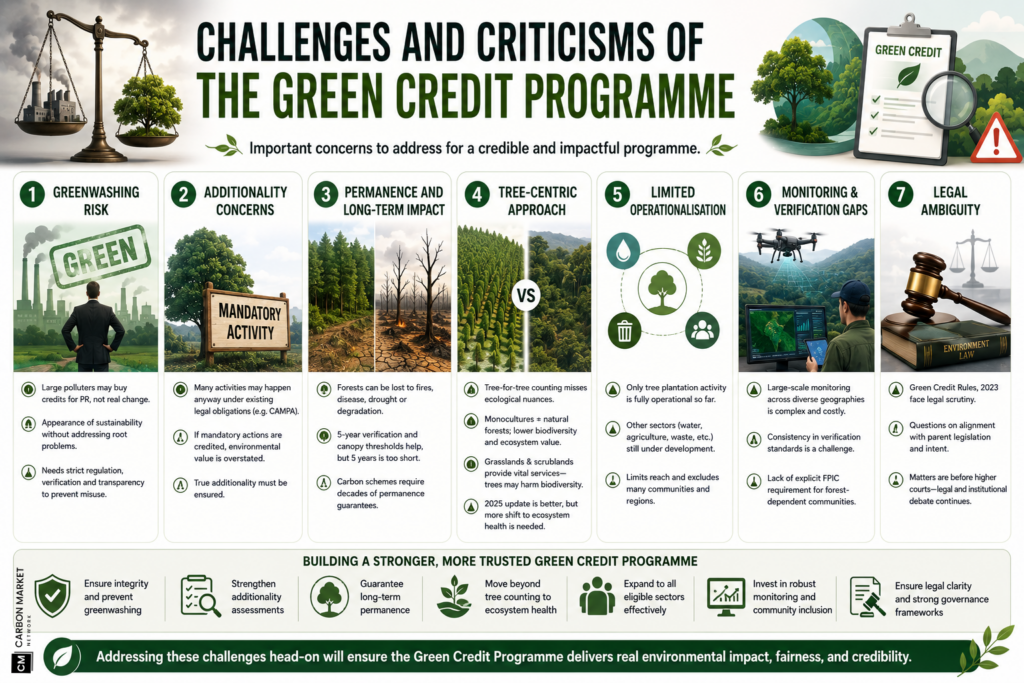
1. Greenwashing Risk
One of the most frequently voiced concerns is the risk that entities, particularly large polluters, could use green credits as a form of environmental PR without making genuine contributions.
If a company that causes significant ecological damage simply purchases green credits, it creates the appearance of sustainability without addressing the root problem. Robust regulation, stringent verification, and transparent reporting are essential to prevent this.
2. Additionality Concerns
Additionality is a key concept in environmental markets. It asks: would this environmental action have happened anyway, even without the green credit incentive?
Critics note that many public sector companies participate in the GCP for activities they would likely carry out anyway under existing legal obligations like the Compensatory Afforestation Fund Management and Planning Authority (CAMPA). If credits are issued for mandatory activities dressed up as voluntary ones, the environmental value is overstated.
3. Permanence and Long-Term Impact
Forests planted today can be damaged, degraded, or lost to fires, disease, or drought over time. The original GCP methodology was criticised for being a one-off transaction that did not adequately account for long-term permanence.
The revised 2025 methodology addresses this partially by extending the verification period to five years and requiring minimum canopy density thresholds. But critics argue that five years is still too short a timeframe for meaningful ecological permanence. Carbon credit schemes typically require permanence guarantees for decades.
4. Tree-Centric Approach
While afforestation has been the programme’s main operational focus, experts argue that a tree-for-tree counting approach misses important ecological nuances.
Monoculture plantations of fast-growing species, for example, do not provide the same biodiversity or ecosystem services as naturally regenerating native forests. Grasslands and scrublands, often labelled “wastelands,” provide critical ecological functions including carbon storage, water retention, and wildlife habitat. Planting trees on these areas can actually damage biodiversity, not improve it.
The updated 2025 methodology moves somewhat in the right direction by incorporating canopy density, indigenous species, and biomass into the credit calculation. But environmentalists continue to call for a fuller shift from tree-counting to ecosystem health assessment.
5. Limited Operationalisation Beyond Tree Plantation
Despite covering eight eligible activity categories, the Green Credit Programme has so far only fully operationalised the tree plantation activity. Methodologies for water conservation, sustainable agriculture, waste management, and other sectors remain under development.
This limits the programme’s reach and leaves large communities and sectors, particularly in water-stressed regions and agricultural areas, unable to participate meaningfully.
6. Monitoring and Verification Gaps
Large-scale monitoring of afforestation across thousands of hectares requires robust technological infrastructure. The programme uses remote sensing, drones, and ground inspections, but maintaining consistent verification standards across diverse geographies and institutional contexts is challenging.
The absence of an explicit requirement for free, prior, and informed consent from forest-dependent communities in the current methodology has also been flagged as a concern by rights-based advocates.
7. Legal Ambiguity
The Green Credit Rules, 2023, have faced legal scrutiny. Questions have been raised about whether the business-oriented provisions of the rules fully align with the parent legislation under which they were issued. Environmental advocacy groups have brought these concerns before higher courts, reflecting the ongoing debate about the programme’s legal and institutional foundations.
How the Green Credit Programme Compares Globally
The GCP draws inspiration from similar mechanisms in other countries but takes a distinct approach.
| Country/Region | Mechanism | Key Approach |
|---|---|---|
| EU | EU Emissions Trading System (EU ETS) | Cap-and-trade; strict emissions caps with tradeable pollution permits |
| USA | State-level renewable portfolio standards + voluntary offsets | Mandatory renewable energy usage requirements |
| China | Green Credit Guidelines | Banks mandated to provide preferential lending to green businesses |
| Global | Voluntary Carbon Market (VCM) | Privately governed; companies buy offsets for GHG reductions |
| GCP (origin country) | Green Credit Programme | Incentive-based, voluntary, broader than carbon, covers multiple ecosystem services |
The GCP is unique in that it explicitly goes beyond carbon to reward a full spectrum of ecological actions. Most existing environmental finance mechanisms are narrowly focused on carbon accounting. The GCP’s multi-dimensional approach, covering trees, water, waste, air, and biodiversity, is genuinely novel.
The Global Green Credit Initiative, if it succeeds in building international momentum, could create an entirely new class of environmental asset distinct from and complementary to carbon credits.
The Connection Between Green Credits and Carbon Credits
A common question is whether green credits can also generate carbon credits, or whether the two systems compete with each other.
The answer is that they complement each other.
An afforestation project, for example, can simultaneously generate green credits (for the ecological restoration activity itself) and carbon credits (for the verified CO₂ absorbed by the growing trees). These are legally separate instruments under different governance frameworks, but they can both arise from the same project.
This dual-credit potential makes high-quality green projects particularly attractive from an investment standpoint. A company or investor that funds a large-scale native forest restoration project could earn returns from both the green credit market and the carbon credit market, improving overall financial viability.
The Future of the Green Credit Programme
The GCP is a work in progress. Significant institutional and methodological development is still underway. But the direction of travel is clear: toward a broader, more rigorous, and increasingly global mechanism.
Key developments to watch include:
- Operationalisation of remaining seven activities, especially water conservation and sustainable agriculture, which will dramatically expand participation
- Development of a robust trading platform that provides liquidity, price discovery, and transparent transaction records
- Stronger safeguards against greenwashing, including more rigorous additionality requirements and community consent provisions
- Integration with national carbon market frameworks, creating synergies between green credit and carbon credit incentives
- International expansion through the Global Green Credit Initiative, potentially creating cross-border trade in environmental goods
As MRV (monitoring, reporting, and verification) technologies including satellite-based monitoring, AI-assisted assessments, and blockchain-based registries continue to mature, the credibility and scale of the programme can grow significantly.
Actionable Takeaways for Businesses and Individuals
If you want to explore participation in or benefit from the Green Credit Programme, here are practical steps you can take.
For businesses:
- Assess your eligibility — Identify which of the eight GCP activity categories align with your operations or sustainability goals.
- Register on the official portal at www.moefcc-gcp.in to understand current opportunities and enrol eligible projects.
- Consult with ICFRE or authorised agencies to understand verification requirements and credit calculation methodologies.
- Integrate GCP participation into your ESG strategy and CSR planning to maximise dual benefits.
- Monitor methodology updates — As new sectors are operationalised, new credit-earning opportunities will open up.
For farmers and communities:
- Check if your land or practices qualify — Degraded land parcels above five hectares enrolled with state forest departments may be eligible for tree plantation credits.
- Connect with your district forest department to understand whether your area has registered land parcels under the GCP.
- Explore sustainable agriculture credits once the methodology is finalised, especially if you practice natural or regenerative farming.
For investors and sustainability professionals:
- Treat green credits as an emerging asset class — The trading market is in early development, and early movers will have positioning advantages.
- Evaluate dual-credit projects that can generate both green credits and carbon credits for maximised financial and environmental returns.
- Follow the Global Green Credit Initiative for signals about international market development.
Frequently Asked Questions (FAQs)
What is the Green Credit Programme in simple terms?
The Green Credit Programme is a government-backed scheme that rewards individuals, farmers, companies, and communities for voluntarily doing good things for the environment, such as planting trees, conserving water, or reducing waste. These rewards come in the form of tradable green credits that can be sold on a market platform or used to meet compliance obligations.
How is the Green Credit Programme different from carbon credits?
Carbon credits specifically represent the reduction or removal of greenhouse gas emissions, measured in tonnes of CO₂ equivalent. Green credits are broader. They reward a wide range of positive environmental actions, not just emission reductions. A single project can potentially generate both types of credits, but they are governed by different laws and administered by different bodies.
Who administers the Green Credit Programme?
The Indian Council of Forestry Research and Education (ICFRE) is the official administrator of the programme. It manages registrations, oversees verifications, maintains the Green Credit Registry, and coordinates the trading platform.
Can individuals earn green credits?
Yes. The Green Credit Programme is explicitly open to individuals, not just businesses. Any individual who undertakes a qualifying environmental activity can register on the portal, complete the required action, undergo verification, and receive green credit certificates.
How are green credits verified?
Verification is carried out by designated third-party agencies under the oversight of ICFRE. For tree plantation, the verification process uses remote sensing, drone surveys, and ground inspections. Credits are only issued after the land parcel meets minimum canopy density thresholds over the required period (five years under the 2025 methodology).
What is the Global Green Credit Initiative?
The Global Green Credit Initiative (GGCI) is an international framework proposed at COP28 in 2023. It extends the Green Credit concept beyond any single country, aiming to create a voluntary global platform where nations and entities can earn and trade credits for a broad range of pro-environment actions. ICFRE hosts the GGCI secretariat.
Can green credits be used for CSR compliance?
Yes. Green credits, particularly those generated from tree plantation activities, can be exchanged to meet Corporate Social Responsibility obligations and compensatory afforestation requirements under forest laws. This makes them particularly useful for industries that face regulatory obligations related to land use and forest diversion.
Are green credits the same as ecosystem service payments?
They are related but not identical. Ecosystem service payments are a broader category of financial incentives for conservation and restoration. The Green Credit Programme is a specific, government-notified mechanism that operates within a market framework, with formal registration, verification, credit issuance, and trading infrastructure. It is best understood as a structured, domestic form of payment for ecosystem services.
What are the biggest risks of the Green Credit Programme?
The main risks include greenwashing (entities using credits to mask environmental harm), additionality problems (crediting actions that would have happened anyway), permanence concerns (credits issued for forests that are later lost), and the current heavy focus on tree planting over wider ecological restoration. Ongoing methodological improvements and stronger verification protocols aim to address these risks over time.
Where can I register for the Green Credit Programme?
Registration for the Green Credit Programme is done through the official government portal at www.moefcc-gcp.in. This portal provides information about eligible activities, land bank listings, and the registration process.
Conclusion
The Green Credit Programme represents a genuinely new approach to environmental incentives. By moving beyond carbon to reward a full range of ecological actions, and by opening participation to individuals and communities, not just corporations, it attempts to build an environmental marketplace that is inclusive, verifiable, and impactful.
It is not without challenges. Questions about greenwashing, additionality, permanence, and ecological rigour are real and important. The programme is still evolving, with several activity categories yet to be operationalised and the trading platform still maturing.
But the direction is right. The world needs more financial pathways for environmental stewardship, not fewer. The Green Credit Programme, particularly if it succeeds in expanding globally through the Global Green Credit Initiative, could become an important pillar of the broader environmental finance ecosystem alongside carbon markets, biodiversity credits, and other emerging instruments.
For businesses looking to strengthen their sustainability credentials, for communities seeking to monetise their conservation efforts, and for investors seeking exposure to environmental markets beyond carbon, the Green Credit Programme deserves close attention.
The planet’s health has always been everyone’s responsibility. The Green Credit Programme is one of the more thoughtful attempts to make it also everyone’s opportunity.
For more insights on carbon markets, environmental finance, and sustainability mechanisms, explore the resources at Carbon Market Network.