Carbon Market Network


Polluting used to be free. A factory could release a million tonnes of carbon dioxide and pay nothing for the damage.
Carbon markets exist to end that free ride.
So, what are carbon markets? They are trading systems that put a price on greenhouse gas emissions and let companies, governments, and individuals buy and sell the right to emit or the proof of an emission cut.
This guide explains carbon markets from the ground up. You will learn how they work, who uses them, which ones matter most, and where they still fall short.
You do not need a finance or climate background. If you can follow a simple budget, you can follow this.
What Are Carbon Markets?
Carbon markets are marketplaces where carbon units are bought and sold. One unit usually equals one tonne of carbon dioxide equivalent (tCO2e).
The word “equivalent” matters. Other gases, such as methane and nitrous oxide, warm the planet too. Scientists convert them into a CO2 equivalent so everything fits one scale.
A carbon market does two jobs at once:
- It gives every tonne of emissions a visible price.
- It rewards anyone who cuts emissions more cheaply than their peers.
That second job is the clever part. Instead of telling every company exactly how to cut emissions, a carbon market lets the cheapest cuts happen first.
The one idea behind every carbon market
Every carbon market rests on a single principle: a tonne of CO2 does the same damage wherever it is released.
So it makes sense to cut emissions where it costs the least. A carbon market makes that happen through prices.
Carbon markets vs carbon pricing vs carbon tax
People mix these terms up all the time. Here is the difference.
| Term | What it means | Who sets the price? |
|---|---|---|
| Carbon pricing | The broad umbrella for any policy that puts a cost on emissions | Varies |
| Carbon tax | A fixed fee charged per tonne of emissions | Government |
| Emissions trading system (ETS) | A market where capped emission allowances are traded | Supply and demand |
| Carbon crediting | A system that issues credits for verified emission cuts or removals | Supply and demand |
| Carbon markets | The trading side of pricing, covering both ETSs and carbon credits | Supply and demand |
A carbon tax sets the price and lets the quantity of emissions adjust. A cap-and-trade market sets the quantity and lets the price adjust.
Carbon Market Insider Newsletter
Weekly insights on carbon markets, climate policy, carbon credits, and sustainability.
Why Do Carbon Markets Exist?
Economists call pollution a negative externality. That is a fancy way of saying someone else pays for the damage.
When a power plant burns coal, the plant owner earns the profit. The public pays through heat waves, health problems, floods, and crop losses.
Carbon markets move that hidden cost back onto the polluter’s balance sheet.
Three goals drive their design:
- Cut emissions at the lowest possible cost.
- Raise money for governments through auctions and fees.
- Move investment toward clean technology, nature, and carbon removal.
Governments also like carbon markets because they offer flexibility. A company can cut its own emissions, buy allowances, or buy credits. It picks the cheapest route.
How Do Carbon Markets Work? A Step-by-Step Explanation
There are two basic engines inside carbon markets. One is cap and trade. The other is baseline and credit.
Engine 1: Cap and trade
Cap and trade powers most large compliance systems, including the European Union’s. Here is how it works.
- A regulator sets a cap. The cap is the total amount of emissions allowed for covered sectors.
- The regulator creates allowances. Each allowance permits one tonne of emissions.
- Companies receive or buy allowances. Some are given free. Many are sold at auction.
- Companies track their real emissions. Independent verifiers check the numbers.
- Companies surrender allowances. At year end, each company hands back one allowance for every tonne it emitted.
- Companies trade extra allowances. Those that cut emissions sell spare allowances. Those that fall short buy more.
- The cap shrinks over time. Fewer allowances exist each year, so prices tend to rise and pressure grows.
A simple example.
Imagine two steel plants, Plant A and Plant B. Each gets 100 allowances. Each emits 100 tonnes.
Plant A installs cleaner equipment and cuts its emissions to 80 tonnes. It now holds 20 spare allowances.
Plant B finds cuts expensive and emits 120 tonnes. It needs 20 extra allowances.
Plant B buys Plant A’s 20 spare allowances. Plant A earns money for cutting. Plant B pays for polluting. Total emissions stay at 200 tonnes, exactly as the cap demands.
Now imagine the regulator trims the cap next year. Both plants face a tighter limit, and the price of allowances rises. The system keeps pushing emissions down.
Engine 2: Baseline and credit
This engine creates carbon credits. It works differently because nobody holds a cap.
- A project reduces or removes emissions compared with what would have happened without it.
- An independent auditor verifies the result.
- A registry issues credits. Each credit stands for one tonne.
- A buyer purchases the credits and retires them to claim the climate benefit.
For example, a village replaces open wood fires with efficient cookstoves. The stoves burn less wood. A verified estimate of the avoided emissions becomes carbon credits that a company can buy.
The Two Main Types of Carbon Markets
All carbon markets fall into two families: compliance and voluntary.
Compliance carbon markets
Governments create compliance carbon markets. The law forces covered companies to take part.
If a company ignores the rules, it faces fines. That legal pressure makes compliance markets large and stable.
Examples include the EU Emissions Trading System, China’s national ETS, and the UK ETS.
Voluntary carbon markets
Voluntary carbon markets run on choice. Companies, organizations, and individuals buy credits because they want to, not because the law demands it.
Buyers usually want to support climate projects, meet a corporate goal, or offset emissions they cannot yet remove.
Private standards bodies, such as Verra and Gold Standard, set the rules and issue the credits.
Compliance vs voluntary carbon markets: a side-by-side view
| Feature | Compliance markets | Voluntary markets |
|---|---|---|
| Who requires participation? | Government law | Nobody. Buyers choose |
| What is traded? | Allowances and some approved offsets | Carbon credits from projects |
| Who sets the rules? | Regulators | Standards bodies and registries |
| Typical buyers | Power plants, factories, airlines | Corporations, funds, and individuals |
| Price drivers | Cap level, policy, energy prices | Credit quality, project type, buyer demand |
| Total money involved | Very large | Much smaller |
| Main risk | Policy changes | Credit quality and reputation |
The size gap is striking. According to the World Bank, carbon pricing policies raised well over 100 billion US dollars in government revenue in a single year. Leading trackers value the entire voluntary market at roughly one billion dollars.
Compliance markets, in other words, move dozens of times more money.
Carbon Allowances vs Carbon Credits
Newcomers often use “allowance” and “credit” as if they mean the same thing. They do not.
| Carbon allowance | Carbon credit | |
|---|---|---|
| What it is | Permission to emit one tonne | Proof of one tonne reduced or removed |
| Where it comes from | Created by a regulator under a cap | Created by a project after verification |
| Market type | Compliance | Voluntary, and some compliance systems |
| Common name | EUA, UKA, CCA | VCU, GS VER, and others |
| Quality concern | Low. The cap is the guarantee | High. Real impact needs checking |
A simple way to remember: an allowance is a ticket to pollute. A credit is a receipt for cleaning up.
People also use “carbon offset” and “carbon credit” interchangeably. Strictly, the credit is the unit, and the offset is what you do when you use it to balance your emissions.
How a Carbon Credit Is Created, Step by Step
A credit does not appear out of thin air. It passes through a strict pipeline.
- Project design. A developer plans an activity, such as forest protection, biochar production, or methane capture.
- Methodology selection. The developer picks an approved method that explains how to count the climate benefit.
- Validation. An independent auditor checks that the design follows the rules.
- Registration. The project joins a registry such as Verra, Gold Standard, American Carbon Registry, or Climate Action Reserve.
- Implementation and monitoring. The project runs and collects data, increasingly with satellites, sensors, and digital MRV tools.
- Verification. A second independent auditor confirms the actual results.
- Issuance. The registry issues serialized credits, each with a unique ID.
- Sale. The developer sells directly, through a broker, or on an exchange.
- Retirement. The buyer retires the credit in the registry so nobody can use it again.
Retirement is the key step. A credit that is not retired is just an asset. A retired credit is a finished climate claim.
Types of Carbon Credit Projects
Carbon credits fall into a few broad families. Each carries different risks and prices.
| Category | What it does | Examples |
|---|---|---|
| Avoidance or reduction | Stops emissions that would have happened | Avoided deforestation, cookstoves, methane capture, renewable energy |
| Nature-based removal | Pulls CO2 out of the air using ecosystems | Reforestation, mangrove restoration, improved soil management |
| Technology-based removal | Pulls CO2 out using engineering | Direct air capture, biochar, enhanced rock weathering, bioenergy with carbon capture |
Avoidance vs removal: why the difference matters
Avoidance credits stop new emissions. Removal credits take existing CO2 out of the atmosphere.
Both help. But as the world moves toward net zero, removals matter more. Climate science says we need to remove CO2 to balance emissions that are hard to eliminate, such as those from aviation, cement, and agriculture.
Durable vs short-lived storage
Not all storage lasts equally long.
- Nature-based storage can last decades but faces risks such as fire, drought, and logging.
- Engineered storage can last for centuries or longer, because the carbon locks into rock or stable materials.
Buyers increasingly pay a premium for durability, which is why durable removals command the highest prices in the market.
Major Carbon Markets Around the World
Carbon pricing has spread across continents. The latest World Bank State and Trends of Carbon Pricing report counts 87 carbon pricing policies in operation worldwide, up by seven in one year. These policies now cover close to 30 percent of global greenhouse gas emissions.
The average direct carbon price has risen to about 21 US dollars per tonne, roughly double its level a decade earlier. Prices still vary enormously from one system to the next.
Here is a snapshot of the biggest players.
| Market | Region | Type | What it covers |
|---|---|---|---|
| EU ETS | European Union, Iceland, Liechtenstein, Norway | Cap and trade | Power, heavy industry, aviation within Europe, and shipping |
| EU ETS2 | European Union | Cap and trade | Road transport and building heating fuels (start delayed to 2028) |
| China national ETS | China | Intensity-based trading | Power, steel, cement, and aluminium smelting |
| UK ETS | United Kingdom | Cap and trade | Power, industry, and aviation |
| California cap-and-invest | California, linked with Quebec | Cap and trade | Power, industry, fuels |
| RGGI | Northeast and Mid-Atlantic US states | Cap and trade | Power sector |
| Washington cap-and-invest | Washington State | Cap and trade | Large emitters across sectors |
| Korea ETS | South Korea | Cap and trade | Power, industry, buildings, transport |
| Japan GX-ETS | Japan | Mandatory trading for large emitters | Companies above 100,000 tonnes of direct CO2 |
| India CCTS | India | Intensity-based baseline and credit | Energy-intensive industrial sectors |
Let us look closer at the systems that shape the global picture.
The European Union: the original carbon market
The EU ETS is the oldest large carbon market. It started more than two decades ago and now covers around 45 percent of EU greenhouse gas emissions.
Its price has recently hovered in the low to mid 80s of euros per tonne. That price is high enough to change investment decisions in power and industry.
Two recent developments matter a lot.
- CBAM (Carbon Border Adjustment Mechanism). Importers of goods such as steel, cement, aluminium, fertilisers, hydrogen, and electricity now report embedded emissions. They must buy CBAM certificates priced in line with the EU ETS. Free EU allowances for those sectors phase out gradually until the mid 2030s. A small-importer threshold of 50 tonnes a year exempts the smallest traders.
- ETS2. This new system will price fuels used in road transport and buildings. EU governments and Parliament pushed its start back by one year to 2028 after political pressure over household energy bills.
CBAM also changes the game outside Europe. Exporters in India, Turkey, China, and elsewhere now face a direct reason to build their own carbon markets, so they keep the carbon revenue at home.
China: the largest market by emissions covered
China launched its national ETS for the power sector, then expanded it to steel, cement, and aluminium smelting. The system now covers roughly 60 percent of the country’s CO2 emissions, which makes it the largest carbon market on Earth by emissions covered.
So far, China uses an intensity-based design. Allowances depend on output and efficiency, not on a fixed national cap.
Policy documents point toward absolute caps for major industries and a wider market that includes more sectors. China also relaunched its voluntary crediting scheme, CCER, to complement the ETS.
India: a fast-growing newcomer
India’s Carbon Credit Trading Scheme (CCTS) turns the older Perform, Achieve and Trade programme into a full carbon market.
Hundreds of industrial entities across energy-intensive sectors now carry binding emission intensity targets. The nine initial sectors account for about 16 percent of the country’s emissions.
Companies that beat their targets earn Carbon Credit Certificates. Companies that miss targets must buy certificates. Trading runs on the power exchanges under the Central Electricity Regulatory Commission.
The World Bank now lists India among the world’s largest new carbon markets.
Japan: from voluntary to mandatory
Japan’s GX-ETS began as a voluntary club for hundreds of companies. It has since entered a mandatory phase for businesses emitting 100,000 tonnes or more of direct CO2 a year, roughly 300 to 400 entities.
Those companies may use approved domestic credits, such as J-Credits and Joint Crediting Mechanism credits, to cover a limited share of their emissions. Full allowance trading follows after the first allocation round.
North America: strong at state level
The United States has no national carbon market. States and regions lead instead.
- California runs the biggest US system. It has extended the program and rebranded it as cap-and-invest, though recent reports show soft compliance demand and price pressure.
- RGGI covers power plants across several northeastern and mid-Atlantic states and returns revenue to energy efficiency and clean energy programs.
- Washington State runs its own cap-and-invest program.
Canada uses a mix of carbon pricing for large industrial emitters and provincial systems.
The UK and linking with Europe
The UK ETS started after Brexit and covers power, industry, and aviation. The UK and EU have been working toward linking their systems.
Linking would let allowances trade across both markets and reduce CBAM friction between them.
Emerging markets to watch
Brazil is building its national regulated market. Turkey has announced plans for an ETS. Singapore raised its carbon tax sharply on a scheduled path.
The World Bank notes that if Brazil and Turkey complete their systems, almost one third of global emissions could sit under an ETS or carbon tax.
Carbon Markets and the Paris Agreement: Article 6 Explained
Carbon markets do not stop at national borders. Article 6 of the Paris Agreement sets the rules for countries that want to cooperate through carbon markets.
It has three main parts.
| Part | What it does | Who runs it |
|---|---|---|
| Article 6.2 | Lets countries trade emission reductions bilaterally. The traded units are called ITMOs | Countries themselves |
| Article 6.4 | Creates a UN-supervised crediting mechanism, the Paris Agreement Crediting Mechanism (PACM) | A UN Supervisory Body |
| Article 6.8 | Supports cooperation that does not involve trading | Countries |
Why corresponding adjustments matter
Imagine Country A sells an emission reduction to Country B. If both countries count that same tonne toward their climate targets, the world gets one tonne of cuts but two tonnes of claims.
That is double counting.
A corresponding adjustment fixes it. The selling country adds the tonne back to its own emissions books. The buying country subtracts it. The tonne counts once.
A real milestone: the first Article 6.4 credits
The UN Supervisory Body approved the first credits under Article 6.4 for a clean cooking project in Myanmar. The project had earlier registered under the Clean Development Mechanism, the predecessor to the new system.
The result teaches an important lesson. Under updated and more conservative calculations, the project received roughly 40 percent fewer credits than the older system would have granted.
More than 165 projects approved by their host countries are now lining up to transition from the old mechanism to the new one.
The message to buyers is clear: the new UN market aims for fewer, tougher credits rather than cheap volume.
CORSIA: The Aviation Carbon Market
CORSIA is the global carbon offsetting scheme for international aviation. Airlines must offset emissions growth above an agreed baseline by cancelling eligible carbon credits.
The scheme runs in phases. The first phase covers three years of emissions, and airlines must cancel units shortly after the phase ends.
About 130 countries take part in the first phase.
Here is why CORSIA matters for everyone watching carbon markets:
- It creates compliance-style demand for credits that come from voluntary-style projects.
- Credits must come from approved programmes and carry a host country authorization.
- Analysts estimate first-phase demand in the range of 170 to 240 million tonnes.
- Eligible supply issued so far covers only a fraction of that need.
That gap explains why credits tied to Article 6 authorization often trade at a premium to ordinary voluntary credits.
How Big Are Carbon Markets Today?
Numbers help show how far carbon markets have come. They also show how unevenly they have grown.
| Indicator | Latest picture |
|---|---|
| Carbon pricing policies in operation | 87 worldwide |
| Share of global emissions covered | Close to 30 percent |
| Government revenue from carbon pricing | More than 107 billion US dollars in a single year, roughly triple the level a decade earlier |
| Share of revenue from emissions trading systems | Over 70 percent |
| Average direct carbon price | About 21 US dollars per tonne, nearly double the level a decade earlier |
| Voluntary market value | Roughly 1 to 1.4 billion US dollars, depending on the tracker |
| Voluntary credits retired | Around 170 million tonnes a year, according to one leading ratings provider |
| Average voluntary credit price | Around 6 US dollars |
| Retired credits rated BBB or better | About one third, up from about one quarter a year earlier |
Three points stand out.
- Compliance carbon markets dwarf voluntary carbon markets. The gap is roughly seventy to one hundred times.
- Value is rising faster than volume. Buyers now pay more for fewer, better credits.
- Most revenue still flows in wealthy economies. Developing countries are catching up quickly.
A quick note on data: voluntary market trackers use different methods, so their totals differ. Always check which tracker a number comes from.
What Drives Carbon Prices?
Carbon prices move for reasons that look different in compliance and voluntary markets.
| Factor | Compliance markets | Voluntary markets |
|---|---|---|
| Supply of units | Cap level and allowance releases | Issuance volume and project pipeline |
| Policy signals | Cap tightening, reforms, new sectors | Standards updates and labels |
| Energy prices | Gas and coal prices shift fuel switching | Limited effect |
| Economic activity | Recession lowers emissions and demand | Corporate budgets rise and fall |
| Quality | Not a factor. All allowances are equal | Central factor. Better quality earns higher prices |
| Project type | Not applicable | Removals cost more than avoidance |
| Authorization | Not applicable | Credits with host government approval earn a premium |
| Sentiment and speculation | Funds trade futures | Reputation and scrutiny |
The price spread in voluntary markets is huge. A legacy renewable credit may cost a dollar or two. A durable engineered removal can cost hundreds of dollars per tonne.
That gap reflects real differences in climate impact, durability, and verification.
Who Takes Part in Carbon Markets?
Carbon markets involve far more players than most people expect.
| Participant | Role |
|---|---|
| Governments and regulators | Write the rules, set caps, run auctions, enforce compliance |
| Regulated companies | Power plants, factories, and airlines that must surrender allowances |
| Corporate buyers | Companies that buy credits to support climate goals |
| Project developers | Build and run the projects that generate credits |
| Registries and standards bodies | Verra, Gold Standard, American Carbon Registry, Climate Action Reserve, Global Carbon Council, Isometric, Puro.earth and others |
| Verifiers | Independent auditors who check emissions and project results |
| Rating agencies | Providers such as Sylvera and BeZero Carbon score credit quality |
| Exchanges and marketplaces | Platforms such as ICE and EEX for allowances, and Xpansiv CBL for voluntary credits |
| Brokers, traders, and funds | Provide liquidity and manage risk |
| Communities and landholders | Host projects and share in the benefits |
| Individuals | Offset personal footprints or invest through financial products |
Do Carbon Markets Actually Work?
The honest answer: carbon markets work well when they are designed well, and poorly when they are not.
What carbon markets do well
- They cut emissions cheaply. Flexibility lets the lowest-cost reductions happen first.
- They raise public money. Governments recycle revenue into clean energy, social support, and industry transition.
- They send a long-term price signal. Investors can plan around a rising cost of carbon.
- They finance projects that otherwise lack funding. Nature restoration, methane control, and carbon removal all draw capital through credits.
- They spread. The number of carbon pricing policies keeps growing every year.
In the EU, emissions from sectors under the ETS have fallen substantially since the system began, especially in the power sector.
Where carbon markets struggle
- Weak caps. If regulators set the cap too loose or give away too many free allowances, prices stay low and cuts stay small.
- Additionality problems. A credit means little if the project would have happened anyway.
- Over-crediting. Weak baselines can inflate credit numbers. The shrunken first Article 6.4 issuance shows how much older methods could overstate.
- Permanence risk. Forests burn. Stored carbon can return to the air.
- Leakage. Protecting one forest may push loggers into the next one.
- Double counting. Two parties may claim the same tonne.
- Price swings. Policy shocks and political debates move prices fast.
- Greenwashing. Some companies use cheap credits to avoid real cuts.
- Community fairness. Projects must respect local and Indigenous rights and share benefits fairly.
Good design answers most of these. That is why the market is moving toward stricter rules, better data, and quality labels.
How to Spot High-Quality Carbon Credits
Not every credit deserves the same trust. Use this checklist before you buy or rely on any credit.
| Quality test | The question to ask |
|---|---|
| Additionality | Would this cut have happened without carbon finance? |
| Permanence | How long does the carbon stay stored, and what protects it from reversal? |
| Baseline and measurement | Are the numbers conservative and backed by solid data? |
| Leakage | Does the project avoid shifting emissions elsewhere? |
| Double counting | Is the credit retired once, with a corresponding adjustment when required? |
| Independent verification | Did an accredited third party audit the results? |
| Transparency | Can I trace the credit by serial number in a public registry? |
| Social safeguards | Do local people consent to the project and share the benefits? |
Three tools make checking easier.
- Core Carbon Principles (CCP) label. The Integrity Council for the Voluntary Carbon Market has approved dozens of methodologies and tags qualifying credits with this label.
- Independent ratings. Rating agencies score credits on quality so buyers can compare.
- Claims guidance. The Voluntary Carbon Markets Integrity Initiative publishes rules on what companies can truthfully say about their credit use.
How Companies Can Use Carbon Markets Responsibly
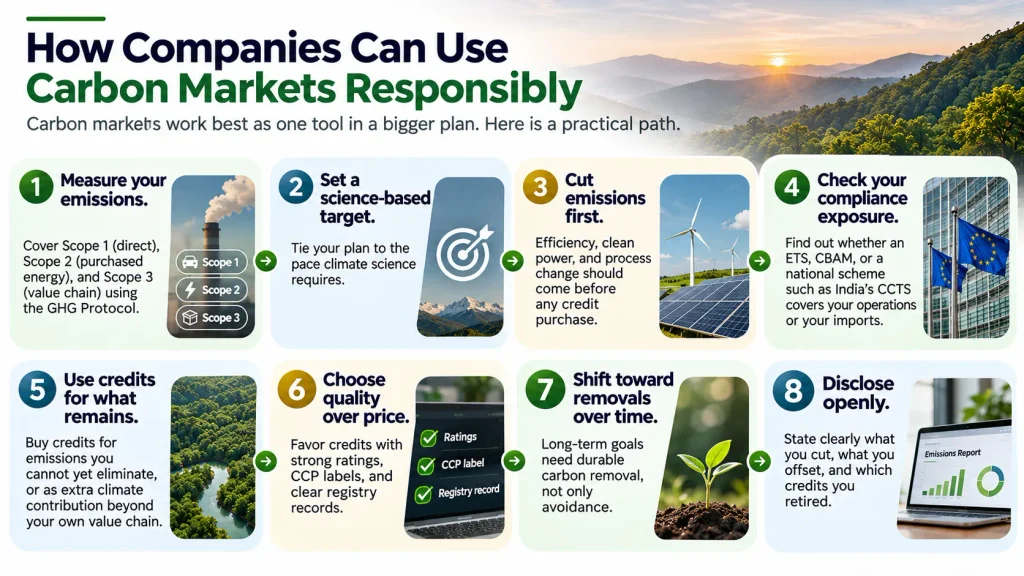
Carbon markets work best as one tool in a bigger plan. Here is a practical path.
- Measure your emissions. Cover Scope 1 (direct), Scope 2 (purchased energy), and Scope 3 (value chain) using the GHG Protocol.
- Set a science-based target. Tie your plan to the pace climate science requires.
- Cut emissions first. Efficiency, clean power, and process change should come before any credit purchase.
- Check your compliance exposure. Find out whether an ETS, CBAM, or a national scheme such as India’s CCTS covers your operations or your imports.
- Use credits for what remains. Buy credits for emissions you cannot yet eliminate, or as extra climate contribution beyond your own value chain.
- Choose quality over price. Favor credits with strong ratings, CCP labels, and clear registry records.
- Shift toward removals over time. Long-term goals need durable carbon removal, not only avoidance.
- Disclose openly. State clearly what you cut, what you offset, and which credits you retired.
Companies that follow these steps protect both the climate and their reputation.
How Individuals Can Take Part in Carbon Markets
You do not need a trading desk to play a part.
| Option | How it works | Things to know |
|---|---|---|
| Offset your footprint | Buy and retire credits through a reputable provider | Check the registry and the project type |
| Fund removals | Subscribe to a carbon removal programme | Prices are higher, durability is stronger |
| Choose green products and tariffs | Support companies that cut emissions in their own operations | Look for transparent reporting |
| Invest in carbon products | Futures or exchange-traded funds track carbon allowance prices | Prices swing, and this is not suitable for everyone |
| Build a career | Work in MRV, project development, policy, trading, or ratings | Demand for skills keeps growing |
A quick caution: this guide gives general information, not financial advice. Anyone considering a carbon market investment should speak with a licensed financial adviser first.
Also remember the golden rule for individuals. Cut what you can first, then offset the rest.
Trends Shaping Carbon Markets
Carbon markets keep changing fast. These trends matter most right now.
| Trend | What it means |
|---|---|
| Flight to quality | Buyers pay more for fewer, better-rated credits. Volume has softened while value holds up |
| Rise of carbon removal | Long-term offtake deals for durable removals grow, though volumes remain small today |
| Article 6 becomes real | Government authorizations and corresponding adjustments increasingly shape credit value |
| CORSIA demand | Airlines need large volumes of eligible units, and supply is tight |
| More national markets | India, Japan, Brazil, Turkey, and others are building or tightening systems |
| Border carbon pricing | CBAM pushes exporting countries to price carbon at home |
| Market linking | Systems such as the UK and EU ETS explore connecting |
| Digital MRV | Satellites, sensors, and AI improve measurement and cut verification costs |
| Stricter claims rules | Regulators and standards bodies scrutinize green claims more closely |
| Political pushback | Debates over energy costs lead to delays, such as the postponement of ETS2 |
The World Bank also reports that credit issuance grew while average credit prices slipped slightly, which shows a market still searching for balance.
Common Myths About Carbon Markets
| Myth | Reality |
|---|---|
| Carbon markets let polluters buy their way out | Under a cap, total emissions still fall. The cap, not the purchase, limits pollution |
| All carbon credits are the same | Quality, durability, and authorization vary enormously |
| Carbon markets are only for big companies | Individuals, small firms, farmers, and communities all take part |
| Voluntary credits are worthless | High-quality credits deliver real results. Low-quality ones do not. Quality is the dividing line |
| Carbon markets replace direct cuts | The best strategy cuts emissions first and uses credits for what remains |
| Only the EU has a carbon market | Dozens of systems operate across continents |
Key Takeaways
- Carbon markets put a price on emissions and let trading find the cheapest cuts.
- There are two main families: compliance markets built on law and voluntary markets built on choice.
- Allowances permit emissions. Credits prove reductions or removals.
- The EU, China, and several other regions run major compliance systems, and India and Japan are moving fast.
- Article 6 and CORSIA connect carbon markets across borders.
- Quality decides whether a credit helps the climate or only the marketing team.
- The smartest approach cuts emissions first and uses markets for the rest.
Frequently Asked Questions About Carbon Markets
What are carbon markets in simple words?
Carbon markets are places where people buy and sell the right to emit greenhouse gases or the proof of an emission cut. One unit equals one tonne of CO2 equivalent. The goal is to make polluting cost money and to reward cleaner choices.
How do carbon markets work?
A government either caps total emissions and trades allowances under that cap, or a project earns credits for verified cuts and sells them to buyers. Companies then surrender allowances or retire credits to account for their emissions.
What are the two types of carbon markets?
The two types are compliance carbon markets and voluntary carbon markets. Governments create compliance markets and require participation. Voluntary markets rely on companies and individuals who choose to buy credits.
What is the difference between a carbon market and a carbon tax?
A carbon tax sets a fixed price per tonne and lets emissions adjust. A carbon market sets a limit on emissions or a standard for credits and lets the price adjust through trading.
What is the largest carbon market in the world?
By emissions covered, China’s national ETS is the largest. By value and maturity, the EU ETS is the most influential. Both anchor the global picture.
Are carbon credits real and legitimate?
Carbon credits can be legitimate when independent auditors verify them, registries track them, and projects meet strong rules on additionality and permanence. Quality varies widely, so buyers should check ratings, labels, and registry records.
What does a carbon credit cost?
Prices range from a few dollars for older, lower-rated credits to hundreds of dollars for durable engineered removals. The average voluntary price sits around six US dollars, while compliance allowances in major systems trade at much higher levels.
Who buys carbon credits?
Compliance buyers include power plants, factories, and airlines. Voluntary buyers include corporations, financial institutions, and individuals who want to support climate action or balance their footprints.
Can individuals trade in carbon markets?
Individuals can buy and retire voluntary credits through reputable providers. Some investors also use futures or exchange-traded funds that track carbon prices. These products carry price risk and need careful research.
What is Article 6 of the Paris Agreement?
Article 6 sets international rules for carbon market cooperation between countries. It covers bilateral trading under Article 6.2, a UN-supervised mechanism under Article 6.4, and non-market cooperation under Article 6.8.
What is CBAM and how does it connect to carbon markets?
CBAM is the EU’s Carbon Border Adjustment Mechanism. It makes importers of certain carbon-intensive goods buy certificates priced in line with the EU ETS, so imports face a similar carbon cost to local products.
Do carbon markets reduce emissions?
Well-designed compliance markets with tightening caps reduce emissions in the sectors they cover. The effect of voluntary credits depends on project quality and on whether companies cut their own emissions too.
Conclusion: What Carbon Markets Mean for the Future
So, what are carbon markets? They are the financial machinery that turns a climate problem into a price, and a price into action.
Compliance carbon markets already cover close to a third of global emissions and move over a hundred billion dollars a year. Voluntary carbon markets are smaller but growing more selective, as buyers demand proof of real impact.
The road ahead is not smooth. Caps need tightening, credits need stronger integrity, and politics will keep testing resolve.
But the direction is clear. More countries are pricing carbon, more companies are measuring it, and more money is flowing toward real reductions and removals.
If you remember one thing from this complete guide to carbon markets, make it this: markets work best when the rules are strict, the data is open, and the cuts come first.
Keep exploring carbon markets on Carbon Market Network, and you will stay ahead of every rule change and price move that follows.