Carbon Market Network


Europe runs the oldest and most closely watched carbon market in the world. It also has some of the most complicated carbon rules.
If you are trying to make sense of allowances, border carbon costs, carbon credits and green claims, you are not alone. That is exactly why carbon market consultants in Europe are so busy right now.
This guide walks you through ten well-known firms. You will see what each one does, where it shines, and who should call it first.
You will also learn how to choose between them, which questions to ask, and which mistakes to avoid.
The firms are listed to show the range of European carbon consulting, not as a scorecard. The best choice depends on your goal, your sector and your budget.
Why Carbon Market Consultants in Europe Are in High Demand
Europe does not have one carbon market. It has several, and they overlap.
Here are the forces pushing companies, governments and investors to look for expert help:
- The EU Emissions Trading System (EU ETS): A cap-and-trade system that covers power, heavy industry, aviation within Europe and shipping. Companies must monitor emissions, report them and surrender allowances.
- ETS2: A second system for fuels used in road transport and buildings. The EU pushed its start back by one year, which gives fuel suppliers a little more time to prepare.
- The Carbon Border Adjustment Mechanism (CBAM): Importers of certain goods now face a carbon cost tied to the emissions inside those products. This hits exporters around the world, not only European firms.
- Article 6 of the Paris Agreement: Countries can now trade emission reductions across borders. Europe’s 2040 climate target even allows a limited share of high-quality international credits in the later years of its pathway.
- Carbon removals: The EU has built a certification framework for permanent and nature-based removals, and policymakers are discussing how permanent removals could connect to the EU ETS.
- Green claims rules: New consumer rules ban product claims like “carbon neutral” when the claim rests only on offsets.
- The UK ETS: The UK runs its own system next to the EU one. Both governments have signalled they want to work toward linking them, yet they operate separately today.
The EU Commission has also proposed a major review of the EU ETS. It would slow the decline of the emissions cap, reform the Market Stability Reserve and bring in permanent removals. Parliament and Council still need to negotiate it.
So the rulebook keeps moving. A good consultant helps you move with it.
Carbon Market Insider Newsletter
Weekly insights on carbon markets, climate policy, carbon credits, and sustainability.
What Do Carbon Market Consultants Actually Do?
The label “carbon consultant” covers very different jobs. Think of four main lanes.
1. Compliance carbon market advice
This lane serves companies that must follow cap-and-trade rules.
- Build a compliance and hedging strategy for EU ETS or UK ETS allowances
- Buy and sell allowances through regulated trading teams
- Prepare for CBAM reporting and certificate costs
- Train internal teams on monitoring, reporting and verification
- Advise airlines and shipping firms on aviation and maritime rules
2. Voluntary carbon market advice
This lane serves companies that buy carbon credits on their own initiative.
- Design a credit buying strategy that fits a net zero plan
- Screen projects for quality and integrity
- Source credits from forestry, soil, biochar, cookstove and removal projects
- Check claims and wording so marketing teams stay out of trouble
3. Policy, Article 6 and government advice
This lane serves ministries, development banks, funds and project developers.
- Design national carbon pricing systems and crediting rules
- Prepare countries for Article 6 deals
- Structure jurisdictional and nature-based programmes
- Write research and guidance for negotiators
4. Corporate climate strategy
This lane serves businesses that need the full journey.
- Measure scope 1, 2 and 3 emissions
- Set science-based targets
- Plan reductions before buying any credits
- Report under European sustainability rules
Most firms in this guide cover more than one lane. Still, each has a home turf. Knowing that turf saves you time.
Types of Carbon Market Consulting Firms in Europe
Before you read the profiles, it helps to know the main firm types.
| Firm type | What they do best | Typical client | Examples in this guide |
|---|---|---|---|
| Carbon asset developer and consultancy | Develop projects, supply credits, advise on strategy | Corporates, airlines, financial firms | South Pole, First Climate |
| Climate software and consulting hybrid | Combine carbon accounting tools with advisory | Mid-size and large companies | ClimatePartner |
| Net zero and standards specialist | Footprinting, targets, certification, technology advice | Corporates, governments, investors | Carbon Trust |
| Policy and research consultancy | Article 6, carbon pricing, market design | Governments, funds, development agencies | Perspectives Climate Group, Climate Focus |
| Compliance market specialist | EU ETS, UK ETS and CBAM advice with trading support | Industrials, utilities, airlines, shipping | Vertis, Redshaw Advisors |
| Corporate sustainability group | Broad sustainability services inside a larger company | Large multinationals | EcoAct (Schneider Electric) |
| Carbon market group | Credit supply and certified climate action programmes | Brands and corporates | Climate Impact Partners |
Top 10 Carbon Market Consulting Firms in Europe at a Glance
Here is a quick comparison of the carbon market consultants in Europe covered below.
| # | Firm | Headquarters | Founded | Best for |
|---|---|---|---|---|
| 1 | South Pole | Zurich, Switzerland | 2006 | End-to-end carbon strategy and credit supply |
| 2 | ClimatePartner | Munich, Germany | 2006 | Software-led carbon management with advisory |
| 3 | Carbon Trust | London, UK | 2001 | Net zero strategy, standards and certification |
| 4 | Perspectives Climate Group | Freiburg, Germany | 2003 | Article 6 and carbon market design |
| 5 | First Climate | Bad Vilbel (near Frankfurt), Germany | 1999 roots | Carbon assets, green energy and public sector advice |
| 6 | Climate Impact Partners | London, UK | 1990s roots | Carbon credit programmes and certification |
| 7 | EcoAct (Schneider Electric) | Paris, France | 2006 | Net zero consulting inside a global sustainability group |
| 8 | Climate Focus | Amsterdam, Netherlands | 2004 | Policy, REDD+ and project advisory |
| 9 | Vertis Environmental Finance | Brussels, Budapest, Madrid, Warsaw | 1998 | EU ETS compliance and trading |
| 10 | Redshaw Advisors | London, UK | n/a | EU ETS, UK ETS, CBAM and carbon risk |
1. South Pole
Headquarters: Zurich, Switzerland
Best for: Companies that want one partner for strategy, credits and project origination
South Pole is one of the best-known names among carbon market consultants in Europe. It started in 2006 and calls itself a carbon asset developer and climate consultancy.
The firm develops carbon projects, sources and sells credits, and advises on emissions accounting, science-based targets, renewable energy and climate risk.
What South Pole does well
- Develops large project portfolios across many countries
- Supports corporate carbon strategies from measurement to credit purchase
- Works on carbon removals, including a buyers club for durable removal technologies
- Publishes a yearly buyer guide that explains market shifts in plain language
A European example
South Pole helped issue and sell Verra-certified soil carbon credits from an Estonian farming platform’s programme. The deal brought in about 1.46 million euros for the programme.
It shows how the firm links European farmland projects to credit buyers.
Worth knowing
South Pole drew public criticism in the past over a forest project in Zimbabwe and later ended its contract with that project’s developer. Since then, the firm has reshaped its leadership and operating model under CEO Nadia Kaddouri.
Ask any firm, including this one, how it vets projects today. That question matters more than a brand name.
2. ClimatePartner
Headquarters: Munich, Germany
Best for: Mid-size and large companies that want carbon accounting software plus human advice
ClimatePartner also began in 2006. Its pitch is simple: pair a cloud platform with consultants who help you act on the numbers.
The team has grown to hundreds of employees with offices across Europe, including Munich, Berlin, Vienna, Zurich, Milan, Paris, London and Stockholm. It also has a presence in North America.
What ClimatePartner does well
- Calculates company and product carbon footprints
- Helps set reduction targets and build decarbonisation plans
- Supports sustainability reporting under European rules
- Offers carbon credit projects to finance climate action beyond the value chain
Worth knowing
ClimatePartner’s strength is the mix of software and consulting. If you only need a trading desk for allowances, a compliance specialist will serve you better.
If your team is new to carbon accounting, this hybrid model can save months of spreadsheet pain.
3. Carbon Trust
Headquarters: London, United Kingdom
Best for: Net zero planning, standards, carbon labelling and low-carbon technology advice
The UK government created the Carbon Trust in 2001. It reinvests its surplus into its mission instead of paying dividends, which sets it apart from most consultancies on this list.
Its global team of roughly 300 people works across five continents. The organisation says it has supported more than 3,000 businesses, cities and institutions on their path to net zero.
What Carbon Trust does well
- Net zero strategy and science-based target support
- Carbon footprinting and supply chain engagement
- Standards and certification, including product carbon labelling
- Technology and policy work, from offshore wind to sustainable finance
Worth knowing
Carbon Trust is better known for advisory, standards and certification than for day-to-day allowance trading.
Pick it when credibility and rigorous method matter more than speed of execution.
4. Perspectives Climate Group
Headquarters: Freiburg, Germany
Best for: Governments, funds, development banks and developers working on Article 6 and carbon pricing
Perspectives started in 2003 and has spent two decades on carbon market mechanisms. Its team works from Freiburg, Hamburg, Berlin, Flensburg, Valencia and Austria.
The group advises on Article 6 of the Paris Agreement, the voluntary carbon market, low emission development strategies and climate finance.
What Perspectives does well
- Supports countries preparing for Article 6 cooperation
- Publishes technical guidance for carbon market stakeholders, including joint work with the Oeko-Institut on applying the Article 6 decisions
- Chairs a working group on carbon market mechanisms that Germany’s economy and climate ministry supports
- Designs crediting approaches and methodologies
Worth knowing
The firm is research-led and policy-heavy. That usually makes it a stronger fit for governments, project developers and funds than for a small company that just wants a quick carbon footprint.
5. First Climate
Headquarters: Bad Vilbel near Frankfurt, Germany, with an office in Zurich
Best for: Corporates and public bodies that want carbon assets, green energy and consulting from one group
First Climate’s roots go back to 1999, when a Swiss consultancy called Factor started working on climate policy and projects. It joined forces with a German firm in 2008 to form First Climate.
Today the group covers consulting, carbon asset development, trading and green energy.
What First Climate does well
- Advises governments and international institutions on climate policy, finance and carbon markets
- Develops and finances carbon projects certified under standards such as Verra and Gold Standard
- Helps companies buy energy attribute certificates and renewable power
- Offers a digital hub for carbon management
It is also a founding member of ICROA, the accreditation body for carbon reduction and offsetting providers. That signals a commitment to high credit standards.
Worth knowing
First Climate is active in carbon removal development too, so it suits buyers who want to build a mixed portfolio of reductions and removals over time.
6. Climate Impact Partners
Headquarters: London, United Kingdom
Best for: Brands and corporates that want certified climate action programmes and carefully sourced credits
Climate Impact Partners formed when two long-standing voluntary market pioneers, Natural Capital Partners and ClimateCare, joined forces. Both had worked in the field since the 1990s.
The group created and manages the CarbonNeutral Protocol, a public standard that many companies have used to certify their climate programmes.
What Climate Impact Partners does well
- Finances and delivers carbon reduction and removal projects
- Helps companies measure emissions and plan reductions
- Builds long-term carbon credit programmes for corporate buyers
- Explores newer products, such as sustainable aviation fuel certificates for companies
Worth knowing
European rules on offset-based product claims have changed the way companies can talk about neutrality. Ask the team how its programmes and labels fit those rules for your products and markets.
7. EcoAct (Schneider Electric)
Headquarters: Paris, France
Best for: Large multinationals that want carbon market advice inside a bigger sustainability and energy group
EcoAct began in France in 2006. Atos bought it in 2020, and Schneider Electric acquired it in 2023. The team now sits inside Schneider’s Sustainability Business.
At the time of the deal, EcoAct had more than 360 climate, carbon and energy experts.
What EcoAct does well
- Net zero strategy and climate risk assessment
- Sustainability reporting and disclosure support
- Climate data tools
- Carbon offset and nature-based project development
Worth knowing
Being part of a large group can help if you want one provider across energy management, renewable procurement and carbon strategy.
Smaller companies may prefer a more specialised or more hands-on partner.
8. Climate Focus
Headquarters: Amsterdam, Netherlands
Best for: Governments, funds and developers designing carbon programmes, forest projects and policy
Climate Focus is an advisory company and think tank. Charlotte Streck founded it in 2004, after years of work in climate law and policy, including a role at the World Bank.
Its offices sit in Amsterdam, Berlin, Rotterdam, Bogota and Washington DC.
What Climate Focus does well
- Advises governments on carbon pricing and Article 6 readiness
- Structures jurisdictional and nature-based programmes, including REDD+
- Helps developers and investors with methodologies, monitoring and verification
- Publishes useful market research, including a regular review of voluntary carbon market trends
- Writes clear legal briefs on new European rules, such as the green claims directive
Worth knowing
Its strength lies in policy and project design. It is less of a natural fit if your main need is routine allowance purchasing.
9. Vertis Environmental Finance
Headquarters: Brussels, Budapest, Madrid and Warsaw offices
Best for: Industrial companies, utilities, airlines and shipping firms that need EU ETS compliance and trading support
Vertis started in 1998 and has worked on the EU carbon market since its early days. The STX Group has owned it since 2021.
It is a regulated financial institution under MiFID II. That matters when you trade allowances and want a counterparty with oversight.
What Vertis does well
- Builds compliance plans for EU ETS, UK ETS, Swiss ETS and German ETS
- Provides trading and risk management for allowances
- Serves more than 300 aviation clients across several systems, including CORSIA
- Publishes frequent market research and commentary
- Supports shipping companies as maritime emissions entered the EU ETS
Industry judges at the Energy Risk Awards named it emissions house of the year in one recent edition.
Worth knowing
Vertis has roots in compliance markets. If you mainly need a voluntary credit sourcing partner, check how deep its offer goes in that area.
10. Redshaw Advisors
Headquarters: London, United Kingdom
Best for: Companies that want carbon risk management, UK and EU compliance advice, and CBAM support
Redshaw Advisors is a specialist carbon risk management and environmental markets advisory firm. It supports clients across EU ETS, UK ETS, CBAM, CORSIA, voluntary carbon markets and renewable energy sourcing.
The firm has won best advisory and consultancy honours in annual market rankings for both the EU and UK carbon markets.
What Redshaw does well
- Market research and price analysis for EU and UK allowances
- Training on emissions trading and CBAM for sector-specific teams
- Help with reporting requirements, greenhouse gas calculations and EU ETS consultancy
- Advice for importers exposed to CBAM, including cement and other heavy sectors
Worth knowing
Redshaw is a specialist, not a full-scale sustainability reporting house. Pair it with a broader partner if you need company-wide reporting support too.
Other Names Worth a Look
Several other organisations influence European carbon markets, even if they work differently from the firms above.
The Oeko-Institut in Berlin is a respected research institute. It works with Perspectives on Article 6 guidance and supports governments with analysis.
Big audit, engineering and strategy firms also run carbon practices. They can help with large corporate programmes, though their carbon market depth varies by team.
How to Choose the Right Carbon Market Consultant in Europe
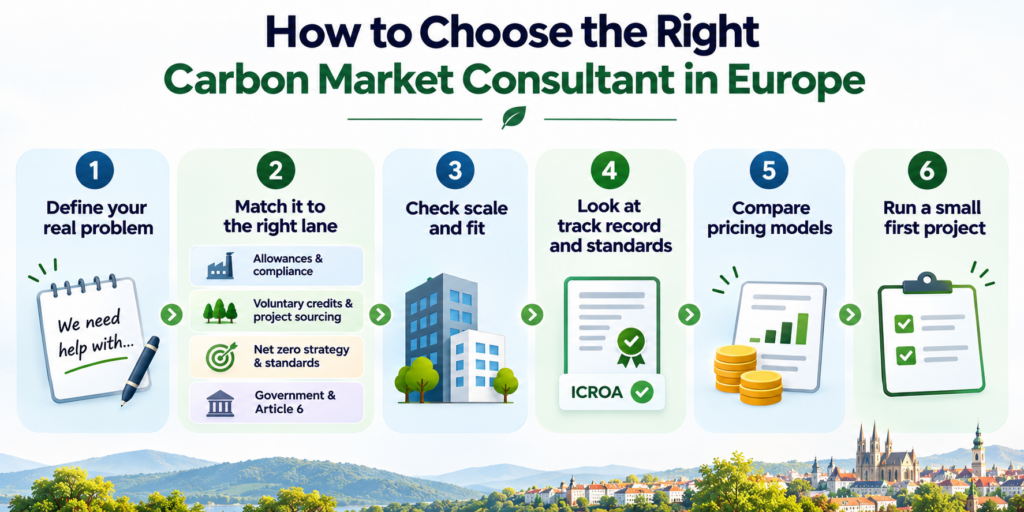
Picking a firm is easier when you follow a clear process.
Step 1: Define your real problem
Write one sentence that starts with “We need help with…”
For example: “We need help buying allowances at lower risk,” or “We need a credit strategy that fits our net zero targets.”
Step 2: Match the problem to a lane
Use the four lanes from earlier.
- Allowance buying and compliance: look at Vertis, Redshaw or First Climate
- Voluntary credits and project sourcing: look at South Pole, Climate Impact Partners or First Climate
- Net zero strategy and standards: look at Carbon Trust, ClimatePartner or EcoAct
- Government and Article 6 work: look at Perspectives or Climate Focus
Step 3: Check scale and fit
A global group may suit a multinational. A boutique may give your team more attention.
Ask who will actually do the work, not just who will attend the pitch.
Step 4: Look at track record and standards
Request case studies from your sector. Check whether the firm follows recognised standards and accreditation, such as ICROA for credit providers.
Step 5: Compare pricing models
Carbon consultants usually charge through one of these models:
- Fixed fee for a defined project
- Monthly retainer for ongoing advice
- Day rates for specialist work
- Trading margin or spread on allowances
- Commission or project fee on credit supply
Ask for the model in writing. Make sure you can see how the firm earns money when it also sells you credits or allowances.
Step 6: Run a small first project
Start with a limited scope, such as a CBAM readiness review or a credit portfolio audit. Judge the quality before you sign a big contract.
Questions to Ask Before You Hire
| Question | Why it matters |
|---|---|
| How do you vet carbon projects, and can you share the criteria? | Shows how seriously the firm takes integrity |
| How do you earn money if we buy from you? | Reveals conflicts of interest |
| Who will work on our account? | Confirms real expertise on your file |
| How do you handle changes in EU rules? | Tests whether the firm tracks policy closely |
| Can you explain our claim risks in plain language? | Protects you from greenwashing trouble |
| Which standards and accreditations do you follow? | Gives you an outside quality check |
| Can we speak with a client in our sector? | Checks real-world results |
Red Flags to Watch For
- Promises of guaranteed carbon price outcomes
- Pressure to buy credits before you set reduction targets
- Vague answers about where credits come from
- No clear explanation of fees or margins
- Marketing language that says “carbon neutral” without evidence
- No plan for reducing your own emissions
Common Mistakes Companies Make
- Buying credits first and cutting emissions later. Strong programmes put reductions first.
- Treating compliance and voluntary markets as the same thing. They follow different rules and need different skills.
- Ignoring suppliers outside Europe. CBAM reaches non-EU producers because importers need their emissions data.
- Copying old marketing claims. New EU rules now limit offset-based neutrality claims on products.
- Choosing on brand name alone. A famous firm may not have the right team for your sector.
- Skipping internal training. Your staff still need to understand the basics, even with outside help.
Real-World Scenarios: Who Should Call Whom?
These are typical situations, not named client cases.
| Situation | What they need | Good places to start |
|---|---|---|
| A cement producer faces rising allowance costs | Hedging, compliance and CBAM planning | Vertis, Redshaw |
| A fashion brand sells to EU consumers and uses “carbon neutral” labels | Claim review, reduction plan, credit strategy | Climate Impact Partners, ClimatePartner, Climate Focus (legal briefs) |
| A ministry in a developing country plans Article 6 deals | Policy design, crediting rules, readiness support | Perspectives, Climate Focus |
| A European airline manages several compliance schemes | EU ETS, UK ETS and CORSIA strategy | Vertis, Redshaw |
| A mid-size manufacturer starts carbon accounting | Footprint, targets, reporting | ClimatePartner, Carbon Trust, EcoAct |
| A food company wants soil or farmland carbon projects | Project sourcing and verification | South Pole, First Climate |
Trends Shaping Carbon Market Consulting in Europe
The work is changing fast. Here are the trends worth watching.
- Integrity over volume. Buyers want fewer, better credits with clear evidence.
- Removals rising. Demand for permanent removals keeps growing, and EU certification rules give buyers more clarity.
- Closer links between compliance and voluntary markets. Policy talks about international credits and removals will keep blurring old lines.
- Border carbon costs spreading. CBAM pushes suppliers worldwide to measure and report embedded emissions.
- Stricter claims. Companies must prove their statements, not just make them.
- Digital tools. Consultants increasingly pair advice with software for data, tracking and reporting.
Frequently Asked Questions
What do carbon market consultants in Europe do?
They help organisations understand and act in carbon markets. That includes compliance with the EU ETS, CBAM planning, buying carbon credits, setting net zero strategy and advising governments on policy.
How do I find the best carbon market consultant in Europe?
Start with your goal. Then match it to a firm type, ask about project vetting and fees, and test the relationship with a small first project.
How much do carbon market consultants charge?
Prices vary with scope, firm size and model. Some charge fixed project fees. Others use retainers, day rates or trading margins. Always ask for a written breakdown.
Do I need a consultant for EU ETS compliance?
Not always. Large installations often have in-house teams. Many still hire specialists for hedging, market views, training or support during rule changes.
What is the difference between compliance and voluntary carbon market consultants?
Compliance consultants help you meet legal obligations, such as surrendering allowances. Voluntary consultants help you buy credits and build climate strategies by choice.
Does CBAM affect companies outside Europe?
Yes. CBAM applies to importers into the EU, but non-EU producers must give those importers accurate emissions data. Many exporters now hire consultants to help.
Are UK consultants part of the European carbon market?
They work closely with it. The UK has its own emissions trading system, separate from the EU one. London-based firms often serve clients in both.
Can a company outside Europe hire these firms?
Yes. Most of them serve clients worldwide, especially those that sell into Europe or buy credits from European platforms.
Does the EU still allow carbon credits?
Yes, in specific ways. Voluntary credits remain legal, but the EU limits offset-based neutrality claims on products. Policy also allows a limited role for high-quality international credits toward the 2040 climate target in later years.
How do I check if a carbon consultant is credible?
Look for transparent methods, recognised standards, accreditation such as ICROA for credit providers, sector case studies and clear fee structures.
Conclusion: Choose Carbon Market Consultants in Europe With Care
Europe’s carbon markets reward companies that plan early and punish those that guess. The right advisor saves money, lowers risk and keeps your claims honest.
Start with your need. Compliance teams should look at Vertis and Redshaw. Credit buyers should compare South Pole, First Climate and Climate Impact Partners.
Companies building a net zero plan can look at Carbon Trust, ClimatePartner and EcoAct. Governments and developers working on Article 6 should speak with Perspectives and Climate Focus.
Whichever of the carbon market consultants in Europe you pick, ask hard questions, start small and demand clarity on fees and project quality.
Company details change, so confirm current services, ownership and team before you sign anything.
If you want to learn more about how carbon markets work, how credits are issued, and what makes a high-quality carbon project, explore the resources at Carbon Market Network.