Carbon Market Network


You switch to a green electricity tariff. Your bill says “100% renewable.”
But the electricity in your wall socket looks the same as everyone else’s. So how does anyone prove it came from a wind farm or a hydro dam?
The answer is a small digital certificate called a Guarantee of Origin. This guide gives you the full picture of Guarantees of Origin explained in simple terms: what they are, how they work, what they cost, and where they fall short.
You will also see how GOs compare with RECs and REGOs, and how companies use them for emissions reporting.
What Are Guarantees of Origin?
A Guarantee of Origin (GO) is an electronic certificate that proves a specific amount of energy came from a specific source.
One GO normally represents one megawatt hour (MWh) of energy. That is 1,000 kWh.
The Simple Definition
Think of a GO as a birth certificate for energy.
A wind farm produces 1 MWh of electricity. The registry issues one GO for that MWh. The certificate says where, when, and how the energy was made.
The electricity itself flows into the grid and mixes with everything else. The GO travels separately and carries the “green” story.
What a GO Is Not
People often mix up GOs with other climate tools. A GO is not:
- A carbon credit. It does not represent a tonne of CO2 avoided or removed.
- Physical electricity. It is a tracking document, not the power itself.
- A compliance credit for national targets. European law says GOs have no function in a country’s renewable target accounting.
- A guarantee that you caused new renewables to be built. It proves origin, not impact.
Keeping these limits in mind will save you from the most common greenwashing mistakes.
What Information a GO Carries
European rules set the minimum details every GO must show. Here is what you will find on one.
| Detail on the GO | What it tells you |
|---|---|
| Energy source | Wind, solar, hydro, biomass, geothermal and so on |
| Production dates | Start and end dates of the production period |
| Energy type | Electricity, gas (including hydrogen), or heating and cooling |
| Installation details | Identity, location, type and capacity of the plant |
| Operational date | When the plant started operating |
| Support information | Whether the plant received public financial support |
| Issue details | Date and country of issue |
| Unique ID | A serial number that prevents double use |
Small installations under 50 kW can have simplified information on their certificates.
Carbon Market Insider Newsletter
Weekly insights on carbon markets, climate policy, carbon credits, and sustainability.
Why Guarantees of Origin Exist
Electricity is a shared pool. Once it enters the grid, nobody can say which electron came from which power plant.
That creates a trust problem. A supplier could claim green power while buying cheap fossil electricity from the grid.
The Problem GOs Solve
GOs separate two things:
- The physical electricity, which flows through the grid.
- The “green attribute,” which says where the energy was produced.
The attribute gets its own certificate. A buyer who wants to claim renewable power must hold and retire that certificate.
This makes every green claim traceable. It also stops two buyers from claiming the same unit of green energy.
Who Benefits
- Consumers get a reliable way to choose green tariffs.
- Suppliers get a legal tool to prove their fuel mix.
- Generators earn extra revenue by selling certificates.
- Businesses get documented evidence for sustainability reports.
- Regulators get a clean system for energy disclosure.
How Guarantees of Origin Work Step by Step
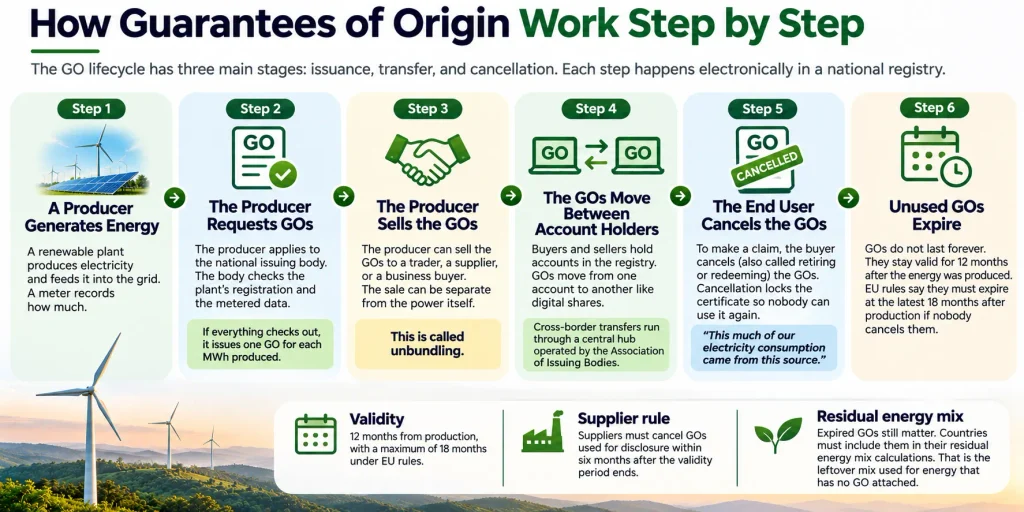
The GO lifecycle has three main stages: issuance, transfer, and cancellation. Each step happens electronically in a national registry.
Step 1: A Producer Generates Energy
A renewable plant produces electricity and feeds it into the grid. A meter records how much.
Step 2: The Producer Requests GOs
The producer applies to the national issuing body. The body checks the plant’s registration and the metered data.
If everything checks out, it issues one GO for each MWh produced. The rules say no more than one GO can be issued for each unit of energy.
Step 3: The Producer Sells the GOs
The producer can sell the GOs to a trader, a supplier, or a business buyer. The sale can be separate from the power itself.
This is called unbundling. A wind farm might sell its electricity to the wholesale market and its GOs to a company in another country.
Step 4: The GOs Move Between Account Holders
Buyers and sellers hold accounts in the registry. GOs move from one account to another like digital shares.
Cross-border transfers run through a central hub operated by the Association of Issuing Bodies. More on that below.
Step 5: The End User Cancels the GOs
To make a claim, the buyer cancels (also called retiring or redeeming) the GOs. Cancellation locks the certificate so nobody can use it again.
After cancellation, the buyer can say: “This much of our electricity consumption came from this source.”
Step 6: Unused GOs Expire
GOs do not last forever. They stay valid for 12 months after the energy was produced. EU rules say they must expire at the latest 18 months after production if nobody cancels them.
Suppliers must cancel GOs used for disclosure within six months after the validity period ends.
Expired GOs still matter. Countries must include them in their residual energy mix calculations. That is the leftover mix used for energy that has no GO attached.
The GO Lifecycle at a Glance
| Stage | Who acts | What happens |
|---|---|---|
| Issue | Issuing body | Creates one GO per MWh produced |
| Transfer | Account holders | GOs move between registry accounts |
| Cancel | Supplier or end user | GO is retired to back a claim |
| Expire | Registry | Unused GOs drop out and feed the residual mix |
Who Runs the Guarantees of Origin System?
No single global body runs GOs. National governments appoint issuing bodies, and those bodies coordinate through a shared association.
National Issuing Bodies
Each country names a competent body to issue, transfer and cancel GOs. The law requires these bodies to supervise the system.
They must make sure the process is electronic, accurate, reliable and fraud-resistant.
The Association of Issuing Bodies (AIB)
The AIB is the main coordinator for European GOs. Its members are appointed by their national governments. Members include countries beyond the EU, such as Norway and Switzerland.
The AIB runs the European Energy Certificate System (EECS). This is a common standard that lets GOs move between national registries.
It also operates the Hub, the technical platform for cross-border transfers.
The Technical Standard
European law tells member states to follow the CEN standard EN 16325 for GO requirements. This standard keeps certificates consistent from one country to the next.
Mutual Recognition Rules
EU countries must recognise GOs issued by other member states as proof of the basic origin details. A country can refuse only if it has well-founded doubts about accuracy, reliability or veracity. It must then tell the European Commission why.
GOs from outside the EU face a tighter rule. They are generally not recognised unless the EU has signed an agreement on mutual recognition and there is direct import or export of energy.
This is why UK certificates and EU certificates no longer trade as equals after Brexit.
The Legal Framework Behind Guarantees of Origin
GOs sit inside the EU Renewable Energy Directive, known as RED. The rules have been updated several times.
How the Rules Evolved
- The first directive introduced GOs as proof of origin for renewable electricity.
- RED I made GOs more detailed and allowed them to trade independently of physical electricity flows.
- RED II set the current structure in Article 19. It sets the standard 1 MWh size, the 12 month validity, and the rules on subsidised producers.
- RED III extended and tightened the system.
What RED III Changed
| Area | Update |
|---|---|
| Hydrogen and gas | Producers of renewable fuels of non-biological origin, including hydrogen, can receive GOs |
| Time stamps | Timestamps on GOs are encouraged for finer tracking |
| Certificate size | GOs smaller than 1 MWh are allowed under certain conditions |
| Energy communities | They get the simplified procedures that small installations enjoy |
| Corporate PPAs | Member states must assess and reduce barriers to long-term renewable power purchase agreements |
| Subsidised energy | Countries keep the right not to issue GOs to subsidised producers |
The Subsidy Rule Explained
When a producer receives public support, countries can choose between two paths:
- Issue the GO but account for its market value in the support scheme.
- Issue the GO and cancel it right away, or not issue it at all.
The goal is to stop producers from being paid twice for the same green value.
Types of Guarantees of Origin
GOs cover more than wind and solar electricity. The system now stretches across several energy carriers.
Electricity GOs
This is the largest segment by far. Each certificate shows the technology, such as hydro, wind, solar, biomass or geothermal.
Gas GOs
Biomethane and other renewable gases can receive GOs. The market is smaller but growing, and the AIB has been adding new gas participants to its hub.
Hydrogen GOs
RED III gives hydrogen producers the right to GOs. This matters for green hydrogen buyers who need to prove the energy source behind their fuel.
Hydrogen rules also come with strict matching requirements. The EU rules for renewable hydrogen require monthly matching at first, with hourly matching coming later this decade.
Heating and Cooling GOs
The directive also covers renewable heating and cooling. Uptake is still modest compared with electricity.
GOs for Non-Renewable Energy
Countries can also issue GOs for non-renewable sources. Nuclear is the notable example. These certificates are labelled clearly and never count as renewable.
The Guarantees of Origin Market Today
The GO market has grown into a large and active trading space.
Market Size
The AIB reports that its members issued about 1,091 TWh of EECS electricity GOs in its latest annual report. That is a small dip from the previous year.
Cancellations rose about 5% to 978 TWh. That means roughly 90% of issued certificates were actually used.
This is a healthy sign. For a long time, far more GOs were issued than used. The gap is closing.
Across all tracking systems, more than 1,500 TWh of electricity consumption was explicitly tracked in the latest residual mix data. That figure covers EECS GOs plus national and other reliable systems.
What Technologies Dominate
| Source | GOs issued (TWh, latest annual figures) |
|---|---|
| Hydro and marine | 424 |
| Wind | 271 |
| Solar | 131 |
| Nuclear | 126 |
| Biomass | 65 |
| Natural gas | 50 |
| Other sources | Small volumes |
About 82% of issuance is renewable. Nuclear’s share is rising.
Hydro leads because Nordic and Alpine countries have large dam fleets that have issued GOs for many years.
How Much Do GOs Cost?
GO prices have swung a lot.
- At the peak of the market, prices climbed to roughly 7 to 10 euros per MWh.
- They then fell back sharply to around 1 to 2 euros per MWh as renewable supply grew.
- Recent market assessments for wind and solar GOs sit in the region of 1.7 to 1.8 euros per MWh.
- French auctions have cleared at similar levels.
Prices vary by technology, country, and vintage (the production year).
Analysts expect prices to stay moderate in the medium term. Rising electrification and policy pressure support demand. A growing supply of renewables caps the upside.
A quick example: a household using 3.5 MWh a year would pay roughly 6 euros to cover its full consumption with GOs at around 1.7 euros per MWh. That is an illustration, not a quote.
What Moves GO Prices
- Hydro, wind and solar output in a given season
- Demand from corporate buyers with reporting targets
- Policy changes, such as stricter matching rules
- Demand from hydrogen producers
- Seasonal patterns, with prices often easing from summer into winter
Guarantees of Origin vs RECs vs REGOs vs I-RECs
Many regions use similar tools under different names. They all aim to track the green attribute of electricity.
Regional Comparison
| Instrument | Where it applies | Administrator | Unit |
|---|---|---|---|
| Guarantee of Origin (GO) | EU, EEA and other AIB members | National issuing bodies, coordinated by AIB | 1 MWh |
| REGO | Great Britain and Northern Ireland | Ofgem | 1 MWh |
| REC | United States and Canada | Regional tracking systems such as WREGIS and M-RETS | 1 MWh |
| I-REC | Many countries in Asia, Africa, Latin America and the Middle East | I-REC Standard | 1 MWh |
| India REC | India | Central registry with trading on power exchanges | 1 MWh |
| Australian REGO | Australia | Clean Energy Regulator | 1 MWh |
The UK REGO in Brief
Ofgem issues one REGO for every MWh of eligible renewable electricity generated in Great Britain and Northern Ireland. Suppliers use REGOs to back the fuel mix they report to customers.
The EU stopped recognising UK REGOs after Brexit. EU GOs also stopped counting for GB fuel mix disclosure from the 2023 disclosure period onward.
The UK also runs Renewable Gas Guarantees of Origin for biomethane.
Australia’s Approach
Australia’s REGO sits inside its Guarantee of Origin scheme, run by the Clean Energy Regulator. Companies can use REGOs to lower the electricity-related emissions on product certificates and in other market-based accounting.
Key Differences to Watch
- Legal basis. GOs come from EU law. RECs mostly come from state or voluntary programmes.
- Compliance role. Some US RECs serve state compliance markets. GOs do not serve EU target compliance.
- Validity. GOs expire after 12 months. Rules for other instruments differ.
- Recognition. Not every reporting framework accepts every instrument in every region.
Always check that your chosen certificate matches the market where your electricity is consumed.
Guarantees of Origin vs Carbon Credits
This is the comparison readers of a carbon market site ask about most.
| Feature | Guarantee of Origin | Carbon credit |
|---|---|---|
| What it proves | Where energy was produced | One tonne of CO2e avoided or removed |
| Unit | 1 MWh | 1 tonne CO2e |
| Main use | Electricity disclosure and Scope 2 market-based claims | Offsetting and climate contributions |
| Governing body | Government-appointed issuing bodies | Registries and standards such as Verra and Gold Standard |
| Impact claim | Origin only | Emission reduction or removal |
| Where it counts in reporting | Scope 2 | Usually reported separately from inventory emissions |
The two tools do different jobs. A GO helps you reduce your reported Scope 2 emissions under the market-based method. A carbon credit helps you compensate for emissions you could not avoid.
Never use one as a substitute for the other.
Who Uses Guarantees of Origin?
Electricity Suppliers
Suppliers must use GOs to show customers the share of renewable energy in their mix. Green tariffs depend on them.
Businesses and Corporations
Companies use GOs to support renewable electricity claims in sustainability reports. Frameworks such as RE100, CDP and the GHG Protocol accept GOs as evidence of market-based claims.
Hydrogen and Gas Producers
Producers use GOs to prove the renewable origin of the energy behind their fuel.
Households
Households rarely buy GOs directly. They benefit when their supplier retires GOs for a green tariff.
Real-World Examples
These scenarios are illustrative, but they mirror how the market works in practice.
Example 1: The Green Tariff
A supplier in Germany sells a green tariff to 50,000 homes. Together they use 175,000 MWh.
The supplier buys and cancels 175,000 GOs. Its disclosure then shows the tariff is backed by renewable sources.
Example 2: The Multinational Buyer
A manufacturer has plants across Europe. It buys wind GOs from several countries and cancels them for its annual consumption.
It also signs a long-term power purchase agreement for a new solar farm. The PPA supports new capacity. The GOs from that solar farm then flow to the buyer.
This combination gives the company both a credible claim and a real impact.
Example 3: The Wind Farm Owner
A wind farm sells its power on the wholesale market. It sells its GOs separately through a broker.
Those GOs bring extra income that helps the farm cover its costs. This is one way GO revenue supports renewable investment.
How to Buy Guarantees of Origin: A Practical Guide
Follow these steps to buy GOs with confidence.
- Measure your electricity consumption. Use your metered data for each country.
- Define your goal. Decide whether you need basic coverage or a higher quality claim.
- Choose the technology. Wind and solar GOs cost more than old hydro, but they tell a stronger story.
- Pick the vintage. Match the production period to your consumption period as closely as you can.
- Match the market. Buy GOs from the same market or a closely linked one where you consume power.
- Work with a trusted seller. Use a registered account holder, broker or supplier.
- Cancel the GOs. Make sure the cancellation is in your name and for the right consumption period.
- Keep the evidence. Save the cancellation statement for your audit file.
A Buyer’s Quality Checklist
- Is the plant new or old?
- Does the GO come from a market connected to where I consume?
- Is the production period close to my consumption period?
- Did the producer receive public subsidies?
- Does the supplier issue a clear cancellation statement?
Guarantees of Origin and Emissions Reporting
Companies mainly use GOs in Scope 2 reporting.
The Two Scope 2 Methods
- Location-based. This uses the average emissions of the local grid.
- Market-based. This reflects the electricity you chose to buy, including certificates.
GOs support the market-based method. A company that cancels enough GOs can report lower or zero market-based emissions for that electricity.
Why Double Counting Matters
If a generator sells its GOs to one buyer and the power to another, only the GO holder can claim the green attribute. The other buyer must use the residual mix.
The residual mix is the energy mix left over after removing all tracked certificates. It stops two parties from claiming the same green unit.
The AIB publishes European residual mix figures every year. It also warns that using average grid data for specific claims can create double claiming.
The GHG Protocol Revision
The GHG Protocol is revising its Scope 2 guidance. A public consultation drew 1,072 responses from 56 countries. Two proposals stood out:
| Proposal | Support | Opposition |
|---|---|---|
| Hourly matching | About 22% in favour | About 70% gave little or no support |
| Deliverability (certificates from connected grids only) | About 30% in favour | About 59% opposed |
| Exemption from hourly matching for smaller organisations | About 76% in favour | About 14% opposed |
Many respondents asked for hourly matching to be optional, with longer phase-in periods. The working group is reviewing the feedback.
A second consultation and a final standard are still ahead. Dual reporting of location-based and market-based figures is expected to stay.
What does this mean for you? Annual matching with GOs remains the current practice. Still, buyers should expect more focus on timing and location in the future.
Limits and Criticisms of Guarantees of Origin
GOs are useful. They are not perfect. Honest buyers should know the weak spots.
Weak Additionality
A GO from a dam built decades ago does not add new renewable capacity. Low prices also send a weak signal to developers.
Oversupply and Low Prices
Plenty of certificates exist. That keeps prices low and can reduce the incentive effect.
Annual Matching Gaps
A company can match a summer solar GO against winter consumption. Real grid emissions at the time of use may be very different.
Uneven Recognition
Not every country or framework treats every certificate equally.
How to Make GO Claims More Credible
- Pair GOs with PPAs that support new projects
- Choose GOs from newer wind and solar plants
- Match production and consumption periods closely
- Buy from connected markets
- Be clear in your report about what you bought and why
Where Guarantees of Origin Are Heading
Several trends will shape the next phase of the market.
- Finer time tracking. RED III encourages timestamps, and buyers want hourly data.
- Stronger link to emissions accounting. The AIB is pushing for one consistent system that tracks origin and emissions to the point of consumption.
- Growth in gas and hydrogen GOs. New participants are joining the gas hub.
- Tighter standards from reporting bodies. The GHG Protocol revision will influence how GOs count.
- More transparent pricing. Price reporting agencies are adding country-specific GO assessments.
Common Mistakes to Avoid
- Treating a GO like a carbon credit
- Claiming “100% renewable” without cancelling certificates
- Buying GOs from a market unconnected to your consumption
- Ignoring the production period of the certificate
- Forgetting to keep cancellation records
- Using a certificate type that your reporting framework does not accept
Conclusion: Guarantees of Origin Explained in One Minute
Guarantees of Origin explained simply: they are digital certificates that prove one MWh of energy came from a named source at a named time and place.
They make green energy claims traceable. They stop double counting. They give generators extra income and give buyers documented evidence.
They also have limits. A GO proves origin, not new impact. Prices are low, and annual matching can hide timing gaps.
The smart approach is to understand what a GO can and cannot claim. Pair certificates with real investment where you can. Keep clear records.
If you work in carbon markets or corporate reporting, a solid grasp of Guarantees of Origin is no longer optional. It sits at the centre of how the world proves its energy is green.
Frequently Asked Questions About Guarantees of Origin
What is a Guarantee of Origin in simple words?
It is an electronic certificate that proves one MWh of energy came from a specific source, such as wind or solar. It travels separately from the physical electricity.
How much does a Guarantee of Origin cost?
Prices change often. Recent market levels for wind and solar GOs have been around 1 to 2 euros per MWh. Prices were far higher at the market peak.
Who issues Guarantees of Origin?
National issuing bodies appointed by governments. In Europe, the Association of Issuing Bodies coordinates them through the EECS standard.
What is the difference between a GO and a REC?
A GO is the European system based on EU law. A REC is the common term in North America. Both track one MWh, but the rules, registries and uses differ.
Is a Guarantee of Origin a carbon credit?
No. A GO proves where energy was produced. A carbon credit represents one tonne of CO2e avoided or removed.
How long is a Guarantee of Origin valid?
It is valid for 12 months after production. Member states must ensure uncancelled GOs expire at the latest 18 months after production.
Can I buy Guarantees of Origin as an individual?
Usually not directly. Most people benefit through a green tariff from a supplier who cancels GOs on their behalf. Some brokers serve small businesses.
Do Guarantees of Origin reduce Scope 2 emissions?
They reduce Scope 2 emissions under the market-based method, as long as the GOs are cancelled for your consumption. They do not change your location-based figure.
Can I use European GOs for electricity used outside Europe?
It depends on the market and the reporting framework. Most frameworks want certificates from the same market or a closely linked one.
Do Guarantees of Origin cover hydrogen?
Yes. RED III gives hydrogen and other renewable fuels of non-biological origin the right to receive GOs.
Why do GOs get criticised?
Critics point to weak additionality, low prices, oversupply and annual matching. Better quality choices and PPAs can address many of these concerns.
Ready to go deeper? Explore more guides at Carbon Market Network.