Carbon Market Network


Building a climate startup is hard. Building one without the right support system is even harder.
That is exactly why climate accelerators exist. They give founders funding, mentorship, and a network that would otherwise take years to build on their own.
If you are searching for the top climate accelerators, you are probably at a turning point. You have an idea, a prototype, or an early product, and you need the right partners to help you scale it.
This guide breaks down everything you need to know. You will learn what climate accelerators actually do, which programs lead the pack, how to choose the right one, and how to apply with confidence.
Let’s get into it.
What Is a Climate Accelerator?
A climate accelerator is a structured program that helps early-stage startups working on climate solutions grow faster.
These programs typically last a few months. During that time, startups get mentorship, technical support, access to investors, and sometimes direct funding.
Climate accelerators focus on startups tackling emissions, clean energy, carbon removal, sustainable agriculture, circular economy, and climate resilience.
Some programs call themselves “accelerators,” while others use terms like “excelerator” or “incubator.” The core idea stays the same: compress years of learning into months.
Carbon Market Insider Newsletter
Weekly insights on carbon markets, climate policy, carbon credits, and sustainability.
How Climate Accelerators Differ From Regular Startup Accelerators
General startup accelerators, like the well-known names in Silicon Valley, work across every industry. Climate accelerators narrow their focus to one mission: helping startups fight climate change and build resilience against its effects.
This focus matters because climate startups often deal with unique challenges. They may need lab space, pilot sites, regulatory guidance, or long development timelines that a typical software startup never faces.
Climate accelerators build their curriculum, mentor network, and investor relationships around these specific needs.
Why Climate Accelerators Matter Right Now
Climate technology has moved from a niche interest to a mainstream investment category. Billions of dollars flow into the sector every year, but that capital does not always reach early-stage founders easily.
Here is why accelerators play such an important role today.
- The funding gap is real. Many climate startups need capital-intensive testing and pilot deployments before they can prove commercial viability. This stage, often called the “missing middle” or the first-of-a-kind financing gap, is one of the hardest parts of building a climate company.
- AI is reshaping the sector. A growing share of climate tech investment now goes toward AI-enabled solutions, from grid optimization to climate risk modeling. Accelerators help founders position their technology correctly for this shift.
- Climate adaptation is now investable. Solutions that help communities and businesses adapt to a warmer world, such as flood resilience and heat management, are attracting serious capital. Accelerators are creating dedicated tracks for this growing category.
- Corporates want climate partners. Large companies are launching their own climate accelerators to find suppliers and technology partners that help them meet sustainability targets.
Understanding these trends helps you pick an accelerator that matches where the market is actually heading, not where it used to be.
Accelerator vs Incubator vs Venture Capital: What Is the Difference?
Founders often mix up these three terms. Here is a simple breakdown.
| Feature | Accelerator | Incubator | Venture Capital |
|---|---|---|---|
| Program length | Fixed, usually 3 to 6 months | Open-ended, often 1 to 2 years | No fixed timeline |
| Funding | Small check, often for equity | Sometimes none, or lab space and resources | Larger checks based on milestones |
| Structure | Cohort-based, intense curriculum | Flexible, resource-based support | Board seats, ongoing oversight |
| Best for | Startups ready to grow fast | Very early ideas needing space and time | Startups with traction seeking growth capital |
| Equity taken | Usually yes, a small percentage | Sometimes none | Yes, in exchange for larger investment |
Climate accelerators often blend elements of all three. Some take no equity at all and operate as nonprofits funded by philanthropy or corporate partners. Others function closer to a venture fund with a structured program attached.
Always read the fine print before applying. Know exactly what you are giving up and what you are getting in return.
Top Climate Accelerators to Know
Below are some of the most established and respected climate accelerators active today. Each one has a distinct focus, so read carefully to find the best match for your startup.
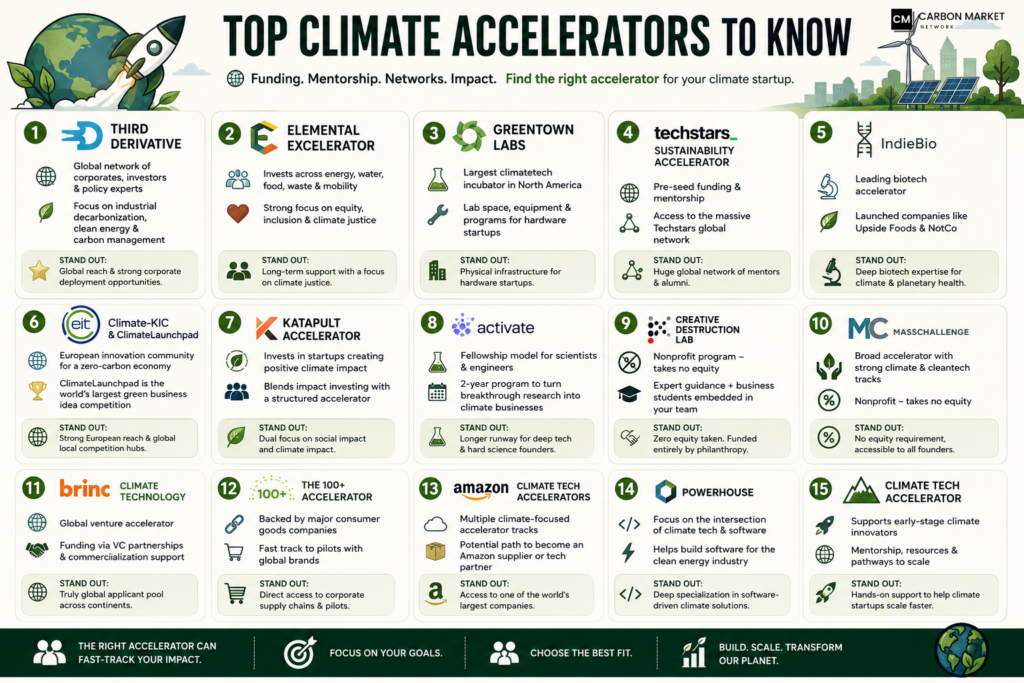
Third Derivative
Third Derivative grew out of a partnership between RMI and New Energy Nexus, two organizations with deep roots in clean energy policy and entrepreneurship.
The program connects founders with corporate partners, investors, and policy experts across the globe. It focuses on hard climate problems, including industrial decarbonization, clean energy, and carbon management.
Website: https://www.third-derivative.org/
What makes it stand out: its global network and strong ties to corporate partners looking for real deployment opportunities, not just pilot projects that go nowhere.
Elemental Excelerator
Elemental calls itself an “Excelerator” rather than an accelerator, and the distinction is intentional. Its founders recognized early on that climate startups need patient, multi-year support rather than a quick three-month sprint.
Elemental invests in startups working across energy, water, food and agriculture, waste, and mobility. It places a strong emphasis on equity and inclusion, supporting founders and communities that are often left out of traditional venture capital.
Notable portfolio companies include BlocPower, a company that helps buildings switch to clean energy systems.
What makes it stand out: long-term support paired with a genuine focus on climate justice and frontline communities.
Greentown Labs
Greentown Labs is widely recognized as the largest climatetech incubator in North America, with physical locations that give hardware-focused startups something most accelerators cannot: real lab space and equipment.
Startups working on batteries, materials science, and other hardware-heavy climate solutions benefit enormously from this hands-on infrastructure.
Greentown also runs specialized cohort programs, including one focused on advancing climatetech leaders from underrepresented backgrounds.
What makes it stand out: physical infrastructure for hardware startups, something few accelerators can offer.
Techstars Sustainability Accelerator
Techstars runs city-based accelerator programs across nearly every industry, and its sustainability-focused track applies the same proven playbook to climate startups.
Founders get pre-seed investment, mentorship from a massive global network, and access to the broader Techstars alumni community.
What makes it stand out: the sheer scale of the Techstars network, which spans thousands of companies and mentors worldwide.
IndieBio
IndieBio is best known as a leading biotech accelerator, and a significant portion of its portfolio addresses climate and planetary health challenges.
The program has helped launch companies like Upside Foods, a cultivated meat company, and NotCo, an AI-powered food technology firm.
What makes it stand out: deep scientific and biotech expertise for startups working at the intersection of biology and climate.
EIT Climate-KIC and ClimateLaunchpad
EIT Climate-KIC is a European innovation community working toward a circular, zero-carbon economy. It runs ClimateLaunchpad, often described as the world’s largest green business idea competition.
This program is a great entry point for very early-stage founders who are still validating their idea and need structured guidance to turn it into a real business.
What makes it stand out: strong European reach and a genuinely global network of local competition hubs.
Katapult Accelerator
Katapult invests in and supports startups creating a positive impact on both society and climate. The program blends impact investing principles with a structured accelerator curriculum.
What makes it stand out: a dual focus on social impact and climate impact, appealing to founders building mission-driven companies.
Activate
Activate offers a fellowship model rather than a traditional accelerator format. It provides scientists and engineers with a stipend and support to spend two years turning breakthrough research into a viable climate business.
What makes it stand out: a longer runway designed specifically for deep tech and hard science founders who need more time to de-risk their technology.
Creative Destruction Lab Climate Stream
Creative Destruction Lab, commonly known as CDL, operates a dedicated climate stream on a nonprofit model. It takes no equity from participating startups.
Founders get technical guidance from scientists, engineers, and economists, plus hands-on support from business students embedded within the company.
What makes it stand out: zero equity taken, funded entirely through philanthropy, which removes a major point of friction for founders.
MassChallenge
MassChallenge runs a broad startup accelerator with strong climate and cleantech tracks. It operates as a nonprofit and does not take equity from participating companies.
What makes it stand out: no equity requirement, making it accessible to founders wary of giving up ownership early.
Brinc Climate Technology
Brinc operates as a global venture accelerator supporting founders across climate tech, food tech, and other emerging sectors. It offers funding opportunities through partnerships with venture capital firms alongside commercialization support.
What makes it stand out: a genuinely global applicant pool, with startups joining from multiple continents in a single cohort.
The 100+ Accelerator
Launched by a coalition of major consumer goods companies, the 100+ Accelerator connects startups directly with corporate supply chains. This gives founders a fast track to pilot projects with household-name brands.
What makes it stand out: direct access to corporate supply chains and real commercial pilots, not just mentorship.
Amazon Sustainability and Climate Tech Accelerators
Amazon runs multiple climate-focused accelerator programs, including tracks dedicated to clean energy, circular economy, and device sustainability. These programs pair startups with Amazon’s technical teams and, in some cases, offer a direct path toward commercial integration with Amazon’s own products and operations.
What makes it stand out: the possibility of becoming a supplier or technology partner to one of the largest companies in the world.
Powerhouse
Powerhouse focuses specifically on the intersection of climate technology and software, helping founders build companies that serve the clean energy industry.
What makes it stand out: deep specialization in software-driven climate solutions rather than hardware or biotech.
Comparing the Top Climate Accelerators
Here is a quick side-by-side summary to help you compare options at a glance.
| Accelerator | Primary Focus | Equity Taken | Best For |
|---|---|---|---|
| Third Derivative | Hard climate tech, industrial decarbonization | Varies by track | Founders wanting corporate and policy connections |
| Elemental Excelerator | Energy, water, food, waste, mobility | Varies, equity or grant-based | Founders focused on climate equity and long-term support |
| Greentown Labs | Hardware, cleantech, materials | Membership-based, minimal equity | Hardware startups needing lab space |
| Techstars Sustainability | Broad sustainability tech | Yes, standard accelerator terms | Founders wanting a large mentor network |
| IndieBio | Biotech, food tech, planetary health | Yes | Science-driven biotech founders |
| EIT Climate-KIC | Early-stage idea validation | No, competition-based | Very early-stage founders |
| Katapult | Social and climate impact | Yes | Mission-driven, impact-first startups |
| Activate | Deep tech, hard science | No, fellowship stipend model | Scientists and engineers with breakthrough research |
| Creative Destruction Lab | Cross-sector deep tech | No | Founders who want mentorship without giving up equity |
| MassChallenge | Broad cleantech and climate | No | Founders avoiding equity dilution |
| Brinc | Climate tech, food tech | Yes | Global founders seeking international exposure |
| The 100+ Accelerator | Consumer goods supply chains | No, pilot-based | Startups targeting large consumer brands as customers |
| Amazon Sustainability Accelerators | Clean energy, circular economy, devices | No, pilot and partnership-based | Startups aiming for a major corporate partner |
| Powerhouse | Climate software | Yes | Software-first climate startups |
How to Choose the Right Climate Accelerator
Not every accelerator fits every startup. Choosing the wrong one wastes time you cannot get back.
Follow these steps to narrow your search.
Step 1: Define Your Stage
Some programs, like Activate and EIT Climate-KIC, work well for very early founders still validating an idea. Others, like Techstars or Brinc, expect a working prototype and early traction.
Be honest about where your startup actually stands before applying.
Step 2: Identify Your Sector
Hardware startups benefit from programs like Greentown Labs that offer physical lab space. Software and data-driven startups may find more value in a program like Powerhouse.
Biotech and food tech founders should look closely at IndieBio.
Step 3: Decide How Much Equity You Can Give Up
Some accelerators take no equity at all, while others follow standard venture terms. Calculate what a percentage of equity actually means for your company’s future ownership before signing anything.
Step 4: Check the Network Quality
Look at each accelerator’s list of past graduates and their outcomes. A strong alumni network often matters more than the size of the initial check you receive.
Step 5: Consider Corporate Access
If your startup needs a large corporate customer to prove commercial viability, programs like the 100+ Accelerator or Amazon’s sustainability tracks can shortcut years of cold outreach.
How to Apply to a Climate Accelerator: A Step-by-Step Guide
Applying to a top climate accelerator takes preparation. Here is a practical process to follow.
- Research thoroughly. Read every past cohort announcement you can find. Understand the type of startup each program actually selects, not just what their website claims.
- Prepare a tight pitch deck. Keep it under 15 slides. Focus on the problem, your solution, your traction, your team, and your ask.
- Quantify your climate impact. Accelerators want numbers. Show your expected carbon reduction, resource savings, or resilience benefit in clear, specific terms.
- Gather your team’s credentials. Highlight relevant technical, scientific, or industry experience that proves your team can execute.
- Get early customer or pilot commitments. Even a signed letter of intent from a potential customer strengthens your application significantly.
- Apply early. Many programs review applications on a rolling basis, and early applicants often get more attention from selection committees.
- Prepare for interviews. If shortlisted, expect deep technical questions. Practice explaining complex science in simple, confident language.
- Negotiate terms carefully. Before accepting an offer, understand exactly what equity, fees, or obligations come with the program.
Key Trends Shaping Climate Accelerators Today
The climate accelerator landscape keeps evolving. Staying aware of these shifts helps you position your startup for success.
- AI integration is now a differentiator. Startups applying artificial intelligence to grid management, climate risk forecasting, and resource optimization are attracting outsized attention from accelerators and investors alike.
- Adaptation and resilience are growing fast. Solutions that help communities and businesses cope with extreme weather, water scarcity, and heat stress are moving from a niche category into a serious investment class.
- Corporate accelerators are multiplying. More large companies are launching their own climate programs to secure supply chain partners and meet internal sustainability commitments.
- Non-dilutive funding is in higher demand. As traditional funding sources tighten, founders increasingly prefer accelerators offering grants, philanthropic capital, or no-equity models over standard venture terms.
- Materials and critical minerals matter more. Startups working on battery materials, recycling, and supply chain security for critical minerals are seeing increased accelerator and investor interest as global demand for these resources grows.
Benefits of Joining a Climate Accelerator
Joining the right program can transform a startup’s trajectory. Here are the most common benefits founders report.
- Faster access to capital through direct investment or warm introductions to investors.
- Credibility that comes from being selected by a respected program, which helps with fundraising and customer conversations alike.
- Technical mentorship from experts who have already solved similar problems.
- Peer support from fellow founders facing the same challenges at the same stage.
- Corporate and government connections that would otherwise take years to build independently.
- Structured accountability that pushes teams to hit milestones faster than they might on their own.
Common Challenges to Watch For
Accelerators are not a guaranteed path to success. Keep these realities in mind.
- Equity dilution adds up. Giving away a percentage of your company in exchange for a small check may not always be worth it, especially if you already have strong investor relationships.
- Not every mentor understands your specific technology. Some programs spread mentorship thin across very different sectors.
- Time commitment is significant. A three-month program can pull founders away from core product development if not managed carefully.
- Selection is competitive. Top programs often accept a very small percentage of applicants, so a rejection does not necessarily reflect the quality of your idea.
Real-World Success Stories
Several climate accelerator graduates have gone on to build significant companies, proving the model works when it fits the right startup.
Upside Foods, a cultivated meat company, emerged from IndieBio’s biotech-focused program and went on to raise substantial follow-on funding.
NotCo, an AI-powered food technology company, also came through IndieBio before scaling into international markets.
BlocPower, which helps buildings transition to clean energy systems, built early momentum with support from Elemental Excelerator.
These examples show a common pattern. The startups that benefit most from accelerators combine a strong technical foundation with a clear plan for commercial deployment, and they use their accelerator experience to sharpen both.
Frequently Asked Questions
What is the difference between a climate accelerator and a climate incubator?
An accelerator runs a fixed, short program focused on rapid growth, usually a few months long. An incubator offers more open-ended support, often including physical space and resources, without a strict timeline.
Do climate accelerators always take equity?
No. Some programs, including nonprofit and philanthropy-funded ones, take no equity at all. Others follow standard venture terms and take a small percentage in exchange for funding and support.
How competitive are top climate accelerators?
Very competitive. Leading programs often receive far more applications than they can accept, so a strong pitch, clear traction, and a well-prepared team significantly improve your chances.
Can early-stage idea-only startups join a climate accelerator?
Yes, some programs like EIT Climate-KIC’s ClimateLaunchpad and fellowship-style programs like Activate are designed specifically for very early founders still validating their concept.
What sectors do climate accelerators typically support?
Common sectors include clean energy, carbon removal, sustainable agriculture, circular economy, climate adaptation, transportation, and industrial decarbonization. Many programs also now prioritize AI-enabled climate solutions.
Is it better to join a climate accelerator or go straight to venture capital?
It depends on your stage. Accelerators work well for early-stage startups needing structure, mentorship, and a first check. Startups with strong traction and a clear growth plan may benefit more from going directly to venture capital.
How long does a typical climate accelerator program last?
Most cohort-based programs run between three and six months. Fellowship-style programs, like Activate, can extend to two years to give deep tech founders more time to de-risk their technology.
Final Thoughts
Choosing among the top climate accelerators comes down to knowing your startup’s stage, sector, and needs.
Some programs offer hands-on lab space for hardware founders. Others provide deep scientific mentorship, corporate pilot access, or equity-free funding for mission-driven teams.
Whichever path you choose, remember that an accelerator is a tool, not a guarantee. The founders who get the most value treat their program as an accelerant for work they are already doing well, not a replacement for a solid business plan.
Take the time to research each option carefully, prepare a strong application, and pick the program that truly fits where your startup stands today.
The climate crisis needs solutions at speed, and the right accelerator can help you build yours faster than you ever could alone.
If you want to keep learning about carbon markets, ESG strategy, and sustainability trends, explore more resources on Carbon Market Network.