Carbon Market Network


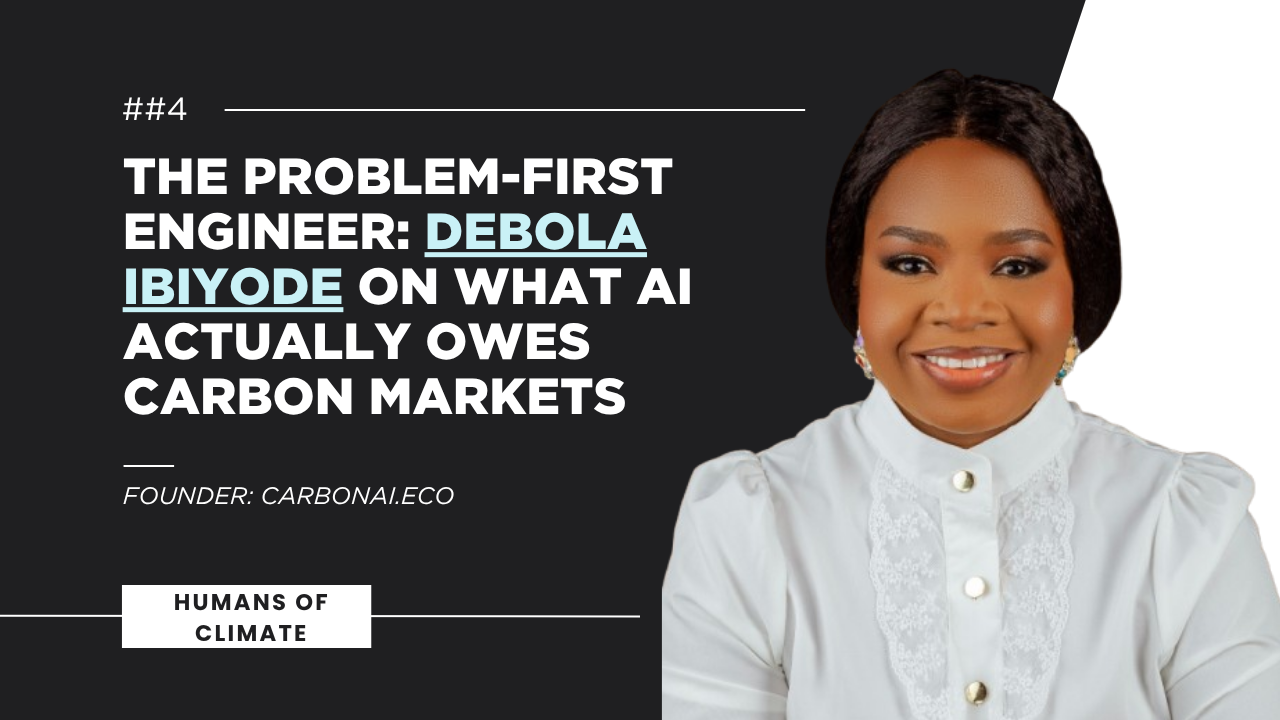
Debola Ibiyode, Chief Executive Officer of CarbonAI Ltd, describes herself as a solution developer. Not a technologist looking for problems to solve, and not a domain expert who discovered technology late. Someone who moves toward a complex problem, learns its internal logic, and then asks what technology can do about it.
Before CarbonAI, she helped build accounting software despite having no background in accounting. She bought a copy of Accounting for Dummies because, as she puts it, you cannot build tools for a world you have not bothered to understand. That principle, understand the problem before reaching for the solution, runs through everything she has built since.
Carbon markets, she argues, are a fundamentally different operating environment from the general-purpose settings where AI has proven itself. The stakes are different. The evidence requirements are different. And the trust problem, which the market has been struggling with for years, is one that poorly designed AI could make considerably worse. Her argument is not that AI cannot help. It is that the version of AI capable of helping is harder to build, and more honest about its limits, than the version that gets demonstrated at conferences.
The Accounting Software Lesson
Before CarbonAI, Debola Ibiyode spent time building Liquid Accounts, a business accounting software company. She was not an accountant. What she had was a conviction that this did not excuse her from understanding the people she was trying to help, so she read enough to take the domain seriously.
The experience crystallised what she calls her identity as a “business software engineer”: someone for whom software engineering divorced from the problem it is solving is a category error. Technology is not the point. The problem is the point. Technology is how you address it, once you have understood it well enough to know whether technology is even the right instrument.
“I’ve always worked at the intersection of technology and problem-solving. For me, technology has always been less about the technology itself and more about the problem it can solve.”
Her move into carbon markets followed the same logic. She encountered an industry with structural challenges around information, analysis, and decision-making, and asked whether her background in software engineering and AI could address any of them. The curiosity preceded the company. The problem preceded the solution.
Why Enterprise AI Keeps Failing
Effective enterprise AI, in Debola’s framework, requires two types of context working simultaneously. Domain context: a genuine understanding of the industry in which the organisation operates, its terminology, rules, and specialist knowledge. And organisational context: an understanding of the specific organisation using the system, how it works, what data it holds, and what it is actually trying to achieve.
An AI system without domain context cannot assess a carbon project in any practically useful sense. One with domain context but without organisational context can offer generic analysis but cannot determine whether a project is appropriate for this specific organisation, given its investment mandate, risk appetite, and due-diligence criteria. Both forms of context are necessary. Neither alone is sufficient.
“Enterprise AI is domain context plus organisational context, enabled by AI technology. That’s where you start creating the conditions for genuine return on investment.”
The failure mode she sees most often is organisations investing in AI in order to say they are investing in AI, or focusing on access to the latest frontier model. The sophistication of the underlying model becomes far less relevant if it cannot interpret the domain or the organisation using it. Deploying a more powerful general-purpose model into a context it cannot read does not produce better outcomes. It produces more confident-sounding wrong ones.
Carbon Market Insider Newsletter
Weekly insights on carbon markets, climate policy, carbon credits, and sustainability.
Carbon Markets Are Not a General-Purpose Problem
Carbon markets are young and informationally fragmented. Regulations are developing, methodologies are changing, new participants are entering continuously, and standardisation is still in progress. General-purpose AI systems are not built for environments that shift this quickly or this unevenly.
Then there is the higher-order problem. General-purpose AI is probabilistic. It is good at producing convincing answers. In most contexts, convincing is enough. In carbon markets, convincing is not enough. When an AI system supports an investment decision or a due-diligence assessment, the user needs to know where the information came from, what evidence supports the conclusion, and how that conclusion was reached. An answer that cannot be traced to its evidence is not useful. In some cases it is worse than no answer, because it gives the appearance of rigour without the substance.
“Trust is already a major issue within carbon markets, so introducing AI without those safeguards could simply create another trust problem on top of an existing one.”
This is why CarbonAI was built, from prototype stage, with evidence at its core. Traceability, auditability, and explainability were design requirements from the start, not features retrofitted once the system was working. Two organisations assessing the same carbon project may reach legitimately different conclusions because they have different mandates and risk tolerances. AI that cannot account for that difference is not doing the job carbon markets need it to do.
The Framework Before the Algorithm
When a carbon project lands on her desk, Ibiyode’s first question is not what the AI says about it. It is what evidence exists, and whether that evidence is reliable.
Her evaluation begins at the baseline: what situation is the project claiming to change, and what data supports that claim? From there: additionality, can it demonstrate that the climate benefit would not have occurred anyway? Then quantification: what reductions or removals are being projected, how were they calculated, and what assumptions sit beneath those numbers? Then credibility: what stakeholder engagement has taken place, which registry is involved, and is the methodology appropriate for this specific project type?
Where the project sits in its lifecycle also matters. At early evaluation, the priority is delivery risk, market suitability, and long-term viability. At the financing stage, the depth and quality of evidence become more critical, because capital will ultimately be placed behind assumptions that need to hold.
“AI analysis is only as useful as the information and context we give it. Show me the data, show me the evidence, and show me how that evidence was produced.”
A single carbon project can involve extensive documentation, methodologies, registry information, and regulatory requirements. A human expert can work through all of it. The question is how long it takes, and how consistent that analysis remains when repeated across hundreds or thousands of projects. AI, given the right domain understanding and evidence base, can reduce that time significantly, surface inconsistencies across documents, and flag areas for closer attention, freeing experts to apply their judgement where it is genuinely irreplaceable.
The Expert Assistant, Not the Expert
Debola Ibiyode is categorical about where the boundary sits between AI and human decision-making. AI, she says, is an expert assistant. Not the expert.
“It takes skill to work a skill. You need expertise to properly assess what an AI system is telling you. If you don’t understand the domain yourself, how do you know when the AI has missed something important?”
If the person using an AI system lacks the domain expertise to evaluate its output, they cannot detect when the system has misunderstood context, missed something material, or produced a recommendation that does not hold up. The AI becomes a black box generating authoritative-sounding answers that nobody in the room can interrogate. That is not a stronger decision process. It is a fragile one that looks rigorous.
At CarbonAI, the approach is AI-driven but human-led. The technology handles the analytical work: bringing domain knowledge, processing large volumes of evidence, generating recommendations. But expert judgement governs the development of the proprietary dataset, the validation of outputs, and the final decisions the system supports. The final judgement and accountability remain with the expert. Anything that erodes that accountability is moving in the wrong direction.
Trust Built From Evidence, Not Confidence
Carbon markets have a trust problem. AI has its own. The probabilistic nature of large language models means they can produce outputs that are fluent, coherent, and wrong. Hallucination is a structural feature of the technology. In a market where credibility is already fragile, AI that compounds the problem rather than addressing it would be damaging.
Debola describes the evolution of AI deployment in three phases. Prompt engineering: how you instruct the model. Context engineering: giving the model the grounded domain information it needs rather than relying on general training. And harness engineering, the current frontier: designing the wider systems, tools, and workflows around increasingly agentic AI so it operates within structures that enforce the right standards.
“Trust doesn’t come from how confidently an AI gives an answer. Trust comes from being able to understand and verify why it gave that answer.”
For high-stakes environments like carbon markets, this means AI that operates within the right domain and organisational context and produces outputs that are evidence-led, explainable, and traceable to their sources. A user should be able to ask: where did this conclusion come from, what evidence supports it, what assumptions were made, and can an expert challenge it? A system that cannot be interrogated is a system that cannot be trusted, regardless of how often its outputs happen to be right.
Africa and the Question of Who Captures the Value
A substantial number of carbon projects are being developed across Africa. African countries are, in practical terms, already contributing to addressing the world’s climate problem. The question Debola finds more important is whether Africa is capturing a proportionate share of the economic value that contribution creates. Her view is that it is not, and that AI offers one path toward changing that.
But the opportunity is not about importing AI built elsewhere and deploying it on African problems. That risks reproducing a familiar pattern: technology developed for other contexts, applied to African challenges by people who understand those challenges less than the communities already working on them.
“We need to build local capability, understand local contexts, and use AI to strengthen the people and institutions already working on these challenges.”
The more substantive opportunity is leapfrogging. Things that took other parts of the world years to build or optimise can potentially be achieved much faster today, if AI is applied with the right local context and in genuine support of local expertise. AI can improve access to information and specialist knowledge, support project developers in underserved markets, and make it easier for credible African projects to demonstrate their quality to global buyers. Contributing to solving the climate problem and benefiting economically from doing so are not the same thing. Closing that gap requires building local institutional capability, not just deploying the technology.
From Demonstration to Adoption
AI has been missold to many organisations. The industry has focused on what the technology can do rather than what specific organisations actually need it to do. The result is a well-documented gap: pilots that never become products, implementations that do not change how people work, investments that are hard to justify against real outcomes.
Her diagnosis: organisations are bringing AI into the organisation instead of bringing the organisation to the AI. The correction is to start with the problem. What are we actually trying to solve? Where could AI genuinely create value? Is our data good enough to support it? How will this fit into how our people already work? Only after working through those questions should an organisation think about introducing AI into its processes.
“Technology stacks shouldn’t be static, particularly in a market that is still evolving. You build, you learn, and you improve.”
When asked whether she would redesign any part of the carbon-market technology stack from scratch, Ibiyode’s answer is instructive. She would still build CarbonAI again, not because it was right from the beginning, but because what she built at the start is not what she is building today. The product has evolved continuously with her understanding of what users actually need. Technology stacks in evolving markets should be designed to be redesigned.
The Uncomfortable Truths for AI Founders in Climate
Building an AI company in the climate space is challenging in specific ways. The first is trust operating on two levels: customers must trust not just the technology but the data, evidence, and conclusions it produces. In carbon markets, where the credibility problem is already acute, building AI that can be trusted requires investment in evidence infrastructure and output validation that goes well beyond what a demonstration requires.
The second challenge is the absence of standardisation. Due diligence processes vary significantly across organisations. Building something technically capable is only part of the work. The technology must also be useful within the specific decision-making processes of the people using it, which requires understanding customers at a depth that product timelines often resist.
The third is the pace of AI itself. Each month brings new model releases and new capability claims. Keeping up technically while maintaining focus on what actually benefits users is a discipline that requires constant active choices.
“You cannot chase every technological advancement. You have limited time and resources, so you have to constantly make choices between what is technically possible and what customers actually need. For me, product-market fit ultimately has to win.”
What AI Still Cannot Do in Carbon Markets
The area where Debola believes the industry is most significantly overestimating AI is quantification and verification. AI can analyse large datasets, review calculations, identify inconsistencies, and flag areas requiring further investigation. The processing capabilities are real. But removing human agency from these processes is a step she does not believe is warranted, or close to warranted.
Verification is not simply information processing. It requires judgement, contextual understanding, the ability to question assumptions, and in some cases the ability to validate what is actually happening on the ground, in the physical environment where a carbon intervention is taking place. Quantification is bounded by the quality of the underlying data, the assumptions in the methodology, and whether that methodology is appropriate for the specific project. AI can support the analysis, but the outcome quality remains bounded by what went in.
The expectation she finds most problematic is that because AI can process enormous amounts of information, it should be able to independently determine whether something is correct. Processing capacity and evaluative judgement are different capabilities. The former scales. The latter, in high-stakes domains, requires human expertise that no AI system operating without oversight can replicate. Used well, AI strengthens the expert. Used carelessly, it creates the appearance of rigour without the substance.
Learn the Why Before You Build the What
Debola Ibiyode’s advice to people entering the AI-climate intersection is a deliberate sequence. First, understand why sustainability and carbon markets exist. What problems are they trying to solve? Why does additionality matter? Why does permanence matter? Why does verification matter? The “why” of carbon markets is not background reading. It is the foundation on which everything else depends.
Second, understand how the industry works in practice: how decisions are made, how projects are developed, where data comes from and where its limitations lie, what the real constraints are as opposed to the idealised version in policy documents.
“Learn the why, understand the how, and then ask what needs doing. That’s where meaningful innovation starts.”
Only then should a builder ask what technology can genuinely contribute. The question “what can I build with this technology?” leads to solutions searching for problems. Understanding carbon markets deeply enough to build something useful for them takes time, and a willingness to sit with complexity before reaching for the solution. That willingness, Debola suggests, is rarer than the technical capability to build AI systems, and considerably more valuable.
Quick Takes
One misconception about AI she would love to retire: That AI replaces humans. Its real power is in augmenting human capability, not replacing it.
One carbon-market process overdue for AI automation: MRV processing. AI can significantly reduce the manual effort involved in monitoring, reporting, and verification.
One thing AI should never be trusted to decide on its own: High-stakes decisions in carbon markets. Final judgement and accountability should always remain with the human expert.
One climate technology she is watching most closely: Digital MRV, particularly how remote sensing, sensors, and AI can make carbon-project monitoring more continuous, evidence-led, and scalable.
One AI capability she thinks is currently underrated: Context engineering. Giving AI the right domain and organisational context is still far more important than most people realise.
One AI application in climate she thinks is overhyped: MCP. Useful infrastructure, but often treated as a solution in itself rather than an enabler for connecting AI to the systems and context it needs.
One emerging market that could surprise the world with its AI adoption: Nigeria. Its scale, young population, and growing appetite for AI could make it one of the most important emerging markets for AI adoption in the next decade.
One thing people misunderstand about building enterprise AI: That it is easy. Building enterprise AI is as much about understanding the organisation, its data, and its context as it is about the AI itself.
One question every company should ask before deploying AI: “What problems do we have that genuinely lend themselves to the capabilities of AI?”
One word that describes the future of AI in carbon markets: Emerging. We are only at the beginning of understanding the role AI can genuinely play here.

Debola Ibiyode
Adebola (Debola) Ibiyode is a technology entrepreneur, AI founder and business software engineer. She is the Founder and CEO of CarbonAI, an enterprise AI platform for sustainability and carbon markets, focused on evidence-led due diligence and project intelligence. With a career spanning software engineering, technology leadership and entrepreneurship, Adebola is passionate about applying AI to real-world business and societal challenges. She is also an advocate for responsible AI adoption and building greater AI capability across Africa.