Carbon Market Network


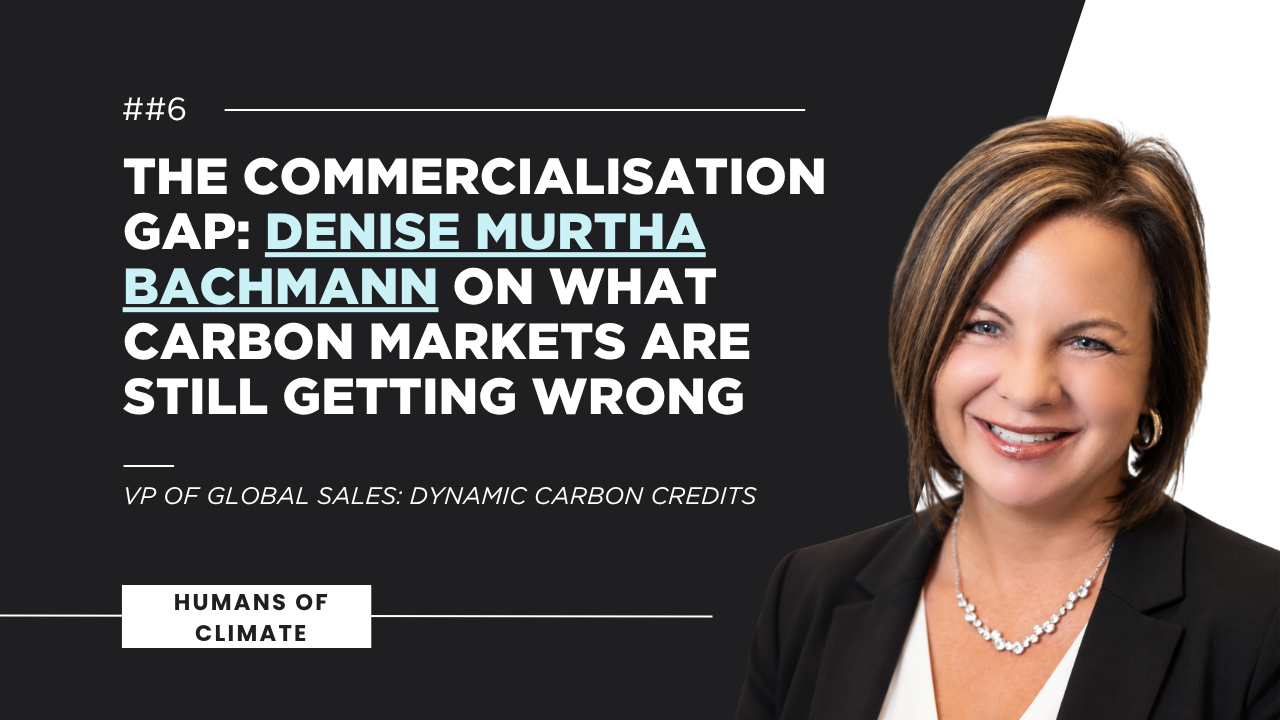
Carbon removal has a science problem, a technology problem, and a cost problem. These are the ones the industry talks about. Denise Murtha Bachmann thinks the less-discussed one is the most consequential: a commercialisation problem.
Denise Bachmann is Vice President of Global Sales at Dynamic Carbon Credits, and she brings more than 30 years in enterprise sales to a market that, she argues, has invested heavily in figuring out how to produce carbon removal and not nearly enough in figuring out how organisations can confidently buy it. She has sat across from enough buyers, CFOs, legal teams, and procurement departments to know exactly where the market’s explanations fall apart and why they keep falling apart in the same places.
Her diagnosis is specific. Carbon removal has not failed to attract interest. It has failed to build the commercial infrastructure that turns interest into transactions at scale. Fixing that, she argues, is as important as any advance in the underlying technology.
Selling Is Not the Same as Translating
When Denise Bachmann entered carbon markets, she assumed her job was selling carbon credits. She realised quickly it was something more demanding: translating an extraordinarily complex market into something a buyer could understand, trust, and ultimately defend purchasing to everyone else in their organisation.
That last part matters. A buyer may personally believe in carbon removal. But then the CFO asks what the company is paying for. Legal wants to understand the risk. Sustainability wants to understand the impact. Procurement wants to compare alternatives. Leadership wants to know why one credit costs $20 and another costs $200. A sale has to survive all of those conversations, not just the first one.
“I came in thinking my job was to sell carbon credits. I realised pretty quickly that my job was to translate an incredibly complex market into something a buyer could understand, trust, and ultimately defend purchasing.”
Her framing for the market reflects this. She describes carbon removal not as a technology market but as an emerging asset market. The science has to be credible. But for the market to scale, these assets also have to be understandable, measurable, verifiable, financeable, and easier to buy. Technology alone does not accomplish any of those things.
Diagnose Before You Prescribe
When a company says it wants to buy high-quality carbon credits, most salespeople hear a prompt to recommend a project. Denise Bachmann hears a prompt to ask a question.
Her first question is never “How many credits do you need?” It is “Why are you buying them?” The distinction reflects a sales methodology built around curiosity, active listening, and what she calls being audible-ready: prepared to respond to what the customer is actually telling you, rather than waiting to deliver a pitch.
“Recommending a carbon project before understanding the buyer’s objective is like prescribing before diagnosing. I wouldn’t do that in any other complex sale.”
The question matters because “high quality” means different things depending on what the organisation is trying to accomplish. A company addressing a compliance issue has different requirements from one building a long-term sustainability strategy. Permanence may be critical for one buyer and secondary for another. Once the why is established, everything else follows: removal versus avoidance, methodology, verification, geography, volume, and price. Without it, you are matching a buyer to a product before you understand the fit.
Carbon Market Insider Newsletter
Weekly insights on carbon markets, climate policy, carbon credits, and sustainability.
A Ton Is a Unit. It Is Not Necessarily an Asset.
One of the most persistent sources of confusion in carbon markets is price. A buyer sees a $10 credit and a $200 credit, both representing one metric ton, and asks a reasonable question: why the difference?
Denise Bachmann’s answer begins by challenging the comparison itself. Before the price question can be answered honestly, you have to establish whether the two credits are the same thing at all. Was carbon avoided or actually removed? How was it measured? What is the methodology? Who independently verified it? How durable is the removal? What is the reversal risk? What environmental co-benefits exist beyond the carbon itself?
“A ton may be the unit of measurement. That doesn’t necessarily make every ton the same asset.”
This is her central argument about where carbon markets are heading. Today, the industry largely treats carbon as a commodity, priced by the ton. She believes that framing will look inadequate in retrospect. As the market matures, the characteristics beneath the ton will matter more: how it was removed, how it was measured, how long it will remain out of the atmosphere, what risks are associated with it, and what other environmental outcomes occurred alongside it. When buyers learn to evaluate those attributes, pricing becomes significantly more sophisticated, and the commodity framing starts to break down.
The Real Reason Companies Are Not Buying
The barriers to corporate carbon removal purchases are frequently described as price, complexity, or lack of supply. Denise identifies a more precise problem: the absence of commercial infrastructure around the supply that already exists.
Consider what the market currently asks a buyer to navigate. Different credit types, methodologies, verification standards, registries, permanence frameworks, additionality requirements, pricing models, and claim structures. Then, internally, sustainability understands the environmental case but cannot speak to finance. Finance wants to understand the value but cannot assess the science. Procurement wants comparability that the market does not yet provide. Legal wants to quantify risk that is not well-documented. Leadership wants a justification for spending money that does not yet have an established language.
“When buyers don’t understand something, they don’t necessarily say no. They wait.”
The waiting looks like inaction. It is actually friction. And Bachmann’s argument is that creating more supply does not resolve friction. What does is building the infrastructure between supply and demand: better education, greater transparency, clearer standards, credible insurance and risk mechanisms, more understandable pricing, and a purchasing process that organisations can actually navigate. The industry has invested heavily in figuring out how to create carbon removals. It needs to invest equally in figuring out how to sell them.
Skepticism Is Not the Problem
Carbon markets have a trust problem, and the instinct within the industry is sometimes to treat buyer skepticism as the obstacle. Bachmann disagrees.
A company considering spending significant capital on an environmental claim should be skeptical. Asking hard questions is not obstructionism. It is exactly what a responsible buyer ought to do. The industry’s error is treating legitimate questions as objections to overcome rather than as opportunities to establish credibility.
She lists the questions that buyers ask and that the industry sometimes deflects: How do I know this carbon was actually removed? Who verified it? How was it measured? Could someone else claim the same ton? What happens if something goes wrong? Why is your credit worth five or ten times what another credit costs?
“Those aren’t objections we should try to overcome. Those are questions we should be able to answer.”
Trust, in her view, is not built by telling a buyer that a project is credible. It is built by giving them enough transparency, independent evidence, and documentation that they can reach that conclusion themselves. A credible project should welcome scrutiny, not resist it. The market earns confidence the same way any market does: by consistently delivering on what it promises and being able to prove it.
Neither Supply Nor Demand Scales Alone
A common framing of the carbon removal challenge pits supply against demand: which side needs to move faster? Bachmann rejects the premise.
Credible supply without the commercial infrastructure to support buyers does not automatically create a functioning market. Corporate demand without credible projects, consistent standards, transparent measurement, and sufficient supply cannot be satisfied responsibly. Both sides are necessary. Neither scales without what sits between them.
“Standards, verification, insurance, financing, marketplaces, pricing transparency, due diligence, procurement frameworks, buyer education. Those things aren’t as exciting to talk about as a new technology or a billion-dollar commitment. But they’re what turn buyers and sellers into a market.”
This infrastructure argument runs through everything she says about the market’s next phase. Technology advances matter. Cost reductions matter. But they do not, by themselves, build a market. Capital, consistent standards, credible verification, better risk mechanisms, purchasing infrastructure, policy support, and sustained corporate demand all have to develop alongside them. The question the industry asks most often is how to scale carbon removal. The question it needs to be asking with equal urgency is how to scale the market that buys it.
Climate Ambition Does Not Close a Deal
One of the most durable lessons from Bachmann’s career is one she brought into carbon markets from elsewhere: caring about the problem does not eliminate the business case.
People sometimes assume that because an organisation has made a public climate commitment, the purchasing decision should be straightforward. It is not. That organisation still has a CFO, a procurement department, legal counsel, shareholders, competing budgets, and a leadership team that has to justify where capital is deployed. A climate commitment opens the conversation. It does not navigate the purchasing process.
“People don’t buy because you want them to care about your solution. They buy when they understand how your solution connects to something they already care about accomplishing.”
This has direct implications for how carbon removal is sold. The sales motion cannot assume that shared values carry the transaction. It has to address the CFO’s question, the legal team’s question, the procurement team’s question, and the sustainability team’s question simultaneously. That is enterprise sales. Carbon removal is not exempt from it.
Five Questions Every Buyer Should Be Able to Answer
For a company making its first carbon removal purchase, Denise’s advice is to start with objective before product. Not “Which credit should we buy?” but “What are we trying to accomplish?”
From there: define the environmental outcome that supports the objective. Understand the methodology and whether the purchase is avoidance or removal. Ask how the outcome was measured and independently verified. Understand permanence and reversal risk. Examine chain of custody and double-counting protections. Understand the claims the purchase supports. Then look at price.
She condenses the standard a buyer should hold themselves to into five questions that any credible purchase should be able to answer plainly:
“What did we buy? Why did we buy it? What environmental outcome occurred? How do we know it occurred? And why did we believe this was an appropriate use of our capital?”
If a buyer can answer those five questions confidently in plain English, they are approaching the market responsibly. If they cannot, the due diligence was not complete, regardless of what the project documentation says. A credible project developer, she adds, should welcome those questions. Resistance to them is its own signal.
What the Market Will Realise It Got Wrong
Looking ahead, Bachmann’s sharpest prediction is about the commodity framing. She believes the industry will look back and recognise that it spent too much time thinking about carbon as a commodity and not enough time thinking about carbon credits as environmental assets with distinct, differentiable characteristics.
The price-per-ton conversation is a starting point, not an endpoint. Two credits priced identically are not the same purchase if one represents avoided emissions with a five-year shelf life and the other represents durable removal verified by an independent third party with a 500-year storage horizon. The ton is the unit. It does not capture the asset.
As the market matures and buyers develop the sophistication to evaluate what sits beneath the ton, she expects pricing to reflect those differences far more precisely. The market will not just ask what a ton of carbon is worth. It will ask what this particular environmental asset is worth, and why. That shift, when it comes, will be the signal that carbon markets have grown up.
Quick Takes
One carbon market misconception she would retire immediately: That buying more $10 credits instead of fewer $100 credits automatically means you are doing more for the environment.
One thing every carbon removal buyer should verify before purchasing: That the project actually delivers what it advertises, and that a third party independently validated and verified it.
Avoidance or removal? We need both. It depends on what the buyer is trying to accomplish.
One factor that matters more than price when evaluating a credit: Independent validation and verification of the project claims and what the project actually delivers.
One carbon removal technology she is watching most closely: Direct air capture at a scale and cost that makes it genuinely viable.
One reason buyers hesitate to purchase removals: They do not understand the difference between what they are comparing, including the technology, quality, risk, and ultimately what they are paying for.
One thing the carbon industry needs more of: Credible projects that are genuinely making a positive environmental impact, not credit-generation vehicles built around a business model.
One thing the carbon industry needs less of: Greenwashing. Projects that are not supported by credible science, rigorous measurement, and independent verification.
One skill every carbon market salesperson should develop: Listening. Stop pitching long enough to ask better questions and understand what the buyer is actually trying to accomplish.
One trend that could dramatically change carbon removal over the next five years: Carbon credits being evaluated and traded as environmental assets with distinct characteristics, rather than as an undifferentiated commodity.
One question she wishes every carbon credit buyer asked: “What exactly am I buying, and can you provide the foundational documents to support it?”
The biggest barrier to scaling removals is… “…building the trust, infrastructure, and buyer confidence necessary to turn credible removal into a functioning market. Commercialisation.”

Denise Murtha Bachmann
Denise Murtha Bachmann is a senior sales and commercialization executive with more than 30 years of experience in enterprise sales and over a decade in AI and machine learning. As Chief Revenue Officer of Dynamic Carbon Credits, she leads global revenue strategy, strategic partnerships, sales operations, and market development. Denise specializes in translating complex, emerging solutions into clear commercial strategies, building the infrastructure needed for growth, and guiding high-value opportunities from early-stage development through execution.