Carbon Market Network


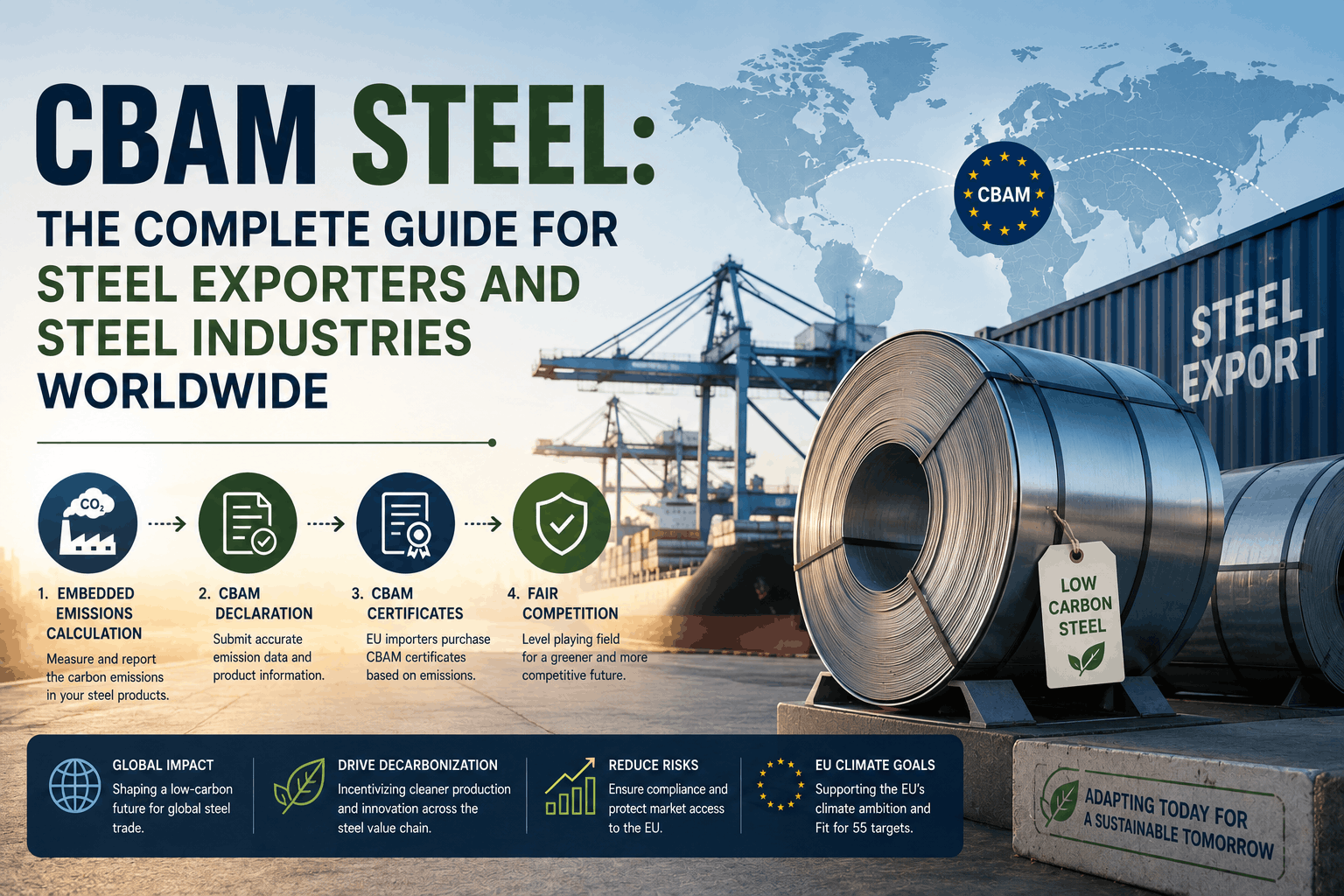
If you export steel to Europe, the rules of the game have permanently changed.
The European Union’s Carbon Border Adjustment Mechanism, known as CBAM, has entered its full compliance phase. Steel exporters everywhere, from Turkey and China to India, Ukraine, and South Korea, now face real, measurable carbon costs on every tonne of steel they ship into the EU. This is not a future threat. The financial obligations are live, the certificate prices are published, and the penalties for non-compliance are steep.
This guide breaks down everything you need to know about CBAM steel in plain, practical language. You will understand what CBAM is, why steel is at the center of it, exactly how the costs are calculated, who is most affected, and what you need to do right now to stay competitive.
What Is CBAM and Why Does Steel Matter So Much?
CBAM stands for Carbon Border Adjustment Mechanism. It is an EU regulation that places a carbon price on specific imported goods based on the greenhouse gas emissions produced during their manufacture.
The logic is straightforward. EU steel producers already pay for their carbon emissions under the EU Emissions Trading System, or EU ETS. If imported steel faces no equivalent carbon cost, foreign producers get an unfair price advantage. CBAM closes that gap.
Steel is at the absolute heart of CBAM. Iron and steel is one of the six sectors covered by the regulation, and it carries the largest trade volumes of all the covered categories. Every major steel-exporting nation ships significant tonnages to the EU. This makes CBAM steel one of the most commercially consequential environmental trade measures ever introduced.
The six sectors covered by CBAM are:
- Iron and steel
- Cement
- Aluminium
- Fertilisers
- Electricity
- Hydrogen
Steel dominates in terms of import volume and CBAM certificate demand. Countries like Russia, India, Turkey, China, and Ukraine together account for more than half of projected CBAM certificate demand by volume.
The CBAM Timeline: From Reporting to Real Costs
Understanding how CBAM evolved helps you appreciate where things stand now.
The Transitional Phase (October 2023 to December 2025)
CBAM started with a three-year transitional period. During this phase, EU importers of covered goods had to submit quarterly reports detailing the embedded emissions in their imports.
No money changed hands during this phase. It was a reporting-only obligation designed to give businesses time to build their data systems and measurement capabilities.
The Definitive Phase (From January 2026)
Everything changed on 1 January 2026. The transitional phase ended and the full compliance regime began.
From this date:
- EU importers must hold Authorised CBAM Declarant status to legally import covered goods
- Financial obligations on embedded emissions are real and accumulating
- Certificate prices are published quarterly, set against the EU ETS auction price
- Penalties of €100 per undeclared tonne apply for non-compliance
The first CBAM certificate price for Q1 2026 was set at €75.36 per tonne of CO₂ equivalent. The Q2 2026 price came in at €75.28 per tonne. These prices track the EU ETS directly and are expected to rise further as free allowances for EU producers phase out between 2026 and 2034.
The first annual declaration covering all 2026 imports is due by 30 September 2027. Certificate sales open on 1 February 2027. So while importers are not physically purchasing certificates today, every tonne of covered steel imported in 2026 is generating a financial liability that must be settled next year.
Which Steel Products Does CBAM Cover?
Not all steel products fall under CBAM. The regulation targets specific product categories identified by Combined Nomenclature, or CN, codes.
Key CBAM Steel Product Categories
| Product Category | Examples | CN Code Range |
|---|---|---|
| Semi-finished products | Billets, blooms, slabs | 7207 series |
| Flat-rolled products | Hot-rolled coil, cold-rolled sheet | 7208, 7209, 7210 |
| Long products | Rebar, wire rod, sections | 7213, 7214, 7216 |
| Tubes and pipes | Seamless and welded | 7304, 7306 |
| Structural products | Beams, angles, frames | 7308 |
| Fasteners and fittings | Bolts, nuts, screws | 7318 |
One important exclusion: ferrous waste and scrap (CN heading 7204) is excluded from CBAM because scrap material is assigned zero embedded emissions under the methodology. This creates a direct compliance advantage for EAF producers who use high proportions of recycled scrap.
The Downstream Expansion Is Coming
The European Commission has already proposed expanding CBAM to cover approximately 180 additional steel-intensive downstream products. These include goods like automotive parts, machinery components, and other manufactured items that contain significant quantities of iron, steel, or aluminium.
This expansion, proposed in December 2025, is not yet enacted. However, exporters of steel-intensive manufactured goods should monitor its progress. If it passes, the CBAM universe for steel will grow dramatically from 2028 onward.
How Are CBAM Steel Emissions Calculated?
This is where many exporters feel overwhelmed. The calculation methodology is detailed, but the core logic is not complicated once you understand the framework.
Direct vs Indirect Emissions
For steel, CBAM covers direct emissions only (Scope 1). This means the CO₂ emitted directly during the steelmaking process.
Unlike cement and fertilisers, which also include indirect emissions from electricity used in production, steel and aluminium are currently assessed on direct emissions only. This reflects the complexity of accurately attributing electricity-related carbon across diverse grid conditions globally.
The Three Production Route Benchmarks
CBAM uses three official benchmark values for steel, set under Implementing Regulation (EU) 2025/2621. These benchmarks represent the default embedded emissions for each major production route.
| Production Route | Official Benchmark | Notes |
|---|---|---|
| Blast Furnace / Basic Oxygen Furnace (BF-BOF) | 1.370 tCO₂e per tonne of crude steel | Highest carbon intensity route |
| Direct Reduced Iron / Electric Arc Furnace (DRI-EAF) | 0.481 tCO₂e per tonne | Natural gas DRI-based route |
| Scrap-based Electric Arc Furnace (Scrap-EAF) | 0.072 tCO₂e per tonne | Lowest carbon intensity route |
A plant is classified as BF-BOF if more than 50% of the crude steel mass comes from blast furnace pig iron. It is DRI-EAF if more than 50% comes from direct reduced iron. And it is Scrap-EAF if more than 50% comes from recycled scrap material.
What This Means in Euros
At the current certificate price of around €75 per tonne of CO₂:
| Production Route | Gross CBAM Cost per Tonne of Steel |
|---|---|
| BF-BOF | ~€103 per tonne (gross) |
| DRI-EAF | ~€36 per tonne (gross) |
| Scrap-EAF | ~€5 per tonne (gross) |
Important: In 2026, EU producers still retain 97.5% of their free ETS allowances. This means the net cost to EU importers in 2026 is multiplied by a CBAM factor of just 2.5%. So the effective net cost for BF-BOF steel in 2026 is approximately €2.50 per tonne.
However, this factor increases every year as free allowances phase out. By 2030 the factor reaches 48.5%, and by 2034 it reaches 100%. At full exposure, BF-BOF steel producers will face CBAM costs potentially exceeding €100 per tonne. This is why building compliance readiness now matters enormously.
Actual Values vs Default Values
Exporters can provide verified actual emissions data instead of using default benchmarks. This almost always results in lower declared emissions for efficient producers, reducing the certificate burden on their EU importer customers.
Using default values is penalising by design. Default values are set conservatively, typically 10 to 30% above industry average. Producers who cannot or do not provide verified data pay more. Producers who invest in measurement and verification gain a direct commercial advantage over competitors relying on defaults.
The Precursor Rule
For complex steel products, CBAM tracks embedded emissions across the full production chain. If a Turkish rolling mill takes Indian hot-rolled coil and processes it into cold-rolled sheet for EU export, the CBAM obligation applies to the cold-rolled product’s embedded carbon, including the carbon embedded in the hot-rolled input from India.
This means the entire upstream production chain’s emissions must be documented and attributed to the final product entering the EU.
Who Carries the CBAM Burden: Importers vs Exporters?
This is one of the most misunderstood aspects of CBAM.
Legally, the obligation falls on the EU importer. It is the EU buyer who must hold Authorised CBAM Declarant status, purchase certificates, and submit annual declarations.
Practically, the burden falls on the non-EU steel producer. Without accurate, verified emissions data from the exporting installation, the EU importer has no choice but to use conservative default values, which means higher costs. And higher costs mean the EU buyer starts looking for alternatives.
Steel producers in Turkey, China, India, Ukraine, and South Korea who do not invest in emissions monitoring and verification are effectively pricing themselves out of the EU market. The steel mills that survive the CBAM era are the ones whose emissions data is traceable, verifiable, and formatted to meet EU compliance requirements.
What Non-EU Steel Producers Need to Provide
- Installation-level emissions data calculated using EU-prescribed methodology
- Documentation of the production route (BF-BOF, DRI-EAF, or Scrap-EAF)
- Scrap content records (high scrap content directly reduces the embedded emissions figure)
- Third-party verified actual emission values where applicable
- Support for precursor emissions tracing where the product is a processed downstream good
CBAM Steel Compliance: Step-by-Step Guide for EU Importers
If you are an EU importer of steel, here is exactly what you need to do.
Step 1: Determine If You Are Above the Exemption Threshold
Importers whose total annual imports of CBAM goods across iron, steel, aluminium, cement, and fertilisers do not exceed 50 tonnes are exempt from CBAM certificate and declaration obligations. They must still self-identify as occasional CBAM importers in their customs declarations.
If you import more than 50 tonnes annually, you need to proceed through the full compliance pathway.
Step 2: Obtain Authorised CBAM Declarant Status
Only entities holding Authorised CBAM Declarant status can legally import covered steel goods into the EU. This status is granted by the National Competent Authority in your member state of establishment.
The March 2026 application deadline has now passed. Importers who did not apply in time are not authorized to import CBAM goods and face higher penalty rates. If you have not yet applied, do so immediately through your national authority.
Step 3: Collect Emissions Data from Your Suppliers
Work with your non-EU steel suppliers to collect installation-level embedded emissions data. Request:
- The production route classification
- Actual direct emissions per tonne of steel produced
- Scrap content percentages
- Third-party verification reports where available
If suppliers cannot provide verified data, you will default to the benchmark values, which increases your certificate costs.
Step 4: Calculate Your CBAM Exposure
Use the formula:
CBAM Cost = Quantity (tonnes) × Embedded Emissions (tCO₂e per tonne) × Certificate Price (€/tCO₂e) × CBAM Factor
In 2026, the CBAM factor is 2.5%. This rises each year through 2034 when it reaches 100%.
Step 5: Register in the CBAM Registry
Access the CBAM Registry through your national competent authority. The registry is the system through which you manage your certificates, submit declarations, and demonstrate compliance.
Step 6: Purchase CBAM Certificates
Certificate sales open on 1 February 2027 for 2026 imports. You purchase certificates at the quarterly average EU ETS auction price for the period in which the goods were imported. Certificates cannot be traded between importers. There is no secondary market.
You must hold certificates covering at least 50% of cumulative embedded emissions at the end of each quarter from 2027 onward.
Step 7: Submit Your Annual Declaration
The first annual CBAM declaration, covering all 2026 imports, is due by 30 September 2027. The declaration must specify:
- Total quantity of CBAM steel goods imported by CN code and country of origin
- Total specific embedded emissions by goods type
- Total CBAM certificates to be surrendered
- Any Article 9 carbon price deductions claimed
- References to verification reports
Step 8: Surrender Certificates
At the time of filing your declaration, you surrender certificates equal to the net verified embedded emissions of your imports. If you have overpurchased, you can sell back up to 50% of certificates purchased in that calendar year at the original purchase price. The buyback deadline is 31 October of the surrender year.
The Financial Penalty for Non-Compliance
The penalty for failing to hold and surrender sufficient CBAM certificates is €100 per tonne of excess CO₂ equivalent, with no upper cap.
On top of the financial penalty, non-compliant importers face administrative fines and mandatory third-party audits at their own expense. Importers who did not obtain authorisation by the deadline face even higher penalty rates.
These are not theoretical risks. The European Commission has invested significantly in IT systems and cross-referencing capabilities to match customs import data against CBAM declarations.
Which Countries Are Most Affected by CBAM Steel?
The impact of CBAM varies significantly by country, depending on the carbon intensity of domestic steel production, the presence or absence of domestic carbon pricing, and the volume of steel exported to the EU.
Countries Facing the Highest CBAM Exposure
| Country | Key Challenge | Production Route | Carbon Pricing |
|---|---|---|---|
| China | Very high BF-BOF share, large EU export volumes | Predominantly BF-BOF | Domestic ETS exists but price far below EU ETS |
| India | High BF-BOF share, no domestic carbon price, large EU steel export share | Predominantly BF-BOF | No carbon price applied to steel |
| Ukraine | Significant EU export volumes, carbon-intensive mills | BF-BOF | Limited domestic carbon pricing |
| Russia | Major exporter historically, sanctions complicate picture | Mostly BF-BOF | Minimal carbon price |
| Turkey | Largest single CBAM steel case, high scrap-EAF share mitigates cost | Mixed: significant EAF share | Developing carbon pricing framework |
Turkey is an interesting case. Because Turkish steel production has a higher proportion of scrap-EAF, its per-tonne CBAM cost is substantially lower than that of BF-BOF dominant producers. But Turkey still represents the most commercially significant CBAM steel case in terms of absolute EU trade volumes.
Countries developing domestic carbon pricing, including Turkey and Brazil, stand to reduce their CBAM exposure through the Article 9 deduction mechanism, which allows importers to offset the carbon price already paid in the country of origin.
The Article 9 Carbon Price Deduction
If a non-EU steel producer has paid a legally binding domestic carbon price on the specific embedded emissions of the exported goods, the EU importer can apply an Article 9 deduction to reduce the number of certificates to surrender.
This deduction reflects CBAM’s design as a mechanism to equalise carbon costs globally, not to punish exporters twice. Countries that implement credible carbon pricing systems reduce the CBAM burden on their steel industries.
The BF-BOF vs EAF Divide: Why Production Route Is Everything
The gap in CBAM costs between production routes is enormous. And it will only widen.
A BF-BOF steel plant carries a benchmark of 1.370 tCO₂e per tonne. A scrap-EAF plant carries just 0.072 tCO₂e per tonne. That is a nearly 20-fold difference in embedded carbon intensity.
At a certificate price of €75 per tonne:
- BF-BOF: roughly €103 gross cost per tonne of steel
- Scrap-EAF: roughly €5 gross cost per tonne of steel
As the CBAM factor rises toward 100% by 2034, this cost difference becomes existential for high-carbon producers.
The Green Steel Advantage
Producers investing in low-carbon production routes gain a structural competitive advantage under CBAM. The key pathways are:
Scrap-EAF with renewable electricity: The lowest-carbon route available today. Zero embedded carbon from scrap inputs plus near-zero process emissions from renewable electricity. The 0.072 tCO₂e benchmark covers only direct process emissions from the EAF operation itself.
Hydrogen DRI-EAF: Using green hydrogen to produce direct reduced iron and then melting in an electric arc furnace achieves 90 to 95% CO₂ reduction versus BF-BOF. Commercial viability improves as green hydrogen costs fall. Analysis suggests H₂-DRI-EAF in locations with cheap renewable electricity and iron ore, such as parts of northern Scandinavia, Portugal, Spain, and the MENA region, may reach cost parity with conventional BF-BOF steel under CBAM conditions before 2035.
Natural gas DRI as a bridge: For producers not yet ready to switch to green hydrogen, natural gas-based DRI at 0.481 tCO₂e per tonne still offers a substantial CBAM cost advantage over BF-BOF. It also provides infrastructure that can transition toward hydrogen injection as green hydrogen costs fall.
China’s steel industry illustrates the urgency. Traditional BF-BOF plants in China typically emit between 1.8 and 2.2 tonnes of CO₂ per tonne of crude steel, far above the CBAM benchmark. However, leading Chinese producers like HBIS Group are now deploying hydrogen metallurgy and exporting the first batches of CBAM-compliant green steel to Europe. The producers who move first gain market access that laggards lose.
The UK CBAM: Parallel Obligations Coming
Steel exporters supplying both EU and UK markets need to plan for two separate carbon border regimes.
The United Kingdom is implementing its own CBAM, currently expected to launch on 1 January 2027. UK CBAM will initially cover the same core sectors as EU CBAM, including iron and steel, aluminium, ceramics, cement, glass, fertilisers, and hydrogen.
The infrastructure built for EU CBAM compliance will serve UK CBAM compliance as well, making the investment in verified data systems more commercially valuable across both markets. But exporters need to recognise that these are two separate legal frameworks with separate authorisation, declaration, and certificate requirements.
What the CBAM Omnibus Simplification Changes
In 2025, the European Commission introduced a significant simplification package under Regulation (EU) 2025/2083, known as the Omnibus Simplification. This amended the original CBAM regulation to reduce administrative burden while preserving environmental objectives.
Key changes that affect steel importers and exporters:
The 50-tonne exemption threshold. The Omnibus replaced a previous value-based threshold with a single mass-based threshold. Importers whose total annual CBAM imports do not exceed 50 tonnes are exempt. This exempts roughly 90% of all importers by number, though the exempt importers account for a small fraction of total CBAM goods by volume.
Extended declaration deadline. The annual CBAM declaration and certificate surrender deadline has been extended to 30 September of the year following importation, replacing the original 31 May deadline. This gives importers additional time to verify data.
Reduced quarterly holding requirement. The Omnibus reduced the minimum certificate holding requirement from 80% to 50% of cumulative embedded emissions at each quarter-end from 2027 onward.
Delayed certificate sales. Certificate sales begin on 1 February 2027 rather than being required from day one of 2026. This means no actual certificate purchases occur in 2026, even though the financial liability is accumulating.
Simplified default values. New country-specific and sector-specific default values are published under Implementing Regulation (EU) 2025/2621, making it clearer what penalty-level costs apply when verified data is unavailable.
Strategic Opportunities CBAM Creates for Steel Producers
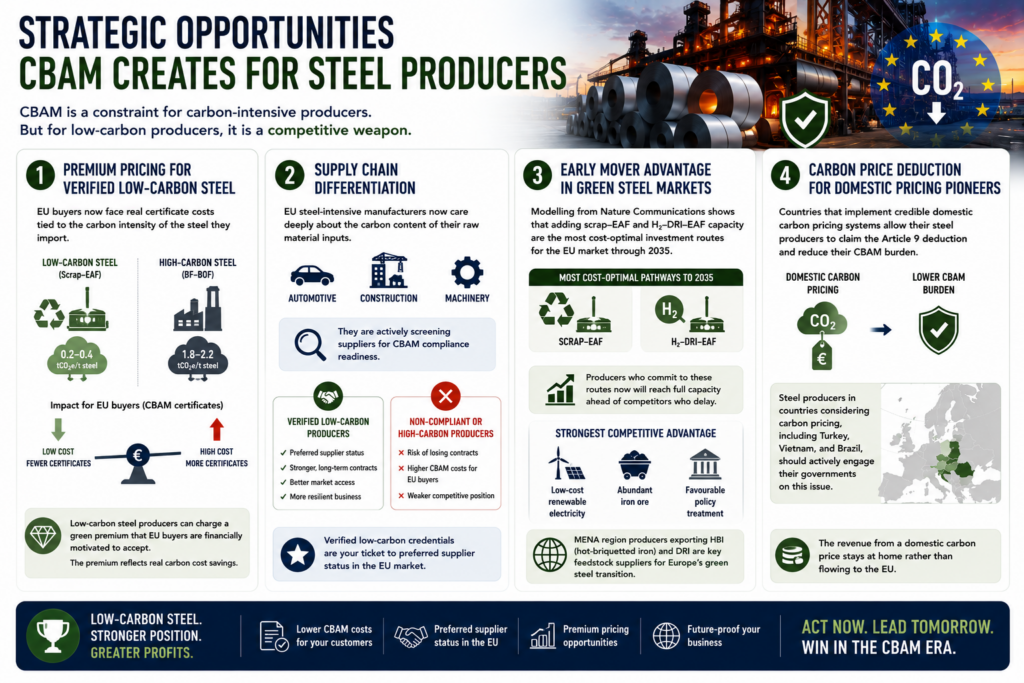
CBAM is a constraint for carbon-intensive producers. But for low-carbon producers, it is a competitive weapon.
Opportunity 1: Premium Pricing for Verified Low-Carbon Steel
EU buyers now face real certificate costs tied to the carbon intensity of the steel they import. A buyer who sources from a scrap-EAF producer with verified low emissions pays dramatically fewer certificates than a buyer sourcing from a BF-BOF producer.
This means low-carbon steel producers can charge a green premium that EU buyers are financially motivated to accept. The premium reflects real carbon cost savings.
Opportunity 2: Supply Chain Differentiation
Steel-intensive manufacturers in the EU who buy imported steel for further processing, such as automotive, construction, and machinery companies, now care deeply about the carbon content of their raw material inputs. They are actively screening suppliers for CBAM compliance readiness.
Non-EU steel producers who can demonstrate verified, low-carbon credentials gain preferred supplier status. Those who cannot risk losing contracts as EU manufacturers seek to manage their own CBAM exposure in the proposed downstream expansion.
Opportunity 3: Early Mover Advantage in Green Steel Markets
Modelling from Nature Communications research shows that adding scrap-EAF and H₂-DRI-EAF capacity are the most cost-optimal investment routes for steel producers targeting the EU market through 2035. Producers who commit to these routes now will reach full production capacity ahead of competitors who delay.
The locations with the strongest competitive advantage for green steel are those with access to low-cost renewable electricity, abundant iron ore, and favourable policy treatment. MENA region producers exporting HBI (hot-briquetted iron) and DRI are already being discussed as critical feedstock suppliers for Europe’s green steel transition.
Opportunity 4: Carbon Price Deduction for Domestic Pricing Pioneers
Countries that implement credible domestic carbon pricing systems allow their steel producers to claim the Article 9 deduction and reduce their CBAM burden. Steel producers in countries considering carbon pricing, including Turkey, Vietnam, and Brazil, should actively engage their governments on this issue. The revenue from a domestic carbon price stays at home rather than flowing to the EU.
Practical Action Plan for Steel Exporters Right Now
If you are a non-EU steel producer exporting to the EU, here is what you need to prioritise immediately.
Map your production installations. Identify every installation that produces steel destined for the EU. Understand which CN codes your products fall under and which CBAM benchmark applies.
Start measuring actual emissions. Do not wait to be asked. Build the monitoring capability to measure actual direct emissions at installation level. Use the EU-prescribed methodology so your data is verifiable and accepted.
Engage accredited verifiers. Third-party verification is mandatory when using actual emissions. Identify accredited verifiers in your region who are registered under the CBAM requirements. Start building these relationships now.
Register your installations in the CBAM Registry. Non-EU producers can register their production installations in the CBAM Registry for secure, standardised data sharing with EU importer customers. This makes the data transfer process smoother and the relationship with EU buyers more reliable.
Calculate your CBAM exposure by customer. Work through the financial impact of CBAM on your EU sales by customer and by product. Understand where your exposure is highest and factor carbon costs into your pricing negotiations.
Engage your EU importer partners. Do not leave EU buyers to figure this out alone. Proactive data sharing and compliance support strengthens the relationship and reduces the risk of buyers switching to lower-carbon or domestic alternatives.
Document your scrap content. If you use significant quantities of recycled scrap, document the scrap percentages rigorously. High scrap content directly reduces your embedded emissions figure. Pre-consumer and post-consumer scrap both carry zero embedded carbon under CBAM methodology.
Plan your long-term route. Look at your production route and assess where it sits relative to the three benchmarks. If you are BF-BOF and exporting significant volumes to the EU, model what the cost looks like at 50% CBAM factor (around 2030) and at 100% (2034). The results should inform your investment decisions now.
CBAM Steel: Key Numbers at a Glance
| Metric | Figure |
|---|---|
| CBAM definitive phase start | 1 January 2026 |
| Q1 2026 certificate price | €75.36 per tCO₂e |
| Q2 2026 certificate price | €75.28 per tCO₂e |
| BF-BOF benchmark | 1.370 tCO₂e per tonne of crude steel |
| DRI-EAF benchmark | 0.481 tCO₂e per tonne |
| Scrap-EAF benchmark | 0.072 tCO₂e per tonne |
| CBAM factor in 2026 | 2.5% |
| CBAM factor in 2030 | 48.5% |
| CBAM factor in 2034 | 100% |
| Annual declaration deadline | 30 September (for prior year) |
| Certificate sales open | 1 February 2027 |
| Non-compliance penalty | €100 per undeclared tCO₂e |
| Exemption threshold | 50 tonnes per year |
| Proposed downstream expansion | ~180 products from 2028 |
| Penalty reduction for ETS domestic price | Article 9 deduction applies |
Frequently Asked Questions About CBAM Steel
What is CBAM steel in simple terms?
CBAM steel means that when steel is exported to the EU, the EU importer must pay for the carbon emissions that were released during its production. The cost is based on the EU carbon price. The goal is to prevent countries with lower environmental standards from having an unfair price advantage over EU steel producers who already pay for their emissions.
Does CBAM apply to all steel exported to the EU?
CBAM applies to specific steel products identified by their CN codes, including semi-finished goods, flat-rolled products, long products, tubes and pipes, and structural items. Scrap steel itself is excluded. Importers below the 50-tonne annual threshold are also exempt.
How much does CBAM add to the cost of imported steel?
In 2026, the net addition is modest because EU producers still retain 97.5% of their free carbon allowances. A BF-BOF tonne of steel with verified actual emissions close to the benchmark adds roughly €2 to €3 net per tonne in 2026. By 2030, that same tonne adds roughly €50 to €60 net. By 2034, the full gross cost applies, potentially exceeding €100 per tonne for BF-BOF producers.
What happens if a steel exporter does not provide verified emissions data?
Their EU importer customer is forced to use default benchmark values, which are deliberately set above industry average. This results in higher certificate costs for the EU importer, who will either pass the cost to the exporter through lower prices or seek a different supplier who can provide verified low-carbon data.
Can a non-EU steel producer register directly in the CBAM Registry?
Yes. Non-EU producers can register their production installations in the CBAM Registry to share emissions data directly and securely with EU importers. This is not mandatory, but it simplifies compliance and strengthens commercial relationships.
Does a domestic carbon price in the exporting country reduce CBAM costs?
Yes. Under Article 9 of the CBAM regulation (refer), if a steel producer has paid a legally binding domestic carbon price on the specific embedded emissions of the exported goods, the EU importer can deduct this from the certificates they need to surrender. Countries with credible carbon pricing systems directly benefit their steel exporters.
When do CBAM certificates actually need to be purchased?
Certificate sales open on 1 February 2027. The first surrender deadline is 30 September 2027 for all 2026 imports. Even though financial obligations started accumulating from 1 January 2026, no actual certificate purchases occur during 2026.
Will CBAM expand beyond the current steel product list?
The European Commission has already proposed expanding CBAM to approximately 180 additional steel-intensive downstream products, including automotive parts and machinery components. This proposed expansion has not yet been enacted but is expected to apply from 2028 if adopted. Steel exporters in adjacent product categories should monitor this closely.
Is the UK introducing a CBAM similar to the EU version?
Yes. The UK is implementing its own Carbon Border Adjustment Mechanism, expected to launch on 1 January 2027. It covers broadly the same sectors as EU CBAM, including iron and steel. Non-EU exporters supplying both markets will face parallel compliance obligations.
What is the penalty for non-compliance with CBAM?
The penalty is €100 per tonne of CO₂ equivalent for certificates not surrendered, with no upper cap. Additional administrative penalties and mandatory audits can also apply. Importers who did not obtain authorisation by the March 2026 deadline face elevated penalty rates.
Conclusion: CBAM Steel Is a Turning Point for Global Trade
CBAM steel is not just another regulatory hurdle. It is a structural shift in how the global steel trade works.
For the first time, the carbon intensity of steel production has a direct, legally mandated price tag at the point of EU market entry. This changes the competitive landscape permanently. BF-BOF producers who export to Europe without adapting will lose ground to scrap-EAF producers, green steel pioneers, and domestic EU mills that no longer face the carbon cost disadvantage they once did.
The window to act is open right now. Producers who invest in verified emissions measurement, production route optimisation, and supplier data partnerships today will carry a growing competitive advantage as CBAM factor rates rise year by year. Those who delay will find their cost position eroding and their EU market access shrinking.
For steel exporters, importers, buyers, and policy watchers alike, CBAM steel is one of the most important developments in the global steel industry in decades. Understanding it is the first step. Acting on it is what separates the leaders from the laggards.
For more in-depth analysis of carbon markets, CBAM, and the global decarbonisation of heavy industry, visit Carbon Market Network.