Carbon Market Network


Your Scope 1 and Scope 2 numbers are done. Then someone asks about your value chain, and the spreadsheet falls apart.
That moment is why Scope 3 emissions software exists.
Scope 3 covers every emission your company causes but does not directly control. That includes your suppliers, your shipping partners, your employees’ commutes and how customers use your products.
For most businesses, this is the biggest part of the carbon footprint. It is also the hardest to measure.
This guide explains what Scope 3 emissions software does, which platforms lead the market, and how to choose one without wasting a year on the wrong tool.
You will find honest strengths and limits for each platform. You will also find a step-by-step buying process, a rollout plan and answers to the questions people search for most.
What Is Scope 3 Emissions Software?
Scope 3 emissions software is a digital platform that helps companies measure, track, report and reduce the indirect emissions in their value chain.
It replaces scattered spreadsheets with one system. That system pulls in spend data, purchase records, supplier information and activity data, then converts them into carbon figures.
Most tools follow the GHG Protocol Corporate Value Chain (Scope 3) Standard. That is the global rulebook for value chain accounting.
You may also see these tools called:
- Scope 3 carbon accounting software
- Value chain emissions software
- Supply chain emissions software
- Carbon management software with Scope 3 modules
- Scope 3 emissions calculation tools
Some platforms only do carbon accounting. Others cover the full job, from data collection to supplier engagement to reduction planning.
Carbon Market Insider Newsletter
Weekly insights on carbon markets, climate policy, carbon credits, and sustainability.
Why Scope 3 Is So Hard to Measure
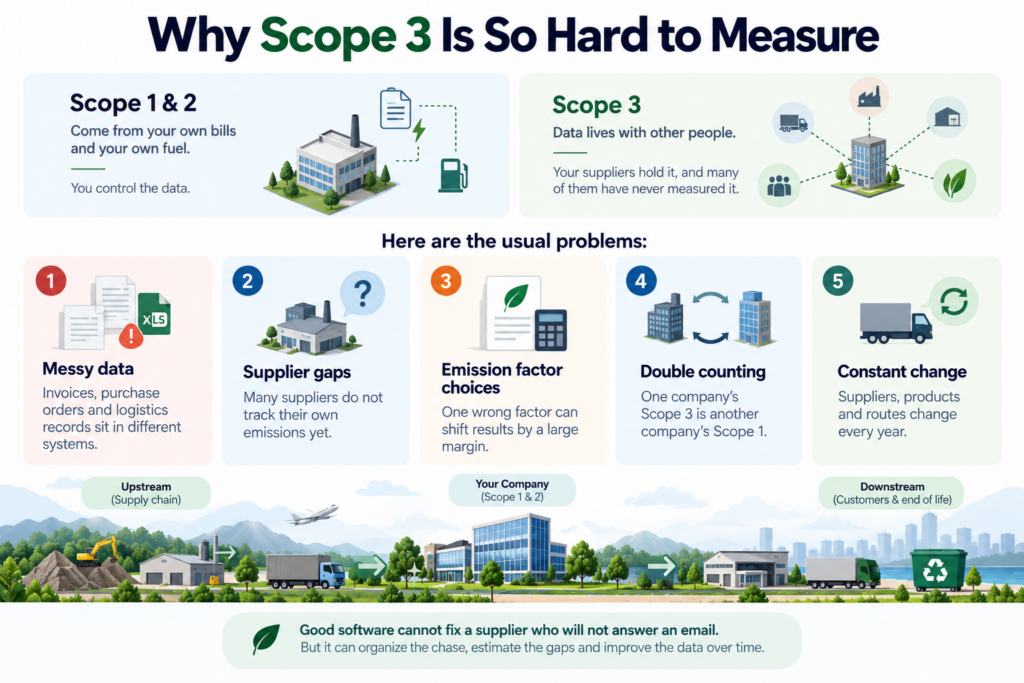
Scope 1 and 2 come from your own bills and your own fuel. You control the data.
Scope 3 data lives with other people. Your suppliers hold it, and many of them have never measured it.
Here are the usual problems:
- Messy data. Invoices, purchase orders and logistics records sit in different systems.
- Supplier gaps. Many suppliers do not track their own emissions yet.
- Emission factor choices. One wrong factor can shift results by a large margin.
- Double counting. One company’s Scope 3 is another company’s Scope 1.
- Constant change. Suppliers, products and routes change every year.
Good software cannot fix a supplier who will not answer an email. But it can organize the chase, estimate the gaps and improve the data over time.
The 15 Scope 3 Categories at a Glance
The GHG Protocol splits Scope 3 into 15 categories. Eight are upstream (before your operations) and seven are downstream (after).
Your software should cover all of them, even if only a few matter to you.
| # | Category | Direction | Typical data source |
|---|---|---|---|
| 1 | Purchased goods and services | Upstream | Spend data, supplier data |
| 2 | Capital goods | Upstream | Asset register, spend data |
| 3 | Fuel and energy related activities | Upstream | Scope 1 and 2 data |
| 4 | Upstream transportation and distribution | Upstream | Freight records, spend data |
| 5 | Waste generated in operations | Upstream | Waste contractor reports |
| 6 | Business travel | Upstream | Travel booking data |
| 7 | Employee commuting | Upstream | Surveys, HR data |
| 8 | Upstream leased assets | Upstream | Lease records |
| 9 | Downstream transportation and distribution | Downstream | Shipping data |
| 10 | Processing of sold products | Downstream | Customer data, estimates |
| 11 | Use of sold products | Downstream | Product specs, usage models |
| 12 | End-of-life treatment of sold products | Downstream | Product weight, waste models |
| 13 | Downstream leased assets | Downstream | Lease records |
| 14 | Franchises | Downstream | Franchisee data |
| 15 | Investments | Downstream | Portfolio data |
For many manufacturers and retailers, Category 1 (purchased goods and services) is the heavy hitter. For banks and asset managers, Category 15 usually dominates.
You do not need to report every category. You must report the ones that are relevant to your business and explain any you exclude.
Why Companies Need Scope 3 Emissions Software Now
Five forces push companies toward dedicated tools.
1. Regulation Keeps Expanding
Disclosure rules around the world now reach into the value chain.
- EU CSRD. The ESRS E1 climate standard asks in-scope companies to report Scope 3 where it is material. The EU has narrowed which companies must report, but the Scope 3 expectation itself remains.
- California SB 253. Large companies doing business in California must report Scope 1 and 2 first, then Scope 3 in later cycles.
- ISSB (IFRS S2). Many countries use this global baseline, and it asks for Scope 3 disclosure with some transition relief.
- Other regimes. Australia, the UK, Japan, Singapore and others are building similar rules.
Rules change often. Always check the current status for the countries where you operate.
2. Customers Are Asking
Big buyers now send supplier questionnaires. If you sell to large retailers, automakers or tech firms, expect questions about your product footprint.
Even small suppliers feel this pressure. Good software helps you answer with confidence.
3. Climate Targets Depend on It
The Science Based Targets initiative has traditionally asked companies to set Scope 3 targets when value chain emissions make up a large share of their total, with 40 percent as the long-standing threshold.
You cannot set a target without a baseline. You cannot track progress without repeat measurement.
4. Investors Want Proof
Lenders and investors compare climate data across companies. Weak or missing Scope 3 numbers raise questions.
5. Reduction Opportunities Hide in the Data
The real prize is not the report. It is finding the supplier, material or shipping lane that drives most of your emissions.
Once you see the hotspot, you can act on it.
How Scope 3 Calculation Methods Work
Every Scope 3 platform uses a mix of methods. Knowing them helps you judge any vendor’s claims.
| Method | How it works | Accuracy | Effort | Best use |
|---|---|---|---|---|
| Spend-based | Multiplies money spent by an emission factor for that spending type | Low | Low | First baseline, low-impact categories |
| Average-data | Multiplies physical quantities (kilograms, kilometers) by average factors | Medium | Medium | Materials, freight, waste |
| Supplier-specific | Uses emissions data reported by the supplier | High | High | Top suppliers, key products |
| Hybrid | Mixes the methods above across categories and suppliers | Medium to high | Medium | Most real programs |
Most companies start with spend-based estimates. That is fine.
The goal is to move toward supplier-specific data for the parts that matter most.
Strong software supports that journey. It lets you start fast and upgrade data quality over time.
What to Look for in Scope 3 Emissions Software
Do not buy on a logo or a flashy demo. Check these features first.
Core Features
- Coverage of all 15 categories. Each category should have multiple calculation methods.
- Spend, activity and supplier data support. You need all three as your program matures.
- Transparent emission factors. You should see which factor was applied and where it came from.
- Audit trail. Every number should trace back to its source data.
- Data import tools. Look for connections to ERP, procurement, accounting, travel and HR systems.
Supplier Engagement Features
- Supplier invitations and questionnaires
- Support for product carbon footprint data
- Tracking of supplier response rates
- Tools to validate what suppliers send
- Ways to share reduction goals with suppliers
Reporting and Compliance
- Alignment with GHG Protocol, CSRD or ESRS, ISSB, CDP and SBTi
- Exportable reports and disclosure templates
- Support for external assurance and audit
- Version control for restated data
Reduction and Planning
- Hotspot analysis by supplier, product, material or region
- Scenario modeling
- Target setting
- Progress tracking
Practical Concerns
- Ease of use. Can a non-expert on your team run it?
- Support quality. Do you get a real expert, or only a help center?
- Security. Look for clear data protection practices.
- Scalability. Will it handle more entities, countries and suppliers next year?
- Pricing clarity. Ask what is included and what costs extra.
Best Scope 3 Emissions Software Platforms
Here is a close look at the leading platforms. They differ in focus, size and style.
No single tool wins for everyone. The right pick depends on your industry, data and team.
Quick Comparison Table
| Platform | Best for | Standout strength | Watch out for |
|---|---|---|---|
| Watershed | Large enterprises | Decarbonization programs and expert advisory | Works best with an in-house sustainability team |
| Persefoni | Finance and audit-focused firms | Audit-ready accounting and financed emissions | Less supplier-facing than some rivals |
| Normative | Scope 3 and supply chain depth | Supplier engagement and science-based method | May suit data-mature teams best |
| Sweep | Complex groups with many teams | Collaborative data model across entities | Full value shows with broad internal rollout |
| Greenly | Small to mid-sized companies | Fast setup and supplier database matching | Check depth for very complex enterprises |
| Plan A | European companies | Compliance focus and reduction planning | Check supplier engagement depth for large supply bases |
| IBM Envizi | Data-heavy enterprises | Consolidating large volumes of data | Often needs more setup effort |
| Salesforce Net Zero Cloud | Salesforce users | Fits inside the Salesforce ecosystem | Best if your team already lives in Salesforce |
| Sphera | Product-focused manufacturers | Lifecycle assessment depth | Broader suite than a pure carbon tool |
| Green Project Technologies | Procurement-led programs | Supplier mobilization tied to categories | Value depends on committed supplier engagement |
| EcoVadis | Supplier assessment at scale | Large supplier network | Not a standalone carbon calculation engine |
1. Watershed
Watershed is one of the best known enterprise carbon platforms. It was founded in the United States and serves large global companies.
Strengths
- Strong Scope 3 measurement using spend data and supplier data
- Scenario modeling for reduction planning
- Streamlined reporting across major frameworks
- A named advisory team that helps with strategy
Limits
- Built for scale, so it suits companies with an established sustainability team
- Smaller businesses may find it more than they need
Best for: Large enterprises that want to go beyond reporting and run a serious reduction program.
2. Persefoni
Persefoni is a carbon accounting platform with strong roots in finance. It is popular with firms that need numbers an auditor will trust.
Strengths
- Audit-ready carbon ledger approach
- Support for Scope 1, 2 and 3 across several disclosure frameworks
- Financed emissions analytics for banks and investors
- Support for moving from spend-based estimates toward supplier data
- An embedded AI assistant for anomaly checks and technical questions
Limits
- Less focused on supplier-facing workflows than some competitors
- Smaller companies may not need all its depth
Best for: Financial institutions and any company whose top priority is rigorous, defensible reporting.
3. Normative
Normative is a European platform with a strong reputation for Scope 3 accuracy. It leans on science-based methods and supplier data.
Strengths
- Strong focus on supply chain transparency
- Supplier engagement tools to improve data quality
- Product-level footprint capability
- Expert guidance on climate strategy
Limits
- Teams new to carbon accounting may need support to use it well
- Some buyers want a broader sustainability suite
Best for: Companies where Scope 3 supplier accuracy is the top priority.
4. Sweep
Sweep is a French sustainability data platform. Its design focuses on cross-team collaboration.
Strengths
- Flexible data model that adapts to complex company structures
- Workflows for collecting and validating data from many teams
- Carbon and wider ESG data in one system
- Good fit for multi-framework reporting
Limits
- You get the most value when many teams join in
- Buyers who only need carbon accounting may not use every feature
Best for: Groups with many entities and many data owners.
5. Greenly
Greenly is a French platform that serves small, mid-sized and growing companies. It aims for fast setup.
Strengths
- Quick path from spreadsheets to a working carbon program
- A large database of suppliers and supplier-specific factors that can match part of your footprint before you contact anyone
- Spend-based and activity-based methods
- Expert review included in the subscription
Limits
- Very large, complex enterprises should test enterprise controls closely
- Depth of primary data exchange for complex categories deserves a close look
Best for: Growing companies that want practical progress without a long implementation.
6. Plan A
Plan A is a European platform built around carbon accounting and reduction planning. It places strong weight on regulatory awareness.
Strengths
- Focus on compliance with European requirements
- Scenario modeling and reduction roadmaps
- Supplier engagement workflows
Limits
- Large supply bases may need deeper supplier tools
- Check integrations with your enterprise systems
Best for: European companies that need accounting and a reduction plan together.
7. IBM Envizi
Envizi is a sustainability data platform that now sits within IBM. It is known for consolidating large and varied data sets.
Strengths
- Strong data consolidation across sites and sources
- Suits enterprises with many facilities and complex systems
- Backed by a large technology vendor
Limits
- Often needs more setup and technical involvement
- May feel heavy for small teams
Best for: Large organizations with lots of data in lots of places.
8. Salesforce Net Zero Cloud
Net Zero Cloud is Salesforce’s carbon accounting product. It includes Scope 3 and supply chain management features.
Strengths
- Lives inside the Salesforce platform your teams may already use
- Carbon accounting, scenario simulation and progress tracking
- Marketplace of partner solutions
Limits
- Most valuable for companies already invested in Salesforce
- Implementation often involves a partner
Best for: Salesforce-centered companies that want one connected system.
9. Sphera
Sphera is known for lifecycle assessment and product sustainability. That makes it a useful pick when product-level footprints drive your Scope 3.
Strengths
- Deep lifecycle assessment capability
- Strong for products, materials and manufacturing
- Broader environmental, health and safety suite
Limits
- A larger suite than a company with simple needs requires
- Pricing and setup can match its enterprise focus
Best for: Manufacturers who need product-level carbon data.
10. Green Project Technologies
Green Project Technologies focuses on supply chain decarbonization. It positions itself around procurement-led Scope 3 programs and supplier action.
Strengths
- Ties supplier actions to Scope 3 categories
- Product carbon footprint features
- Tools for supplier mobilization
Limits
- Works best when you commit real effort to supplier engagement
- Check how it fits with your wider reporting stack
Best for: Procurement teams that want to drive supplier change.
11. EcoVadis
EcoVadis is best known for supplier sustainability ratings. It has a very large supplier network.
Strengths
- Large network of rated suppliers
- Scalable evidence collection and improvement tracking
- Useful for supplier mobilization
Limits
- It is not a standalone carbon calculation engine
- You often pair it with another carbon accounting tool
Best for: Companies that already need strong supplier assessment and want to add carbon data.
Other Tools Worth a Look
The market is crowded and moves fast. Vendors merge, rebrand and shut down products.
Before you sign, confirm the vendor’s current status. Ask about its roadmap and its customer support.
You can also consider:
- Reporting suites. Workiva and similar platforms help with disclosure writing and controls. Many teams pair them with a carbon engine.
- ERP-based tools. Large enterprise software vendors offer sustainability modules that connect to finance and procurement data.
- Specialist tools. Some tools focus on freight, travel, product footprints or financed emissions only.
Which Platform Fits Which Company?
Use this table as a starting point, not a final answer.
| Your situation | Platform types to shortlist |
|---|---|
| Large enterprise with a strong sustainability team | Watershed, Persefoni, Normative, Sweep, IBM Envizi |
| Bank, asset manager or insurer (financed emissions) | Persefoni and other finance-specialist tools |
| Manufacturer with complex products | Sphera, Normative, Watershed |
| Mid-sized company moving off spreadsheets | Greenly, Plan A, Sweep |
| European company facing CSRD pressure | Plan A, Normative, Sweep, Greenly |
| Already runs on Salesforce | Salesforce Net Zero Cloud plus a specialist if needed |
| Procurement team leading supplier action | Green Project Technologies, Normative, Sweep |
| Needs supplier ratings at scale | EcoVadis alongside a carbon engine |
How to Choose Scope 3 Emissions Software: A Step-by-Step Process
Follow these steps and you will avoid the most common buying mistakes.
Step 1: Define Why You Need It
Write down your main goal. It might be a legal report, a customer request, a science-based target or a cost-saving plan.
Different goals point to different tools.
Step 2: Map Your Likely Hotspots
Run a rough screening first. Use your spend data to find the categories likely to matter most.
Do this before demos. You will ask sharper questions.
Step 3: List Your Must-Have Features
Use the feature list earlier in this guide. Mark each item as must-have, nice-to-have or not needed.
Step 4: Check Your Data Readiness
Ask yourself these questions:
- Do we have clean spend data by supplier?
- Can we export purchase data from our ERP?
- Do we know our top 50 suppliers?
- Who owns each data source?
Weak data does not stop you. But it changes how much help you need.
Step 5: Build a Shortlist of Three to Four Vendors
More than four wastes time. Pick vendors that match your size, region and industry.
Step 6: Run a Real Demo With Your Own Data
Do not accept a generic demo. Ask each vendor to show a sample of your spend data inside the tool.
Watch how they handle messy or missing data.
Step 7: Ask Hard Questions
Use this list:
- Which emission factor databases do you use, and how often do you update them?
- How do you handle supplier-specific data?
- Can I see the calculation behind any number?
- How do you support external assurance?
- What happens when the GHG Protocol standard changes?
- How do you prevent double counting?
- What does implementation involve, and how long does it take?
- What is included in the price, and what costs extra?
- Can I export all my data if I leave?
Step 8: Check References
Speak with customers of similar size and industry. Ask what went wrong, not only what went well.
Step 9: Compare Total Cost
Look beyond the license fee. Add implementation, training, consulting, integrations and the internal time you will spend.
Most enterprise vendors price by quote. Many mid-market tools use tiers based on company size or data volume.
Step 10: Start With a Pilot
If possible, test with one business unit or one category before a full rollout.
How to Roll Out Scope 3 Software in Practice
Buying the tool is the easy part. Here is a realistic rollout.
| Phase | What you do | Outcome |
|---|---|---|
| 1. Set scope | Define organizational boundary, reporting year and categories | Clear plan |
| 2. Load data | Import spend, travel, freight and product data | First baseline |
| 3. Screen | Run spend-based estimates across all categories | Hotspot map |
| 4. Prioritize | Pick top categories and top suppliers | Focus list |
| 5. Engage | Invite top suppliers to share data | Better data |
| 6. Refine | Replace estimates with activity or supplier data | Higher accuracy |
| 7. Report | Produce disclosures and share results | Compliance and trust |
| 8. Reduce | Set targets and act on hotspots | Real emission cuts |
Expect the first cycle to be rough. That is normal.
Regulators and auditors generally expect you to improve data quality over time, not to be perfect on day one.
Real-World Examples of How Companies Use Scope 3 Software
These examples are illustrative scenarios. They show how the tools work in typical situations.
Example 1: A Mid-Sized Apparel Brand
A clothing brand spends most of its budget on fabric, factories and shipping. Its Scope 3 is mostly Category 1 and Category 4.
It loads purchase data and runs a spend-based baseline. The results show that fabric from two mills drives a large share of emissions.
The brand invites those mills to share real data. It then switches part of its sourcing to a lower-carbon option.
Example 2: A Software Company
A software firm has little physical supply chain. Its Scope 3 comes from cloud services, purchased hardware, business travel and employee commuting.
Software pulls in travel and cloud usage data automatically. The team spots that flights and cloud hosting make up most of the total.
It sets travel policies and asks its cloud provider for emissions data.
Example 3: An Asset Manager
An investment firm’s footprint sits in Category 15, which covers its investments.
It uses a platform with financed emissions features aligned with PCAF, the standard for financial institutions. It measures portfolio emissions and tracks them over time.
Example 4: A Food Manufacturer
A food company discovers that dairy and packaging dominate its footprint. It uses supplier engagement tools to ask farms and packaging firms for data.
It then ties purchasing decisions to reduction goals.
Common Mistakes When Buying Scope 3 Emissions Software
| Mistake | Why it hurts | Better approach |
|---|---|---|
| Buying before knowing your goals | You pay for features you never use | Define goals first |
| Chasing perfect data | Progress stalls | Start with estimates, then improve |
| Ignoring supplier engagement | Numbers stay generic | Plan supplier outreach early |
| Skipping the audit trail check | Assurance becomes painful | Test traceability in the demo |
| Choosing on price alone | Hidden costs appear later | Compare total cost of ownership |
| Treating software as the whole solution | Nobody owns the program | Assign clear internal owners |
| Forgetting future rules | Costly switching later | Ask how the vendor handles standard updates |
Trends Shaping Scope 3 Emissions Software
The market keeps changing. Watch these shifts.
AI Is Becoming Standard
Most leading platforms now embed AI features. These help classify spend, flag unusual numbers, match suppliers to emission factors and answer technical questions.
AI speeds up the work. It does not remove the need for human review.
Primary Data Is Gaining Ground
Spend-based estimates are a starting point. Buyers and regulators increasingly want supplier-specific data.
The GHG Protocol is revising its Scope 3 Standard. Proposals discussed so far point toward stronger data quality expectations and clearer rules.
Product Carbon Footprints Are Growing
More companies need product-level footprints. Tools that connect lifecycle data with procurement data will gain importance.
Assurance Is Coming
Many disclosure regimes are phasing in external assurance. That means your software must produce traceable, defensible numbers.
The Market Is Consolidating
Vendors keep merging and acquiring each other. Ask about a vendor’s financial stability and roadmap before you commit.
Practical Tips to Get More Value From Your Software
- Start with materiality. Focus on categories that drive most of your footprint.
- Name an owner. Every data source needs a person responsible for it.
- Prioritize your top suppliers. A small group often covers most emissions.
- Document your methods. Write down every assumption and exclusion.
- Track data quality scores. Aim to improve them each cycle.
- Link emissions to procurement. Add carbon criteria to supplier selection.
- Review before every report. Check unusual swings and missing data.
- Plan for restatements. Standards and factors change.
Frequently Asked Questions
What is the best Scope 3 emissions software?
There is no single best tool. Watershed, Persefoni, Normative and Sweep lead for large enterprises. Greenly and Plan A suit growing and mid-sized companies. Match the tool to your size, industry and goals.
What does Scope 3 emissions software cost?
Pricing varies widely. Many enterprise vendors give custom quotes. Mid-market tools often price by company size, number of entities or data volume. Always ask what is included.
Can I calculate Scope 3 emissions in Excel?
Yes, for a first estimate. Excel works for small companies with simple supply chains. It becomes hard to manage as data, suppliers and audit requirements grow.
Do I need to report all 15 Scope 3 categories?
You should assess all 15, then report the ones that are relevant and material. You must explain any exclusions.
What is the difference between Scope 3 software and general carbon accounting software?
General carbon accounting tools cover Scope 1 and 2 well. Scope 3 software adds supplier engagement, many calculation methods, product footprints and value chain analysis.
How accurate is Scope 3 emissions software?
Accuracy depends on your data. Spend-based estimates are rough. Supplier-specific data is far more accurate. Good software helps you improve accuracy step by step.
Does Scope 3 software collect data from suppliers automatically?
Most platforms send supplier invitations and questionnaires and collect responses in one place. You still need suppliers to cooperate.
Is Scope 3 reporting mandatory?
In many places, yes, for companies that meet certain size or revenue thresholds. Rules differ by country and keep changing, so check your local requirements.
How long does implementation take?
It depends on your data and vendor. Simple setups can run in weeks. Complex enterprise rollouts can take several months.
Can small businesses use Scope 3 software?
Yes. Several platforms serve small and mid-sized companies with lighter setups and simpler pricing.
Which framework do Scope 3 tools follow?
Most follow the GHG Protocol Corporate Value Chain Standard. Many also support CSRD and ESRS, ISSB, CDP and SBTi.
Final Thoughts: Choosing the Best Scope 3 Emissions Software
Scope 3 is where most of your climate impact sits. It is also where most of your reduction opportunities hide.
The right Scope 3 emissions software turns a messy data problem into a clear action plan.
Start by defining your goal. Check your data. Shortlist three or four platforms and test them with your own numbers.
Watershed, Persefoni, Normative and Sweep suit larger programs. Greenly and Plan A fit growing teams. Tools like Sphera, IBM Envizi, Salesforce Net Zero Cloud and Green Project Technologies serve more specific needs.
Do not wait for perfect data. Begin with estimates, engage your top suppliers and improve every cycle.
Pick the platform that your team will actually use. That choice matters more than any feature list.
Looking to learn more about carbon markets, climate reporting and decarbonization? Explore more guides on Carbon Market Network.