Carbon Market Network


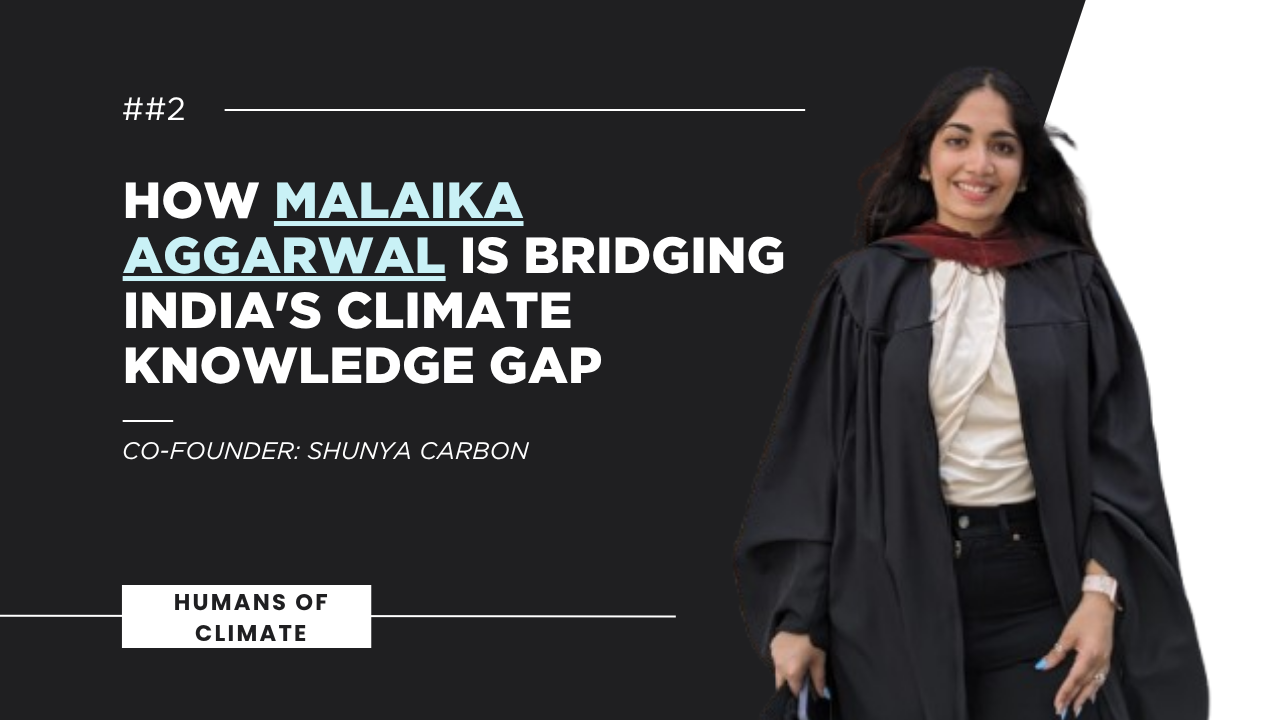
India’s carbon market is no longer a future consideration. With the Carbon Credit Trading Scheme taking shape and regulatory expectations evolving faster than most boardrooms can follow, the country’s businesses face a growing need for practical guidance that policy documents alone cannot provide. Malaika Aggarwal, co-founder of Shunya Carbon, has built her career on closing exactly that gap.
Malaika trained as an economist before moving into the carbon markets industry, and the combination has given her an unusual vantage point: she understands both how market mechanisms are designed and why businesses so often struggle to engage with them. Shunya Carbon, the consulting firm she co-founded, works with Indian companies to demystify carbon markets and translate regulatory complexity into actionable strategy. Her argument, developed through years of working with businesses across sectors, is not that sustainability is virtuous. It is that sustainability is becoming unavoidable, and that the companies treating it as strategy rather than compliance will be the ones with the most flexibility when the rules tighten.
From Economics to Climate: Finding the Right Problem
Malaika describes her intellectual journey as driven less by a single revelatory moment and more by a gradual recognition of where her interests converged with a genuinely difficult problem.
She had always been drawn to questions about how systems shape decisions. Studying economics, she became fascinated by the mechanics of incentives and market design. Climate change, she came to understand, was not just an environmental problem. It was a failure of economic incentives on a massive scale, and carbon markets were among the most serious attempts to correct that failure.
“Climate change isn’t just an environmental challenge,” she has explained to clients. “It’s also an economic one.” That framing matters because it shapes how she approaches the work. Shunya Carbon is not in the business of persuading companies to care about the planet. It is in the business of helping them understand why carbon is becoming a material business consideration, and what they can do about it before they are forced to act.
Her interest in behavioural economics runs alongside this. She is drawn to the question of why people and organisations make the decisions they do, and what it takes to shift behaviour at scale. Carbon markets, she argues, are essentially an applied experiment in behavioural economics at the level of entire industries. Rather than mandating emission reductions through rules alone, they create financial incentives that make lower-carbon choices more economically attractive. The design is elegant in principle; the implementation is where things get complicated.
What Most People Get Wrong About Carbon Credits
The most persistent misconception Malaika encounters, across boardrooms and policy conversations alike, is that carbon credits exist to allow companies to pay for the right to keep polluting. The concern is understandable. The language around “offsetting” invites the impression that emissions are simply being transferred rather than reduced.
Malaika’s response is to correct the premise rather than defend the mechanism. Well-designed carbon markets, she argues, are not intended to substitute for emission reductions. They are intended to make emissions costly and to reward businesses that find ways to reduce them. The credit is the incentive, not the exemption.
“I always tell people to think of carbon markets as a financial incentive, not a shortcut.”
The distinction is not merely semantic. Companies that approach carbon markets looking for ways to delay action on their own emissions tend to make poor strategic decisions. Companies that treat them as a signal about where costs and regulations are heading tend to be better positioned when the market evolves.
Carbon Market Insider Newsletter
Weekly insights on carbon markets, climate policy, carbon credits, and sustainability.
Explaining the Stakes to a Sceptical CEO
Malaika has had to develop ways of making carbon markets legible to senior business leaders who have never engaged with the subject. Her preferred approach is analogy.
When speaking with a manufacturing company CEO unfamiliar with India’s Carbon Credit Trading Scheme, she draws a parallel to cybersecurity two decades ago. Most businesses did not regard it as a boardroom priority until it became an operational necessity. Today, it is central to how companies think about risk and resilience. She believes carbon is on a similar trajectory.
“India’s Carbon Credit Trading Scheme isn’t just another environmental regulation,” she explains. “It’s the beginning of carbon becoming a business metric.” The implication is not that companies should rush to generate credits or make large immediate investments. It is that the businesses spending time now to understand their emissions profile, identify efficiency opportunities, and develop a long-term approach will have considerably more flexibility than those waiting for regulatory pressure to force their hand.
The underlying message is about competitive positioning, not corporate responsibility. Companies that move early will face lower compliance costs, attract a wider range of investors, and have more options when the rules become more demanding. Those that delay will find themselves playing catch-up under worse conditions.
The Policy Gap That Holds India Back
One of the more structural challenges Malaika identifies is the distance between climate policy as written and climate action as practised. The gap is not primarily about intent on either side. Policymakers are generally trying to design effective systems. Businesses are generally trying to navigate them responsibly. The problem is translation.
Climate regulations, she observes, often assume that companies have the internal resources, expertise, and data infrastructure to understand and comply with what is required. For large organisations with dedicated sustainability teams, that assumption is sometimes reasonable. For the small and medium-sized enterprises that make up the vast majority of India’s industrial base, it frequently is not.
Equally, businesses often underestimate how quickly the policy environment is shifting. A regulation that seems distant or abstract in one year can become a compliance requirement in the next. The result is a cycle in which companies wait for certainty before acting, and then discover that the window for preparation has closed.
Her practical recommendation to policymakers, if she had a single hour with the architects of India’s climate framework, would focus less on the substance of the regulations and more on how they are communicated. Businesses need clear roadmaps, realistic timelines, and guidance on what steps they should be taking now, rather than waiting for full implementation to begin. Uncertainty, she argues, is one of the biggest barriers to participation in India’s low-carbon transition. Reducing it would cost relatively little and unlock considerably more action.
What a Client Conversation Changed
Not every business entering the carbon markets space is driven by regulation or financial calculation. Malaika describes a conversation with a client that shifted her thinking about what Shunya Carbon’s role actually is.
The client was not looking to meet a compliance threshold or generate credits to sell. He wanted to understand where sustainability could genuinely fit into his business and what practical steps were available to him. During the conversation, he mentioned an algae-based carbon capture project he had come across. He was not asking whether it was the right solution for his specific situation. He was simply exploring, looking for ways to act.
That conversation, Malaika says, reminded her that not every business begins its sustainability journey because of financial incentives or regulatory pressure. Many leaders want to make a contribution but do not know where to start, which solutions are relevant to them, or how to evaluate options. The role of a consultant in that context is not to explain what carbon markets are. It is to help a business find its own entry point and build from there.
An Honest Assessment of the Industry
Malaika is direct about a tension that sustainability consultants are not always willing to name openly. Sustainability is not the top priority for most businesses, and pretending otherwise makes it harder to have useful conversations.
Companies have to manage profitability, operations, and growth. These are not obstacles to sustainability; they are the context in which sustainability decisions get made. A consulting approach that frames climate action as a moral imperative and expects that framing to override commercial considerations is unlikely to produce durable results. An approach that shows how sustainability supports business resilience, reduces operational costs, and strengthens long-term competitive positioning is considerably more likely to land.
That perspective also shapes how she thinks about the broader obstacle to climate action in India. The single barrier she would most want to remove is not a regulation or a market structure. It is the misconception that climate action exists in opposition to business growth. Companies that treat sustainability as a compliance burden tend to do the minimum required. Companies that treat it as a strategic lens tend to find opportunities others are not looking for.
What Businesses Will Wish They Had Done Earlier
On the question of what companies will regret not starting sooner, Malaika’s answer is deliberately broad. She is not prescribing a specific technology or a particular kind of investment. She is describing a posture.
The businesses that will be best positioned in the years ahead are those that have spent time understanding where emissions occur in their operations, evaluating what green technologies or approaches could be relevant to them, and building internal capability to engage with carbon markets as they mature. Many of these steps do not require large capital commitments today. They require curiosity and a willingness to begin.
“What can we do today that will put us in a stronger position tomorrow?”
The ones that wait until regulations make the answer obvious will find that the most attractive options have already been taken.
Building Something from Incomplete Information
Malaika reflects on what entrepreneurship has taught her with a characteristic directness. The lesson she points to is not about strategy or market timing. It is about the nature of decision-making in conditions of uncertainty.
She had assumed, before starting Shunya Carbon, that successful founders operated from a position of relative confidence, that they had mapped out the territory and knew what to expect. What she found instead was that the distinguishing characteristic of people who build things is not certainty. It is a willingness to make reasonable decisions with incomplete information, and to keep adjusting as more becomes available. “Done is almost always better than perfect,” she says, when asked for the biggest lesson entrepreneurship has taught her.
She lists Carbon Pulse as the resource that keeps her most connected to developments across global carbon markets, and cites Daniel Kahneman’s Thinking, Fast and Slow as the book she has recommended most often, a reflection, perhaps, of the continuing pull of behavioural economics on the way she thinks about climate action.
The Longer Arc
Asked what she would hope someone reading this interview in five years would take from it, Malaika returns to the argument she has been making throughout. The framing of sustainability as a trade-off against business performance is, she believes, both empirically wrong and strategically counterproductive. The companies that will define the next generation of Indian industry will not be the ones that spent the most or grew the fastest. They will be the ones that adapted early, built the right capabilities, and treated climate strategy as business strategy.
For India’s carbon market specifically, she believes the future depends on “building trust, transparency and making participation practical for businesses of every size.” That is a description of what still needs to happen, not a prediction that it will happen automatically. It is also a reasonable summary of what Shunya Carbon is trying to do, one conversation at a time.
Quick Takes
One carbon market trend she is watching closely: The integration of compliance and voluntary carbon markets.
One sustainability buzzword that is overused: “Net zero,” when there is no real plan behind it.
One climate regulation every business leader should understand: India’s Carbon Credit Trading Scheme.
One person in climate she would most like to have dinner with: Her grandmother, who taught her that leaving the world better than you found it is one of the most meaningful things a person can do.
Something people are always surprised to learn about her: She is quite introverted, but happens to love talking about carbon markets.

Malaika Aggarwal
Malaika is an economist and sustainability advisor specializing in carbon markets, climate policy, and environmental economics. She combines analytical research, market intelligence, and economic modelling to help organizations identify commercially viable sustainability opportunities and navigate evolving environmental regulations.