Carbon Market Network


Your sustainability team spends weeks chasing invoices, utility bills, and supplier spreadsheets. Then an auditor asks, “Where did this number come from?”
That moment is why AI carbon accounting software exists.
These platforms use artificial intelligence to collect messy data, match it to the right emission factors, flag errors, and draft disclosures. The work that once took months now takes days.
But the market is crowded, and “AI-powered” appears on almost every vendor website. Some tools use AI to do real work. Others add a chatbot and call it a day.
This guide cuts through that noise. You will learn what AI does inside carbon accounting software, how GHG reporting works behind the scenes, and which 10 platforms use AI in meaningful ways.
You will also get a practical framework to choose the right tool for your company.
What Is AI Carbon Accounting Software?
AI carbon accounting software is a platform that measures, tracks, and reports greenhouse gas (GHG) emissions, and uses machine learning, language models, or AI agents to automate the hardest parts of that job.
It follows the same rulebook as any carbon accounting tool. Most platforms build on the GHG Protocol, the most widely used standard for corporate emissions.
The difference is how much manual work remains.
Traditional carbon accounting software gives you a place to store data and run calculations. You still clean the data, pick the emission factors, and write the report.
AI-driven carbon accounting software takes over many of those steps. It reads files, classifies transactions, suggests factors, spots outliers, and answers questions in plain language.
Carbon Market Insider Newsletter
Weekly insights on carbon markets, climate policy, carbon credits, and sustainability.
The Three Scopes in Simple Terms
Every GHG inventory sorts emissions into three buckets.
- Scope 1: Direct emissions from sources you own or control, such as company vehicles, boilers, and on-site fuel use.
- Scope 2: Indirect emissions from the electricity, steam, heat, or cooling you buy.
- Scope 3: All other indirect emissions across your value chain, split into 15 categories. These include purchased goods, business travel, transport, and the use of your products.
Scope 3 is where AI matters most. For many companies, it is the largest share of the footprint, and it is also the hardest to measure.
How AI Carbon Accounting Differs From Other Approaches
| Approach | How it works | Main weakness |
|---|---|---|
| Spreadsheets | Teams enter data and formulas by hand | Errors, version chaos, weak audit trail |
| Traditional carbon accounting software | Central database with built-in factors and reports | Still needs heavy manual data prep |
| AI carbon accounting software | AI cleans data, matches factors, flags anomalies, and drafts reports | Needs human review and strong governance |
| Consultant-led accounting | Experts build the inventory for you | Slow, costly, hard to repeat each year |
Most strong platforms today blend software, AI, and human experts. That mix matters, and you will see why in a moment.
Why Companies Are Moving to AI GHG Reporting Software
Three forces push companies toward AI-based emissions tracking.
First, regulation keeps expanding. Second, investors and customers now ask for emissions data in every procurement and funding round. Third, the data volume is simply too big for spreadsheets.
The Regulatory Pressure Behind GHG Reporting
Rules differ by region, and they keep shifting. Here is how the major frameworks touch emissions data.
| Framework | Who it affects | What it asks for |
|---|---|---|
| CSRD and ESRS (European Union) | Very large EU companies, plus some non-EU groups with major EU turnover | Climate disclosures including GHG emissions, under simplified standards after recent reform |
| California SB 253 | Companies with over $1 billion in revenue that do business in California | Scope 1 and 2 first, then Scope 3, with assurance phasing in |
| IFRS S2 (ISSB) | Companies in jurisdictions that adopt ISSB standards | Scope 1, 2, and 3 emissions, measured under the GHG Protocol |
| CDP | Companies responding to investor and customer requests | Detailed emissions and climate strategy questionnaires |
| CBAM (European Union) | Importers of certain carbon-intensive goods | Embedded emissions data for imported products |
| BRSR (India) | Top listed Indian companies | Sustainability disclosures that include emissions metrics |
Rules and deadlines change often. California’s regulator, for example, has adjusted early reporting timelines more than once. Always check the latest guidance from the relevant authority.
Meanwhile, the EU narrowed the scope of CSRD and simplified its reporting standards. Fewer companies report directly, but large companies still pass data requests down their supply chains.
In short, even small suppliers often need credible emissions numbers.
The Data Problem Nobody Warns You About
Carbon accounting is mostly a data problem, not a math problem.
A mid-sized manufacturer might handle thousands of invoices, dozens of utility accounts, and hundreds of suppliers. Each source arrives in a different format, language, and currency.
Spreadsheets break under that weight. AI handles it better because it reads patterns across messy inputs.
How AI Works Inside Carbon Accounting Software
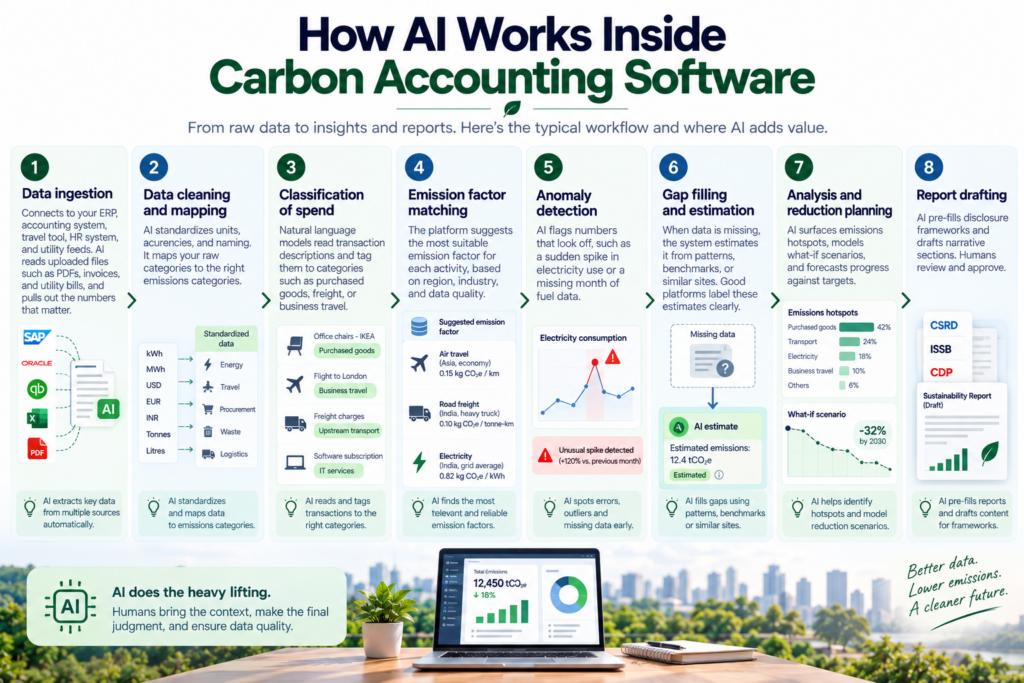
Let’s walk through the typical workflow. Each step shows where AI adds value.
- Data ingestion. The platform connects to your ERP, accounting system, travel tool, HR system, and utility feeds. AI reads uploaded files such as PDFs, invoices, and utility bills, and pulls out the numbers that matter.
- Data cleaning and mapping. AI standardizes units, currencies, and naming. It maps your raw categories to the right emissions categories.
- Classification of spend. Natural language models read transaction descriptions and tag them to categories such as purchased goods, freight, or business travel. This is the backbone of spend-based Scope 3 accounting.
- Emission factor matching. The platform suggests the most suitable factor for each activity, based on region, industry, and data quality.
- Anomaly detection. AI flags numbers that look off, such as a sudden spike in electricity use or a missing month of fuel data.
- Gap filling and estimation. When data is missing, the system estimates it from patterns, benchmarks, or similar sites. Good platforms label these estimates clearly.
- Analysis and reduction planning. AI surfaces emissions hotspots, models what-if scenarios, and forecasts progress against targets.
- Report drafting. AI pre-fills disclosure frameworks and drafts narrative sections. Humans review and approve.
The Three Calculation Methods AI Supports
Understanding these helps you judge any platform.
- Spend-based: Multiplies money spent by an average emission factor. It is fast and rough.
- Activity-based: Uses physical data like kilowatt-hours, liters, or tonne-kilometers. It is more accurate.
- Supplier-specific: Uses emissions data that suppliers measure themselves. It is the most accurate and the hardest to collect.
Most companies start spend-based and improve over time. AI speeds up the first stage and makes the upgrade path less painful.
Where AI Helps and Where Humans Still Matter
| Task | AI strength | Human role |
|---|---|---|
| Reading invoices and bills | High | Spot-check samples |
| Classifying spend | High | Review low-confidence items |
| Picking emission factors | Medium to high | Approve methodology choices |
| Flagging errors | High | Investigate root causes |
| Estimating missing data | Medium | Judge whether estimates are reasonable |
| Drafting disclosures | Medium to high | Verify facts, own the final text |
| Setting boundaries and policies | Low | Decide scope, base year, and approach |
| Dealing with auditors | Low | Explain and defend the numbers |
The pattern is clear. AI handles volume. People handle judgment.
10 AI Carbon Accounting Software Platforms for GHG Reporting
The platforms below all use AI for real tasks in the GHG reporting workflow. They differ in size, focus, and ideal customer.
Features change quickly, so confirm current capabilities with each vendor before you decide. Most vendors sell on quote-based pricing, so expect to book a demo.
Quick Comparison Table
| Platform | Best for | Key AI capabilities | Scope 3 strength |
|---|---|---|---|
| Watershed | Large enterprises | AI agents for data cleaning, anomaly detection, and report drafting | Very strong |
| Persefoni | Enterprises and financial institutions | AI copilot, analytics agent, anomaly detection | Strong |
| Sweep | Mid-market and enterprise teams with complex supply chains | Multiple AI agents, AI assistant, emission factor suggestions | Strong, with supplier tools |
| Greenly | SMEs to large companies | EcoPilot AI, factor selection, data gap detection | Strong |
| Plan A | Companies that want certified methods plus expert help | Gaia AI assistant, guided data onboarding | Solid |
| Normative | Teams that want audit-ready accounting with advisor support | AI data categorization and quality control | Strong |
| Workiva Carbon | Companies that want carbon and financial reporting together | AI data ingestion, error detection, emission factor matching | Solid |
| IBM Envizi | Large enterprises with complex data | AI spend classification, forecasting, planning analytics | Strong |
| SAP Sustainability Control Tower | Companies that run SAP | AI-supported factor management and reporting | Solid, tied to SAP data |
| Salesforce Agentforce Net Zero | Companies that run Salesforce | AI agents for insights and disclosure answers | Solid, with procurement tools |
1. Watershed
Watershed positions itself as a sustainability AI platform for large enterprises.
How it uses AI: Its AI agents clean and format data, support analysis, and draft reports with human review. The platform also uses AI to break down supply chains and reveal emissions hotspots.
It offers methods for all 15 Scope 3 categories, a supplier portal, and an audit trail with sourcing for AI outputs. That last point matters for assurance.
Watershed also runs a marketplace where companies can fund clean power and sustainable aviation fuel.
Best for: Large companies with big data volumes and a dedicated sustainability team.
Watch out for: The platform targets enterprises, so smaller teams may find it more than they need.
2. Persefoni
Persefoni is one of the earlier players in the category and built its brand around carbon accounting and climate disclosure.
How it uses AI: It offers a copilot built on its own language model that answers technical carbon accounting questions in a chat format. It also provides an analytics agent that helps users ask and explore emissions data, plus AI features for anomaly detection and forecasting.
The platform supports GHG Protocol methods and the PCAF standard for financed emissions, which makes it relevant for banks and investors. It also supports CBAM compliance for EU importers.
Persefoni took on carbon accounting clients from Diligent through a partnership that also gave Diligent an equity stake.
Best for: Enterprises and financial institutions that need disclosure-ready reporting.
Watch out for: Check how its AI features fit your reporting framework and assurance needs during the demo.
3. Sweep
Sweep is a carbon and ESG data platform founded in France, with a strong focus on collaboration and supply chains.
How it uses AI: Sweep embeds AI agents directly into the data workflow. Reviewers describe an orchestrator plus agents for data analysis, dashboard building, and disclosure writing. Its assistant, Sweepy, flags data gaps, surfaces hotspots, and suggests next steps.
The platform recommends emission factors, supports supplier data collection for Scope 3, and calculates product carbon footprints aligned to ISO 14067.
Sweep also tracks the carbon footprint of its own AI usage, which signals a thoughtful approach.
Best for: Mid-market and enterprise companies with multiple entities and many suppliers.
Watch out for: Wide scope means a longer setup if you only need a basic inventory.
4. Greenly
Greenly started as a consumer carbon app and grew into a business platform that serves thousands of companies.
How it uses AI: Its AI layer, EcoPilot, cleans and structures data, selects emission factors from a large library, detects data gaps, and flags statistical anomalies. A “what if” feature lets you test how changes in suppliers, materials, or transport affect your footprint.
Greenly connects with a large number of ERP, accounting, logistics, and cloud tools. It also pairs the software with climate specialists who review methodology.
Greenly says it runs language models on its own servers to reduce data transfers and energy use.
Best for: Growing companies and SMEs that want fast onboarding, plus larger firms that need supplier engagement.
Watch out for: Confirm that your industry’s specific data needs fit the standard workflows.
5. Plan A
Plan A is a European carbon accounting and decarbonization platform. It now sits within the Diginex group but still runs as its own product.
How it uses AI: Its Gaia AI assistant answers sustainability questions inside the platform. The software also guides data onboarding and produces one-click carbon footprint reports.
The company highlights certified, science-led methodology and offers expert services such as CSRD readiness and decarbonization consulting.
Best for: Companies that want certified methods and access to human experts.
Watch out for: Pricing is sales-quoted, and some reviewers say smaller companies may find costs steep. Reviewers also note that users sometimes still need a human when AI answers feel unclear.
6. Normative
Normative focuses on audit-ready carbon accounting across Scope 1, 2, and 3.
How it uses AI: The platform applies AI to data categorization and quality control, and automates data ingestion. The company states that its accounting follows GHG Protocol standards and has independent verification from TÜV SÜD.
It also supports CSRD reporting, product carbon footprints, supplier engagement, CDP reporting, and SBTi target-setting support. Each account gets a named climate strategy advisor.
Best for: Teams that care most about defensible numbers and want advisor support.
Watch out for: If you want heavy agent-style automation across many ESG topics, compare it closely with broader platforms.
7. Workiva Carbon
Workiva built its name on connected financial and ESG reporting, and Workiva Carbon extends that model to emissions.
How it uses AI: The platform offers AI-powered data ingestion with error detection and AI-driven emission factor matching. It adds data lineage, version history, attached evidence, and granular access controls.
Its main selling point is integration. Carbon data and financial data live in one environment, which helps with consistency and assurance.
Best for: Companies that already use Workiva for financial or ESG reporting and want one system of record.
Watch out for: If you only need carbon accounting, a specialist tool may offer deeper emissions features.
8. IBM Envizi
Envizi is IBM’s ESG and emissions management suite.
How it uses AI: It uses natural language models, built on IBM’s watsonx.ai, to categorize spend data for Scope 3 calculations. The AI Assist feature began with purchased goods and services, the biggest pain point for many Scope 3 inventories.
IBM states that its AI features include human review steps, confidence scoring, and transparent reasoning. The suite also offers AI-infused planning and forecasting, supplier data management, and a financed emissions module.
Best for: Large organizations with complex data, many sites, and heavy Scope 3 needs.
Watch out for: A suite this broad can need training and time to master.
9. SAP Sustainability Control Tower
SAP offers carbon accounting inside its business suite, through tools like Sustainability Control Tower, Green Ledger, and Sustainability Data Exchange.
How it uses AI: SAP says AI improves emission factor management before carbon data flows into core business processes. It also uses AI to generate ad hoc reports for detailed carbon data analysis and to automate parts of sustainability reporting.
Green Ledger combines carbon data with financial data to support audit-ready decisions.
Best for: Companies that already run SAP and want emissions data tied to ERP processes.
Watch out for: Value is highest inside the SAP ecosystem. Mixed IT environments may need extra integration work.
10. Salesforce Agentforce Net Zero
Salesforce’s carbon product, known as Net Zero Cloud, now carries the Agentforce name for its AI layer.
How it uses AI: Agentforce lets users ask carbon and energy questions in plain language and get answers from the platform’s data. It also helps respond to disclosure frameworks such as CSRD, SASB, and CDP using the platform’s information library and saved company documents.
For Scope 3, the Procurement Hub aggregates supplier emissions data and procurement carbon footprints. The platform also helps audit auto-calculated emissions.
Best for: Companies that already run Salesforce and want emissions data close to their CRM and operations data.
Watch out for: Check how its Scope 3 depth compares with specialist tools if supplier data is your main challenge.
How to Choose the Right AI Carbon Accounting Software
Do not pick a platform from a feature list alone. Follow these steps.
- Define your reporting drivers. List the frameworks you must meet, such as CSRD, SB 253, ISSB, CDP, or customer requests.
- Map your data sources. Note your ERP, accounting, travel, utility, and HR systems. Ask which ones each vendor connects to.
- Estimate your Scope 3 complexity. Count suppliers, product lines, and entities.
- Set your assurance needs. Decide whether you need limited assurance now or soon.
- Shortlist three vendors. Pick tools that fit your size and tech stack.
- Run a real-data pilot. Upload a messy sample, not a clean demo file.
- Score the results. Compare accuracy, time saved, and clarity of audit trails.
Evaluation Criteria Table
| Criterion | What to check |
|---|---|
| Methodology | Alignment to the GHG Protocol, plus any third-party verification |
| AI transparency | Can you see why AI chose a factor or category? |
| Audit trail | Does every number trace back to source data? |
| Human review controls | Can you approve, edit, or override AI outputs? |
| Integrations | Prebuilt connectors for your ERP, finance, and travel tools |
| Scope 3 tools | Supplier portals, product footprints, and hybrid methods |
| Framework coverage | Ready templates for your required disclosures |
| Data security | Hosting, access control, and how AI handles your data |
| Support | Access to carbon accountants and onboarding help |
| Total cost | Licenses, setup, services, and extra modules |
Questions to Ask Every Vendor
Bring these to your demo calls.
- Which tasks does your AI perform, and which does it only assist with?
- How do you label estimated or AI-generated values?
- Can an auditor trace each AI decision?
- Do you train models on our data?
- How often do you update emission factor libraries?
- What happens when AI confidence is low?
- How do you handle our AI and cloud emissions, if relevant?
- Which customers of our size and industry can we speak with?
Vendors who answer clearly and show you the product earn trust. Vendors who deflect deserve a second look.
Common Mistakes When Buying AI Carbon Accounting Software
Avoid these traps.
- Trusting the label. “AI-powered” means little without specifics. Ask for a live walkthrough.
- Skipping the pilot. Clean demo data hides problems.
- Ignoring data ownership. Know who owns the data, the models, and the outputs.
- Expecting zero effort. AI reduces work but does not remove the need for governance.
- Overlooking the people side. Someone must own the inventory every year.
- Starting with Scope 3 perfection. Begin with a solid baseline, then improve data quality over time.
A 90-Day Roadmap to Your First AI-Assisted Inventory
Here is a practical plan.
- Weeks 1 to 2: Set your organizational boundary, base year, and reporting standard. Pick your platform.
- Weeks 3 to 4: Connect core systems and upload historical data for Scope 1 and 2.
- Weeks 5 to 6: Load spend data and let AI classify it. Review low-confidence items.
- Weeks 7 to 8: Review factor choices and estimation rules with your internal team or advisor.
- Weeks 9 to 10: Identify hotspots and prioritize supplier outreach.
- Weeks 11 to 12: Generate draft reports, run internal checks, and document your methodology.
Document every assumption as you go. Your future self, and your auditor, will thank you.
Real-World Scenarios: How Teams Use AI for GHG Reporting
These examples are illustrative. They show how typical teams apply the tools above.
Scenario 1: A Manufacturer With Thousands of Suppliers
A manufacturer needs to report Scope 3 but holds spend data in a messy ERP export. The team uploads the file and lets the AI classify transactions into categories.
They review the low-confidence items, then run a spend-based baseline. Next, they use the hotspot view to pick the top 20 suppliers for direct data requests.
That focus saves months of chasing everyone.
Scenario 2: A Mid-Sized Services Firm Answering Customer Requests
A software company gets emissions questionnaires from three large clients. Instead of answering each manually, the team builds one inventory and reuses it across CDP and customer forms.
AI drafts the narrative answers. A sustainability lead edits and approves them.
Scenario 3: A Finance Team Preparing for Assurance
A company wants its emissions numbers to meet the same standards as its financial figures. The finance team uses a platform that links carbon data to the financial reporting system, with version history and attached evidence.
When the assurance provider asks about a number, the team clicks through to the source file.
What Is Next for AI in Carbon Accounting
The category moves fast. Watch these trends.
- Agentic AI. Instead of answering questions, agents will complete multi-step tasks, such as cleaning a dataset, running a calculation, and drafting the disclosure.
- Assurance-grade AI. Vendors now emphasize audit trails, confidence scores, and human review. Expect this to become standard.
- Product carbon footprints at scale. AI helps estimate footprints across entire product catalogs, which supports supplier requests and border carbon rules.
- Standards in motion. The GHG Protocol is revising its corporate standards, including Scope 2 guidance with proposals on hourly matching. Platforms will need to adapt, and AI can help handle the added data granularity.
- The footprint of AI itself. Companies now ask how to count emissions from their own AI use. Watershed has published a framework for estimating corporate AI emissions, and some vendors track their own AI usage.
Taken together, these trends point to a future where AI handles routine accounting and people focus on strategy and reduction.
Conclusion
AI carbon accounting software cannot replace sound judgment. It can remove the grind that keeps teams stuck in spreadsheets.
The 10 platforms in this guide show different paths. Watershed, Persefoni, Sweep, and Greenly lean into AI agents and copilots. Normative and Plan A pair software with expert support. Workiva Carbon, IBM Envizi, SAP, and Salesforce fit companies that want emissions data inside systems they already use.
Your best choice depends on your regulations, data, supply chain, and team size.
Start with your reporting drivers. Test two or three tools with real data. Demand clear audit trails. Keep humans in the loop.
Do that, and AI carbon accounting software becomes more than a trend. It becomes the engine behind credible GHG reporting.
If you want to compare more tools beyond AI features, read our guide to the best carbon accounting software.
Frequently Asked Questions
What is AI carbon accounting software?
It is a platform that measures and reports GHG emissions and uses AI to automate tasks like data cleaning, emission factor matching, anomaly detection, and report drafting. Most follow the GHG Protocol.
Is AI carbon accounting software accurate?
It can be very accurate when it uses good data and clear methods. AI speeds up classification and checks, but results depend on input quality. Always review low-confidence outputs and keep an audit trail.
Can AI calculate Scope 3 emissions?
Yes, AI helps with Scope 3 by classifying spend, matching emission factors, estimating gaps, and organizing supplier data. For the best accuracy, move from spend-based estimates toward supplier-specific data over time.
Which companies need GHG reporting software?
Any company facing regulation, investor requests, or customer questionnaires benefits. Large firms often face direct rules such as CSRD, SB 253, or ISSB-based requirements. Smaller suppliers often need emissions data to keep large customers.
How much does AI carbon accounting software cost?
Most vendors do not publish fixed prices. They quote based on company size, data volume, modules, and services. Ask for a full breakdown, including onboarding and add-ons.
Can AI carbon accounting software pass an audit?
Software helps, but the audit looks at your data, methods, and controls. Choose a platform with traceable calculations, version history, and documented methodology. Check which assurance standards your auditor expects.
What is the difference between carbon accounting software and ESG software?
Carbon accounting software focuses on measuring and reporting GHG emissions. ESG software covers a broader range of topics, such as social and governance metrics. Many platforms now combine both.
Does AI carbon accounting software replace carbon accountants?
No. It automates repetitive work and flags issues, but people still set boundaries, approve methods, explain results to auditors, and drive reduction plans.
Do small businesses need AI carbon accounting software?
Many do, especially when large customers request emissions data. Smaller teams often prefer platforms with fast onboarding and guided workflows, so check each vendor’s fit for your size.
Explore more guides, tools, and resources on Carbon Market Network to deepen your understanding of carbon markets and emissions measurement.