Carbon Market Network

Biochar has quietly become one of the most trusted tools in the fight against climate change. It locks away carbon for centuries, boosts soil health, and turns farm and forest waste into something genuinely valuable.
But here is the real question buyers and farmers keep asking: which biochar companies actually deliver on their promises?
This guide breaks down the top biochar companies operating today, what makes each one stand out, and how you can pick the right partner whether you are a business buying carbon removal credits or a farmer looking for a soil amendment supplier.
By the end, you will know exactly how the biochar industry is structured, who the major players are, and what questions to ask before you buy.
Why Biochar Companies Matter Right Now
Biochar is made by heating organic waste, like wood chips, crop residue, or manure, in a low-oxygen environment through a process called pyrolysis. This turns the waste into a stable, carbon-rich material that can stay in the soil for hundreds to over a thousand years.
That durability is exactly why corporations, farmers, and governments are paying attention.
For companies chasing net-zero targets, biochar offers one of the few carbon removal methods that is available today, not decades from now. For farmers, it offers a way to improve soil structure, retain water, and cut fertilizer costs.
This growing demand has created two distinct types of biochar companies:
- Carbon removal focused producers, who sell verified carbon credits generated through biochar production
- Agricultural and soil health focused producers, who sell biochar directly as a farm input
Many companies now operate in both spaces at once, stacking revenue from carbon credits, biochar sales, and even energy generated during pyrolysis.
Carbon Market Insider Newsletter
Weekly insights on carbon markets, climate policy, carbon credits, and sustainability.
How These Companies Are Evaluated
Before diving into the list, it helps to understand what actually separates a strong biochar company from an average one. Buyers and researchers typically look at:
- Feedstock sourcing: Where does the biomass come from, and is it sustainably sourced waste rather than purpose-grown material
- Production scale: How many tonnes of biochar or carbon removal credits the company delivers each year
- Certification: Whether the company is certified under recognized standards like Puro.earth, Carbon Standard International, or the European Biochar Certificate
- Monitoring, Reporting, and Verification (MRV): How transparently the company tracks and proves its carbon removal claims
- Track record: Whether the company has a history of delivering credits or products on schedule
- Co-benefits: Additional value like improved soil health, local jobs, or reduced wildfire risk
Keep these criteria in mind as you read through the list below, since they explain why certain companies keep showing up across independent rankings.
Top Biochar Companies Focused on Carbon Removal Credits
These companies primarily generate revenue by selling verified carbon removal credits backed by biochar production. They are the names most often mentioned by corporate sustainability teams.
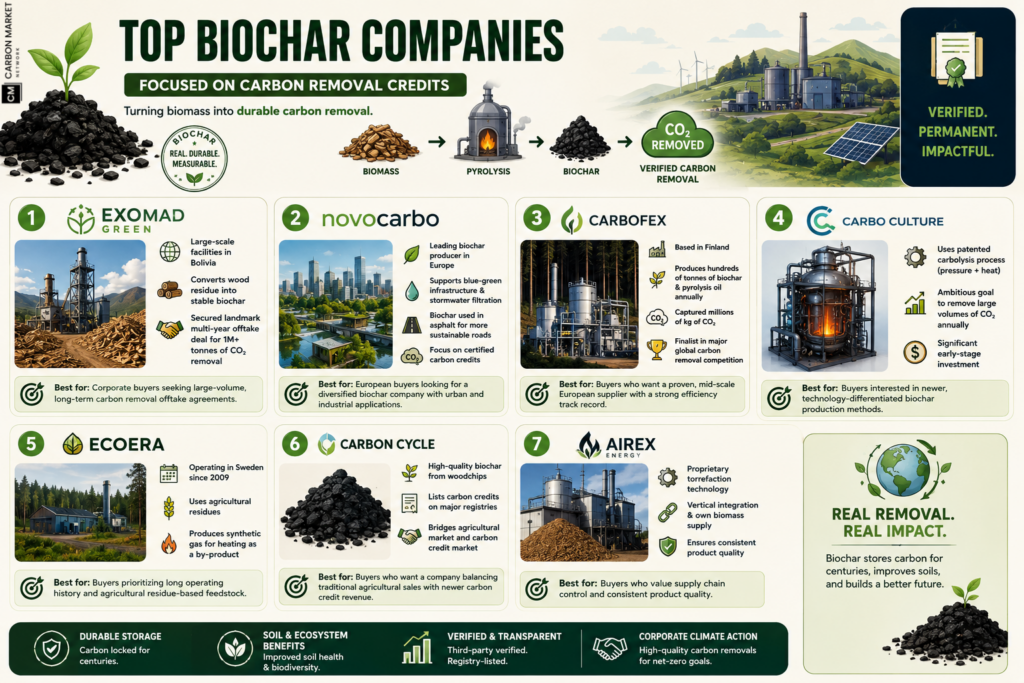
1. Exomad Green
Exomad Green operates some of the largest biochar production facilities in the world, based in Bolivia. The company converts sawmill and wood residue, material that would otherwise be burned in open pits, into stable biochar through pyrolysis.
Exomad Green has become one of the most recognized names in durable carbon removal after securing a landmark multi-year agreement with a major technology buyer for over a million tonnes of CO2 removal. This deal is considered one of the largest carbon removal purchases ever signed, and it signaled that biochar had moved from a niche experiment into an industrial-scale climate solution.
Best for: Corporate buyers seeking large-volume, long-term carbon removal offtake agreements.
2. Novocarbo
Headquartered in Germany, Novocarbo has grown into one of Europe’s leading biochar producers. The company does more than enrich soil. It supports blue-green infrastructure in cities, filters stormwater, and has even tested biochar as an additive in asphalt to improve sustainability.
Novocarbo focuses heavily on certified carbon credits alongside its physical biochar products, making it a strong example of the revenue-stacking model that defines the modern biochar business.
Best for: European buyers looking for a diversified biochar company with urban and industrial applications.
3. Carbofex
Based in Finland, Carbofex started as a small demonstration plant and has scaled into a facility capable of producing several hundred tonnes of biochar and pyrolysis oil each year. The company has captured millions of kilograms of CO2 since its early operations and has sold credits to well-known corporate buyers.
Carbofex was also recognized as a finalist in a major global carbon removal competition, which helped raise its profile among institutional buyers.
Best for: Buyers who want a proven, mid-scale European supplier with a strong efficiency track record.
4. Carbo Culture
Carbo Culture uses a patented process called carbolysis, a variation of traditional pyrolysis that applies pressure along with heat. The company has an ambitious long-term goal of removing large volumes of CO2 annually and has attracted significant early-stage investment to scale its technology.
Best for: Buyers interested in newer, technology-differentiated biochar production methods.
5. Ecoera
Ecoera has operated in Sweden since 2009, making it one of the country’s earliest large-scale biochar producers. The company uses agricultural residues to create carbon-rich pellets before converting them into biochar, and it also produces synthetic gas for heating as a secondary output.
Best for: Buyers prioritizing long operating history and agricultural residue-based feedstock.
6. Carbon Cycle
This German company bridges two markets at once. It sells high-quality biochar made from woodchips directly to farms across Europe while also listing carbon credits on major registries. This dual approach reflects where much of the industry is heading.
Best for: Buyers who want a company balancing traditional agricultural sales with newer carbon credit revenue.
7. Airex Energy
Based in Canada, Airex Energy (https://airex-energy.com/) uses proprietary torrefaction technology to convert biomass waste into biochar and other carbonized products. The company has focused on vertical integration, acquiring its own biomass sources and building production facilities to maintain quality control.
Best for: Buyers who value supply chain control and consistent product quality.
Top Biochar Companies Focused on Agriculture and Soil Health
These companies sell biochar primarily as a physical product for farms, gardens, and landscaping, often alongside smaller carbon credit programs.
1. Pacific Biochar
Based in California, Pacific Biochar retrofits retired biomass power plants into biochar production facilities. It collects organic material from forests with high wildfire potential, which helps reduce fire risk, and then distributes the resulting biochar to agricultural buyers.
The company has grown quickly by using a capital-light model, expanding production significantly year over year without building expensive new facilities from scratch.
Best for: Agricultural buyers and carbon credit buyers who want a company combining wildfire risk reduction with soil health benefits.
2. Oregon Biochar Solutions
This company leads large-scale biochar production in the United States using forest residuals as its primary feedstock. It offers multiple grades of biochar suited to different agricultural and industrial applications.
Best for: Large-scale farms and industrial buyers needing consistent, high-volume supply.
3. CharGrow
Founded in North Carolina, CharGrow specializes in probiotic biochar formulations designed to enhance plant health and soil fertility. The company focuses heavily on regenerative agriculture and soil restoration projects.
Best for: Farms practicing regenerative agriculture that want biochar blended with beneficial microbes.
4. American BioChar Company
This company produces blended soil amendments that combine activated biochar with humate, available in both liquid and granular forms. Its products carry OMRI certification for organic use and IBI certification for quality and safety.
Best for: Home gardeners, landscapers, arborists, and smaller-scale growers.
5. Carbon Gold
Established in the United Kingdom, Carbon Gold has built a reputation over almost two decades for soil improvers and specialty compost products used everywhere from backyard gardens to golf courses.
Best for: UK and European buyers seeking established, retail-friendly biochar products.
6. Biochar Now Style Producers (Restoration Bioproducts and similar developers)
Several companies in this category develop custom pyrolysis-based projects for businesses dealing with agricultural or forestry waste, turning that waste into biochar and syngas rather than selling a single fixed product line.
Best for: Businesses with their own waste stream looking for a custom biochar production partnership.
Companies to Watch in Emerging Markets
Biochar is not limited to Europe and North America. Several companies are scaling quickly in other regions:
- Chardust and Safi Organics (Kenya): Focused on affordable, effective biochar for East African farmers, supporting food security and soil health at the smallholder level
- BIOSORRA (Kenya): Operates one of the largest biochar production facilities in East Africa, centered on regenerative agriculture
- Varaha: Works across multiple biochar and regenerative agriculture projects, partnering with local farming networks to generate verified carbon removal credits
These companies matter because they show biochar working at the community level, not just inside large industrial facilities.
Biochar Verification and Registry Platforms
It is worth noting that a few important organizations are not biochar producers themselves, but they play a critical role in verifying the credits these companies sell:
| Platform | Role |
|---|---|
| Puro.earth | Issues CO2 Removal Certificates (CORCs) for engineered carbon removal, including biochar |
| Carbon Standard International | Certifies small-scale and artisan biochar projects with C-Sink certificates |
| Isometric | High-integrity registry using science-based digital monitoring for carbon removal |
| European Biochar Certificate | Sets quality and safety standards for biochar sold in Europe |
If a biochar company you are researching is certified by one of these bodies, that is a strong signal of credibility.
Comparison Table: Top Biochar Companies at a Glance
| Company | Region | Primary Focus | Notable Strength |
|---|---|---|---|
| Exomad Green | Bolivia | Carbon removal credits | Largest single biochar offtake deal in history |
| Novocarbo | Germany | Carbon credits and urban applications | Blue-green infrastructure and stormwater filtration |
| Carbofex | Finland | Carbon credits | Proven efficiency and competition recognition |
| Carbo Culture | Finland/US | Advanced pyrolysis technology | Patented carbolysis process |
| Ecoera | Sweden | Agricultural residue biochar | Long operating history since 2009 |
| Airex Energy | Canada | Vertically integrated production | Full supply chain control |
| Pacific Biochar | United States | Agriculture and wildfire mitigation | Capital-light, fast-scaling model |
| Oregon Biochar Solutions | United States | Large-scale agricultural supply | Multiple biochar grades |
| CharGrow | United States | Regenerative agriculture | Probiotic biochar blends |
| Carbon Gold | United Kingdom | Retail soil products | Established brand since 2007 |
How to Choose the Right Biochar Company
Whether you are buying carbon credits or biochar for your fields, the selection process should follow a similar logic.
For Carbon Credit Buyers
- Check the certification. Confirm the company’s credits are verified through Puro.earth, Carbon Standard International, Isometric, or an equivalent recognized standard.
- Ask about feedstock origin. Sustainably sourced waste biomass is far more defensible than purpose-grown material.
- Request MRV documentation. A credible company can show exactly how it measures and verifies carbon removal.
- Review delivery history. Ask whether the company has consistently delivered credits on schedule in the past.
- Understand permanence claims. Biochar’s carbon storage typically ranges from one hundred to over a thousand years depending on production quality, so ask for specifics rather than general statements.
For Agricultural Buyers
- Match the biochar grade to your soil type. Sandy, acidic, or degraded soils tend to see the biggest yield improvements.
- Ask for lab testing results. Reputable companies test for contaminants and share results openly.
- Look for OMRI or IBI certification if you need organic-compliant products.
- Start with a small trial batch before committing to large-scale application.
- Consider application form. Granular, powder, and liquid suspension formats each suit different equipment and use cases.
Current Trends Shaping Top Biochar Companies
The biochar industry is evolving fast, and a few trends are worth watching:
- Revenue stacking is becoming standard. Leading companies now earn income from carbon credits, physical biochar sales, waste tipping fees, and energy co-generation all at once, which makes their businesses more resilient than single-revenue models.
- Regulatory frameworks are catching up. New government-backed certification frameworks in regions like the European Union are beginning to formally classify biochar as a permanent carbon removal method, which could unlock even larger compliance-market demand.
- Corporate demand keeps climbing. Large technology and financial services companies continue to be the biggest buyers of biochar carbon credits, drawn by the combination of low cost, high durability, and immediate availability compared to newer removal technologies.
- Diversification beyond soil. Companies are expanding biochar use into construction materials, water filtration, animal feed additives, and urban stormwater management.
Practical Takeaways
- Biochar companies fall into two broad camps: carbon removal credit sellers and agricultural product sellers, though many now do both.
- Certification from a recognized registry is one of the clearest signs of a trustworthy biochar company.
- Feedstock sourcing and MRV transparency matter just as much as production scale.
- Farmers should always request lab testing and start with a small trial before scaling up.
- The industry is shifting toward diversified revenue models, which generally makes the strongest companies more financially stable and easier to trust for long-term partnerships.
Frequently Asked Questions
What is the biggest biochar company in the world?
Exomad Green, operating out of Bolivia, currently runs some of the largest biochar production facilities globally and holds the record for the largest single biochar carbon removal agreement ever signed.
Are biochar companies a good source of carbon credits?
Yes, biochar is widely considered one of the most reliable carbon removal methods available today because it stores carbon for centuries and has clear, measurable production processes compared to some other offset types.
How do I know if a biochar company’s carbon credits are legitimate?
Look for third-party certification from registries like Puro.earth, Carbon Standard International, or Isometric, along with transparent monitoring, reporting, and verification practices.
Can small farms buy biochar directly from these companies?
Many companies, especially agriculture-focused producers like Pacific Biochar, Oregon Biochar Solutions, and American BioChar Company, sell directly to farms, landscapers, and even home gardeners in smaller quantities.
What makes one biochar company better than another?
The strongest companies combine sustainable feedstock sourcing, transparent verification, consistent production quality, and a track record of delivering on their commitments, whether that means shipping biochar on time or retiring carbon credits as promised.
Is biochar actually effective for improving soil health?
Yes, though results vary by soil type. Sandy, acidic, or degraded soils tend to show the biggest improvements in water retention and nutrient availability, while already fertile soils see smaller gains.
Final Thoughts
The list of top biochar companies keeps growing as demand rises from both climate-conscious corporations and farmers looking for better soil solutions. Some companies focus purely on scaling carbon removal credits, others stay rooted in agriculture, and a growing number are learning to do both well.
Choosing the right partner comes down to the same core questions every time. Is the feedstock sustainable? Is the verification transparent? Does the company have a track record you can trust?
Keep those questions in mind, and you will be well equipped to find a biochar company that matches exactly what you need, whether that is a multi-year carbon removal agreement or a bag of soil amendment for your next planting season.
For more insights on carbon markets, environmental finance, and sustainability mechanisms, explore the resources at Carbon Market Network.