Carbon Market Network


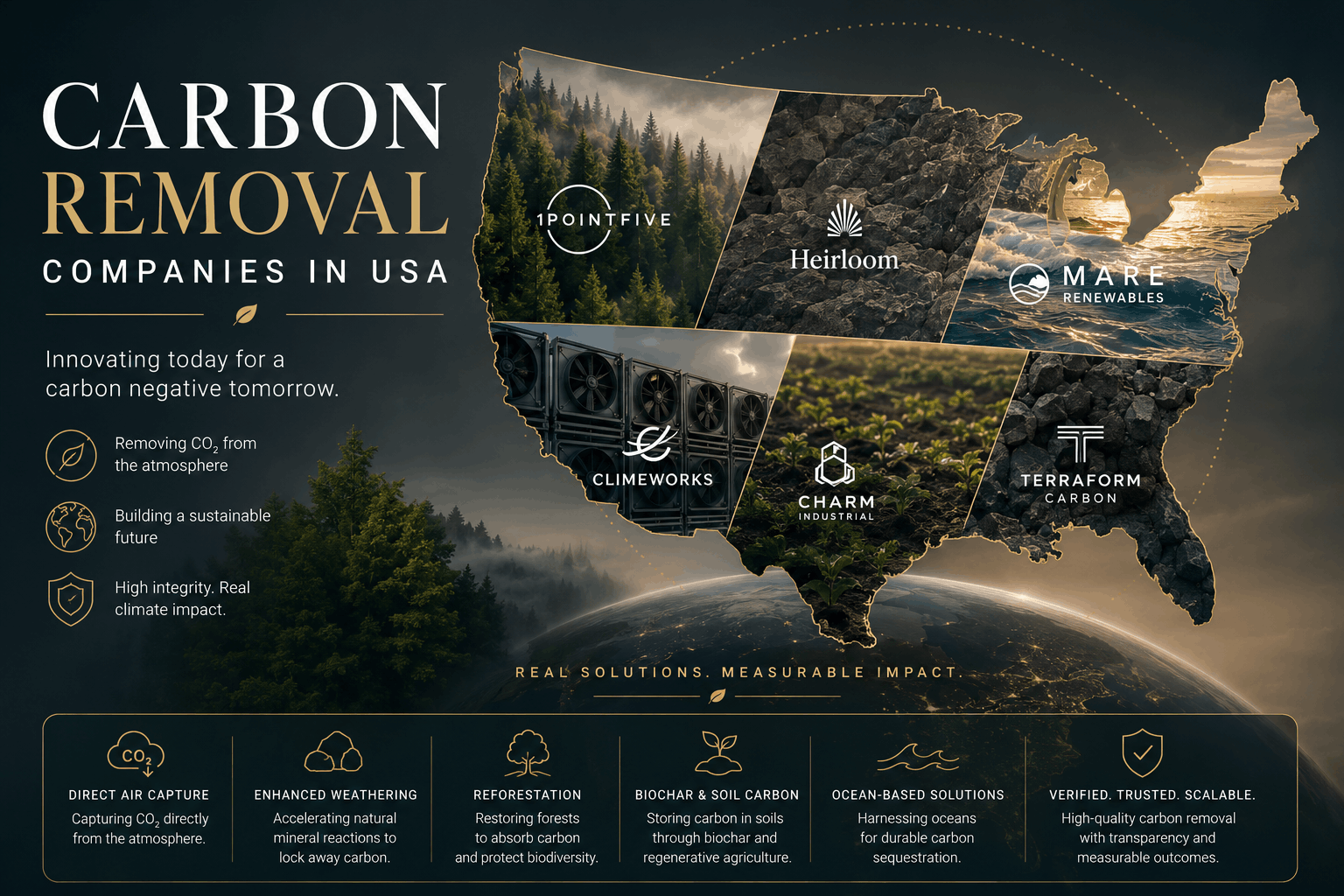
Climate change is not waiting for anyone, and neither are America’s carbon removal companies.
Across the country, a new industry is racing to pull carbon dioxide straight out of the sky and lock it away for good.
This is not the same as simply cutting emissions. It is a completely different approach, and it is growing fast.
If you are a business leader, sustainability manager, investor, or just a curious reader, you have probably heard the term “carbon removal” more often lately.
You may also have come across “CDR companies USA” while researching climate solutions or corporate net zero strategies.
This guide breaks down everything you need to know. We will cover what carbon removal actually means, how it works, who the major players are, what it costs, and how to choose the right partner.
By the end, you will understand this industry well enough to make smart decisions, whether you are buying carbon removal credits or simply want to stay informed.
Let’s get started.
What Are Carbon Removal Companies?
Carbon removal companies are businesses that develop and operate technology or land based systems to extract carbon dioxide from the atmosphere or ocean.
Once captured, that carbon dioxide gets stored somewhere it cannot escape back into the air. This could be deep underground, in rock formations, in the ocean floor, or locked into long lasting materials.
This process is often called carbon dioxide removal, or CDR for short.
It is different from carbon capture at emission sources, like a factory smokestack. Traditional carbon capture stops new emissions from entering the air.
Carbon removal goes a step further. It takes carbon dioxide that is already floating around in the atmosphere and removes it permanently.
Think of it like this:
- Emission reduction stops the bathtub from overflowing by turning down the tap.
- Carbon removal pulls water that has already spilled onto the floor and puts it back where it belongs.
Both matter. But most climate scientists agree that reducing emissions alone will not be enough to meet global climate targets. The world also needs large scale carbon removal.
That is exactly why carbon removal companies in the USA have become such a hot topic among corporations, investors, and policymakers.
Carbon Market Insider Newsletter
Weekly insights on carbon markets, climate policy, carbon credits, and sustainability.
Why the USA Leads the Global Carbon Removal Industry
The United States has become the epicenter of the carbon dioxide removal industry, and there are clear reasons why.
Strong Government Incentives
The federal 45Q tax credit gives companies a direct financial incentive to capture and store carbon dioxide permanently. This credit pays out per ton of CO2 captured and stored, making large scale projects more financially viable.
The Department of Energy has also funded regional Direct Air Capture Hubs. These hubs bring together companies, research institutions, and infrastructure in one place to speed up deployment.
Corporate Demand
Major American companies have become the biggest buyers of carbon removal credits in the world.
Microsoft alone has signed some of the largest carbon removal purchase agreements ever recorded. Other big buyers include technology companies, airlines, and consumer brands trying to meet their own net zero commitments.
This corporate demand gives carbon removal companies the revenue they need to build and scale their technology.
Deep Investment and Research Base
America is home to a dense cluster of climate tech investors, national laboratories, universities, and engineering talent. This combination has allowed carbon removal startups to move quickly from lab experiments to real world pilot projects.
Geological Advantage
The US has vast underground rock formations suited for permanently storing captured CO2. States like Texas, Louisiana, and Wyoming offer geology that makes long term carbon storage both safe and practical.
Main Types of Carbon Removal Technology
Not all carbon removal companies work the same way. Different companies use different methods, and each one has its own strengths, costs, and permanence.
Here is a simple breakdown of the major approaches used across the industry today.
1. Direct Air Capture (DAC)
Direct air capture machines pull ambient air through a filter or chemical solution that binds to carbon dioxide molecules. The captured CO2 is then separated out and injected deep underground or turned into solid material.
DAC is one of the most measurable and verifiable forms of carbon removal because it happens inside a controlled facility. That makes it easy to track exactly how much CO2 has been captured.
The tradeoff is cost. DAC remains one of the more expensive removal methods, though prices are steadily coming down as facilities scale up.
2. Biomass Carbon Removal and Storage (BiCRS)
This method uses plant based material, like agricultural waste or forestry residue, that has already absorbed CO2 from the atmosphere while growing.
Instead of letting that biomass decompose or burn and release its carbon back into the air, companies bury it, convert it into stable biochar, or store it in ways that prevent decomposition.
BiCRS is often cheaper than DAC and can scale relatively quickly since it uses existing waste streams.
3. Enhanced Rock Weathering
This approach speeds up a natural process where certain rocks react with CO2 in the air and convert it into stable minerals.
Companies spread crushed basalt or similar rock across farmland. Over time, the rock reacts with rainwater and carbon dioxide, locking the carbon into solid mineral form while also improving soil health.
4. Ocean Based Carbon Removal
Oceans naturally absorb enormous amounts of carbon dioxide. Some companies use electrochemistry or mineral additions to boost the ocean’s ability to store CO2 without increasing acidity.
This category is still developing scientifically, and verification remains more complex compared to land based methods.
5. Afforestation and Improved Forest Management
Trees capture carbon dioxide as they grow. Companies in this space plant new forests or manage existing ones to increase how much carbon they store over time.
This is one of the oldest and most familiar forms of carbon removal, though permanence can be a concern since forests face risks like wildfire and disease.
6. Biochar Production
Biochar involves heating organic material in a low oxygen environment to create a stable, carbon rich material. This biochar can be added to soil, where it stores carbon for centuries while also improving soil fertility.
Table: Comparing Carbon Removal Methods
| Method | Typical Cost per Ton | Permanence | Scalability |
|---|---|---|---|
| Direct Air Capture | High | Very long term (thousands of years) | Growing steadily |
| BiCRS | Moderate | Long term (centuries to longer) | Fast growing |
| Enhanced Rock Weathering | Moderate to high | Very long term | Early stage, scaling |
| Ocean Based Removal | Varies widely | Uncertain, still studied | Early stage |
| Afforestation | Low to moderate | Medium (decades, risk of reversal) | Well established |
| Biochar | Low to moderate | Long term (centuries) | Fast growing |
Top Carbon Removal Companies in the USA
Below is a look at some of the most notable carbon removal companies operating in the United States. This list covers a range of technologies so you can see how differently these companies approach the same core problem.
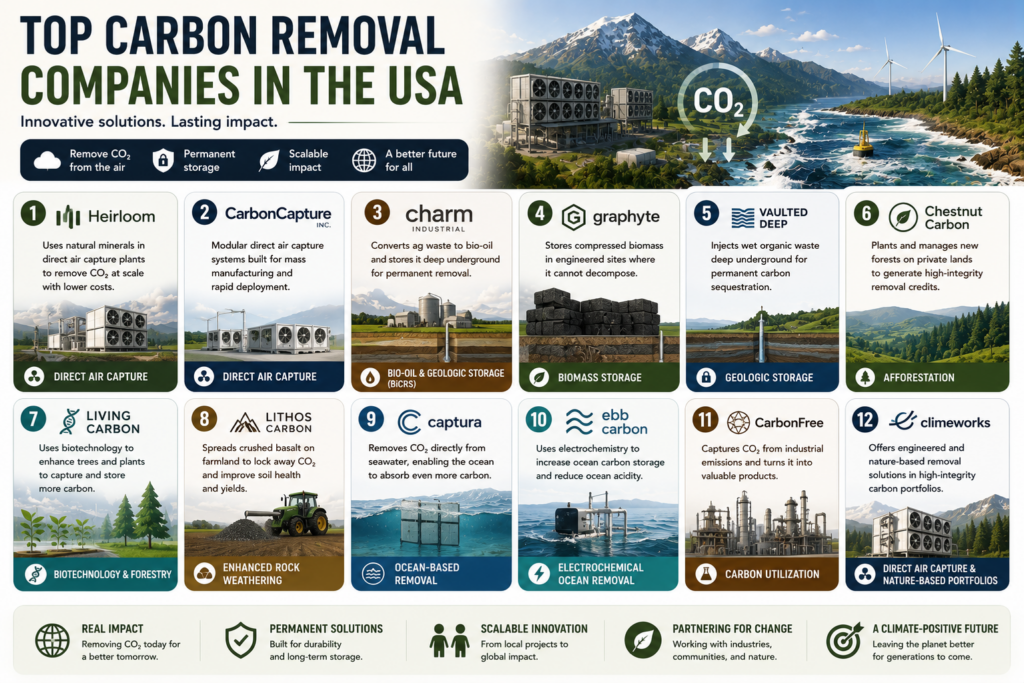
Heirloom
Heirloom operates direct air capture facilities that use naturally occurring minerals to absorb CO2 from the air at an accelerated pace. The company has built commercial scale DAC plants and has agreements with major corporate buyers.
Heirloom stands out for using a relatively low cost, mineral based approach compared to some other DAC methods.
CarbonCapture Inc.
Based in California, CarbonCapture Inc. (website) builds modular direct air capture systems designed to be manufactured at scale, similar to how solar panels or batteries are mass produced.
Their approach focuses on driving down costs through modular design and rapid deployment rather than building a single giant facility.
Charm Industrial
Charm Industrial converts agricultural waste into a bio oil through a process called fast pyrolysis. That bio oil is then injected deep underground for permanent storage.
This is one of the more established BiCRS companies in the country, with a track record of delivering verified removal credits to corporate buyers.
Graphyte
Graphyte compresses waste biomass, like wood chips and rice hulls, into dense blocks and stores them in engineered containment sites where oxygen and moisture are kept out. Without oxygen, the material cannot decompose and release its stored carbon.
Graphyte’s process is notably simple and fast compared to more complex chemical methods, which helps keep costs relatively low.
Vaulted Deep
Vaulted Deep takes wet organic waste, such as biosolids and manure, and injects it deep underground into geological formations. This keeps the carbon locked away permanently while also solving a waste management problem for partner companies.
Chestnut Carbon
Chestnut Carbon focuses on large scale afforestation projects across privately owned land in the United States. The company plants new forests specifically designed to generate high integrity, verifiable carbon removal credits over the long term.
Living Carbon
Living Carbon uses biotechnology to enhance how efficiently trees and other plants absorb and store carbon. Their approach blends forestry with genetic and biological research to boost natural carbon capture.
Lithos Carbon
Lithos Carbon specializes in enhanced rock weathering, spreading crushed basalt rock across agricultural land. This locks away carbon dioxide while also benefiting farmers through improved soil conditions and crop yields.
Captura
Developed using technology from Caltech, Captura focuses on ocean based carbon removal. Their system pulls CO2 directly from seawater, which then allows the ocean to absorb even more carbon dioxide from the atmosphere.
Ebb Carbon
Ebb Carbon uses electrochemistry to boost the ocean’s natural capacity to store carbon dioxide while simultaneously reducing ocean acidity, an added environmental benefit beyond carbon removal itself.
CarbonFree
CarbonFree focuses on capturing CO2 directly from industrial facility emissions and converting it into useful products, like specialty chemicals, rather than simply storing it.
Climeworks
Although originally a Swiss company, Climeworks has an active presence in the American carbon removal market. It manages carbon removal portfolios by combining engineered solutions like direct air capture with nature based approaches, offering corporate clients a blended, high integrity portfolio.
Table: Carbon Removal Companies by Technology Type
| Company | Primary Technology | Storage Method |
|---|---|---|
| Heirloom | Direct Air Capture | Mineralization or underground storage |
| CarbonCapture Inc. | Direct Air Capture | Underground geological storage |
| Charm Industrial | Biomass to bio oil (BiCRS) | Deep underground injection |
| Graphyte | Compressed biomass (BiCRS) | Sealed containment burial |
| Vaulted Deep | Organic waste injection | Deep underground geological formations |
| Chestnut Carbon | Afforestation | Living forest biomass |
| Living Carbon | Enhanced biological carbon capture | Living biomass |
| Lithos Carbon | Enhanced rock weathering | Mineral conversion in soil |
| Captura | Ocean based direct capture | Ocean equilibrium restoration |
| Ebb Carbon | Ocean electrochemistry | Ocean mineral storage |
| CarbonFree | Industrial point source capture | Product conversion |
| Climeworks | Direct Air Capture and portfolio management | Multiple methods |
Note that this industry moves fast. Company names, technology approaches, and project locations can change, so always verify current details directly with a company before making purchasing decisions.
How Carbon Removal Companies Actually Make Money
Understanding the business model helps explain why some companies succeed and others struggle.
Most carbon removal companies generate revenue by selling carbon removal credits. Here is the basic cycle.
- A company captures and permanently stores carbon dioxide using one of the technologies described above.
- An independent verification body checks the work. This step confirms that the claimed amount of CO2 was actually removed and stored durably.
- The company issues a carbon removal credit representing one metric ton of verified CO2 removal.
- Corporate buyers purchase these credits to offset their own emissions or meet climate commitments.
- Revenue from credit sales funds further research, construction, and scaling of the removal technology.
Some companies also earn revenue through direct government incentives, like the 45Q tax credit, which rewards permanent CO2 storage regardless of whether a private buyer is involved.
A smaller number of companies, like CarbonFree, convert captured carbon into a marketable product, giving them an additional revenue stream beyond credit sales.
Who Buys Carbon Removal Credits
Corporate buyers drive almost all demand in this market today. Common reasons companies purchase carbon removal credits include:
- Meeting voluntary net zero or science based climate targets
- Complying with emerging regulatory requirements
- Supporting early stage climate technology to help it scale
- Strengthening sustainability reporting and brand reputation
- Diversifying a broader climate strategy that also includes emission reductions
Large technology companies remain the dominant buyers, largely because their operations, especially data centers, consume enormous amounts of energy. Airlines, financial institutions, and consumer goods companies have also become active buyers as they look for credible ways to address emissions that are difficult to eliminate entirely.
The Real Challenges Facing Carbon Removal Companies
This industry is exciting, but it is not without serious challenges. Being upfront about these helps set realistic expectations.
High Costs
Many removal methods, especially direct air capture, remain expensive compared to traditional carbon offsets like forest conservation. Costs are falling, but they still limit how much carbon removal companies can sell.
Market Demand Volatility
Corporate demand for carbon credits can shift quickly based on economic conditions, public sentiment, and shifting priorities. A slowdown in demand can leave a promising company without enough revenue to continue operating.
This is exactly what happened to Running Tide, an ocean based carbon removal startup that shut down after struggling to secure enough financing, despite having signed deals with well known corporate buyers. Its closure served as a wake up call for the industry about the risks of relying too heavily on a shrinking pool of voluntary buyers.
Verification and Permanence Concerns
Buyers want confidence that a ton of CO2 claimed as removed will actually stay locked away. Different methods carry different levels of certainty, and the industry continues working to standardize verification protocols across all technology types.
Scaling Fast Enough
Scientists estimate the world needs carbon removal at a scale many times larger than what currently exists. Getting there requires massive investment, faster permitting, and continued policy support.
How to Choose the Right Carbon Removal Company
If you are a business evaluating potential carbon removal partners, here is a practical step by step approach.
Step 1: Define your climate goals clearly. Decide whether you need permanent, long duration removal or a blended portfolio that also includes shorter term nature based solutions.
Step 2: Evaluate technology maturity. Some methods, like direct air capture, offer strong measurability but higher costs. Others, like BiCRS, may offer a better balance of cost and verifiable permanence.
Step 3: Check third party verification. Look for independent verification of both the amount of carbon removed and the durability of storage.
Step 4: Review the company’s track record. Has the company delivered removal credits successfully in the past? Do they have existing corporate customers you can learn from?
Step 5: Understand pricing and contract terms. Carbon removal credit prices vary enormously depending on technology and durability. Get clarity on what exactly you are paying for.
Step 6: Diversify across multiple companies and methods. Just like an investment portfolio, spreading purchases across several carbon removal companies and technology types reduces risk if one project underperforms or a company faces financial trouble.
The Role of Policy in Growing This Industry
Government support plays a massive role in whether carbon removal companies succeed long term.
The 45Q federal tax credit remains one of the most important tools driving investment into carbon capture and storage infrastructure in the US. It offers a direct financial reward tied to verified tons of CO2 permanently stored.
Regional Direct Air Capture Hubs, funded through federal energy programs, aim to cluster infrastructure, research, and multiple companies in strategic locations. This shared infrastructure approach helps lower costs for everyone involved.
State level policies also matter. Some states offer additional incentives or streamlined permitting for carbon storage projects, making them more attractive locations for new facilities.
Ongoing policy support will likely determine how quickly this industry can scale to the size scientists say is necessary.
What the Future Looks Like for US Carbon Removal Companies
The carbon removal industry in the United States is still young, but its trajectory points toward steady growth.
Costs for most removal methods are expected to keep falling as facilities scale up and engineering improves, similar to how solar panel costs dropped dramatically over time.
Corporate demand, while occasionally volatile, is expected to grow overall as more companies adopt formal net zero commitments and face pressure from investors and regulators alike.
New technology approaches will likely continue emerging, and consolidation is possible as stronger companies acquire or outcompete smaller ones.
Government policy will remain a critical factor. Continued or expanded tax incentives could accelerate growth significantly, while policy uncertainty could slow investment.
For buyers, the message is simple. This market rewards careful research and diversification rather than betting on a single company or technology.
Common Myths About Carbon Removal Companies
There is a lot of confusion around this topic, so let’s clear up a few common myths.
Myth: Carbon removal is just a marketing gimmick. The underlying science is real and well documented. Independent researchers and national laboratories have studied these methods extensively. The industry does face business and financing challenges, but the core technology is grounded in solid chemistry and biology.
Myth: All carbon removal credits are equally trustworthy. This is false. Credits vary enormously in quality depending on the verification standard, the permanence of storage, and how transparent the company is about its methodology. Always dig into the details rather than assuming one credit equals another.
Myth: Carbon removal can replace the need to cut emissions. Even the most optimistic scenarios show that carbon removal works alongside emission cuts, not instead of them. Companies that rely solely on removal credits while ignoring their own emissions face growing criticism from regulators and the public.
Myth: Only huge corporations can get involved. While large buyers dominate the market today, smaller businesses can also purchase carbon removal credits, often through marketplaces or brokers that aggregate smaller volumes into larger purchases.
Why Corporate Demand Keeps Rising
A major driver behind the growth of carbon removal companies in the USA is the explosion of energy hungry data centers.
As artificial intelligence and cloud computing expand, the electricity demand from data centers has grown sharply. Many of the companies operating these facilities have made public commitments to reach net zero emissions.
Since fully eliminating emissions from massive computing operations is extremely difficult in the short term, these companies increasingly turn to carbon removal to balance out what they cannot yet eliminate directly.
This trend has made technology companies the single largest category of carbon removal credit buyers today, and that demand is expected to continue growing as computing needs expand further.
Airlines face a similar challenge. Aviation emissions are notoriously hard to eliminate with current technology, which pushes airlines toward carbon removal purchases as part of their broader sustainability strategy.
Financial institutions and consumer brands round out the buyer landscape, often motivated by investor pressure, customer expectations, or upcoming regulatory requirements around climate disclosure.
How Verification and Measurement Work
One of the biggest questions buyers ask is simple. How do we know the carbon was actually removed?
This is where measurement, reporting, and verification, often shortened to MRV, becomes essential.
Here is generally how the process works.
- Baseline measurement. Before a project begins, scientists measure existing carbon levels to establish an accurate starting point.
- Ongoing monitoring. Sensors, sampling, satellite imagery, or laboratory testing track how much carbon dioxide is captured over time.
- Third party verification. An independent auditor, separate from the company selling the credits, reviews the data and confirms the results meet an established standard.
- Registry issuance. Once verified, a credit gets registered with a recognized carbon registry, creating a public record that prevents the same ton of CO2 from being sold twice.
- Ongoing durability checks. For methods like afforestation, monitoring often continues for years or even decades to confirm the carbon stays stored.
Direct air capture and BiCRS methods tend to have the most straightforward MRV processes since the process happens in a controlled setting. Ocean based and forestry methods often require more complex, longer term monitoring due to natural variability.
Buyers should always ask a company which registry and verification standard they use, since this single detail says a lot about credit quality.
Practical Tips for Beginners Exploring Carbon Removal
If you are new to this space, here are a few practical starting points.
- Start small. Consider purchasing a modest volume of credits to understand the process before committing to a large scale agreement.
- Ask direct questions. Reach out to companies and ask specifically how they measure removal, verify permanence, and price their credits.
- Read independent research. Universities, national laboratories, and nonprofit research groups regularly publish studies evaluating different carbon removal methods.
- Watch the news. This industry changes quickly. Companies merge, shut down, or launch new technology often, so staying updated helps you make informed decisions.
- Think long term. Carbon removal is a decades long project, not a quick fix. Approach it with patience and a willingness to learn as the science and market mature.
Frequently Asked Questions
What is the difference between carbon capture and carbon removal?
Carbon capture typically refers to capturing emissions at their source, like a power plant smokestack, before they enter the atmosphere. Carbon removal takes CO2 that is already in the atmosphere or ocean and extracts it permanently.
Are carbon removal credits the same as carbon offsets?
Not exactly. Traditional carbon offsets often represent avoided emissions, like preventing deforestation. Carbon removal credits specifically represent CO2 that has already been physically extracted and stored.
How much does carbon removal cost per ton?
Prices vary widely depending on the technology used. Nature based methods and biomass approaches tend to cost less per ton, while direct air capture remains more expensive, though prices are trending downward.
Which carbon removal method is most permanent?
Direct air capture combined with deep underground geological storage, along with enhanced rock weathering, generally offers the longest term permanence, often measured in thousands of years.
Who are the biggest buyers of carbon removal credits?
Large technology companies are currently the dominant buyers, largely due to the significant energy demands of their operations, particularly data centers. Airlines and consumer brands are also increasingly active in this market.
Is carbon removal technology proven to work?
Yes, the underlying science behind capturing and storing CO2 is well established. The main challenges facing the industry are cost, scale, and consistent financing rather than whether the technology works.
Can individuals invest in carbon removal companies?
Some carbon removal companies are privately held and not open to public investment, while others may offer opportunities through public markets or specialized climate investment funds. Always research investment options carefully before committing funds.
Final Thoughts
Carbon removal companies in the USA represent one of the most important and fast moving frontiers in the fight against climate change.
From direct air capture machines pulling CO2 straight from the sky to biomass burial projects locking carbon away underground, American companies are pioneering an entirely new industry.
Government incentives, corporate demand, and deep technical talent have positioned the United States as a global leader in this space.
Challenges remain, particularly around cost and consistent demand, but the direction is clear. Carbon removal is moving from experimental pilot projects toward a genuine, scalable climate solution.
Whether you are a business exploring your first carbon removal purchase or simply want to understand where climate technology is headed, keeping an eye on these companies is time well spent.
The next decade will likely determine whether carbon removal becomes a mainstream climate tool or remains a niche solution. Either way, the companies covered in this guide are shaping that outcome right now.
For more updates, guides, and resources on carbon markets, explore Carbon Market Network.