Carbon Market Network


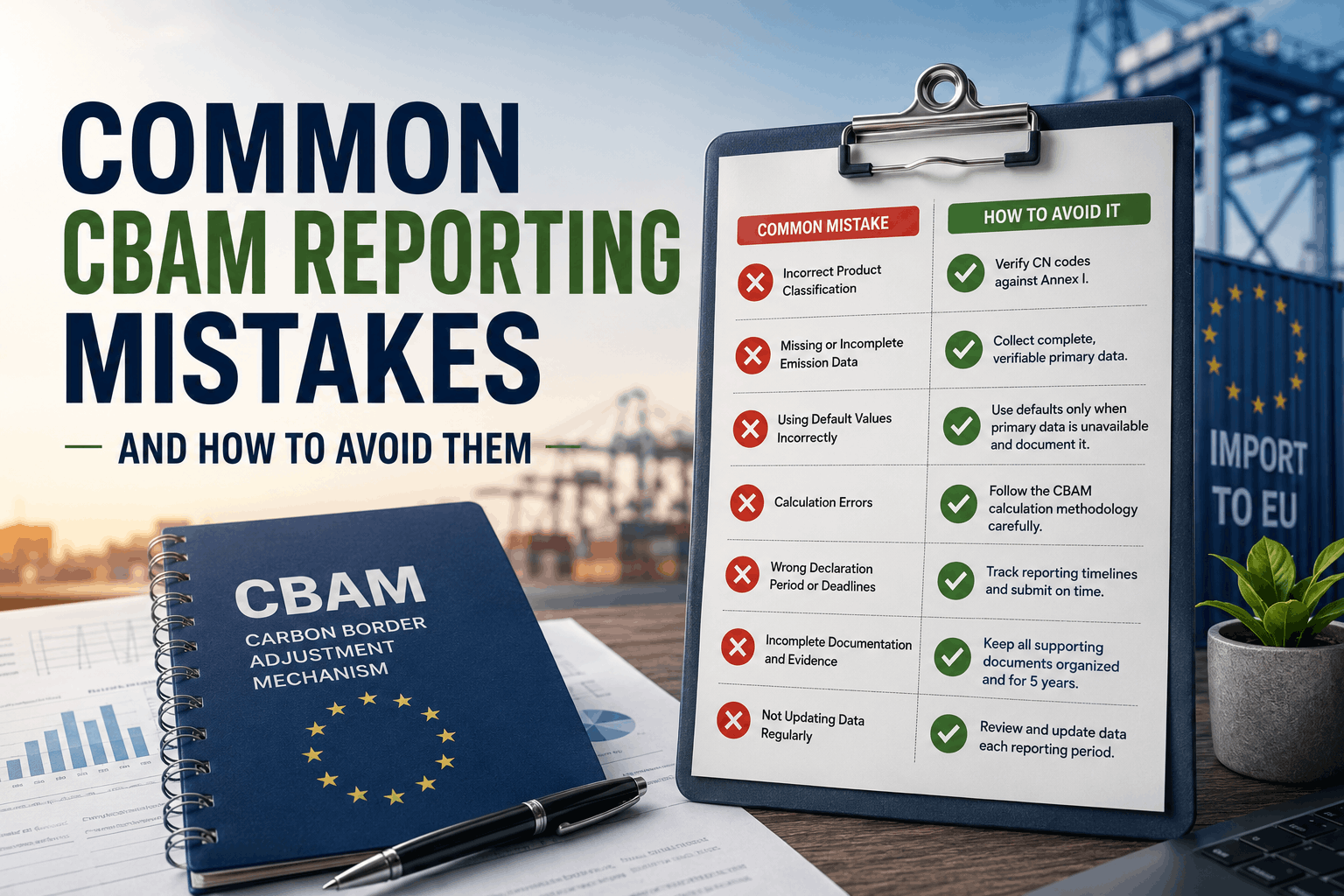
If you import goods into the European Union and you have heard of CBAM, there is a good chance you are already stressed about getting your reporting right. And honestly, that stress is valid.
The Carbon Border Adjustment Mechanism is no longer a future concern. It is live, it is mandatory, and it has teeth. The definitive phase kicked in at the start of the current compliance cycle, meaning importers now face real financial penalties for every error they make in their CBAM declarations.
The frustrating part? Most of the common CBAM reporting mistakes are entirely avoidable. They are not the result of complex regulatory ambiguity. They happen because companies rush, misclassify goods, trust the wrong data, or simply do not know what is actually required of them.
This article breaks down every major CBAM reporting error in detail, explains why each one happens, and tells you exactly what to do about it. Whether you are a first-time CBAM declarant or a compliance professional reviewing your current process, this guide will help you report accurately, avoid penalties, and stay on the right side of EU regulators.
What Is CBAM and Why Accurate Reporting Matters So Much
The Carbon Border Adjustment Mechanism (CBAM) is the EU’s way of making sure that imported goods bear the same carbon cost as goods manufactured within the EU. Under the EU Emissions Trading System (EU ETS), European producers pay for every tonne of carbon they emit. CBAM extends that principle to imports.
Covered goods currently include iron and steel, aluminium, cement, fertilisers, hydrogen, and electricity. If you import any of these into the EU above the applicable threshold, you are in scope.
In the definitive phase, the stakes are financial. Importers must purchase CBAM certificates that correspond to the verified embedded emissions in their imports. Certificates are priced in line with the weekly average auction price of EU ETS allowances, which has ranged from around €50 to over €100 per tonne of CO2 in recent years.
Now here is why accuracy matters so much. If you underreport emissions, you owe more certificates than you have surrendered, which triggers a penalty. If you misclassify goods and the mistake is caught during an audit, the correction is retrospective. Every single figure in your CBAM declaration now has a euro value attached to it.
The National Competent Authority (NCA) in each EU member state is responsible for reviewing declarations and imposing fines. Penalties for inaccurate or missing reporting can range from €10 to €50 per tonne of CO2 in many cases, and can reach €100 per excess tonne for certificate surrender failures. For high-volume importers, even a small error rate can add up to a very large bill.
So let us look at exactly where things go wrong.
Carbon Market Insider Newsletter
Weekly insights on carbon markets, climate policy, carbon credits, and sustainability.
Mistake 1: Getting the CN Code Classification Wrong
This is consistently the first mistake auditors look for, and it is one of the most consequential.
Combined Nomenclature (CN) codes are the 8-digit product classification codes used in EU customs. CBAM only applies to goods whose CN codes are listed in Annex I of the CBAM Regulation. If you report under the wrong CN code, everything that follows is incorrect: the emissions factor, the certificate quantity, and ultimately your financial liability.
Why This Happens
Many companies have been using the same CN codes for years without ever verifying whether they are applying the most precise classification. Some goods sit in grey zones where the right code is genuinely difficult to determine. Others have been incorrectly classified at the customs level and those errors simply carry forward into CBAM reporting.
A real-world example: a supplier internally classifies their goods as “parts” rather than as a CBAM-relevant product category. When the EU importer checks the actual CN code at the point of preparing their CBAM declaration, it turns out the goods are squarely within scope. By that point, no emissions data has been collected, and the importer is forced to rely on default values, which are almost always higher than actual emissions.
How to Avoid It
- Cross-check every imported product’s CN code against Annex I of the CBAM Regulation before you import, not after.
- Involve your customs classification team in the CBAM scoping exercise. This is not a job for the sustainability department alone.
- If there is any doubt about classification, seek a formal Binding Tariff Information (BTI) ruling from your national customs authority.
- Review your full import catalogue at least once per reporting cycle to catch any goods that may have moved in or out of scope.
Mistake 2: Failing to Obtain Authorised CBAM Declarant Status
This mistake does not affect the accuracy of your report. It affects whether you are legally allowed to import at all.
From the start of the definitive phase, only importers with Authorised CBAM Declarant status can bring in-scope goods into the EU. Companies that failed to apply for this status by the relevant deadline risked having their shipments blocked at customs. That is not a compliance issue. That is an operational emergency.
Why This Happens
During the transitional period, there was no authorisation requirement. Any importer with an EORI number could submit quarterly CBAM reports. The shift to a mandatory authorisation process caught many businesses off guard, particularly smaller importers and those who had been handling CBAM reporting in-house without specialist support.
Some companies simply did not track the regulatory timeline carefully enough. Others assumed that submitting transitional reports was sufficient to carry them through to the definitive phase.
How to Avoid It
- If you have not already applied for Authorised CBAM Declarant status, do it immediately. Check the CBAM Registry and your national authority’s portal for current guidance.
- Assign one person within your organisation who is specifically responsible for tracking CBAM regulatory deadlines.
- Set up calendar alerts at least three months ahead of any CBAM administrative deadline.
- If you are importing through an indirect customs representative, confirm in writing that they have declarant status and are authorised to submit on your behalf.
Mistake 3: Relying Too Heavily on Default Values
Default values were designed as a fallback, not as a reporting strategy. Yet many importers have been using them far beyond what the regulation intended, often because collecting actual emissions data from suppliers feels difficult.
Here is the problem. Default values are set conservatively high. They represent a global weighted average based on production volumes, and they are deliberately punitive to incentivise actual data collection. Using default values when you could have collected real data almost always means you are overpaying for CBAM certificates.
The Limits on Default Values
During the transitional period, there were strict limits on how much of your total reported emissions could come from estimates, including default values. From a certain point in the transitional period onward, only up to 20% of total embedded emissions could come from estimates. The definitive phase tightens this further, requiring actual verified data as the standard approach.
Additionally, using default values for precursors (the materials used to produce your imported good) can significantly inflate your total embedded emissions figure, because default values compound across the supply chain.
How to Avoid It
- Start supplier data collection early, well before any reporting deadline. Waiting until the last quarter creates exactly the kind of time pressure that forces you back onto defaults.
- Create a simple data request template for your suppliers that covers: total energy consumption, fuel mix, process emissions, and production volumes. Make it as easy as possible for them to fill in.
- Prioritise suppliers who account for the largest share of your imported tonnage. Even getting actual data from your top three or four suppliers can reduce your default value reliance dramatically.
- If a supplier is genuinely unable to provide actual data, document why. This creates an audit trail showing good-faith effort.
Mistake 4: Missing or Misreporting Indirect Emissions
Not all emissions from manufacturing are created equal. For CBAM purposes, there are two types: direct emissions and indirect emissions.
Direct emissions are those produced during the manufacturing process itself, such as CO2 from burning fuel in a furnace or process emissions from chemical reactions.
Indirect emissions are the emissions associated with the electricity consumed during production.
Whether you need to report indirect emissions depends on which product category you are importing.
| Product Category | Direct Emissions | Indirect Emissions |
|---|---|---|
| Iron and Steel | Required | Currently focused on direct only |
| Aluminium | Required | Currently focused on direct only |
| Cement | Required | Required |
| Fertilisers | Required | Required |
| Hydrogen | Required | Required |
| Electricity | N/A (special rules) | N/A (special rules) |
Why This Mistake Happens
Many importers assume that if their supplier gives them an emissions figure, they are done. But if that figure only covers direct emissions and your product category requires indirect emissions reporting too, your declaration is incomplete. Incomplete declarations attract retrospective penalties once the underdeclaration is identified, and there is no discretionary leniency in the enforcement framework.
How to Avoid It
- Check the specific reporting requirements for each CN code you import, not just the general sector rules.
- Ask your suppliers to provide separate figures for direct and indirect emissions in their data submissions.
- If your suppliers use a carbon-priced electricity grid, this may affect the indirect emissions adjustment. Understand how this interacts with your CBAM liability.
- Review the latest implementing regulations carefully, since the exact requirements for indirect emissions have evolved over time.
Mistake 5: Not Engaging Suppliers Early Enough
CBAM compliance is not something an EU importer can complete on their own. The emissions data has to come from the producer of the goods, who is typically outside the EU. This creates a fundamental dependency that many companies underestimate until it is too late.
The challenge is that non-EU suppliers are not themselves subject to CBAM. The obligation sits with the EU importer. Yet the EU importer cannot file an accurate declaration without data that only the supplier holds. This mismatch in incentives is one of the biggest structural weaknesses in CBAM supply chains right now.
What Goes Wrong in Practice
- Suppliers receive a CBAM data request very late in the process and simply do not have time to compile it accurately.
- Suppliers do not understand what is being asked of them and provide incomplete or incorrectly formatted data.
- Suppliers view CBAM data requests as intrusive or commercially sensitive and resist sharing detailed production information.
- Different internal teams at the supplier (operations, procurement, sustainability) all hold pieces of the required data, and no one consolidates it properly.
How to Avoid It
- Contact your key suppliers as soon as you identify that their goods fall within CBAM scope. Do not wait for the declaration deadline to approach.
- Educate your suppliers on what CBAM is, why the data matters, and what specific figures you need from them. The more clearly you explain the ask, the more likely you are to get a useful response.
- Build CBAM data requirements into your supplier contracts and procurement agreements. Make it a standard part of supplier onboarding for CBAM-covered goods.
- Establish a regular cadence for data collection, such as quarterly updates aligned to your reporting cycle, rather than a single frantic request at year-end.
- Consider using a standardised data collection template based on the EU’s own guidance documents, so suppliers know exactly what format is expected.
Mistake 6: Confusing Production Route and Emissions Methodology
This is a more technical mistake, but it is worth understanding because it affects the mathematical foundation of your entire declaration.
CBAM requires that embedded emissions be calculated using the EU’s specific methodology as set out in the implementing regulations. This methodology is not the same as the GHG Protocol or ISO 14067, which are the frameworks that many suppliers use for their own carbon footprint reporting. Emissions calculated under a different methodology cannot simply be plugged into a CBAM report without conversion.
Why the Methodology Matters
CBAM uses a concept called “embedded emissions,” which tracks the carbon that went into making a product across its full production process, including the emissions from any precursor materials. The methodology specifies exactly how to account for each input, how to handle heat and electricity, and which emission factors to apply.
If a supplier provides you with a product carbon footprint calculated under ISO 14067 or the GHG Protocol, the scope boundaries, allocation rules, and emission factors may differ significantly from what CBAM requires. Using that figure directly creates a reporting error even though the supplier did their calculation correctly under their own chosen standard.
How to Avoid It
- Explicitly instruct your suppliers to calculate and report emissions using the CBAM-specific methodology, not their standard sustainability reporting framework.
- Share the relevant EU guidance documents with your suppliers, particularly the sections covering the calculation methodology for your specific product category.
- Have a qualified professional review any supplier-provided emissions data before it goes into your declaration to confirm it aligns with CBAM requirements.
- Understand the distinction between simple goods (where only direct emissions from the final production process are included) and complex goods (where precursor emissions are also included), and apply the correct methodology accordingly.
Mistake 7: Ignoring the Third-Party Verification Requirement
In the definitive phase, all embedded emissions data reported in your annual CBAM declaration must be verified by an independent, accredited verifier before the declaration is submitted.
This is not optional. It is not a best practice. It is a legal requirement.
Many importers who were handling CBAM reporting in-house during the transitional period assumed they could continue to do so without engaging an external verifier. That assumption is incorrect and costly.
What Verification Actually Involves
An accredited verifier will review your emissions data, check it against supporting evidence from your suppliers, verify that the correct methodology was applied, and produce a verification statement confirming the accuracy of your reported figures. Without this statement, your declaration is non-compliant.
Common Verification-Related Mistakes
- Starting the verification process too late. Verification takes time, particularly for importers with complex supply chains. If you engage a verifier two weeks before your declaration deadline, you will almost certainly not have the necessary documentation ready in time.
- Not keeping adequate documentation. Verifiers need evidence. If your suppliers cannot provide bills of materials, energy consumption records, fuel mix data, and production volume figures, the verifier cannot sign off on the data.
- Assuming your existing sustainability auditors can verify CBAM data. CBAM verification requires specific accreditation under the CBAM Regulation. Your general ESG auditor may not have that accreditation.
How to Avoid It
- Engage an accredited CBAM verifier at least three to four months before your declaration deadline.
- Build your documentation system now. Every piece of data that goes into your declaration needs to be traceable back to a source document.
- Check that your chosen verifier is specifically accredited for CBAM verification under the relevant implementing regulations, not just accredited for GHG verification in general.
Mistake 8: Misunderstanding the 50-Tonne Exemption Threshold
Not every importer of CBAM goods has to submit a full annual declaration. The Omnibus simplification introduced a mass-based exemption threshold: importers who bring in less than 50 tonnes of CBAM-covered goods per year are exempt from the main declaration and certificate obligations.
However, this exemption is frequently misunderstood in both directions.
Common Errors Around the Threshold
- Assuming the threshold applies per shipment. It does not. The 50-tonne figure is an annual aggregate across all in-scope goods from all origins. A company that imports 5 tonnes per month is well above the threshold.
- Not monitoring import volumes. If your import volumes are close to 50 tonnes per year, you need to monitor them actively. Crossing the threshold mid-year does not exempt you from that year’s declaration.
- Thinking the exemption eliminates all obligations. Even importers below the threshold should understand the rules in case their volumes change, and they should still be prepared to demonstrate that they fall below the threshold if asked.
How to Avoid It
- Calculate your total annual import volume for all CBAM-covered goods at the start of each compliance year.
- Monitor volumes quarterly so you are not caught off guard if you approach or cross the threshold.
- Keep records that demonstrate your import volumes, in case your NCA asks you to confirm your exemption status.
Mistake 9: Poor Internal Coordination Between Teams
CBAM does not fit neatly into any single department. It sits at the intersection of customs, procurement, sustainability, finance, and legal. Yet many companies assign it to one team and expect that team to handle everything, which almost never works well.
The result is that critical information gets siloed. The customs team knows what was imported and under which CN codes. The sustainability team knows how to calculate emissions. The procurement team has the supplier relationships. Finance needs to understand the certificate costs. When these teams do not talk to each other, the CBAM declaration ends up being assembled from incomplete, inconsistent pieces.
Practical Coordination Problems We See
- The customs team submits import data using codes that the sustainability team has never reviewed for CBAM eligibility.
- The procurement team contacts suppliers for CBAM data without knowing what specific figures are required.
- The finance team is unaware of the forthcoming certificate costs and has not budgeted for them.
- No one person has overall responsibility for the declaration, so it falls through the cracks.
How to Fix It
| Department | CBAM Responsibility |
|---|---|
| Customs / Trade Compliance | CN code verification, import volume tracking |
| Procurement | Supplier engagement, data request management |
| Sustainability / ESG | Emissions methodology, data quality review |
| Finance | Certificate cost forecasting, budget planning |
| Legal | Regulatory monitoring, contract clauses |
| Senior Management | Overall accountability, cross-team coordination |
- Appoint a single CBAM owner or coordinator who is responsible for pulling together input from all departments.
- Hold regular cross-functional CBAM check-ins, especially in the months leading up to any declaration deadline.
- Create a shared internal CBAM calendar that shows supplier data deadlines, verification timelines, and submission dates.
Mistake 10: Treating CBAM as a One-Time Project
This is perhaps the most strategic mistake on the list.
CBAM is not a box-ticking exercise that you complete once and forget about. The regulation is evolving. The list of covered products may expand. The methodology requirements are being refined. Certificate prices will fluctuate with the EU carbon market. And your supply chain will change over time as you add new suppliers, import from new countries, or shift your product mix.
Companies that treat CBAM as a one-time compliance project find themselves scrambling to catch up every time something changes. Companies that build CBAM into their ongoing trade compliance processes stay ahead.
Building a Sustainable CBAM Process
- Review your in-scope product list at least annually, or whenever you add a new supplier or product category.
- Keep your supplier data collection live throughout the year rather than running a single frantic campaign before the declaration deadline.
- Track EU ETS carbon prices and model the financial impact of CBAM certificate costs on your import economics.
- Watch for regulatory updates from the European Commission (website), particularly any changes to the list of covered products, methodology implementing regulations, or exemption thresholds.
- Invest in systems that make data collection, storage, and verification easier over time. Spreadsheets are a common starting point, but they scale poorly as your import volume and supplier base grows.
A Summary of Common CBAM Reporting Mistakes and How to Fix Them
| Mistake | Why It Happens | How to Fix It |
|---|---|---|
| Wrong CN code classification | Outdated customs classifications carried forward | Verify CN codes against Annex I before importing |
| No Authorised CBAM Declarant status | Regulatory deadline missed | Apply immediately via national customs authority |
| Over-reliance on default values | Supplier data too hard to collect | Start supplier engagement early in the compliance cycle |
| Missing indirect emissions | Incomplete understanding of product-specific requirements | Check requirements per CN code, not just by sector |
| Late supplier engagement | Treating CBAM as an end-of-year task | Build CBAM data requests into procurement processes |
| Wrong emissions methodology | Supplier uses GHG Protocol or ISO 14067 | Require CBAM-specific methodology from suppliers |
| No third-party verification | Transitional period habits carried forward | Engage accredited verifier months before deadline |
| Misunderstanding the 50t threshold | Applying it per shipment instead of annually | Monitor annual aggregate import volumes by product |
| Poor internal coordination | CBAM assigned to one team | Appoint a cross-functional CBAM coordinator |
| One-time project mindset | Compliance seen as a task, not a process | Build CBAM into ongoing trade compliance routines |
What Happens If You Make CBAM Reporting Errors
Understanding the consequences of reporting mistakes is important for building the business case for proper CBAM investment internally.
Financial penalties. The NCA in each member state can impose fines for missing, incorrect, or incomplete reports. In the definitive phase, the penalty for failing to surrender sufficient certificates is €100 per excess tonne, plus the obligation to still purchase and surrender the missing certificates. Enforcement is stricter now than during the transitional period.
Retrospective corrections. If an error is identified, you will be required to correct your declaration. This may involve submitting additional certificates, paying the associated costs, and going through the correction procedure with your NCA. There is no amnesty for corrections that are triggered by an audit rather than self-reported.
Reputational risk. For large multinational importers, repeated CBAM compliance failures can attract regulatory attention that extends beyond carbon to broader trade compliance matters. Being flagged as a non-compliant importer in one area tends to invite greater scrutiny in others.
Higher certificate costs. If your emissions data is wrong in a way that understates actual emissions, you will have to purchase more certificates than originally planned, at whatever the current market price is at the time of correction. Depending on when in the compliance cycle this happens, the cost could be significantly higher than it would have been with accurate data from the outset.
Actionable Steps to Get Your CBAM Reporting Right
Here is a practical checklist you can use to audit your current CBAM compliance position.
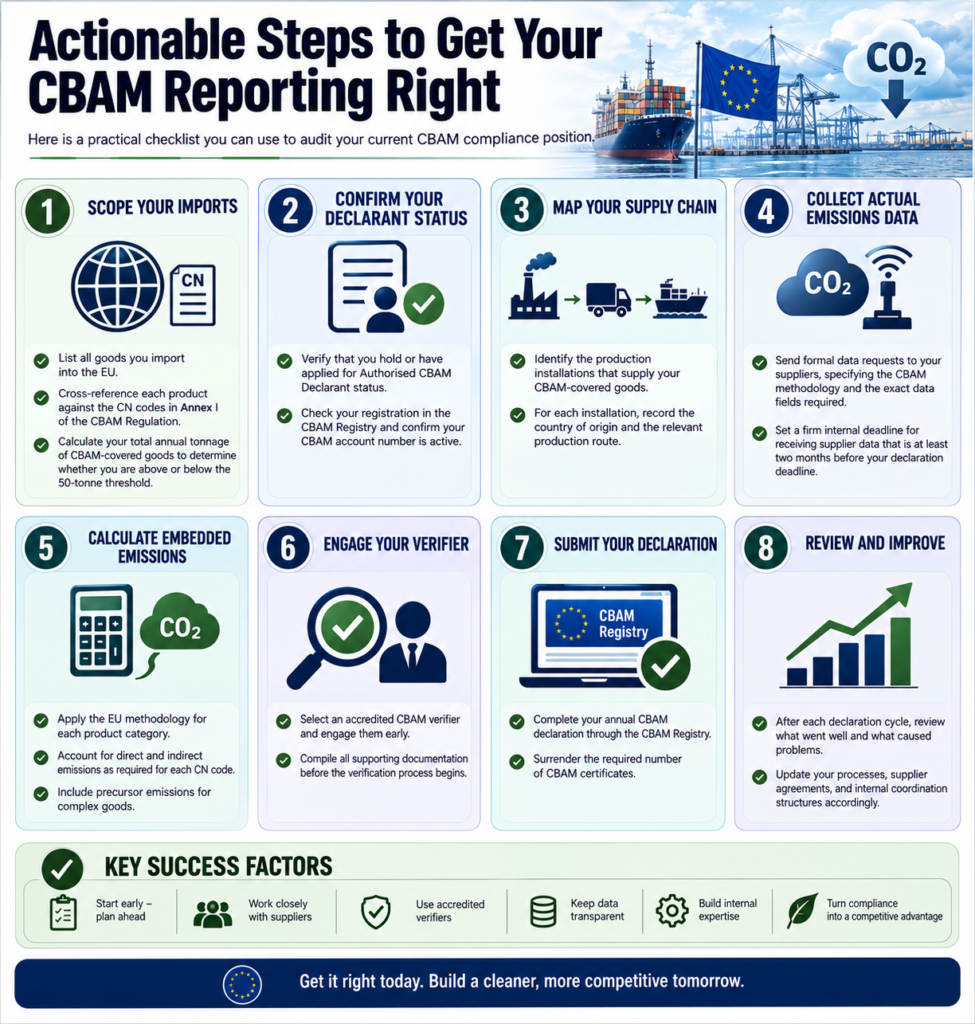
Step 1: Scope your imports
- List all goods you import into the EU.
- Cross-reference each product against the CN codes in Annex I of the CBAM Regulation.
- Calculate your total annual tonnage of CBAM-covered goods to determine whether you are above or below the 50-tonne threshold.
Step 2: Confirm your declarant status
- Verify that you hold or have applied for Authorised CBAM Declarant status.
- Check your registration in the CBAM Registry and confirm your CBAM account number is active.
Step 3: Map your supply chain
- Identify the production installations that supply your CBAM-covered goods.
- For each installation, record the country of origin and the relevant production route.
Step 4: Collect actual emissions data
- Send formal data requests to your suppliers, specifying the CBAM methodology and the exact data fields required.
- Set a firm internal deadline for receiving supplier data that is at least two months before your declaration deadline.
Step 5: Calculate embedded emissions
- Apply the EU methodology for each product category.
- Account for direct and indirect emissions as required for each CN code.
- Include precursor emissions for complex goods.
Step 6: Engage your verifier
- Select an accredited CBAM verifier and engage them early.
- Compile all supporting documentation before the verification process begins.
Step 7: Submit your declaration
- Complete your annual CBAM declaration through the CBAM Registry.
- Surrender the required number of CBAM certificates.
Step 8: Review and improve
- After each declaration cycle, review what went well and what caused problems.
- Update your processes, supplier agreements, and internal coordination structures accordingly.
FAQ: Common CBAM Reporting Mistakes
Q: What is the most common CBAM reporting mistake?
A: The most frequently observed mistake is using incorrect CN codes to classify imported goods. Because the CN code determines which emissions factor and methodology applies, a classification error cascades through every downstream calculation and can result in significant financial penalties during an audit.
Q: What happens if I submit my CBAM report late?
A: Your National Competent Authority can initiate a correction procedure and may impose financial penalties. In the definitive phase, the consequences of non-compliance are significantly more serious than during the transitional period. Do not assume leniency just because enforcement was softer in earlier phases.
Q: Can I use my supplier’s ISO 14067 carbon footprint data for CBAM reporting?
A: No. CBAM requires embedded emissions to be calculated using the EU-specific methodology set out in the implementing regulations. Data calculated under ISO 14067 or the GHG Protocol may have different scope boundaries and emission factors, and cannot be used directly without a proper reconciliation exercise.
Q: Do I need to report indirect emissions for all CBAM products?
A: No. Currently, cement and fertilisers require both direct and indirect emissions reporting. Iron, steel, and aluminium reporting is currently focused on direct emissions. Check the specific requirements for each CN code in your import portfolio, as these rules are set at the product level.
Q: What if my supplier refuses to provide emissions data?
A: If actual data is genuinely unavailable, you may be required to use default values, which are set conservatively high and will almost certainly increase your certificate costs. Document all efforts to obtain actual data. You should also review whether CBAM data provision can be included as a contractual requirement in future supplier agreements.
Q: Is third-party verification of emissions data mandatory in the definitive phase?
A: Yes. From the definitive phase onward, all embedded emissions data submitted in an annual CBAM declaration must be verified by an independent, accredited verifier. This is a legal requirement, not a best practice.
Q: I import less than 50 tonnes of CBAM goods per year. Do I still have obligations?
A: If your total annual import volume of CBAM-covered goods is below 50 tonnes, you are exempt from the main declaration and certificate obligations under the current Omnibus simplification. However, you should monitor your import volumes to ensure you remain below the threshold, and be prepared to demonstrate this to your NCA if asked.
Q: What is the penalty for failing to surrender enough CBAM certificates?
A: In the definitive phase, the penalty for surrendering insufficient certificates is €100 per excess tonne of CO2, plus the ongoing obligation to purchase and surrender the certificates you owe. This is in addition to any penalties for underlying reporting inaccuracies.
Final Thoughts on Avoiding CBAM Reporting Errors
CBAM compliance is challenging. The regulation is complex, the data requirements are demanding, and the supply chain coordination needed to get everything right takes significant effort. But the companies that are getting it right are not doing anything magical. They started early, assigned clear ownership, engaged their suppliers proactively, and built CBAM into their normal trade compliance processes rather than treating it as an occasional project.
The common CBAM reporting mistakes covered in this article are all avoidable. None of them require extraordinary resources to fix. What they do require is awareness, organisation, and a genuine commitment to treating CBAM as the serious regulatory obligation it is.
If you are still working through your first declaration cycle, now is the time to act. Identify your gaps, engage your suppliers, find an accredited verifier, and make sure your internal teams are coordinated. The sooner you build a solid CBAM reporting process, the less painful each subsequent declaration cycle will be.
For more resources on CBAM compliance, carbon markets regulation, and practical guides for EU importers, explore the content at Carbon Market Network.
This article reflects publicly available regulatory guidance and industry-observed best practices. Always consult qualified legal and compliance professionals for advice specific to your business situation.