Carbon Market Network


Still building your emissions inventory in spreadsheets? You are not alone.
But spreadsheets break fast. One missing utility bill, one wrong emission factor, or one bad formula can wreck your numbers during an audit.
That is why more companies now use GHG accounting software. It collects your data, applies the right emission factors, and gives you numbers you can defend.
The market is crowded, though. Dozens of platforms promise the same thing, and most pricing pages just say “contact sales.”
So we compared 16 of the best GHG accounting software platforms in plain language. You will see who each tool suits, what it does well, and where it falls short.
You will also learn how GHG accounting works, which rules push companies to adopt these tools, and how to choose without wasting months on demos.
What Is GHG Accounting Software?
GHG accounting software is a tool that measures, tracks, and reports the greenhouse gas emissions of your organization.
You may also see it called carbon accounting software, greenhouse gas accounting software, or carbon footprint software. These terms mostly mean the same thing.
Most platforms follow the GHG Protocol, which is the most widely used standard for corporate emissions accounting.
Here is what a typical platform does:
- Pulls activity data from your finance, energy, travel, and HR systems
- Matches each data point to an emission factor
- Converts everything into tonnes of carbon dioxide equivalent (CO2e)
- Sorts results into Scope 1, Scope 2, and Scope 3
- Keeps an audit trail so reviewers can trace every number
- Produces reports for frameworks like CDP, CSRD, and ISSB
The better platforms also help you set reduction targets and plan how to reach them.
Carbon Market Insider Newsletter
Weekly insights on carbon markets, climate policy, carbon credits, and sustainability.
GHG Accounting Software vs Spreadsheets
Spreadsheets work for a first rough estimate. They struggle after that.
| Factor | Spreadsheets | GHG Accounting Software |
|---|---|---|
| Setup cost | Very low | Low to high, depending on the tool |
| Data collection | Manual copy and paste | Automated imports and integrations |
| Emission factors | You find and update them yourself | Managed libraries, refreshed regularly |
| Audit trail | Weak, easy to overwrite | Built in, with version history |
| Scope 3 | Painful at scale | Spend-based, activity-based, and supplier data |
| Reporting | Rebuilt for each framework | One dataset, many report formats |
| Team collaboration | Version chaos | Roles, approvals, and workflows |
If you only have a single office and a few energy bills, a spreadsheet may be enough for now.
Once you add multiple sites, suppliers, or a regulator, software starts paying for itself.
Why Companies Need GHG Accounting Software Now
Three forces push companies toward software: regulation, customers, and investors.
Regulation Keeps Growing, Even When It Gets Simplified
Rules have shifted a lot, and some have been scaled back. But emissions reporting is not going away.
Here are the main regimes that touch GHG inventories:
| Regime | Where | Who it covers | What it asks for |
|---|---|---|---|
| CSRD with ESRS | European Union | EU companies with more than 1,000 employees and more than €450 million in net turnover, plus certain non-EU groups | Climate disclosures, including Scope 1, 2, and 3 emissions, under simplified standards |
| California SB 253 | California, USA | Companies with more than $1 billion in revenue that do business in California | Scope 1 and 2 first, with Scope 3 phased in later, backed by independent assurance |
| ISSB (IFRS S2) | Adopted or being adopted in many countries | Depends on each country’s rules | Scope 1, 2, and 3 emissions measured under the GHG Protocol |
| BRSR and BRSR Core | India | India’s top 1,000 listed companies | GHG footprint disclosures, with assurance rolling out across the top 1,000 |
| SECR | United Kingdom | Large UK companies | Energy use and emissions in annual reports |
Two details matter here.
First, the EU narrowed the CSRD to far fewer companies. Many mid-sized firms dropped out of scope, but large companies still ask suppliers for data.
Second, California’s regulator moved the first Scope 1 and 2 deadline to November 10 and said Scope 3 is not required in the first cycle. Legal challenges have also been in play, so check the California Air Resources Board for the latest status.
Customers and Investors Ask for Numbers
Even if no law applies to you, a big customer might.
Large buyers now send supplier questionnaires that ask for your footprint. Lenders and investors also want climate data, and many bids include emissions questions.
If you sell into regulated companies, your own GHG inventory becomes a sales tool.
The Standards Themselves Are Changing
The GHG Protocol is revising its corporate standards. It has already published its Land Sector and Removals Standard.
It also ran a public consultation on its Scope 2 guidance. The proposals include hourly matching for market-based electricity claims, with exemptions for smaller organizations, a legacy clause for existing contracts, and a phased rollout.
You do not need to master every detail. You do need a vendor that tracks these changes and updates its methods on time.
How GHG Accounting Works (The 5-Minute Version)
Before you compare tools, you need a basic map of how emissions get sorted.
The Three Scopes
| Scope | What it covers | Common examples | Typical data source |
|---|---|---|---|
| Scope 1 | Direct emissions from sources you own or control | Company vehicles, boilers, furnaces, refrigerant leaks | Fuel records, fleet logs, maintenance records |
| Scope 2 | Indirect emissions from purchased electricity, steam, heat, and cooling | Office and factory electricity | Utility bills, meter data, energy contracts |
| Scope 3 | All other indirect emissions in your value chain, across 15 categories | Purchased goods, business travel, commuting, freight, waste, use of sold products, investments | Procurement spend, supplier data, travel and HR systems |
For most companies, Scope 3 is the biggest slice. It is also the hardest to measure.
Four Ways to Calculate Emissions
| Method | How it works | Accuracy | Effort |
|---|---|---|---|
| Spend-based | Money spent multiplied by an emission factor | Lowest | Low |
| Average-data | Physical quantity (kilograms, kilometers) multiplied by an average factor | Medium | Medium |
| Supplier-specific | Uses emissions data from your actual suppliers | Highest | High |
| Hybrid | Mixes methods based on data you have | Varies | Medium |
A good platform lets you start with spend-based estimates and upgrade to better data over time.
That upgrade path matters. Nobody gets perfect supplier data on day one.
What Happens Inside the Software
- Connect your data. The tool imports files, links to your ERP or accounting system, or reads utility bills.
- Map the data. It sorts each record into the right scope and category.
- Match emission factors. It pairs each activity with a factor from its library, often with AI help.
- Calculate CO2e. It converts different gases into one comparable unit.
- Check quality. It flags gaps, outliers, and double counting.
- Report. It exports numbers for CDP, CSRD, ISSB, and other frameworks.
- Plan reductions. It helps you set targets and model scenarios.
What to Look For in GHG Accounting Software
Every vendor says “audit-ready” and “Scope 3 made easy.” Use this checklist to cut through the noise.
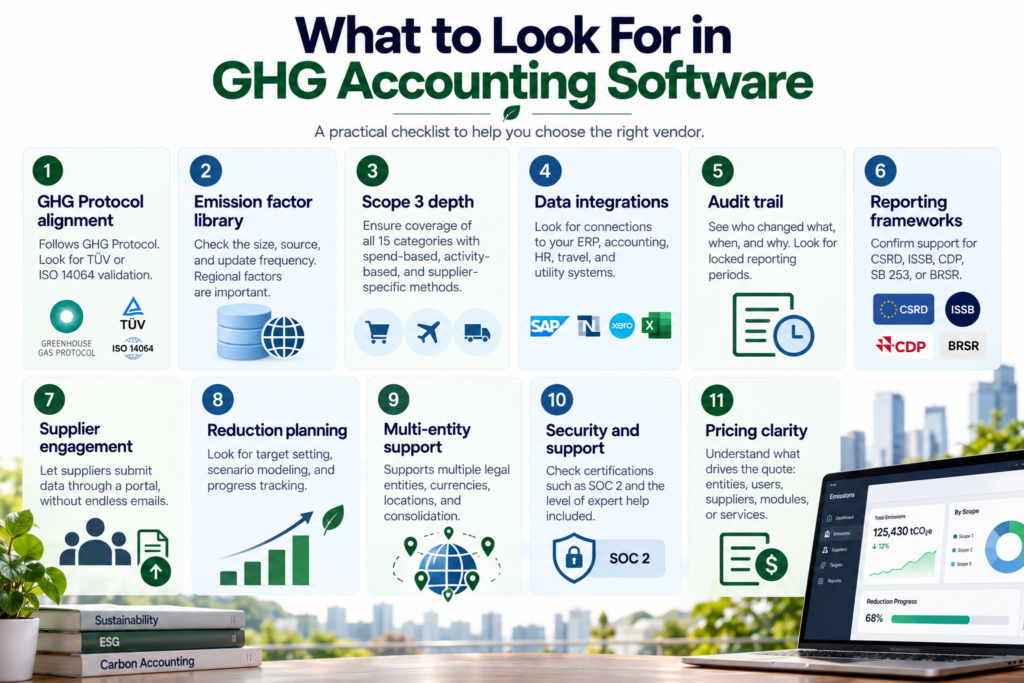
- GHG Protocol alignment. The method should follow the GHG Protocol. Third-party validation, such as TÜV certification or alignment with ISO 14064, adds trust.
- Emission factor library. Ask how many factors it holds, where they come from, and how often they refresh. Regional factors matter if you operate in many countries.
- Scope 3 depth. Check that it covers all 15 categories and supports spend-based, activity-based, and supplier-specific methods.
- Data integrations. Look for connections to your ERP, accounting, HR, travel, and utility systems.
- Audit trail. You should see who changed what, when, and why. Locked reporting periods help too.
- Reporting frameworks. Confirm support for the frameworks you actually face, such as CSRD, ISSB, CDP, SB 253, or BRSR.
- Supplier engagement. Good tools let suppliers submit data through a portal, without a pile of emails.
- Reduction planning. Target setting, scenario modeling, and progress tracking help you move beyond reporting.
- Multi-entity support. Groups with many legal entities, currencies, and sites need consolidation tools.
- Security and support. Check certifications such as SOC 2 and the level of expert help included.
- Pricing clarity. Ask what drives the quote: entities, users, suppliers, modules, or services.
Quick Comparison: 16 GHG Accounting Software Platforms
Here is the full lineup at a glance. Detailed reviews follow in the next section.
| # | Platform | Best for | Based in | Standout strength | Pricing model |
|---|---|---|---|---|---|
| 1 | Watershed | Large enterprises with big Scope 3 footprints | United States | Deep Scope 3 and disclosure automation | Quote-based |
| 2 | Persefoni | Enterprises and financial institutions | United States | Financed emissions and investor-grade reporting | Quote-based, with a free self-guided tier offered for small teams |
| 3 | SINAI | Heavy industry and complex enterprises | United States | Audit-grade accounting plus carbon pricing models | Quote-based |
| 4 | Plan A | European companies facing CSRD | Germany | Certified methodology and tiered plans | Tiered, quote-based |
| 5 | Sweep | Mid-market and enterprise supply chains | France | Supplier collaboration and compliance modules | Quote-based |
| 6 | Greenly | Small and mid-sized teams, non-experts | France | Fast onboarding and broad ESG coverage | Quote-based |
| 7 | Normative | Companies wanting scientific rigor | Sweden | Large emission factor database | Quote-based |
| 8 | Coolset | EU mid-market companies | Netherlands | Carbon plus CSRD, EU Taxonomy, and VSME | Quote-based, per module |
| 9 | Terrascope | Asia-Pacific supply chains and land-based sectors | Singapore | Scope 3 and land-sector reporting | Contact vendor |
| 10 | Green Project Technologies | Procurement-led Scope 3 programs | United States | Supplier engagement and renewable energy procurement | Contact vendor |
| 11 | Workiva Carbon | Finance-led teams | United States | Links carbon data to financial reporting | Annual subscription, quote-based |
| 12 | Microsoft Sustainability Manager | Microsoft-centered organizations | United States | Fits the Microsoft cloud and Power Platform | Essentials and Premium plans |
| 13 | SAP Sustainability Footprint Management | SAP ERP customers | Germany | Corporate and product footprints from ERP data | Contact vendor |
| 14 | Agentforce Net Zero (formerly Net Zero Cloud) | Salesforce-centered organizations | United States | Runs on Salesforce data and AI agents | Contact vendor |
| 15 | IBM Envizi ESG Suite | Global enterprises with large data volumes | United States | Automated data capture and AI-assisted Scope 3 | Contact vendor |
| 16 | Sphera | Manufacturers needing product footprints | United States | Life cycle assessment depth | Contact vendor |
A quick note before the reviews. We describe each platform based on what vendors and independent listings publish. Features and plans change, so always confirm details in a live demo.
Best GHG Accounting Software: 16 Platforms Reviewed
We grouped the platforms into three types. This makes it easier to find your lane.
Group 1: Dedicated Enterprise Carbon Platforms
These tools focus on carbon first. They suit larger teams with complex data.
1. Watershed
Best for: Large companies with heavy Scope 3 emissions and big disclosure workloads.
Watershed is one of the best-known enterprise carbon platforms. It covers Scope 1, 2, and 3, and it has methods built for all 15 Scope 3 categories.
Its built-in library holds more than 500,000 emission factors. It also uses AI to break down purchased materials when you build product carbon footprints.
What stands out:
- Reports mapped to CSRD, ISSB, CDP, TCFD, and California climate laws from one dataset
- Connections to systems such as NetSuite, Workday, ADP, Rippling, Navan, and BambooHR
- Access to a marketplace for clean power and carbon removal projects
- Automated error checks that catch bad data early
Watch out for:
- Pricing sits at the higher end of the market
- Teams with no sustainability staff may face a steeper learning curve
- Supplier programs can add to the cost
Pricing: Quote-based. Cost usually rises with the number of entities, integrations, supplier programs, and disclosure modules.
2. Persefoni
Best for: Large enterprises and financial institutions that need investor-grade numbers.
Persefoni is built around audit-ready carbon accounting. It is especially strong for banks and asset managers because it supports financed emissions under the PCAF methodology.
It also supports disclosure needs such as CSRD, ISSB, CDP, and California climate laws.
What stands out:
- Financed emissions and portfolio analytics
- An AI assistant that helps users query data and pick calculation methods
- Smart emission factor matching
- A partnership with Workiva for connected carbon and financial reporting
- A free, self-guided tier that Persefoni has offered to small teams
Watch out for:
- Complexity and pricing reflect its enterprise focus
- Small teams may find the full platform more than they need
Pricing: Quote-based for the enterprise product.
3. SINAI
Best for: Heavy industry and large enterprises that tie carbon data to investment decisions.
SINAI goes beyond reporting. It combines audit-grade Scope 1 to 3 accounting with tools for carbon pricing and decarbonization planning.
Its methodology is TÜV-certified, and it lists more than 100,000 emission factors and over 130 methodologies.
What stands out:
- Marginal abatement cost curve modeling to rank reduction projects by cost and impact
- Internal carbon pricing and transition risk analysis
- AI matching of supplier-specific emissions data
- Carbon, water, and waste in one platform
Watch out for:
- Enterprise pricing is not public
- Implementation scope can be large
Pricing: Quote-based.
4. Plan A
Best for: European companies that need certified methods and CSRD support.
Plan A is a Berlin-based platform that measures Scope 1, 2, and 3 emissions. Its calculation methodology is TÜV Rheinland certified, and the platform holds a SOC 2 Type II certification.
It sells three tiers: Essential, Pro, and Enterprise.
What stands out:
- A certified method you can point to during assurance talks
- Optional CSRD reporting and a Supply Chain+ module
- API access and a dedicated customer success manager on higher tiers
- Expert services for data migration, CSRD readiness, and decarbonization planning
Watch out for:
- Some advanced features, such as double materiality tools, tie to paid add-ons
- Extra services can raise first-year costs
Pricing: Tiered subscription, quote-based. Plan A does not publish list prices.
5. Sweep
Best for: Mid-market and enterprise teams that need to collect data from many suppliers.
Sweep is a Paris-based platform known for collaboration. Teams can invite colleagues and suppliers to submit data through portals and surveys.
It also offers a compliance solution for CSRD reporting and a portfolio tool for financial institutions that follows PCAF.
What stands out:
- Supplier portals and surveys for primary data
- Free supplier accounts, according to published listings
- AI assistants that help map data and draft disclosures
- B Corp certification
Watch out for:
- Pricing is not public
- Check how deep the product carbon footprint features go for your sector
Pricing: Quote-based. Reviewers often place it below the very top enterprise tools in price, but you should confirm with a quote.
Group 2: Fast-Growing, AI-Led, and Mid-Market Platforms
These tools aim for faster onboarding, guided support, or regional strengths.
6. Greenly
Best for: Small and mid-sized teams, and beginners who want a quick start.
Greenly is a French platform designed for people who are not carbon experts. Onboarding is fast, and the product covers more than carbon, with broader ESG features.
It also lists more than 100 integrations with business software.
What stands out:
- Simple interface for non-specialists
- Spend-based and activity-based methods in one place
- A network of implementation partners that deliver on the platform
Big news: Greenly and Normative have announced a merger. Greenly will be the parent company, and Normative will operate as a Greenly company.
The companies say existing Greenly customers keep their current contracts and pricing, with no immediate changes planned. They also say the combined dataset holds more than five million emission factors.
Watch out for:
- Product roadmaps may shift as the two companies combine
- Large enterprises with complex needs should test depth carefully
Pricing: Quote-based, and often cited as more approachable for smaller teams.
7. Normative
Best for: Companies that value scientific rigor and transparent calculations.
Normative is a Stockholm-based platform and one of the earliest carbon accounting engines. It follows the GHG Protocol and shows the math behind your footprint.
Its database holds more than 349,000 emission factors from 18 scientific sources, and it refreshes them every six months. AI helps match activities to the right factor.
What stands out:
- Large, well-documented emission factor library
- Audit exports and calculation transparency
- Scenario modeling to compare reduction options
- A vendor claim of a full baseline, including Scope 3, in 8 to 12 weeks
Watch out for:
- Pricing is quote-only across both plans, Essential and Premium
- The Greenly merger may change packaging and support over time
Pricing: Quote-based.
8. Coolset
Best for: EU mid-market companies that want carbon accounting and compliance in one place.
Coolset is an Amsterdam-based platform. It combines GHG Scope 1 to 3 accounting with modules for CSRD, EU Taxonomy, and the VSME standard for smaller companies.
Its carbon methodology is TÜV Rheinland certified and aligned with the GHG Protocol. Reports export in XBRL, PDF, and Word.
What stands out:
- Coverage of all 15 Scope 3 categories with spend, activity, and supplier-specific methods
- Unlimited users, according to independent listings
- Extra modules for supply chain rules such as EUDR and PPWR
Watch out for:
- Its breadth can mean less carbon-only depth than a pure carbon specialist
- No public prices, and modules are quoted separately
Pricing: Annual subscription, priced per module.
9. Terrascope
Best for: Companies with Asia-Pacific supply chains, and agriculture and land-based sectors.
Terrascope is a Singapore-based platform backed by Olam Ventures. It focuses on Scope 3, supply chains, and both product and corporate carbon footprints.
It also supports land-based emissions, SBTi FLAG, and reporting under the GHG Protocol Land Sector and Removals Standard. Few platforms put this much emphasis on land sectors.
What stands out:
- Strong fit for agriculture, forestry, and commodity supply chains
- Regional expertise in Asia-Pacific markets, with offices across APAC, North America, and EMEA
- Supplier collaboration across multiple tiers
Watch out for:
- Its breadth across supply chains may not match every niche industry method
- Public pricing is limited
Pricing: Contact the vendor.
10. Green Project Technologies (with Emitwise)
Best for: Procurement teams that want to cut Scope 3 emissions through suppliers.
Green Project Technologies is a New York-based platform owned by ACT Group. It later acquired the software platform of Emitwise, a UK company built for procurement-led Scope 3 work.
Its tools connect carbon accounting, supplier engagement, and renewable energy procurement through the account50, engage50, and act50 modules.
What stands out:
- Supplier scorecards and benchmarking
- An AI-powered product carbon footprint calculator for suppliers
- A link between carbon data and renewable energy buying
Watch out for:
- Integration of the acquired platform is still maturing, so ask for a current roadmap
- Existing Emitwise customers should confirm how their API and portal will evolve
Pricing: Contact the vendor.
Group 3: ERP, Cloud, and Enterprise Suite Options
These tools sit inside bigger business platforms. They work best when you already use the parent system.
11. Workiva Carbon
Best for: Finance-led teams that want carbon data linked to financial and ESG reporting.
Workiva Carbon is the carbon accounting product that grew from Workiva’s acquisition of Sustain.Life. It lives inside the wider Workiva platform for financial reporting, ESG, and governance, risk, and compliance.
It collects data from ERP, accounting, and utility systems. It covers Scope 1, 2, and 3, with emission factors across more than 240 countries.
What stands out:
- One system for financial, sustainability, and audit reporting
- Data lineage that supports assurance work
- Support for CSRD, SEC, and California climate rules
Watch out for:
- You may buy more suite than you need if you only want carbon accounting
- Independent reviews often focus on its wider reporting strengths, not carbon alone
Pricing: Annual subscription, quote-based by solution and users.
12. Microsoft Sustainability Manager
Best for: Organizations already built on Microsoft cloud and Power Platform.
Microsoft Sustainability Manager is part of Microsoft Cloud for Sustainability. It handles emissions, plus water and waste data, and its Scope 3 tools cover all 15 categories.
It comes in two plans, Essentials and Premium. Copilot features let users ask questions about their data in plain language.
What stands out:
- Fits the Microsoft ecosystem and data model
- Brings in emissions data from Microsoft cloud services
- Quarterly release schedule with a steady update rhythm
Watch out for:
- Setup runs through the Power Platform admin center, so you may need technical help or a partner
- Microsoft has retired some features, including an invoice data capture solution, so check the current feature list
- Microsoft advises customers to stay within two releases of the latest for support
Pricing: Licensed through Microsoft, with Essentials and Premium plans.
13. SAP Sustainability Footprint Management
Best for: Large companies running SAP ERP.
SAP offers several sustainability products. The core carbon tool is SAP Sustainability Footprint Management, which calculates corporate and product carbon footprints across Scope 1, 2, and 3.
It reuses data from SAP S/4HANA Cloud and connects to other ERP systems through public APIs.
What stands out:
- Footprints built from live ERP data on materials, production, energy, and transport
- Product carbon footprint fact sheets
- AI help with emission factor mapping
- Links to SAP Sustainability Control Tower for ESG reporting and SAP Sustainability Data Exchange for supplier carbon data
Watch out for:
- Best value for SAP-centered companies
- Several related products can make the buying path confusing, so map your needs first
Pricing: Contact SAP or a partner.
14. Agentforce Net Zero (formerly Net Zero Cloud)
Best for: Companies that already run on Salesforce.
Salesforce’s sustainability product has been renamed Agentforce Net Zero. It was formerly known as Net Zero Cloud, and before that as Sustainability Cloud.
It covers Scope 1, 2, and 3, supplier engagement, carbon conversions, and waste and water management.
What stands out:
- Report builders that walk you through voluntary and required frameworks
- Supplier dashboards showing Scope 3 emissions next to supplier spend
- AI agents that answer questions using your sustainability data
- Runs on the same platform as your CRM data
Watch out for:
- Most useful when Salesforce already sits at the center of your business
- Implementation often needs a Salesforce partner
Pricing: Contact Salesforce.
15. IBM Envizi ESG Suite
Best for: Global enterprises with large, messy data across many sites.
IBM Envizi automates data capture from ERPs, meters, utilities, spreadsheets, and supplier portals. It supports Scope 1, 2, and 3 accounting built on the GHG Protocol.
Its Scope 3 tools use AI to categorize spend. They also include a Supply Chain Intelligence feature for supplier-level emissions, plus a separate module for financed emissions.
What stands out:
- Utility bill analytics with AI-assisted data extraction
- An emissions API for teams that want to calculate emissions inside their own tools
- Excel functions that retrieve emission factors for you
- Planning and scenario tools for reduction targets
Watch out for:
- Some users report that learning the full feature set takes time and training
- Works best with a dedicated data team
Pricing: Contact IBM.
16. Sphera
Best for: Manufacturers and product companies that need life cycle assessment.
Sphera is an enterprise platform that combines sustainability reporting, environment, health and safety compliance, product stewardship, and life cycle assessment.
Its LCA software, formerly known as GaBi and now called Sphera LCA for Experts, serves more than 10,000 users and draws on large managed databases.
What stands out:
- Deep product footprint and environmental product declaration tools
- LCA data that many companies already use to calculate GHG Protocol results
- A good fit when sustainability, safety, and compliance teams need one vendor
Watch out for:
- It can feel heavy if you only need a simple corporate footprint
- Teams may need training to use LCA tools well
Pricing: Contact the vendor.
Which GHG Accounting Software Fits Your Situation?
Use this table as a starting point, then test two or three tools with your own data.
| Your situation | Platforms to shortlist |
|---|---|
| Small business building a first footprint | Greenly, Coolset, Persefoni’s self-guided tier |
| EU mid-market company facing CSRD pressure | Plan A, Coolset, Sweep, Normative |
| Large enterprise with a huge Scope 3 footprint | Watershed, Persefoni, SINAI, Sweep |
| Bank or asset manager with financed emissions | Persefoni, Sweep, IBM Envizi |
| SAP, Microsoft, or Salesforce shop | SAP Sustainability Footprint Management, Microsoft Sustainability Manager, Agentforce Net Zero |
| Manufacturer needing product carbon footprints | Sphera, SAP, Watershed, Green Project Technologies |
| Agriculture or land-based supply chains | Terrascope |
| Finance team that wants one reporting system | Workiva Carbon |
| Heavy industry weighing carbon prices and abatement costs | SINAI |
| Procurement team driving supplier reductions | Green Project Technologies, Sweep |
Real-World Scenarios (Illustrative)
These examples show how different buyers might think. They are simplified cases, not named customers.
Scenario 1: The 120-Person European Manufacturer
A Dutch manufacturer sells to large EU buyers. It faces supplier data requests but no direct CSRD duty.
It needs a clear Scope 1, 2, and 3 footprint, a few customer-ready reports, and a simple reduction plan.
A mid-market tool like Coolset, Greenly, or Plan A fits well. Guided onboarding matters more than advanced analytics.
Scenario 2: The Large US Retailer
A US retailer with more than $1 billion in revenue does business in California. It must prepare Scope 1 and 2 reporting with assurance, and later Scope 3.
It needs strong audit trails, multi-entity consolidation, and a clear path to supplier data.
Watershed, Persefoni, or Workiva Carbon would belong on this shortlist.
Scenario 3: The Listed Indian Company
A company in India’s top 1,000 by market value must publish BRSR disclosures with assurance on core metrics.
It needs a platform that handles Scope 1 and 2 in a way assurance providers can test. It also needs regional emission factors and local reporting formats.
Run a pilot to see whether a vendor handles Indian grid factors and BRSR templates before you sign.
Scenario 4: The Regional Bank
A bank needs to measure the emissions of its loan and investment portfolio, not just its offices.
Financed emissions need a different method, usually PCAF. Persefoni, Sweep, and IBM Envizi list tools for this work.
How to Choose GHG Accounting Software: A Step-by-Step Guide
Follow these steps to avoid a costly mistake.
- Define your reason. Are you chasing regulation, customer demands, investor questions, or internal targets? Your reason shapes your must-haves.
- Set your boundary. Decide which entities and sites you include. The GHG Protocol lets you choose between operational control, financial control, and equity share.
- List your data sources. Write down where fuel, electricity, travel, procurement, and supplier data live today.
- Rank your must-haves. Pick five features you cannot live without, such as ERP integration, supplier portals, or a specific framework template.
- Shortlist three or four tools. Use the table above. More than four makes decisions slower, not better.
- Test with your own messy data. Never judge a tool on a polished demo. Upload a real utility bill file and a real spend export.
- Check audit readiness. Ask your assurance provider or auditor what evidence they need. Then see whether the tool produces it.
- Ask about the roadmap. Ask how the vendor will handle GHG Protocol changes and new regulations.
- Read the contract closely. Check the term length, supplier limits, module fees, and your right to export data if you leave.
- Plan the rollout. Name an owner, set data deadlines, and agree on who reviews results.
Questions to Ask Every Vendor
Bring this list to your demos:
- Which emission factor sources do you use, and how often do you update them?
- Can I see the full calculation behind any single number?
- How do you handle missing or low-quality data?
- Which Scope 3 methods do you support, and can I mix them?
- Do suppliers pay to use your portal?
- Which frameworks do your reports cover today, not on the roadmap?
- What does the quote include: users, entities, suppliers, services?
- How will you adapt to GHG Protocol updates?
- Can I export all my data in a usable format at any time?
- Who will support me during the first three months?
Vendors who answer these clearly usually run better products.
How Much Does GHG Accounting Software Cost?
Most vendors do not publish prices. Costs depend on company size, data complexity, and how much expert help you need.
Public buyer guides suggest the following rough ranges. Treat them as estimates, not quotes.
| Company size | Typical approach | Rough annual spend |
|---|---|---|
| Small team | Free tiers, self-serve tools, or low-cost SaaS | Free to a few thousand dollars |
| Mid-market | Guided platform with expert support | Mid four figures to low six figures |
| Large enterprise | Full platform with supplier modules and services | Often $50,000 to $250,000 or more |
What drives the price:
- Number of legal entities and sites
- Number of users
- Supplier programs and portal volume
- Extra modules, such as CSRD reporting or product footprints
- Integrations and API work
- Implementation, migration, and advisory services
Always ask for a total first-year cost, not only the software fee.
Free and Low-Cost Alternatives
You do not always need a paid platform on day one.
- GHG Protocol tools. The GHG Protocol offers free guidance and calculation tools for common sources.
- Government emission factors. The UK government publishes conversion factors each year, and the US EPA runs an emission factors hub.
- Free tiers. Some vendors have offered free or self-guided plans for small teams.
- Spreadsheet templates. A well-built template works for a very simple first inventory.
The tradeoff is time and risk. You manage the factors, the checks, and the audit evidence yourself.
Common Mistakes When Buying GHG Accounting Software
Avoid these traps:
- Buying for features you will never use. A heavy enterprise suite wastes money if you only need a basic footprint.
- Ignoring data quality. Even the best tool cannot fix bad inputs. Clean your data sources first.
- Starting with only spend-based Scope 3. Spend-based estimates are fine for a first pass. They do not show real reductions, so plan to improve them.
- Skipping the audit conversation. Talk to your assurance provider early.
- Forgetting about lock-in. Make sure you can export your full history.
- Treating software as a strategy. Software measures emissions. Your team still has to cut them.
Trends Shaping GHG Accounting Software
The market is changing quickly. Here is what we see.
The Market Is Consolidating
Greenly and Normative are merging. Green Project Technologies acquired the Emitwise platform. Workiva bought Sustain.Life and relaunched it as Workiva Carbon.
Expect more deals. When you pick a vendor, ask about funding, ownership, and what happens to your contract if the company is acquired.
AI Is Now Standard, but Quality Varies
Most platforms now use AI to match spend to emission factors, read utility bills, and draft disclosures.
AI saves time, but it can also guess wrong. Ask to see accuracy results on your own data, and keep a human review step.
Product Carbon Footprints Are Growing
More buyers ask for emissions per product, not just per company. Platforms with life cycle assessment features or product footprint calculators are gaining ground.
Supplier Data Exchange Is Getting Serious
Companies want real supplier data instead of spend-based averages. Tools that let suppliers share verified data, ideally for free, will matter more.
Standards Are Evolving
The GHG Protocol is updating its guidance, including how companies account for purchased electricity. Pick vendors that publish clear plans for adapting.
Practical Tips to Get Value Fast
- Start with Scope 1 and 2. These are easier and give you a quick win.
- Use spend-based Scope 3 as a screen. Find your biggest categories, then improve them.
- Pick three suppliers to engage first. Focus on the biggest contributors, not all of them.
- Assign data owners. Facilities owns energy, finance owns spend, HR owns commuting.
- Review quarterly, not yearly. Small checks beat a year-end scramble.
- Document your choices. Write down your boundary, factors, and assumptions so auditors can follow them.
Frequently Asked Questions
What is the best GHG accounting software?
There is no single best tool. Watershed, Persefoni, SINAI, and Sweep often suit large enterprises. Greenly, Coolset, and Plan A suit smaller and mid-sized teams. ERP-linked tools like SAP, Microsoft, and Salesforce suit companies already on those systems.
What is the difference between GHG accounting software and carbon accounting software?
In practice, they mean the same thing. GHG accounting software covers all greenhouse gases, converted into CO2e. Carbon accounting software is a more common everyday name for the same category.
How much does GHG accounting software cost?
Prices range from free tiers to well over $100,000 a year for large enterprises. Most vendors quote based on entities, users, suppliers, modules, and services.
Is there free GHG accounting software?
Some vendors have offered free or self-guided tiers for small teams, and the GHG Protocol provides free guidance and tools. Free options usually offer less automation, less support, and fewer audit features.
Which GHG accounting software is best for small businesses?
Look at tools built for fast onboarding and guided support, such as Greenly and Coolset, and check for self-guided tiers like the one Persefoni has offered. Choose one that handles your actual data sources.
Which software handles Scope 3 best?
Watershed, Persefoni, Sweep, SINAI, IBM Envizi, and Normative all put strong emphasis on Scope 3. The best choice depends on your supplier data, sector, and how much primary data you can collect.
Do I need software to comply with CSRD or California SB 253?
The laws do not force you to buy software. But the data volume, audit trail, and assurance needs make software the practical choice for most in-scope companies.
How long does implementation take?
It depends on data readiness. A simple setup can take weeks. One vendor claims a full baseline, including Scope 3, in 8 to 12 weeks. Complex groups with many entities can take longer.
Can GHG accounting software be audited?
Yes. Good platforms keep audit trails, version history, and calculation records. Some also hold third-party certifications. Still, your auditor will review your inputs and your boundary, not only the tool.
How accurate is GHG accounting software?
The software is only as accurate as your data and methods. Spend-based estimates give broad direction. Activity data and supplier-specific data give more accurate results.
Should I use a consultant or software?
Many companies use both. Software handles data and calculations. Consultants help with strategy, assurance prep, and reduction plans. Some vendors include expert support in their plans.
Conclusion
The best GHG accounting software is the one that fits your size, your data, and your reporting needs.
Large enterprises with deep Scope 3 problems should look at Watershed, Persefoni, SINAI, and Sweep. European mid-market teams should test Plan A, Coolset, Greenly, and Normative. Companies already tied to SAP, Microsoft, Salesforce, IBM, or Workiva may get faster results from the tool in their own ecosystem.
Whatever you choose, run a pilot with your own data. Ask hard questions about emission factors, audit trails, and supplier data. And read the contract before you sign.
Good GHG accounting software will not cut your emissions by itself. But it gives you clear, trusted numbers, and that is where every real reduction plan starts.
Pick two or three platforms from this list, book demos, and put them to the test this month.
This article is published by Carbon Market Network – your resource for clear, practical, and up-to-date education on the global carbon markets.