Carbon Market Network


Your board wants a credible net zero plan. Your regulators want audit-ready numbers. Your customers want to know what you will ask of them.
Meanwhile, your emissions data still lives in dozens of spreadsheets.
That gap is exactly why carbon management software has become a core enterprise system, not a nice-to-have sustainability tool.
This guide compares the top 10 carbon management software platforms for enterprises. You will see what each platform does well, who it suits best, and where it can fall short.
You will also learn how to choose, how to run a smart evaluation, and which mistakes to avoid.
What Is Carbon Management Software?
Carbon management software is a platform that helps companies measure, manage, report and reduce their greenhouse gas emissions.
It pulls data from sources like utility bills, ERP systems, travel tools and supplier records. Then it converts that activity data into emissions using standard methods and emission factors.
Most enterprise platforms follow the Greenhouse Gas Protocol. They cover Scope 1 (direct emissions), Scope 2 (purchased energy) and Scope 3 (value chain emissions).
The best tools go further than counting. They help you set targets, model reduction pathways, engage suppliers and prepare disclosures.
Carbon Market Insider Newsletter
Weekly insights on carbon markets, climate policy, carbon credits, and sustainability.
The Four Jobs Carbon Management Software Does
- Collect data from systems, files, meters and suppliers.
- Calculate emissions with auditable methods and emission factors.
- Report to frameworks such as CSRD, ISSB, CDP and California’s climate laws.
- Reduce emissions through targets, scenarios and action tracking.
If a tool only does the first two jobs, you are buying a carbon accounting tool. If it does all four, you are buying an enterprise carbon management platform.
Carbon Management Software vs Carbon Accounting Software vs ESG Software
These terms get mixed up in vendor marketing. Here is a simple way to separate them.
| Category | Main purpose | Typical depth on carbon | Typical buyer |
|---|---|---|---|
| Carbon accounting software | Calculate a GHG inventory | High on measurement | Sustainability or finance team |
| Carbon management software | Measure, report and reduce emissions | High on measurement and reduction | Sustainability, operations, procurement |
| ESG reporting software | Collect and publish broad ESG disclosures | Medium, often one module | Finance, legal, reporting teams |
| Product carbon footprint (LCA) software | Calculate emissions per product | High at product level | R&D, product, supply chain teams |
Many platforms now blend these categories. Always check what is native and what is an add-on.
Why Enterprises Need Carbon Management Software Now
Spreadsheets worked when carbon reporting was voluntary and small. They break down when auditors, investors and regulators start asking questions.
Three forces are pushing enterprises toward dedicated carbon management software.
1. Regulation Is Getting More Specific
Rules differ by region, but the direction is the same. Large companies must disclose emissions with more rigor.
| Rule or framework | Region | What it means for carbon data |
|---|---|---|
| CSRD and ESRS | European Union | After the Omnibus simplification, mandatory reporting targets companies with more than 1,000 employees and more than 450 million euros in net turnover. Reporting standards are being simplified, but climate data remains central. |
| California SB 253 | United States (California) | Large companies doing business in California, with revenue above 1 billion dollars, report Scope 1 and 2 first, then Scope 3 on a later schedule. |
| California SB 261 | United States (California) | Climate related financial risk reports. Enforcement has been paused by a court injunction pending appeal at the time of writing, so check the current status. |
| ISSB standards (IFRS S1 and S2) | Global | Adopted or being adopted by many jurisdictions. Climate disclosures must cover emissions and climate risk. |
| CBAM | European Union | Importers of covered goods must account for embedded emissions, which pushes data requests down the supply chain. |
| CDP and SBTi | Global, voluntary | Widely used by investors and customers to judge climate credibility and targets. |
Regulations keep shifting, so build your program around the Greenhouse Gas Protocol and let the software handle framework mapping.
2. Scope 3 Is the Hard Part
For many companies, Scope 3 makes up most of the total footprint. It also depends on data from suppliers, logistics partners and customers.
No spreadsheet scales to thousands of suppliers. Enterprise carbon management software gives you supplier portals, spend based estimates and a path to better data over time.
3. Stakeholders Expect Proof
Investors, lenders and large customers now ask for audit-ready emissions data. They also ask for credible reduction plans.
A platform with an audit trail, version history and clear methodology makes those conversations far easier.
Key Features to Look For in Enterprise Carbon Management Software
Not every platform fits every company. Use these feature areas as your checklist.
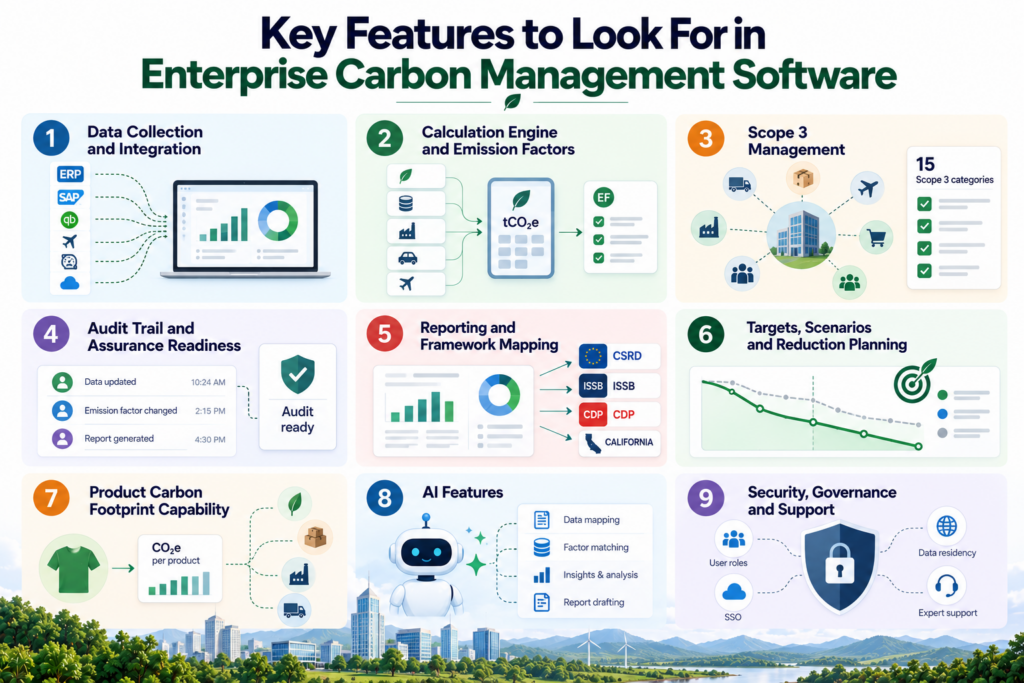
Data Collection and Integration
Look for connectors to your ERP, finance tools, travel platforms, energy meters and cloud providers.
Ask how the platform handles messy data, missing records and multiple currencies or units.
Calculation Engine and Emission Factors
The calculation engine is the heart of the product. Check which emission factor databases it uses and how often it updates them.
Ask whether you can see the formula behind every number. Auditors will.
Scope 3 Management
Check support for all 15 Scope 3 categories. Look for supplier engagement tools, spend based and activity based methods, and a path to supplier specific data.
Audit Trail and Assurance Readiness
You need a full history of who changed what and when. Many enterprises now expect limited or reasonable assurance on emissions data.
Reporting and Framework Mapping
The platform should map one dataset to many frameworks, such as CSRD, ISSB, CDP and California reporting.
Targets, Scenarios and Reduction Planning
A good tool lets you set science based targets, model pathways and track initiatives against budgets.
Product Carbon Footprint Capability
Manufacturers and consumer brands increasingly need emissions per product, not only per company. Check support for product level footprints and data exchange standards.
AI Features
Many vendors now add AI for data mapping, emission factor matching and report drafting. These features save time, but you should still ask how outputs are validated and traced back to source data.
Security, Governance and Support
Check user roles, single sign on, data residency options and the quality of implementation support.
How We Chose the Top 10 Carbon Management Software Platforms
We focused on platforms that serve large organizations with complex footprints.
Our criteria included:
- Enterprise readiness: multi-entity structures, permissions and audit trails
- Scope 3 depth: supplier engagement and category coverage
- Methodology and data quality: transparent calculations and factor libraries
- Reporting coverage: support for major global frameworks
- Ecosystem fit: integration with ERP, CRM and finance systems
- Market recognition: presence in independent analyst evaluations
- Global reach: usefulness for companies operating across regions
Analyst firms such as IDC and Verdantix regularly evaluate this market, and Gartner publishes market guidance as well. Rankings change with every new edition, so treat them as one input and not the final answer.
One more note. Vendors change fast, and this market is consolidating. Always confirm current features, pricing and ownership directly with each vendor before you sign.
Top 10 Carbon Management Software for Enterprises at a Glance
| # | Platform | Best for | Standout strength | Ecosystem fit |
|---|---|---|---|---|
| 1 | Watershed | Large enterprises with complex Scope 3 | Data quality and decarbonization programs | Standalone, many integrations |
| 2 | Sweep | Multi-entity groups and financial institutions | AI assisted data management | Standalone, ERP integrations |
| 3 | Persefoni | Finance led teams and financial institutions | Ledger style accounting and financed emissions | Standalone, finance focused |
| 4 | SAP Sustainability Footprint Management | Companies running SAP | Corporate and product footprints inside the ERP | SAP |
| 5 | IBM Envizi ESG Suite | Energy heavy, asset rich operations | Utility and meter data consolidation | IBM, standalone |
| 6 | Sphera | Industrial and manufacturing companies | LCA content and product footprints | EHS and product stewardship |
| 7 | Salesforce Agentforce Net Zero | Salesforce centered companies | Carbon data inside CRM workflows | Salesforce |
| 8 | Workiva | Finance led reporting teams | Audit controls and connected reporting | Finance and reporting |
| 9 | Plan A | European and mid to large enterprises | Guided carbon accounting with expert support | Standalone |
| 10 | Terrascope | Food, agriculture and commodity supply chains | Scope 3 and land based emissions | Standalone, strong in Asia Pacific |
The list is not a strict ranking. The best platform depends on your systems, your sector and your reporting goals.
1. Watershed
Watershed is one of the best known enterprise carbon platforms in the market. It focuses on data quality, Scope 3 measurement and practical decarbonization.
It has been named a Leader in the Verdantix Green Quadrant for enterprise carbon management.
Key Features
- Scope 1, 2 and 3 measurement with detailed methodology controls
- Dozens of integrations with ERP, finance and cloud systems
- Supplier engagement tools for Scope 3 improvement
- Target setting, reduction planning and scenario tools
- Reporting support for major disclosure frameworks
Best For
Global enterprises with complex value chains, many entities and large Scope 3 footprints.
Things to Consider
Enterprise platforms like this need real implementation effort. Expect a longer onboarding than a lightweight tool, and a quote based price.
2. Sweep
Sweep is a sustainability data platform headquartered in Paris and London. It positions itself as a system for managing sustainability data across entities, teams and value chains.
It has been named a Leader in both the Verdantix Green Quadrant and the IDC MarketScape for carbon accounting and management.
Key Features
- Enterprise data management built for large and messy datasets
- Skills based AI for data ingestion and mapping
- Scope 3 and supply chain tracking
- Portfolio carbon tools for financial institutions
- Support for double materiality and wider ESG reporting
Best For
Multi-entity groups and financial institutions that want carbon data to feed both reporting and operational decisions.
Things to Consider
Because the platform covers a wide scope, plan your rollout in phases. Start with the data that matters most for your next disclosure.
3. Persefoni
Persefoni is a carbon accounting and climate disclosure platform founded in 2020. It describes its approach as a ledger style system, similar to how finance teams think about accounting.
It has been named a Leader in the IDC MarketScape for carbon accounting and management applications.
Key Features
- Ledger style carbon accounting with audit trails
- Strong support for financed emissions, which matters to banks and asset managers
- Framework alignment for investor grade disclosure
- Scenario analysis and target tracking
- A free entry tier for a single user at the time of writing, with advanced tiers by quote
The company also expanded its enterprise base by acquiring the carbon accounting customers of Diligent.
Best For
Finance led teams, banks, insurers and asset managers that need investor grade carbon accounting.
Things to Consider
The platform leans toward financial rigor. If you need broad social and governance reporting, check how it fits with your other ESG tools.
4. SAP Sustainability Footprint Management
SAP offers an ERP centric approach to carbon management. Its Sustainability Footprint Management solution calculates corporate and product carbon footprints and feeds results back into business processes.
SAP has been named a Leader in the IDC MarketScape for carbon accounting and management applications.
Key Features
- Corporate footprints across Scope 1, 2 and 3
- Product carbon footprints with lifecycle calculation
- Support for data exchange standards such as PACT, Catena-X and Together for Sustainability
- Tight integration with SAP S/4HANA and other SAP systems
- A wider SAP sustainability portfolio, including SAP Green Ledger
SAP Green Ledger allocates financial and carbon data to profit centers and business segments. It does not calculate footprints itself, so it works alongside the footprint solution.
Best For
Manufacturers and large enterprises that already run SAP and want sustainability data next to financial data.
Things to Consider
The value is highest when your core processes already run on SAP. Mixed system landscapes may need extra integration work.
5. IBM Envizi ESG Suite
IBM Envizi grew out of energy and environmental data management. It captures, consolidates and reports ESG data, with strong depth in utility and operational data.
It has been named a Leader in the Verdantix Green Quadrant for enterprise carbon management.
Key Features
- Scope 1, 2 and 3 emissions calculations built on the GHG Protocol
- Consolidation of utility bills and interval meter data
- A supplier portal to collect Scope 3 data, including category 1 supplier emissions
- Target setting and decarbonization tracking
- A single system of record for hundreds of data types
Best For
Companies with many sites, large energy footprints and a need for detailed operational data, such as real estate, retail and manufacturing.
Things to Consider
The platform’s heritage is environmental and energy data. Native social and governance features are less developed, and users should plan for training time.
6. Sphera
Sphera comes from the environment, health, safety and product stewardship world. Its carbon management software grew out of that operational risk heritage.
It has been named a Leader in the Verdantix Green Quadrant for carbon management software.
Key Features
- Scope 1, 2 and 3 data collection and carbon footprint calculation
- A large managed life cycle assessment content database, formerly known as GaBi
- Product carbon footprint tools, including a supplier product footprint calculator
- Environmental accounting and corporate sustainability modules
- Consulting support for net zero strategy
Best For
Industrial, chemical and manufacturing companies where operational data, EHS workflows and product footprints need to connect.
Things to Consider
Sphera is a broad suite. If you only need a simple corporate inventory, you may not use every module.
7. Salesforce Agentforce Net Zero
Salesforce Net Zero Cloud now appears under the name Agentforce Net Zero. It is a sustainability management platform built on the Salesforce ecosystem.
It turns energy, travel and fleet data into emissions aligned with the Greenhouse Gas Protocol.
Key Features
- Scope 1, 2 and 3 tracking across subsidiaries and suppliers
- A Scope 3 Hub add-on that matches spend data to emission factors at scale
- Natural language questions and report drafting through Agentforce AI
- Framework report builders for standards such as CSRD, CDP and GRI
- Supplier data collection and scorecards
Best For
Companies already standardized on Salesforce that want carbon data inside the same workflows as customer and operational data.
Things to Consider
Salesforce prices in tiers and add-ons. Scope 3 coverage depends on which modules you license, so map your needs before you request a quote.
8. Workiva
Workiva is a connected reporting platform used by finance and compliance teams. It entered carbon accounting through Workiva Carbon, built in part on its acquisition of Sustain.Life.
It has been named a Leader in an IDC MarketScape for ESG reporting and compliance applications.
Key Features
- Linked data and documents with strong version control
- Financial grade audit trails and review workflows
- Carbon accounting that feeds the same reports as your financial statements
- Support for multi-framework disclosure
- Collaboration tools for large reporting teams
Best For
Finance led organizations that want sustainability reporting to follow the same controls as financial reporting.
Things to Consider
Workiva is reporting first. Companies with deep Scope 3 needs may want to compare it against carbon specialists.
9. Plan A
Plan A is a carbon accounting and decarbonization platform founded in 2017 and headquartered in Berlin. It also has offices in other European cities.
The company says its methodology is certified by TUV Rheinland and aligned with the Greenhouse Gas Protocol.
Key Features
- Carbon accounting across Scope 1, 2 and 3
- A supplier module for value chain data
- Reduction planning and science based target support
- CSRD oriented reporting templates
- Expert services, including carbon accounting and CSRD readiness support
- Essential, Pro and Enterprise tiers, priced by quote
Best For
European and international mid to large enterprises that want software plus hands-on expert guidance.
Things to Consider
Very large groups with heavy ERP integration needs should test data connectors early in the evaluation.
10. Terrascope
Terrascope is a Singapore headquartered carbon platform with a focus on Scope 3, land based emissions and product carbon footprints. It began as a venture of Olam Group and has since changed ownership.
That ownership change is worth a question during due diligence.
Key Features
- Corporate and product carbon footprinting at scale
- Scope 3 tools built for complex supply chains
- Support for land sector reporting, including SBTi FLAG and the GHG Protocol Land Sector and Removals guidance
- Customers across agriculture, food and beverage, manufacturing, retail and real estate
- Operations across Asia Pacific, North America and Europe
The company also describes itself as a CDP accredited software provider.
Best For
Food, agriculture and commodity companies, and any business with a supply chain that touches land use.
Things to Consider
Confirm current roadmap, support coverage and product depth outside its core sectors.
How to Choose the Right Carbon Management Software
A good choice starts with your own needs, not with a vendor’s demo. Follow these steps.
- Define the main goal. Is it regulatory disclosure, supplier engagement, product footprints or reduction programs?
- Map your data sources. List your ERP, finance, energy, travel and procurement systems. This reveals integration risk early.
- Set your scope boundaries. Decide which entities, regions and Scope 3 categories matter most.
- Shortlist three to four vendors. Match them to your ecosystem and sector.
- Run a pilot with real data. Demos use clean data. Your data is not clean.
- Involve your auditors. Ask them to review the audit trail and calculation logic.
- Compare total cost. Include implementation, add-on modules and internal time.
- Check vendor stability and roadmap. This market is consolidating, so ask about ownership and product direction.
Questions to Ask Every Vendor
| Topic | Question to ask |
|---|---|
| Methodology | Can I see the formula and emission factor behind every number? |
| Scope 3 | How do you move suppliers from spend based estimates to supplier specific data? |
| Audit | What does the audit trail show, and has it supported external assurance? |
| Integration | Which of my systems have ready connectors, and which need custom work? |
| AI | How are AI generated outputs checked and traced to source data? |
| Reporting | Which frameworks are native, and how fast do you update after rule changes? |
| Pricing | What drives price: entities, users, data volume or modules? |
| Exit | Can I export all my data if I leave? |
Which Platform Fits Which Enterprise? Illustrative Scenarios
These are simple examples to show how fit works. They are not customer case studies.
| Scenario | What matters most | Platforms to start with |
|---|---|---|
| Global manufacturer running SAP | ERP integration and product footprints | SAP Sustainability Footprint Management, Sphera |
| Bank or asset manager | Financed emissions and investor disclosure | Persefoni, Sweep |
| Food and agriculture group | Scope 3 and land based emissions | Terrascope, Watershed |
| Retailer with hundreds of sites | Energy and utility data at scale | IBM Envizi, Watershed |
| Salesforce centered services firm | Carbon data in existing workflows | Salesforce Agentforce Net Zero |
| Finance led listed company | Audit controls and connected reporting | Workiva, Persefoni |
| European mid to large enterprise | Guided setup and expert support | Plan A, Sweep |
How Much Does Enterprise Carbon Management Software Cost?
Most enterprise vendors do not publish prices. They sell annual subscriptions through quotes.
Price usually depends on the factors below.
- Number of legal entities or sites
- Data volume and number of data sources
- Modules, such as Scope 3, product footprints, supplier portals and reporting
- Users and permissions
- Implementation and support services
Some vendors offer entry tiers or trials. Persefoni, for example, has offered a free single user tier, and IBM Envizi has offered a trial of its Essentials package. Always confirm current terms with the vendor.
Budget for internal time as well. Data cleanup and supplier outreach often cost more than the license.
A Simple Implementation Roadmap
A phased rollout reduces risk and builds trust in the numbers.
| Phase | Focus | Result |
|---|---|---|
| 1. Foundation | Set boundaries, base year and data owners | A clear scope and owner list |
| 2. Scope 1 and 2 | Connect energy, fuel and facility data | A reliable core inventory |
| 3. Scope 3 screening | Use spend based methods to find hotspots | A ranked list of categories and suppliers |
| 4. Supplier engagement | Collect supplier specific data for hotspots | Better data quality over time |
| 5. Reporting and assurance | Map data to frameworks and prepare for audit | Disclosure ready outputs |
| 6. Reduction | Set targets, model pathways and track actions | A funded decarbonization plan |
Common Mistakes to Avoid
- Buying for the demo. Test with your own messy data.
- Ignoring data owners. Software cannot fix missing ownership inside your company.
- Expecting perfect Scope 3 on day one. Start with estimates and improve every cycle.
- Skipping the auditors. Involve them before you commit.
- Treating it as a reporting tool only. The value comes from acting on the data.
- Forgetting the exit plan. Make sure you can export your data.
Carbon Management Software Trends to Watch
AI Is Becoming Standard
Vendors use AI to map messy data, match emission factors and draft disclosures. The winners will be those that keep every AI output traceable to source data.
The Market Is Consolidating
Acquisitions are reshaping the field. Persefoni took on Diligent’s carbon accounting customers, and Workiva built its carbon offering partly through Sustain.Life. Press reports also describe a combination of Greenly and Normative, though you should verify its status directly.
This makes vendor stability a real buying criterion.
Product Level Data Is Growing
CBAM, battery rules and customer demands push companies toward product carbon footprints. Data exchange standards such as PACT are gaining attention.
Regulation Is Simpler but Not Going Away
The EU narrowed CSRD scope, and rules in other regions keep evolving. Yet investors, lenders and customers still ask for credible emissions data.
Strong carbon management software helps you stay ready, whatever rules apply next.
Final Thoughts: Choosing the Best Carbon Management Software
There is no single best carbon management software for every enterprise.
Watershed and Sweep suit complex, data heavy programs. Persefoni fits finance led and financial sector teams. SAP, Salesforce and IBM make sense when you want to build on a system you already run.
Sphera, Workiva, Plan A and Terrascope each serve clear needs, from product footprints to connected reporting to supply chain depth.
Start with your goals, test with real data, involve your auditors and plan for change. Do that, and your carbon management software will do more than produce a number. It will help you cut emissions.
Frequently Asked Questions
What is carbon management software?
Carbon management software helps companies measure, report and reduce greenhouse gas emissions across Scope 1, 2 and 3. It collects data, calculates emissions and supports disclosures and reduction planning.
What is the best carbon management software for enterprises?
It depends on your needs. Watershed and Sweep are widely recognized for enterprise programs. SAP, Salesforce and IBM suit companies in those ecosystems. Persefoni fits finance led teams.
What is the difference between carbon accounting and carbon management software?
Carbon accounting software calculates your emissions inventory. Carbon management software also supports targets, supplier engagement and reduction planning.
Can carbon management software handle Scope 3 emissions?
Yes, most enterprise platforms do. They use spend based estimates first, then move toward supplier specific data. Depth varies by vendor, so test this carefully.
Does carbon management software help with CSRD and other regulations?
Many platforms map emissions data to CSRD, ISSB, CDP and California reporting. Check which frameworks are native and how quickly the vendor updates after rule changes.
How much does carbon management software cost?
Enterprise pricing is quote based. Cost depends on entities, data volume, modules and services. A few vendors offer free or trial entry tiers.
How long does implementation take?
It depends on data readiness and system complexity. Scope 1 and 2 usually come first, while Scope 3 and supplier engagement take longer and improve over time.
Is free carbon management software enough for an enterprise?
Free tools suit small inventories and early learning. Enterprises usually need audit trails, multi-entity support, integrations and assurance readiness, which paid platforms provide.
How do I make sure my carbon data is audit ready?
Choose a platform with a full audit trail and transparent methods. Document your boundaries and data owners, and involve your auditors early.
Explore more guides, tools, and resources on Carbon Market Network to deepen your understanding of carbon markets and climate.