Carbon Market Network


Two carbon credits can cost the same, sit on the same registry, and still be worlds apart in quality.
One may fund a project that truly cuts emissions. The other may pay for something that would have happened anyway.
That gap is why carbon credit rating agencies exist. They act like the Moody’s or S&P of the carbon market, and they tell you how likely a credit is to deliver the tonne it promises.
This guide covers the top carbon credit rating agencies and providers in the world. You will learn what each one does, how their grades work, and how to choose between them.
Whether you buy credits, invest in projects, or develop them, this guide gives you a clear starting point.
What Are Carbon Credit Rating Agencies?
Carbon credit rating agencies are independent firms that assess the quality of carbon credits and the projects behind them.
They publish ratings, usually as letter grades, that show how likely a credit is to avoid or remove one tonne of CO2e as claimed.
Think of a bond rating. A buyer checks it before lending money, and a carbon buyer can check a carbon credit rating before spending on offsets.
Most rating agencies do not sell carbon credits themselves. That separation helps keep their opinions independent.
Carbon Market Insider Newsletter
Weekly insights on carbon markets, climate policy, carbon credits, and sustainability.
What a Carbon Credit Rating Actually Measures
Each agency uses its own method, but most look at the same core risks.
| Factor | The question it answers |
|---|---|
| Additionality | Would this reduction have happened without carbon finance? |
| Carbon accounting (over-crediting) | Did the project count its tonnes accurately, or did it overstate them? |
| Permanence | Will the stored or avoided carbon stay out of the atmosphere? |
| Leakage | Did emissions simply move somewhere else? |
| Co-benefits and safeguards | Does the project help or harm communities and nature? |
Some agencies fold these into one grade. Others score each factor separately.
How Carbon Credit Rating Agencies Differ From Registries and Standards
Many beginners mix these up. Each player has a different job.
| Player | Main job | Example |
|---|---|---|
| Registry or standard | Verifies projects and issues credits | Verra, Gold Standard, ACR |
| Integrity label body | Sets a minimum quality bar with a label | ICVCM (CCP label) |
| Rating agency | Scores how likely a credit is to deliver | BeZero, Sylvera, Calyx Global, MSCI |
| Marketplace or exchange | Lets you buy and sell | Trading platforms |
A registry says a project followed its rules. A rating agency gives a view on how well those rules worked in practice.
Why Carbon Credit Ratings Matter So Much Now
The voluntary carbon market has a trust problem. Headlines about junk credits scared many buyers.
Ratings give buyers a way to separate strong credits from weak ones. That shift is changing how the market works.
Ratings Now Influence Price
Quality now shows up in what buyers pay.
Sylvera reported in a recent quarterly update that credits rated BBB or higher made up about 18% of rated retirement volume but 42% of rated market value.
That means a small share of high-grade credits drives a big share of the money spent.
The average price paid per retired credit sits at roughly six to seven US dollars. Top-rated credits sell far above that average.
BeZero ran its own price analysis using AlliedOffsets data. In Sub-Saharan African cookstoves, it found little ratings-based premium at first. Later data showed a premium of about 17% per rating notch.
In other words, a higher grade now earns a higher price in more and more parts of the market.
Ratings Reach Governments and Financial Platforms
Ratings no longer live only in sustainability teams.
- Singapore’s National Environment Agency appointed BeZero, Calyx Global and Sylvera as a panel of carbon rating service providers. They assess methodologies and projects under the country’s international carbon credit framework.
- Bloomberg has added both Sylvera and Calyx Global ratings to its Terminal.
- Tokyo’s carbon credit marketplace for small businesses uses BeZero ratings.
When governments and major financial platforms adopt ratings, buyers take them more seriously.
Carbon Credit Rating Agencies at a Glance
Here is a quick side-by-side before we go deeper.
| Provider | Type | Rating scale | Best for |
|---|---|---|---|
| BeZero Carbon | Rating agency | AAA to D | Project risk, pre-issuance ratings |
| Sylvera | Rating agency and data provider | AAA to D | Buyers, traders, market data |
| Calyx Global | Rating agency | AAA to D (plus SDG ratings) | Integrity and impact scoring |
| MSCI Carbon Markets | Investor-grade ratings and data | AAA to CCC | Institutions and investors |
| CCQI | Non-profit scoring tool | 1 to 5 | Free, credit-type level checks |
| ICVCM | Integrity label body | Pass or fail (CCP label) | Minimum quality screening |
| Carbon Direct | Science-led advisory | Not a letter-grade agency | Advisory and removal buying |
| AlliedOffsets | Data and analytics | Shows partner ratings | Price and project research |
Top 8 Carbon Credit Rating Agencies and Providers
1. BeZero Carbon
BeZero is a London-based carbon ratings agency and one of the best-known names in the field.
Its BeZero Carbon Rating is an independent view on whether a credit avoids or removes a tonne of CO2e. It uses an eight-point scale from AAA to D.
BeZero says it was the first agency to publish all of its headline letter ratings publicly. Its platform also includes risk scores, pre-rating scorecards, geospatial tools and an AI assistant.
How BeZero rates projects:
- It analyses additionality, carbon accounting and permanence.
- It scores project execution risk.
- It looks at beyond-carbon factors such as community and nature impacts.
Standout strengths:
- Ex-ante ratings. BeZero rates projects before credits are issued. It published 14 pre-issuance rating reports for projects reviewed in Microsoft’s carbon removal diligence process, which gave the market a rare look at how a major buyer vets risk.
- Wide reach. It sits on Singapore’s rating panel and has opened an office in Tokyo.
- Growing toolset. It acquired the AI climate data startup Cedar to deepen its due diligence tools.
- Regulation-ready. BeZero has said it expects to fall under the EU’s ESG ratings rules.
Watch out for: Full reports sit behind the paid platform, while headline ratings are public.
Best for: Buyers and developers who want deep, risk-based analysis, especially before issuance.
2. Sylvera
Sylvera is a carbon data and ratings provider that serves buyers, investors and developers.
Its ratings run from AAA to D. They rest on three pillars: carbon, additionality and permanence. Co-benefits get their own score.
Sylvera does not sell carbon credits. That keeps its ratings free from sales conflicts.
Standout strengths:
- Market data. Sylvera publishes regular carbon market data snapshots on retirements, prices and rating trends. Many analysts cite them.
- Removal coverage. It built a rating framework for biochar, one of its first ratings for durable carbon removal.
- Financial integration. Its ratings now appear inside the Bloomberg Terminal.
- Government trust. It holds a seat on Singapore’s rating panel.
- Clear stance on renewables. Sylvera does not rate renewable energy projects above C. It cites additionality concerns with many grid-connected projects.
Watch out for: Its strict view on some project types may surprise buyers who expect higher grades.
Best for: Corporate buyers and traders who want ratings plus market intelligence in one place.
3. Calyx Global
Calyx Global is a US-based ratings platform. It focuses on two things: greenhouse gas integrity and sustainable development impact.
Its GHG ratings run from AAA to D. The firm moved to that scale to match the rest of the market. It looks at additionality, over-crediting, permanence and overlapping claims.
Calyx also publishes separate SDG ratings that score claimed benefits such as health, jobs and biodiversity.
The firm reports more than 1,000 GHG ratings and over 500 SDG ratings across 25 or more project types.
Standout strengths:
- Independence. Calyx says its ratings are not financed by the projects it assesses.
- Open access. Core ratings are available to the public on its platform. Advanced research and API access sit behind a subscription.
- Wide distribution. Its ratings appear on Bloomberg, Carbonplace, Emsurge Open Markets and Climate Impact X.
- Pricing tools. Its Pricing Intelligence feature helps buyers see market price context.
- Policy role. It sits on Singapore’s rating panel.
Watch out for: Its dual GHG and SDG system takes a little time to learn.
Best for: Buyers who care about both climate integrity and real-world social impact.
4. MSCI Carbon Markets
MSCI is a global financial data giant. It entered carbon ratings by acquiring Trove Research and building a carbon markets team.
Its Carbon Project Ratings score thousands of projects from AAA to CCC. The ratings use rules-based frameworks for each project type, and they mix geospatial data, data science and economic modelling.
At launch, MSCI noted that no project received an AAA. It also said only about 5% of projects showed very high integrity.
Standout strengths:
- Investor-grade brand. Institutions already trust MSCI data across other asset classes.
- Broad coverage. It covers registered and pre-registration projects across major project types.
- Beyond ratings. MSCI also offers carbon price indexes and supply, demand and price projections.
Watch out for: The scale (AAA to CCC) differs from the AAA to D scale used by the big three, so do not compare letters directly.
Best for: Investors, banks and large institutions that want carbon data inside a familiar financial toolkit.
5. Carbon Credit Quality Initiative (CCQI)
CCQI is a non-profit project led by the Environmental Defense Fund, WWF-US and Oeko-Institut.
It offers a free online scoring tool. Scores run from 1 to 5 against seven quality objectives, such as robust emissions impact and strong safeguards.
CCQI says it is led by non-profits and is not funded, even in part, by carbon credit revenue.
Standout strengths:
- Free and transparent. Anyone can use the tool and read the methodology.
- Granular scoring. It uses a scale instead of a pass or fail result.
- Program comparisons. It shows how scores differ between carbon crediting programs.
Watch out for: CCQI scores types of credits by program and methodology. It does not rate each individual project like the commercial agencies do.
Best for: Learners, NGOs, small buyers and anyone who wants a free, science-based first check.
6. ICVCM and the Core Carbon Principles (CCP) Label
The Integrity Council for the Voluntary Carbon Market, or ICVCM, is not a rating agency. It earns a place on this list because its label now shapes how buyers judge quality.
The ICVCM uses a two-tick process. A carbon crediting program must be approved as CCP-Eligible. Then the methodology behind the credits must be CCP-Approved.
Credits that pass both can carry the CCP label. It is a pass or fail mark, not a letter grade.
Programs such as Verra, Gold Standard, ACR, Climate Action Reserve, ART TREES, Puro.earth, Isometric and the Global Carbon Council have reached CCP-Eligible status.
Standout strengths:
- Simple signal. A label is easy to understand.
- Growing coverage. Sylvera’s data shows CCP-labelled credits grew from under 3% of issuances to nearly a fifth of the total.
- Quality proxy. Sylvera’s data also shows CCP-aligned projects skew toward higher grades.
Watch out for: BeZero’s analysis found a wide spread of ratings among CCP-labelled credits. The label sets a floor, not a ceiling.
Best for: Anyone who wants a quick minimum-quality filter. Pair it with a rating for a fuller picture.
7. Carbon Direct
Carbon Direct is a science-led carbon management and advisory firm. It is not a classic ratings agency, but many large buyers use its expertise to vet credits.
Its scientists review carbon credits and help buyers build portfolios, with a strong focus on carbon removal. The firm says it has been involved in more than two thirds of carbon removal procurement in the voluntary market.
It also acquired Pachama, a forest carbon monitoring and verification platform. That move added satellite and AI tools to its evaluation work.
Standout strengths:
- Deep science bench. It brings expert review of project quality.
- Removal expertise. It supports buyers of engineered and nature-based removals.
- Technology. Pachama’s digital tools strengthen its forest project analysis.
Watch out for: Carbon Direct also helps buyers source credits. That makes it different from pure, sales-free rating agencies. Ask how it handles conflicts.
Best for: Companies that want hands-on advice and help building a high-quality portfolio.
8. AlliedOffsets
AlliedOffsets is a London-based data platform for the carbon offset market.
It aggregates information on thousands of projects, including pricing, retirements, buyers and brokers. It also uses AI and machine learning to estimate credit prices.
AlliedOffsets does not run a letter-grade system of its own as its headline product. It brings in ratings from agencies. It has partnered with BeZero and Calyx Global to show their ratings next to market data.
Standout strengths:
- Price context. You can see ratings next to price estimates.
- Research depth. It suits analysts who study market trends.
- Neutral view. It displays more than one rating source.
Watch out for: It works best as a research layer, not as a primary rating opinion.
Best for: Analysts, researchers and procurement teams who want data and ratings side by side.
Other Names You May Come Across
Renoster built public ratings for nature-based projects using LiDAR, satellite imagery and AI. It has reportedly shifted its focus toward carbon supply, so confirm whether its ratings are still maintained before you rely on them.
Pachama once offered its own forest project analysis. It is now part of Carbon Direct.
How to Read Carbon Credit Ratings
Most major agencies use letters. The basic idea is simple: more letters near the top mean lower risk.
| Agency | Scale | What the top grade means |
|---|---|---|
| BeZero | AAA to D (eight points) | Highest likelihood the credit delivers a tonne |
| Sylvera | AAA to D | Top mark across carbon, additionality and permanence |
| Calyx Global | AAA to D | Strong GHG integrity across its four areas |
| MSCI | AAA to CCC (seven points) | Very high emissions impact and strong integrity |
| CCQI | 1 to 5 | Highest quality score against its objectives |
What Does “Investment Grade” Mean for Carbon Credits?
Many buyers treat BBB or higher as investment grade. Sylvera’s data uses the same cut-off when it compares quality tiers.
Credits below that level carry more risk. They are not always bad, but they need closer review.
A Letter Is Not Always a Letter
Three agencies now use the same AAA to D look, but they measure slightly different things.
BeZero’s rating is a judgement on the likelihood that a credit achieves a tonne. Sylvera builds its grade on three pillars. Calyx focuses on GHG integrity.
So an AA from one agency is not a promise of an AA from another.
Why Carbon Credit Ratings Differ Between Agencies
A 2023 review by Carbon Market Watch found that the same projects received notably different ratings from BeZero, Calyx, Sylvera and Renoster.
That surprises many beginners. It should not. Bond agencies also disagree at times.
Common reasons include:
- Different methods. Agencies weigh factors in different ways.
- Different data. They may use different satellite, field or registry inputs.
- Different timing. A rating can change as new evidence appears.
- Different scope. Some include safeguards in the main score. Others score them apart.
Practical tip: Check two or more agencies for any large purchase. If they agree, you can feel more confident. If they differ, dig into why.
How to Choose the Right Carbon Credit Rating Provider
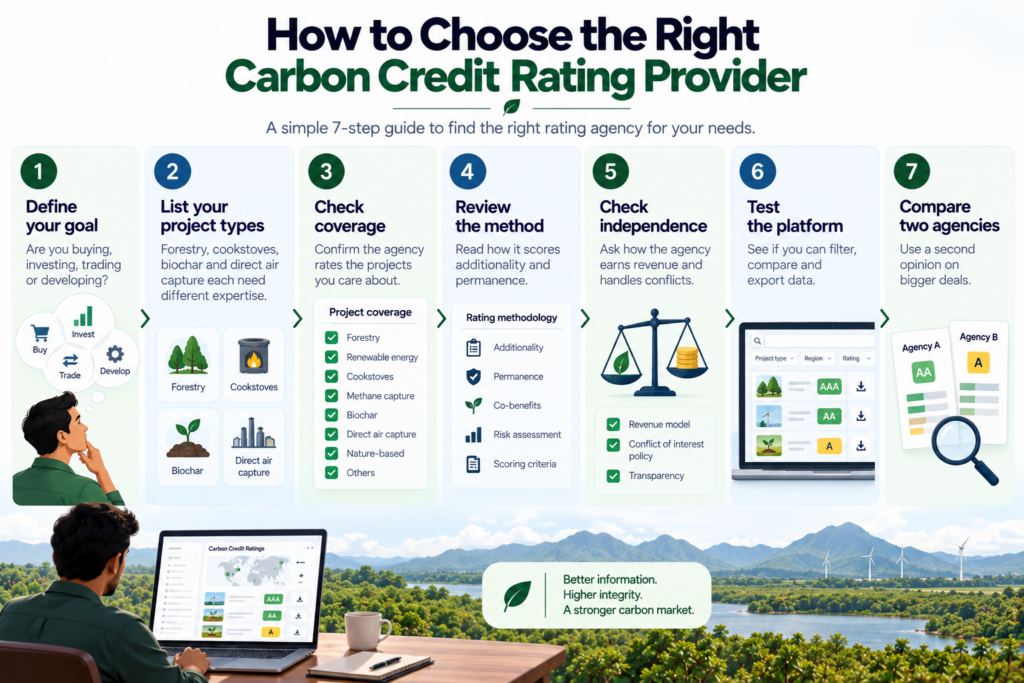
Follow these steps.
- Define your goal. Are you buying, investing, trading or developing?
- List your project types. Forestry, cookstoves, biochar and direct air capture each need different expertise.
- Check coverage. Confirm the agency rates the projects you care about.
- Review the method. Read how it scores additionality and permanence.
- Check independence. Ask how the agency earns revenue and handles conflicts.
- Test the platform. See if you can filter, compare and export data.
- Compare two agencies. Use a second opinion on bigger deals.
Which Provider Fits Which User?
| If you are a… | Start with | Why |
|---|---|---|
| Corporate buyer | BeZero, Sylvera or Calyx Global | Deep ratings and procurement support |
| Investor or bank | MSCI or Sylvera | Financial-style data and terminal access |
| Project developer | BeZero or Sylvera | Pre-issuance ratings and market signals |
| Small business or learner | CCQI and Calyx public platform | Free or open access |
| Analyst or researcher | AlliedOffsets plus an agency | Data with ratings in one view |
| Government or policy team | BeZero, Sylvera or Calyx Global | Role in national frameworks |
How to Use Carbon Credit Ratings When You Buy
Ratings work best inside a wider buying process.
Here is a simple workflow.
- Set your quality bar. Many buyers start at BBB or above.
- Filter by label. Check for the CCP label and the registry behind the project.
- Check ratings. Look at one or two agencies.
- Read the summary. Do not stop at the letter.
- Compare price to rating. A big gap may signal a bargain or a hidden risk.
- Review delivery risk. For future credits, ask about buffers, insurance and contract protections.
- Monitor after purchase. Ratings can change, so keep tracking.
A Simple Example
Say you shortlist three tree-planting projects for a corporate buyer.
Project A holds a high rating from two agencies and a CCP label. Project B holds a mid rating. Project C has no rating.
You would probably shortlist A first and ask harder questions about B and C. That small step cuts your reputational risk.
Regulation Is Coming for Carbon Credit Rating Agencies
Carbon ratings have grown fast with little formal oversight. That is starting to change.
The EU ESG Ratings Regulation now applies, and it brings ESG rating providers under the supervision of the European Securities and Markets Authority (ESMA).
After a transition period, only ESMA-authorised providers will be able to distribute ESG ratings in the EU. Carbon ratings are widely expected to fall in scope, and BeZero has said it expects to be regulated.
Calyx Global has also pointed to the new rules as a source of formal oversight for carbon credit ratings.
The UK is building its own ESG ratings regime. Whether it will cover carbon credit ratings is still unsettled.
Why it matters: Oversight should push agencies toward clearer methods, stronger conflict controls and better transparency. Check each agency’s current regulatory status before you sign a contract.
Limits and Criticisms of Carbon Credit Ratings
Ratings help, but they are not magic.
- They are opinions. A rating is a view, not a guarantee.
- Agencies can disagree. Cross-checking takes extra time.
- Coverage gaps exist. Some projects and credit types have no rating.
- Pricing can lag. Not every segment shows a clear premium yet.
- Models can miss things. Remote sensing and data tools have limits.
- Business models vary. Buyers should ask how each agency earns revenue.
Good buyers use ratings alongside registry checks, labels, site-level due diligence and strong contracts.
Where Carbon Credit Rating Agencies Are Heading
A few trends are shaping the next phase.
- More pre-issuance ratings. Buyers want risk views before credits exist.
- More removal ratings. Biochar, direct air capture and other durable removals need robust frameworks.
- Tighter integration. Ratings now flow into trading screens, banks and data terminals.
- Consolidation. Firms keep buying tools and teams, as seen with BeZero’s purchase of Cedar and Carbon Direct’s purchase of Pachama.
- Stronger oversight. Regulation should raise the bar for every agency.
Expect ratings to become a standard part of carbon procurement, much like credit checks in finance.
Conclusion
Carbon credit rating agencies now sit at the center of a more mature carbon market.
BeZero, Sylvera and Calyx Global lead the pack for project-level ratings. MSCI brings investor-grade depth, while CCQI offers a free, science-based check. The ICVCM adds a simple quality label, and Carbon Direct and AlliedOffsets support advice and research.
No single provider fits every need. Match the agency to your goal, check at least two opinions on big purchases, and read beyond the letter grade.
If you remember one thing, make it this: a rating does not replace due diligence, but it makes your due diligence much stronger.
Start with the provider that fits your use case, and build your carbon credit rating process from there.
Frequently Asked Questions
What are carbon credit rating agencies?
They are independent firms that assess the quality of carbon credits and projects. They publish ratings that show how likely a credit is to deliver one tonne of CO2e avoided or removed.
Who are the biggest carbon credit rating agencies?
BeZero Carbon, Sylvera and Calyx Global are the three most widely cited. MSCI Carbon Markets is also a major player with investor-grade ratings.
Which carbon credit rating agency is the best?
It depends on your needs. BeZero suits deep risk analysis, Sylvera suits buyers who want data and ratings, and Calyx Global suits those who value GHG and SDG scores. For large deals, compare two agencies.
What is an investment-grade carbon credit?
Most buyers treat credits rated BBB or higher as investment grade. Credits below that carry more risk and need closer review.
Are carbon credit ratings regulated?
Until recently, they were not. The EU ESG Ratings Regulation now brings ESG rating providers under ESMA supervision, and carbon ratings are widely expected to fall in scope. Check each agency’s status.
What is the difference between a CCP label and a carbon credit rating?
The CCP label is a pass or fail mark from the ICVCM that shows a minimum quality bar. A rating gives a graded view of risk, so the two work well together.
Can the same carbon credit get different ratings?
Yes. Agencies use different methods, data and weightings. A review by Carbon Market Watch found notable differences across agencies for the same projects.
Are carbon credit ratings free?
Some are. Calyx Global opens core ratings to the public, BeZero publishes headline ratings, and CCQI is free. Full reports and advanced tools usually need a paid subscription.
Do carbon credit ratings guarantee a credit is good?
No. A rating is an expert opinion on likelihood, not a guarantee. Use it alongside registry checks, labels and your own due diligence.
Explore more guides, tools, and resources on Carbon Market Network to deepen your understanding of carbon markets and emissions measurement.