Carbon Market Network


The world’s most significant carbon border policy is now fully operational. And if you export goods to the European Union, it could directly affect your business.
The Carbon Border Adjustment Mechanism, widely known as CBAM, entered its definitive financial phase on 1 January 2026. That means real money is now on the table, not just reporting paperwork. Importers in the EU must now purchase carbon certificates to cover the embedded emissions in the goods they bring in from outside the bloc.
Whether you are an exporter in India, a manufacturer in China, a trade compliance officer in the UK, or simply someone trying to understand how climate policy is reshaping global trade, this guide covers everything you need to know.
We explain what CBAM is, why the EU created it, how it works step by step, which sectors it covers, how the costs are calculated, and what the road ahead looks like.
What Is the Carbon Border Adjustment Mechanism (CBAM)?
CBAM is a carbon pricing policy introduced by the European Union. It places a carbon cost on specific goods imported into the EU from countries outside the bloc.
The core idea is straightforward. EU manufacturers already pay a price for carbon emissions under the EU Emissions Trading System (EU ETS). A factory in Germany that produces steel must buy allowances for every tonne of carbon dioxide it emits.
But a steel producer in a country with no carbon pricing faces no such cost. That creates an unfair competitive advantage. And it creates a risk that production simply moves overseas to avoid carbon costs, without any reduction in global emissions.
CBAM solves this by making sure imports face a comparable carbon cost to EU-produced goods.
Think of it as a carbon equaliser at the EU’s border. If the product you export to Europe carries embedded emissions that have not been priced at home, you pay the difference when that product enters the EU market.
Carbon Market Insider Newsletter
Weekly insights on carbon markets, climate policy, carbon credits, and sustainability.
Why Did the EU Create CBAM?
To understand CBAM, you need to understand two related problems it was designed to solve: carbon leakage and competitive imbalance.
The Carbon Leakage Problem
Carbon leakage happens when a country’s climate ambitions push production offshore rather than reducing emissions overall.
Here is how it works. As the EU tightened its climate rules and raised carbon prices under the EU ETS, energy-intensive industries faced rising costs. Some of those industries considered moving production to countries with weaker climate regulations, where they could emit freely.
The result? Emissions do not fall globally. They just shift location. The EU’s climate effort gets undermined. And jobs potentially move out of Europe in the process.
To guard against this for years, the EU handed out free allowances to heavy industry. Steel, cement, aluminium, and fertiliser producers received a certain number of emission allowances at no cost, partly shielding them from the full carbon price. This prevented the worst of carbon leakage but also reduced incentives to decarbonise.
CBAM is a cleaner, more effective alternative. Instead of giving free allowances to European producers, the EU now levels the playing field by applying a carbon cost at the border for imports. As CBAM phases in from 2026 to 2034, free allowances in these sectors will be phased out.
The Competitive Fairness Problem
European companies that invest in cleaner technologies face higher production costs than competitors abroad who do not pay for carbon emissions.
Without CBAM, a European aluminium producer that spends heavily on reducing emissions competes directly with an overseas producer who emits freely and sells cheaply. The EU producer loses market share not because they are less efficient, but because they are paying for carbon that their competitor ignores.
CBAM removes this distortion. It ensures that the cost of carbon is embedded in the price of goods regardless of where they are produced.
Encouraging Global Decarbonisation
There is a third goal that is less discussed but equally important.
CBAM incentivises exporting countries to introduce their own carbon pricing. If a country prices carbon domestically at a level equivalent to the EU ETS, those payments count toward the CBAM obligation. Exporters from that country can deduct what they paid at home from what they owe at the EU border.
This gives governments around the world a financial reason to implement carbon pricing. It nudges the global economy toward a price on carbon without the EU having to enforce rules in other jurisdictions.
A Brief Timeline: How CBAM Evolved
CBAM did not arrive overnight. It went through a careful design, consultation, and phased rollout process.
May 2021: The European Commission first proposed CBAM as part of the Fit for 55 package, the EU’s plan to cut emissions by at least 55% by 2030.
May 2023: The CBAM Regulation (EU) 2023/956 was formally adopted and entered into force.
October 2023: The transitional phase began. EU importers started submitting quarterly reports on embedded emissions in covered goods. No financial payments required yet, but data collection was mandatory.
October 2023 to December 2025: The transitional phase ran for just over two years. Importers learned the system. Suppliers outside the EU began tracking and verifying their emissions data.
October 2025: The Omnibus Regulation (EU) 2025/2083 simplified parts of the system. A key change was the introduction of a 50-tonne de minimis threshold, exempting importers who bring in 50 tonnes or less of covered goods per year.
1 January 2026: The definitive phase began. Real financial obligations kicked in. Importers must now purchase and hold CBAM certificates to cover the embedded emissions in their goods.
31 March 2026: The deadline passed for importers to obtain Authorised CBAM Declarant status. Businesses that missed this deadline risk having shipments blocked at EU customs.
7 April 2026: The European Commission published the first-ever official CBAM certificate price, setting the Q1 2026 rate at €75.36 per tonne of CO₂ equivalent.
February 2027: The first actual certificate purchase and surrender process begins, covering 2026 imports.
Which Sectors and Products Does CBAM Cover?
As of 2026, CBAM covers six categories of goods. These sectors were selected because they are carbon-intensive and face the highest risk of carbon leakage.
Iron and Steel This is the largest CBAM sector by volume. It covers a wide range of iron and steel products including pig iron, direct reduced iron, flat-rolled products, bars, rods, angles, and wire. India is one of the major exporters of steel to the EU, making this sector especially significant for Indian businesses.
Aluminium Primary aluminium, secondary aluminium, and many downstream aluminium products fall under CBAM. Aluminium production is highly energy-intensive, and its carbon footprint depends heavily on the energy mix used in smelting.
Cement Cement clinker and various cement products are covered. Cement produces significant process emissions during the calcination of limestone, making it one of the hardest sectors to decarbonise.
Fertilisers Nitrogen-based fertilisers including ammonia, nitric acid, urea, and mixed fertilisers are included. Fertiliser production consumes large amounts of natural gas, resulting in high embedded emissions.
Hydrogen Both grey hydrogen (produced from fossil fuels) and other forms of hydrogen are included, reflecting the importance of a clean hydrogen supply chain for Europe’s energy transition.
Electricity Imported electricity is covered under CBAM, with the aim of ensuring that electricity imports from countries with carbon-intensive grids bear an appropriate carbon cost.
What Counts as “Embedded Emissions”?
Embedded emissions are the greenhouse gases released during the production of a good.
For most sectors, CBAM currently focuses on direct emissions, meaning the gases emitted directly at the production facility. For cement and fertilisers, both direct emissions and indirect emissions from electricity consumption must be reported.
The 50-Tonne De Minimis Threshold: Who Is Exempt?
One of the key changes introduced by the Omnibus simplification in late 2025 is the introduction of a single mass-based threshold.
Importers who bring in 50 tonnes or less per year (cumulative net mass) of CBAM-covered goods do not have to register as an Authorised CBAM Declarant or purchase certificates.
This exemption aims to protect small businesses and reduce administrative burden for low-volume traders.
If your combined imports of all covered goods total 50 tonnes or less per year, CBAM does not apply to you. If you exceed that threshold, full compliance obligations apply.
How CBAM Works: A Step-by-Step Explanation
Let us walk through exactly how the Carbon Border Adjustment Mechanism operates in practice.
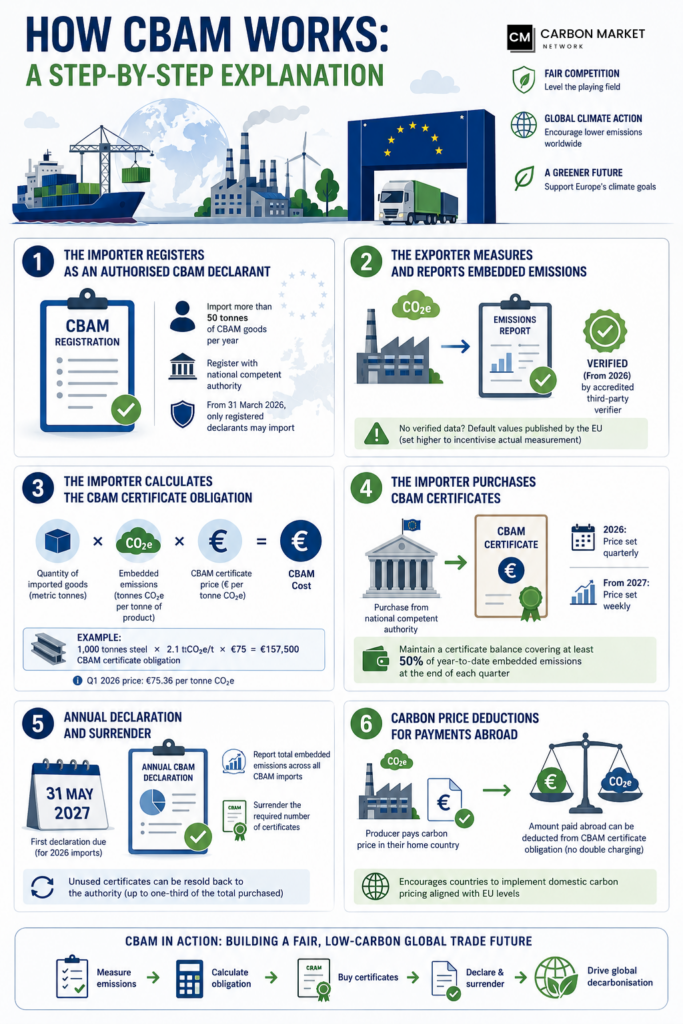
Step 1: The Importer Registers as an Authorised CBAM Declarant
Any EU importer (or indirect customs representative) who brings more than 50 tonnes of CBAM-covered goods into the EU per year must register with their national competent authority to become an Authorised CBAM Declarant.
As of 31 March 2026, only registered declarants may import in-scope goods. Non-registered importers can have their shipments blocked at the border.
Step 2: The Exporter Measures and Reports Embedded Emissions
The EU importer needs emissions data from the supplier or producer abroad.
This means the factory or mill outside the EU must calculate the tonnes of CO₂ equivalent emitted per tonne of product during the manufacturing process. This data needs to be verifiable, and from 2026, it must be certified by an accredited third-party verifier.
If a supplier cannot provide verified emissions data, the EU importer falls back on default values published by the European Commission. These default values are deliberately set higher than the typical performance of most producers, to incentivise actual measurement rather than reliance on defaults.
Step 3: The Importer Calculates the CBAM Certificate Obligation
The formula is straightforward:
CBAM Cost = Quantity of imported goods (metric tonnes) × Embedded emissions (tonnes CO₂e per tonne of product) × CBAM certificate price (€ per tonne CO₂e)
The certificate price is based on the EU ETS carbon price. For 2026, the Commission publishes four quarterly prices. From 2027 onwards, prices will be published weekly.
The Q1 2026 price was €75.36 per tonne of CO₂ equivalent.
To take a practical example: if you import 1,000 tonnes of steel with an embedded emissions intensity of 2.1 tonnes of CO₂ per tonne of steel, and the certificate price is €75, your CBAM certificate obligation for that shipment would be approximately €157,500.
Step 4: The Importer Purchases CBAM Certificates
CBAM certificates are not traded on open markets. Importers purchase them from their national competent authority at the prevailing price.
During 2026, the price is set quarterly. From 2027, it moves to a weekly price to reflect the live EU ETS carbon market.
Importers must maintain a certificate balance covering at least 50% of their year-to-date embedded emissions at the end of each quarter.
Step 5: Annual Declaration and Surrender
The first annual CBAM declaration covers 2026 imports and is due by 31 May 2027 (with certificate purchases beginning in February 2027).
In the declaration, the importer reports total embedded emissions across all CBAM imports during the year and surrenders the required number of certificates. Unused certificates can be resold back to the authority (up to one-third of the total purchased).
Step 6: Carbon Price Deductions for Payments Abroad
Here is an important provision that benefits exporters from countries with their own carbon pricing.
If a producer abroad has already paid a carbon price in their home country for the embedded emissions in the exported goods, that amount can be deducted from the CBAM certificate obligation.
This means a producer in a country with meaningful carbon pricing does not get double-charged. It also gives exporting countries a strong incentive to implement domestic carbon prices that align with EU levels.
CBAM Certificate Pricing: How Is the Price Determined?
The price of a CBAM certificate is directly linked to the EU ETS carbon price.
The European Commission calculates the certificate price as the weighted average of EU ETS allowance auction clearing prices. This ensures that the carbon cost faced by importers mirrors exactly the carbon cost faced by EU producers under the ETS.
For 2026, the Commission calculates and publishes four quarterly prices:
- Q1 2026: €75.36 per tonne CO₂e (published 7 April 2026)
- Q2 2026: To be published in July 2026
- Q3 2026: To be published in October 2026
- Q4 2026: To be published in January 2027
From 2027 onwards, prices move to a weekly publication schedule.
EUA prices have been volatile, rising above €90 in January 2026 before falling to the low €60s by mid-March 2026 due to policy uncertainty around ETS reform. The Q1 average settled at €75.36. Markets expect carbon prices to rise over the medium term as the EU tightens its climate policies toward 2030 targets.
The Phase-In Schedule: Free Allowances vs CBAM (2026 to 2034)
CBAM does not operate in isolation from the EU ETS. The two systems are connected through a carefully designed phase-in schedule.
As CBAM ramps up, free allowances in CBAM-covered sectors under the EU ETS are being phased out. This prevents double protection for EU producers.
The transition runs as follows:
In 2026 and 2027, free allowances in CBAM-covered sectors are reduced by 2.5% per year. The CBAM phase-in factor rises gradually, meaning importers cover a rising share of embedded emissions through certificate purchases each year.
By 2034, free allowances in CBAM-covered sectors will be fully eliminated and CBAM will cover 100% of embedded emissions. This represents the complete transition from free allowance protection to border carbon adjustment as the primary tool against carbon leakage.
The gradual phase-in gives industries time to adapt, suppliers time to reduce emissions, and governments time to develop compatible carbon pricing systems.
What Is the CBAM Registry?
The CBAM Registry is the official online platform managed by the European Commission. It is the central administrative system for the entire CBAM process.
Through the CBAM Registry, authorised declarants can:
- Submit annual CBAM declarations
- Purchase CBAM certificates from their national authority
- View their certificate holdings
- Surrender certificates during the annual compliance process
- Receive published CBAM certificate prices directly
Access to the registry requires prior approval as an Authorised CBAM Declarant from the relevant national authority in the EU member state where the importer is established.
CBAM and the EU ETS: Understanding the Relationship
The EU Emissions Trading System (EU ETS) is the world’s largest carbon market. It operates on a cap-and-trade model. The EU sets a total cap on emissions from covered sectors. Companies within the EU receive or purchase allowances up to that cap. Those that emit less can sell surplus allowances. Those that emit more must buy additional ones.
One EU ETS allowance (called a European Union Allowance or EUA) represents the right to emit one tonne of CO₂ equivalent. The price of EUAs fluctuates with supply and demand on the carbon market.
CBAM mirrors this system for imported goods. Where an EU steel producer pays the EUA price for its emissions, an importer of steel from outside the EU pays the CBAM certificate price, which tracks the EUA price.
The two systems thus create a unified carbon price signal for the EU market, regardless of whether the product was made inside or outside Europe.
This is what makes CBAM fundamentally different from a traditional import tariff. It is not a fixed duty based on the product. It is a dynamic carbon cost based on the actual emissions embedded in the product and the live EU carbon price.
CBAM’s Impact on India: What Indian Exporters Need to Know
India is among the countries most significantly affected by CBAM. The EU is one of India’s largest trading partners, and India’s export mix includes substantial volumes of steel, aluminium, and other covered goods.
Which Indian Sectors Are Most Exposed?
Steel and Iron: India exports large volumes of iron and steel to the EU. Indian integrated steel mills using blast furnace-basic oxygen furnace (BF-BOF) technology typically emit around 2.1 tonnes of CO₂ per tonne of crude steel, compared to the EU average of approximately 1.8 tonnes per tonne. This emissions gap directly translates into a higher CBAM cost per tonne.
Aluminium: India is a significant aluminium producer and exporter. The carbon intensity of Indian aluminium depends heavily on the energy source for smelting. Coal-heavy grids produce high-emission aluminium, which carries a large CBAM liability.
Fertilisers: India exports nitrogen-based fertilisers to several markets. As the EU expands CBAM coverage of this sector, Indian fertiliser exporters will face growing compliance obligations.
The Financial Scale of the Impact
To put numbers to it: for a typical Indian steel product, the CBAM cost using the Q1 2026 price of €75.36 per tonne CO₂ and an emissions intensity of 2.1 tonnes CO₂ per tonne of steel comes to approximately €158 per tonne of steel exported.
The Centre for Science and Environment estimated that CBAM could impose the equivalent of a 25% additional tax on India’s covered goods exported to the EU. A Chatham House study ranked India among the top eight most-affected countries globally.
With CBAM expanding to 180 downstream products in 2028, the Indian automotive components, mechanical machinery, and fabricated metals sectors will face new obligations. The automotive components sector alone ships roughly 27% of its total output to the EU, and cities like Pune, Rajkot, Coimbatore, and Faridabad have deep exposure.
The Practical Compliance Challenge for Indian Exporters
The legal CBAM obligation falls on the EU importer, not the Indian exporter. But the commercial reality is that EU buyers expect their suppliers to provide verified emissions data.
If an Indian manufacturer cannot supply credible, verified emissions figures, the EU importer falls back on the Commission’s default values. Those defaults are set conservatively high to discourage reliance on them. That means higher costs for the EU buyer, which gets passed back as pressure on the Indian supplier to either lower its price or improve its emissions data.
Indian exporters unable to submit credible figures risk losing EU orders to competitors from countries that have invested in emissions measurement and verification.
How Indian Exporters Can Prepare
Measure emissions accurately. Map your production process and calculate embedded emissions at the plant level. Do not wait for your EU buyer to request this data. Proactively build your measurement capability.
Get your emissions verified. From 2026, embedded emissions data must be certified by an accredited third-party verifier. Identify accredited verifiers and build that relationship now.
Invest in decarbonisation. Indian steel producers are already piloting hydrogen-ready direct reduced iron plants and expanding scrap-based electric arc furnace capacity. Aluminium manufacturers are increasing renewable energy use through captive solar and wind projects. Lower emissions intensity means lower CBAM costs.
Track EU carbon prices. Your CBAM exposure is a live financial variable that moves with EU ETS prices. Model your costs regularly and build this into export pricing.
Follow India’s carbon market development. India’s Carbon Credit Trading Scheme (CCTS) is developing. If India introduces a domestic carbon price that aligns with EU ETS levels, that price can be deducted from CBAM costs. A credible domestic price reduces your CBAM liability.
CBAM’s Scope Expansion: What Is Coming in 2028?
The current six-sector CBAM is only the first chapter. The European Commission has already proposed a major expansion.
From 1 January 2028, CBAM is planned to cover approximately 180 additional downstream products. These are manufactured goods with high steel or aluminium content, selected because the risk of carbon leakage shifts downstream when raw materials face carbon costs.
The proposed 2028 additions include:
- Fabricated metal products (fasteners, fittings, structural components)
- Industrial machinery and equipment
- Automotive parts (gearboxes, chassis, vehicle components)
- Domestic appliances (refrigerators, washing machines)
- Power transformers and cables
- Construction products
- Farming machinery
- Metal furniture components
- Medical instruments
This expansion is expected to bring roughly 7,500 additional importers into compliance scope. In value terms, these downstream products already account for over half of CBAM-relevant imports by value, making the 2028 expansion a major escalation of the policy’s reach.
The proposal is currently going through the EU legislative process and must pass the European Parliament and Council before becoming law.
For India specifically, the 2028 expansion could bring at least $1.1 billion in additional Indian exports within CBAM scope.
The UK CBAM: A Parallel System Arriving in 2027
The UK is not part of the EU ETS following Brexit, but it is introducing its own Carbon Border Adjustment Mechanism.
The UK CBAM is scheduled to take effect on 1 January 2027. Unlike the EU model, the UK version will not feature a transitional period. It will function as a direct levy from day one.
The UK CBAM will initially cover similar sectors to the EU version: aluminium, cement, ceramics, fertilisers, glass, hydrogen, and iron and steel.
Businesses that export to both the EU and the UK will face two separate compliance regimes with potentially different pricing, reporting requirements, and product classifications.
Common Misconceptions About CBAM
“CBAM is a tariff.” CBAM is not a traditional tariff. It is a carbon cost adjustment based on the embedded emissions in a specific product. Two shipments of the same product from the same country can carry different CBAM obligations if one is produced with lower-emission methods.
“CBAM punishes developing countries unfairly.” This is a widely debated point. Critics argue that developing nations have historically contributed less to climate change and have fewer resources to decarbonise quickly. The EU’s response is that CBAM does not discriminate by country. It applies the same carbon cost rules to all non-EU imports. Countries with domestic carbon pricing can have those payments credited against their CBAM obligations.
“If I use default values, CBAM is simpler.” Using default values may seem simpler administratively, but it is usually far more expensive. Default values are deliberately conservative. Verified actual emissions are almost always lower, resulting in significantly lower certificate costs.
“CBAM only affects large companies.” The 50-tonne de minimis threshold does protect very small importers. But for any company regularly trading in CBAM-covered goods above that threshold, the obligations are real and the financial exposure is significant.
CBAM and Climate Policy: The Bigger Picture
CBAM sits at the intersection of climate policy and trade policy, and it is reshaping how the world thinks about both.
For the first time, a major economic bloc has created a mechanism that exports its carbon price to trading partners. This is significant because it means the EU’s domestic climate ambition is no longer undercut by imports from countries with no carbon costs.
The potential systemic effect is substantial. If exporting countries respond by implementing domestic carbon pricing to avoid CBAM charges, global emissions could fall well beyond the EU’s borders. This is the positive-sum scenario CBAM’s designers had in mind.
Several countries are already observing closely, including Canada, Japan, South Korea, and Australia, all of which have existing or developing carbon pricing systems. The G7 has discussed coordinated approaches to border carbon adjustments.
The World Economic Forum has described CBAM as the first fully operational border carbon adjustment policy to begin charging costs based on emissions intensity. It marks the first time the price of carbon in one jurisdiction has been externalised beyond its borders.
Anti-Circumvention: Closing the Loopholes
A serious concern with any border measure is circumvention, where goods are rerouted through third countries or processed minimally to disguise their origin.
The European Commission’s December 2025 legislative package included specific anti-circumvention provisions. These allow the EU to take action against importers or supply chains that artificially reroute goods to avoid CBAM obligations.
The 2028 downstream expansion was partly driven by concerns that carbon-intensive steel or aluminium could be processed into finished goods outside the EU and imported without the embedded raw material costs facing a CBAM charge.
Who Pays CBAM? The Liability Chain
It is worth being very clear about who bears the legal and commercial CBAM burden.
The EU importer (or Authorised CBAM Declarant) bears the legal obligation. They must register, report, purchase, and surrender certificates.
The non-EU exporter does not have a direct legal CBAM obligation under EU law. However, they carry the commercial burden of providing verified emissions data to their EU buyers.
The ultimate cost typically flows through pricing negotiations. If your production is carbon-intensive and you cannot demonstrate otherwise through verified data, your EU buyer will face higher CBAM costs, and those costs will eventually feed back into contract terms, pricing pressure, or order loss.
This is why saying “CBAM is the EU importer’s problem” misses the point entirely for exporters.
Practical Checklist for Businesses Affected by CBAM
If you export CBAM-covered goods to the EU, use this checklist to assess your readiness.
For EU Importers:
- Register as an Authorised CBAM Declarant (the March 2026 deadline has passed; late registration carries risk)
- Collect verified embedded emissions data from all CBAM-covered suppliers
- Set up a system to track quarterly certificate balance requirements (hold at least 50% of year-to-date embedded emissions)
- Budget for certificate purchase costs at prevailing EU ETS prices
- Prepare for the first annual declaration due by 31 May 2027
For Non-EU Exporters:
- Calculate the embedded emissions of your CBAM-covered products at the facility level
- Engage an accredited third-party verifier for your emissions data
- Communicate verified emissions data proactively to EU buyers
- Assess your CBAM cost exposure at current and projected EU ETS prices
- Invest in emissions reduction projects that directly reduce your CBAM liability
- Monitor developments around domestic carbon pricing in your home country
FAQs on Carbon Border Adjustment Mechanism (CBAM)
What is the Carbon Border Adjustment Mechanism in simple terms?
CBAM is a policy by the European Union that charges a carbon cost on certain imported goods. It ensures that products imported into the EU face a similar carbon price to goods produced inside the EU, preventing unfair competition and discouraging the relocation of polluting production to countries with weaker climate rules.
When did CBAM start?
CBAM started its transitional reporting phase on 1 October 2023. The definitive financial phase, where actual certificate payments are required, began on 1 January 2026.
Which products does CBAM cover?
As of 2026, CBAM covers iron and steel, aluminium, cement, fertilisers, hydrogen, and electricity. From 2028, approximately 180 additional downstream products with high steel and aluminium content are proposed to be added.
Who pays for CBAM?
The legal obligation falls on the EU importer or authorised representative. However, non-EU exporters face commercial pressure to provide verified emissions data and to reduce their emissions intensity to help their EU buyers manage costs.
How is the CBAM certificate price determined?
The price tracks the EU ETS carbon market. In 2026, the European Commission publishes four quarterly prices calculated as the weighted average of EU ETS allowance auction prices. From 2027, prices are published weekly. The Q1 2026 price was €75.36 per tonne of CO₂ equivalent.
Does CBAM apply to all countries equally?
Yes, CBAM applies to imports from all non-EU countries. However, importers can deduct carbon prices already paid in the country of production, which benefits exporters from countries with domestic carbon pricing systems.
What happens if you do not comply with CBAM?
Importers who fail to register as Authorised CBAM Declarants risk having their shipments blocked at EU customs. There are also financial penalties for non-compliance with reporting and certificate surrender requirements.
Does CBAM replace the EU ETS?
No. CBAM operates alongside the EU ETS. It applies to imported goods, while the EU ETS applies to EU-based producers. As CBAM phases in from 2026 to 2034, free allowances under the EU ETS for CBAM-covered sectors are being progressively phased out.
Will CBAM expand beyond its current sectors?
Yes. The European Commission proposed expanding CBAM to around 180 downstream steel and aluminium-intensive products from 2028. Further expansions covering additional sectors could follow in subsequent years.
Is CBAM a tariff or a tax?
CBAM is neither a traditional tariff nor a flat tax. It is a carbon cost mechanism. The amount payable depends on the specific embedded emissions of the product and the live EU carbon price. Two identical products from the same country can face different CBAM costs if one is produced with lower emissions than the other.
Conclusion: Why CBAM Matters More Than Ever in 2026
The Carbon Border Adjustment Mechanism is not just another compliance requirement. It represents a fundamental change in how global trade and climate policy intersect.
For the first time in history, the world’s largest single market is placing a real-time price on the carbon embedded in its imports. That price moves with the EU carbon market. It rewards cleaner production. It penalises high-emission manufacturing. And it sends a powerful signal to industries and governments worldwide: the age of free-riding on loose climate standards is ending.
For EU importers, CBAM has moved from a future concern to a live financial obligation. For exporters around the world, it is a reason to measure emissions accurately, invest in decarbonisation, and engage seriously with the growing global carbon pricing landscape.
For India and other developing economies, CBAM presents both a challenge and an opportunity. The challenge is real: higher compliance costs, new verification requirements, and competitive pressure from lower-emission producers. The opportunity is also real: companies that decarbonise their supply chains now build a lasting competitive advantage in the EU market and beyond.
The expansion of CBAM to 180 downstream products in 2028 will deepen its reach dramatically. The UK CBAM arriving in 2027 will create a parallel obligation for UK-bound exports. Other major economies are watching closely and may follow.
Understanding the Carbon Border Adjustment Mechanism today is not optional for anyone in or connected to the EU trade ecosystem. It is the price of admission to the world’s most ambitious climate-linked trade regime.
This article reflects the latest available information as of June 2026. CBAM regulations evolve regularly. For compliance decisions, consult the official European Commission CBAM portal or a qualified trade compliance advisor.