Carbon Market Network


Ever wondered why heating oil, petrol, and natural gas keep getting a little more expensive in Germany, even when global energy prices are calm?
The answer lies in a policy tool called the Germany nEHS (website), short for the national emissions trading system, or Nationales Emissionshandelssystem in German.
This system puts a price on carbon dioxide from fuels used in buildings and transport. It touches almost every household and business in the country, whether people realize it or not.
In this guide, we break down the Germany nEHS in plain language. No jargon, no confusion, just a clear explanation of how it works, who it affects, and what comes next.
Whether you are a homeowner trying to understand your heating bill, a business owner checking compliance duties, or simply curious about national emissions trading Germany has built, this article covers it all.
What Is the Germany nEHS?
The Germany nEHS is a carbon pricing system that covers fuel emissions not already covered by the European Union Emissions Trading System.
Its full legal name is the Brennstoffemissionshandelsgesetz, commonly shortened to BEHG, which translates to the Fuel Emissions Trading Act.
In simple terms, the nEHS puts a price on every tonne of carbon dioxide released when fuels like petrol, diesel, heating oil, natural gas, and coal are burned.
Unlike the older EU-wide system that targets power plants and heavy industry, the Germany nEHS focuses on sectors that were previously left out of carbon pricing, mainly buildings and road transport.
Here is the core idea in one line: companies that sell or supply fossil fuels must buy an emissions certificate for every tonne of CO2 those fuels will produce when burned.
This is called an upstream system. The obligation sits with fuel suppliers and distributors, not directly with the driver filling up their tank or the family heating their home. But the cost naturally flows down to consumers through fuel and heating prices.
Carbon Market Insider Newsletter
Weekly insights on carbon markets, climate policy, carbon credits, and sustainability.
Why the Name “National” Emissions Trading System?
The word “national” simply distinguishes this scheme from the European Union Emissions Trading System, which operates across multiple member states and targets different sectors.
Germany designed the nEHS as a national bridge measure, filling the gap left by the EU system until a broader European scheme for buildings and transport becomes fully operational.
Why Did Germany Launch the National Emissions Trading System?
Germany has ambitious climate targets under both its own Climate Change Act and the European Union’s broader climate framework.
Before the nEHS, sectors like heating and road transport had no direct carbon price. Emissions kept rising in these areas even as industrial emissions slowly declined under the older EU trading system.
Policymakers needed a tool that would:
- Put a clear, rising price signal on carbon-heavy fuels
- Encourage households to switch to cleaner heating systems
- Push transport toward greener alternatives
- Generate steady revenue for climate investments
The Germany nEHS was the answer. It creates a financial incentive for people and companies to reduce fossil fuel use, without banning any specific technology outright.
Instead of telling people exactly what to do, the system lets the market respond to a rising carbon cost, while government funding supports the transition through subsidies and incentives.
A Quick Look at How the Germany nEHS Came to Be
Germany’s climate targets kept running into the same problem. Industrial emissions were falling under the EU trading system, but emissions from home heating and road transport barely moved.
Lawmakers debated several options, including a straightforward carbon tax similar to schemes used in some neighboring countries. Eventually, they settled on a trading-based model instead, arguing that a certificate system offered more flexibility and a clearer path toward eventual integration with a future European scheme.
The Fuel Emissions Trading Act passed into law and set out a long runway for implementation. Rather than starting with a market-driven price on day one, lawmakers chose to begin with a fixed, predictable price that would rise gradually.
This design choice mattered a lot. It gave households, landlords, and fuel suppliers time to adjust before market forces took over. Only after several years of fixed pricing did the system shift toward the auction-based price corridor, and eventually toward full market alignment.
Coal was added to the list of covered fuels a couple of years after launch, followed later by waste incineration, broadening the system’s reach as the government refined its scope.
Throughout this evolution, one thing stayed consistent: the overall direction of the carbon price has always been upward, never downward.
How Does the Germany nEHS Work?
Understanding the mechanics of the Germany nEHS becomes much easier once you break it into simple steps.
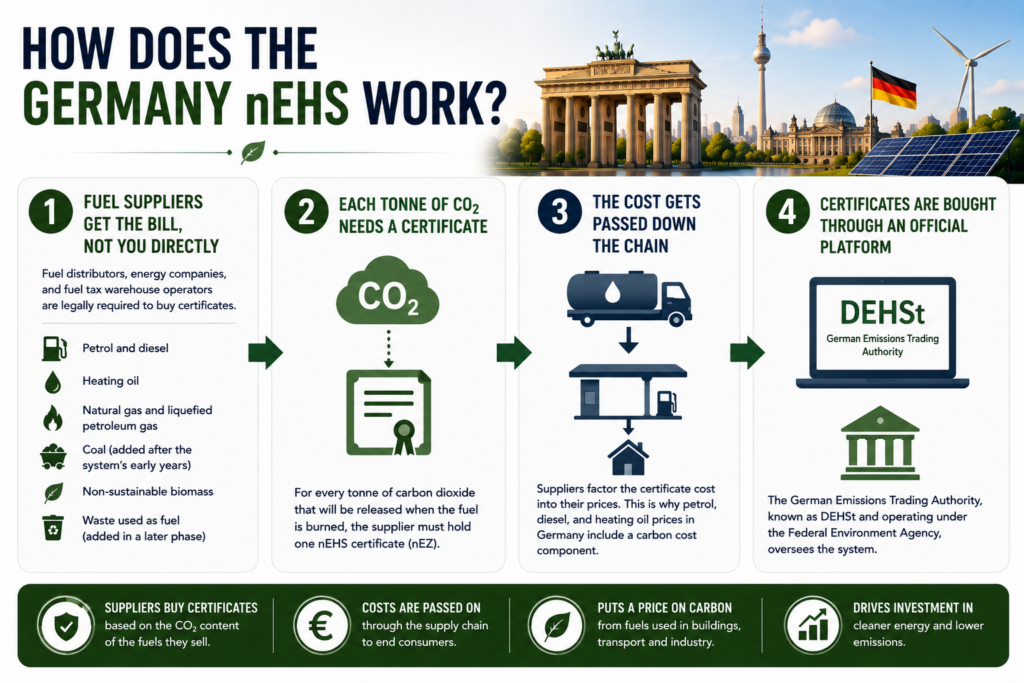
Step 1: Fuel Suppliers Get the Bill, Not You Directly
Fuel distributors, energy companies, and fuel tax warehouse operators are the ones legally required to buy certificates. This includes companies selling:
- Petrol and diesel
- Heating oil
- Natural gas and liquefied petroleum gas
- Coal (added after the system’s early years)
- Non-sustainable biomass
- Waste used as fuel (added in a later phase)
Step 2: Each Tonne of CO2 Needs a Certificate
For every tonne of carbon dioxide that will be released when the fuel is burned, the supplier must hold one nEHS certificate, often abbreviated as nEZ in German documentation.
Step 3: The Cost Gets Passed Down the Chain
Suppliers factor the certificate cost into their prices. This is why petrol, diesel, and heating oil prices in Germany include a visible carbon cost component, even if it is not always labeled separately.
Step 4: Certificates Are Bought Through an Official Platform
The German Emissions Trading Authority, known as DEHSt and operating under the Federal Environment Agency, oversees the system. The European Energy Exchange in Leipzig serves as the official sales and auction platform.
The Three Phases of Germany nEHS
The system was designed to roll out gradually, giving businesses and households time to adjust. It runs in distinct phases:
Phase 1: Fixed Price Introduction
In the earliest years of the scheme, the price per certificate was set by law and rose in predictable steps. This gave companies and households planning certainty, since everyone knew the carbon price in advance rather than facing sudden market swings.
Phase 2: Price Corridor Auctions
After the fixed price period ends, the system shifts to an auction-based model. Certificates are sold through competitive auctions, but within a defined price corridor, meaning a minimum and maximum price still apply. This avoids extreme price shocks while allowing the market to determine the exact figure within that range.
Phase 3: Full Market Integration
Looking ahead, the Germany nEHS is designed to merge into the wider European Emissions Trading System 2, a European-level scheme covering buildings and road transport across multiple member states. Once that broader system becomes fully operational, the national scheme will largely be phased out, with pricing aligned to the European market rate.
Germany nEHS Pricing Overview
Pricing under the nEHS has followed a clear, rising trajectory since launch. Below is a simplified overview of how the pricing structure has evolved through its phases.
| Phase | Pricing Mechanism | Approximate Range | Key Feature |
|---|---|---|---|
| Introductory fixed-price phase | Price set by law, rising yearly | Started around €25 per tonne, rising to about €55 per tonne | Predictable, no auctions |
| Price corridor auction phase | Competitive auctions within a floor and ceiling | Roughly €55 to €65 per tonne | Market-based within limits |
| Post-corridor fixed sale | Unlimited certificates at a set higher price | Around €68 per tonne | Applies once corridor volume is exhausted |
| Buyback window | Limited repurchase option for shortfalls | Around €70 per tonne | Capped at a small percentage of prior purchases |
| Future market integration | Aligned with the wider European scheme | Market-determined | Merges into the broader EU system |
This structure means the carbon price under the Germany nEHS has consistently trended upward, giving businesses a clear long-term signal to invest in cleaner alternatives sooner rather than later.
What Does This Mean for Fuel Prices?
The certificate cost translates into a small addition per litre of fuel or per kilowatt-hour of gas. The exact amount depends on the emissions intensity of each fuel type.
Heating oil and coal see a larger addition per unit compared to natural gas, since they release more carbon dioxide per unit of energy.
Fuel blended with sustainable biofuels, such as petrol containing bioethanol or diesel containing biodiesel, sees a smaller effective carbon cost, because the biogenic portion is not charged under the scheme when sustainability criteria are met.
Who Must Comply with the Germany nEHS?
The obligated parties under BEHG are generally companies further up the supply chain, not individual consumers. This typically includes:
- Companies operating fuel tax warehouses
- Natural gas suppliers and distributors
- Companies importing or distributing heating oil
- Coal suppliers
- Waste-to-energy operators using fuel classified under the scheme
Individual households and drivers are not required to buy certificates themselves. Their exposure comes indirectly, through the price of the fuel or energy they purchase.
Avoiding Double Counting
Some facilities already covered under the EU Emissions Trading System also use fuels that would otherwise fall under the nEHS. To prevent paying twice for the same emissions, the system includes a compensation mechanism.
Where a fuel is delivered directly to an EU ETS-covered installation, and that installation already reports the resulting emissions under the EU scheme, the fuel supplier can deduct or receive compensation for the double-counted portion.
Carbon Leakage Protection for Industry
One risk of any national carbon pricing scheme is that companies might simply relocate production to countries with no carbon price, a phenomenon known as carbon leakage.
To prevent this, the Germany nEHS includes a compensation mechanism for emission-intensive, trade-exposed sectors.
Companies operating in industries listed on the EU’s carbon leakage list can apply for compensation to offset the indirect cost burden created by the nEHS, keeping them competitive against international rivals that face no equivalent carbon price.
This mechanism reflects a broader principle common to global carbon markets: environmental ambition works best when it does not simply push emissions and jobs somewhere else.
Where Does the Money Go?
Revenue collected through nEHS certificate sales does not disappear into general government spending. It flows into Germany’s Climate and Transformation Fund, a dedicated vehicle for financing the country’s energy transition.
This fund supports programs such as:
- Energy-efficient building renovation subsidies
- Support for switching to heat pumps and renewable heating
- Electric vehicle incentives and charging infrastructure
- Industrial decarbonization projects
- Renewable energy expansion
In other words, the carbon price collected from fossil fuel use is partly recycled into the solutions that help people move away from fossil fuels in the first place.
Impact on German Households and Businesses
For Households
Most households feel the Germany nEHS through slightly higher heating and fuel costs rather than through any direct paperwork or registration requirement.
Homes still relying on oil or gas heating see the clearest impact, since these fuels carry higher carbon intensity. Homes using efficient heat pumps or district heating powered by renewables see less exposure over time.
Practical takeaways for households:
- Check whether your heating system relies heavily on oil, gas, or coal
- Look into renovation subsidies funded partly through nEHS revenue
- Consider efficiency upgrades, since rising carbon prices make savings more valuable each year
- Track fuel bills for the carbon cost component, which is often listed as a separate line item
For Businesses
Companies that are direct obligated parties under BEHG face compliance duties, including registration, reporting, and certificate purchases.
Businesses further down the supply chain, such as retailers or logistics companies, feel the impact mainly through higher fuel and energy procurement costs.
Practical takeaways for businesses:
- Confirm whether your company falls under BEHG’s obligated party definition
- Budget for a rising carbon cost component in fuel and heating expenses
- Explore compensation eligibility if operating in an emission-intensive, trade-exposed sector
- Factor future carbon costs into long-term investment and fleet decisions
Landlords and Tenants: A Special Consideration
Heating costs under the Germany nEHS raise a fairness question that lawmakers had to address directly: landlords choose the heating system, but tenants often pay the heating bill.
To address this, rules were introduced requiring landlords to share part of the carbon cost themselves in buildings with poor energy efficiency. The less efficient the building, the larger the share the landlord contributes.
This creates a direct incentive for landlords to invest in insulation, modern heating systems, and efficiency upgrades, rather than simply passing the full carbon cost onto tenants indefinitely.
Practical takeaways for landlords and tenants:
- Tenants can ask landlords about planned efficiency upgrades tied to this cost-sharing structure
- Landlords benefit financially, not just environmentally, from improving building efficiency sooner rather than later
- Energy performance certificates for a building often indicate how the carbon cost will be split
Germany nEHS vs EU ETS vs EU ETS 2
People often confuse the three systems, since all three involve emissions trading in some form. Here is a straightforward comparison.
| Feature | Germany nEHS | EU ETS (Original) | EU ETS 2 |
|---|---|---|---|
| Scope | Fuel emissions for heating and transport in Germany | Power plants and heavy industry across the EU | Buildings and road transport across the EU |
| Level | National | European | European |
| Launch stage | Already operating, transitioning toward EU ETS 2 | Long-established, oldest carbon market of its kind | Newer scheme, phasing in after nEHS |
| Who pays | Fuel suppliers and distributors | Power and industrial installation operators | Fuel suppliers and distributors |
| Pricing model | Fixed price phase, then auction corridor, then market alignment | Fully market-based auctions | Auction-based, aligned with European market |
| Future direction | Set to merge into EU ETS 2 | Continues as the core industrial carbon market | Will absorb most of the national scheme’s role |
Think of the Germany nEHS as a national trial run that prepared businesses, regulators, and infrastructure for the arrival of a Europe-wide equivalent covering the same sectors.
How Germany nEHS Compares to Carbon Pricing Elsewhere
Germany is not alone in pricing carbon from heating and transport fuels. Several European countries introduced similar national measures well before the EU-wide scheme took shape.
Some neighboring countries chose a straightforward carbon tax model, applying a fixed cost per tonne of CO2 without any trading or auction mechanism. Others opted for trading-based systems closer to the German approach, allowing prices to respond to market conditions within set limits.
Key differences to understand:
- Carbon tax model: A government sets one fixed price per tonne, and it usually only changes through new legislation.
- Trading-based model (like the Germany nEHS): Prices can shift within a range once the fixed-price introductory phase ends, based on auction demand.
- Hybrid approaches: Some countries combine features of both, using a floor price alongside a market-based ceiling.
The Germany nEHS sits closer to the trading end of this spectrum, which is one reason it was designed to eventually connect smoothly with the broader European scheme rather than requiring a completely separate policy overhaul.
Monitoring, Reporting, and Verification Under the Germany nEHS
Compliance is not just about buying certificates. Obligated parties also carry ongoing monitoring and reporting duties.
Core reporting responsibilities include:
- Tracking the volume of each covered fuel type placed on the market
- Applying standardized emissions factors published by the regulator to convert fuel volumes into CO2 equivalents
- Submitting annual emissions reports to the German Emissions Trading Authority
- Surrendering the correct number of certificates to match reported emissions
- Keeping records available for potential audits or verification checks
Accuracy matters here. Under-reporting emissions or failing to surrender enough certificates can trigger penalties, similar to compliance risk under the EU Emissions Trading System.
Companies that also operate under the EU scheme need to be especially careful about avoiding double reporting, since fuel delivered directly to an EU ETS-covered installation should not be counted twice under both systems.
Key Numbers to Remember
For a quick reference, here are the core structural facts about the Germany nEHS worth remembering.
| Question | Answer |
|---|---|
| What sectors does it cover? | Heating and road transport fuel emissions |
| Who is legally obligated? | Fuel suppliers, distributors, and fuel tax warehouse operators |
| What is the legal basis? | The Fuel Emissions Trading Act (BEHG) |
| Who regulates it? | The German Emissions Trading Authority, under the Federal Environment Agency |
| Where are certificates traded? | The European Energy Exchange in Leipzig |
| Where does the revenue go? | Germany’s Climate and Transformation Fund |
| What is its long-term direction? | Gradual integration into the wider European Emissions Trading System for buildings and transport |
Step-by-Step: How Companies Register and Comply
For businesses that fall under BEHG’s obligated party rules, compliance generally follows this process:
- Determine obligated party status. Confirm whether your company supplies or distributes covered fuels under BEHG definitions.
- Register with the relevant authority. Obligated parties register with DEHSt, the German Emissions Trading Authority.
- Gain admission to the trading platform. Companies apply for admission to the European Energy Exchange to participate in certificate sales or auctions.
- Track fuel volumes and emissions factors. Use standardized emissions values for each fuel type to calculate the required certificate volume.
- Purchase certificates. Buy the required nEHS certificates through fixed-price sales or auctions, depending on the current phase.
- Submit annual reports. File emissions reports and surrender the appropriate number of certificates to match reported emissions.
- Apply for compensation where eligible. Trade-exposed, emission-intensive companies can apply for carbon leakage compensation to reduce net cost impact.
- Monitor regulatory updates. Stay informed on auction calendars, price corridor rules, and the transition timeline toward the wider European scheme.
Challenges and Criticism of the Germany nEHS
No carbon pricing system is without debate, and the Germany nEHS has faced its share of criticism.
Common concerns include:
- Affordability for low-income households. Rising heating and fuel costs disproportionately affect households with limited ability to switch to efficient alternatives quickly.
- Overlap and complexity with the EU system. Businesses operating across both schemes sometimes find compliance and double-counting rules complex to navigate.
- Uncertainty around the transition timeline. As the scheme moves toward integration with the broader European system, businesses face planning uncertainty about exact pricing and timing.
- Effectiveness debate. Some analysts argue the price level needs to rise faster to meaningfully shift behavior, while others warn that faster increases risk public backlash.
Supporters counter that the phased approach, price corridor, and dedicated Climate and Transformation Fund were specifically designed to balance climate ambition with economic and social stability.
The Future of Germany nEHS
The direction of travel is clear: national systems for fuel emissions across Europe are gradually giving way to a unified continental approach.
Germany plans to reuse much of its existing nEHS infrastructure, including reporting systems and the European Energy Exchange platform, to support the transition toward the broader European scheme.
For businesses and households, this means:
- Carbon costs on heating and transport fuels are very unlikely to disappear
- The long-term trend points toward market-based pricing rather than fixed government-set prices
- Early adaptation, through efficiency improvements and cleaner heating choices, reduces long-term exposure to rising carbon costs
- Policy details around the exact transition timeline may still shift, so staying updated matters for compliance planning
Actionable Takeaways
- The Germany nEHS puts a price on carbon from fuels used in heating and transport, collected upstream from suppliers rather than directly from consumers.
- Pricing has moved from a predictable fixed-price phase into an auction-based price corridor, with further market alignment expected ahead.
- Revenue supports Germany’s Climate and Transformation Fund, funding renovation subsidies, renewable heating, and electric vehicle incentives.
- Trade-exposed industries can apply for carbon leakage compensation to remain competitive internationally.
- Households benefit most by improving heating efficiency and exploring subsidy programs tied to this revenue stream.
- Businesses should confirm their obligated party status early and build rising carbon costs into long-term planning.
- The scheme is a transitional bridge, gradually merging into a wider European emissions trading system for buildings and transport.
Conclusion
The Germany nEHS might sound technical at first, but its purpose is simple: put a fair, rising price on the carbon dioxide released by heating and transport fuels, and use that revenue to fund the transition to cleaner alternatives.
For households, it shows up quietly in fuel and heating bills. For businesses, especially fuel suppliers and distributors, it means direct compliance obligations under national emissions trading Germany has built into law.
As the system moves closer to full integration with the wider European scheme, understanding how the Germany nEHS works today puts households and businesses in a stronger position to plan ahead, manage costs, and take advantage of the incentives designed to ease this transition.
Carbon pricing is no longer a distant policy concept. In Germany, it is already part of everyday energy decisions, and understanding the nEHS is the first step toward navigating it wisely.
Frequently Asked Questions
What does nEHS stand for?
nEHS stands for Nationales Emissionshandelssystem, which translates to national emissions trading system in English.
Who actually pays for nEHS certificates?
Fuel suppliers and distributors are legally obligated to buy certificates. However, the cost is generally passed down to consumers through fuel and heating prices.
Does the Germany nEHS apply to electricity?
No, the nEHS focuses on fuel emissions from heating and transport, such as petrol, diesel, heating oil, natural gas, and coal. Electricity generation is covered under the separate, older EU Emissions Trading System.
Is the Germany nEHS the same as the EU ETS?
No, they are different systems. The EU ETS covers power plants and heavy industry across the European Union, while the Germany nEHS is a national scheme covering heating and transport fuels not covered by the EU system.
Will the Germany nEHS continue forever?
The scheme is designed as a transitional bridge. It is expected to gradually merge into the wider European Emissions Trading System 2, which covers buildings and transport across the European Union.
How does the carbon leakage compensation mechanism work?
Emission-intensive, trade-exposed industries listed on the EU carbon leakage list can apply for compensation to offset the indirect cost impact of the nEHS, helping them stay competitive against international competitors without an equivalent carbon price.
Where does the money from nEHS certificate sales go?
Revenue flows into Germany’s Climate and Transformation Fund, which finances building renovation subsidies, renewable heating support, electric vehicle incentives, and broader decarbonization programs.
How can households reduce their exposure to nEHS-related costs?
Households can reduce exposure by improving building insulation, switching to efficient heating systems such as heat pumps, and taking advantage of renovation subsidies funded through the scheme’s revenue.
Do landlords or tenants pay the nEHS-related heating cost?
Both can be involved. Rules require landlords to absorb a larger share of the carbon cost in buildings with poor energy efficiency, while tenants in efficient buildings bear a smaller share, creating an incentive for landlords to upgrade their properties.
Is the Germany nEHS a carbon tax or an emissions trading system?
It is structured as an emissions trading system rather than a straightforward tax, since certificates are bought through fixed-price sales and later through auctions within a set price range, rather than through one government-set tax rate alone.
If you want to keep learning about carbon markets, ESG strategy, and sustainability trends, explore more resources on Carbon Market Network.