Carbon Market Network

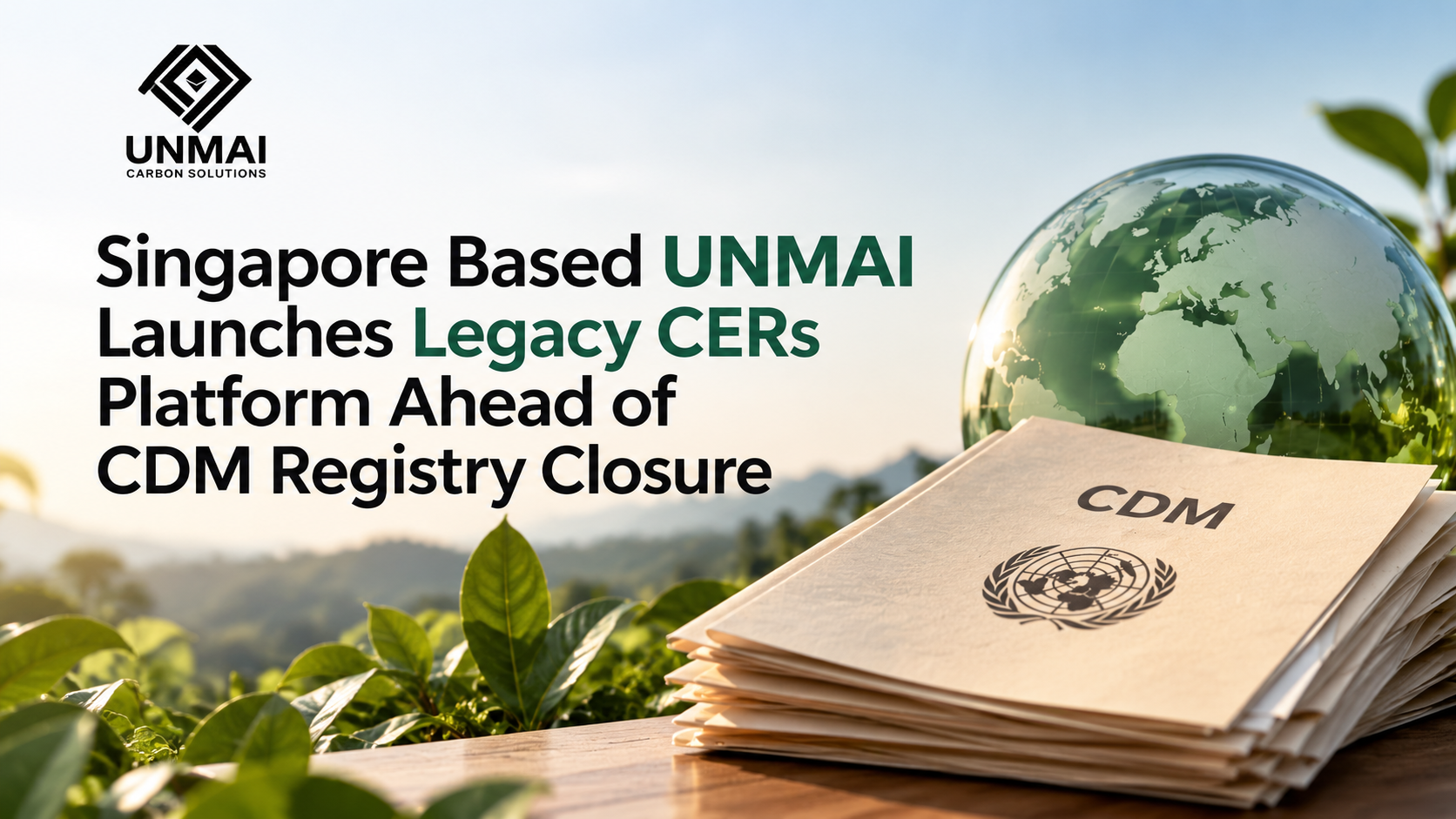
Billions of dollars of climate investment sit inside a registry that is about to go dark. Those assets are Legacy CERs.
They are old UN-issued carbon credits, and many of them will be cancelled by default when the CDM registry stops working.
A Singapore based firm, UNMAI Carbon Solutions, has built a platform to give these credits a second life. This guide explains what is happening, how the platform works, what it costs, and what holders should do next.
Checl out UNMAI’s Legacy CERs platform: https://legacycers.earth/
What Are Legacy CERs?
Legacy CERs are Certified Emission Reductions issued under the Clean Development Mechanism (CDM) that never found a clear path to use or sale.
One CER equals one tonne of CO2 equivalent. The CDM was created under the Kyoto Protocol, and it let developing countries earn credits for cutting emissions.
Rich countries and companies bought these credits to meet their targets. That market was huge for a few years.
How big was the CDM?
The numbers explain why the closure matters so much:
- The CDM generated more than 2.1 billion CERs.
- Those credits came from more than 8,200 projects worldwide.
- Most issuance happened between 2005 and 2011.
- Project developers in Asia (mainly India and China), Latin America, and Africa earned most of them.
Why did so many CERs get stranded?
Two events broke the market.
First, CER prices collapsed after the first Kyoto commitment period ended. Demand from compliance buyers dried up.
Second, the Paris Agreement replaced the Kyoto system. That left unclear rules for what old credits could still do.
The result is a large stock of unsold, unused credits. People now call them stranded or legacy credits.
Carbon Market Insider Newsletter
Weekly insights on carbon markets, climate policy, carbon credits, and sustainability.
Why CDM Registry Closure 2027 Is a Turning Point
The UN climate process has decided to wind down the CDM. The decision came out of COP 30 in Belem.
The key point is simple. After the final transaction deadline, CERs left in the CDM registry can no longer be transferred, cancelled, or used through that registry.
The registry then moves toward shutdown. CERs that remain are cancelled administratively.
The UNMAI documentation says roughly 1.275 billion legacy CERs face extinction. Many were built up over two decades by thousands of project developers.
What is happening with the registry?
The UNFCCC lists the key steps. The table below summarises them.
| Step | Deadline |
|---|---|
| Registry disconnected from the International Transaction Log | 31 March |
| New requests for CER issuance stop being processed | 30 June |
| Transfers to the Article 6.4 mechanism registry end | 31 December |
| Cancellations and all other registry transactions end | 31 December |
| CERs in pending accounts with unpaid Share of Proceeds are administratively cancelled | 1 July (following year) |
| CDM registry stops operating | 2 July (following year) |
The shutdown date you will see in most news coverage is 1 January. That reflects the point where registry transactions are no longer available.
The CDM registry closure 2027 timeline is tight. Holders who wait for the last week risk missing the window.
Which projects can still transition?
Some projects can move into the Article 6.4 mechanism. This path is called CDM transition.
But only a subset of projects qualifies. Of roughly 4,700 CDM projects assessed for transition, many have no route forward.
The deadline for transition requests has also passed. India and China did not approve any projects under this category.
That leaves thousands of projects in several countries with stranded assets.
The Four Types of Legacy CERs
Not every legacy credit has the same status. UNMAI groups them into four types. Each type has different recovery options.
| Type | Description | Status and use |
|---|---|---|
| Type 1: Kyoto CP1 CERs | Issued on or before 31 December 2012 | Not eligible under the Paris Agreement. Could be used voluntarily in theory, but demand is almost non-existent. |
| Type 2: Kyoto CP2 CERs | Issued between 1 January 2013 and 31 December 2020 | Eligible against the first NDC target and under Paris only if the project transitioned into Article 6.4. Otherwise limited to voluntary use. |
| Type 3: CERs from transitioned CDM activities | Issued from 1 January 2021 | Become ITMOs after host country authorisation under Article 6.2 or 6.4. Not threatened by registry closure. |
| Type 4: Pending and transferred CERs | (a) CERs in the project proponent’s pending account, not moved to the holding account because Share of Proceeds was unpaid. (b) CERs moved to developed country registries but not yet retired. | Depends on payment status and registry location. |
Why this matters in practice
Type 3 credits are the safest. They already have a route into the Paris framework.
Types 1, 2, and 4 are where the risk sits. These are the credits the new platform targets.
Holding account versus pending account
For Types 1 and 2, one detail changes everything.
- Holding account: CERs already transferred to the project developer’s account.
- Pending account: CERs issued by the CDM Executive Board but not yet forwarded because the Share of Proceeds fee was not paid.
Holders must know which account their credits sit in. The steps to save them differ.
Who Is UNMAI and What Is the Legacy CERs Platform?
UNMAI Carbon Solutions is a Singapore based company. Its founder and CEO is Nithyanandam Yuvaraj Dinesh Babu.
The company has also signed an agreement with TERI, India’s Energy and Resources Institute, to collaborate on carbon markets and decarbonisation.
The Legacy CERs platform is UNMAI’s answer to the registry closure. Its stated goal is to extend the life of CERs held in pending and holding accounts before the sunset.
After that, the platform aims to unlock market value through a project-wise Integrity Ranking process.
An important clarification
This is a private platform. It is not run by the UNFCCC.
The platform does not recreate UN issuance. It builds a parallel record that preserves the credit’s original provenance.
Buyers should treat it like any new market infrastructure. Read the rules, check acceptance, and verify claims before committing funds.
Who can use it?
The platform serves two groups:
- Project participants and representatives who hold legacy CERs.
- Brokers and other account holders who want to buy, hold, trade, or retire them.
Access is subject to successful KYC and payment of fees.
How the Legacy CERs Platform Works: Step by Step
UNMAI describes a four-step process. It keeps the original UNFCCC provenance while opening the credits to the voluntary market.
The credits can also be used by project proponents to offset their own emissions. UNMAI mentions retroactive vintage offsetting as one such use.
Phase 1.1: Transfer and re-issue
This is the core of the platform. It has three actions.
- Cancel (Step 1a): The project developer voluntarily cancels CERs on the UNFCCC CDM registry. The registry issues a Voluntary Cancellation Certificate.
- Shift (Step 1b): For CERs sitting in pending accounts, the developer submits verification reports and Share of Proceeds evidence.
- Issue (Step 1c): The Legacy CERs platform issues digital Legacy CERs that mirror the cancelled units.
What does the cancellation certificate show?
UNMAI shows a sample certificate in its materials. The reason for cancellation reads that the units are cancelled for reissuance on the Legacy CERs platform.
The sample shows 14,402 CERs, equal to 14,402 tonnes of CO2. Serial numbers and names are redacted in the example.
This certificate is the proof trail. It shows the original UN credit was retired from the CDM registry, not double counted.
Phase 1.2: Tokenisation (optional)
The platform can mint Digital Carbon Tokens (DCTs) on a blockchain. UNMAI states that 1,000 DCT equals one tonne of CO2e.
Tokens are backed by the Legacy CERs evidence. This step is optional.
The documentation lists the mechanism for this step as yet to be decided. Treat the details as still developing.
Phase 2: Trade on a marketplace
Legacy CERs or DCTs can be listed and traded multiple times until someone retires them.
UNMAI describes smart contract settlement with zero counterparty risk. The marketplace mechanism is also marked as yet to be decided.
Phase 3: Retire on the platform
The final buyer retires the credits. Retirement uses an on-chain burn, a registry retirement, and a PDF retirement certificate.
This step is meant to prevent double counting.
The Timeline Holders Must Watch
UNMAI’s materials reproduce the UNFCCC submission timelines. These are the dates by which the secretariat guarantees processing.
| Key activity | Guaranteed processing date |
|---|---|
| Requests to forward CERs to national registries | 10 March |
| Submission of VCP listing | 15 August |
| VCP purchases paid by bank transfer | 30 September |
| Share of Proceeds payment | 30 September |
| Requests to transfer CERs to the Article 6.4 registry | 25 October |
| Changes to modalities of communication | 15 November |
| Requests for cancellations and other registry transactions | 25 November |
The secretariat says it cannot guarantee processing by 31 December for requests that arrive after these dates.
So the real deadline is earlier than the closing date. Late submissions can fail even if you file before the final day.
Always check the UNFCCC CDM registry page for updates. Dates can change.
Fees on the Legacy CERs Platform
UNMAI publishes a fee schedule, excluding tokenisation. The charges are modest per credit but add up at scale.
| Fee type | Who pays | Amount (USD) |
|---|---|---|
| Account opening | Project participants and representatives | 100 |
| Account opening | Brokers and non-project owners | 100 |
| Annual account fee | Project participants and representatives | 50 |
| Annual account fee | Brokers and non-project owners | 100 |
| Project onboarding | Project participants and representatives | 100 |
| Project assessment | Project participants and representatives | Not applicable |
Issuance fees (from holding or pending accounts)
| Volume of Legacy CERs | Fee per credit |
|---|---|
| Up to 250,000 | 4 cents |
| 251,000 to 500,000 | 3 cents |
| 501,000 to 1,000,000 | 2 cents |
| Above 1,000,000 | 1.5 cents |
Transfer and retirement fees
| Action | Who pays | Fee per credit |
|---|---|---|
| Transfer | Buyer (any account holder) | 1.5 cents |
| Retirement | Buyer or seller (any account holder) | 1.5 cents |
A simple example
Imagine a project owner in India with 200,000 legacy CERs.
- Issuance: 200,000 x 4 cents = 8,000 USD
- Account opening: 100 USD
- Project onboarding: 100 USD
- First annual fee: 50 USD
The first-year cost comes to about 8,250 USD.
A buyer who later retires 10,000 of those credits pays 150 USD to transfer and 150 USD to retire.
UNMAI Carbon has waived its account-opening fee and charges only an onboarding fee. The platform also receives its share of revenue after project developers (sellers) generate revenue from the sale of Legacy CERs.
The schedule does not say whether volume tiers apply to the whole batch or in slices. Ask UNMAI before you budget for a large holding.
Integrity Ranking: Why It Matters
Legacy credits vary widely in quality. A buyer cannot judge a 15-year-old project from a registry entry alone.
UNMAI plans a project-wise Integrity Ranking. It is an optional service for buyers, subject to a fee.
The methodology is still being devised. That means no final scoring criteria exist yet.
What buyers should look for
When the ranking arrives, test it against these questions:
- Is the method published and transparent?
- Does it check additionality and baseline quality?
- Does it look at monitoring and verification history?
- Does it review co-benefits and community impact?
- Is the ranking independent of sales incentives?
Until then, buyers should do their own due diligence on each project.
What Should Project Owners Do Now?
Time is short. Here is a practical action plan.
- Audit your inventory. List every CER by vintage, account, and project.
- Split by account type. Separate holding account units from pending account units.
- Check Share of Proceeds status. Unpaid fees keep CERs stuck in pending accounts.
- Check transition eligibility. Ask your host country authority whether any Article 6.4 route remains.
- Compare exit options. Weigh platform reissuance, national registry transfers, and other voluntary routes.
- Gather documents. Collect verification reports, payment evidence, and registry records.
- File before the guaranteed dates. Do not wait for the last week of December.
Real-world scenario
Picture a wind farm developer in South Asia. The project issued credits for years, but many sit unsold.
Some credits are in the holding account. Others remain in pending because the developer never paid Share of Proceeds.
The developer can pay the fee, move the pending units, and then cancel them on the registry. The platform then reissues digital Legacy CERs against the cancellation record.
If the developer does nothing, the units face administrative cancellation.
Who Might Buy Legacy CERs?
Buyers are the missing piece. A platform needs demand, and demand for old credits is thin.
UNMAI points to two uses:
- Voluntary market buyers who want low-cost credits with a UN origin.
- Project proponents who want to offset their own emissions, including retroactive vintage offsetting.
Why a buyer might care
Legacy CERs are usually cheap. They have a documented UN issuance history.
For a company with a past-year footprint it never offset, old vintages can match the year of emissions.
Why a buyer might hesitate
- Standards and rating agencies may not accept them.
- Many voluntary buyers prefer recent vintages.
- Reputational risk exists if the credit’s quality is questioned.
- The platform is new and unproven.
A smart buyer reads the claim rules of their own reporting framework before purchasing.
Risks and Open Questions
Honest coverage needs a clear view of the unknowns.
| Area | Open question |
|---|---|
| Market acceptance | Will major buyers and standards recognise reissued Legacy CERs? |
| Blockchain mechanism | UNMAI lists the minting method as yet to be decided. |
| Marketplace design | The trading mechanism is also still to be decided. |
| Integrity Ranking | The methodology is under development. |
| Regulatory view | Host countries may take different positions on cancelled and reissued units. |
| Double counting | The platform relies on the registry cancellation and its own retirement records. |
None of this means the platform will fail. It means holders should move with care.
How This Fits the Wider Carbon Market
The CDM was the first large global carbon crediting scheme. Its closure marks the end of an era.
Its successor, the Article 6.4 mechanism, now carries the baton. Eligible CERs can migrate there.
Meanwhile, the voluntary carbon market grows around standards such as Verra and Gold Standard.
Legacy CERs sit between these worlds. They have UN heritage but limited modern use.
The UN carbon offset platform, which let the public buy and cancel CERs, is also affected. The voluntary cancellation deadline applies to it too.
Key Takeaways
- Legacy CERs are old UN credits at risk of administrative cancellation.
- Registry transactions end on 31 December, and leftover CERs are cancelled.
- UNMAI offers a private route to cancel, reissue, trade, and retire these credits.
- Fees start at 4 cents per credit for issuance, with lower rates at scale.
- Several design features, such as tokenisation and trading, are still undecided.
- Holders should audit inventory and file well before the guaranteed dates.
FAQ
What are Legacy CERs?
Legacy CERs are Certified Emission Reductions issued under the CDM that remain unused or unsold. Many are stranded because demand collapsed.
What is the CDM Registry closure 2027 about?
The UN is winding down the CDM. Registry transactions end on 31 December, and remaining CERs are administratively cancelled afterwards.
What happens to CERs left in the CDM registry?
They can no longer be transferred, cancelled, or used through the registry. They face administrative cancellation.
Can Legacy CERs be used under the Paris Agreement?
Some can. CP2 CERs from projects that transitioned into Article 6.4 may count toward the first NDC. CP1 CERs cannot.
What is the UNMAI Legacy CERs platform?
It is a private platform from Singapore based UNMAI Carbon Solutions. It lets holders cancel CERs on the CDM registry and receive digital Legacy CERs.
Is the platform run by the UN?
No. It is a private initiative. The UNFCCC runs the CDM registry separately.
How much does it cost?
Issuance starts at 4 cents per credit and falls to 1.5 cents for large volumes. Account, onboarding, transfer, and retirement fees also apply.
What is a Digital Carbon Token?
It is an optional blockchain token backed by Legacy CERs evidence. UNMAI states 1,000 DCT equals one tonne of CO2e.
What is Share of Proceeds?
It is a fee paid on CERs to cover CDM administrative costs. Unpaid fees keep CERs in the pending account.
Should I act now?
If you hold CERs, yes. The guaranteed processing dates come before the final closing date.
Conclusion
The CDM registry closure 2027 will erase a large part of the world’s oldest carbon credit stock. For project developers, the loss is real and the clock is running.
UNMAI’s Legacy CERs platform gives holders a way to preserve and monetise these credits. It is a promising idea, but parts of it are still being designed.
If you own Legacy CERs, audit your holdings today. Pay what you owe, file early, and compare every exit route before the deadline passes.
Disclaimer: This article is for educational purposes only and is not financial, legal, or investment advice, so please verify all deadlines and platform terms with the UNFCCC and UNMAI before acting.
Explore more guides, tools, and updates on global carbon markets at Carbon Market Network.