Carbon Market Network


Every week, you hear a company, a government, or a celebrity announce they are “going net zero.” But what does net zero actually mean? And why does it matter so much right now?
Net zero meaning, at its core, is simple: it is the point where the amount of greenhouse gases we put into the atmosphere equals the amount we take out. The result? Zero net addition to the atmosphere. Like filling and emptying a bathtub at exactly the same rate, the water level stays the same.
This guide breaks down the net zero meaning in plain language. You will learn what it involves, why it is urgent, how countries and companies are trying to get there, and what you can do as an individual. No jargon, no fluff.
What Is Net Zero? The Simple Definition
Net zero meaning refers to achieving a balance between the greenhouse gases emitted into the atmosphere and the greenhouse gases removed from it.
Think of it like a weighing scale. On one side, you have all the carbon dioxide (CO2), methane, and other gases that human activities release. On the other side, you have all the carbon that forests, oceans, and technologies absorb or remove.
When both sides of the scale are equal, you have reached net zero.
It does not mean producing zero emissions. It means that whatever emissions remain are fully cancelled out by an equivalent amount of removal.
The global target is to reach net zero greenhouse gas emissions by 2050. Scientists say this is necessary to limit global warming to 1.5 degrees Celsius above pre-industrial levels, which is the threshold beyond which climate impacts become far more dangerous.
Check out Carbon Market Network to get started with your net zero journey.
Carbon Market Insider Newsletter
Weekly insights on carbon markets, climate policy, carbon credits, and sustainability.
Why Does Net Zero Matter?
You may wonder: why is this goal so important? The answer comes down to what greenhouse gases do.
When we burn fossil fuels, cut down forests, or raise livestock, we release gases like CO2 and methane. These gases trap heat in the atmosphere, warming the planet.
The more gases we release without removing them, the hotter the planet gets.
This leads to:
- More intense and frequent heatwaves
- Rising sea levels threatening coastal cities
- Stronger storms, floods, and droughts
- Destruction of ecosystems and biodiversity
- Disruptions to food and water supplies
Limiting warming to 1.5°C versus 2°C may sound like a small difference. But at 2°C, the number of people exposed to severe heatwaves roughly doubles, and extreme weather events become far more common.
Reaching net zero is not just an environmental goal. It is a survival strategy.
Net Zero vs Carbon Neutral vs Carbon Negative: Key Differences
People often use these terms interchangeably. They should not. Each term means something different, and understanding the difference helps you spot real climate action from empty promises.
What Does Carbon Neutral Mean?
Carbon neutral means that a business or activity balances the amount of CO2 it releases by removing or offsetting an equal amount. It typically focuses on carbon dioxide only and usually applies to Scope 1 and Scope 2 emissions (more on those below).
Carbon neutrality is often achieved by purchasing carbon offsets, which are credits representing carbon removed or avoided somewhere else in the world.
What Does Net Zero Mean (in Detail)?
Net zero is a stricter, more ambitious goal. It covers all greenhouse gases, not just CO2. It requires deep cuts across the entire value chain, including Scope 3 emissions (supply chain and product use).
Under the Science Based Targets initiative (SBTi), companies must cut at least 90% of their emissions before 2050. Only the remaining residual emissions can be offset or removed.
The key difference: Carbon neutral allows you to compensate for your emissions. Net zero requires you to actually eliminate most of them first.
What Does Carbon Negative Mean?
Carbon negative (also called “climate positive”) means removing more carbon from the atmosphere than you emit. You are not just at zero. You are actively reducing the total amount of carbon in the atmosphere.
Bhutan is the world’s only carbon-negative country. About 72% of the country is covered by forests, which absorb more carbon than the entire nation emits.
Microsoft has pledged to become carbon negative by 2030 and to remove all the carbon it has ever emitted by 2050.
Quick Comparison Table
| Term | Scope | Mechanism | Ambition Level |
|---|---|---|---|
| Carbon Neutral | CO2 only, Scopes 1-2 | Offsets acceptable | Lower |
| Net Zero | All GHGs, Scopes 1-2-3 | Deep cuts + minimal offsets | High |
| Carbon Negative | All GHGs | Remove more than emitted | Highest |
| Climate Positive | All GHGs | Same as carbon negative | Highest |
What Are Greenhouse Gas Emissions?
To fully understand net zero meaning, you need to know what we are trying to reduce.
Greenhouse gases (GHGs) are gases that trap heat in the Earth’s atmosphere. The main ones are:
- Carbon dioxide (CO2): Released from burning coal, oil, and gas, as well as deforestation. Responsible for the largest share of warming.
- Methane (CH4): Released from livestock farming, landfills, and natural gas leaks. It is 80 times more potent than CO2 over a 20-year period.
- Nitrous oxide (N2O): Released from agricultural fertilisers and industrial processes.
- Fluorinated gases (F-gases): Released from refrigeration and air conditioning. Some are thousands of times more potent than CO2.
- Water vapour: Naturally occurring, but increases as temperatures rise, amplifying warming.
When scientists talk about emissions, they often express everything as CO2 equivalent (CO2e) to make different gases comparable on a single scale.
What Are Scope 1, 2, and 3 Emissions?
This framework is central to how businesses measure and reduce their emissions on the path to net zero.
Scope 1 Emissions
These are direct emissions that a company produces from sources it owns or controls.
Examples:
- Fuel burned in company vehicles
- Emissions from a factory’s furnaces
- Gas used to heat office buildings
Scope 2 Emissions
These are indirect emissions from the energy a company purchases and uses, such as electricity from the grid.
If the electricity comes from a coal power plant, those emissions count as Scope 2 for the company using it.
Scope 3 Emissions
These are all other indirect emissions across a company’s value chain. They are usually the largest and hardest to address.
Examples:
- Emissions from a company’s suppliers
- Business travel by employees
- Emissions from customers using the product
- Waste disposal
For most companies, Scope 3 emissions account for 70 to 90% of their total footprint.
True net zero requires tackling all three scopes, not just the easy ones.
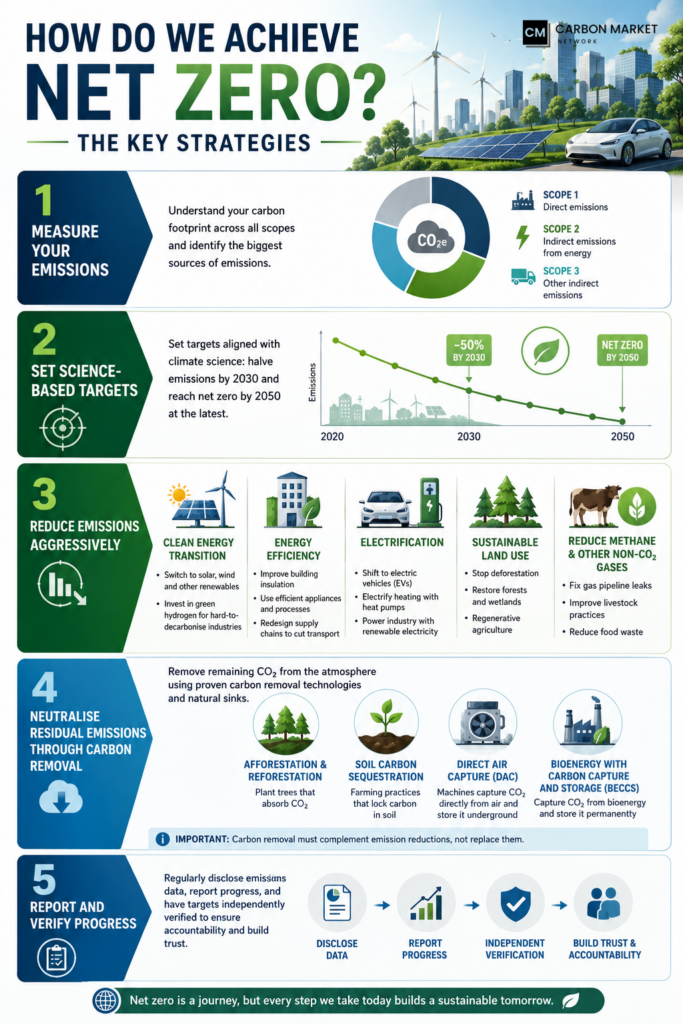
How Do We Achieve Net Zero? The Key Strategies
Reaching net zero is a multi-step process. It requires action across energy, transport, industry, land, and buildings. Here is a clear breakdown.
Step 1: Measure Your Emissions
You cannot manage what you do not measure. The first step for any country, company, or individual is to understand where emissions are coming from.
This means calculating your carbon footprint across all scopes and identifying the biggest sources of emissions.
Step 2: Set Science-Based Targets
Once you know your baseline, you set targets aligned with climate science. The Science Based Targets initiative (SBTi) provides a framework that requires companies to commit to halving emissions by 2030 and reaching net zero by 2050 at the latest.
As of early 2026, the SBTi surpassed 10,000 companies with validated targets, marking a major milestone in corporate climate accountability.
Step 3: Reduce Emissions Aggressively
This is the most critical step. You must cut emissions as deeply as possible across your operations and supply chain. Key strategies include:
Clean Energy Transition
- Switch from coal, oil, and gas to solar, wind, and other renewables
- Invest in green hydrogen for hard-to-decarbonise industries like steel and shipping
Energy Efficiency
- Improve insulation in buildings
- Use energy-efficient appliances and industrial processes
- Redesign supply chains to cut unnecessary transport
Electrification
- Shift from petrol and diesel vehicles to electric vehicles (EVs)
- Electrify heating systems using heat pumps
- Transition industrial processes from gas to electricity powered by renewables
Sustainable Land Use
- Stop deforestation and restore forests and wetlands
- Shift to regenerative agricultural practices that sequester carbon in soil
Reduce Methane and Other Non-CO2 Gases
- Fix gas pipeline leaks
- Improve livestock farming practices
- Reduce food waste
Step 4: Neutralise Residual Emissions Through Carbon Removal
After cutting emissions as far as possible, some small amount of residual emissions will remain. These must be removed from the atmosphere through carbon removal technologies or natural sinks.
Methods include:
- Afforestation and reforestation: Planting trees that absorb CO2
- Soil carbon sequestration: Using farming practices that lock carbon in soil
- Direct Air Capture (DAC): Machines that literally pull CO2 out of the air and store it underground
- Bioenergy with Carbon Capture and Storage (BECCS): Growing plants that absorb CO2, burning them for energy, and capturing the emissions
Important: Carbon removal must complement emission reductions, not replace them.
Step 5: Report and Verify Progress
Transparency matters. Companies and governments must regularly disclose their emissions data, report on progress, and have targets independently verified to maintain accountability.
Net Zero at the Global Level: The Paris Agreement and 2050 Target
The global net zero goal did not come out of nowhere. It is rooted in a landmark international agreement.
The Paris Agreement (2015)
In December 2015, 196 countries adopted the Paris Agreement, committing to limit global warming to well below 2°C and to pursue efforts to keep it to 1.5°C above pre-industrial levels.
To achieve this, global greenhouse gas emissions need to drop by 55% by 2035 compared to 2019 levels, and reach net zero by 2050.
Where Are We in 2026?
The picture is both encouraging and sobering.
Global energy-related CO2 emissions reached 38 gigatonnes in 2024, according to the International Energy Agency (IEA). The IEA’s Net Zero Emissions Scenario projects that emissions must fall by nearly 55% by 2035 to stay on track.
The IEA’s updated 2025 World Energy Outlook acknowledges a difficult truth: exceeding 1.5°C of warming around 2030 is now likely. However, strong action can still bring temperatures back below 1.5°C by the end of the century.
What Is an NDC?
Countries submit Nationally Determined Contributions (NDCs): official climate plans that outline what each country will do to cut emissions. Under the Paris Agreement, countries update these plans every five years.
The challenge? Current NDCs, if fully implemented, would only reduce emissions by about 12% by 2035 compared to 2019 levels. Scientists say 55% is needed.
Net Zero at the Country Level: Who Has Committed?
As of September 2025, 137 of 198 national governments have adopted net-zero targets. These commitments cover 74% of global greenhouse gas emissions, 77% of global GDP, and 79% of the world’s population.
Importantly, 67% of country targets are now codified in law or formal policy, up from 52% in 2024. This is a significant step forward, as legally binding targets are harder to walk back.
Country Examples
United Kingdom The UK became the first major economy to pass a net zero law in 2019, committing to net zero by 2050. It has set interim carbon budgets to stay on track.
European Union The EU’s European Green Deal targets net zero emissions by 2050. It aims to reduce net emissions by at least 55% by 2030 compared to 1990 levels.
India India committed to net zero by 2070 and aims to achieve 50% of its electricity from non-fossil sources by 2030.
China China, the world’s largest emitter, pledged carbon neutrality by 2060 and a peak in CO2 emissions before 2030.
United States The US has a net zero by 2050 target, though domestic policy implementation has been subject to political changes.
The six largest GHG emitters globally are China, the United States, India, the European Union, Russia, and Indonesia. Their progress is critical to global success.
Net Zero at the Company Level: Real-World Examples
Businesses across every sector are setting net zero targets. Here are some notable examples.
Ørsted (Denmark) – Energy Sector
Ørsted transformed itself from a fossil-fuel-heavy utility into a global offshore wind leader. It successfully achieved its 2025 target of a 99% renewable energy share in its own operations and became the first energy company to have its net-zero goal validated by the SBTi.
Microsoft (USA) – Technology Sector
Microsoft has pledged to be carbon negative by 2030 and to remove all the carbon it has emitted since its founding in 1975 by 2050. It invests in Direct Air Capture and other carbon dioxide removal technologies.
Moody’s (USA) – Financial Services
Moody’s has set a net-zero target for 2040, aiming well ahead of the global 2050 deadline.
TDC Net (Denmark) – Telecommunications
TDC has set an ambitious net-zero target for 2030, among the earliest in its sector.
Volvo Cars (Sweden) – Automotive
Volvo is partnering with H2 Green Steel to use steel produced with green hydrogen, directly tackling Scope 3 supply chain emissions.
As of April 2026, the SBTi reached 10,000 companies with validated net-zero targets. Asia is the fastest-growing region, with a 53% increase in validated companies in 2025 alone.
The Role of Carbon Offsets and Carbon Removal
Carbon offsets and carbon removal often appear in net-zero discussions. Understanding the difference and the limitations is important.
What Is a Carbon Offset?
A carbon offset is a credit representing the reduction or removal of one tonne of CO2 somewhere in the world, which a company or individual can purchase to “balance” their own emissions.
Examples:
- Funding a reforestation project
- Investing in a wind farm that replaces a coal plant
- Paying for methane capture at a landfill
The Problem With Over-Reliance on Offsets
Carbon offsets have faced serious scrutiny. Some concerns:
- Studies suggest that a large proportion of rainforest carbon offsets may not represent genuine, permanent carbon reductions.
- Offsets can encourage companies to delay the deep emission cuts that are actually needed.
- Greenwashing risk is high: companies can appear climate-friendly while continuing high-emission activities.
In 2025, courts and regulators in Europe and North America increasingly scrutinised net-zero and carbon neutrality claims backed heavily by offsets. Companies that relied on offsets without demonstrating real reductions faced legal action.
What Is Carbon Removal (CDR)?
Carbon Dioxide Removal (CDR) is different from traditional offsets. Instead of compensating for emissions elsewhere, CDR actively pulls CO2 out of the atmosphere and stores it.
Key CDR methods include:
- Direct Air Capture (DAC): Industrial machines that extract CO2 from ambient air
- Enhanced rock weathering: Spreading crushed minerals on farmland to absorb CO2
- Ocean-based carbon removal: Using oceans’ natural carbon-absorbing capacity
- Afforestation: Large-scale tree planting
The IEA acknowledges that some reliance on carbon removal technologies is unavoidable to return warming below 1.5°C, but notes these technologies are expensive and not yet proven at scale. This makes reducing emissions now even more urgent, as it limits how much we need to rely on unproven future removal.
Challenges and Criticism: Is Net Zero Enough?
Net zero is widely accepted as the global target, but it faces real challenges and some sharp criticism.
The Implementation Gap
The biggest challenge is the gap between ambition and action. Only 11% of large enterprises are reducing emissions in line with their stated net-zero ambitions, according to BCG research from 2024.
Current national climate plans would reduce emissions by only 12% by 2035. The required reduction is 55%.
Greenwashing Concerns
Greenwashing happens when companies or governments claim climate credentials without backing them up with real action.
In 2025:
- Tyson Foods agreed to drop its net-zero by 2050 claims after environmental groups challenged them.
- DWS Asset Management was fined €25 million by German regulators for overstating its ESG credentials.
- Delta Air Lines faced a class-action lawsuit over carbon neutrality claims relying heavily on offsets.
Regulators are tightening rules. In Europe, environmental claims must now meet the same standards of accuracy as price or performance claims.
Is 2050 Too Late?
Some scientists and activists argue that net zero by 2050 is not ambitious enough. They point out that:
- The atmosphere does not care about 2050 targets; it responds to cumulative emissions now.
- Every year of delay means more warming is locked in.
- “Real zero” (eliminating all emissions rather than balancing them) would be more effective.
The Justice Question
There is also a question of fairness. Developed countries industrialised over centuries, releasing enormous amounts of CO2. Should they not reach net zero sooner, to give developing countries more time to grow?
Many agreements, including the Paris Agreement, acknowledge “common but differentiated responsibilities,” recognising that wealthier nations should act faster.
Political Risk
Net zero commitments can be reversed by political changes. In 2024, New Zealand faced challenges in meeting its 2050 commitments after policy shifts following a change in government. In early 2025, BP walked back significant parts of its net-zero plan, increasing investment in oil and gas.
What Does Net Zero Mean for You as an Individual?
You might be wondering: what can I actually do? Individual action matters, even if systemic change by governments and corporations is the primary driver.
Reduce Your Carbon Footprint
Your personal carbon footprint is the total greenhouse gas emissions you cause through your lifestyle.
The biggest levers for most people are:
Diet
- Reduce meat and dairy consumption, especially beef and lamb.
- Eating plant-rich diets has one of the largest individual impacts on emissions.
Transport
- Drive less and choose electric or hybrid vehicles.
- Fly less, or offset unavoidable flights through high-quality carbon removal schemes.
- Use public transport, cycling, or walking where possible.
Home Energy
- Switch to a renewable energy tariff.
- Improve home insulation to reduce heating and cooling energy.
- Consider a heat pump instead of a gas boiler.
- Install solar panels if practical.
Consumption
- Buy less, especially fast fashion and single-use items.
- Choose products from companies with genuine net-zero commitments.
- Reduce food waste, which accounts for about 8% of global emissions.
Use Your Influence
Beyond your own choices, you have influence as a voter, consumer, employee, and investor.
- Vote for policies that support the clean energy transition.
- Support companies that have credible, science-based net-zero targets.
- Divest from banks and funds that heavily finance fossil fuels.
- Advocate in your workplace for a corporate sustainability strategy.
Understand the Difference Between Individual and Systemic Change
Individual actions matter, but they are most powerful when combined with advocacy for systemic change. Shifting to a plant-based diet or driving an EV is good. Pressuring governments to price carbon, phase out fossil fuel subsidies, and invest in clean infrastructure is even more powerful.
Net Zero Keywords You Should Know
Here is a quick glossary of related terms that appear alongside net zero meaning in conversations about climate change.
| Term | Meaning |
|---|---|
| Net zero | Balance between GHG emissions and removals |
| Carbon neutral | Offsetting CO2 emissions, narrower scope |
| Carbon negative | Removing more CO2 than emitted |
| Greenhouse gases (GHGs) | Gases that trap heat: CO2, methane, N2O, etc. |
| Carbon footprint | Total GHGs produced by an entity |
| Carbon offset | Credit representing a tonne of CO2 reduced elsewhere |
| Carbon removal (CDR) | Technologies or methods that pull CO2 from the atmosphere |
| Scope 1, 2, 3 emissions | Framework for categorising where emissions come from |
| Paris Agreement | Global treaty to limit warming to 1.5-2°C |
| NDC | Nationally Determined Contribution: country climate plan |
| SBTi | Science Based Targets initiative: framework for corporate net zero |
| Greenwashing | False or misleading environmental claims |
| Decarbonisation | Process of eliminating carbon emissions from an activity |
| Carbon sink | Natural or artificial system that absorbs more CO2 than it emits |
| Direct Air Capture | Technology that removes CO2 directly from the atmosphere |
| 1.5°C target | Paris Agreement goal to limit global temperature rise |
| Net zero by 2050 | The globally agreed deadline for reaching net zero emissions |
| Just transition | Moving to a low-carbon economy in a fair and inclusive way |
Conclusion: Net Zero Meaning and Why It Is the Defining Goal of Our Time
So, what does net zero mean? It means reaching a state where human activities no longer add to the total stock of greenhouse gases in the atmosphere. It means cutting emissions as deeply as possible and removing what we cannot cut.
Net zero is not a distant concept for scientists and policymakers. It is the central organising principle for how countries, companies, cities, and individuals plan to avoid catastrophic climate change.
As of 2026, 137 countries and over 10,000 companies have set net-zero targets. Clean energy is growing faster than ever. But the gap between ambition and reality remains dangerously wide. Emissions are still rising globally. Too many net-zero plans lack the detail, the funding, and the urgency they need.
The next ten years are the most critical window. Decisions made between now and 2035 will largely determine whether the world stays on a 1.5°C path or locks in far greater warming.
Net zero is achievable. The technologies exist. The economic case is clear. What is needed is consistent, honest, and bold action at every level, from global agreements all the way down to what we choose to eat, drive, and vote for.
Understanding net zero meaning is your first step. Acting on it is the next one.
FAQ: Common Questions About Net Zero Meaning
Q: What does net zero mean in simple terms? Net zero means that the amount of greenhouse gases you put into the atmosphere equals the amount you take out. The result is no net increase in total atmospheric greenhouse gases.
Q: Is net zero the same as zero emissions? No. Zero emissions means producing no greenhouse gases at all, which is extremely difficult to achieve. Net zero allows for some remaining emissions as long as they are fully cancelled out by an equivalent amount of carbon removal.
Q: What is the net zero target for 2050? The goal is for the world to reach net zero greenhouse gas emissions by 2050. This is considered necessary to limit global warming to 1.5°C and avoid the worst climate impacts.
Q: What is the difference between net zero and carbon neutral? Carbon neutral usually means offsetting CO2 emissions, often using carbon credits. Net zero is stricter: it covers all greenhouse gases, requires deep emission cuts first, and only allows minimal offsets for truly unavoidable residual emissions.
Q: Which country has already achieved net zero? No major industrialised country has achieved net zero yet. Bhutan is considered carbon negative because its forests absorb far more carbon than the country emits. Several countries have pledged net zero by various dates, with most targeting 2050.
Q: How many companies have net zero targets? As of early 2026, over 10,000 companies have validated science-based net-zero targets through the Science Based Targets initiative (SBTi), with Asia being the fastest-growing region.
Q: Can I personally help achieve net zero? Yes. Reducing your diet’s meat content, flying less, switching to cleaner energy, driving an electric vehicle, and voting for climate-forward policies all contribute. Individual action is most powerful when combined with support for systemic policy change.
Q: What is greenwashing in relation to net zero? Greenwashing means making misleading claims about climate action. In the context of net zero, it often involves companies claiming net-zero status while primarily relying on cheap carbon offsets rather than actually cutting their emissions.
Q: What happens if we do not reach net zero? If the world does not reach net zero emissions, global temperatures will continue to rise beyond 1.5°C or 2°C, leading to more extreme weather, rising seas, food insecurity, and widespread harm to ecosystems and human populations.
Q: What is the role of carbon removal in reaching net zero? Carbon removal technologies and natural methods like reforestation help cancel out residual emissions that cannot be eliminated. However, experts agree that carbon removal should supplement, not replace, deep and rapid emission reductions.
Last updated: June 2026. Information reflects the latest available data from the IEA, IPCC, UNDP, Science Based Targets initiative, and Net Zero Tracker.