Carbon Market Network



If your company operates in a power-intensive or emissions-heavy sector in India, you have probably heard the term CCTS floating around in boardrooms lately.
Maybe your compliance team mentioned it. Maybe your auditor asked about it. Maybe a client from Europe asked if you are “carbon market ready.”
Whatever brought you here, one thing is clear. The Carbon Credit Trading Scheme, or CCTS, is no longer a future policy idea. It is India’s real, operating carbon market, and it is already changing how industrial companies manage emissions, costs, and compliance.
This guide walks you through exactly how Indian companies can prepare for CCTS, step by step, in plain language. No jargon overload. No fluff. Just what you need to know and do.
Let us get into it.
What Is CCTS and Why Should Your Company Care
CCTS stands for Carbon Credit Trading Scheme. It is India’s national framework for pricing and trading carbon emissions. (website)
Think of it as India’s own version of a carbon market. Companies that cut their emission intensity below a set target earn Carbon Credit Certificates, known as CCCs. Companies that miss their target must buy CCCs to cover the gap.
In simple terms, being efficient can now become a source of revenue. Being inefficient can now become a real cost.
This is a major shift from the older Perform, Achieve and Trade scheme, known as PAT, which only tracked energy consumption. CCTS goes further. It tracks actual greenhouse gas emissions, covering both the emissions from your own operations and the emissions linked to the electricity you purchase.
Carbon Market Insider Newsletter
Weekly insights on carbon markets, climate policy, carbon credits, and sustainability.
Why This Matters Beyond Compliance
CCTS is not just another regulatory box to tick. It has real business implications.
Here is why Indian companies should treat CCTS preparation seriously:
- Financial exposure. Missing your target means buying credits, which is a direct cost to your bottom line.
- Revenue opportunity. Beating your target means selling credits, which becomes a new income stream.
- Export competitiveness. With carbon border taxes like the EU’s Carbon Border Adjustment Mechanism now in effect, having a strong domestic carbon compliance record helps Indian exporters avoid double taxation on emissions.
- Investor and lender expectations. Banks, private equity firms, and global buyers are increasingly asking for emissions data before signing deals.
- Reputation. Being an early, organized mover positions your company as a climate leader in your sector, not a laggard scrambling to catch up.
Who Is Covered Under CCTS
CCTS applies to companies through two separate mechanisms. Understanding which one applies to you is the first step in preparation.
The Compliance Mechanism
This is the mandatory track. It applies to obligated entities in specific energy-intensive sectors that have been assigned legally binding emission intensity targets.
The sectors currently notified under the compliance mechanism include:
| Sector | Notification Status |
|---|---|
| Aluminium (including secondary aluminium) | Final targets notified |
| Cement | Final targets notified |
| Chlor-alkali | Final targets notified |
| Pulp and paper | Final targets notified |
| Petroleum refining | Final targets notified |
| Petrochemicals | Final targets notified |
| Textiles | Final targets notified |
| Iron and steel | Targets notified |
| Fertiliser | Targets notified |
Together, these nine sectors account for a significant share of India’s total industrial emissions, and hundreds of individual entities across the country now carry binding emission intensity targets for their compliance years.
A second expansion phase is expected to bring in sectors like aviation, ports, railways, and data centres, so if your business sits in one of these areas, it is worth watching closely even if you are not obligated yet.
The Offset Mechanism
This is the voluntary track. It is designed for non-obligated entities, meaning businesses and project developers outside the compliance sectors above.
Under the offset mechanism, companies can register emission reduction, removal, or avoidance projects and earn CCCs, which can then be sold. This mechanism currently covers project areas such as:
- Renewable and clean energy
- Industrial process improvements
- Agriculture
- Waste handling and disposal
- Forestry and afforestation
- Transport
A second phase is planned to widen this further, adding areas like fugitive emissions, construction, solvent use, and carbon capture, utilization and storage.
If your company runs a biogas plant, a plantation project, a waste management facility, or any activity that reduces or removes emissions, the offset mechanism could be a genuine revenue opportunity, not just a compliance exercise.
How CCTS Actually Works
Understanding the mechanics helps you prepare smarter. Here is the basic flow.
Step 1: Baseline and Target Setting
Each obligated entity gets an emission intensity target, measured in tonnes of CO2 equivalent per unit of production. This target is based on a historical baseline year and is compared against sector-wide efficiency benchmarks.
Facilities that are already efficient get relatively gentler targets. Facilities that lag behind their peers face steeper reduction requirements.
Step 2: Monitoring, Reporting and Verification
Every obligated entity must track its emissions data throughout the compliance year. This includes fuel use, electricity purchases, and production output.
At the end of the year, this data must be verified by a Bureau of Energy Efficiency accredited verification agency before it is submitted.
Step 3: Performance Assessment
Once verified data is submitted, the actual emission intensity is compared against the assigned target.
- If a company performs better than its target, it earns CCCs equal to the improvement.
- If a company performs worse than its target, it must buy and surrender CCCs to cover the shortfall.
Step 4: Trading
CCCs are traded through regulated power exchanges under the oversight of the Central Electricity Regulatory Commission. Over the counter trading outside these exchanges is not permitted, which keeps the system transparent and helps prevent fraud.
Step 5: Surrender and Compliance Closure
Entities that fall short must surrender the required number of CCCs within a set window after the compliance year ends. Non-compliance can attract financial penalties.
Key Institutions Behind CCTS
It helps to know who does what in this ecosystem, especially when you need approvals, clarifications, or registrations.
| Institution | Role |
|---|---|
| Ministry of Power | Oversees the overall scheme and sector selection |
| Ministry of Environment, Forest and Climate Change | Notifies emission intensity targets |
| Bureau of Energy Efficiency | Acts as scheme administrator |
| Grid Controller of India | Operates the official carbon credit registry |
| Central Electricity Regulatory Commission | Regulates trading on power exchanges |
| National Steering Committee | Provides overall governance, co-chaired by Ministry of Power and MoEFCC |
| Accredited Carbon Verification Agencies | Verify emissions data submitted by companies |
Step by Step: How Indian Companies Can Prepare for CCTS
This is the part that matters most. Here is a practical roadmap you can actually follow, whether you run a large industrial plant or a smaller facility hoping to participate voluntarily.
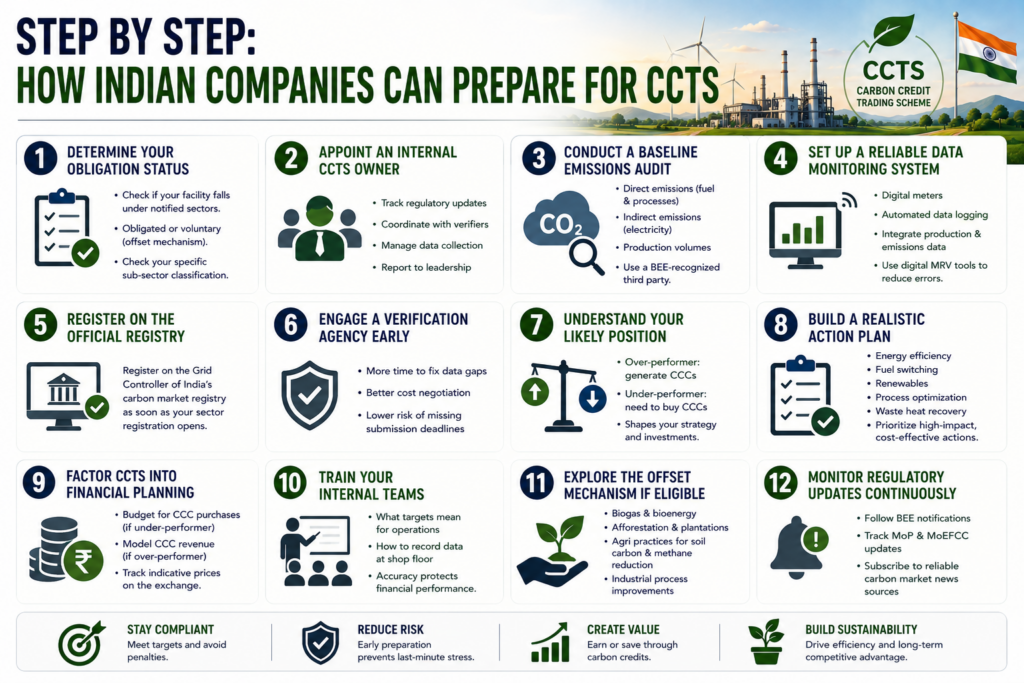
Step 1: Determine Your Obligation Status
Start by checking whether your facility falls under one of the notified compliance sectors.
- If you fall under an obligated sector, you have legal targets and reporting duties.
- If you do not, you may still be eligible to participate through the offset mechanism.
Do not assume you are exempt just because your industry was not mentioned first. Sub-sector classifications matter, so check the specific product category your facility falls under.
Step 2: Appoint an Internal CCTS Owner
Every company preparing seriously for CCTS should assign a dedicated person or small team to own this process.
This person’s job includes:
- Tracking regulatory updates
- Coordinating with verification agencies
- Managing internal data collection
- Reporting progress to leadership
Without clear internal ownership, CCTS preparation tends to fall through the cracks between departments like environment, finance, and operations.
Step 3: Conduct a Baseline Emissions Audit
Before you can improve anything, you need to know exactly where you stand.
Commission a detailed audit of your facility’s greenhouse gas emissions, covering:
- Direct emissions from fuel combustion and industrial processes
- Indirect emissions from purchased electricity
- Production volumes tied to each product line
Use a qualified, ideally BEE-recognized, third party to conduct this audit so the numbers hold up to future verification.
Step 4: Set Up a Reliable Data Monitoring System
Manual spreadsheets are risky when real money depends on accuracy. A single error in your emission factor calculation can flip your position from earning credits to owing them.
Consider setting up:
- Digital meters for fuel and electricity consumption
- Automated data logging systems
- Integration between production data and emissions tracking
Many companies are now adopting digital monitoring, reporting and verification tools, often called digital MRV systems, specifically to reduce manual errors and speed up reporting.
Step 5: Register on the Official Registry
Once registration opens for your sector, make sure your entity is formally registered on the Grid Controller of India’s carbon market registry.
Delaying registration can put you behind on your first compliance cycle, which creates unnecessary risk and rushed paperwork later.
Step 6: Engage a Verification Agency Early
Do not wait until the reporting deadline to contact a verification agency. The accredited agencies are limited in number, and demand tends to spike close to deadlines.
Booking verification support early gives you:
- More time to fix data gaps before formal submission
- Better negotiating position on verification costs
- Reduced risk of missing your submission window
Step 7: Understand Your Likely Position
Based on your baseline audit, estimate whether your facility is likely to be:
- An over-performer, meaning you may generate sellable CCCs
- An under-performer, meaning you may need to purchase CCCs to stay compliant
This early estimate shapes your entire strategy, from budgeting to technology investment decisions.
Step 8: Build a Realistic Action Plan
Obligated entities are generally expected to submit action plans outlining how they intend to meet their emission intensity targets.
A solid action plan usually includes:
- Energy efficiency upgrades
- Fuel switching options, such as moving to cleaner fuels
- Renewable energy procurement
- Process optimization
- Waste heat recovery, where applicable
Prioritize the improvements that offer the best return relative to cost. Not every efficiency upgrade needs to happen at once.
Step 9: Factor CCTS Into Financial Planning
Treat carbon credit certificates like any other tradable commodity in your financial planning.
- Budget for potential CCC purchases if you expect to be an under-performer.
- Model potential CCC revenue if you expect to be an over-performer.
- Track indicative price movements on the trading exchange once trading begins.
Early price estimates for CCCs suggest a wide range depending on sectoral supply and demand, so building flexibility into your financial models is wise rather than betting on a single fixed number.
Step 10: Train Your Internal Teams
Your plant managers, finance team, and sustainability staff all need a working understanding of CCTS.
Conduct internal training sessions covering:
- What emission intensity targets mean for daily operations
- How data should be recorded at the shop floor level
- Why accuracy in reporting protects the company financially
Step 11: Explore the Offset Mechanism if Eligible
If your company is not an obligated entity but runs projects that reduce or avoid emissions, look into offset mechanism registration.
Examples of eligible activities include:
- Biogas and bioenergy projects
- Afforestation and plantation activities
- Agricultural practices that reduce methane or improve soil carbon
- Industrial process improvements outside the compliance sectors
This mechanism turns sustainability efforts that were previously unmonetized into a potential new revenue stream.
Step 12: Monitor Regulatory Updates Continuously
CCTS is still evolving. Methodologies, price floors, trading rules, and sector coverage are all subject to change as the market matures.
Make it a habit to:
- Follow official Bureau of Energy Efficiency notifications
- Track updates from the Ministry of Power and MoEFCC
- Subscribe to reliable carbon market news sources for plain language summaries
Common Mistakes Companies Make While Preparing for CCTS
Avoiding these mistakes can save significant time, money, and stress.
- Waiting for the deadline. Companies that start data collection only close to the reporting window often scramble and pay premium rates for rushed verification.
- Ignoring sub-sector classification. Some companies assume they are exempt without checking their exact product classification.
- Underinvesting in data systems. Manual, error-prone tracking creates compliance risk that could easily be avoided with better systems.
- Treating CCTS as only a compliance cost. Companies that only focus on penalties miss the revenue opportunity of becoming an efficient over-performer.
- Not training plant-level staff. Head office may understand CCTS well, but if shop floor teams do not record data correctly, the whole compliance chain breaks down.
CCTS Compliance Checklist for Indian Companies
Use this quick checklist to track your readiness at a glance.
| Task | Status |
|---|---|
| Confirmed sector and sub-sector obligation status | |
| Appointed internal CCTS compliance owner | |
| Completed baseline emissions audit | |
| Set up emissions data monitoring system | |
| Registered entity on the official registry | |
| Engaged an accredited verification agency | |
| Estimated over-performer or under-performer position | |
| Built an emission reduction action plan | |
| Included CCC costs or revenue in financial planning | |
| Trained internal teams on data recording | |
| Reviewed eligibility for the offset mechanism | |
| Set up a process to track regulatory updates |
How CCTS Compares to Other Carbon Markets
Many Indian companies, especially exporters, are also familiar with international carbon mechanisms. Here is a quick comparison to put CCTS in context.
| Feature | CCTS (India) | EU ETS (European Union) | Voluntary Carbon Market |
|---|---|---|---|
| Nature | Mandatory for obligated sectors, voluntary offset track | Mandatory cap and trade | Fully voluntary |
| Basis | Emission intensity per unit of output | Absolute emissions cap | Project-based credits |
| Regulator | Bureau of Energy Efficiency, CERC | European Commission and national regulators | Independent standards bodies |
| Trading Platform | Regulated power exchanges | EU carbon exchanges | Various registries and marketplaces |
| Applicability | Indian obligated entities and eligible offset projects | EU-based installations and aviation | Global, open participation |
Understanding this comparison helps Indian exporters see why building a strong domestic carbon compliance record under CCTS can also support their position when dealing with international carbon-linked trade measures.
The Business Case for Early Preparation
Some company leaders still see CCTS as a distant regulatory requirement. That mindset carries real risk.
Here is why early movers come out ahead:
- They get better rates from verification agencies before demand peaks.
- They have time to fix data gaps instead of discovering errors at the last moment.
- They can plan capital investment in efficiency upgrades over a longer runway.
- They position themselves to sell CCCs early if they become over-performers.
- They build credibility with lenders, investors, and international buyers who are increasingly screening for carbon performance.
Companies that delay often end up paying more, both in compliance costs and in lost opportunity.
Practical Example: How a Mid-Sized Cement Plant Might Prepare
To make this concrete, imagine a mid-sized cement plant that falls under the obligated sector list.
Here is a realistic preparation path:
- The plant confirms its sub-sector classification and understands its assigned emission intensity target.
- It appoints its environment manager as the internal CCTS lead.
- It hires a third-party auditor to establish its baseline emissions across fuel use, electricity, and clinker production.
- It installs digital meters at key process points to automate data collection.
- It compares its baseline against the assigned target and realizes it is currently a likely under-performer.
- It builds an action plan that includes switching a portion of kiln fuel to alternative fuels and improving waste heat recovery.
- It budgets for potential CCC purchases in the short term while working toward becoming an over-performer within a few compliance cycles.
This kind of structured, honest self-assessment is exactly what regulators and verification agencies expect to see, and it protects the company from compliance surprises.
What Happens if a Company Does Not Prepare
Non-compliance under CCTS is not a minor administrative issue. Companies that fail to meet their targets and do not surrender the required CCCs can face financial penalties.
Beyond the direct penalty, unprepared companies also face:
- Higher last-minute costs for rushed data verification
- Reputational damage with clients and investors focused on climate performance
- Reduced competitiveness compared to peers who are already earning CCC revenue
- Difficulty accessing financing that increasingly considers emissions performance
Preparation is simply the safer, smarter, and more profitable path.
Sector-Specific Preparation Notes
While the core preparation steps apply broadly, each sector has its own quirks. Here is a closer look at a few notified sectors.
Cement
Cement plants face targets tied to clinker production and fuel mix. Companies in this sector often find the fastest wins in alternative fuel usage, blended cement products, and waste heat recovery systems. Since cement is a high-volume, high-emission sector, even small percentage improvements can translate into a meaningful number of CCCs.
Aluminium
Aluminium production, especially primary smelting, is highly electricity-intensive. For this sector, the source of purchased power matters a great deal. Companies sourcing a larger share of electricity from renewable sources naturally see a lower emission intensity, which directly improves their compliance position.
Chlor-Alkali
This sector’s emissions are closely tied to electricity consumption during electrolysis. Efficiency upgrades in cell technology and power management systems tend to offer the most direct path to meeting targets.
Pulp and Paper
This sector has some of the widest target ranges, reflecting a large efficiency gap between modern integrated mills and older, smaller units. Companies operating older facilities should prioritize early audits, since the gap between current performance and target may be larger than expected.
Petroleum Refining and Petrochemicals
These sectors deal with complex, multi-stream processes, which makes accurate emissions accounting more challenging. Investment in proper metering and process-level data tracking is especially important here, since a single miscalculated stream can distort the entire facility’s reported intensity.
Textiles
Textile units vary enormously in size and process type, from spinning to dyeing to finishing. Companies in this sector should pay close attention to their specific sub-process classification, since targets can differ meaningfully between processing types.
Iron and Steel, and Fertiliser
Both sectors are among the more recently notified, so companies here still have a valuable window to build baseline data and internal capacity before their first full compliance cycle becomes routine. Early engagement with verification agencies is particularly valuable in these sectors given the complexity of process emissions involved.
Building Internal Capacity for the Long Term
CCTS is not a one-time project. It is a recurring annual cycle that will shape how Indian industrial companies operate for years to come. Building internal capacity early pays off repeatedly.
Create a Cross-Functional Carbon Team
Rather than leaving CCTS entirely to the environment department, bring together representatives from:
- Operations and production
- Finance and accounting
- Environment and sustainability
- Legal and compliance
This cross-functional structure ensures emissions data, financial planning, and legal obligations stay aligned rather than siloed.
Invest in Skill Development
Carbon accounting, emissions monitoring, and carbon market trading are relatively new disciplines for many Indian industrial teams. Consider:
- Sending key staff for carbon market and MRV training programs
- Bringing in external experts for periodic internal workshops
- Encouraging certification in recognized carbon accounting frameworks
Document Everything
Keep detailed records of your data collection methodology, calculation approach, and any assumptions used. Good documentation makes verification faster, smoother, and less expensive, and it protects your company if data is ever questioned later.
Should You Hire a Carbon Market Consultant
Many companies, especially those without prior experience in energy or emissions reporting, choose to bring in external carbon market consultants during their first one or two compliance cycles.
A good consultant can help with:
- Interpreting sector-specific target notifications correctly
- Setting up emissions monitoring systems aligned with verification requirements
- Coordinating with accredited verification agencies
- Building a realistic, cost-effective emission reduction roadmap
- Advising on offset mechanism project registration, where relevant
If your internal team is stretched thin or unfamiliar with carbon accounting, a consultant can shorten your learning curve significantly and reduce the risk of costly early mistakes.
The Role of Technology in CCTS Compliance
Technology is quickly becoming a core part of CCTS preparation, not just a nice-to-have.
Digital Monitoring, Reporting and Verification Tools
Digital MRV platforms automate data collection from meters and production systems, apply standardized emission factors, and flag inconsistencies before they become reporting errors. This reduces manual workload and improves data accuracy considerably.
Emissions Calculators and Dashboards
Some companies use dedicated calculators to estimate their likely compliance position throughout the year, rather than waiting until year-end to find out whether they are an over-performer or under-performer. Real-time visibility allows for mid-year corrective action if targets look at risk.
Integration With Existing Systems
The most efficient setups integrate emissions tracking directly with existing production and energy management systems, avoiding duplicate data entry and reducing the chance of human error.
Frequently Overlooked Considerations
A few details often get missed during CCTS preparation, and they are worth flagging separately.
- Baseline year accuracy matters enormously. Since targets are often set relative to a specific historical baseline, any errors in that baseline data can affect your targets for multiple years.
- Production data must match emissions data. Emission intensity is a ratio, so incorrect production figures can distort your reported performance just as much as incorrect emissions figures.
- Grid emission factors change over time. The emission factor used to calculate indirect emissions from purchased electricity is updated periodically, so using outdated factors can lead to inaccurate reporting.
- Multiple product lines need separate treatment. Facilities producing more than one product type under different sub-sector classifications should track emissions intensity separately for each, rather than applying a blended average.
- Compliance is annual, not one-time. Preparation needs to be built into a recurring internal calendar, not treated as a single project with a defined end date.
Final Thoughts
CCTS marks a genuine shift in how Indian industry will operate going forward. Emissions are no longer just an environmental metric sitting in a sustainability report. They are becoming a financial variable that directly affects your company’s costs, revenue, and competitiveness.
The good news is that preparing for CCTS does not have to be overwhelming. Start with clarity on your obligation status, build reliable data systems, get your verification partner in place early, and treat carbon performance as a real part of your financial strategy.
Companies that act early will not just avoid penalties. They will build a genuine competitive edge in a market where carbon efficiency is quickly becoming as important as cost efficiency.
If you are only starting to think about how your company should prepare for CCTS, the best time to begin is now, not when your first compliance deadline is already close.
Frequently Asked Questions on CCTS Preparation
What does CCTS stand for?
CCTS stands for Carbon Credit Trading Scheme, India’s national framework for pricing and trading carbon emissions through Carbon Credit Certificates.
Which companies are obligated under CCTS?
Companies operating in specific energy-intensive sectors, including aluminium, cement, chlor-alkali, pulp and paper, petroleum refining, petrochemicals, textiles, iron and steel, and fertiliser, are currently the notified obligated sectors.
Can a non-obligated company still participate in CCTS?
Yes. Non-obligated companies can participate voluntarily through the offset mechanism by registering eligible emission reduction, removal, or avoidance projects.
How are Carbon Credit Certificates earned?
Companies earn CCCs by performing better than their assigned emission intensity target during a compliance year, based on verified emissions and production data.
What happens if a company misses its emission intensity target?
The company must purchase and surrender enough CCCs to cover the shortfall. Failing to do so can result in financial penalties.
Where are CCCs traded?
CCCs are traded on regulated power exchanges under the oversight of the Central Electricity Regulatory Commission. Over the counter trading is not permitted.
How is CCTS different from the earlier PAT scheme?
PAT focused only on energy consumption efficiency, while CCTS tracks actual greenhouse gas emissions, covering both direct and electricity-related indirect emissions.
Why should exporters care about CCTS?
A strong domestic carbon compliance record under CCTS can help Indian exporters manage exposure to international carbon border measures that tax imports based on their carbon footprint.
What is the first step a company should take to prepare for CCTS?
The first step is confirming whether the company’s specific sector and sub-sector classification falls under the obligated compliance mechanism or is eligible for the voluntary offset mechanism.
Is CCTS preparation only relevant for large companies?
No. While large industrial facilities in obligated sectors carry mandatory obligations, smaller companies with eligible emission reduction projects can also benefit through the voluntary offset mechanism.
For more updates, guides, and resources on carbon markets in India, explore Carbon Market Network.