Carbon Market Network



India is sitting on one of the biggest carbon market opportunities in the world.
With a legally backed Carbon Credit Trading Scheme now under rollout, a booming voluntary market, and global buyers actively sourcing high-quality credits, Indian companies are right at the center of a multi-billion-dollar green economy shift.
Whether you are a business owner wondering if you qualify to generate carbon credits, an investor trying to understand the landscape, or simply someone curious about how this market works in India, this guide covers everything you need to know.
We will walk you through what carbon credits are, which companies are leading the space in India, how the regulatory framework operates, what types of projects generate credits, and what opportunities exist for businesses of all sizes.
Let us start from the basics.
What Is a Carbon Credit? A Quick Refresher
A carbon credit is a tradable certificate that represents the reduction, avoidance, or removal of one metric tonne of carbon dioxide (CO2) or its equivalent greenhouse gas.
Think of it as a permission slip for emissions.
Companies that reduce or avoid emissions earn credits. Companies that are unable to reduce fast enough buy those credits to offset their remaining emissions.
This system turns climate action into a financial incentive.
The logic is simple: if you pollute less than your limit, you earn credits you can sell. If you pollute more, you must buy credits from someone who polluted less.
One credit equals one tonne of CO2 reduced or removed. That is the universal unit across all carbon markets globally.
Carbon Market Insider Newsletter
Weekly insights on carbon markets, climate policy, carbon credits, and sustainability.
Why India? Understanding the Scale of the Opportunity
India is the world’s third-largest emitter of greenhouse gases. That sounds like a problem, but in the carbon market world, it is also an opportunity.
Because India has so many industries still transitioning to cleaner technologies, there is an enormous pipeline of projects that can generate carbon credits.
Solar farms, wind energy plants, clean cookstoves, biogas systems, afforestation projects, agricultural reforms, waste management sites, and more can all produce verified credits.
India has been one of the largest suppliers of carbon credits to the global voluntary market for over a decade.
As of early 2026, the country is now formalizing a domestic compliance market through the Carbon Credit Trading Scheme (CCTS), which adds an entirely new demand layer on top of the existing voluntary market.
The Indian carbon credit market is estimated to be worth over $1 billion today, with projections pointing significantly higher as CCTS compliance trading begins.
This creates real business for carbon credit companies in India, ranging from large listed firms to niche climate tech startups.
Two Types of Carbon Markets in India
Before diving into the companies, you need to understand that India’s carbon market operates on two parallel tracks.
The Compliance Carbon Market (CCTS)
The Carbon Credit Trading Scheme is India’s mandatory, government-mandated carbon market. It is governed by the Ministry of Power, the Ministry of Environment, Forest and Climate Change (MoEFCC), and the Bureau of Energy Efficiency (BEE).
Under CCTS, large industrial companies in specific sectors receive emission intensity targets.
If they reduce emissions below those targets, they earn Carbon Credit Certificates (CCCs) that can be sold. If they exceed their targets, they must buy CCCs to cover the shortfall.
As of April 2026, the CCTS covers nine energy-intensive sectors:
- Aluminium
- Cement
- Chlor-alkali
- Pulp and paper
- Iron and steel
- Fertilizers
- Petroleum refining
- Petrochemicals
- Textiles
These sectors collectively cover roughly 740 industrial entities across India, representing approximately 16% of India’s total greenhouse gas emissions.
Trading under the CCTS compliance mechanism is expected to officially commence in the 2026-27 compliance period. CCCs are traded on India’s power exchanges under supervision of the Central Electricity Regulatory Commission (CERC).
The Voluntary Carbon Market (VCM)
The voluntary carbon market operates independently of government mandates. Here, companies, organizations, and even individuals choose to buy carbon credits to offset their emissions, meet ESG commitments, or fulfill net-zero pledges.
Credits in this market are verified by internationally recognized standards like Verra’s Verified Carbon Standard (VCS), Gold Standard, and others.
India also launched a domestic voluntary offset mechanism within the CCTS framework in December 2023, adding a government-backed layer to the existing private voluntary market.
Both markets run simultaneously, and most carbon credit companies in India serve clients across both.
The Regulatory Framework Backing India’s Carbon Market
Understanding who governs the carbon market in India helps you pick the right company to work with.
Bureau of Energy Efficiency (BEE): BEE serves as the administrator of the CCTS. It issues emission intensity targets, manages the registry, and oversees compliance for obligated entities.
Ministry of Power: Co-manages the CCTS alongside MoEFCC and BEE, providing oversight at the policy level.
Ministry of Environment, Forest and Climate Change (MoEFCC): Handles the environmental integrity of the scheme, including issuing sector-level emission intensity targets.
Central Electricity Regulatory Commission (CERC): Provides market oversight for CCC trading on power exchanges and takes corrective action to prevent fraud.
Grid Controller of India: Operates the registry for the CCTS, tracking issuance, holding, and transfer of CCCs.
Energy Conservation (Amendment) Act, 2022: This is the legal backbone. It empowered the Indian government to establish a carbon market and authorize designated agencies to issue carbon credit certificates.
In March 2025, the Ministry of Power approved eight crediting methodologies for generating voluntary carbon credits, including renewable energy, energy efficiency, and nature-based solutions.
India’s formal submission to the UNFCCC under Article 6 of the Paris Agreement further opened doors for international carbon trading through Internationally Transferred Mitigation Outcomes (ITMOs), enabling Indian projects to sell credits to foreign buyers under a government-authorized framework.
Top Carbon Credit Companies in India
Here is a detailed look at the key players operating across different segments of India’s carbon credit ecosystem.
1. EKI Energy Services Ltd. (Formerly EnKing International)
Type: Carbon credit developer, supplier, advisory Headquarters: Indore, Madhya Pradesh Listed on: BSE (Bombay Stock Exchange)
EKI Energy Services is arguably the most prominent pure-play carbon credit company in India and one of the largest carbon credit developers globally.
Founded in 2008, EKI has supplied over 200 million carbon offsets to date, working with clients across more than 40 countries.
The company was recognized as one of the Top Five Suppliers of Renewable Energy Carbon Credits for 2025 in Abatable’s global carbon market intelligence report titled “The Carbon Market Dimensions that Matter in 2026.”
EKI operates across the full carbon credit value chain: project identification, development, verification, issuance, trading, and retirement.
What EKI does:
- Develops carbon credit projects in renewable energy, waste management, clean cooking, and nature-based solutions
- Provides carbon footprint assessment and management
- Offers CDP rating support, ESG services, and sustainability advisory
- Runs community-based projects including improved cookstoves and biogas systems
- Has been the first company to list a plastic waste project from India on Verra
EKI was appointed as Carbon Consultant for the Varanasi Smart City Bio-Conversion Project in 2025, a methane reduction initiative estimated to reduce over 33,000 tonnes of CO2 equivalent over seven years.
The company has also submitted emission reduction targets validated by the Science-Based Targets initiative (SBTi), aligning with a 1.5°C climate scenario.
Note: EKI has experienced financial volatility in recent years, including steep quarterly losses in late 2025 due to a broader downturn in voluntary carbon credit trading volumes. Potential clients and investors should factor in this market-level challenge while engaging with the company.
2. South Pole
Type: Climate solutions, carbon project development, advisory India presence: Bengaluru and other cities (Global HQ in Zurich)
South Pole is one of the world’s largest climate solutions providers, with a strong operational footprint in India.
The company has helped over 1,000 organizations globally reduce their environmental impact through verified carbon projects. In India, South Pole partnered with 3eco Systems to launch India’s first carbon credit programme for three-wheeled electric vehicles, registered under Verra’s Voluntary Carbon Standard (VCS).
South Pole provides end-to-end services:
- Carbon footprint measurement and reporting
- Carbon offset procurement
- Net-zero strategy development
- Project development and finance for Indian climate projects
Their India work spans renewable energy, mobility, agriculture, and forestry projects.
3. Greenko Group
Type: Renewable energy and carbon credit generation Headquarters: Hyderabad, Telangana
Greenko is one of India’s largest renewable energy companies, with a massive portfolio of wind, solar, and hydroelectric projects.
Their carbon credit work stems directly from their clean energy capacity.
By displacing fossil fuel-based electricity generation, Greenko’s renewable projects generate verified emission reductions that translate into tradable carbon credits.
Greenko’s Chief Sustainability Officer Rambabu Paravastu has been a vocal voice at carbon market forums, noting that India’s initial carbon price under the domestic scheme is likely to be in the sub-$10 per credit range as the market matures.
The company has, however, faced scrutiny. A 2025 report by Corporate Accountability found that three of Greenko’s renewable solar power projects had a “very low likelihood” of achieving genuine carbon avoidance due to questions about additionality, meaning the emission reductions may have occurred anyway without carbon credit financing.
This underscores the importance of working with companies that prioritize credit quality and robust additionality assessments.
4. Tata Power
Type: Renewable energy, green transition, carbon reduction Headquarters: Mumbai, Maharashtra
Tata Power is aggressively repositioning itself as a clean energy leader. The company is expanding capacity in solar, wind, hydro, rooftop solar, EV charging infrastructure, and green power distribution.
While Tata Power is not primarily a carbon credit trading firm, its large-scale renewable energy pipeline generates substantial emission reductions that can be monetized as carbon credits.
Its transition away from coal-based power toward sustainable infrastructure positions it as a significant player in India’s future carbon compliance market.
Tata Power’s net-zero commitments and renewable capacity growth make it a major contributor to India’s overall carbon credit supply pipeline.
5. Torrent Power
Type: Energy utility, carbon credit market participant Headquarters: Ahmedabad, Gujarat
Torrent Power is a leading integrated power utility that operates across generation, transmission, and distribution.
As India’s CCTS compliance market takes shape, large power utilities like Torrent are positioned to become significant participants.
Torrent Power has been noted in market research as one of the major players in India’s carbon credit landscape, particularly given its growing investments in renewable energy capacity and energy efficiency improvements.
6. Carbon Check (India) Pvt. Ltd. (CCIPL)
Type: Verification, certification, GHG audit services Focus: Carbon neutrality certification and GHG inventory
Carbon Check India is a specialized firm focusing on the verification and certification side of carbon markets. Rather than developing projects, CCIPL provides third-party assurance services that are essential to the credibility of carbon credits.
Their services include:
- Carbon neutrality certification for organizations
- GHG emission inventory preparation and verification
- Sustainability assurance services
- Support for companies seeking carbon credit certification
If your company wants to get a carbon project verified or achieve a recognized carbon neutral status, CCIPL is the type of firm you would engage.
7. EurAsia Carbon
Type: Carbon credit consultancy, offset services Focus: End-to-end carbon credit facilitation
EurAsia Carbon helps organizations achieve carbon neutrality by managing the entire carbon credit process. This includes project design, registration with international standards, credit issuance, and trading.
Their work spans both voluntary and compliance markets. For smaller businesses that do not have internal sustainability teams, a firm like EurAsia Carbon acts as a full-service partner for entering the carbon credit ecosystem.
8. CoreCarbonX (CCX)
Type: Climate and sustainability consulting Focus: Carbon credit generation and exchange, climate change mitigation
CoreCarbonX is a climate-focused consultancy that emphasizes carbon credit generation for private, public, and NGO clients. The firm helps organizations understand their emissions profile, identify credit-generating opportunities, and navigate the complexities of carbon markets.
As India’s market matures, consultancies like CCX play an important education and facilitation role for first-time participants.
9. GreenCarbonHub
Type: B2B marketplace, carbon offset facilitation Focus: Businesses and residential communities
GreenCarbonHub operates as a marketplace model, connecting credit buyers with sellers. The platform also helps businesses install rooftop solar panels, which can contribute to emission reductions and support carbon credit generation.
Their marketplace approach lowers the barrier for smaller businesses to participate in carbon markets without needing to navigate technical verification processes independently.
10. Continuum Research and Development Pvt. Ltd.
Type: SaaS platform for carbon credit tracking and trading Focus: Technology-driven carbon credit management
Continuum Research provides a software platform specifically designed for carbon credit tracking and trading. In a market where transparency and real-time monitoring are critical to credit quality, tech platforms like Continuum’s play an infrastructure role.
As India’s domestic carbon market formalizes, demand for digital MRV (Monitoring, Reporting, and Verification) tools and carbon registry technology will grow significantly.
11. RenewCred
Type: Climate technology startup Headquarters: Bangalore Founded: 2024
RenewCred is one of the most exciting new entrants in India’s carbon market. Founded in 2024, the company is building India’s first technology-driven carbon credit standard and registry, specifically designed for the voluntary carbon market.
Their platform enables projects to track, report, and verify carbon reductions through a technology-enabled MRV process.
The system uses real-time data and advanced modeling to improve transparency and reduce verification costs.
RenewCred focuses on several project types including nature-based solutions, renewable energy, agriculture, and waste management.
For a market where verification costs and opacity have historically been barriers to entry for smaller projects, RenewCred’s approach is relevant and timely.
12. Grow Billion Trees
Type: Afforestation, nature-based solutions, carbon sequestration Mission: Plant 100 crore trees by June 2030
Grow Billion Trees leads one of India’s largest reforestation initiatives. The organization generates carbon credits through tree planting, forest restoration, and agroforestry projects that sequester carbon dioxide over time.
Nature-based solutions like afforestation account for a meaningful share of India’s voluntary carbon credit supply. Forestry projects in India represent roughly 30% of all carbon credits generated domestically.
For companies looking to purchase high-integrity, nature-based credits with strong social co-benefits, afforestation-focused organizations like Grow Billion Trees offer an appealing option.
13. Ecofirst Services
Type: Sustainability consulting, carbon footprint management, carbon offset programs Headquarters: Bangalore
Ecofirst Services helps companies across different industries identify their emission sources, develop emission reduction projects, and create carbon credits from those reductions.
The firm focuses on creating long-term environmental benefits alongside compliance support. Their work spans industries including manufacturing, real estate, and services.
14. Gensol Engineering
Type: Solar energy, electric vehicles, carbon credit generation Headquarters: Ahmedabad, Gujarat
Gensol is known for its solar energy projects, EV fleet services, and green mobility solutions. The company generates carbon credits as a by-product of its solar and EV deployment activities.
Gensol has taken an innovative approach to carbon credit generation, combining local employment creation with emission reduction in its project design.
What Types of Projects Generate Carbon Credits in India?
Carbon credit companies in India work across a wide range of project types. Here are the main categories.
Renewable Energy Projects
Solar, wind, hydro, and biomass projects that generate clean electricity and displace fossil-fuel-based power earn carbon credits under international standards like VCS and Gold Standard.
India has thousands of such projects, making renewable energy the single largest source of carbon credits generated in the country.
Important caveat: Large-scale grid-connected solar and wind projects have faced scrutiny on additionality grounds. Regulators and rating agencies like BeZero have questioned whether these projects would have happened anyway given government subsidies and falling costs. Buyers of credits from these project types should check project ratings carefully.
Energy Efficiency Projects
Industrial energy efficiency improvements, efficient building technologies, efficient agricultural pumps, and LED lighting programs all qualify as emission reduction activities.
The PAT (Perform, Achieve and Trade) scheme was India’s original energy efficiency trading mechanism and forms part of the foundation for the CCTS.
Clean Cooking Solutions
Improved cookstoves and biogas systems are a major source of high-quality, community-benefiting carbon credits in India.
Companies like EKI, through programs like Surya Nutan solar cooking devices and Oorja Biogas systems, have built significant credit portfolios from clean cooking projects. These projects are especially compelling because they simultaneously reduce emissions, improve indoor air quality, reduce firewood consumption, and deliver direct health and economic benefits to rural households.
Waste Management and Landfill Gas
Capturing methane from landfills, waste-to-energy projects, and organic waste management are strong sources of carbon credits because methane is approximately 80 times more potent than CO2 over a 20-year period. Preventing its release generates large volumes of credits relative to project cost.
Agriculture and Soil Carbon
Regenerative agriculture, cover cropping, reduced tillage, and agroforestry practices can trap carbon in soil, generating soil carbon credits.
Indian farmers like the hypothetical Rajesh mentioned earlier, switching to regenerative cotton farming in Maharashtra, represent the enormous potential of agriculture-based carbon credits at scale.
Afforestation and Reforestation
Planting trees on degraded land, restoring mangroves, and protecting existing forests generate carbon credits through biological carbon sequestration. These nature-based solutions are popular with buyers who want credits with strong biodiversity and community co-benefits.
Electric Mobility
India’s first carbon credit programme for three-wheeled electric vehicles, launched by South Pole and 3eco Systems under VCS, opened a new project category. As India’s EV fleet grows, transport-based carbon credits will become an increasingly important segment.
Biochar and Agricultural Waste
In early 2025, Google announced a major deal to purchase 100,000 tonnes of carbon credits from an Indian biochar initiative that converts agricultural waste into stable carbon stored in soil. This signals growing international buyer interest in India’s innovative, high-integrity project types.
How Carbon Credit Verification Works in India
Generating a carbon credit is not as simple as planting a tree and claiming a tonne of CO2. There is a rigorous verification process involved.
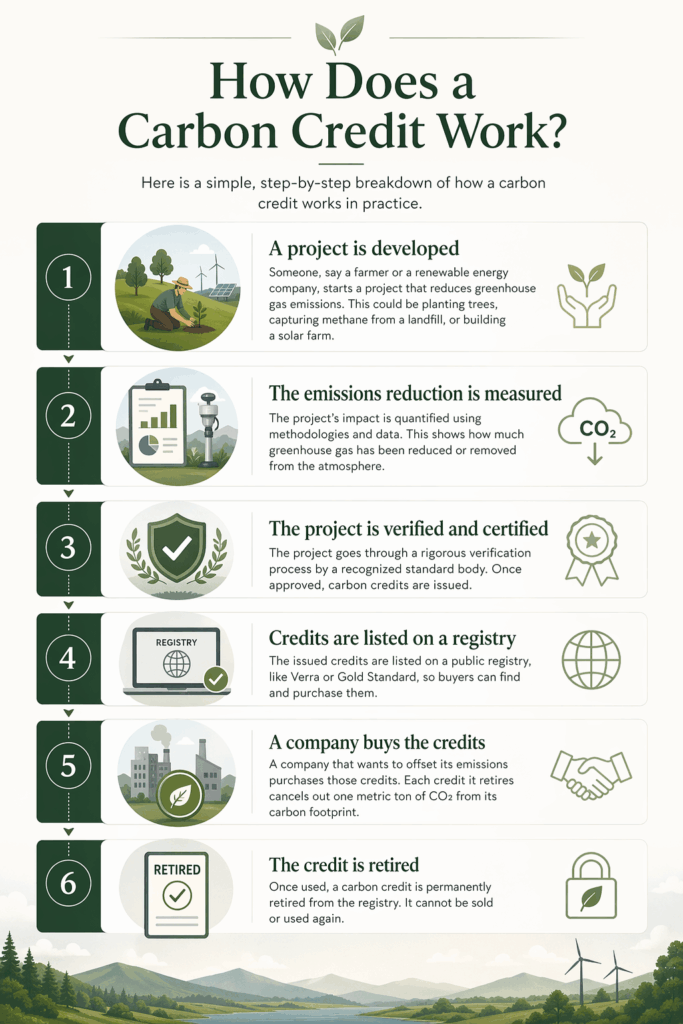
Here is how it typically works:
Step 1: Project Design The project developer designs the emission reduction activity and writes a Project Design Document (PDD) that explains the baseline emissions, the project methodology, and how reductions will be measured.
Step 2: Methodology Selection The developer selects an approved methodology from standards like VCS, Gold Standard, or the CCTS offset mechanism. The methodology defines how emission reductions are calculated.
Step 3: Validation An accredited third-party auditor validates that the project design is credible, the baseline is sound, and the activity is genuinely additional.
Step 4: Implementation The project is implemented and monitored. Data on emission reductions is collected regularly.
Step 5: Verification A third-party verifier independently confirms that the claimed emission reductions actually occurred based on real monitoring data.
Step 6: Credit Issuance Once verified, the standard (Verra, Gold Standard, or the CCTS registry) issues carbon credits into the project developer’s account.
Step 7: Trading or Retirement Credits can be sold to buyers who retire them against their own emissions, or held for later sale.
This process typically takes 12 to 24 months from project design to first credit issuance, depending on the standard and project complexity.
The Role of International Standards in India’s Carbon Market
Most carbon credits generated in India today, especially in the voluntary market, are certified under internationally recognized standards.
Verra’s Verified Carbon Standard (VCS): The most widely used standard globally. Verra registers thousands of projects and issues credits that trade in global markets. Many Indian renewable energy, clean cooking, and forestry projects are VCS-certified.
Gold Standard: A more stringent standard that requires projects to demonstrate sustainable development co-benefits beyond just emission reductions. Credits carry a premium.
CDM (Clean Development Mechanism): The original UN-backed standard under the Kyoto Protocol. While CDM is now transitioning to the Article 6.4 mechanism under the Paris Agreement, India had hundreds of CDM projects registered, particularly in renewable energy and energy efficiency.
Article 6.4 of the Paris Agreement: This is the emerging international mechanism that replaces CDM. India’s formal submission to the UNFCCC in 2025 outlines the types of activities it will authorize under Article 6, enabling Indian projects to sell internationally transferred mitigation outcomes (ITMOs) to foreign buyers.
CCTS Domestic Registry: For compliance credits within India’s mandatory scheme, CCCs are issued and tracked through the Grid Controller of India’s domestic registry.
How India’s CCTS Is Changing the Game for Carbon Credit Companies
The Carbon Credit Trading Scheme is the most significant structural shift in India’s carbon market since the Energy Conservation Act of 2022.
Here is what has happened so far, as of April 2026:
- October 2025: Final emission intensity targets for aluminium, cement, chlor-alkali, and pulp and paper were officially notified, covering 282 industrial plants.
- January 2026: Final targets for refinery, petrochemicals, textiles, and secondary aluminium sectors were notified by MoEFCC.
- Expected 2026-27: Credit issuance under the compliance mechanism is expected to begin, pending completion of registry systems and trading infrastructure.
Reduction targets range from approximately 2.8% to 15% depending on the sector, with roughly 40% of required reductions expected in 2025-26 and 60% in 2026-27.
Once fully operational, the CCTS will cover over 700 million tonnes of CO2 equivalent annually, placing India among the world’s largest emissions trading systems by scope.
For carbon credit companies in India, the CCTS creates:
- New demand from obligated entities that need to buy credits to cover shortfalls
- New supply from entities that outperform their intensity targets and earn CCCs
- New advisory revenue for consultants helping companies navigate compliance
- New technology demand for MRV platforms, registry systems, and trading tools
The EU Carbon Border Adjustment Mechanism (CBAM) and Indian Exporters
India’s carbon credit market is not developing in isolation. External pressure from global trade policy is accelerating urgency.
The European Union’s Carbon Border Adjustment Mechanism (CBAM) is now in effect. CBAM places a carbon price on imported goods from countries without equivalent carbon pricing.
This directly affects Indian exporters of steel, cement, aluminium, fertilizers, and electricity to Europe.
For Indian companies exporting to the EU, demonstrating credible carbon management through verified credits, low-carbon production processes, or compliance under the CCTS will become a commercial necessity, not just an environmental choice.
This is creating a new wave of demand for carbon credit companies in India that can help exporters understand their carbon footprint, generate credits from emission reductions, and communicate climate performance to global buyers.
Challenges Facing Carbon Credit Companies in India
The carbon credit market in India is growing fast, but it is not without challenges. Here is an honest look at what companies in this space are navigating.
Credit Quality and Greenwashing
The biggest challenge in any carbon market is ensuring that credits represent real, additional, permanent emission reductions.
A 2025 report by Corporate Accountability found that nine Indian projects among the top 100 globally produced “problematic credits,” including several large renewable energy projects from well-known companies.
The core issue was additionality: these projects likely would have happened anyway given India’s strong government incentives for solar and wind, meaning the carbon credits generated from them do not represent genuinely new emission reductions.
The Indian government launched the Indian Carbon Market Portal in early 2026 specifically to address greenwashing concerns through stricter verification requirements.
Market Price Volatility
Carbon credit prices fluctuate significantly. In the global voluntary market, prices collapsed in 2023 and 2024 due to integrity concerns, affecting companies like EKI Energy that rely heavily on credit trading revenue.
Prices have shown signs of stabilization in 2026 as integrity standards tighten.
India’s initial domestic CCTS price is estimated to be in the sub-$10 per tonne range, which is low compared to European ETS prices but expected to rise over time as targets tighten.
Verification Complexity and Delays
Getting a project verified and registered is still a bureaucratic and technical process that takes time and money. For smaller projects like farmer-level soil carbon or rural cookstove programs, verification costs can eat into the value of credits generated.
New technology platforms and streamlined domestic methodologies under the CCTS are beginning to address this, but it remains a barrier for small-scale project developers.
Implementation Lags
The CCTS compliance mechanism has not yet begun credit issuance, with implementation running behind its original schedule.
Uncertainty about timelines affects business planning for both obligated entities and carbon credit developers.
Limited Market Linkage
India’s domestic CCTS currently does not allow over-the-counter trading. All transactions must go through regulated power exchanges, which limits flexibility in early stages. International linkage under Article 6 is also in early stages.
Opportunities for Different Types of Businesses
For Large Industrial Companies
If your company operates in cement, steel, aluminium, or any of the nine CCTS-covered sectors, you need to start preparing now.
Steps to take:
- Conduct a baseline GHG inventory for fiscal year 2023-24, the reference year for CCTS targets
- Map your emission intensity against assigned targets for 2025-26 and 2026-27
- Identify abatement options: energy efficiency improvements, fuel switching, process changes
- Engage a carbon consultant to help with MRV setup and compliance documentation
- Explore whether surplus reductions qualify for CCC generation and trading
For Renewable Energy Developers
If you run a solar, wind, or hydro project in India, your asset may qualify to generate carbon credits under international standards or the domestic CCTS offset mechanism.
The key question is additionality. Work with a credible validation body to assess whether your project qualifies, especially if it received government subsidies or is in a sector where clean energy is already commercially standard.
For SMEs and Service Businesses
Even if you are not in a heavy industry, you can participate in the voluntary carbon market by:
- Measuring your carbon footprint using digital tools
- Purchasing verified credits to offset residual emissions
- Building a credible net-zero or carbon-neutral claim to strengthen your ESG positioning
Carbon neutrality certification through firms like Carbon Check India can support your brand credibility with sustainability-conscious customers and investors.
For Farmers and Landowners
Agriculture is one of the most exciting frontiers for carbon credit generation in India. Options include:
- Regenerative farming practices that sequester carbon in soil
- Agroforestry on degraded land
- Biochar production from agricultural residue
- Methane capture from livestock or organic waste
Programs aggregating small farmer credits are emerging, making it feasible for individual farmers to access carbon markets without navigating verification independently.
How to Choose the Right Carbon Credit Company in India
Not all carbon credit companies in India offer the same services or the same level of quality. Here are the factors to evaluate.
1. Track Record and Verifications Ask how many projects the company has successfully registered and verified under recognized standards. Check Verra and Gold Standard registries directly to confirm claimed project portfolios.
2. Standard Alignment Ensure the company works with credible, internationally recognized standards: VCS, Gold Standard, Article 6.4, or the CCTS domestic methodology. Be cautious of companies working with obscure or unrecognized standards.
3. Additionality Rigor Ask specifically how the company assesses additionality. Companies that acknowledge additionality risks and conduct rigorous assessments are more trustworthy than those that promise credits without this scrutiny.
4. Transparency and MRV Systems Does the company use digital MRV tools and provide ongoing monitoring data? Transparency in monitoring is a key indicator of credit quality.
5. Range of Services Depending on your needs, you may want a full-service partner (advisory, project development, trading) or a specialized provider (verifier, marketplace, registry technology). Match the company’s specialization to your need.
6. Reputation and Client References Ask for references from clients in similar industries. Check media coverage, rating agency assessments (BeZero, Sylvera), and any reported controversies.
7. Knowledge of India’s Regulatory Framework Given the complexity of the CCTS, PAT scheme, Article 6 framework, and CBAM implications, your partner should have deep knowledge of India’s evolving regulatory landscape, not just global carbon markets in general.
The Future of Carbon Credit Companies in India
India’s carbon market is entering a new phase of maturity. Here is what to expect.
Domestic compliance market launch (2026-27): Once the CCTS begins issuing CCCs and trading commences on power exchanges, carbon credits will move from a niche sustainability tool to a mainstream financial instrument for Indian industry.
Rising carbon prices: As targets tighten through 2030 and beyond, domestic carbon prices will increase from the initial sub-$10 range. Companies that act early will earn credits at low abatement cost. Companies that delay will face rising purchase costs.
Technology-driven markets: Blockchain-based registries, satellite monitoring for nature-based projects, AI-driven MRV tools, and digital trading platforms are already emerging in India. Companies like RenewCred and Continuum are building this infrastructure.
Nature-based solutions growth: Investor and buyer demand for nature-based credits with strong co-benefits (biodiversity, community development) is growing globally. India’s forests, wetlands, and agricultural lands offer enormous potential for this credit type.
CBAM-driven demand from exporters: As more Indian sectors face EU carbon tariffs, demand for verifiable carbon credentials will spike among exporters, creating sustained demand for advisory and offset services.
Article 6 international flows: With India’s formal submission to the UNFCCC under Article 6, Indian carbon projects will increasingly sell credits to foreign governments and companies that need internationally transferred mitigation outcomes, opening higher-value markets.
Integrity focus: The era of easy, cheap credits from large grid-connected renewables is largely over. The market is moving toward higher-integrity, high-co-benefit project types: clean cooking, soil carbon, biochar, community forestry, and methane reduction. Companies that specialize in these areas will lead the next phase.
Frequently Asked Questions (FAQs)
Q1. What are carbon credit companies in India?
Carbon credit companies in India are organizations that develop, verify, trade, or facilitate carbon credit projects. They help businesses generate, buy, sell, or retire verified carbon credits. They operate across both India’s domestic compliance market (CCTS) and the global voluntary carbon market.
Q2. Which is the biggest carbon credit company in India?
EKI Energy Services Ltd. (formerly EnKing International), listed on the BSE, is widely regarded as India’s largest pure-play carbon credit company. It has supplied over 200 million carbon offsets globally and operates across more than 40 countries. However, large energy companies like Greenko and Tata Power also generate significant volumes of carbon credits through their renewable energy operations.
Q3. How do companies earn carbon credits in India?
Companies earn carbon credits by reducing or avoiding greenhouse gas emissions below a baseline level. This can be through renewable energy projects, energy efficiency improvements, clean cookstoves, afforestation, waste management, or agricultural practices. The reductions must be verified by an accredited third party under a recognized standard like VCS, Gold Standard, or India’s CCTS.
Q4. Can small businesses participate in India’s carbon credit market?
Yes. Small businesses can participate by purchasing verified carbon credits to offset their own emissions and achieve carbon neutrality certification. They can also generate credits if they implement qualifying emission reduction projects. Aggregator platforms and marketplace services are making it easier for smaller players to participate without navigating the full verification process independently.
Q5. What is the Carbon Credit Trading Scheme (CCTS) in India?
The CCTS is India’s mandatory, government-backed carbon market established under the Energy Conservation (Amendment) Act, 2022. It covers nine energy-intensive industrial sectors and assigns emission intensity targets to large companies. Companies that reduce emissions below their targets earn Carbon Credit Certificates that can be traded. Companies that exceed targets must buy CCCs. Credit trading is expected to begin in the 2026-27 compliance period.
Q6. What is the price of a carbon credit in India?
As of early 2026, industry estimates suggest India’s initial domestic carbon price under CCTS will be in the sub-$10 per tonne range. In the global voluntary market, high-quality Indian credits (such as those from clean cooking or biochar projects) can command higher prices depending on quality ratings and co-benefits. Prices are expected to rise as India’s carbon targets tighten toward 2030.
Q7. How do I sell carbon credits in India?
To sell carbon credits in India, you need to: (1) identify an eligible emission reduction project, (2) select an appropriate crediting methodology, (3) get the project validated and registered under a recognized standard, (4) implement the project and collect monitoring data, (5) get the reductions verified by an accredited auditor, and (6) receive issued credits that can be sold on a carbon marketplace or directly to buyers. Engaging an experienced carbon credit company in India to guide this process significantly simplifies it.
Q8. Is carbon credit trading regulated in India?
Yes. India’s compliance carbon market (CCTS) is regulated by the Bureau of Energy Efficiency (BEE), Ministry of Power, and MoEFCC. Trading takes place on regulated power exchanges under CERC oversight. The voluntary market is governed by international standards like Verra and Gold Standard, with India’s domestic voluntary offset mechanism operating under the CCTS framework. The Indian Carbon Market Portal, launched in early 2026, adds a layer of transparency and anti-greenwashing oversight.
Q9. What sectors are covered under India’s CCTS?
As of April 2026, nine sectors are covered: aluminium, cement, chlor-alkali, pulp and paper, iron and steel, fertilizers, petroleum refining, petrochemicals, and textiles. These sectors collectively cover approximately 740 industrial entities representing roughly 16% of India’s total emissions.
Q10. How does the EU CBAM affect Indian carbon credit companies?
The EU’s Carbon Border Adjustment Mechanism puts a carbon price on imports from countries without equivalent carbon pricing. This makes verified carbon management a commercial necessity for Indian exporters of steel, cement, aluminium, and fertilizers to Europe. It drives demand for carbon consultants, footprint auditors, and offset providers in India, expanding the market for carbon credit companies.
Conclusion
India’s carbon credit market is no longer a future possibility. It is a present reality.
The Carbon Credit Trading Scheme is rolling out binding compliance targets for hundreds of India’s largest industrial companies.
The voluntary market is active and growing. International buyers are sourcing high-quality Indian credits. And new technology platforms are making the market more accessible and transparent.
Carbon credit companies in India sit at the intersection of all of this. Whether they develop projects, verify credits, trade on exchanges, advise on strategy, or build digital infrastructure, they are essential participants in India’s journey toward its 2070 net-zero goal and its competitiveness in a carbon-pricing global economy.
If you are a business in India, the most important thing you can do right now is understand where you stand. Know your emissions.
Know your sector’s targets under CCTS. Know what opportunities exist to generate or purchase credits. And find the right partner to guide you through it.
The companies covered in this guide represent the breadth of what India’s carbon credit ecosystem offers today.
From global giants like South Pole to India-born leaders like EKI Energy, from technology startups like RenewCred to nature-based solution providers, the ecosystem is deep and growing.
The window to act early, and act on your own terms, is open. The question is whether you will walk through it.