Carbon Market Network


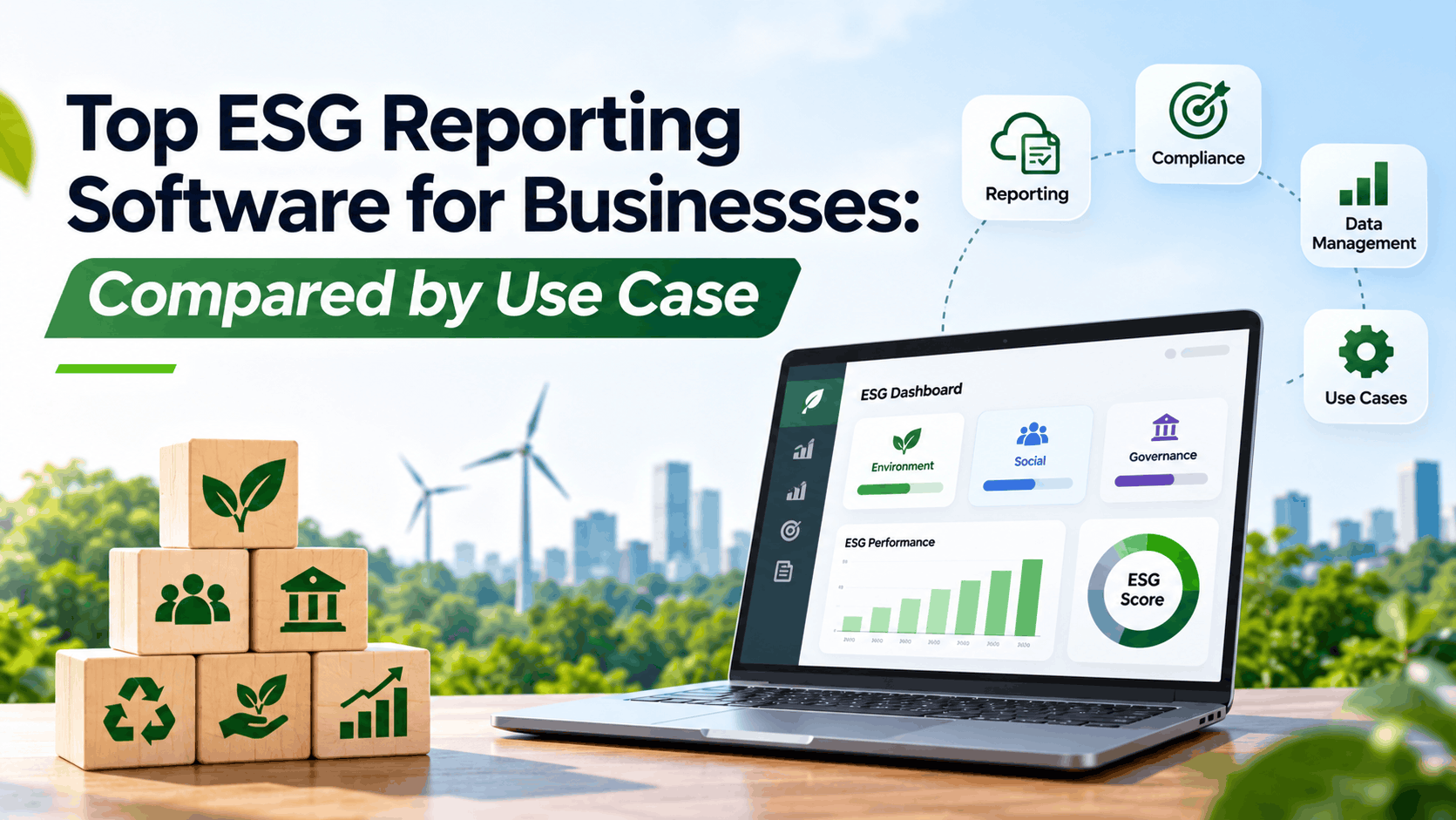
Still building your sustainability report in a maze of spreadsheets? Most teams start there, and most teams hit a wall. Data sits in ten different places. Nobody fully trusts the numbers. And the deadline keeps getting closer. ESG reporting software fixes that.
It collects your environmental, social and governance data in one place, checks it, and turns it into reports that investors, regulators and customers can trust.
The market has grown fast, and it can feel crowded. This guide covers the top 12 ESG reporting software platforms for businesses, explains who each one fits best, and shows you how to choose without wasting months on demos.
You will also see how reporting rules are changing across the EU, the UK, the US and other regions, and why the right ESG reporting platform matters more than ever.
A quick note: this list is not a strict ranking. Each tool wins in a different situation, so we group them by who they serve best.
What Is ESG Reporting Software?
ESG reporting software is a digital platform that helps companies collect, manage, verify and report data on their environmental, social and governance performance.
Think of it as one source of truth for your sustainability data. Vendors also call it sustainability reporting software, ESG data management software or ESG compliance software. The labels differ, but the core job stays the same.
What an ESG reporting platform typically does
- Collects data from utility bills, ERP, HR, finance and supplier systems
- Calculates metrics such as emissions, energy use, water, waste, pay gap and injury rates
- Maps data to frameworks such as ESRS, IFRS S1 and S2, GRI, SASB and CDP
- Tracks approvals and evidence so every number has an audit trail
- Produces reports and dashboards for boards, investors, lenders and customers
ESG reporting software vs. carbon accounting software vs. GRC tools
These categories overlap, and that confuses many buyers. This table clears it up.
| Category | Main focus | Typical output | Best fit |
|---|---|---|---|
| ESG reporting software | Broad environmental, social and governance data and disclosure | Sustainability report and framework disclosures | Companies with regulatory or investor reporting needs |
| Carbon accounting software | Greenhouse gas emissions across Scope 1, 2 and 3 | Carbon footprint and reduction plans | Teams that start with climate data |
| GRC software | Governance, risk and compliance | Risk registers, policy and audit workflows | Risk, legal and board teams |
| EHS software | Workplace safety and environmental compliance | Incident, audit and permit records | Industrial and operations teams |
Many modern platforms now combine two or more of these. That is why the lines keep blurring.
Carbon Market Insider Newsletter
Weekly insights on carbon markets, climate policy, carbon credits, and sustainability.
Why Businesses Need ESG Reporting Software Today
Pressure now comes from four directions at once: regulators, investors, customers and lenders, and your own board.
The rules keep shifting. The demand for reliable, auditable sustainability data does not.
The global reporting rules in plain English
This table gives you a quick view of the main regimes that shape demand for ESG reporting software.
| Rule or standard | Who it affects | What it asks for | Where it stands |
|---|---|---|---|
| EU CSRD and ESRS | EU companies with more than 1,000 employees and more than €450 million net turnover, plus large non-EU groups with major EU turnover | Sustainability statements using ESRS, double materiality and external assurance | The Omnibus reform cut the scope sharply. The Commission has adopted simplified ESRS, so confirm timing for your reporting year |
| ISSB (IFRS S1 and S2) | Companies in jurisdictions that adopt the standards | General sustainability and climate disclosures for investors | Dozens of jurisdictions have adopted the standards or are moving toward them |
| UK SRS | UK companies, once regulators apply the standards | Disclosures built on IFRS S1 and S2 | Standards are issued. Mandatory use depends on how regulators apply them |
| California SB 253 and SB 261 | US companies doing business in California with revenue above $1 billion (SB 253) or $500 million (SB 261) | Scope 1 and 2 emissions now, Scope 3 later (SB 253), and climate risk reports (SB 261) | SB 253 is moving forward. SB 261 enforcement has been paused by court action |
| SEC climate rule | US listed companies | Climate risk and emissions disclosure | The rule was stayed and never took effect. The SEC is moving to rescind it |
| India BRSR | Top 1,000 listed companies by market capitalization | ESG disclosures, with assurance on core indicators | In force |
| Australia climate standard (AASB S2) | Large entities, phased by size | Climate disclosures aligned with ISSB | Phased in by company size |
Rules change often. Always confirm current requirements with your legal, audit or assurance advisor.
What if your company is not directly in scope?
You may still feel the pressure. Banks, insurers and large customers keep asking for ESG data from their suppliers and borrowers.
In Europe, a voluntary standard for smaller companies is becoming the common format for those requests. A good ESG reporting tool helps you answer once and reuse the data everywhere.
Business benefits of ESG reporting software
- Saves time. Teams stop chasing spreadsheets and emails.
- Cuts errors. Built-in checks catch gaps and outliers early.
- Improves audit readiness. Every figure links back to its source and its approver.
- Speeds up questionnaires. You reuse governed data for investors, lenders and customers.
- Supports better decisions. Dashboards show where emissions, risk and cost sit.
- Builds trust. Consistent, traceable data makes your story more credible.
Key Features to Look For in ESG Reporting Software
Not every tool needs every feature. Use this table to match features to your real needs.
| Feature | Why it matters | What to check |
|---|---|---|
| Data collection and integrations | Manual entry creates errors and delays | Connectors for ERP, HR, finance, utilities and APIs |
| Framework library | Rules and standards keep changing | ESRS, IFRS S1 and S2, GRI, SASB, CDP, BRSR and automatic updates |
| Double materiality support | Required under ESRS | Workflows for impact, risk and stakeholder input |
| Carbon accounting | Emissions sit at the heart of most reports | Scope 1, 2 and 3 coverage, emission factor libraries, supplier data |
| Audit trail and controls | Assurance providers need evidence | Version history, approvals, locked periods, source links |
| Digital tagging | Some regimes require machine readable reports | XBRL or iXBRL tagging where your rules need it |
| Workflow and collaboration | Many teams contribute data | Tasks, reminders, roles, comments and sign-off |
| Supplier engagement | Value chain data is often the hardest | Supplier portals, questionnaires and data quality scoring |
| Analytics and dashboards | Leaders need insight, not just reports | Targets, trends, scenario views and drill downs |
| AI assistance | Speeds up drafting and data mapping | Human review steps, transparency and explainability |
| Security and scalability | You handle sensitive company data | SSO, role based access, security certifications, multi-entity support |
Quick Comparison of the Top 12 ESG Reporting Software
Here is the snapshot. Detailed reviews follow right after the table.
| Software | Best for | Standout strength | Typical company size |
|---|---|---|---|
| Workiva | Finance-led, audit-ready disclosure | Connected reporting with digital tagging and audit trails | Mid-size to large |
| Watershed | Climate-first enterprises | Carbon accounting plus reporting and reduction planning | Mid-size to large |
| Sweep | Complex value chains | Collaborative data management across carbon and ESG | Mid-size to large |
| IBM Envizi ESG Suite | Energy and asset heavy businesses | Large scale data consolidation and emissions engine | Large |
| Persefoni | Financial institutions and carbon-led teams | Financed emissions and audit-ready carbon data | Mid-size to large |
| Novisto | Multi-framework ESG data management | Framework mapping and investor request handling | Large |
| SAP Sustainability Control Tower | Companies running SAP | ERP-native data and CSRD-aligned reporting | Large |
| Sphera | Industrial and manufacturing firms | ESG data with EHS and product carbon footprints | Large industrial |
| Diligent ESG | Board and GRC-led teams | ESG inside a governance and risk suite | Mid-size to large |
| Cority Sustainability Cloud | EHS-led organizations | EHS and sustainability data on one platform | Mid-size to large |
| Position Green | European firms new to CSRD | Software plus in-house advisory | Mid-size to large |
| Greenly | Small and mid-sized businesses | Easy start for carbon and ESG reporting | Small to mid-size |
Top 12 ESG Reporting Software for Businesses
1. Workiva
Best for: Finance-led teams that need audit-ready, assurance-ready disclosure.
Workiva built its name on connected reporting for finance and regulatory filings. It now applies the same approach to ESG reporting.
Teams link source data directly to the report. When a number changes, the report updates and the change history stays on record.
Key features:
- Connected data and documents with full audit trails
- Digital tagging support for regulated filings
- Collaboration tools for large, cross-functional teams
- Framework support for CSRD, ISSB and other disclosure regimes
- Carbon accounting capability added through its Sustain.Life acquisition
Pros:
- Strong fit when finance, legal and sustainability share one report
- Excellent controls and collaboration for assurance
Cons:
- Companies with very complex Scope 3 needs often add a dedicated carbon tool
- Can feel heavy for smaller teams
Pricing: Quote-based.
2. Watershed
Best for: Enterprises that want carbon accounting and ESG reporting in one climate-focused platform.
Watershed started as a carbon measurement platform and expanded into reporting and decarbonization planning. Many large brands use it to manage emissions data across complex supply chains.
It has also rolled out AI-assisted tools to speed up sustainability reporting work.
Key features:
- Automated emissions data collection and calculation
- Supply chain and Scope 3 tools
- Reporting aligned to major frameworks
- Reduction planning and scenario tools
Pros:
- Strong analyst recognition in carbon management
- Useful for teams that want to cut emissions, not only report them
Cons:
- Carbon is the core strength, so check depth for social and governance metrics
- Priced for serious enterprise programs
Pricing: Quote-based.
3. Sweep
Best for: Companies with complex value chains and many data contributors.
Sweep is a French-founded sustainability data management platform. It connects carbon data with wider ESG metrics, reporting frameworks and team workflows.
Its collaborative approach helps when dozens of people across sites and suppliers must feed data into one system.
Key features:
- Carbon and ESG data in one workspace
- Multi-framework reporting
- Supplier and value chain data collection
- AI-assisted data ingestion
Pros:
- Strong analyst recognition in enterprise carbon management
- Good fit for collaborative, cross-functional reporting
Cons:
- It has grown through acquisition, so ask about roadmap and integration plans
- Quote-based pricing makes early budgeting harder
Pricing: Quote-based.
4. IBM Envizi ESG Suite
Best for: Large organizations with heavy energy, facilities and asset data.
IBM acquired Envizi, which began as an energy and emissions data platform. That heritage shows in its strong data consolidation and calculation engine.
It connects with other IBM tools, including asset management and AI analytics.
Key features:
- Automated collection of thousands of data types across sites and assets
- Mature emissions and energy management engine
- Reporting support across major frameworks
- Links to the wider IBM ecosystem
Pros:
- Excellent for multi-site, data-heavy operations
- Strong governance of large data volumes
Cons:
- Stronger at data management than at narrative disclosure writing, so many firms pair it with a reporting layer
- Roadmap follows IBM’s wider priorities
Pricing: Quote-based.
5. Persefoni
Best for: Financial institutions, asset managers and carbon-led teams.
Persefoni focuses on carbon accounting and ESG data management. It is especially popular in financial services, where portfolio and financed emissions matter.
It supports reporting to frameworks such as CSRD, ISSB and CDP.
Key features:
- Financed emissions calculations aligned with PCAF
- Audit-ready carbon data and documentation
- Scope 1, 2 and 3 coverage
- Reporting outputs for several major frameworks
Pros:
- Deep expertise in financial sector climate reporting
- Clear focus on data quality and auditability
Cons:
- Carbon is the main strength, so confirm coverage for broader social and governance topics
- Pricing details vary by plan and need
Pricing: Check current plans with the vendor.
6. Novisto
Best for: Large companies juggling many standards and investor requests.
Novisto is a Canadian ESG data management platform built for multi-framework reporting. It helps teams reuse one dataset across CSRD, ISSB, GRI and investor questionnaires.
The company has also acquired the carbon management firm Minimum to bring carbon accounting into the platform.
Key features:
- Central ESG data model that maps once and reports many times
- Automatic updates to metrics and framework mappings
- Workflows for data owners and reviewers
- Carbon accounting added through the Minimum acquisition
Pros:
- Strong for teams that manage many frameworks at once
- Designed as an audit-ready system of record
Cons:
- Built for enterprise complexity, which may be more than a small team needs
- Ask how fully the carbon module is integrated today
Pricing: Quote-based.
7. SAP Sustainability Control Tower
Best for: Large organizations that already run SAP.
SAP built this tool to pull sustainability data straight from the systems where your business already lives. That means less exporting, re-keying and reconciling.
It supports CSRD-aligned reporting and sits close to finance and supply chain data.
Key features:
- Native connection to SAP data and processes
- Support for ESRS-based reporting
- Links between sustainability and financial data
- Built for large, multi-entity groups
Pros:
- Strong fit for companies that want one data foundation
- Reduces integration effort inside the SAP estate
Cons:
- Value drops if most of your data lives outside SAP
- Less attractive for teams that want a light, standalone tool
Pricing: Quote-based and often bundled with other SAP products.
8. Sphera
Best for: Manufacturing, chemicals, energy and other heavy industry.
Sphera combines ESG data management with environmental, health and safety tools and product carbon footprint capabilities. That mix suits companies where operations drive most of the ESG risk.
If you already use Sphera for EHS compliance, adding its sustainability modules is a natural step.
Key features:
- ESG and carbon reporting alongside EHS data
- Product carbon footprint and lifecycle assessment capabilities
- Supply chain risk tools
- Consulting support from the same vendor
Pros:
- Deep operational data for industrial sectors
- One vendor for EHS, carbon and ESG
Cons:
- A broad suite can mean a longer rollout
- May be more than a service company needs
Pricing: Quote-based.
9. Diligent ESG
Best for: Companies where ESG sits inside board, risk and governance oversight.
Diligent ESG is part of Diligent’s governance, risk and compliance platform. It grew from the Accuvio acquisition, a specialist greenhouse gas and ESG software provider.
The big draw is the link between ESG data and board-level reporting.
Key features:
- ESG data aggregation and reporting
- Connection to board, risk and compliance workflows
- Support for common disclosure frameworks
- Dashboards for leadership and directors
Pros:
- Natural fit if you already use Diligent tools
- Keeps ESG visible at board level
Cons:
- Compare carbon accounting depth against specialist platforms
- Best value comes from using the wider Diligent suite
Pricing: Quote-based.
10. Cority Sustainability Cloud
Best for: Organizations led by EHS teams that want sustainability data on the same platform.
Cority is best known for EHS software. It has built out its sustainability offering through acquisitions that include Greenstone, WeSustain and Reporting 21.
That makes it a practical choice when safety, environmental and ESG data should connect.
Key features:
- Sustainability and ESG reporting in one cloud
- Shared data with EHS, quality and safety modules
- Carbon and supply chain capabilities
- Reporting across several major frameworks
Pros:
- Strong when operational and ESG data overlap
- Mature vendor with a long track record in compliance software
Cons:
- EHS roots may feel heavy for pure disclosure teams
- Ask how the acquired products now work together
Pricing: Quote-based.
11. Position Green
Best for: European companies new to CSRD that need both software and guidance.
Position Green is a Nordic ESG software and advisory group. It has expanded through acquisitions, including Greenomy, which strengthened its EU Taxonomy and CSRD capabilities.
Most first-time reporters need methodology help as much as tools. This vendor offers both.
Key features:
- ESRS data collection and reporting workflows
- Double materiality support
- EU Taxonomy reporting capability
- Advisory services from in-house sustainability experts
Pros:
- Software and advice from one vendor
- Strong European and Nordic customer base
Cons:
- Strongest in Europe, so check coverage for other regions
- Confirm which components are fully unified after acquisitions
Pricing: Quote-based.
12. Greenly
Best for: Small and mid-sized businesses starting their carbon and ESG reporting journey.
Greenly is a French platform that helps smaller teams measure emissions and build sustainability reports without a large internal team.
It works well for companies that answer customer or bank questionnaires and want a simple place to start.
Key features:
- Guided carbon footprint measurement
- Sustainability reporting tools for smaller companies
- Reduction planning and tracking
- Faster setup than enterprise suites
Pros:
- Approachable for teams without sustainability specialists
- Quicker to launch than large platforms
Cons:
- Large, multi-entity groups with strict assurance needs may outgrow it
- Check framework coverage against your exact requirements
Pricing: Check current plans with the vendor.
Honorable Mentions
These tools did not make the top 12, but they deserve a look depending on your needs.
| Software | Why consider it |
|---|---|
| Wolters Kluwer Enablon | EHS, risk and sustainability software for large operational businesses |
| UL Solutions (UL 360) | ESG and sustainability reporting with supply chain and regulatory workflows |
| Benchmark Gensuite | EHS, quality, sustainability and ESG management in one suite |
| EcoOnline | Accessible EHS and sustainability reporting for mid-sized companies |
| Plan A | Carbon and ESG tools aimed at mid-sized European companies |
| Coolset | Friendly option for startups, SMEs and mid-market teams |
| Dcycle | Carbon and ESG reporting platform popular with European mid-market firms |
| osapiens | Took over a former Nasdaq ESG reporting and carbon platform and its customers |
Best ESG Reporting Software by Use Case
Still unsure? Match your situation to the table.
| Your situation | Platforms to shortlist |
|---|---|
| Finance team owns the report and assurance is critical | Workiva |
| Emissions reduction is your top priority | Watershed, Sweep, Persefoni |
| You run SAP across the business | SAP Sustainability Control Tower |
| Many sites, assets and energy data sources | IBM Envizi ESG Suite, Sphera |
| Many frameworks and constant investor requests | Novisto, Sweep |
| Board and risk teams drive ESG | Diligent ESG |
| EHS and ESG teams share data | Cority, Sphera |
| First-time CSRD reporter in Europe | Position Green |
| Bank or asset manager with financed emissions | Persefoni |
| Small or mid-sized business | Greenly, Coolset, Plan A |
How to Choose the Right ESG Reporting Software: Step by Step
A clear process saves months. Follow these eight steps.
- Define your reporting obligations. List every rule, framework and stakeholder request that applies to you.
- Map your data sources. Note where energy, HR, finance, procurement and supplier data live today.
- Decide who owns what. Name data owners, reviewers and approvers before you buy.
- Set your must-have features. Use the feature table above and separate must-haves from nice-to-haves.
- Build a shortlist of three to five vendors. Match tools to your size, region and sector.
- Run a scripted demo. Give each vendor the same scenario and your own sample data.
- Check references and independent reviews. Talk to customers of similar size and read analyst reports.
- Pilot before you commit. Test one reporting cycle slice, such as emissions or one business unit.
A simple scorecard you can copy
Score each vendor from one to five on every row, then multiply by the weight.
| Criteria | Suggested weight |
|---|---|
| Framework and regulation coverage | 20 percent |
| Data integrations and automation | 20 percent |
| Audit trail and assurance readiness | 15 percent |
| Ease of use and adoption | 15 percent |
| Carbon accounting depth | 10 percent |
| Security and compliance | 10 percent |
| Vendor stability and roadmap | 5 percent |
| Total cost of ownership | 5 percent |
Adjust the weights to match your priorities. A bank may raise carbon depth. A listed manufacturer may raise audit trail.
Questions to ask every vendor
- How do you update frameworks when standards change?
- Which integrations are ready today, and which sit on the roadmap?
- How do you handle assurance requests and evidence storage?
- Where does your emissions factor data come from?
- How does AI work in the product, and where does a human review?
- What happens to our data if we leave, or if you get acquired?
- Who supports implementation, and what does it cost?
ESG Reporting Software Pricing: What to Expect
Most vendors do not publish prices. They quote based on your needs, and a few offer public tiers or entry plans for smaller teams.
Expect an annual subscription. These factors usually move the price.
| Pricing factor | How it affects cost |
|---|---|
| Number of legal entities or sites | More entities mean higher cost |
| Modules selected | Carbon, supply chain, materiality and reporting often cost extra |
| Number of users | Some plans charge per user or role |
| Data volume and integrations | Complex connectors add setup fees |
| Frameworks and assurance support | Advanced compliance packs can cost more |
| Implementation and advisory | Onboarding and consulting are often separate |
Always ask for the total cost across a multi-year term, not just the first-year license.
How to Implement ESG Reporting Software Without the Pain
Good software still fails with a weak rollout. Plan these phases.
| Phase | What happens | Tip |
|---|---|---|
| 1. Scope | Confirm frameworks, entities and reporting boundaries | Start with what regulators and customers require |
| 2. Data mapping | Link sources, metrics and owners | Fix messy data at the source, not in the tool |
| 3. Configuration | Set up users, workflows, approvals and templates | Keep the first version simple |
| 4. Pilot | Run a small cycle with real data | Capture feedback early |
| 5. Rollout | Train data owners and reviewers | Short, role-based training works best |
| 6. Review and improve | Close gaps and expand coverage | Review after each reporting cycle |
Timelines vary a lot by company size and data quality. Plan for weeks at the lighter end and several months for complex groups.
Common Mistakes When Buying ESG Reporting Software
- Buying for features, not for rules. Start with your obligations, then match features.
- Ignoring data quality. Software cannot fix missing or messy inputs.
- Skipping data owners. A tool without clear owners becomes another spreadsheet.
- Overbuying. A small team rarely needs a full enterprise suite.
- Underbuying. A cheap tool without audit trails creates pain at assurance time.
- Forgetting the exit plan. Ask how you can export your data later.
- Treating AI as a shortcut. AI can draft and map data, but people must verify every claim.
Real-World Scenarios: Which Tool Fits Which Company?
These are illustrative examples, not customer case studies. They show how the choice plays out in practice.
Scenario 1: A mid-sized European manufacturer on SAP
The company falls inside the narrowed CSRD scope and already runs SAP across finance and supply chain.
A tool that connects to SAP data reduces manual work, so SAP Sustainability Control Tower is a natural first look. If the team needs stronger narrative reporting, pairing it with a reporting platform may help.
Scenario 2: An asset manager with portfolio emissions to report
The firm must calculate financed emissions across hundreds of holdings and explain its method to investors.
A platform built around financed emissions and audit-ready carbon data, such as Persefoni, fits the core need better than a general ESG suite.
Scenario 3: A 200-person supplier answering customer questionnaires
Two large customers and a bank now ask for emissions and ESG data every year.
The team needs a simple, guided tool, not a heavy enterprise system. Options such as Greenly, Coolset or Plan A are worth a trial.
Scenario 4: A global group that reports under several regimes
The company answers to EU rules, investor questionnaires and US state requirements at the same time.
A framework-flexible platform such as Novisto or Workiva, paired with strong carbon data, helps the team reuse one dataset across many outputs.
Trends Shaping ESG Reporting Software
The category keeps changing. Keep these trends in mind when you sign a multi-year contract.
- AI inside the workflow. Vendors now use AI for data ingestion, drafting and mapping. Look for human review and clear explanations.
- Consolidation. Carbon tools and ESG reporting platforms keep merging. Workiva added Sustain.Life, Novisto added Minimum, Position Green added Greenomy and Cority added Greenstone.
- Simplified rules and voluntary standards. Lighter requirements in some regions push vendors to serve smaller companies and voluntary reporting.
- Assurance pressure. Auditors want traceable evidence, so audit trails matter more each year.
- Wider topics. Standard setters are working on nature related reporting, so platforms are adding biodiversity and nature modules.
- Finance and ESG convergence. Boards want sustainability data governed with the same rigor as financial data.
ESG Reporting Software and Carbon Markets
ESG reporting software tracks your emissions. Carbon markets help some companies finance climate action beyond their own operations.
If your company buys carbon credits, keep that data clean and separate. Reporting frameworks such as the ESRS climate standard have asked companies to disclose credits and removals separately from their own emission reduction progress.
A few good habits help:
- Report gross emissions first, then show any credits separately
- Store registry names, serial numbers and retirement records as evidence
- Record the project type, standard and vintage for each credit
- Explain your claims in plain language to avoid greenwashing risk
A good ESG reporting platform keeps this evidence in one place, ready for auditors and stakeholders.
Frequently Asked Questions
What is ESG reporting software?
ESG reporting software is a platform that helps companies collect, manage and report environmental, social and governance data. It maps your data to frameworks and creates audit-ready disclosures.
How much does ESG reporting software cost?
Most vendors quote prices based on entities, modules, users and support needs. Smaller companies may find entry plans, while enterprises usually negotiate annual contracts. Always compare total cost over several years.
Which is the best ESG reporting software for small businesses?
Small teams usually do better with guided, simple platforms. Greenly, Coolset and Plan A are common starting points. Choose the one that matches your region, customer requests and budget.
What is the difference between ESG reporting software and carbon accounting software?
Carbon accounting software focuses on greenhouse gas emissions. ESG reporting software covers a wider range of environmental, social and governance topics. Many vendors now offer both in one platform.
Is ESG reporting software required by law?
No law requires the software itself. However, several regimes require sustainability reporting, and software makes that reporting faster, more accurate and easier to audit.
Can one tool handle CSRD and ISSB reporting?
Yes, many platforms support both. Look for a tool that maps your data once and reuses it across ESRS, IFRS S1 and S2, GRI and other frameworks.
Do I need ESG reporting software if I am outside CSRD scope?
Often yes, or at least something simple. Banks, investors and large customers still request ESG data. A lightweight tool helps you respond once and reuse the answers.
How long does it take to implement ESG reporting software?
Small teams can launch in a few weeks. Large groups with many entities and systems may need several months. Clean data and clear ownership speed everything up.
Can AI write my ESG report?
AI can draft text, map data and flag gaps. It cannot replace human judgment. Your team must verify every claim, and auditors will expect evidence.
Are there free ESG reporting software options?
Some vendors offer free trials or entry plans, and free templates exist for basic reporting. Always check data security, framework coverage and audit features before relying on a free option.
Conclusion: Choose ESG Reporting Software That Fits Your Reality
The best ESG reporting software is not the one with the longest feature list. It is the one that fits your rules, your data and your team.
Finance-led groups often lean toward Workiva. Climate-focused enterprises look at Watershed, Sweep or Persefoni. SAP, IBM, Sphera, Cority and Diligent suit companies that already live in those ecosystems. Position Green helps European first-timers, and Greenly serves smaller teams.
Start with your obligations. Map your data. Run a scripted demo and pilot before you sign.
Do that, and your ESG reporting software becomes more than a compliance tool. It becomes a trusted engine for better decisions, stronger investor confidence and credible climate action.
If you want to learn more about how carbon markets work, how credits are issued, and what makes a high-quality carbon project, explore the resources at Carbon Market Network.