Carbon Market Network


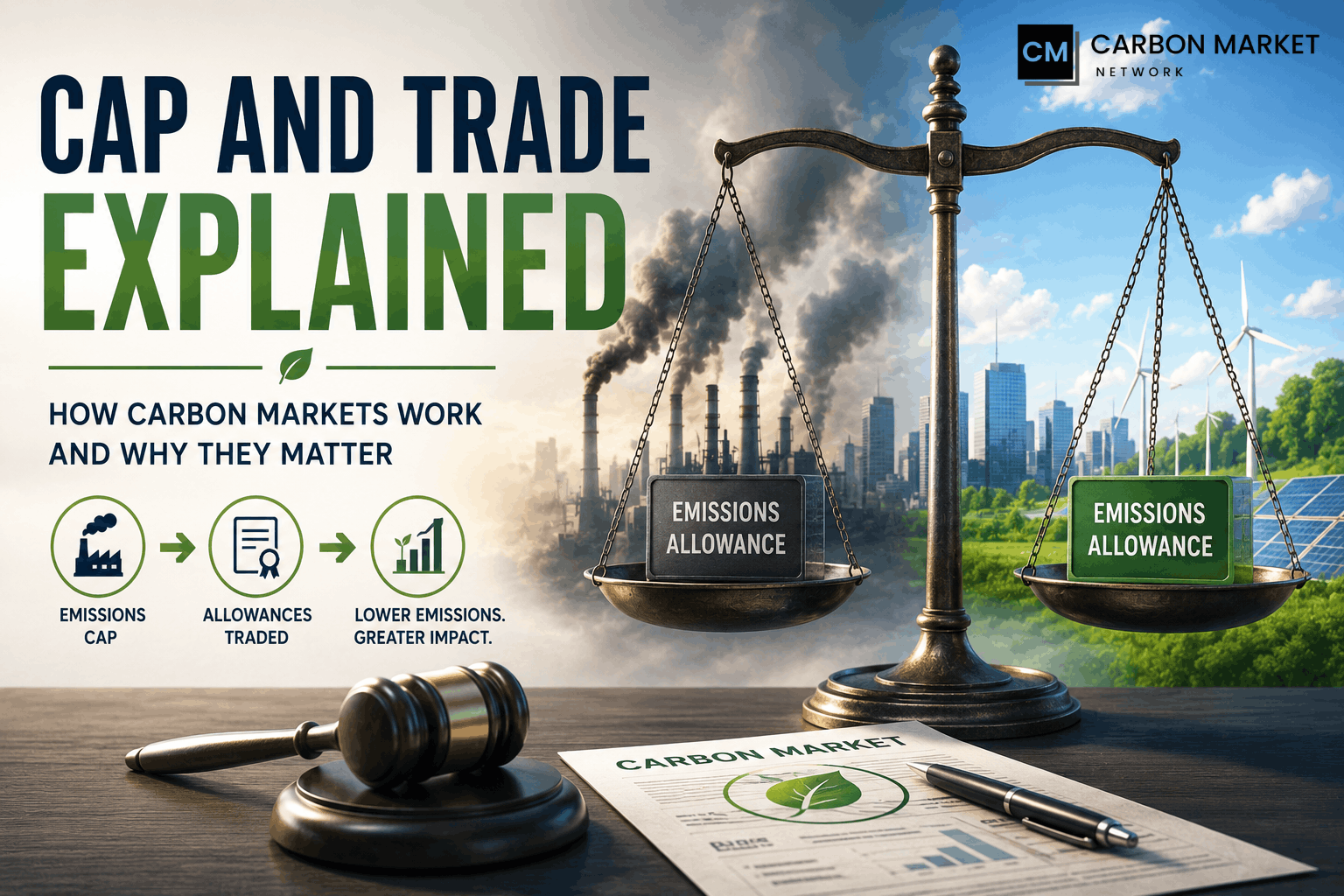
Every year, factories, power plants, and airlines pump billions of tonnes of carbon dioxide into the atmosphere. Governments know they need to stop this. But how do you actually make companies pollute less without shutting down their entire business?
Cap and trade is one of the most powerful answers the world has come up with. It uses the logic of markets to solve an environmental problem. And right now, it covers more of the global economy than ever before.
This guide will explain cap and trade from the ground up. Whether you are completely new to carbon markets or want a deeper understanding of how these programs actually function, you will find exactly what you need here.
What Is Cap and Trade?
Cap and trade is a government policy tool that limits the total amount of greenhouse gases a group of companies can emit, and allows those companies to buy and sell pollution permits among themselves.
The name tells you exactly how it works. There is a “cap” on total emissions. And companies can “trade” the permits that allow them to emit within that cap.
Think of it this way. The government decides that a group of industries can collectively release no more than, say, 500 million tonnes of CO2 in a given year. It then issues exactly that many permits, one per tonne. Companies that keep their emissions below their permit allocation can sell the leftover permits. Companies that emit more than their allocation must buy extra permits from those sellers.
The result is a carbon price that makes pollution expensive and rewards clean production.
Carbon Market Insider Newsletter
Weekly insights on carbon markets, climate policy, carbon credits, and sustainability.
Why Was Cap and Trade Created?
For most of modern industrial history, pollution was essentially free. A factory could dump CO2 into the air without paying a cent. Economists call this a “market failure” because the real cost of that pollution, harm to the climate, human health, and future generations, never showed up in the factory’s accounts.
Governments tried various solutions. They set emission limits through regulations. They taxed fuel. They funded clean technology. But these approaches had limits. They were often inflexible, politically difficult, and sometimes expensive.
Cap and trade offered a different approach. Instead of telling every company exactly how much to cut, it set an overall limit and let companies figure out the cheapest way to meet it collectively. The companies with the cheapest ways to reduce emissions would reduce the most. The companies with the most expensive paths to clean production could buy permits and keep operating while the market sorted it out.
This market-based logic made cap and trade popular with both economists and policymakers starting in the 1990s.
How Cap and Trade Works: Step by Step
Here is a clear walkthrough of the full process.
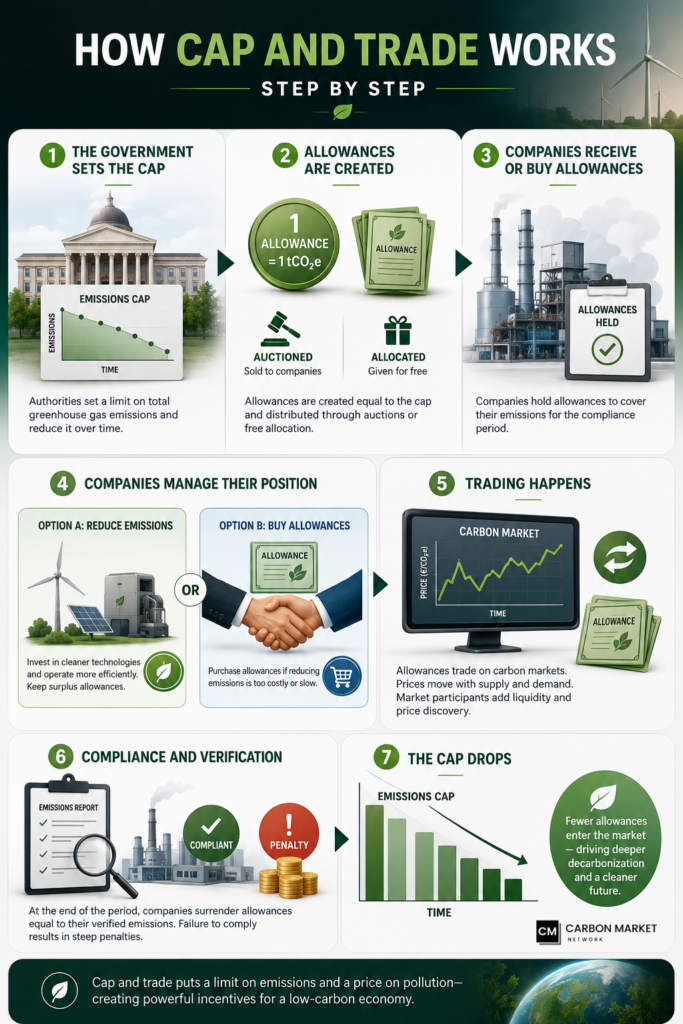
Step 1: The Government Sets the Cap
A regulatory authority, such as the European Commission or the California Air Resources Board, decides on the total volume of greenhouse gases that covered industries can emit in a given period. This is the cap.
The cap is usually set below current emission levels. Over time, the government reduces the cap further, making the system progressively tighter.
Step 2: Allowances Are Created
The government creates emission allowances equal to the cap. Each allowance typically represents the right to emit one metric tonne of CO2 equivalent (tCO2e).
These allowances are either given to companies for free (called free allocation or grandfathering) or sold to companies through auctions. Most modern systems are moving toward more auctioning and less free allocation, since auctions generate government revenue and avoid giving incumbents a financial windfall.
Step 3: Companies Receive or Buy Their Allowances
Every covered company now holds a certain number of allowances. It can use these to cover its emissions for the compliance period, which is usually one year or multiple years.
Step 4: Companies Manage Their Position
During the compliance period, companies have two main options.
Option A: Reduce emissions. Invest in energy efficiency, switch to cleaner fuels, or upgrade equipment. If they emit less than their allowances, they hold surplus permits.
Option B: Buy allowances. If reducing emissions is too expensive or too slow, they buy extra allowances from other companies who have a surplus.
Step 5: Trading Happens
Allowances trade on carbon markets, just like shares trade on a stock exchange. Prices fluctuate based on supply and demand. When the economy is booming and industrial activity is high, demand for allowances rises and prices go up. When energy demand falls, prices tend to drop.
Speculators, banks, and carbon brokers also participate in these markets, adding liquidity and price discovery.
Step 6: Compliance and Verification
At the end of each compliance period, every company must surrender enough allowances to cover all of its actual emissions, verified by independent auditors. Companies that fail to surrender enough allowances face steep financial penalties.
This surrender and verification process is what gives the cap its teeth.
Step 7: The Cap Drops
For the next compliance period, the government reduces the cap. Fewer allowances enter the market. This makes emissions increasingly scarce and more expensive over time, driving deeper decarbonization.
Key Terms You Need to Know
Allowance (or Permit): A certificate giving the holder the right to emit one tonne of CO2e. Also called an Emission Allowance Unit (EAU) or European Union Allowance (EUA) in the EU context.
The Cap: The hard limit on total emissions from covered sectors.
Carbon Price: The market price of one allowance. This is the central signal that drives investment decisions.
Compliance Entity: A company or facility legally required to participate in the program and surrender allowances.
Banking: Saving unused allowances for future use. Most programs allow this, which gives companies flexibility.
Borrowing: Using future allowances today. Most programs restrict or prohibit this.
Price Floor: A minimum price below which allowances cannot trade. Protects against very cheap carbon making emission reductions unattractive.
Price Ceiling (or Price Cap): A maximum price above which the government releases additional allowances. Protects against economic shocks from very expensive carbon.
Offset: An emission reduction achieved outside the capped sectors that can be used to partially satisfy compliance obligations. For example, a forest project that absorbs CO2 might generate offsets that a factory can buy to cover some of its emissions.
Cap and Trade vs. Carbon Tax: What Is the Difference?
People often confuse these two approaches. Both put a price on carbon. But they work differently.
A carbon tax sets a price and lets the quantity of emissions float. Companies pay a set fee per tonne. The government knows exactly what carbon will cost, but not exactly how much total pollution will result.
A cap and trade system sets a quantity and lets the price float. The government knows exactly how many total tonnes will be emitted, but not exactly what price the market will set.
The key trade-off is price certainty vs. emissions certainty.
- If you want to guarantee you hit a specific emissions target, cap and trade is better.
- If you want to guarantee businesses can plan around a stable carbon cost, a carbon tax is better.
Some modern programs combine both, setting a price floor and price ceiling around a cap-and-trade system to get the best of both worlds.
A Brief History of Cap and Trade
Cap and trade did not start with climate change. The idea was first applied to acid rain in the United States.
In 1990, the US Clean Air Act Amendments created a cap-and-trade program for sulfur dioxide (SO2) emissions from power plants, which caused acid rain. The program was a remarkable success. SO2 emissions fell dramatically, faster and cheaper than most analysts predicted.
That success story gave economists and policymakers the confidence to apply the same idea to greenhouse gases.
The European Union Emissions Trading System (EU ETS) launched in 2005. It became the world’s first major carbon market. Early versions had problems, including too many free allowances that kept prices artificially low. But successive reforms strengthened the system significantly.
California’s cap-and-trade program launched in 2013, linking with Quebec, Canada in 2014. It became the most sophisticated cap-and-trade program in North America.
Since then, carbon markets have spread rapidly across the globe.
Major Cap and Trade Programs Around the World in 2026
The world of cap and trade has expanded dramatically. As of 2026, the International Carbon Action Partnership (ICAP) reports that 41 emissions trading systems are in operation globally.
The EU Emissions Trading System (EU ETS)
The EU ETS is the oldest and most influential carbon market on the planet. It covers roughly 40% of EU greenhouse gas emissions, including power plants, heavy industrial facilities, intra-EU aviation, and (since 2024) maritime shipping.
The system has helped reduce covered emissions by approximately 47% between 2005 and 2023. The EU ETS entered its fourth phase in 2021, running through 2030. Carbon allowance prices in the EU have hovered around €70-75 per tonne in 2026, though they have seen volatility.
A significant development in 2026 is the ETS2, a second trading system covering road transport, buildings, and small industrial installations. Fuel suppliers in these sectors entered a monitoring phase in 2025, with the full system set to be operational soon after. The EU Commission is also conducting a wide-ranging assessment of the ETS in H1 2026, examining potential scope expansions.
The EU also introduced the Carbon Border Adjustment Mechanism (CBAM), which charges importers of carbon-intensive goods (like steel and cement) a fee equivalent to what EU producers pay under the ETS. As of April 2026, the CBAM certificate price stood at roughly €75.36 per tonne. This landmark policy prevents “carbon leakage,” where companies simply move production to countries with weaker climate rules.
California’s Cap-and-Invest Program
California’s program is one of the most closely watched carbon markets in the world.
In September 2025, California Governor Gavin Newsom signed AB 1207 and SB 840 into law, extending the state’s program until January 1, 2046 and renaming it the “Cap-and-Invest Program” (formerly Cap-and-Trade). The extension removed a major source of market uncertainty by addressing what analysts called the post-2030 “cliff.”
California Carbon Allowance prices rose about 12% in Q3 2025 following the extension, climbing back above USD 30 on the secondary market. The program remains linked with Quebec’s carbon market, forming what is called the Western Climate Initiative (WCI).
The new legislation requires the California Air Resources Board (CARB) to update all compliance offset protocols to reflect the best available science by January 1, 2029.
The Regional Greenhouse Gas Initiative (RGGI)
RGGI is a cooperative effort among eleven northeastern and mid-Atlantic US states: Connecticut, Delaware, Maine, Maryland, Massachusetts, New Hampshire, New Jersey, New York, Rhode Island, Vermont, and Virginia. Pennsylvania participates but has been sidelined by litigation.
RGGI, established in 2009, covers CO2 emissions from the power sector. It has generated billions in auction revenue that states have reinvested in energy efficiency, renewable energy, and consumer rebates.
New York is also developing its own broader economy-wide cap-and-invest program that is set to expand climate policy coverage beyond RGGI.
Washington State Cap-and-Invest Program
Washington launched its Cap-and-Invest program in 2023 under the Climate Commitment Act. The program covers large emitters above a threshold of 25,000 metric tonnes of CO2e per year. In December 2025, the program held its twelfth auction since launch, selling all offered allowances at a settlement price of USD 70.86 per allowance.
China’s National ETS
China’s national emissions trading system is the largest carbon market in the world by emissions coverage, covering approximately 8 billion tonnes of CO2 annually, which equals roughly 20% of total global emissions.
The system launched in 2021, initially covering the power sector only. In 2024, it expanded to include cement, steel, and aluminum smelting industries, adding approximately 1,500 new entities and an additional 3 billion tonnes of CO2 equivalent per year.
A landmark development: China has issued guidelines to transition its ETS from an intensity-based approach (where limits are tied to production output) to an absolute cap by 2027. This is a critical step toward making China’s market consistent with global best practices and driving real absolute emission reductions.
Other Notable Programs
- The UK ETS operates as a mature standalone market post-Brexit, with stable allowance volumes and strong policy clarity.
- South Korea has entered a stronger new phase of its ETS with greater auctioning and new market stability mechanisms.
- Brazil, Chile, and Colombia have passed ETS legislation and are preparing for implementation.
- Turkey is completing final preparations for its pilot ETS.
- Taiwan launched its carbon fee system in 2025 and began a cap-and-trade ETS pilot in 2026.
As of 2026, jurisdictions operating an ETS together account for 63% of global GDP and more than half the world’s population.
How Companies Actually Respond to Cap and Trade
Understanding the mechanism is one thing. Understanding how real businesses behave under it is another.
Companies That Can Reduce Cheaply Will Do So
Suppose Company A can install new LED lighting and insulation for $5 per tonne of CO2 saved. If the carbon price is $30 per tonne, Company A makes a clear profit by reducing emissions and selling spare allowances. The incentive is obvious and powerful.
Companies Facing High Reduction Costs Will Buy Allowances
Suppose Company B runs a steel mill. Cleaning up its production requires a billion-dollar furnace replacement. In the short term, buying allowances at $30 per tonne is far cheaper. Company B pays for compliance while planning its long-term investment in cleaner technology.
The Market Finds the Cheapest Reductions First
This is the central economic beauty of cap and trade. By letting the market set the price, the system automatically channels emission reductions to wherever they are cheapest. Society achieves its emissions target at the lowest possible total cost.
Innovation Gets Rewarded
If a company invents a dramatically cheaper way to cut emissions, every allowance it frees up can be sold for profit. Cap and trade directly rewards innovation in clean technology, which carbon regulations alone often fail to do.
Where the Revenue Goes
When governments auction allowances rather than giving them away for free, they generate substantial revenue. This money does not simply disappear. It gets reinvested.
- The EU ETS has raised over €175 billion since 2013, with revenue flowing to national budgets and mandatory green investment programs.
- Global ETS revenues reached a record nearly USD 80 billion in 2025, according to ICAP’s 2026 Status Report.
- California directs its auction revenue into the Greenhouse Gas Reduction Fund (GGRF), funding public transit, low-income community programs, wildfire suppression, high-speed rail, and clean energy projects.
How auction revenue gets spent is one of the most politically important questions in carbon market design. Programs that use the money visibly and fairly tend to be more durable politically.
The Role of Offsets in Cap and Trade
Most cap-and-trade programs allow companies to use carbon offsets to partially satisfy their compliance obligations. An offset represents a verified emission reduction or carbon removal outside the capped sectors.
For example, a forestry project that avoids deforestation might generate one offset credit per tonne of CO2 avoided. A factory covered by the cap might buy that credit and use it to cover part of its emissions instead of surrendering a costly allowance.
Why Offsets Are Controversial
Offsets expand the flexibility of cap and trade. They lower compliance costs and can channel climate finance to sectors and regions outside the cap. But they also carry risks.
If an offset credit represents a reduction that was not real, additional, or permanent, it undermines the environmental integrity of the whole system. The company “complied” on paper while actual emissions went up.
This is why offset standards, verification processes, and eligibility rules matter enormously. California’s updated program, for instance, limits offset use to 6% of a company’s compliance obligation from 2026 to 2045, and requires CARB to update all offset protocols to reflect the best available science by 2029.
The Advantages of Cap and Trade
1. It Guarantees an Emissions Outcome
Unlike a carbon tax, where the final emissions depend on how companies respond to the price, a cap-and-trade program guarantees that total emissions stay below the cap. If the cap is set correctly and the system is well-enforced, the environmental target is met.
2. It Is Cost-Effective
By letting the market find the cheapest reductions first, cap and trade minimizes the total economic cost of reaching an emissions target. A well-designed cap-and-trade program will always be cheaper than requiring every company to reduce by the same percentage.
3. It Drives Innovation
The continuous carbon price signal incentivizes companies to invest in new clean technologies, processes, and business models. Unlike regulations that simply set a floor, cap and trade rewards companies that go further.
4. It Generates Revenue
Auctioning allowances raises substantial public revenue that governments can deploy for clean energy, vulnerable communities, or deficit reduction.
5. It Is Flexible
Companies can decide the timing and method of their emission reductions. They can bank allowances, buy them, or invest in offsets. This flexibility reduces economic disruption compared to rigid technology mandates.
The Criticisms and Challenges of Cap and Trade
Cap and trade is not a perfect system. Honest readers deserve to know its weaknesses.
1. Price Volatility
Because the price is set by the market, it can fluctuate significantly. During economic downturns, industrial output falls, demand for allowances drops, and prices collapse. Low prices mean weak incentives. The EU ETS experienced years of near-zero prices in its early phases precisely because of this problem.
Modern programs address this through price floors, price ceilings, and market stability reserves, but volatility remains a challenge.
2. The Cap May Be Set Too High
If the government sets the cap too generously (too many allowances), the carbon price stays low and companies face little pressure to clean up. Early EU ETS critics pointed to exactly this problem. Political pressure from industry often pushes governments toward a weak cap.
3. Free Allocation Creates Windfall Profits
When companies receive allowances for free but can pass the notional carbon cost on to customers in their product prices, they earn windfall profits. The EU ETS’s early over-reliance on free allocation was a significant criticism. Auctioning addresses this, but free allocation persists in many programs to protect trade-exposed industries.
4. Carbon Leakage
If one country or region has a cap-and-trade program and its neighbors do not, companies might shift production to where carbon is cheap. This “carbon leakage” undermines the environmental benefit. The EU’s CBAM is specifically designed to address this, but it is a complex, contested mechanism.
5. Hotspot Pollution
Cap and trade focuses on aggregate emissions. It does not ensure that pollution reductions happen in particular communities or locations. A company might buy enough allowances to keep polluting heavily near a low-income neighborhood while another company elsewhere cleans up. Critics, particularly environmental justice advocates, point to this as a serious equity flaw.
6. Offsets May Not Deliver Real Reductions
As discussed above, poor-quality offsets can allow companies to “comply” while actual emissions do not fall. The integrity of offset standards is a constant concern in every cap-and-trade program that allows offset use.
Cap and Trade vs. Direct Regulation: Which Is Better?
Neither approach is universally superior. Each has strengths in different contexts.
Direct regulation (like emission performance standards or technology mandates) works well when you need guaranteed outcomes at specific facilities, when you want to address localized pollution hotspots, or when the market may not develop the needed technologies fast enough on its own.
Cap and trade works well when you want economy-wide cost efficiency, when you need to manage an aggregate emission budget, and when you want to harness market innovation.
Most experts and policy designers today argue that cap and trade works best when combined with complementary policies: renewable energy targets, building efficiency codes, clean vehicle standards, and direct investment in research and development.
California’s experience illustrates this well. Research has shown that California’s power sector emissions fell significantly under the cap, but the industrial sector saw weaker results. Complementary regulations targeting specific sectors and facilities strengthened the overall outcome.
How Cap and Trade Connects to the Voluntary Carbon Market
The compliance carbon market (where cap-and-trade programs operate) and the voluntary carbon market (where companies and individuals buy offsets on their own initiative) are related but distinct.
In the compliance market, participation is legally mandatory. Companies covered by a cap must surrender allowances or face penalties.
In the voluntary carbon market, participation is optional. Companies buy credits to meet their own net-zero commitments, respond to investor expectations, or manage reputational risk.
The two markets interact. As compliance carbon prices rise, they tend to pull up voluntary market prices too. Projects that generate voluntary credits sometimes qualify for compliance use under specific programs. And as the voluntary market scales up, it generates data and infrastructure that helps compliance markets improve.
For carbon market professionals, understanding both systems and their connections is essential.
What Businesses Need to Know About Cap and Trade Compliance
If you work at or advise a company that operates in a region with a cap-and-trade program, here are the essential compliance steps.
Step 1: Determine if you are a covered entity. Each program has a threshold. In California, facilities emitting above 25,000 tCO2e per year are covered. Check the relevant program’s regulations for your jurisdiction.
Step 2: Register with the relevant registry. Covered entities must open accounts in the program’s registry, where allowances are tracked.
Step 3: Monitor and report your emissions. Emissions must be measured using approved methodologies and reported to the regulator on a set schedule.
Step 4: Get your emissions verified. Third-party verification is required to confirm reported emissions are accurate.
Step 5: Acquire enough allowances. Through the initial free allocation, through government auctions, or through the secondary market. Develop a strategy for managing your allowance position over time.
Step 6: Surrender allowances at the end of the compliance period. The number of allowances surrendered must equal or exceed verified emissions.
Step 7: Plan your long-term decarbonization strategy. As caps tighten year after year, allowances will become progressively more expensive. Companies that invest early in emission reductions build a competitive advantage over those that rely on bought allowances indefinitely.
The Future of Cap and Trade
The trajectory is clear: cap and trade is expanding, tightening, and deepening globally.
A few major trends define the landscape in 2026 and beyond.
Carbon Markets Are Becoming More International
With 41 ETS programs operating globally and revenues hitting a record USD 80 billion in 2025, carbon pricing is no longer a niche policy experiment. Brazil, Chile, Colombia, and Turkey are all entering the space. The EU’s CBAM is forcing trading partners worldwide to strengthen their own carbon pricing or pay the difference at the EU border.
Caps Are Getting Tighter
California’s program now extends to 2046 with progressively declining caps. The EU ETS cap declines at a steeper rate each year under Phase 4 reforms. China is moving toward an absolute cap by 2027. Tighter caps mean higher carbon prices over time.
More Revenue Is Going to Clean Investment
The shift from “cap and trade” to “cap and invest” in naming (California, Washington) reflects a political and policy reality: auction revenue is being channeled more explicitly into clean energy transition, community programs, and climate adaptation.
Integrity Standards Are Rising
Regulators and markets are demanding higher-quality offsets. The era of cheap, low-scrutiny credits is ending. Programs like the Paris Agreement’s Article 6 mechanism are establishing international frameworks for crediting that require far more rigorous accounting.
Article 6 of the Paris Agreement Opens New Doors
Article 6 of the Paris Agreement allows countries to trade emission reductions internationally. When properly implemented, this could link national cap-and-trade programs and allow global emissions to be reduced where it is most cost-effective, which in many cases means developing countries. The rules for Article 6 are still being finalized and implemented, but they represent a major frontier for the carbon market.
Real-World Examples That Bring Cap and Trade to Life
Example 1: The Steel Mill and the Solar Farm
A steel mill in Germany needs 1 million allowances under the EU ETS. It can only generate 800,000 through its current operations. It must buy 200,000 more. Across the country, a utility that switched from coal to solar has 500,000 spare allowances. It sells 200,000 to the steel mill for €70 each, generating €14 million that it reinvests in more renewable capacity. The cap holds. Total emissions stay within budget.
Example 2: The California Trucking Company
A California trucking company emits 30,000 tonnes of CO2 per year, above the 25,000-tonne threshold. It must participate in the Cap-and-Invest program. To reduce its compliance cost, it transitions part of its fleet to electric trucks. Its verified emissions drop to 22,000 tonnes. It now holds 3,000 spare allowances that it sells on the secondary market at $30 each, netting $90,000. That money helps finance the next phase of fleet electrification.
Example 3: The RGGI Power Plant Auction
A coal-fired power plant in a RGGI state attends the quarterly RGGI allowance auction. It bids for enough allowances to cover its projected emissions. The auction price comes in higher than expected, making its coal plant significantly less competitive against natural gas and renewables. The plant’s owners begin analyzing whether a conversion to gas or an early retirement makes more financial sense than continuing to pay an escalating carbon price year after year.
Frequently Asked Questions About Cap and Trade
What is the basic idea behind cap and trade?
Cap and trade sets a hard limit on total pollution from a group of companies and lets them buy and sell permits to emit within that limit. Companies that pollute less can sell their spare permits to companies that pollute more. This market mechanism finds the cheapest path to the emissions target.
How is cap and trade different from a carbon tax?
A carbon tax sets a price on emissions but does not guarantee a specific emissions quantity. Cap and trade sets a quantity limit but lets the price float with market supply and demand. A cap guarantees an emissions outcome; a tax guarantees a price.
Which countries use cap and trade?
As of 2026, over 40 jurisdictions use emissions trading systems, including the European Union, the United Kingdom, California (USA), Canada, China, South Korea, New Zealand, Japan (Tokyo and Saitama), Australia, and many more.
Does cap and trade actually work?
Evidence from established programs shows real results. The EU ETS helped reduce covered-sector emissions by around 47% between 2005 and 2023. The US acid rain SO2 trading program of the 1990s cut sulfur emissions faster and cheaper than predicted. However, the effectiveness of any program depends heavily on how tight the cap is, how well it is enforced, and what complementary policies support it.
What happens if a company does not surrender enough allowances?
Companies that fail to surrender sufficient allowances face heavy financial penalties. In the EU ETS, the penalty is €100 per tonne of excess emissions. The company also still has to surrender the missing allowances in the next compliance period.
What is the difference between a cap-and-trade allowance and a carbon offset?
An allowance is issued by the government directly under the cap. An offset is a credit representing an emission reduction achieved outside the capped sectors, verified against a separate standard. Most programs allow limited offset use for compliance but restrict how many offsets can substitute for allowances.
Is cap and trade good or bad for businesses?
It depends on the business. Companies with clean, efficient operations benefit because they can sell spare allowances or avoid buying them. Companies with dirty, inefficient operations face higher costs but also gain clear investment signals. Over time, cap and trade rewards clean businesses and penalizes dirty ones.
What is the carbon price under cap and trade?
Carbon prices vary widely by program and time. In 2026, the EU ETS has averaged around €70-75 per tonne of CO2. California allowances trade around $30 per tonne. Washington state saw recent auction prices around $70 per allowance. China’s prices are lower but rising. There is no single global carbon price.
Can individuals participate in cap and trade?
In most compliance programs, only covered industrial entities participate directly. But investors, banks, and brokers trade allowances, and the price signals created by cap and trade influence energy prices and consumer costs broadly. Some voluntary markets allow individuals to buy and retire credits.
What is “banking” in a cap-and-trade program?
Banking means saving unused allowances from one compliance period to use in a future one. Most programs allow banking, which smooths price spikes, rewards early action, and gives companies long-term planning flexibility.
Conclusion
Cap and trade is one of the most important tools the world has for reducing greenhouse gas emissions at scale. It works by combining a firm environmental limit with the efficiency of market forces.
The concept is simple: set a cap, issue permits, let companies trade. The real-world implementation is more complex, involving auction designs, offset rules, price corridors, and verification systems. But the core logic holds up everywhere it has been tried well.
In 2026, cap and trade is no longer an experiment. It is a mature, global policy infrastructure. With 41 systems in operation, record revenues, and expanding coverage, carbon markets are at the center of the world’s decarbonization effort.
For businesses, investors, and policymakers, understanding cap and trade is not optional. It is foundational knowledge for operating in the 21st-century economy.
The programs will get tighter. The caps will fall. The carbon price will rise. The companies that understand and prepare for this now will be the ones that thrive.
This article is published by Carbon Market Network. For more deep-dive content on carbon markets, emissions trading, and the voluntary carbon market, explore our full library at carbonmarketnetwork.com.