Carbon Market Network


Climate change is not waiting for anyone. Even if the entire world stopped emitting carbon dioxide tomorrow, the gas already sitting in the atmosphere would keep warming the planet for decades.
That is where carbon removal comes in.
A new wave of companies has built technologies and nature-based methods that pull carbon dioxide out of the air and lock it away for good. Some use giant machines. Others use crushed rock, biochar, or the ocean itself.
This guide breaks down the top carbon removal companies working today, how their technologies actually work, and how businesses use their services to hit net zero targets. Whether you are a sustainability manager, an investor, or simply curious about climate solutions, this article gives you a clear, practical picture of the carbon removal industry.
What Is Carbon Removal, and Why Does It Matter
Carbon removal means taking carbon dioxide out of the atmosphere and storing it somewhere it cannot escape back into the air.
This is different from carbon avoidance, which stops emissions from happening in the first place. Carbon removal deals with emissions that already exist.
Scientists agree that the world cannot meet global climate goals through emission cuts alone. Some industries, like aviation, cement, and heavy shipping, are extremely hard to fully decarbonize.
Carbon removal offers a way to balance out these hard-to-abate emissions. It plays a critical role in any credible net zero strategy.
There are two broad categories of carbon removal:
- Engineered removal: Technology-driven methods like direct air capture, enhanced rock weathering, and mineralization
- Nature-based removal: Biological methods like afforestation, biochar, and soil carbon sequestration
Buyers increasingly favor removal methods that are durable, meaning the carbon stays locked away for hundreds or even thousands of years, rather than short-term storage that can reverse.
Carbon Market Insider Newsletter
Weekly insights on carbon markets, climate policy, carbon credits, and sustainability.
How Carbon Removal Companies Actually Work
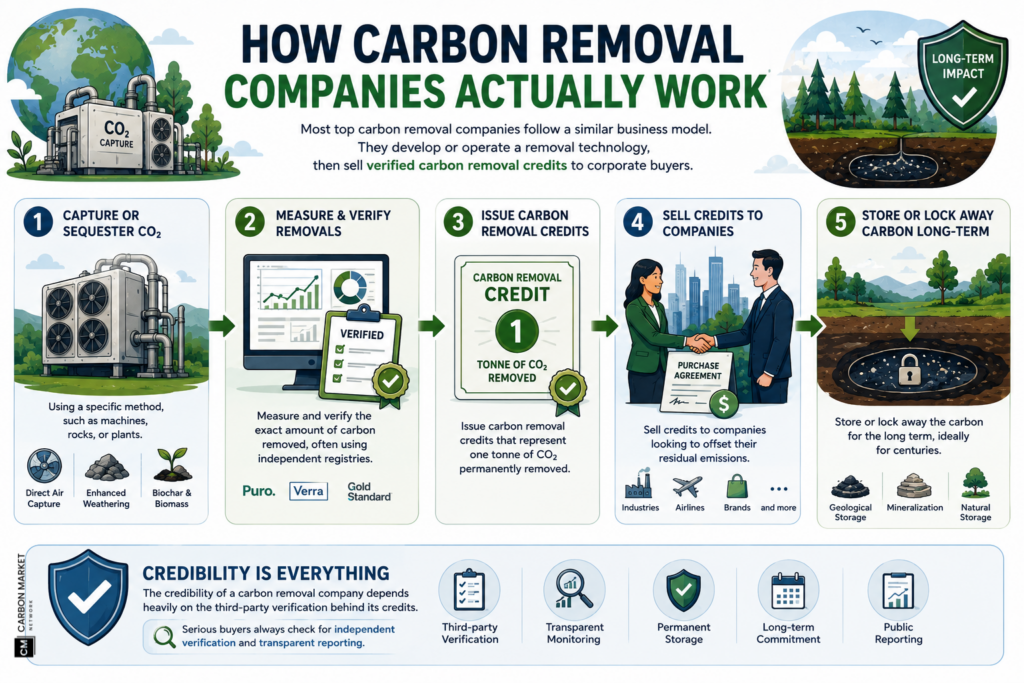
Most top carbon removal companies follow a similar business model. They develop or operate a removal technology, then sell verified carbon removal credits to corporate buyers.
Here is a simple breakdown of the process:
- Capture or sequester CO2 using a specific method, such as machines, rocks, or plants
- Measure and verify the exact amount of carbon removed, often using independent registries
- Issue carbon removal credits that represent one tonne of CO2 permanently removed
- Sell credits to companies looking to offset residual emissions
- Store or lock away the carbon for the long term, ideally for centuries
The credibility of a carbon removal company depends heavily on the third-party verification behind its credits. Serious buyers always check for independent monitoring, reporting, and verification systems, known as MRV, before purchasing.
Top Carbon Removal Companies by Technology
The carbon removal industry is not one single market. It is a collection of very different technologies, each with its own cost, scale, and permanence profile. Below is a breakdown of the leading companies in each category.
1. Direct Air Capture (DAC) Companies
Direct air capture uses large machines to pull CO2 directly out of ambient air, then stores it deep underground or turns it into stable minerals.
Climeworks
Climeworks is one of the most recognized names in direct air capture. The company operates large-scale DAC facilities in Iceland that use solid sorbent filters to capture CO2 from the air, then mineralize it permanently underground with the help of geothermal energy.
Its plants have signed multi-year offtake agreements with major global companies, and the credits it issues carry some of the highest integrity ratings in the voluntary carbon market.
1PointFive
1PointFive combines direct air capture with large-scale geological storage. The company is building industrial-sized DAC facilities designed to capture hundreds of thousands of tonnes of CO2 per year, backed by secured underground storage capacity.
Heirloom
Heirloom uses a clever twist on natural mineral carbonation. It speeds up the process by which limestone naturally absorbs CO2 from the air, compressing a process that normally takes years into just days. The captured CO2 is then stored permanently underground.
Carbon Engineering
Carbon Engineering pioneered a liquid solvent-based DAC process. Air passes through large contactors where potassium hydroxide captures the CO2, which is then purified and either stored underground or converted into low-carbon fuels.
2. Enhanced Rock Weathering Companies
Enhanced rock weathering speeds up a natural geological process. Crushed rock, usually basalt, is spread on farmland, where it reacts with CO2 in the air and rainwater to lock carbon into stable minerals over time.
Lithos Carbon
Lithos Carbon spreads finely crushed basalt on agricultural land, helping farmers improve soil health while permanently capturing carbon. The company uses proprietary measurement technology to track exactly how much CO2 each field removes. It has secured some of the largest offtake agreements in the enhanced weathering space, with storage permanence estimated at thousands of years.
Undo (UNDO Carbon)
Undo works with farmers across multiple countries to spread crushed silicate rock across cropland. The company focuses heavily on rigorous field-level measurement to prove exactly how much carbon each application removes.
3. Biochar Companies
Biochar is made by heating organic waste, like wood chips or crop residue, in a low-oxygen environment. This process, called pyrolysis, locks carbon into a stable charcoal-like material that can be added to soil for centuries without decomposing.
Carbofex
Carbofex is a European biochar producer known for its transparent, science-backed approach to carbon accounting. It produces biochar from sustainably sourced wood residue and applies it to soil for long-term storage.
Novocarbo
Novocarbo operates a network of biochar production facilities using organic waste streams. Its credits are considered among the more accessible, durable removal options for companies building a balanced carbon removal portfolio.
Biochar is popular because it is relatively low-cost compared to direct air capture, while still offering strong permanence and added benefits for soil health.
4. Bio-Oil and Biomass Injection Companies
Charm Industrial
Charm Industrial converts plant waste into a carbon-rich bio-oil through fast pyrolysis, then injects that bio-oil deep underground for permanent storage. The company argues this approach avoids the slow decomposition and wildfire risk associated with leaving biomass on the surface.
Vaulted Deep
Vaulted Deep takes organic waste, such as manure and biosolids, and injects it deep underground into secure geological formations. This locks the carbon away permanently while also solving a waste management problem for industries that generate these byproducts.
5. Bioenergy with Carbon Capture and Storage (BECCS)
BECCS combines biomass energy production with carbon capture technology, effectively removing carbon while also generating power or heat.
SLB Capturi
SLB Capturi integrates carbon capture, transport, and storage into a single value chain. Its BECCS-linked credits typically cost less than direct air capture while still meeting strong durability standards, making the technology attractive to utilities and industrial buyers.
6. Ocean-Based Carbon Removal Companies
Ocean-based removal uses the ocean’s natural chemistry to absorb more CO2 than it otherwise would.
Ebb Carbon
Ebb Carbon uses electrochemistry to enhance the ocean’s natural ability to absorb and store CO2, while also helping reduce ocean acidification. This approach is still developing but is seen as one of the more scalable long-term removal pathways because oceans cover most of the planet.
7. Industrial Carbon Capture and Utilization Companies
These companies focus on capturing CO2 at industrial sources, or turning captured carbon into useful products.
Carbon Clean
Carbon Clean develops carbon capture technology used across industries like steel, cement, and chemicals, targeting emissions that are otherwise very difficult to eliminate.
CarbonCure Technologies
CarbonCure (https://www.carboncure.com/) injects captured CO2 into fresh concrete, where it mineralizes permanently while also improving the concrete’s strength. This lets construction companies reduce their carbon footprint without changing their existing processes.
Svante
Svante builds modular carbon capture equipment using engineered filters, serving both industrial emission sources and direct air capture applications.
Comparison Table: Top Carbon Removal Companies at a Glance
| Company | Technology | Storage Permanence | Best Suited For |
|---|---|---|---|
| Climeworks | Direct air capture | Hundreds to thousands of years | Enterprises seeking premium, high-integrity removal |
| 1PointFive | Direct air capture | Hundreds to thousands of years | Large-scale industrial buyers |
| Heirloom | Mineralization-based DAC | Thousands of years | Buyers wanting proven mineral storage |
| Lithos Carbon | Enhanced rock weathering | Thousands of years | Buyers wanting scalable, farm-based removal |
| Carbofex | Biochar | 100+ years | Cost-conscious buyers seeking durable removal |
| Novocarbo | Biochar | 100+ years | Companies building a diversified portfolio |
| Charm Industrial | Bio-oil injection | Thousands of years | Buyers prioritizing biomass-based permanence |
| Vaulted Deep | Waste injection | Thousands of years | Companies wanting waste-to-storage solutions |
| SLB Capturi | BECCS | Thousands of years | Utilities and industrial-scale buyers |
| Ebb Carbon | Ocean-based removal | Long-term, still developing | Buyers exploring emerging ocean pathways |
| Carbon Clean | Industrial capture | Depends on end use | Hard-to-abate industrial sectors |
| CarbonCure | CO2 mineralization in concrete | Permanent | Construction and building materials sector |
Carbon Removal Marketplaces and Procurement Platforms
Not every company that touches carbon removal builds the technology itself. Several platforms help corporate buyers find, verify, and purchase high-quality carbon removal credits.
Puro.earth operates a leading crediting platform focused specifically on engineered carbon removal, ensuring credits represent carbon locked away for over a century.
Senken is a procurement platform for audit-ready carbon removals, it focuses on European enterprises (customers include Lufthansa, Deutsche Telekom, Vodafone) and selects top 5% of credits on the market through its Sustainability Integrity Index
Carbonfuture connects buyers with verified durable removal suppliers through a data-driven monitoring and verification system.
Patch offers an API-first marketplace that lets companies plug both avoidance and removal credits directly into their own products or platforms.
Isometric works as an independent carbon removal registry and standard, applying rigorous scientific review to the credits it certifies.
These platforms matter because carbon removal is still a young market. Buyers need a trusted layer to confirm that a tonne of carbon removal actually happened the way it was claimed.
How Companies Choose the Right Carbon Removal Partner
Choosing a carbon removal supplier is not just about price. Here are the factors that matter most.
Permanence
Ask how long the carbon stays locked away. Direct air capture and enhanced rock weathering typically offer storage measured in centuries or millennia. Some nature-based methods offer shorter timeframes.
Verification and Standards
Look for credits certified by independent registries and rated by third-party agencies. This reduces the risk of buying credits that do not represent real, additional carbon removal.
Cost per Tonne
Prices vary enormously across technologies. Direct air capture credits sit at the premium end of the market, while biochar and BECCS credits are generally more affordable. A balanced portfolio often blends multiple price points.
Co-Benefits
Some methods offer extra value beyond carbon removal. Enhanced rock weathering can improve soil health for farmers. Biochar can boost crop yields. CarbonCure’s technology strengthens concrete. These co-benefits can make a removal method more attractive to stakeholders.
Track Record and Transparency
Established companies with multi-year delivery history and public data reporting are generally lower risk than early-stage suppliers with unproven delivery capacity.
The Role of Advance Market Commitments
One of the biggest forces accelerating the carbon removal industry is the advance market commitment model, often shortened to AMC.
Under this model, a coalition of large corporate buyers pools its purchasing power and commits to buy a set volume of carbon removal in advance, even before the supplying technology has fully scaled.
This gives early-stage carbon removal companies the guaranteed demand and funding they need to grow, while giving buyers early access to future supply at negotiated prices.
Major technology and financial companies have backed these coalitions, funneling hundreds of millions of dollars into companies working on direct air capture, enhanced weathering, biochar, and bio-oil injection. This kind of coordinated demand has been one of the single biggest growth drivers for emerging carbon removal companies over the past few years.
Challenges Facing Carbon Removal Companies
The carbon removal industry is growing fast, but it still faces real hurdles.
- High costs: Many advanced removal methods remain expensive compared to traditional carbon offsets
- Scaling difficulty: Moving from pilot projects to gigaton-scale removal requires massive infrastructure investment
- Measurement complexity: Accurately quantifying how much carbon a project actually removes, especially for nature-based and ocean-based methods, is technically challenging
- Limited supply: Demand for high-quality durable removal credits currently outpaces available supply
- Policy uncertainty: Government incentives and regulations vary widely across countries and can shift over time
Despite these challenges, capture costs have been falling steadily as technology matures and production scales up, following a pattern seen in other clean energy industries like solar and batteries.
Practical Takeaways for Businesses Considering Carbon Removal
If your company is exploring carbon removal as part of a climate strategy, keep these points in mind.
- Start with reduction first. Carbon removal should supplement genuine emission cuts, not replace them.
- Diversify across technologies. Blending direct air capture, biochar, and enhanced weathering spreads risk and balances cost.
- Prioritize durability. Favor removal methods with storage measured in centuries, not years.
- Demand transparency. Only work with suppliers that publish clear, independently verified data.
- Think long-term. Carbon removal is a multi-year commitment, not a one-time purchase.
- Watch co-benefits. Projects that also support farmers, soil health, or local communities tend to build stronger stakeholder support.
Frequently Asked Questions
What are the top carbon removal companies in the world?
Leading names include Climeworks, 1PointFive, Heirloom, Lithos Carbon, Charm Industrial, Vaulted Deep, Carbofex, Novocarbo, SLB Capturi, and Ebb Carbon. Each specializes in a different removal technology, from direct air capture to enhanced rock weathering and biochar.
What is the difference between carbon removal and carbon offsetting?
Carbon offsetting is a broad term that includes both avoidance projects, like renewable energy or forest protection, and removal projects. Carbon removal specifically means taking existing CO2 out of the atmosphere and storing it permanently.
Which carbon removal method is the most affordable?
Biochar and BECCS credits are generally more affordable than direct air capture. Enhanced rock weathering also tends to sit at a lower price point while still offering strong permanence.
Which carbon removal method offers the longest storage?
Direct air capture with mineral storage and enhanced rock weathering both offer storage permanence measured in thousands of years, among the longest of any current method.
How do companies verify carbon removal credits?
Independent registries and standards bodies review project data, apply strict monitoring and verification protocols, and issue credits only after confirming the claimed removal actually took place.
Is carbon removal enough to solve climate change on its own?
No. Carbon removal is one tool among many. Cutting emissions at the source remains the most important priority, with carbon removal addressing the residual emissions that are hardest to eliminate.
Why is direct air capture more expensive than other removal methods?
Direct air capture requires significant energy and specialized equipment to extract CO2 from ambient air, where concentrations are very low. This makes it more resource-intensive than methods that work with concentrated CO2 sources or natural processes.
Final Thoughts
The carbon removal industry has moved well beyond the experimental stage. Companies across direct air capture, enhanced rock weathering, biochar, bio-oil injection, and ocean-based removal are now delivering real, verified tonnes of CO2 removal at growing scale.
For businesses building a credible net zero strategy, understanding these top carbon removal companies is no longer optional. It is a core part of climate planning.
The right approach usually means combining multiple removal methods, prioritizing durability and transparency, and treating carbon removal as a long-term partnership rather than a quick fix. As technology matures and costs continue to fall, carbon removal will keep playing a bigger role in how the world tackles its hardest climate challenges.
For more insights on carbon markets, environmental finance, and sustainability mechanisms, explore the resources at Carbon Market Network.