Carbon Market Network


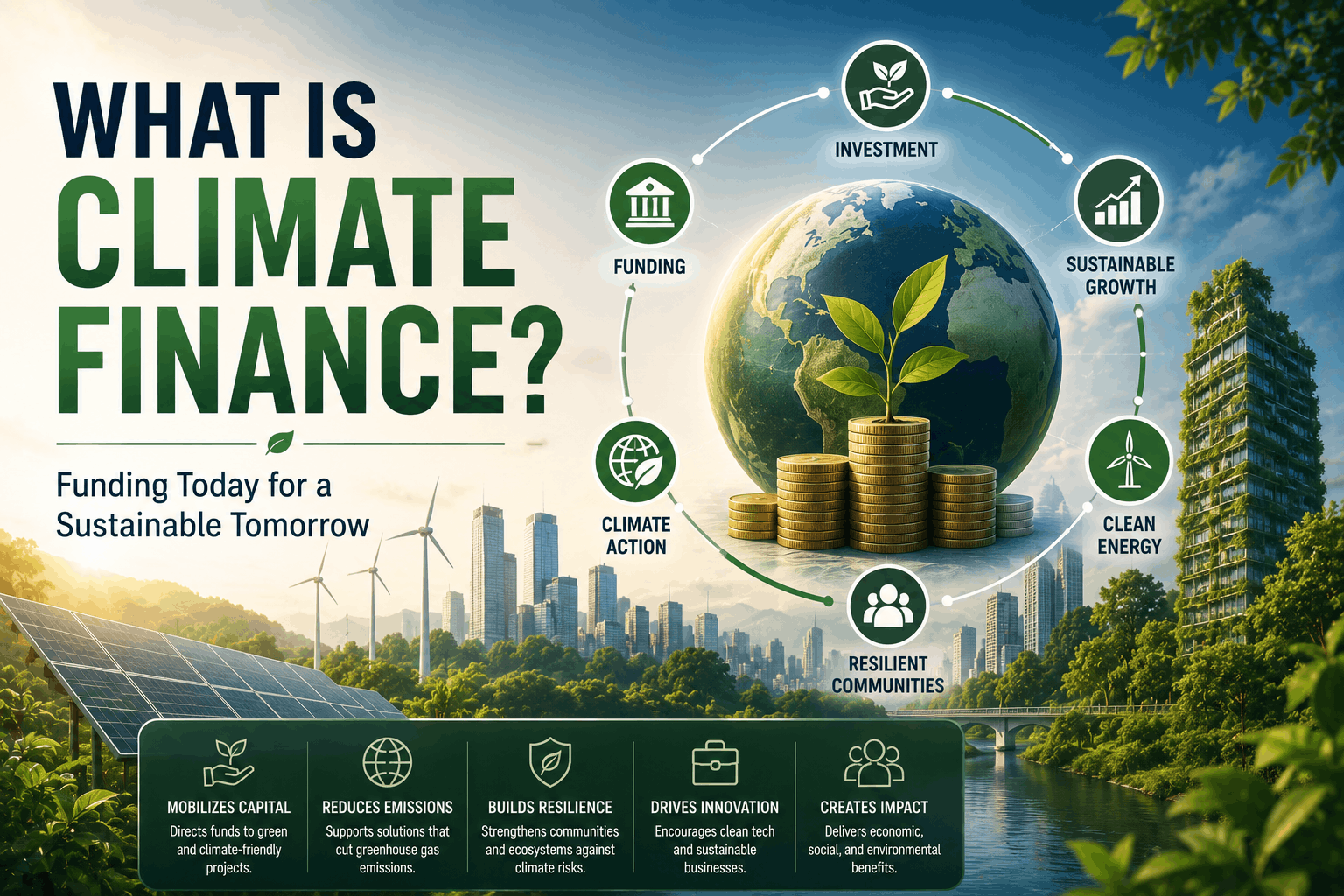
Every big climate goal you have heard about, from clean energy to disaster protection, needs one thing to actually happen. Money.
That money has a name. It is called climate finance.
If you have ever wondered what is climate finance, how it works, or why world leaders argue about it every year, you are in the right place.
This guide breaks down climate finance in plain language. No jargon walls. No confusing acronyms without explanation.
By the end, you will understand what climate finance means, who pays for it, where it goes, and why it affects businesses, governments, and everyday people around the world.
What Is Climate Finance in Simple Terms
Climate finance means money used to support action against climate change.
This includes funding to reduce greenhouse gas emissions. It also includes funding to help communities adapt to a changing climate.
In short, climate finance answers one basic question: who pays for climate action, and how much?
The term covers a wide range of financial flows. These include:
- Government grants and loans
- Private investment in clean technology
- Funding from international climate funds
- Loans from development banks
- Insurance and risk-sharing tools
- Carbon market revenue used for climate projects
Climate finance is not one single fund or one single source. It is an entire financial system built around a single mission, which is limiting climate damage and helping the world adjust to its effects.
Carbon Market Insider Newsletter
Weekly insights on carbon markets, climate policy, carbon credits, and sustainability.
A Short History of How Climate Finance Became a Global Priority
Climate finance did not appear overnight. It grew out of decades of international climate negotiations.
Early climate talks focused mostly on emission targets. Over time, negotiators realized that targets without funding rarely translate into real action.
This realization pushed climate finance into the center of global climate diplomacy. Developed nations, which historically produced the largest share of emissions, agreed to help fund climate action in developing nations.
A landmark moment came when countries set an initial global climate finance floor, aiming to mobilize a fixed amount annually to support developing economies.
As climate impacts intensified and scientific understanding improved, it became clear that this initial goal was far too small compared to actual needs.
This led to a new, more ambitious phase of climate finance negotiations, focused on raising both public and private contributions to a much higher combined target.
Today, climate finance sits at the core of nearly every major climate summit, shaping discussions on emissions, resilience, and global economic fairness.
Why Climate Finance Matters So Much
Climate change is not just an environmental issue. It is an economic one.
Building clean energy grids, protecting coastlines, upgrading agriculture, and recovering from climate disasters all cost money. A lot of it.
Without adequate financing, even the best climate policies stay stuck on paper.
Here is why climate finance matters:
- It turns climate promises into real projects. Targets and pledges need capital to become solar farms, flood defenses, or early warning systems.
- It protects vulnerable communities. Many countries facing the worst climate impacts contributed the least to the problem. Climate finance helps balance that gap.
- It drives the clean energy transition. Renewable energy, electric transport, and energy efficiency all depend on large-scale investment.
- It reduces long-term costs. Every dollar spent on prevention today can save many more dollars in disaster recovery later.
- It supports global cooperation. Climate finance is a core part of international climate agreements, including the Paris Agreement.
Put simply, climate finance is the fuel that keeps global climate action moving.
The Three Core Pillars of Climate Finance
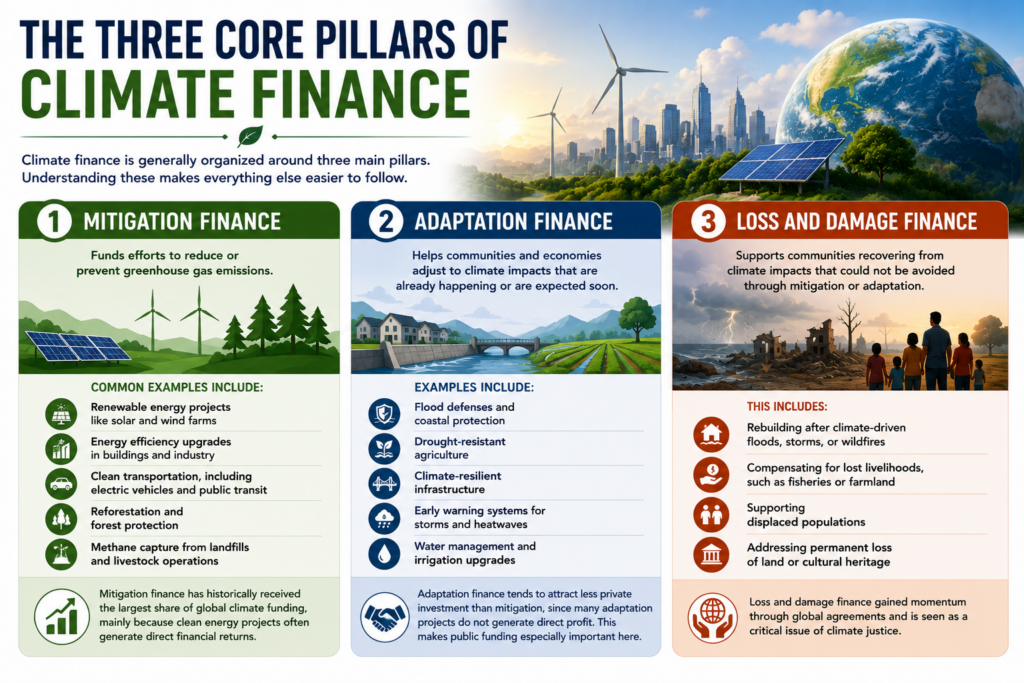
Climate finance is generally organized around three main pillars. Understanding these makes everything else easier to follow.
1. Mitigation Finance
Mitigation finance funds efforts to reduce or prevent greenhouse gas emissions.
Common examples include:
- Renewable energy projects like solar and wind farms
- Energy efficiency upgrades in buildings and industry
- Clean transportation, including electric vehicles and public transit
- Reforestation and forest protection
- Methane capture from landfills and livestock operations
Mitigation finance has historically received the largest share of global climate funding, mainly because clean energy projects often generate direct financial returns.
2. Adaptation Finance
Adaptation finance helps communities and economies adjust to climate impacts that are already happening or are expected soon.
Examples include:
- Flood defenses and coastal protection
- Drought-resistant agriculture
- Climate-resilient infrastructure
- Early warning systems for storms and heatwaves
- Water management and irrigation upgrades
Adaptation finance tends to attract less private investment than mitigation, since many adaptation projects do not generate direct profit. This makes public funding especially important here.
3. Loss and Damage Finance
Loss and damage finance is the newest pillar. It supports communities recovering from climate impacts that could not be avoided through mitigation or adaptation.
This includes:
- Rebuilding after climate-driven floods, storms, or wildfires
- Compensating for lost livelihoods, such as fisheries or farmland
- Supporting displaced populations
- Addressing permanent loss of land or cultural heritage
Loss and damage finance gained major global attention after vulnerable nations pushed for a dedicated fund to address climate harms beyond simple adaptation.
| Pillar | Main Goal | Example Projects | Typical Funders |
|---|---|---|---|
| Mitigation | Reduce emissions | Solar farms, EV infrastructure, reforestation | Private investors, development banks, governments |
| Adaptation | Adjust to climate impacts | Flood barriers, drought-resistant crops | Public funds, multilateral banks |
| Loss and Damage | Recover from unavoidable harm | Disaster recovery, displacement support | Dedicated climate funds, government pledges |
Who Actually Pays for Climate Finance
Climate finance flows from many different sources. Broadly, it splits into public and private finance.
Public Climate Finance
Public climate finance comes from governments and public institutions. It includes:
- Bilateral finance: Direct funding from one country to another, often through foreign aid budgets.
- Multilateral finance: Funding channeled through international institutions like development banks and dedicated climate funds.
- Domestic public budgets: National and local government spending on climate programs within their own borders.
Private Climate Finance
Private climate finance comes from businesses, banks, and investors. It includes:
- Corporate investment in renewable energy and clean technology
- Green bonds issued by companies and financial institutions
- Venture capital funding for climate startups
- Institutional investment from pension funds and asset managers
- Carbon credit purchases that fund emission reduction projects
Private finance is essential because public budgets alone cannot cover the scale of investment needed. Most global estimates suggest that trillions of dollars are required every year, far beyond what governments can provide on their own.
| Source Type | Examples | Strength | Limitation |
|---|---|---|---|
| Public bilateral | Country-to-country aid | Flexible, targeted | Limited by donor budgets |
| Public multilateral | Development bank loans | Large scale, technical expertise | Slower approval processes |
| Private capital | Green bonds, corporate investment | High volume potential | Focuses on profitable projects |
| Blended finance | Public funds reducing private risk | Attracts hesitant investors | Complex to structure |
Key Institutions and Mechanisms in Climate Finance
Several major institutions channel climate finance around the world. Knowing these names helps you follow climate finance news with confidence.
Green Climate Fund
The Green Climate Fund is one of the largest dedicated climate funds. It supports both mitigation and adaptation projects in developing countries, funding everything from renewable energy to resilient agriculture.
Global Environment Facility
The Global Environment Facility funds a broad range of environmental projects, including climate change, biodiversity, and land degradation programs.
Adaptation Fund
The Adaptation Fund focuses specifically on adaptation projects for communities that are highly vulnerable to climate impacts.
Loss and Damage Fund
This fund was created to help nations recover from climate disasters that go beyond what adaptation can prevent. It represents a major shift in how the world addresses climate justice.
Multilateral Development Banks
Institutions such as the World Bank and regional development banks provide large volumes of climate-related lending, often bundled into broader development projects like infrastructure and energy access.
| Institution | Primary Focus | Funding Type |
|---|---|---|
| Green Climate Fund | Mitigation and adaptation | Grants and concessional loans |
| Global Environment Facility | Broad environmental issues | Grants |
| Adaptation Fund | Adaptation only | Grants |
| Loss and Damage Fund | Disaster recovery | Grants and pledges |
| Development banks | Infrastructure, energy, resilience | Loans, guarantees, equity |
How Climate Finance Is Tracked and Measured
Tracking climate finance is harder than it sounds. Different institutions use different definitions, which can make global figures difficult to compare.
Generally, tracking involves a few key steps:
- Reporting by funders: Governments and institutions report how much money they committed and disbursed toward climate projects.
- Classification checks: Analysts review whether the funding genuinely supports climate goals or only loosely relates to them.
- Avoiding double counting: Since multiple institutions can claim credit for the same funding stream, careful accounting is needed to avoid inflating totals.
- Third-party verification: Independent research organizations often cross-check official figures against actual project outcomes.
- Annual progress reports: International bodies publish yearly summaries comparing pledged finance against real disbursed funding.
This tracking matters because it builds trust. Without clear measurement, it becomes difficult to know whether climate finance commitments are genuinely being honored.
Climate Finance Compared to Similar Terms
Climate finance often gets confused with related terms. Here is how they differ.
| Term | What It Means | How It Relates to Climate Finance |
|---|---|---|
| Green finance | Broader term covering any environmentally friendly financial activity | Climate finance is a subset focused specifically on climate change |
| Sustainable finance | Covers environmental, social, and governance goals together | Climate finance focuses narrowly on climate outcomes |
| Development finance | Funding aimed at broader economic development | Often overlaps with climate finance when projects have climate benefits |
| ESG investing | Investment strategy considering environmental, social, and governance factors | Climate finance can be one component of an ESG investment strategy |
Understanding these distinctions helps avoid confusion when reading climate related news, corporate sustainability reports, or investment materials.
Climate Finance for Small and Medium Businesses
Climate finance is often associated with large governments and multinational corporations. However, smaller businesses have a growing role to play as well.
Small and medium enterprises can access climate finance through:
- Green business loans: Many banks now offer lower interest loans for energy efficiency upgrades or clean equipment purchases.
- Grants for sustainability projects: Various development agencies and climate funds offer grant programs targeted at smaller businesses.
- Carbon credit generation: Businesses running projects like reforestation, clean cookstoves, or renewable energy can generate and sell carbon credits, creating a direct revenue stream tied to climate finance.
- Supply chain partnerships: Larger corporations increasingly support smaller suppliers in adopting cleaner practices, sometimes offering financing or technical assistance.
For smaller businesses, climate finance is not just about environmental responsibility. It is also becoming a genuine growth opportunity, opening access to new funding channels and markets.
How Climate Finance Flows: Step by Step
Understanding the journey of climate finance makes the whole system much clearer.
- Commitment stage: Governments, institutions, or companies pledge funding toward climate goals.
- Channeling stage: Money moves through a chosen mechanism, such as a climate fund, development bank, or direct investment.
- Project selection stage: Recipient countries or organizations propose projects that match funding criteria.
- Approval and disbursement stage: Funders review proposals and release money in stages, often tied to milestones.
- Implementation stage: Projects are built and executed, whether that means a solar plant, a flood barrier, or a reforestation program.
- Monitoring and reporting stage: Funders track results to confirm the money achieved its intended climate impact.
This process explains why climate finance sometimes moves slower than expected. Each stage involves due diligence, risk assessment, and accountability checks.
Common Climate Finance Instruments
Climate finance is not just handed over as cash. It comes through specific financial tools, each suited to different needs.
- Grants: Non-repayable funding, often used for adaptation projects with limited direct financial returns.
- Concessional loans: Loans offered at lower interest rates than the market, making projects more affordable for developing economies.
- Guarantees: Risk-reducing tools that make private investors more willing to fund climate projects.
- Equity investment: Direct ownership stakes in climate-focused companies or projects.
- Green bonds: Debt instruments where funds raised must be used for environmentally beneficial projects.
- Carbon credits and carbon markets: Financial mechanisms where emission reductions are verified, certified, and sold, generating revenue that funds further climate action.
Each instrument fits a different type of project and risk profile. Grants suit high-risk, low-return adaptation work. Equity and bonds suit large-scale renewable energy that can generate steady returns.
Global Climate Finance Goals and Targets
International climate negotiations have repeatedly focused on setting clear climate finance targets.
For years, the global goal centered around mobilizing significant public and private funding annually to support developing nations. More recently, negotiators agreed on a far more ambitious framework.
This newer goal calls for:
- Developed nations taking the lead in mobilizing a substantially higher amount annually within the coming decade
- A broader global ambition to unlock well over a trillion dollars a year in total climate finance from all sources combined, including public funds, private investment, and multilateral contributions
This shift reflects a growing understanding that the scale of the climate challenge requires financing far beyond what earlier targets allowed.
Reaching these goals depends on:
- Stronger private sector participation
- Reformed international financial institutions
- Innovative funding tools, including debt-for-climate swaps and blended finance structures
- Greater transparency in how funds are tracked and reported
Major Challenges Facing Climate Finance
Climate finance faces several real obstacles that slow down progress.
1. Funding Gap
The amount of climate finance mobilized still falls far short of what is actually needed. Estimates consistently show a gap between pledged funding and real-world requirements.
2. Access Difficulties
Smaller and lower-income nations often struggle to access funds due to complex application processes and limited technical capacity.
3. Uneven Distribution
Mitigation projects, especially clean energy, attract far more investment than adaptation and loss and damage work, leaving vulnerable regions underfunded.
4. Double Counting and Transparency Issues
Some funding gets counted multiple times across different reports, making it difficult to measure real progress accurately.
5. Political and Economic Uncertainty
Shifts in government priorities, budget constraints, and changing international relationships can disrupt funding commitments.
6. Private Sector Hesitation
Adaptation and resilience projects often lack clear revenue models, making private investors less willing to participate compared to profitable clean energy ventures.
How Climate Finance Connects to Carbon Markets
Climate finance and carbon markets are closely linked, though they are not the same thing.
Carbon markets allow companies and governments to buy and sell carbon credits, each representing a verified reduction or removal of greenhouse gas emissions.
The revenue generated from carbon credit sales often becomes a direct source of climate finance. It funds renewable energy projects, forest conservation, methane capture, and community-based climate initiatives.
In this way, carbon markets act as one practical channel through which private climate finance reaches real projects on the ground.
Understanding both systems together gives a fuller picture of how climate action gets funded globally, from formal government pledges to market-driven private investment.
How Climate Finance Distribution Varies Around the World
Climate finance does not flow evenly across the globe. Some regions attract far more investment than others, largely based on market readiness, policy stability, and perceived investment risk.
- Regions with strong renewable energy markets tend to attract higher volumes of private climate finance, since clean energy projects there often offer predictable returns.
- Small island nations and least developed countries frequently receive a much smaller share of total climate finance, despite facing some of the most severe climate risks. This mismatch remains one of the most debated issues in climate finance policy.
- Middle income economies often sit in between, benefiting from both public climate funds and growing private investor interest as their clean energy markets mature.
- Regions with weaker financial infrastructure may struggle to absorb large-scale funding quickly, even when funds are technically available, due to limited institutional capacity.
This uneven distribution is a major reason why international negotiations keep pushing for improved access mechanisms, particularly for the most vulnerable nations.
Common Mistakes People Make When Thinking About Climate Finance
Even well-informed readers sometimes misunderstand a few key aspects of climate finance. Clearing these up helps build a more accurate picture.
- Assuming climate finance is only government money. In reality, private investment often makes up a larger share than public funding, especially in mitigation projects.
- Confusing pledges with actual disbursed funds. A funding announcement does not always mean the money has already reached a project on the ground.
- Believing climate finance only benefits developing countries. Many developed nations also rely heavily on climate finance tools, such as green bonds and clean energy loans, to fund their own transition projects.
- Treating all climate finance as equally effective. The quality of finance matters as much as the quantity. Grants suited for adaptation work differently than loans suited for profitable clean energy ventures.
- Overlooking the role of carbon markets. Carbon credit revenue is a growing and often underappreciated channel for climate finance, particularly for community-based and nature-based projects.
Avoiding these misconceptions makes it much easier to follow climate finance discussions accurately, whether in news coverage, corporate reports, or policy debates.
Real World Examples of Climate Finance in Action
Seeing climate finance in practice makes the concept far easier to grasp.
- Renewable energy scale-up: Development banks provide concessional loans to help countries build large solar and wind farms, reducing dependence on fossil fuels.
- Coastal resilience projects: Adaptation funds support seawalls and mangrove restoration in coastal communities facing rising sea levels.
- Green bond issuances: Corporations and governments issue green bonds to raise capital specifically earmarked for clean energy or efficient infrastructure.
- Blended finance structures: Public funds absorb early-stage risk in clean energy projects, encouraging private investors to commit capital they might otherwise avoid.
- Disaster recovery funding: Loss and damage mechanisms provide financial support after major climate-driven floods or storms, helping communities rebuild faster.
- Carbon credit funded reforestation: Companies purchase verified carbon credits, and that revenue directly funds tree planting and forest protection programs.
Each example shows the same pattern. Money moves from a funder toward a specific, measurable climate action.
How Businesses and Individuals Can Engage With Climate Finance
Climate finance is not limited to governments and large institutions. Businesses and individuals can participate too.
For businesses:
- Explore green bonds as a financing option for sustainability projects
- Apply for climate-focused grants or concessional loans available through development finance institutions
- Participate in voluntary carbon markets to fund emission reduction projects while supporting business sustainability goals
- Track climate finance trends to anticipate new regulations and funding opportunities
For individuals:
- Invest in green bonds or ESG-focused funds through personal investment accounts
- Support organizations and projects funded through verified carbon credit programs
- Stay informed about national climate policies that affect local funding and infrastructure
- Advocate for stronger climate finance commitments through civic engagement
Climate finance touches everyone, even if the connection is not always obvious at first glance.
The Future of Climate Finance
Climate finance is evolving quickly, and several trends are shaping its future direction.
- Greater private sector involvement: As public budgets remain limited, private capital will play an increasingly central role in closing the funding gap.
- Innovative financial instruments: Tools like debt-for-nature swaps, resilience bonds, and blended finance structures are gaining traction.
- Stronger transparency standards: Improved tracking and reporting systems aim to reduce double counting and build trust in reported figures.
- Expanded focus on adaptation and loss and damage: Historically underfunded, these areas are gaining more attention as climate impacts intensify globally.
- Deeper integration with carbon markets: As carbon credit demand grows, market-based finance will likely fund a larger share of climate projects worldwide.
- Reformed international financial institutions: Calls continue for development banks to expand lending capacity and simplify access for vulnerable nations.
The direction is clear. Climate finance is moving from being a niche policy topic toward becoming a mainstream part of global economic planning.
Conclusion
Climate finance is the financial backbone of global climate action. It funds everything from solar farms and flood barriers to disaster recovery and forest protection.
Understanding what climate finance is helps you make sense of major climate negotiations, corporate sustainability strategies, and the growing world of carbon markets.
While challenges remain, especially around funding gaps and fair access, climate finance continues to grow as governments, businesses, and investors recognize its importance.
Whether you are a policy enthusiast, a business leader, or simply someone curious about how the world funds climate solutions, understanding climate finance gives you a clearer view of one of the most important financial shifts of our time.
Frequently Asked Questions About Climate Finance
What is climate finance in simple words?
Climate finance is money used to fund actions that reduce greenhouse gas emissions, help communities adapt to climate change, or recover from climate-related damage.
What are the main types of climate finance?
The three main types are mitigation finance, adaptation finance, and loss and damage finance.
Who provides climate finance?
Climate finance comes from governments, international climate funds, development banks, private investors, and companies through tools like green bonds and carbon credits.
What is the difference between public and private climate finance?
Public climate finance comes from governments and international institutions, while private climate finance comes from businesses, banks, and individual investors.
How is climate finance different from a carbon credit?
Climate finance is the broader funding system supporting climate action, while a carbon credit is a specific financial instrument representing a verified emission reduction, often used to generate climate finance revenue.
Why do developing countries need climate finance?
Many developing countries face severe climate impacts despite contributing relatively little to global emissions. Climate finance helps them build resilience and transition to cleaner energy without bearing the full cost alone.
Is climate finance the same as green investing?
They overlap but are not identical. Green investing usually refers to private investment decisions, while climate finance is a broader term covering public funding, multilateral support, and private investment combined.
How can a company get involved in climate finance?
Companies can issue green bonds, apply for climate-focused loans or grants, or participate in carbon markets by purchasing verified carbon credits to support emission reduction projects.
What is the biggest challenge facing climate finance today?
The biggest challenge remains the gap between the funding pledged and the funding actually needed, along with uneven access for smaller and lower-income nations.
Will climate finance continue to grow in the future?
Most experts expect climate finance to keep growing, driven by stronger global targets, increased private sector participation, and expanding carbon markets worldwide.
Does climate finance only cover renewable energy projects?
No. While renewable energy attracts a large share of climate finance, the term also covers adaptation projects, disaster recovery, sustainable agriculture, water management, and forest conservation.
What role do carbon credits play in climate finance?
Carbon credits generate revenue when companies or individuals purchase them to offset emissions. That revenue often flows directly into climate projects, making carbon credits a practical, market-based form of climate finance.
Can individuals directly contribute to climate finance?
Yes. Individuals can invest in green bonds, support verified carbon offset projects, or choose banking and investment products that fund renewable energy and sustainability initiatives.
Key Takeaways
- Climate finance funds three main areas: mitigation, adaptation, and loss and damage.
- Funding comes from a mix of public budgets, multilateral institutions, and private investors.
- Grants, concessional loans, guarantees, green bonds, and carbon credits are the main financial tools used.
- Global climate finance targets have grown significantly as the scale of need has become clearer.
- Businesses, investors, and individuals all have practical ways to participate in the climate finance system.
- Carbon markets remain one of the fastest growing channels connecting private capital to real climate projects.
Understanding climate finance is no longer optional for anyone following global economic or environmental trends. It sits at the intersection of policy, investment, and real world climate impact, making it one of the most important financial topics of the current decade.
For more updates, guides, and resources on carbon markets, explore Carbon Market Network.
Learn more about carbon credits: https://carboncreditcourse.com/