Carbon Market Network


Your emissions spreadsheet probably worked fine until the rules changed.
The UAE now has a federal climate law that makes measuring and reporting greenhouse gas emissions a legal duty. Fines can reach AED 2,000,000.
That is why carbon accounting platforms UAE companies can trust have become one of the most searched topics in regional sustainability. Finance teams, sustainability leads, and SME owners all want the same thing: an emissions number they can defend.
This guide covers the best 5 carbon accounting platforms in the UAE. You will see what each one does well, who it suits, and what to check before you sign anything.
You will also learn what the law asks for, how to prepare your data, and how to pick a tool without losing months to demos.
Why Carbon Accounting Platforms Matter in the UAE Right Now
Three things changed the game for UAE businesses: a federal law, an emirate-level reporting system, and tougher expectations from investors and customers.
Let’s take them one at a time.
The UAE Climate Law in Plain Words
Federal Decree-Law No. 11 on the Reduction of Climate Change Effects is the UAE’s first federal climate law. It took effect on 30 May and gave in-scope entities a one-year transition window.
The law covers public and private entities that release greenhouse gases. That includes companies in free zones.
It asks them to do four things:
- Measure emissions and build an inventory, using methods such as the GHG Protocol.
- Report periodically, in the format MOCCAE or the local authority sets.
- Keep records of measured emissions for at least five years.
- Reduce emissions through measures such as clean energy, efficiency, and offsets.
Penalties run from AED 50,000 to AED 2,000,000. The fine doubles for a repeat offence within two years.
Here is the nuance most blog posts skip. The law sets no size threshold of its own. MOCCAE or an emirate-level authority decides which entities must report and how.
So check whether your company has been designated. Then plan as if you will be, because customers and banks are asking anyway.
Where the Deadline Stands
The law set 30 May as the end of its first transition window. MOCCAE has signalled that the filing date may move while its technical guidance is finalised.
Sources checked at the time of writing showed no confirmed revised date. Rules like this change often, so confirm the current position on the MOCCAE website before you act.
The smart move is simple. Measure the reporting year you are in now. Do not wait for a new date to appear.
The National MRV System and the IEQT
MOCCAE runs the National Measurement, Reporting and Verification (MRV) Transparency System. Its reporting tool is the Integrated Emissions Quantification Tool (IEQT), available at mrv.ae.
This matters for your platform choice. A carbon accounting platform does not replace the government portal. It builds the clean, auditable inventory that you then submit through it.
Scope 1 and Scope 2 are the immediate focus. Many advisers expect Scope 3 to follow later.
Abu Dhabi’s Facility-Level MRV
Abu Dhabi runs its own system through the Environment Agency Abu Dhabi (EAD). It is more specific than the federal baseline.
- It covers facility-level Scope 1 emissions in covered sectors, including power, oil and gas, and heavy industry such as steel, aluminium, and cement.
- The reporting threshold is 25,000 tonnes of CO2e of annual Scope 1 emissions.
- Reports are due once a year, by 31 March.
- Facilities in covered sectors below the threshold still submit at least one year of data to confirm their status.
- Independent third-party verification is being phased in.
The first reporting cycle captured roughly 90 million tonnes of CO2 from more than 250 companies, according to BDO.
If you run an industrial site in Abu Dhabi, your platform must handle facility-level data and a clean verification trail.
Listed Companies and ESG Disclosure
Companies listed on the Abu Dhabi Securities Exchange (ADX) or the Dubai Financial Market (DFM) must publish an annual sustainability report under Securities and Commodities Authority (SCA) rules.
DFM’s ESG Reporting Guide sets out 32 recommended metrics aligned with GRI, ISSB, and TCFD. ADX publishes its own disclosure guidance. ADGM runs a comply-or-explain framework for larger companies.
Carbon data sits at the heart of all these reports. A good platform feeds the environmental section directly.
Customers, Banks, and Supply Chains
Even if no regulator has designated you, pressure often arrives by email. European and UK customers that report on their own value chains frequently ask suppliers for emissions data.
Banks and investors ask too, especially when sustainable finance is on the table.
Who Asks for Carbon Data in the UAE
| Who asks | What they want | Who it hits |
|---|---|---|
| MOCCAE (federal) | Emissions inventory through the national MRV system, with records kept for five years | Entities designated as sources, free zones included |
| Environment Agency Abu Dhabi | Annual facility-level Scope 1 report | Covered facilities at or above 25,000 tonnes CO2e |
| SCA, ADX, and DFM | Annual sustainability report | Listed public joint stock companies |
| ADGM | Comply-or-explain ESG disclosure | Larger ADGM companies |
| Banks, investors, and customers | Verified footprint and supplier data | Any company in their value chain |
What Is a Carbon Accounting Platform?
A carbon accounting platform is software that measures your greenhouse gas emissions and turns them into reports. Think of it as accounting software, but for CO2e instead of dirhams.
It does five jobs:
- Collects activity data such as electricity bills, fuel use, travel, and purchases.
- Converts that data into emissions using emission factors.
- Sorts results into Scope 1, 2, and 3.
- Produces inventories and reports for regulators, banks, and customers.
- Tracks reduction progress over time.
What the Three Scopes Look Like in the UAE
| Scope | What it means | Typical UAE examples |
|---|---|---|
| Scope 1 | Direct emissions from sources you own or control | Company vehicles and trucks, diesel generators, gas boilers, refrigerant leaks from air conditioning |
| Scope 2 | Emissions from purchased energy | Grid electricity, chilled water from district cooling |
| Scope 3 | Everything else in your value chain | Suppliers, business flights, staff commuting, waste, shipping, leased assets |
Air conditioning is a big deal in the Gulf. Refrigerant top-ups count as Scope 1, and purchased cooling counts as Scope 2. Teams often miss both.
Why Spreadsheets Stop Working
Spreadsheets break at the worst moment: audit time. Formulas drift, files multiply, and nobody can explain last year’s emission factor.
A platform gives you one source of truth, an audit trail, and the five-year record the law expects.
What to Look for in Carbon Accounting Software in the UAE
Use this checklist when you compare tools. It saves hours in demos.
| Criterion | Why it matters | Question to ask the vendor |
|---|---|---|
| GHG Protocol alignment | Regulators and verifiers expect it | Is your methodology documented and reviewed by a third party? |
| UAE emission factors | Local grid and cooling factors change your Scope 2 result | Which factor sources do you use for UAE electricity and cooling? |
| Regulatory outputs | Submissions go through MOCCAE or EAD formats | Can I export data that matches the MOCCAE and EAD templates? |
| Audit trail | Verifiers trace every number to a source document | Can I attach invoices and see change history? |
| Data integrations | Manual entry drives errors | Do you connect to ERP, accounting, and utility data? |
| Scope 3 depth | Customers ask even when the law does not | Can you collect supplier data, not only estimate it? |
| Multi-entity support | Many UAE groups span free zones and the mainland | Can I consolidate several legal entities and sites? |
| Language and support | Teams and regulators work in Arabic and English | What languages and local support do you offer? |
| Pricing model | Costs scale by sites, entities, or users | What is included, and what costs extra? |
Quick Comparison of the Best 5 Carbon Accounting Platforms in the UAE
| Platform | Base | Best fit | Coverage | Standout feature |
|---|---|---|---|---|
| Zeroe | Dubai (DIFC Innovation Hub) | Mid-size and large organisations | Carbon plus wider ESG data | Full data lifecycle with audit-ready records |
| Ahya (AhyaOS) | UAE, Saudi Arabia, and Pakistan | Regional groups and financial institutions | Scope 1 to 3 and financed emissions | Arabic and English support, linked offset marketplace |
| Net0 | Dubai (DIFC Innovation Hub), London, Monaco | Large multi-site enterprises | Scope 1 to 3 | AI-driven data capture from documents |
| Climate Essentials | UK (London, Belfast), DMCC Hub Partner | DMCC members, SMEs, mid-size firms | Scope 1 to 3 | Published entry price, managed service, verification |
| Emirates Carbon | UAE (Farnek) | Individuals, SMEs, first baselines | Scope 1 and 2, travel, events | Free to use, upgrade path to CarbonTek |
This list is an editorial selection, not a scored ranking. The order reflects different needs, not a league table.
Details come from company announcements and public pages. Confirm current features and pricing with each vendor before you decide.
Best 5 Carbon Accounting Platforms in the UAE
1. Zeroe
Overview. Zeroe is a Dubai-based data platform for sustainability and impact. It sits in the DIFC Innovation Hub and started as an AI-powered carbon management platform for enterprises.
It is a founding member of the Carbon Accounting Alliance and a signatory to the ADGM Sustainable Finance Declaration. Its CEO has said the company works with bodies such as ADGM and DIFC on sustainable finance goals.
What it does well
- Manages the full data lifecycle: it captures, ingests, transforms, and validates data from manual inputs, files, and system integrations.
- Builds a structured, auditable record that teams can trust at reporting time.
- Gives year-round visibility instead of a once-a-year scramble.
- Connects carbon data to wider ESG and sustainable finance reporting.
Real-world example. Emicool, a UAE district cooling provider owned by Dubai Investments and an Actis-led consortium, partnered with Zeroe to bring its ESG data into one governed system. Emicool already had audited greenhouse gas inventories. The goal was scale, analytical depth, and year-round visibility.
Best for. Mid-size and large UAE organisations, especially those with finance-linked ESG goals and data scattered across many systems.
Keep in mind. Zeroe positions itself as a broader data platform. A very small business with one office may not need that depth. Ask early about pricing and about export formats for MOCCAE and EAD submissions.
2. Ahya (AhyaOS)
Overview. Ahya is a climate technology company built for the Middle East, North Africa, and Pakistan region. It operates in the UAE, Saudi Arabia, and Pakistan, and several profiles place its base in Dubai.
Its flagship product, AhyaOS, is an AI-powered carbon management and accounting platform.
What it does well
- Measures Scope 1, 2, and 3 emissions, plus financed emissions for banks and investors.
- Models reductions and builds decarbonisation roadmaps.
- Offers platform guidance in Arabic and English.
- Links to Tawazun, its voluntary carbon marketplace, for emissions that teams cannot avoid.
- Reportedly serves sectors such as construction, logistics, food and beverage, hospitality, real estate, and retail.
Real-world example. Ahya worked with Dubai Chambers on an accurate assessment of emissions and impact, according to its founder.
Best for. Regional groups that operate across the GCC and Pakistan, financial institutions that need financed emissions, and teams that want Arabic support.
Keep in mind. Some regional comparisons describe it as strongest for early and mid-stage programmes. If you run a large supply chain, test its Scope 3 depth in a pilot. Also keep measurement and offsetting as separate decisions, even though the marketplace sits nearby.
3. Net0
Overview. Net0 is an AI-first carbon accounting and management platform. Its main base is the DIFC Innovation Hub in Dubai, with offices in London and Monaco.
What it does well
- Automates data collection, including invoices and documents, to cut manual entry.
- Tracks Scope 1, 2, and 3 emissions with real-time dashboards.
- Includes supplier engagement tools for Scope 3 data.
- Supports decarbonisation planning, scenario modelling, and offsetting.
- Supports reporting aligned with frameworks such as CDP and TCFD.
Real-world example. Net0 says it works with Majid Al Futtaim on automated ESG data collection and audit-ready reporting. It also says it unified Scope 1 to 3 tracking for GEMS Education across more than 60 campuses.
Best for. Large enterprises and multi-site groups with heavy invoice and document volumes.
Keep in mind. AI automation is only as good as the source data. Ask how the platform flags uncertain extractions. Request reference calls with UAE clients and a full price breakdown.
4. Climate Essentials
Overview. Climate Essentials is a UK company with offices in London and Belfast. It is B Corp certified and a founding member of the Carbon Accounting Alliance.
Its UAE credentials are strong. It is an official Hub Partner of the DMCC Sustainability Hub, alongside S&P Global, C3, and Earthly.
What it does well
- Measures Scope 1, 2, and 3 emissions with built-in GHG Protocol methodology and automated emission factors.
- Collects emissions data directly from suppliers, so primary data replaces industry averages.
- Offers a managed service where its team runs your carbon accounting end to end.
- Provides independent verification of footprints, reductions, and offsets.
- Publishes an entry price: the core software starts from £132 per year.
- Gives DMCC members access to exclusive subscription rates.
Best for. DMCC members, SMEs and mid-size firms that want a clear price, and companies that supply UK or European customers.
Keep in mind. The interface and standard reports are in English. Arabic summary reports come through the managed service.
Also ask whether the team that calculates your footprint is the same team that verifies it. Some lenders and regulators prefer independent verifiers, and Abu Dhabi plans to publish a list of accredited ones.
5. Emirates Carbon (by Farnek)
Overview. Emirates Carbon is a free, open-access platform launched by Farnek, a UAE-based facilities management company and offset provider. Farnek describes it as the country’s first open-access carbon management platform.
What it does well
- Calculates Scope 1 and 2 emissions, plus travel and event footprints, at no cost.
- Gives access to offset programmes, certified carbon credits, and International Renewable Energy Certificates (I-RECs).
- Supports the UAE Climate Law and the upcoming national MRV framework.
- Connects to CarbonTek, Farnek’s premium enterprise tool for full Scope 1, 2, and 3 tracking, dashboards, and compliance reporting.
Best for. Individuals, SMEs, event organisers, and first-time measurers.
Keep in mind. A free tool suits a first baseline. It may not give you an audit-ready enterprise inventory.
Farnek also sells offsets. Cut emissions first, and treat any offset suggestion as a separate decision.
Other Carbon Accounting Platforms Worth a Look
The UAE market moves fast. A few more names deserve a spot on a longer shortlist.
- CarbonSifr: an AI-enabled platform for organisations in the Middle East and wider Global South. It covers Scope 1 to 3 and positions itself around the UAE Climate Law.
- Updapt: ESG data management software with net-zero and emissions modules. It lists a Dubai office.
- Leaf by Alpha Nero: launched by a Dubai fit-out specialist. It tracks Scope 1 to 3 emissions and reports on each build, which suits construction and interiors.
Belong to an international group? You may already use a global sustainability suite. Before you extend it to the UAE, check three things: UAE emission factors, MOCCAE-ready exports, and multi-country consolidation.
How to Choose the Right Carbon Accounting Platform in the UAE
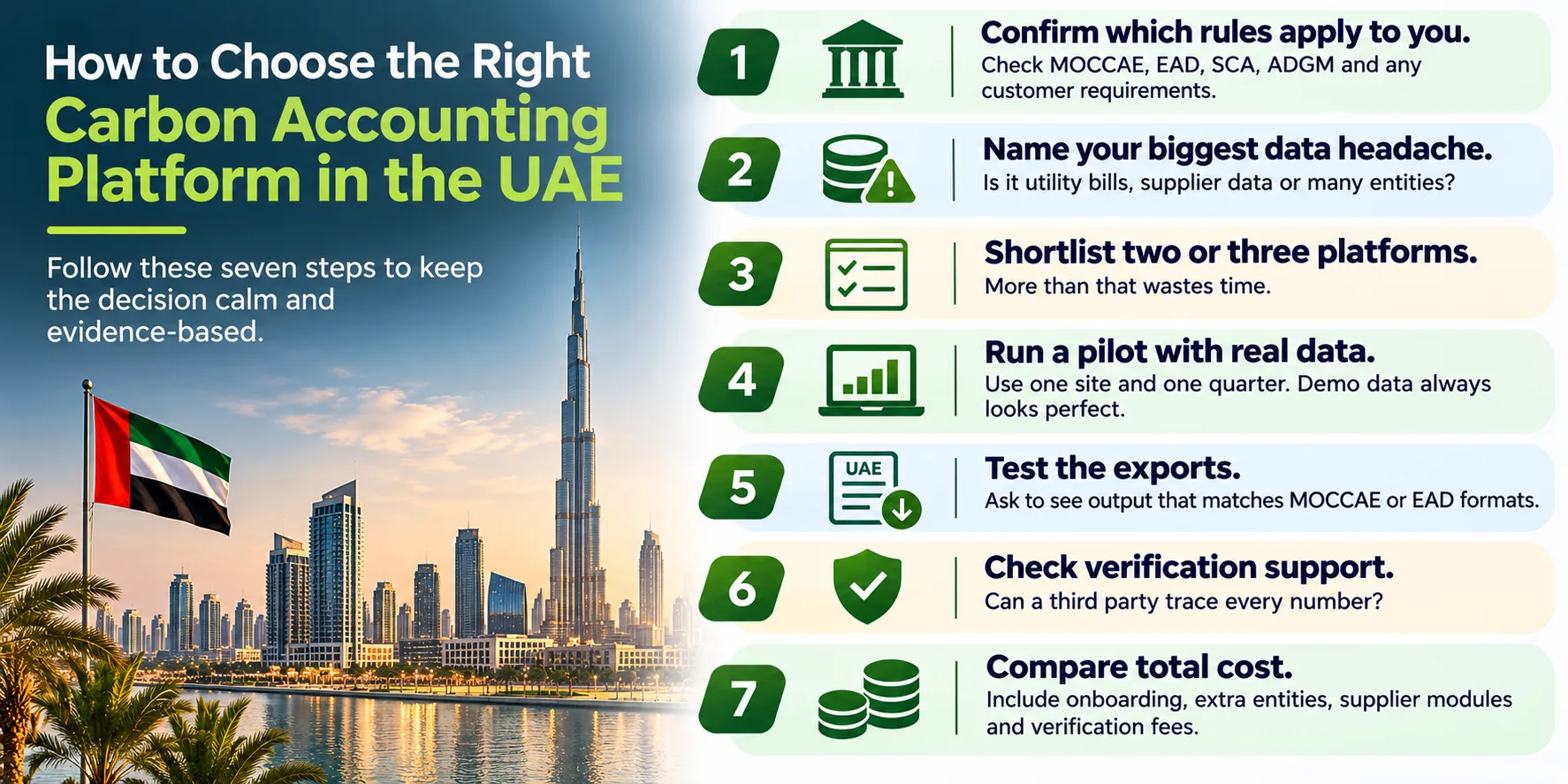
Follow these seven steps. They keep the decision calm and evidence-based.
- Confirm which rules apply to you. Check MOCCAE, EAD, SCA, ADGM, and any customer requirements.
- Name your biggest data headache. Is it utility bills, supplier data, or many entities?
- Shortlist two or three platforms. More than that wastes time.
- Run a pilot with real data. Use one site and one quarter. Demo data always looks perfect.
- Test the exports. Ask to see output that matches MOCCAE or EAD formats.
- Check verification support. Can a third party trace every number?
- Compare total cost. Include onboarding, extra entities, supplier modules, and verification fees.
Which Platform Fits Which Business?
| If you are… | Consider starting with | Why |
|---|---|---|
| A first-time SME or event organiser | Emirates Carbon | Free baseline, with an upgrade path |
| A DMCC member | Climate Essentials | Hub Partner with member rates |
| A large group with scattered data | Zeroe or Net0 | Built for complex, multi-system data |
| A GCC or Pakistan regional group, or a financial institution | Ahya | Regional focus and financed emissions |
| A supplier to UK or European customers | Climate Essentials or Net0 | Supplier data tools and Scope 3 support |
Treat this table as a starting point. Your own pilot should have the final say.
How to Build Your UAE Carbon Inventory in 8 Steps
Any platform works better when your data is ready. Here is the process most successful teams follow.
- Check your status. Find out whether MOCCAE or your emirate has designated you as a source.
- Set your boundary. List every legal entity, site, and vehicle fleet. Decide whether you use the operational control or financial control approach.
- Collect activity data. Gather electricity and chilled water bills, fuel records, refrigerant top-ups, travel logs, and purchase data.
- Pick the reporting year. Use a clean 12-month period and stick to it.
- Calculate with the right factors. Use documented UAE grid and cooling factors where available.
- Review data quality. Flag estimates and gaps. Fix the biggest ones first.
- Verify and submit. Get independent checks where required, then file through the MOCCAE MRV system or the EAD template. Keep records for five years.
- Set reduction targets. Start with energy efficiency and cooling, because they usually deliver the fastest savings.
Example: A Dubai Logistics Company (Illustrative)
Picture a logistics firm with 40 trucks and two warehouses in a free zone. Its Scope 1 comes from diesel and refrigerant top-ups on cooled storage.
Its Scope 2 comes from warehouse electricity. Its Scope 3 comes from subcontracted haulage and staff commuting.
The team starts with fuel card data and electricity bills. That alone covers most of Scope 1 and 2 within weeks. Supplier data for Scope 3 comes later.
This is a made-up example, but the pattern is real. Start with data you already hold, then widen the net.
Common Mistakes When Choosing Carbon Accounting Software
| Mistake | Why it hurts | Better approach |
|---|---|---|
| Waiting for a deadline extension | Reporting years keep passing while you wait | Measure the current year now |
| Ignoring refrigerants and cooling | You understate Scope 1 and Scope 2 | Track refrigerant top-ups and chilled water use |
| Using generic global grid factors | Scope 2 numbers drift from reality | Ask for UAE-specific factors with documented sources |
| Counting offsets as emission cuts | Offsets are reported separately from your inventory | Reduce first, then offset what remains |
| Skipping the export test | Surprises appear at submission time | Test MOCCAE and EAD formats during the pilot |
| Missing entities or sites | Your total looks smaller than it is | Map every entity before you start |
Carbon Accounting Platforms UAE: Frequently Asked Questions
What is the best carbon accounting platform in the UAE?
There is no single winner. Zeroe and Net0 suit complex enterprises, Ahya suits regional groups and financial institutions, Climate Essentials suits DMCC members and price-conscious teams, and Emirates Carbon suits first-time measurers.
Is carbon accounting mandatory in the UAE?
The federal climate law makes measuring and reporting emissions a legal duty for covered entities. MOCCAE or your emirate decides which entities must report and how. Listed companies also face annual sustainability reporting rules.
Do I still need the MOCCAE reporting tool if I use a platform?
Yes. A carbon accounting platform builds your inventory. You submit through the national MRV system and its IEQT tool. Ask your vendor how its exports line up with the MOCCAE format.
Which emission scopes do UAE companies need to report?
Scope 1 and Scope 2 are the immediate focus. Many advisers expect Scope 3 to follow. Customers and banks already ask for Scope 3 data, so start collecting supplier information early.
Does the law apply to free zone companies?
Yes. The law covers public and private entities, free zones included. Abu Dhabi also runs its own facility-level system through EAD.
How much does carbon accounting software cost in the UAE?
Prices vary widely. Free tools such as Emirates Carbon cover basic footprints. Climate Essentials lists its core software from £132 per year. Enterprise platforms usually quote by entities, sites, and modules.
Do UAE companies need third-party verification?
Verification is a core part of the MRV model. Abu Dhabi is phasing in independent verification, and federal guidance on verifiers is still developing. Build an audit trail now so you are ready.
Can I use international carbon accounting software in the UAE?
Yes, if it supports UAE emission factors, GHG Protocol methods, and exports that fit MOCCAE or EAD requirements. Test those points in a pilot before you commit.
Conclusion: Choosing Among the Best Carbon Accounting Platforms in the UAE
The UAE has moved from voluntary reporting to enforceable rules. Carbon accounting platforms in the UAE now sit at the centre of compliance, finance, and customer trust.
The best 5 carbon accounting platforms in the UAE each solve a different problem. Zeroe and Net0 handle complex data. Ahya brings regional depth and financed emissions. Climate Essentials offers clear pricing and DMCC ties. Emirates Carbon gives everyone a free starting point.
Your next step is simple:
- Confirm which rules apply to you.
- Shortlist two or three platforms.
- Run a pilot with real data.
- Test the exports before you sign.
Start measuring now. The companies that build clean data early will report faster, verify easier, and win more trust from customers and banks.
Ready to go deeper? Explore more guides at Carbon Market Network.