Carbon Market Network


If you have ever seen the term “UK Allowances” or “UKA” in a news article about climate policy and wondered what it actually means, you are not alone.
UK Allowances sit at the heart of one of the most important tools the United Kingdom uses to cut carbon emissions. Yet most people outside the energy and finance world have never had them explained in plain English.
This guide breaks down UK Allowances from the ground up. No jargon, no confusing legal language, just a clear and complete explanation of what UKAs are, how the UKA carbon market works, and why it matters to businesses and the wider UK economy.
By the end of this article, you will understand exactly how UK Allowances function, how they are bought and sold, what moves their price, and how they fit into the UK’s broader climate strategy.
What Are UK Allowances (UKAs)?
A UK Allowance, commonly shortened to UKA, is a tradeable permit that gives its holder the right to emit one tonne of carbon dioxide equivalent gas.
Think of it as a permission slip for pollution. Every UKA represents exactly one tonne of greenhouse gas that a business is allowed to release into the atmosphere.
Companies operating in certain heavy-emitting sectors are legally required to hand over one UKA for every tonne of carbon dioxide equivalent they emit each year. If they emit more than they have allowances for, they must buy more allowances or face financial penalties.
UK Allowances are the currency of the UK Emissions Trading Scheme (website), usually called the UK ETS. This scheme is the main carbon pricing mechanism used across the United Kingdom.
Carbon Market Insider Newsletter
Weekly insights on carbon markets, climate policy, carbon credits, and sustainability.
The Simple Idea Behind UK Allowances
The logic behind UK Allowances is straightforward:
- The government sets a limit, called a cap, on the total emissions allowed from covered industries.
- That cap is divided into individual UKAs, with each one covering one tonne of emissions.
- Businesses need to hold enough allowances to match their actual emissions.
- The cap gets smaller over time, so fewer allowances are available each year.
- As allowances become scarcer, their price tends to rise, pushing companies toward cleaner technology.
This approach is known as cap and trade. It uses market forces, rather than direct government control, to encourage businesses to cut emissions in the most cost-effective way possible.
A Quick Look at Why the UK ETS Exists
Before the UK left the European Union, British companies took part in the EU Emissions Trading System alongside other European nations.
Once the UK left the EU, it needed its own domestic carbon market. The result was the UK Emissions Trading Scheme, which closely mirrors the EU model but operates entirely within the UK.
The UK ETS was designed to:
- Give the UK full control over its own carbon pricing policy
- Maintain continuity for British businesses already familiar with emissions trading
- Support the UK’s legally binding target of reaching net zero emissions
- Create a domestic market where UK Allowances could be bought, sold, and traded
Since launch, the scheme has expanded in scope and tightened its emissions cap, reflecting the UK’s ambition to align carbon pricing with its net zero pathway.
How the UKA Carbon Market Actually Works
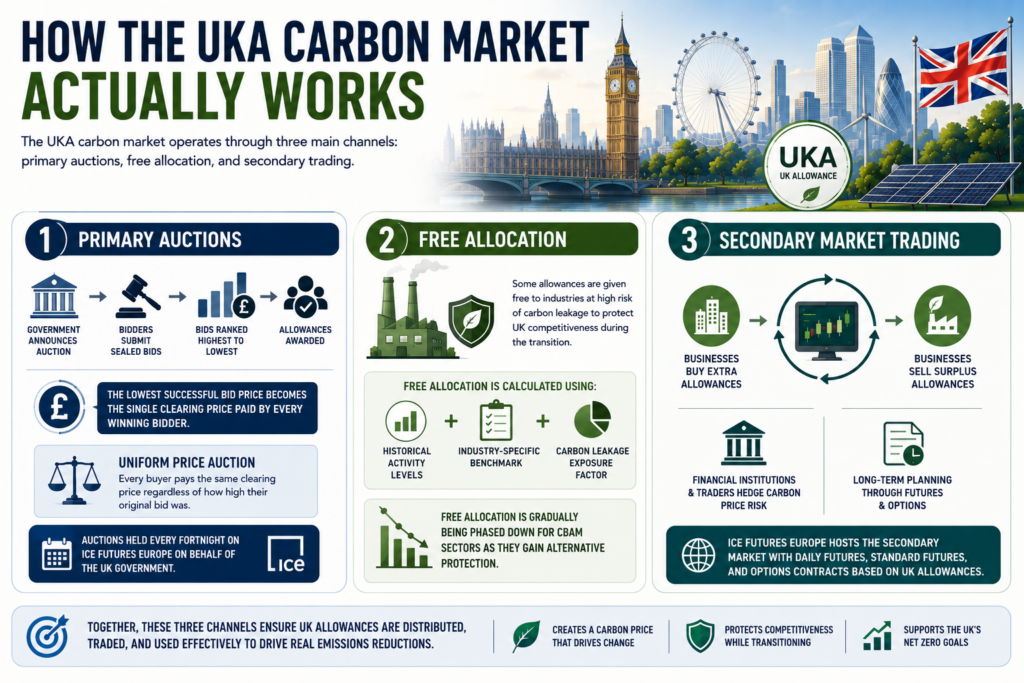
The UKA carbon market operates through three main channels: primary auctions, free allocation, and secondary trading. Understanding each one helps make sense of how allowances move through the system.
1. Primary Auctions
Most UK Allowances enter the market through regular auctions. These auctions are held every fortnight and are hosted on the ICE Futures Europe exchange on behalf of the UK government.
Here is how a typical auction works, step by step:
- The government announces an auction calendar in advance, showing dates and the volume of allowances on offer.
- Eligible bidders, mainly compliance businesses, financial institutions, and authorised trading groups, submit sealed bids.
- Bids are ranked from highest to lowest price.
- Allowances are awarded starting with the highest bidder and working down until the full volume is sold.
- The lowest successful bid price becomes the single clearing price paid by every winning bidder.
This is known as a uniform price auction, meaning every buyer pays the same clearing price regardless of how high their original bid was.
2. Free Allocation
Not every UKA is sold. Some are given away free of charge to industries considered at high risk of “carbon leakage.”
Carbon leakage happens when a business moves its production to another country with weaker climate rules simply to avoid paying for emissions. Free allocation protects UK manufacturers from this risk while the broader economy transitions to lower carbon methods.
Free allowances are calculated using:
- The installation’s historical activity levels
- An industry-specific benchmark
- A carbon leakage exposure factor
This free allocation is gradually being phased down for sectors that fall under the UK’s Carbon Border Adjustment Mechanism, since those sectors gain a different form of protection instead.
3. Secondary Market Trading
Once allowances are in circulation, whether through auctions or free allocation, they can be freely bought and sold on the secondary market.
The secondary market allows:
- Businesses to buy extra allowances if they expect to emit more than planned
- Businesses to sell surplus allowances if they emit less than expected
- Financial institutions and traders to hedge future carbon price risk
- Long-term planning through futures and options contracts
ICE Futures Europe hosts this secondary market, offering daily futures, standard futures, and options contracts based on UK Allowances.
Who Actually Buys and Trades UK Allowances
A common misconception is that only heavy polluters can hold UKAs. In reality, several types of participants take part in the UKA carbon market.
| Participant Type | Role in the Market |
|---|---|
| Compliance businesses | Must surrender UKAs to match their verified emissions |
| Financial institutions | Trade allowances for investment and hedging purposes |
| Business groupings | Represent multiple compliance entities in auctions |
| Public and state bodies | May participate on behalf of entities they control |
| Individual traders | Can trade UKA derivatives through authorised brokers |
This mix of participants helps keep the market liquid, meaning allowances can be bought and sold efficiently without wild, unpredictable price swings.
What Determines the Price of a UK Allowance?
The price of a UKA is not fixed. It moves according to supply and demand, just like any other traded commodity.
Several key factors influence UKA prices:
Supply Side Factors
- The overall emissions cap: A shrinking cap means fewer allowances are available, which tends to push prices upward over time.
- Free allocation levels: Higher free allocation means fewer allowances need to be bought, which can soften demand at auction.
- Banking: Businesses can save unused allowances for future years, affecting how many allowances circulate at any given time.
Demand Side Factors
- Economic activity: When industrial output rises, emissions tend to rise too, increasing demand for allowances.
- Fuel prices: Higher gas prices can push power generators toward more carbon-intensive fuels, increasing allowance demand.
- Policy expectations: Anticipated tightening of future caps often causes prices to rise in advance.
- Weather patterns: Colder winters or lower renewable output can increase reliance on fossil fuel generation.
Built-In Price Controls
The UK ETS includes two mechanisms designed to prevent extreme price behaviour.
Auction Reserve Price (ARP)
The ARP sets a minimum price below which bids will not be accepted at auction. This floor price is adjusted periodically in line with inflation, ensuring its real value does not erode over time.
Cost Containment Mechanism (CCM)
The CCM protects against sudden price spikes. If the average UKA price stays at three times the average of the previous two years for six consecutive months, the mechanism can be triggered.
When triggered, the UK ETS Authority may respond by:
- Bringing forward allowances from future auctions
- Releasing allowances from a market stability reserve
- Auctioning unused allowances from the new entrants’ reserve
- Redistributing supply between planned auctions
This gives the market a built-in safety valve, helping avoid extreme volatility while still allowing prices to reflect genuine scarcity.
Understanding the UK ETS Emissions Cap
The cap is the single most important design feature of the UK Allowances system. It determines exactly how many tonnes of emissions the covered sectors are allowed to produce.
Here is what makes the cap function so effectively:
- The cap declines every year, following a set reduction trajectory.
- A smaller cap means fewer UKAs are issued, tightening supply.
- The reduction trajectory is designed to align with the UK’s broader climate commitments.
- The cap can be adjusted to reflect scope changes, such as new sectors joining the scheme.
A shrinking cap is the mechanism that ultimately drives long-term decarbonisation. As allowances become scarcer and more expensive, switching to cleaner processes becomes financially attractive compared to paying for ever-costlier emissions.
UK Allowances vs EU Allowances: Key Differences
Since the UK ETS was modelled on the EU ETS, people often confuse UK Allowances with EU Allowances, known as EUAs. They are related in design but are entirely separate assets.
| Feature | UK Allowances (UKA) | EU Allowances (EUA) |
|---|---|---|
| Governing scheme | UK Emissions Trading Scheme | EU Emissions Trading System |
| Geographic coverage | United Kingdom only | European Economic Area |
| Trading currency | British pounds | Euros |
| Auction host | ICE Futures Europe | Multiple EU platforms |
| Linkage status | Currently a standalone scheme | N/A |
| Cap trajectory | Aligned with UK net zero targets | Linear Reduction Factor approach |
The UK and EU have agreed in principle to work toward linking their two schemes in the future. A formal link would allow UKAs and EUAs to be used somewhat interchangeably, potentially improving liquidity and price stability on both sides. Until that linkage is finalised, the two carbon markets remain separate.
Which Sectors Are Covered by the UK ETS?
The UK ETS currently applies mainly to industries that produce large volumes of emissions and would otherwise struggle to reduce output quickly.
| Sector | Examples |
|---|---|
| Power generation | Fossil fuel power stations |
| Heavy industry | Steel, cement, chemicals, refining |
| Aviation | Flights within the UK and to the European Economic Area |
| Maritime (expanding) | Domestic shipping journeys above a set tonnage threshold |
| Waste (expanding) | Waste incineration and related processes, entering a monitoring phase before full inclusion |
The scheme is gradually widening its scope. Maritime transport is being phased in, waste management is moving through a monitoring stage ahead of full participation, and further sector expansion remains under active review.
The Future of UK Allowances and the UK Carbon Market
The UK ETS is not a static system. Several major developments are shaping where the UKA carbon market is heading.
Greenhouse Gas Removals
Engineered carbon removal credits are being integrated into the scheme. These credits would come from verified domestic removal projects and would replace allowances on a one-for-one basis without changing the overall emissions cap.
To qualify, removal projects must meet strict permanence requirements, ensuring the carbon stays locked away for a very long period rather than being released again shortly after capture.
Carbon Border Adjustment Mechanism (CBAM)
A UK version of a carbon border tax is being introduced. This mechanism will apply a carbon price to certain imported goods, helping prevent cheaper, carbon-intensive imports from undermining UK industries that already pay for their emissions through UKAs.
As CBAM comes into force for relevant sectors, free allocation for those same sectors will be gradually phased down, since businesses will gain protection from the border mechanism instead.
Sector Expansion
Maritime emissions are being brought into scope, with domestic shipping journeys above a certain size already covered and international shipping under active consultation. Waste management is following a similar phased approach.
A Longer Term Phase
The scheme has been extended into a new long-term phase, giving businesses much greater certainty about the future of the UK carbon market and allowing for long-range investment planning in low-carbon technology.
Potential EU Linkage
The UK and EU have committed to working toward linking their emissions trading systems. If this happens, it could significantly change how UK Allowances are priced and traded, bringing the two markets closer together.
Why UK Allowances Matter for Businesses
If your company operates in a covered sector, or if you work in finance, sustainability, or corporate strategy, UK Allowances are not just an abstract policy detail. They carry real financial weight.
Here is why UKAs matter in practical terms:
- Compliance cost: Businesses must budget for the ongoing cost of surrendering allowances each year.
- Financial risk management: Rising or falling UKA prices directly affect operating costs, making hedging strategies important.
- Investment signals: A rising carbon price makes low-carbon technology investments more financially attractive.
- Competitive positioning: Companies that decarbonise faster can reduce their allowance costs and even sell surplus UKAs.
- Reporting obligations: Covered businesses must accurately monitor, report, and verify their emissions each year.
A Simple Example
Imagine a UK-based manufacturing plant that emits 100,000 tonnes of carbon dioxide equivalent in a year.
If the plant receives 60,000 free allowances, it still needs another 40,000 UKAs to cover the remaining emissions. It can buy these either at auction or on the secondary market.
If the market price per allowance rises, the plant’s compliance cost increases directly. This creates a clear financial incentive to invest in energy efficiency, cleaner fuels, or emissions reduction technology to shrink that gap over time.
Step by Step: How Businesses Participate in UKA Trading
For companies new to the UKA carbon market, participation generally follows this process:
- Determine compliance status: Confirm whether your installation or activity falls under UK ETS scope.
- Obtain a permit: Apply for the relevant emissions permit or monitoring plan required to operate legally within the scheme.
- Open a registry account: Register with the UK Emissions Trading Registry, which acts as the official record-keeping system for allowances.
- Monitor emissions: Track emissions throughout the year using approved monitoring and reporting methods.
- Acquire allowances: Source UKAs through auctions, free allocation, or secondary market purchases.
- Surrender allowances: Submit the required number of UKAs to match verified annual emissions by the compliance deadline.
- Plan ahead: Use forward contracts or banked allowances to manage future price risk.
Businesses without in-house carbon trading expertise often work with brokers or corporate banking partners experienced in UK ETS participation.
Common Misconceptions About UK Allowances
A few misunderstandings come up again and again when people first learn about UKAs.
- “UKAs are the same as carbon offsets.” They are not. UKAs are compliance instruments tied to a legal cap, while offsets are voluntary credits generated outside the compliance system. Offsets cannot currently be used for UK ETS compliance.
- “Only big polluters can trade UKAs.” Financial institutions, brokers, and eligible traders can also participate in the secondary market.
- “The price only goes up.” UKA prices rise and fall based on real market conditions, including economic activity, energy prices, and policy news.
- “UK Allowances and EU Allowances are interchangeable.” They currently belong to two entirely separate schemes, even though a future link is being discussed.
Practical Takeaways
If you are trying to understand or work with UK Allowances, keep these key points in mind:
- A UKA represents one tonne of carbon dioxide equivalent emissions permission.
- The UK ETS uses a shrinking cap to gradually reduce total allowed emissions.
- Allowances enter the market through auctions and free allocation, then circulate on the secondary market.
- Prices are shaped by supply, demand, and two built-in safety mechanisms, the ARP and the CCM.
- The scheme is actively expanding to cover more sectors and integrate carbon removals.
- Businesses in covered sectors should treat UKA costs as a core part of long-term financial planning.
Frequently Asked Questions About UK Allowances
What does UKA stand for?
UKA stands for UK Allowance, the tradeable unit used within the UK Emissions Trading Scheme. Each UKA permits the emission of one tonne of carbon dioxide equivalent.
How is the price of a UK Allowance determined?
Price is set through open auctions and ongoing secondary market trading, influenced by the emissions cap, industrial demand, energy prices, and policy expectations.
Who needs to buy UK Allowances?
Businesses operating in covered sectors, such as power generation, heavy industry, and aviation, must hold enough allowances to match their verified annual emissions.
Can individuals invest in UK Allowances?
Individuals can gain exposure through authorised brokers offering UKA derivatives, though direct participation is mainly aimed at compliance entities and financial institutions.
Are UK Allowances and EU Allowances the same thing?
No. They belong to two separate emissions trading schemes with different governing rules, currencies, and auction platforms, although a future link between the two markets is under discussion.
What happens if a company does not surrender enough allowances?
Non-compliant businesses face financial penalties and are still required to make up the shortfall by surrendering the missing allowances.
Can UK Allowances be saved for future years?
Yes. Businesses can bank unused allowances and carry them forward for use in later compliance years.
Is the UK ETS cap the same every year?
No. The cap reduces annually according to a set trajectory, gradually tightening the total supply of allowances over time.
Final Thoughts
UK Allowances might sound like a niche financial instrument at first glance, but they represent one of the UK’s most powerful tools for driving down emissions across its most carbon-intensive industries.
By putting a real financial cost on carbon, the UKA carbon market pushes businesses toward cleaner operations without dictating exactly how they get there. That flexibility, combined with a steadily shrinking cap, is what makes cap and trade systems like the UK ETS so effective over the long run.
Whether you are a business owner navigating compliance obligations, a finance professional exploring carbon markets, or simply someone trying to understand climate policy, grasping how UK Allowances work gives you real insight into how the UK is pricing its path toward net zero.
As the scheme continues to expand into new sectors and integrate carbon removals, UK Allowances will only become more central to how the country manages its climate commitments in the years ahead.
If you want to keep learning about carbon markets, ESG strategy, and sustainability trends, explore more resources on Carbon Market Network.