Carbon Market Network


By James Berry, Senior ESG Analyst, ESG Consulting
Guest Contribution: This article has been written by James Berry, Senior ESG Analyst at ESG Consulting. The views, opinions, and information expressed in this article belong to the author and their organisation. Carbon Market Network is not affiliated with, nor does it necessarily endorse, the views expressed by the author.
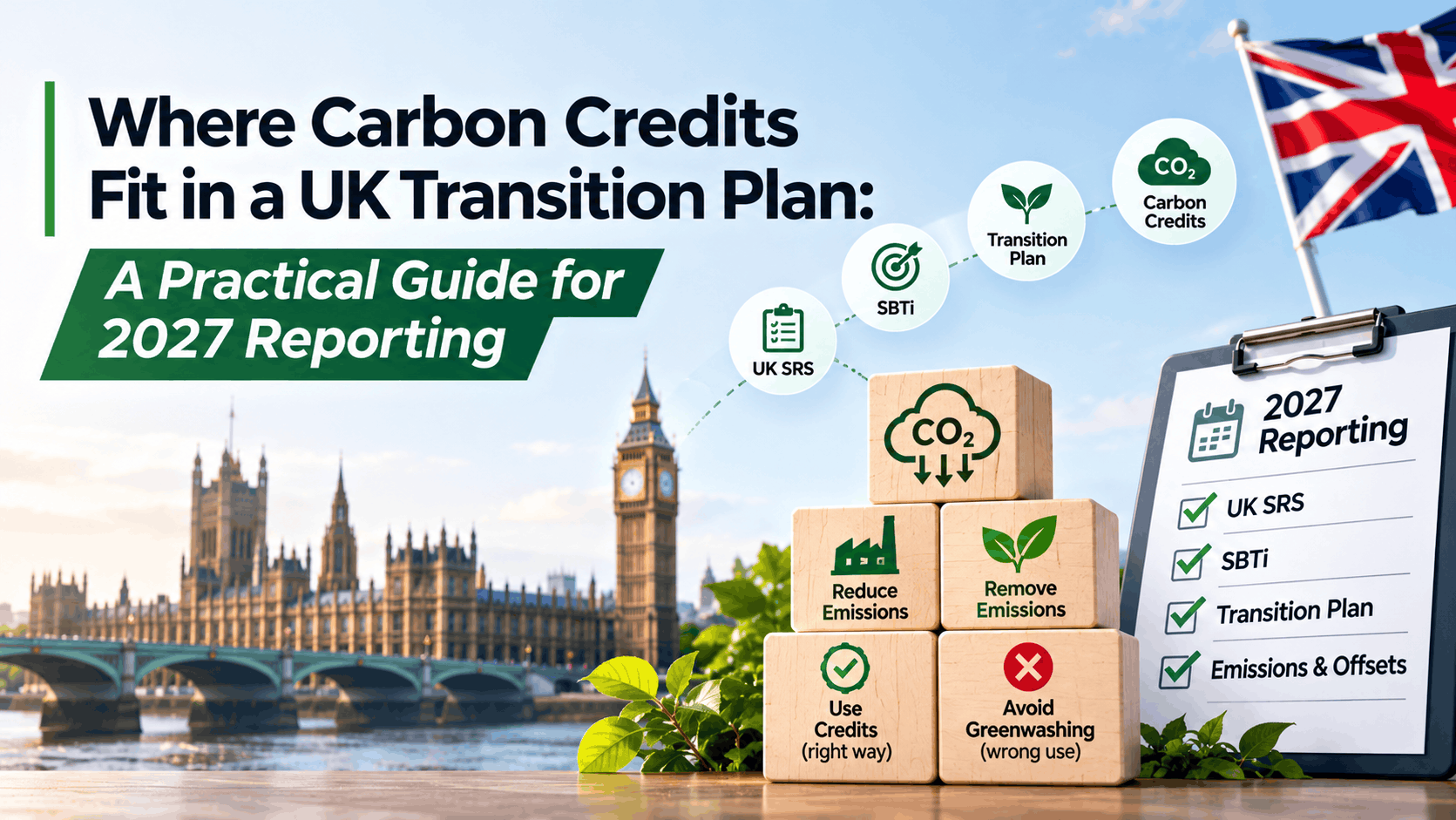
UK companies are about to face sharper questions about carbon credits. From accounting periods beginning 1 January 2027, the FCA’s new rules require companies with a primary UK listing to report against UK SRS S2 on a comply or explain basis. They must also state whether they have published a climate transition plan, where it can be found, or why they have not published one. Investors, auditors and campaigners will read those plans closely, and the role given to carbon credits is often the first thing they test.
This article sets out how UK firms can treat credits inside a transition plan in a way that is credible and defensible.
What the guidance actually says
There is no single UK rulebook for offsets in transition plans, but the main sources point the same way.
UK SRS S2. The final UK SRS S1 and S2 were published by the government on 25 February 2026 and are based on the ISSB’s IFRS S1 and S2. Like IFRS S2, UK SRS S2 asks companies to explain how they plan to meet their climate targets. Where a company has a net greenhouse gas target, it must disclose the planned use of carbon credits to meet it. That includes the extent to which the target relies on credits, which third-party scheme verifies or certifies them, whether they are nature-based or technological, whether they come from removals or emission reductions, and any other factors needed to judge their credibility, such as assumed permanence.
Transition Plan Taskforce. The TPT Disclosure Framework, published in October 2023, says a transition plan should set out how a company will decarbonise its own operations and value chain first. Credits can feature, but they should be disclosed separately and should not be presented as reductions in gross emissions. The TPT materials have since passed to the IFRS Foundation, and the FCA points listed companies to the IFRS educational material on transition plans.
Government integrity principles. In November 2024 the government published six Principles for Voluntary Carbon and Nature Market Integrity. The first principle is to use credits in addition to ambitious action within value chains, not instead of it. The 2025 consultation tested endorsing the VCMI Claims Code of Practice and the ICVCM Core Carbon Principles as reference points, and the summary of responses published in 2026 showed broad support for both.
Consumer law. Any public claim based on credits, such as “carbon neutral” or “net zero product”, also falls under the CMA’s Green Claims Code. Since April 2025 the CMA has been able to fine companies directly for breaches of consumer protection law, so loose offset claims are now a financial risk as well as a reputational one.
The common thread is simple. Abatement comes first. Credits are a supplement, they are disclosed separately, and their quality has to be evidenced.
The core distinctions every plan needs
Gross emissions versus net claims. Report gross Scope 1, 2 and 3 emissions and progress against reduction targets without any netting. If credits are used, show them in a separate line. A reader should be able to see the real trajectory of the business without the credits.
Abatement versus residual emissions. Residual emissions are what remains after all technically and economically feasible reductions have been made. Under the SBTi Corporate Net-Zero Standard this is typically no more than 5 to 10 percent of base year emissions, depending on sector. Neutralising residual emissions at net zero requires permanent removals, not avoidance credits.
Beyond value chain mitigation versus offsetting. Many companies now buy credits as a contribution to climate action beyond their own value chain, while still reporting gross emissions in full. This is more defensible than claiming credits cancel out current emissions.
Reductions versus removals. Avoidance and reduction credits, such as cookstove or avoided deforestation projects, can channel useful finance. Removal credits, such as afforestation, biochar or direct air capture, are what matter for neutralising residual emissions. The plan should say which type is used and why.
Integrity checks that hold up under scrutiny
Before a credit is relied on in any plan, it should pass basic quality tests.
- Additionality. Would the reduction or removal have happened anyway? Projects that were already financially viable or legally required are weak.
- Permanence. How long will the carbon stay out of the atmosphere, and what happens if it is reversed? Forestry credits need buffer pools and monitoring. Geological storage offers far longer durability.
- Robust baselines and quantification. Over-credited baselines have been the source of many recent controversies, particularly in older REDD+ projects.
- No double counting. Check that the credit is retired in a public registry in your name. For credits linked to international transfers under Article 6 of the Paris Agreement, check whether a corresponding adjustment applies if you plan to make a claim that depends on one.
- Social and environmental safeguards. Evidence of community consent, benefit sharing and no harm to biodiversity.
- Recognised labels. ICVCM CCP-approved methodologies, and for UK nature projects the Woodland Carbon Code, Peatland Code or BSI Nature Investment Standards, give a useful minimum bar. They are not a substitute for project-level due diligence.
A practical checklist for UK firms
- Set the abatement case first. Build a costed decarbonisation pathway for Scope 1, 2 and material Scope 3 categories before deciding any role for credits.
- Quantify residual emissions. Estimate what is genuinely hard to abate by 2030, 2040 and the net zero year, with the reasons for each item.
- Decide the purpose of any credits. Separate interim beyond value chain contributions from long-term neutralisation of residual emissions.
- Write a credit policy. Cover eligible credit types, quality standards, vintage limits, removal share over time and approval governance.
- Disclose in line with UK SRS S2. State the extent of reliance on credits, the verification schemes used, nature-based versus technological, and reduction versus removal.
- Keep credits off the gross line. Report gross emissions and reduction progress separately from any credit retirements.
- Plan the removals ramp. Set out how the share of durable removals will rise towards the net zero year, and consider long-term offtake agreements to manage price and supply risk.
- Check every public claim. Test product and corporate claims against the CMA Green Claims Code and the VCMI Claims Code before they are published.
- Assign board oversight. Make credit strategy part of transition plan governance, with clear ownership and periodic review.
- Report progress honestly. Each year, show what was retired, what it was used for and how actual abatement compares with the plan.
Final thought
The UK direction of travel is now settled enough to plan around. Credits have a legitimate place in a transition plan, but only as a clearly disclosed supplement to real decarbonisation, backed by evidence of quality. Companies that lean on credits to flatter their trajectory are likely to face growing challenge as 2027 reporting begins.
From our work at ESG Consulting, the strongest plans are usually the most transparent ones. They show the gross numbers plainly, explain the residual emissions honestly and treat credits as one tool among many rather than the headline.
Public sources
- UK SRS S1 and S2 (GOV.UK): https://www.gov.uk/government/publications/uk-sustainability-reporting-standards-uk-srs-s1-and-uk-srs-s2
- FCA sustainability reporting requirements: https://www.fca.org.uk/firms/climate-change-sustainable-finance/reporting-requirements
- Voluntary carbon and nature markets: raising integrity (GOV.UK): https://www.gov.uk/government/consultations/voluntary-carbon-and-nature-markets-raising-integrity
- Transition Plan Taskforce Disclosure Framework: https://transitiontaskforce.net/disclosure-framework/
- ICVCM Core Carbon Principles: https://icvcm.org/core-carbon-principles/
- VCMI Claims Code of Practice: https://vcmintegrity.org/vcmi-claims-code-of-practice/
James Berry is a Senior ESG Analyst at ESG Consulting, where he works on climate disclosure and transition planning.
If you want to learn more about how carbon markets work, how credits are issued, and what makes a high-quality carbon project, explore the resources at Carbon Market Network.