Carbon Market Network


Water is disappearing faster than farmers can pump it, and the atmosphere is warming faster than most crops can adapt to. Drip irrigation has quietly become one of the smartest tools to fix both problems at once, and it now pays farmers to do it.
Carbon credits from drip irrigation are turning a simple switch, from flooding fields to dripping water directly to the roots, into a real income stream. This is not a future concept. It is happening on farms right now, from rice paddies in Asia to vineyards in Europe and row crops in the Americas.
This guide explains exactly how carbon credits from drip irrigation work, why they exist, who can earn them, and how much money is realistically on the table. It also covers the science, the risks, the paperwork, and the practical steps needed to get started.
By the end, you will understand this topic better than most consultants selling carbon programs to farmers.
What Are Carbon Credits from Drip Irrigation
Carbon credits from drip irrigation are tradable certificates earned when a farm switches from traditional irrigation, like flood or furrow irrigation, to drip systems that measurably cut greenhouse gas emissions.
Each credit typically represents one tonne of carbon dioxide equivalent (CO2e) that was reduced or avoided. Companies and governments buy these credits to offset emissions they cannot yet eliminate directly.
Drip irrigation earns credits mainly by cutting three things:
- Methane emissions from waterlogged soil, especially in rice cultivation.
- Nitrous oxide emissions that spike when fields stay wet and nitrogen fertilizer is applied.
- Fuel and electricity use from pumps that run less often and less intensely.
In simple terms, less standing water means fewer anaerobic conditions in the soil, and fewer anaerobic conditions mean less methane and nitrous oxide escaping into the air.
Carbon Market Insider Newsletter
Weekly insights on carbon markets, climate policy, carbon credits, and sustainability.
Why Irrigation Matters So Much for Climate Change
Most people think about carbon emissions in terms of cars, factories, and power plants. Farming, especially irrigated farming, is a massive and often overlooked source of greenhouse gases.
Flooded agriculture, particularly rice paddies, is responsible for a significant share of global methane emissions. Methane traps far more heat than carbon dioxide over a short time horizon, which makes it a priority target for climate action.
Here is a simple breakdown of why irrigation choices matter:
| Irrigation Method | Typical Water Use | Methane Risk | Nitrous Oxide Risk | Energy Use |
|---|---|---|---|---|
| Flood irrigation | Very high | High (in rice) | Moderate to high | High (pumping large volumes) |
| Furrow irrigation | High | Low to moderate | Moderate | Moderate |
| Sprinkler irrigation | Moderate | Low | Moderate | Moderate to high |
| Drip irrigation | Low | Very low | Low | Low |
Switching just a fraction of the world’s irrigated farmland to drip systems can meaningfully cut agricultural emissions while also saving enormous volumes of fresh water.
Learn more about carbon credits: https://carboncreditcourse.com/
How Drip Irrigation Reduces Greenhouse Gas Emissions
Understanding the mechanism helps explain why carbon registries take this seriously. It is not just a marketing claim, it is measurable soil chemistry.
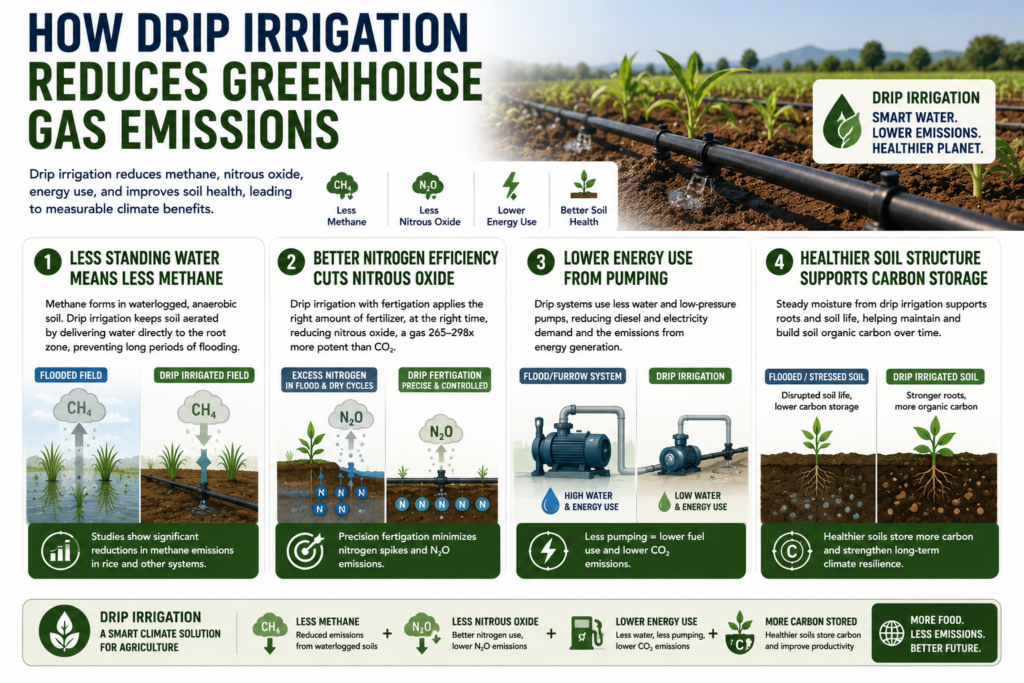
1. Less Standing Water Means Less Methane
Methane forms when soil bacteria break down organic matter without oxygen, a process that thrives in waterlogged, flooded conditions. Drip irrigation delivers small amounts of water directly to the root zone instead of submerging the whole field, so the soil stays aerated most of the time.
Studies on rice systems using controlled or drip based irrigation, instead of continuous flooding, have recorded sharp cuts in methane output, since the soil no longer stays anaerobic for weeks at a stretch.
2. Better Nitrogen Efficiency Cuts Nitrous Oxide
When fields are flooded and then dry repeatedly, nitrogen fertilizer converts more easily into nitrous oxide, a gas roughly 265 to 298 times more potent than carbon dioxide over a hundred year period.
Drip irrigation allows precise fertigation, meaning fertilizer gets applied through the drip lines in small, controlled doses exactly when the plant needs it. This avoids the large nitrogen spikes that trigger nitrous oxide formation.
3. Lower Energy Use From Pumping
Flood and furrow systems often require pumping large water volumes over long periods, which burns diesel or draws heavily on the electricity grid. Drip systems use far less water overall and often run on low pressure pumps, cutting fuel and electricity demand and the emissions tied to generating that power.
4. Healthier Soil Structure Supports Carbon Storage
Consistent, moderate soil moisture from drip irrigation supports steady root growth and microbial activity, which can help maintain or slowly build soil organic carbon over time. Flooded or drought stressed soils, by contrast, swing between extremes that disrupt this process.
Who Can Actually Earn Carbon Credits from Drip Irrigation
Not every farm automatically qualifies, but the eligible pool is large and growing. Typical candidates include:
- Rice farmers switching from continuous flooding to drip or alternate wetting and drying combined with drip technology.
- Orchard and vineyard growers moving from flood or furrow systems to drip lines.
- Vegetable and row crop farmers replacing sprinkler or furrow irrigation with subsurface or surface drip.
- Sugarcane and cotton growers in regions where flood irrigation is still standard practice.
- Water utilities and municipal programs that fund precision irrigation to cut both water use and emissions across many small farms at once.
Farm size is not usually the deciding factor. What matters most is a clear, documented shift from a high emission baseline practice to a lower emission drip based practice, along with reliable data to prove it happened.
The Science Behind Verification: How Emissions Are Measured
Carbon credits only exist if the emissions reduction can be proven, monitored, and verified independently. This process is often called MRV, short for Measurement, Reporting, and Verification.
Step 1: Establishing a Baseline
Before any credits get issued, project developers must document what the farm was doing before drip irrigation, including irrigation frequency, water volume, fertilizer schedule, and crop type. This baseline is the comparison point for every future measurement.
Step 2: Choosing a Methodology
Carbon registries approve specific methodologies that define exactly how emissions reductions must be calculated for a given practice. For irrigation and fertilization projects, registries such as Verra have been developing and refining methodologies specifically covering precision irrigation and fertilization, alongside existing agricultural methodologies that cover improved land management more broadly.
Step 3: Monitoring Emissions and Practices
Modern projects increasingly rely on a mix of tools:
- Flux chambers placed in fields to directly measure methane and nitrous oxide moving from soil to air.
- Soil moisture sensors to confirm the field is not being over watered back toward flooded conditions.
- Satellite and remote sensing data to confirm irrigation patterns and crop health across large areas.
- IoT enabled water meters to log exactly how much water each drip system uses.
- Farmer record keeping and surveys, still required in many programs alongside digital data.
Step 4: Third Party Verification
An accredited, independent verifier reviews the data against the approved methodology and confirms the emissions reduction actually happened, at the level claimed, without double counting.
Step 5: Credit Issuance
Once verification is complete, the registry issues carbon credits, which then get listed, sold, and eventually retired by a buyer who counts the reduction toward their own climate targets.
Real World Example: Rice Farming and Drip Irrigation Programs
Rice cultivation offers one of the clearest and most studied examples of this opportunity, since flooded paddies are such a large methane source.
Agricultural technology companies specializing in irrigation equipment have partnered with rice growers in regions such as parts of Asia and the Mediterranean to trial drip based systems for rice, a crop traditionally grown underwater.
In one documented project, a large rice farm in Italy adopted drip irrigation across its paddies and worked with researchers using flux chambers to measure real time emissions from the soil. The data was then submitted for independent verification so that carbon credits could be issued and sold, with proceeds shared back to the farming operation.
The broader logic behind these programs is straightforward: rice covers a massive share of the world’s irrigated cropland, so even a modest shift away from continuous flooding can add up to a meaningful global emissions cut.
One challenge that keeps surfacing in these programs is upfront cost. Farmers often need to buy drip equipment before planting, but carbon credit payments typically arrive only after the harvest season ends and verification is complete. Several programs now address this by allowing carbon credit buyers to pre-purchase future credits, giving farmers working capital earlier in the cycle.
How Much Money Can Drip Irrigation Carbon Credits Generate
This is the question every farmer actually wants answered. The honest response is that it depends heavily on crop type, region, credit price, and the size of the emissions reduction achieved.
That said, here is a general framework for thinking about potential revenue:
| Factor | Why It Matters |
|---|---|
| Crop type | Rice and other water intensive crops usually generate larger emissions cuts, and therefore more credits, than crops with lower baseline emissions. |
| Farm size | More hectares under drip irrigation generally means more tonnes of CO2e reduced, and more credits issued. |
| Baseline practice | A farm moving from heavy flood irrigation sees a bigger drop than one moving from an already efficient sprinkler system. |
| Carbon credit price | Voluntary carbon market prices vary widely depending on project type, credit quality, and buyer demand. |
| Verification costs | Registry fees, verifier costs, and monitoring equipment reduce the net payout to farmers. |
| Program structure | Some programs pay farmers a flat fee per hectare, others share a percentage of credit sale revenue. |
As a rough guide, agricultural carbon credit projects globally often generate anywhere from a fraction of a tonne to several tonnes of CO2e reduction per hectare per year, depending on the crop and baseline conditions. Farmers should treat any specific number offered by a program as an estimate until their own baseline data is measured.
It is worth noting that carbon credit income is rarely a farm’s main revenue source. It works best as a supplementary income stream that helps offset the cost of the drip irrigation equipment itself, alongside the water and fertilizer savings the farmer already gains from switching systems.
Step by Step: How a Farmer Can Start Earning Carbon Credits from Drip Irrigation
- Assess current irrigation practices. Document water source, irrigation method, frequency, and fertilizer use for at least one full growing season if possible.
- Research eligible methodologies and registries. Look into registries such as Verra and Gold Standard, and check which approved methodologies cover irrigation, fertilization, or broader agricultural land management improvements relevant to the crop being grown.
- Find a project developer or aggregator. Most individual farms are too small to run a carbon project alone. Aggregators bundle many farms together, handle the paperwork, and connect farmers to buyers.
- Install drip irrigation infrastructure. This includes main lines, drip tape or tubing, filtration systems, and often soil moisture sensors to support monitoring.
- Maintain detailed records. Keep logs of irrigation timing, water volume, fertilizer application, and any changes to farming practice throughout the season.
- Support the monitoring process. Allow flux chamber installation, sensor deployment, or field visits from the verification team as required by the chosen methodology.
- Undergo third party verification. An independent verifier reviews all data against the baseline and methodology requirements.
- Receive issued credits and payment. Once credits are verified and issued, they get sold on the voluntary carbon market, and the farmer receives an agreed share of the proceeds.
- Continue monitoring in future seasons. Most carbon programs require ongoing monitoring for several years to confirm the practice change is permanent, not a one time event.
Benefits Beyond Carbon Credits
Farmers considering drip irrigation should not view carbon credits as the only reason to switch. The direct farming benefits are often larger and more immediate than the carbon income itself.
- Significant water savings, since drip systems typically use far less water than flood or furrow irrigation for the same yield.
- Reduced fertilizer waste, because fertigation applies nutrients precisely where and when the plant needs them.
- Lower labor and energy costs, from reduced pumping time and simpler field management.
- Higher and more consistent yields in many crops, thanks to steady moisture levels instead of wet and dry extremes.
- Reduced weed growth, since water reaches only the root zone instead of the whole field surface.
- Better resilience during drought, since drip systems make every drop of available water count.
Carbon credits act as a bonus on top of these existing advantages, helping offset the upfront capital cost of drip equipment.
Challenges and Risks to Understand Before Joining a Program
No opportunity is without friction, and drip irrigation carbon projects carry a few real risks that farmers and investors should weigh carefully.
Upfront Capital Requirements
Drip systems cost money to install, and carbon credit payments usually arrive well after that investment, sometimes only after a full season of verified data. Farmers should plan financing carefully rather than assuming carbon income will cover setup costs immediately.
Methodology Availability
Not every crop and region has a finalized, registry approved methodology covering drip irrigation specifically. Some methodologies remain under development or apply only to certain crops, such as rice. Farmers should confirm methodology status before committing to a program.
Additionality Requirements
Carbon registries require that the emissions reduction would not have happened anyway without the carbon credit incentive. A farmer already planning to switch to drip irrigation for water saving reasons alone may face extra scrutiny proving the carbon program specifically enabled the change.
Measurement Complexity
Accurately measuring methane and nitrous oxide reductions requires specialized equipment and expertise. Smaller farms may struggle to justify this cost alone, which is why aggregator models pooling many farms together have become common.
Market Price Volatility
Voluntary carbon credit prices fluctuate based on buyer demand, credit quality perceptions, and broader market sentiment. Farmers should treat carbon income as variable, not guaranteed.
Long Term Monitoring Commitments
Most programs require monitoring for multiple years to confirm the practice continues, which means farmers commit to ongoing record keeping and site access for verifiers well beyond the first payment.
Drip Irrigation Carbon Credits vs Other Agricultural Carbon Practices
It helps to see how this practice compares with other well known agricultural carbon strategies.
| Practice | Main Emission Reduced | Verification Complexity | Typical Co-Benefit |
|---|---|---|---|
| Drip irrigation | Methane, nitrous oxide, energy use | Moderate to high | Water savings, yield improvement |
| No-till farming | Soil carbon loss | Moderate | Soil health, reduced fuel use |
| Cover cropping | Soil carbon loss, nitrous oxide | Moderate | Soil health, erosion control |
| Alternate wetting and drying (rice) | Methane | Moderate | Water savings |
| Biochar application | Long term carbon storage | High | Soil fertility |
| Agroforestry | Carbon sequestration in biomass | High | Biodiversity, shade, timber |
Drip irrigation often pairs well with several of these practices, and some carbon programs now combine drip irrigation with cover cropping or reduced tillage under a single broader agricultural methodology to maximize both emissions reductions and farmer income.
The Role of Technology in Scaling These Projects
Technology is what makes small scale, distributed farming emissions reductions verifiable at a cost that makes sense. Without it, monitoring thousands of small farms individually would be far too expensive for any carbon program to run profitably.
Key technologies shaping this space include:
- Remote sensing and satellite imagery, used to confirm irrigation patterns and crop cover across large areas without site visits for every field.
- Low cost IoT soil and water sensors, which have dropped significantly in price and now make continuous monitoring realistic for mid sized farms.
- Digital MRV platforms, software systems that combine sensor data, satellite data, and farmer input into a single verifiable record for registries.
- Mobile apps for farmer record keeping, replacing paper logs with structured, timestamped digital records that verifiers trust more easily.
As these tools become cheaper and more widespread, the cost of running a credible drip irrigation carbon project keeps falling, which should open the opportunity to smaller farms that could not previously afford participation.
Global Outlook: Where This Market Is Heading
Interest in agricultural carbon credits, including those tied to irrigation, continues to grow as corporate buyers look for high integrity, verifiable offset projects with real co-benefits like water conservation.
Several trends are shaping the direction of this market:
- Methodology development is accelerating. Major registries continue refining and expanding methodologies that specifically cover precision irrigation and fertilization, which should reduce uncertainty for new projects entering the space.
- Aggregator and technology partnerships are growing. Irrigation equipment manufacturers, agricultural technology firms, and carbon project developers are increasingly working together, combining hardware, monitoring software, and carbon expertise into single offerings for farmers.
- Buyer demand favors co-benefits. Corporate carbon credit buyers increasingly prefer projects that also demonstrate water savings, biodiversity support, or community benefits, which positions drip irrigation projects favorably compared to single benefit offset types.
- Financing models are evolving. Pre-purchase agreements, results based financing, and blended finance structures are being tested to solve the upfront cost problem farmers face when adopting new irrigation infrastructure.
- Water scarcity is pushing adoption regardless of carbon incentives. In many regions, drip irrigation adoption is accelerating simply because water is becoming scarce and expensive, with carbon credits acting as an additional financial layer on top of that existing pressure.
Farmers, investors, and project developers who understand both the water story and the carbon story will be best positioned to benefit as this space matures.
Practical Tips for Farmers Considering This Opportunity
- Start with a clear picture of current water and fertilizer use before making any changes, since strong baseline data makes future carbon credit claims far easier to prove.
- Talk to more than one aggregator or project developer, since terms, payment structures, and revenue shares vary significantly between programs.
- Ask specifically which methodology and registry a program uses, and confirm it is approved for the crop being grown.
- Budget for drip irrigation equipment as if carbon income will arrive later, not immediately, to avoid cash flow problems.
- Keep meticulous records from day one, since incomplete data is one of the most common reasons carbon credit claims get delayed or rejected.
- Treat carbon credit income as a bonus on top of water, fertilizer, and yield benefits, not as the primary reason to switch irrigation methods.
Practical Tips for Buyers and Investors
- Prioritize projects with transparent, third party verified data rather than relying only on marketing claims from a project developer.
- Look for projects that report co-benefits like water savings alongside emissions data, since these tend to reflect stronger overall project design.
- Understand which registry and methodology backs any credits being purchased, and confirm the methodology is finalized rather than still under development.
- Diversify across multiple agricultural carbon project types rather than concentrating all offset purchases in a single practice or region.
Common Mistakes Farmers Make When Entering These Programs
Even well intentioned farmers can lose value or delay payments by making avoidable mistakes early in the process. Knowing these pitfalls in advance can save significant time and money.
Signing with the first aggregator that offers a contract. Revenue share terms, contract length, and exit clauses vary widely between project developers, and the first offer is rarely the best one available.
Skipping the baseline documentation step. Without solid records of prior irrigation and fertilizer practices, it becomes very difficult to later prove how much emissions actually dropped, which can delay or shrink credit issuance.
Assuming all carbon credits are worth the same price. Credit prices depend heavily on project type, registry, vintage, and buyer perception of quality, so two farms doing similar work can see very different payouts depending on how their project is structured and sold.
Underestimating ongoing monitoring obligations. Many farmers focus only on the installation phase and are surprised when verifiers request several more years of data before final credit issuance is complete.
Ignoring the fine print on data ownership. Some contracts give the project developer broad rights over farm data collected during monitoring, which can matter if the farmer later wants to switch aggregators or join a different program.
Overestimating how quickly payment will arrive. Verification, registry review, and credit sale to a buyer all take time, so farmers should plan cash flow assuming a longer timeline rather than a shorter one.
How This Fits Into a Farm’s Broader Sustainability Strategy
Carbon credits from drip irrigation work best when treated as one piece of a larger sustainability and efficiency plan rather than a standalone project bolted onto existing operations.
Farms that already track water use, fertilizer application, and yield data tend to move through the carbon credit process faster, since much of the baseline documentation already exists in some form. Farms starting from scratch on record keeping should expect a longer runway before their first credits are issued.
Pairing drip irrigation with complementary practices, such as reduced tillage, cover cropping, or improved fertilizer timing, can also strengthen a farm’s overall sustainability story when talking to buyers, lenders, or supply chain partners who increasingly ask about environmental practices as part of contracts and financing decisions.
Viewed this way, the carbon credit itself becomes almost a side effect of running a more efficient, better documented, lower input farm operation, rather than the entire point of the exercise.
Conclusion
Carbon credits from drip irrigation represent a rare situation where good farming practice, water conservation, and climate action all point in the same direction. Farmers get lower water and fertilizer bills, buyers get verifiable emissions reductions with strong co-benefits, and the atmosphere gets fewer tonnes of methane and nitrous oxide.
This is not a guaranteed path to riches, and it comes with real complexity around measurement, methodology, and upfront costs. But for farmers willing to document their practices carefully and work with credible project developers, carbon credits from drip irrigation offer a genuine, growing opportunity to turn smarter water use into real financial return.
As methodologies mature, technology gets cheaper, and buyer demand for high integrity agricultural credits grows, this space is likely to keep expanding well beyond its current footprint. Farmers who start building strong baseline data and relationships with reputable project developers today will be best placed to benefit as the market matures further.
Frequently Asked Questions
What exactly is a carbon credit in farming?
A carbon credit represents one verified tonne of carbon dioxide equivalent that has been reduced or avoided through a specific practice, such as switching from flood to drip irrigation, and it can be sold to companies looking to offset their own emissions.
Can any farmer earn carbon credits from drip irrigation?
Most crops and irrigation systems can theoretically qualify, but the strongest opportunities currently exist for water intensive crops like rice, along with orchards, vineyards, and row crops moving away from heavy flood or furrow irrigation.
Do farmers need to install drip irrigation before they can apply for carbon credits?
Typically yes, since carbon credits are issued based on verified emissions reductions after the practice change happens, not before. Some programs offer pre-purchase agreements to help farmers cover upfront equipment costs.
How long does it take to receive carbon credit payments after switching to drip irrigation?
It varies by program, but payments usually follow monitoring, data collection, and third party verification, which can take a full growing season or longer after the practice change is implemented.
Is drip irrigation the same as alternate wetting and drying in rice farming?
No, though they share a similar goal. Alternate wetting and drying involves periodically draining and re-flooding rice paddies, while drip irrigation delivers water directly and continuously to the root zone instead of flooding the field at all. Some programs combine both approaches.
Which carbon registries cover irrigation and fertilization projects?
Verra is among the registries actively developing and expanding methodologies covering precision irrigation and fertilization, alongside broader agricultural land management methodologies that can apply to irrigation improvements.
Is the carbon credit income enough to justify installing drip irrigation on its own?
Usually not by itself. Carbon credit income works best as an additional benefit layered on top of the water savings, fertilizer efficiency, and yield improvements that drip irrigation already provides.
What is the biggest risk in a drip irrigation carbon credit program?
The most common risks are upfront capital costs before payment arrives, uncertainty around methodology approval for certain crops, and the need for consistent, accurate data collection over multiple growing seasons.
Do smaller farms have a realistic chance of participating?
Yes, especially through aggregator models that combine data and monitoring costs across many small farms, making participation financially viable even when a single farm alone would be too small to justify the verification expense.
How is drip irrigation different from sprinkler irrigation for carbon purposes?
Drip irrigation delivers water directly to the root zone with minimal evaporation and runoff, while sprinklers spray water over a wider area, often leading to more water loss and less precise fertilizer application, which generally results in a smaller emissions reduction compared to drip systems.
For more updates, guides, and resources on carbon markets, explore Carbon Market Network.