Carbon Market Network


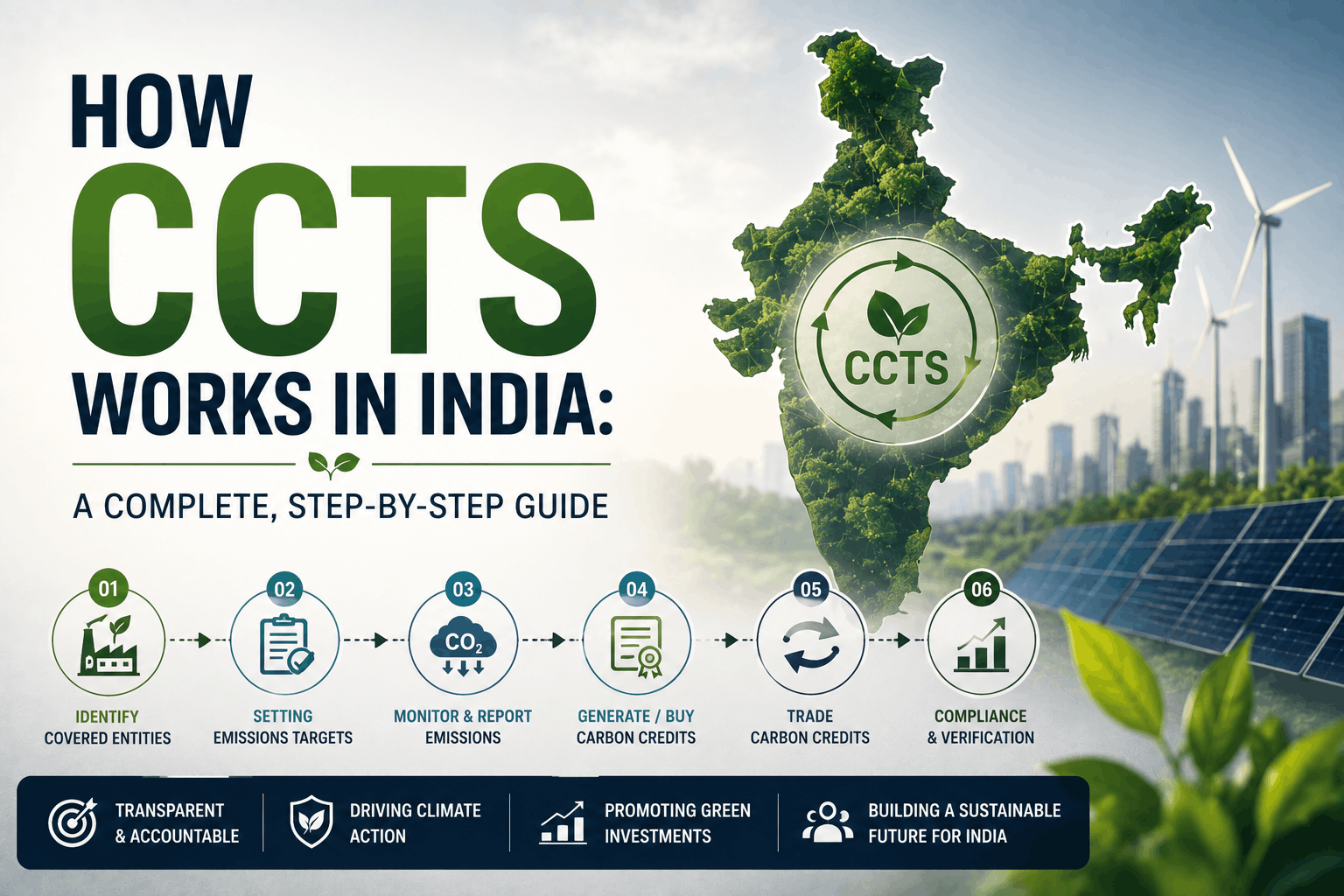
India just launched its first-ever mandatory carbon market. And if you work in industry, run a business, or care about climate change, you need to understand how CCTS works in India.
The Carbon Credit Trading Scheme, or CCTS, is not just another policy document sitting in a government drawer. It is a live, operating system that is already assigning legally binding emission targets to hundreds of Indian companies. Real money, real penalties, and real carbon credits are at stake.
Whether you are an industrialist trying to stay compliant, a student curious about carbon markets, or an entrepreneur spotting opportunities, this guide breaks it all down — simply, clearly, and completely.
What Is CCTS? Understanding the Full Form and the Basics
CCTS stands for Carbon Credit Trading Scheme. It is India’s first compliance-based carbon market, and it sits at the heart of what the government calls the Indian Carbon Market (ICM).
The scheme was notified on 28 June 2023 under the Energy Conservation (Amendment) Act, 2022. It legally mandates that India’s most energy-intensive industrial sectors must reduce their greenhouse gas (GHG) emission intensity over time.
In plain terms:
- The government sets targets for how much CO2 equivalent a factory can emit per unit of production.
- If a factory does better than its target, it earns Carbon Credit Certificates (CCCs).
- If it does worse, it must buy CCCs from those who over-performed.
- This creates a carbon trading market inside India.
This is the CCTS mechanism in its simplest form: cut emissions to earn credits, or buy credits to cover your shortfall.
Carbon Market Insider Newsletter
Weekly insights on carbon markets, climate policy, carbon credits, and sustainability.
Why India Needed CCTS: The Big Picture
Before we get into how the CCTS process works step by step, it helps to understand why India created it in the first place.
India’s Climate Commitments
India has committed to reducing its GDP emission intensity by 45% by 2030 compared to 2005 levels, as part of its Nationally Determined Contributions (NDCs) under the Paris Agreement.
To get there, India needs more than just policy intentions. It needs a financial mechanism that makes it profitable to go green and expensive to keep polluting.
The CBAM Pressure
The European Union’s Carbon Border Adjustment Mechanism (CBAM) is already applying carbon tariffs on certain imports, including steel, aluminium, cement, and fertilisers.
Indian exporters selling into Europe now face a choice: pay the carbon cost in Europe, or prove they are already paying it at home through a credible domestic system like CCTS.
Without a domestic carbon market, Indian companies lose competitive advantage globally.
Beyond Energy Efficiency: The PAT Problem
India already had a market-based scheme called the Perform, Achieve and Trade (PAT) scheme, launched in 2012. PAT was about energy efficiency, not GHG emissions. It issued Energy Saving Certificates (ESCerts), not carbon credits.
PAT was a good start, but it did not track actual greenhouse gases. CCTS is the upgrade. It measures what actually matters for climate: tonnes of CO2 equivalent emitted per unit of output.
Who Governs CCTS in India? The Key Institutions
The CCTS mechanism involves multiple government bodies, each with a specific role.
| Institution | Role in CCTS |
|---|---|
| Ministry of Power | Nodal ministry overseeing the entire CCTS framework |
| Ministry of Environment, Forest and Climate Change (MoEFCC) | Notifies legally binding GHG emission intensity targets for each sector |
| Bureau of Energy Efficiency (BEE) | Administrator: sets emission trajectories, accredits verifiers, issues CCCs, manages MRV oversight |
| Grid Controller of India Limited (GCIL) | Operates the ICM Registry, the official digital ledger for all CCCs |
| Central Electricity Regulatory Commission (CERC) | Regulates CCC trading on power exchanges |
| Central Pollution Control Board (CPCB) | Enforcement body for non-compliance penalties |
| National Steering Committee | High-level oversight body, chaired by the Ministry of Power Secretary |
Think of these institutions as a relay team. MoEFCC sets the targets, BEE runs the scheme day-to-day, GCIL keeps the accounts, and CERC oversees the marketplace where credits actually change hands.
Which Sectors Are Covered Under CCTS?
The CCTS covers India’s most energy-intensive industrial sectors. Together, these sectors account for over 700 million tonnes of CO2 equivalent (tCO2e) annually, making India’s carbon market one of the largest in the world once fully operational.
The Nine Notified Sectors
| # | Sector | Key Products Covered |
|---|---|---|
| 1 | Aluminium | Primary and secondary aluminium smelting |
| 2 | Cement | Clinker production and grinding |
| 3 | Chlor-Alkali | Chlorine and caustic soda production |
| 4 | Fertiliser | Ammonia, urea, and related products |
| 5 | Iron and Steel | Integrated and secondary steel production |
| 6 | Pulp and Paper | Paper and paperboard manufacturing |
| 7 | Petrochemicals | Ethylene, propylene, and derivatives |
| 8 | Petroleum Refinery | Crude oil refining |
| 9 | Textile | Spinning, weaving, and processing units |
Important note: As of the current stage of implementation, seven of the nine sectors have active compliance obligations, with final targets for Iron and Steel and Fertilisers still pending notification. Once all nine are fully covered, approximately 740 entities will be obligated.
If you run a business in any of these sectors and meet the notified threshold for production, you are a Designated Consumer (DC) under CCTS, and compliance is a legal requirement, not a choice.
How Does CCTS Work in India? The Step-by-Step Process
This is the core of the article. Let us walk through the CCTS process exactly as it works, from start to finish.
Step 1: Setting the GHG Emission Intensity Target
The process begins with target setting.
MoEFCC, on the recommendation of BEE, notifies a Greenhouse Gas Emission Intensity (GEI) target for each sector and sub-sector.
The GEI target is not an absolute cap on total emissions. It is a relative target expressed as:
tCO2e per unit of product output
For example, a cement plant may receive a target of X tonnes of CO2e per tonne of clinker produced. A steel plant’s target might be expressed per tonne of crude steel.
This intensity-based approach is important for India because it allows companies to grow production while still reducing their emission efficiency. A factory that doubles production but cuts its emission intensity in half has still made genuine climate progress.
Key design details:
- Targets use FY 2023-24 as the baseline year.
- Targets are facility-specific, so two plants in the same sector can have different numbers depending on their historical performance.
- Phase 1 targets require a 1-3% GEI reduction from baseline.
- Phase 2 targets (FY 2026-27) tighten to a 2-8% reduction, depending on sub-sector.
- BEE will notify targets progressively through 2030.
Step 2: Monitoring, Reporting, and Verification (MRV)
Once targets are set, every obligated entity must measure, track, and report its actual GHG emissions with precision.
This is the MRV phase, and it is the backbone of the entire CCTS process.
What gets measured:
- Scope 1 emissions: Direct emissions from combustion, industrial processes, and fugitive releases at the facility.
- Scope 2 emissions: Indirect emissions from purchased electricity and heat.
- Coverage is gate-to-gate: from the point raw materials enter the facility to the point finished goods leave.
How emissions are measured:
BEE uses a standardised methodology aligned with:
- ISO 14064-1:2018 for GHG quantification and reporting.
- ISO 14064-3:2019 for verification and validation by third-party agencies.
The verification requirement:
Every obligated entity must get its GHG data verified by a BEE-Accredited Carbon Verification Agency (ACVA). You cannot simply self-report. An independent, accredited body must audit your data.
The forms involved:
- Form A: The primary verified GHG emissions data submission. Every obligated entity submits this to BEE annually.
- Forms B, C, D, and E2: Supporting documentation covering monitoring plans, production data, energy consumption records, and additional disclosures.
Step 3: BEE Reviews the Data and Determines Performance
After entities submit their verified data, BEE assesses each entity’s actual GEI against its notified target.
There are three possible outcomes:
| Outcome | What Happened | Result |
|---|---|---|
| Over-performer | Entity’s actual GEI is better than its target | Entity earns Carbon Credit Certificates (CCCs) |
| On-target | Entity meets its target exactly | No CCCs issued, no deficit |
| Under-performer | Entity’s actual GEI is worse than its target | Entity has a compliance shortfall and must buy CCCs |
BEE completes its review and issues CCCs (or identifies shortfalls) after the Form A submission deadline.
Step 4: Issuance of Carbon Credit Certificates (CCCs)
For every tonne of CO2e that an over-performer reduces beyond its target, BEE issues one Carbon Credit Certificate (CCC) into the ICM Registry.
Key facts about CCCs:
- One CCC = one tonne of CO2e reduced beyond the notified target.
- Each CCC carries a unique serial number, a vintage year, and the identifier of the entity that generated it.
- CCCs are issued directly into the entity’s account on the ICM Registry, operated by GCIL.
- CCCs can be banked indefinitely. There is no expiry date forcing a rushed sale.
- CCCs cannot be borrowed against future allocations.
The registry ensures transparency. Every CCC has a traceable history: who generated it, when it was issued, whether it has been traded, and whether it has been surrendered for compliance.
Step 5: Trading on the Power Exchange
This is where CCTS becomes a real market.
Under-performers need to buy CCCs to cover their shortfall. Over-performers want to sell CCCs to earn revenue from their efficiency gains.
The CERC (Terms and Conditions for Purchase and Sale of Carbon Credit Certificates) Regulations, 2026, notified in March 2026, set out exactly how this trading works.
Where trading happens:
CCC trading takes place on regulated power exchanges such as IEX (Indian Energy Exchange), HPOWERT, and PXIL. These are the same platforms already used for electricity trading in India.
Trading rules:
- No OTC (over-the-counter) trading in Phase 1. All trades go through supervised exchanges, ensuring price transparency.
- No short selling in Phase 1.
- No derivatives on CCCs in Phase 1.
- Banking is unlimited: entities can hold CCCs and sell them in future cycles.
What will CCCs cost?
No official floor price has been set. Analyst estimates for early-phase CCC prices range from Rs 600 to Rs 1,200 per tonne, though some estimates stretch from Rs 250 to Rs 1,500 depending on sector-specific supply and demand. The actual price will be discovered through market trading once exchanges open.
Step 6: Compliance Deadline and Surrender
After trading closes, under-performing entities must surrender enough CCCs to cover their exact shortfall.
The surrender of a CCC means it is permanently retired from the registry. It cannot be traded again.
Once an entity surrenders sufficient CCCs, its compliance obligation for that year is met.
Step 7: Penalties for Non-Compliance
What happens if a company refuses to buy CCCs or simply cannot cover its shortfall?
The penalty is severe by design.
The non-compliance penalty is 2x the average CCC market price per unit of shortfall.
This is called an environmental compensation under the Energy Conservation Act. It is mathematically designed so that buying CCCs is always cheaper than paying the penalty. There is no rational commercial argument for choosing non-compliance over purchasing credits.
The enforcement architecture involves BEE identifying shortfalls, CPCB issuing penalty notices, and the penalty funds not going to the government’s general budget but into a designated environmental compensation fund.
The Two Pillars of CCTS: Compliance vs. Offset Mechanism
The CCTS operates through two distinct pillars under the Indian Carbon Market. Understanding the difference matters.
Pillar 1: Compliance Mechanism (Mandatory)
This is the mandatory side. Obligated entities in the nine notified sectors must meet their GEI targets or buy CCCs. This is not optional.
Everything described in the step-by-step process above applies to the compliance mechanism.
Pillar 2: Offset Mechanism (Voluntary)
This is the voluntary side, and it is a major opportunity for businesses and project developers outside the nine industrial sectors.
Who can participate:
Any entity can participate in the offset mechanism:
- Small businesses
- Farmers and agricultural cooperatives
- NGOs
- Clean energy developers
- Local governments
- Start-ups
How it works:
- Register an eligible GHG reduction project on the ICM portal.
- Develop the project using a BEE-approved offset methodology.
- Get the project monitored, reported, and verified by an ACVA.
- Earn CCCs, which are issued into the ICM Registry.
- Sell those CCCs on the power exchange to voluntary buyers (like corporations meeting net-zero pledges) or potentially to compliance entities.
Approved offset methodologies (Phase 1):
- Renewable energy (solar, wind, small hydro, pumped hydro storage)
- Green hydrogen production
- Industrial energy efficiency
- Mangrove afforestation
Phase 2 will add methodologies for construction, fugitive emissions reduction, solvent use efficiency, and carbon capture, utilisation and storage (CCUS).
Critical distinction: Offset CCCs currently cannot be used by compliance entities to meet their mandatory obligations. The two markets are kept separate in Phase 1. This is an important design choice to protect the integrity of each market.
The ICM Registry: India’s Carbon Credit Ledger
Every CCC in India lives in the Indian Carbon Market (ICM) Registry, operated by Grid Controller of India Limited (GCIL).
Think of it as the stock exchange’s depository equivalent, but for carbon credits.
What the Registry Does
- Maintains individual accounts for every obligated and voluntary participant.
- Records each CCC with a unique serial number, vintage year, and issuer identifier.
- Tracks the full lifecycle of every CCC: issuance, transfer, banking, and retirement.
- Prevents double counting: one CCC can only be in one place at one time.
- Interfaces with power exchanges for seamless trading.
- Is designed for eventual international linkage under Article 6 of the Paris Agreement.
The registry opened for entity registration in early 2026 through the ICM portal. If your company is in an obligated sector, registration on the ICM portal is one of your first compliance actions.
CCTS vs. PAT: What Changed?
Many Indian industries are familiar with the PAT (Perform, Achieve and Trade) scheme. Here is a clear comparison of what changed.
| Feature | PAT Scheme | CCTS |
|---|---|---|
| What it measures | Energy consumption intensity | GHG emission intensity (tCO2e per unit) |
| Certificate type | Energy Saving Certificates (ESCerts) | Carbon Credit Certificates (CCCs) |
| What it tracks | Energy efficiency | Actual greenhouse gas emissions |
| Paris alignment | No | Yes (linked to India’s NDCs) |
| International recognition | Limited | Designed for Article 6 linkage |
| Sectors covered | Up to 13 sectors (PAT I-VII) | 9 sectors (Phase 1), expanding |
| Voluntary participation | No | Yes (Offset Mechanism) |
| Compliance market | Energy efficiency only | Full GHG emissions trading market |
Seven of the nine CCTS sectors transitioned directly from PAT to CCTS starting FY 2026. The transition is gradual, and legacy ESCerts from PAT cycles remain a separate instrument.
CCTS and CBAM: The International Connection
One of the biggest reasons CCTS matters beyond India’s borders is its relationship with the European Union’s Carbon Border Adjustment Mechanism (CBAM).
CBAM applies carbon tariffs on imports of cement, steel, aluminium, fertilisers, and hydrogen from countries without comparable carbon pricing systems.
For Indian exporters, this is a significant threat to market competitiveness.
Here is where CCTS helps — and where the picture is still evolving:
The potential benefit: A credible domestic carbon market like CCTS demonstrates to EU importers that Indian producers are already priced on their emissions. Future EU recognition of CCTS payments could reduce the CBAM cost Indian exporters face.
The current reality: As of now, there is no formal EU recognition that CCTS compliance costs qualify as “carbon cost paid” for CBAM deduction. Indian exporters of CBAM-covered goods still face the full CBAM certificate cost. This remains an active item in India-EU trade discussions.
The bottom line: Even without immediate CBAM deduction benefits, CCTS provides Indian industry with an internationally credible emissions ledger that will be critical for future bilateral climate trade negotiations.
The Compliance Timeline: Key Milestones
Here is a consolidated view of the CCTS process timeline that every Indian industrialist and carbon market professional should know.
| Milestone | What Happens |
|---|---|
| June 2023 | CCTS formally notified under the Energy Conservation Act |
| July 2024 | BEE publishes the Detailed Procedure for Compliance Mechanism (Version 1.0) |
| October 2025 | GEI targets notified for the first batch of sectors |
| January 2026 | Second batch of sector targets notified |
| March 2026 | CERC notifies CCC trading regulations; ICM portal opens |
| April 2025 | First compliance period (FY 2025-26) begins |
| July 2026 | Form A (verified GHG data) submission deadline for FY 2025-26 |
| October 2026 | First CCC trading expected to open on power exchanges |
| FY 2026-27 | Second compliance year, with tighter targets (2-8% GEI reduction) |
| 2030 | BEE to progressively notify targets for all covered sectors |
What If My Company Is Not in the Nine Sectors?
Not being in an obligated sector does not mean CCTS is irrelevant to you.
Option 1: Participate in the Offset Mechanism
If you run a renewable energy project, a green hydrogen plant, an energy-efficient factory, or an afforestation initiative, you can register under the offset mechanism and earn CCCs to sell on the market.
Option 2: Become a Voluntary Buyer
Corporations with net-zero pledges can buy CCCs from over-performers or offset project developers through the exchange, using them to demonstrate climate action to investors, customers, and regulators.
Option 3: Build Capability Now
A second expansion phase is expected to include aviation, ports, railways, and data centres. The time to build your MRV system and internal carbon accounting capabilities is before the mandate arrives.
Real-World Example: How CCTS Works for a Cement Plant
Let us make this concrete with a practical example.
The setup:
Assume a cement plant in Rajasthan has received a GEI target of 0.75 tCO2e per tonne of clinker produced for FY 2025-26. This target is a 2% reduction from its baseline.
Scenario A: The Over-Performer
The plant invests in a waste heat recovery system and switches part of its fuel mix to biomass.
At the end of FY 2025-26, its verified GEI comes in at 0.70 tCO2e per tonne of clinker. It produced 1 million tonnes of clinker.
- Target was: 0.75 tCO2e x 1,000,000 = 750,000 tCO2e
- Actual emissions: 0.70 tCO2e x 1,000,000 = 700,000 tCO2e
- Over-performance: 50,000 tCO2e below target
- CCCs earned: 50,000 certificates
If CCCs trade at Rs 800 per tonne, the plant can sell Rs 4 crore worth of carbon credits. Green investment pays off directly.
Scenario B: The Under-Performer
A less efficient plant in the same sector ends the year at 0.80 tCO2e per tonne, worse than its 0.75 target. It produced 500,000 tonnes of clinker.
- Target was: 0.75 x 500,000 = 375,000 tCO2e
- Actual emissions: 0.80 x 500,000 = 400,000 tCO2e
- Shortfall: 25,000 tCO2e
- Must buy 25,000 CCCs
At Rs 800 per CCC, it pays Rs 2 crore to buy credits from the over-performer on the exchange, then surrenders them to BEE to clear its compliance obligation.
If it refuses to buy CCCs, the penalty is 2x the market price = Rs 1,600 per tonne x 25,000 = Rs 4 crore in environmental compensation. Always better to buy.
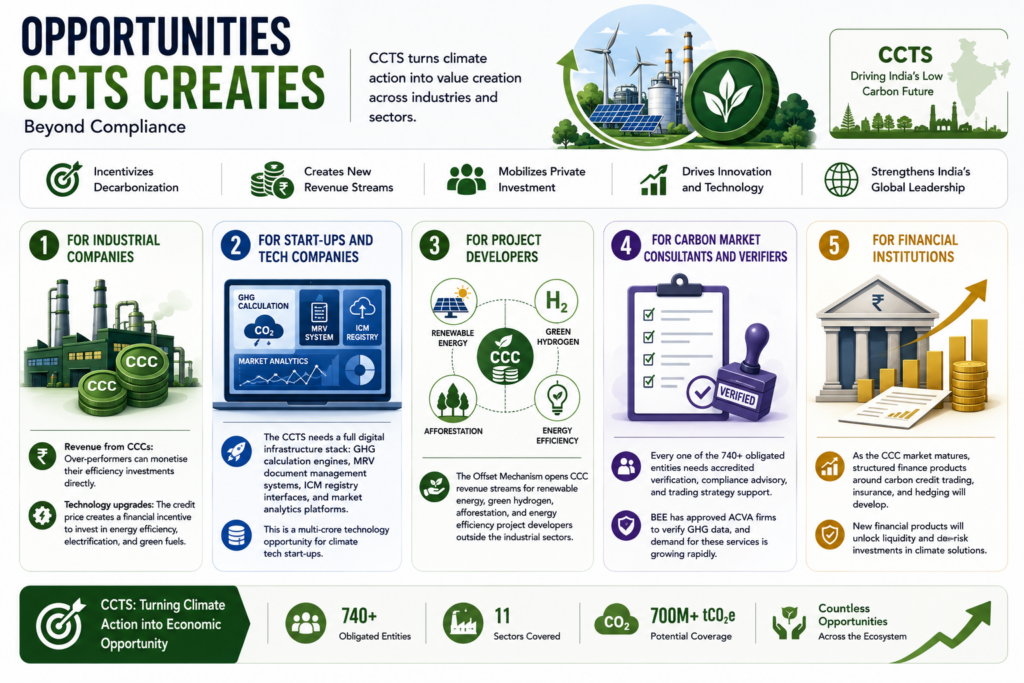
Opportunities CCTS Creates Beyond Compliance
The CCTS mechanism is not just a compliance burden. It opens several real business opportunities.
For Industrial Companies
- Revenue from CCCs: Over-performers can monetise their efficiency investments directly.
- Technology upgrades: The credit price creates a financial incentive to invest in energy efficiency, electrification, and green fuels.
For Start-Ups and Tech Companies
- The CCTS needs a full digital infrastructure stack: GHG calculation engines, MRV document management systems, ICM registry interfaces, and market analytics platforms.
- This is a multi-crore technology opportunity for climate tech start-ups.
For Project Developers
- The Offset Mechanism opens CCC revenue streams for renewable energy, green hydrogen, afforestation, and energy efficiency project developers outside the industrial sectors.
For Carbon Market Consultants and Verifiers
- Every one of the 740+ obligated entities needs accredited verification, compliance advisory, and trading strategy support.
- BEE has approved ACVA firms to verify GHG data, and demand for these services is growing rapidly.
For Financial Institutions
- As the CCC market matures, structured finance products around carbon credit trading, insurance, and hedging will develop.
Challenges and Limitations of CCTS in India
No new market is without challenges. Here are the key issues being watched by practitioners.
1. Price uncertainty: No floor price is currently published, making compliance cost modelling difficult for CFOs.
2. Double counting risk: A renewable energy generator could potentially claim both RECs (Renewable Energy Certificates) under the Renewable Purchase Obligation framework and CCCs under the CCTS Offset Mechanism for the same megawatt-hour. The current regulations are silent on this.
3. CBAM recognition gap: As noted above, Indian CCTS payments are not yet formally recognised by the EU for CBAM deduction purposes.
4. Coverage gaps: Coal-fired power generation, India’s largest single source of emissions, is not in Phase 1. Its inclusion in future phases will be a major expansion.
5. Capacity constraints: Small and medium enterprises adjacent to the obligated sectors need significant capacity building in GHG measurement and reporting.
Frequently Asked Questions About CCTS in India
Q1. What is the full form of CCTS in India?
CCTS stands for Carbon Credit Trading Scheme. It is India’s first compliance-based carbon market, notified under the Energy Conservation (Amendment) Act, 2022.
Q2. Who administers CCTS in India?
The Bureau of Energy Efficiency (BEE), under the Ministry of Power, is the primary administrator of CCTS. MoEFCC notifies the GHG targets, and GCIL operates the ICM Registry.
Q3. What is a Carbon Credit Certificate (CCC)?
A CCC is the tradeable unit of the CCTS. One CCC represents one tonne of CO2 equivalent reduced beyond a company’s notified emission intensity target. It is issued by BEE into the ICM Registry.
Q4. Which sectors are covered under CCTS?
Nine sectors are notified: aluminium, cement, chlor-alkali, fertiliser, iron and steel, pulp and paper, petrochemicals, petroleum refinery, and textile.
Q5. What is the penalty for non-compliance under CCTS?
The penalty is twice the average market price of CCCs for every tonne of CO2e by which a company falls short of its target. This makes non-compliance the most expensive outcome by design.
Q6. Can small businesses and farmers participate in CCTS?
Yes, through the Offset Mechanism. Any entity, including small businesses, farmers, NGOs, and clean energy developers, can register eligible GHG reduction projects, earn CCCs, and sell them on the market.
Q7. What is the difference between CCTS and PAT?
PAT tracked energy efficiency and issued Energy Saving Certificates. CCTS tracks actual greenhouse gas emission intensity and issues Carbon Credit Certificates aligned with India’s climate commitments under the Paris Agreement.
Q8. Where will CCCs be traded?
CCCs will be traded on CERC-regulated power exchanges, including IEX and PXIL. No OTC trading is permitted in Phase 1.
Q9. Can offset CCCs be used for compliance?
Currently, no. Offset CCCs and compliance CCCs are separate. Offset credits cannot be surrendered to meet mandatory compliance obligations in Phase 1.
Q10. Is CCTS linked to the EU’s CBAM?
Not formally yet. While CCTS helps Indian industry build a credible emissions record, the EU does not currently recognise CCTS payments as a formal deduction from CBAM costs. This is under active negotiation between India and the EU.
Q11. What is the expected price of CCCs in India?
Analyst estimates range from Rs 600 to Rs 1,200 per tonne for early-phase trading, with some projections ranging between Rs 250 and Rs 1,500 depending on sector-specific supply and demand dynamics.
Q12. What is the ICM Registry?
The Indian Carbon Market (ICM) Registry is the centralised digital ledger operated by GCIL that records the issuance, transfer, banking, and retirement of every CCC in India.
Conclusion: Why CCTS Is a Game-Changer for India
Understanding how CCTS works in India is not just academic anymore. It is practical, urgent, and commercially significant.
The CCTS mechanism creates a direct financial link between a company’s emission performance and its bottom line. Companies that reduce their emission intensity earn CCCs and can sell them for revenue. Companies that lag behind must buy CCCs, adding a real cost to inefficiency.
This is precisely how carbon markets are supposed to work: they put a price on pollution and a reward on efficiency.
For India, the CCTS process does three important things simultaneously:
- It accelerates industrial decarbonisation through financial incentives.
- It builds an internationally credible emissions infrastructure that supports India’s Paris Agreement commitments and future CBAM negotiations.
- It creates a new financial market, generating opportunities for industry, start-ups, consultants, and investors.
The scheme is still in its early stages. Targets will tighten, more sectors will be added, and the market will deepen over time. But the foundation is in place and operational.
Whether you are trying to stay compliant, spot business opportunities, or simply understand India’s climate strategy, the CCTS is the most important market mechanism in Indian industry right now.
The best time to learn how CCTS works in India was yesterday. The second-best time is today.
For more in-depth guides on carbon markets, carbon credits, and climate finance in India, visit Carbon Market Network.