Carbon Market Network


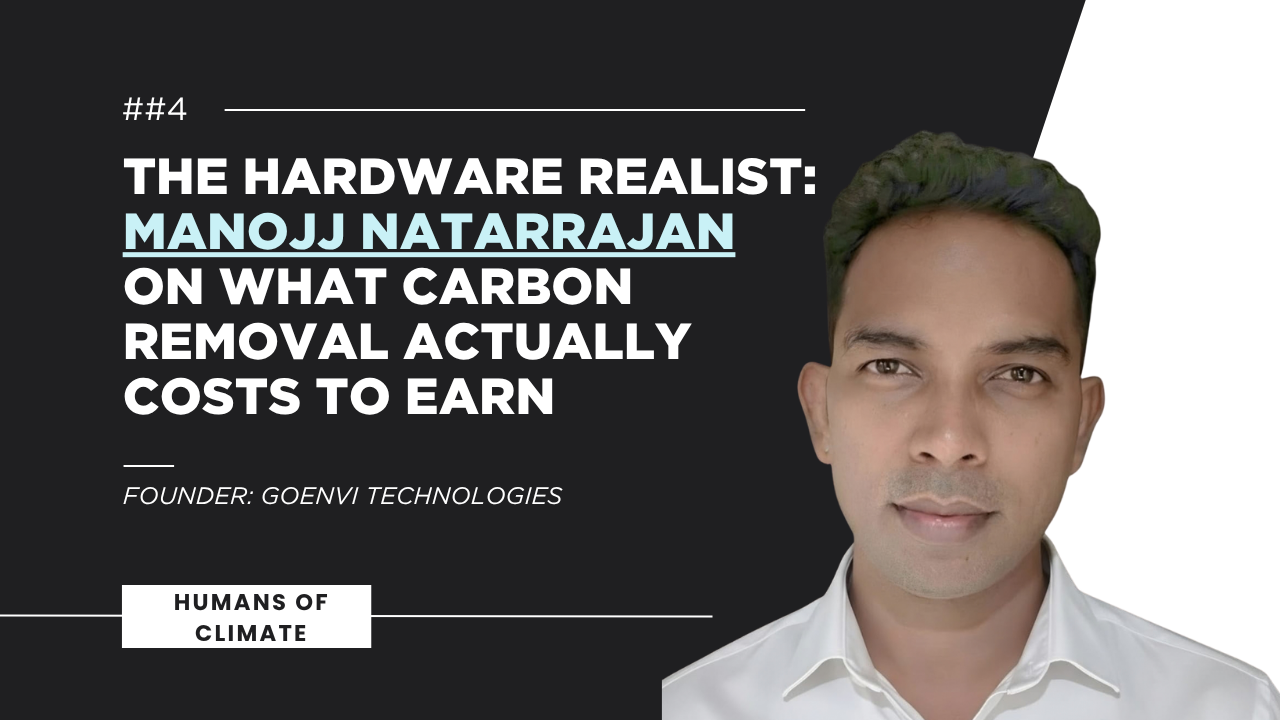
Carbon markets tell you what a tonne of CO2 is worth on paper. A pyrolysis plant tells you what a tonne actually costs to earn. Manojj has spent more than 16 years on the second kind of education.
He is the Founder and Director of Goenvi Technologies, a UK-India climate-tech company that combines its patented CTDT pyrolysis hardware—which forms the very heart of the system—with Goenvi Carbon, an AI-native enterprise dMRV platform. With 14 or more plants commissioned across plastic-to-fuel, RDF-to-fuel, and biomass-to-biochar applications, and offices in Wada, Maharashtra and Covent Garden, London, Goenvi operates at the point where the physics of carbon removal and the integrity requirements of carbon markets have to meet.
Manojj is a particular kind of voice in the current carbon-removal conversation: someone who has stood inside enough plants to know exactly where the gap between promise and performance lives, and who has built both the hardware and the data infrastructure to close it. His arguments are grounded in what he has measured himself, and he has little patience for anything that is not.
What Sixteen Years Inside Plants Teaches You
The carbon market prices a tonne of CO2 removal. What it does not price, at least not visibly, is the full cost of producing that tonne reliably, plant after plant, batch after batch, in conditions that bear little resemblance to the assumptions in a project design document.
Manojj learned this the way most hardware builders do: through the gap between design and reality. Every carbon credit, he points out, depends on a physical process that has to survive bad feedstock, power cuts, worn parts, and human error. None of that appears in a carbon market model. All of it shows up at the plant.
“The carbon market shows you what a tonne of CO2 is worth on paper. A plant shows you what a tonne actually costs to earn.”
The lesson that stayed with him is about MRV. Across the carbon market, monitoring, reporting, and verification is typically treated as paperwork added on top of a project once it is running. What he came to believe, through years of commissioning plants, is that it has to be built into the plant from day one. A system that measures properly from the start produces a fundamentally different quality of evidence from one that reconstructs the picture later from logbooks. That conviction is the foundation on which Goenvi is built.
Pyrolysis Is a Chemical Process, Not a Machine You Switch On
One of the most consequential misunderstandings in the biomass and waste-to-energy space is the classification of pyrolysis as mechanical equipment. Manojj is direct about the consequences. Most project failures trace back to it.
Project developers often mistake a biochar machine for simple mechanical equipment, frequently ending up buying a basic charcoal machine. However, pyrolysis is a complex thermo-chemical process. Success depends on a precise mix of robust machine design and strict control over chemical parameters—specifically residence time, process temperature, internal pressure, and feedstock moisture. At the heart of the system is Goenvi’s patented CTDT hardware, which uses this precise control to guarantee consistent chemical output, rather than just relying on programmability to fix operator errors.
“A lot of what is marketed as pyrolysis today is simply charcoal-making, with claims that run well ahead of the output.”
Consistency is not only a quality standard. It is the precondition for unlocking value beyond biochar itself: wood vinegar, acetic acid, silica from silica-rich feedstocks, activated carbon, and bio-carbon with the potential to help decarbonise steel. A plant that produces inconsistent output leaves most of that value on the table.
Carbon Market Insider Newsletter
Weekly insights on carbon markets, climate policy, carbon credits, and sustainability.
Why Hardware and MRV Cannot Be Stitched Together Separately
The conventional path for a carbon removal project developer is to find the technology, then separately find an MRV provider, an auditor, and a registry, and hope the pieces align. Manojj built Goenvi to make that path unnecessary.
Goenvi Carbon, the company’s AI-native dMRV platform, is built alongside the pyrolysis hardware rather than layered on top of it. Real-time, traceable data reaches the developer, the auditor, and the registry from the same source, at the same time. The stored-carbon formula and a seven-parameter biochar grading system apply identically across every project. Calculations are fixed and auditable, not left to interpretation. Problems surface the day they happen, not for the first time at audit.
“Integrity is the layer that will protect carbon removal from greenwashing. And it can’t be retrofitted later.”
The platform is also built as an enterprise tool. A developer running multiple projects, each with multiple machines and sites, can track the entire portfolio under a single login. For the market to scale without accumulating credibility debt, that kind of portfolio-level visibility is not optional.
What an Integrity Layer Actually Means in Practice
The phrase “integrity layer” gets used loosely in the carbon market. Manojj is specific about what it should mean: one connected system, not separate parties each holding a fragment of the picture.
In practice, this means IoT data captured batch by batch at the point of production, shared in real time with everyone who needs it. It means calculations that are fixed and auditable rather than subject to interpretation at the time of audit. It means a chain of evidence that runs from feedstock intake to final credit issuance without gaps: a GPS- and QR-tracked feedstock record showing what came in and where it came from; the sensor log from the batch as it ran through the reactor; the biochar’s lab-graded quality; and the stored-carbon calculation for that exact batch, with a checksummed audit trail that prevents quiet editing after the fact.
“No one should have to take my word for any single step. Every step should be independently checkable.”
The practical consequence of continuous data is also economic. Standards today are largely built around periodic audits. A proper IoT layer can flag a problem the day it happens, which means verification gets faster and cheaper, credits can be issued sooner, and developers stop carrying months of operating cost while waiting to be paid.
Where the Gap Between Technology and Standards Still Lives
Manojj identifies two persistent gaps between what industrial technology can measure and what carbon standards currently require developers to prove.
The first is emission factors. Most standards apply one-size-fits-all assumptions to processes whose plant-level reality varies considerably. Goenvi’s platform maintains separate emission factor sets for the UK, India, and Japan because the reality on the ground in each market is different enough that a single factor set produces distorted results. As the industry matures, continuous MRV allows projects to upgrade from conservative, generalized baselines to highly accurate, localized models, ultimately elevating the fidelity of the entire market.
The second is the audit model. Most standards are still built around periodic verification events. Rather than making carbon standards obsolete, an IoT layer capturing continuous data drastically reduces the manual effort required by project third-party verifiers. By creating a system that ensures transparency and verifiability in every step, this technology empowers auditors to verify projects faster and with higher confidence. When they do, the benefits are material: faster verification, lower cost, and earlier credit issuance for developers who have invested in proper measurement infrastructure.
Where AI Adds Real Value, and Where It Is Marketing
Manojj has built an AI-native MRV platform. He is also precise about what AI genuinely contributes versus what it is used to claim.
AI adds real value in three places: turning raw IoT data into audit-ready documentation automatically; enabling natural-language queries against live project data rather than static reports; and spotting patterns across a fleet of plants so that a fix identified at one site propagates to all of them. The sharpest near-term application is anomaly detection, catching a batch that does not match its own sensor history before it reaches a verifier, and helping the developer address the issue at the moment it appears rather than months later.
“It becomes marketing the moment AI is used to cover for a project that never installed proper sensors in the first place.”
The distinction matters because the carbon market’s trust problem is real, and AI that provides the appearance of rigour without the underlying measurement infrastructure can amplify that problem rather than solve it. Sensors and data architecture come first. AI processes what they produce.
Engineering Risk Versus Storytelling Risk
Goenvi operates a pre-buy model for corporate carbon buyers, selling future credits from projects still in development. The question buyers ask, reasonably, is what they are actually underwriting.
Manojj’s answer draws a deliberate distinction. A serious buyer should be underwriting engineering risk, which is bounded and manageable, not storytelling risk, which is not. The difference is what the developer can put on the table before the first credit is issued.
For Goenvi’s first carbon removal project, expected to generate 4,000 to 5,000 credits annually, that means its patented hardware—and MRV system already live as a Rainbow Standard dMRV partner within a CCP-eligible programme; a clear permanence methodology; and project economics that work without the credit price carrying all the weight. Instead of promising to remove failure points entirely, the patented hardware and MRV system are engineered to immediately isolate and manage inevitable physical disruptions. They feature explosion-proof motors, precision engineering, automatic burners and scrubbers, branded and traceable raw materials, designed for the highest safety, simplest operation, and lowest maintenance.
“A credit is only as reliable as the machine behind it. We pre-sell future credits, but never before the measurement system is running.”
Execution history, he argues, matters more than the size of the promise. In a market that has suffered from projects that over-promised and under-delivered, the most credible thing a developer can offer a buyer is evidence of having done it before.
What Changes When the Same Technology Enters a Different Market
Goenvi operates across India, the UK, the EU, and Japan. Manojj is candid about what this requires: the hardware travels well; almost everything else has to be rebuilt for each market.
Japan’s GX-ETS became mandatory for large emitters in April 2026, alongside its own J-Credit and JCM rules. India remains largely a voluntary market. UK corporates face growing pressure to account for Scope 3 emissions, which is why Goenvi built CETrace specifically for supply-chain reporting in that market. Europe is developing its own certification framework under the Carbon Removal Certification Framework. Each market has its own financing landscape, certification path, and regulatory expectation.
Operating from both Wada and London under the UK Department for Business and Trade’s Global Entrepreneur Programme is not incidental to this strategy. Being present in both markets means Goenvi can build the local relationships and regulatory fluency that technology alone cannot substitute for.
How to Build a Credible Waste-to-Carbon Ecosystem in India
Asked how he would deploy one hundred crore rupees to build India’s most credible waste-to-carbon-removal ecosystem, Manojj’s answer reflects the hard-won priorities of someone who has built the supply side.
The largest allocation goes to plants and feedstock supply together, not separately. A fleet of plants without contracted feedstock is worthless. He would rather fund fewer plants with guaranteed supply than many competing for the same waste streams. The next significant allocation goes to MRV, because every plant reporting through one trusted system makes the whole portfolio more credible, not just the individual project. A dedicated share goes to people who can actually run and fix plants, not model them on paper, and another to R&D aimed at separating pyrolysis co-products into high-value outputs, so each plant earns from significantly more than biochar alone. He would fully develop one flagship project rather than spread capital across many half-finished ones.
What he would deliberately avoid is equally instructive: building a new registry or standard; funding charcoal-grade or backyard-kiln approaches that cannot produce repeatable quality or real data; backing gasification set-ups that waste the heat they generate; and spending on marketing before the supply side can actually deliver credits.
“Spend on marketing before the supply side can deliver, and you haven’t built a market. You’ve built a liability.”
Quick Takes
One misconception about pyrolysis he would love to retire: That it is a piece of mechanical equipment. It is a chemical process, and it has to be programmed, controlled, and repeated like one.
One thing carbon buyers should demand from every project: Continuous, sensor-level data that the operator cannot edit and the buyer can check at any time. Not just an annual report.
One carbon-removal technology he is watching most closely: Direct air capture. It is expensive today, but it is raising the bar for how rigorously every removal pathway, biochar included, gets measured.
One feedstock with far more potential than the market realises: Prosopis juliflora, an invasive species damaging land and water across India. Converting it into biochar restores ecosystems and removes carbon at the same time, with bamboo close behind.
One thing AI can fundamentally change about MRV: Turn verification from a once-a-year check into an always-on one.
One part of carbon verification that should be automated: Flagging unusual batches the day they happen, not months later.
One mistake he sees climate-tech founders making repeatedly: Buying a cheap charcoal machine and calling it a pyrolyser. When the machine fails, the entire project fails with it.
One country he thinks will become a major carbon-removal market: Japan. Mandatory emissions trading and new credit rules are creating real, compliance-driven demand for high-quality removals.
One book that has influenced how he thinks or builds: The Master Key System by Charles F. Haanel, and the Bhagavad Gita.
One engineer or entrepreneur he would love to spend a day with: Elon Musk. He has shown how fast hardware can scale, and his XPRIZE helped put carbon removal on the global map.
One thing people misunderstand about building climate hardware in India: The hard part is not manufacturing cost. It is regulatory approval, which is why Goenvi invested early in getting its plants approved and registered.

Manojj Natarrajan
Manojj Natarrajan is the Founder and Director of Goenvi Technologies, a climate-tech company focused on patented pyrolysis, biochar and carbon-removal solutions. With over 16 years of experience in thermal conversion technologies, he works on transforming biomass and hydrocarbon waste into valuable products while enabling measurable climate impact. His current focus includes scalable biochar carbon-removal projects, AI-native digital MRV, traceable carbon-credit generation, and technology platforms that combine waste management, circularity and high-integrity carbon removal.