Carbon Market Network


Every time you hear about a company “buying carbon credits” or a state “capping emissions,” you are looking at a piece of US carbon trading in action.
It sounds complicated at first. Allowances, offsets, caps, auctions. The jargon can scare away anyone who just wants a straight answer.
This guide breaks down US carbon trading in plain English. No fluff, no unnecessary technical detail, just a clear explanation of how emissions trading in the USA actually works.
By the end, you will understand how the carbon trading market operates, which programs matter most, how companies use it, and where the whole system is heading next.
What Is US Carbon Trading
US carbon trading is a system that lets companies buy and sell the right to emit carbon dioxide and other greenhouse gases.
Instead of the government telling every factory exactly how much pollution it can release, a market decides the price of that pollution.
Here is the basic idea in one line: a regulator sets a limit on total emissions, then lets companies trade permits to emit within that limit.
This approach is often called cap and trade. The “cap” limits total pollution. The “trade” lets companies buy and sell permission to pollute, known as allowances.
The United States does not have one single national carbon market. Instead, it has a patchwork of state and regional programs, plus a large voluntary carbon market that operates alongside them.
That patchwork is exactly what makes US carbon trading confusing for beginners, and exactly what this article will untangle.
Carbon Market Insider Newsletter
Weekly insights on carbon markets, climate policy, carbon credits, and sustainability.
Why Carbon Trading Exists in the First Place
Carbon trading exists because pollution is cheap to produce but expensive for society to absorb.
Factories, power plants, and vehicles release carbon dioxide for free under a traditional system. Nobody pays directly for the smoke coming out of a smokestack.
Carbon trading changes that. It puts a real cost on carbon pollution and lets the market figure out the cheapest way to cut emissions.
Here is why economists and policymakers like this approach:
- It rewards companies that cut emissions cheaply and lets them sell their extra allowances for profit.
- It forces heavy polluters to either reduce emissions or pay more to keep polluting.
- It creates a predictable, shrinking cap on total emissions over time.
- It raises public revenue that many states reinvest in clean energy and community programs.
In short, carbon trading tries to solve a pollution problem using market incentives instead of pure command and control regulation.
How Carbon Trading Works: Step by Step
Carbon trading can feel abstract, so let’s walk through it as a simple, step by step process.
Step 1: The Regulator Sets a Cap
A government body, whether a state agency or a regional group of states, decides the total amount of carbon dioxide that covered industries can emit during a set period.
This total is called the cap. It usually shrinks a little every year to push emissions downward over time.
Step 2: Allowances Are Created
The regulator then creates a fixed number of tradable permits called allowances. Each allowance usually represents the right to emit one ton of carbon dioxide.
If the cap allows 50 million tons of emissions, the regulator issues 50 million allowances, no more.
Step 3: Companies Get or Buy Allowances
Some allowances are given away for free to certain industries to ease the transition. Most are sold through public auctions open to power plants, refineries, industrial facilities, and financial participants.
Companies bid for allowances just like they would bid at any auction. The price is decided by supply and demand, not set by a fixed government tax rate.
Step 4: Companies Emit and Then Settle Their Accounts
Throughout the year, covered facilities emit carbon dioxide as part of normal operations. At the end of a compliance period, each facility must hand over enough allowances to match its actual emissions.
Step 5: Trading Happens in Between
This is where the “trade” in cap and trade comes alive. A company that cuts its emissions faster than expected will have leftover allowances. It can sell those allowances to another company that is struggling to reduce emissions fast enough.
This buying and selling activity is what people mean when they talk about the carbon trading market.
Step 6: The Cap Shrinks Over Time
Each year, or every few years, regulators reduce the total number of allowances available. This steady tightening is what actually drives emissions down over the long run.
Compliance Carbon Markets vs Voluntary Carbon Markets
This distinction is the single most important thing to understand about US carbon trading.
| Feature | Compliance Carbon Market | Voluntary Carbon Market |
|---|---|---|
| Who participates | Companies legally required to cap emissions | Companies that choose to offset emissions |
| Legal requirement | Mandatory under state or regional law | Optional, driven by corporate goals |
| Example programs | RGGI, California Cap-and-Trade, Washington Cap-and-Invest | Private carbon credit purchases, corporate net-zero programs |
| Main instrument | Allowances | Carbon credits or offsets |
| Price driver | Government-set cap and auction dynamics | Buyer demand, project quality, certification standards |
| Oversight | State or regional government agencies | Independent registries and standards bodies |
A compliance market is created by law. If your company falls under the rules, you must participate, no exceptions.
A voluntary market is created by choice. Companies buy carbon credits to support climate goals, improve their brand image, or prepare for future regulation, even though nothing forces them to do it.
Both markets involve trading, but they serve very different purposes and operate under very different rules.
The Major Compliance Carbon Trading Programs in the United States
The United States runs its emissions trading system at the state and regional level rather than nationally. Here are the programs that matter most.
The Regional Greenhouse Gas Initiative (RGGI)
RGGI is the oldest mandatory carbon trading program in the country and covers power plants across a group of Northeastern and Mid-Atlantic states.
Here is how it works in practice:
- Fossil fuel power plants with a generating capacity of 25 megawatts or larger inside participating states must hold allowances equal to their carbon dioxide emissions over a multi-year compliance period.
- RGGI was the first mandatory market based program in the United States designed to reduce greenhouse gas emissions.
- The program includes built-in price controls. A Cost Containment Reserve releases extra allowances if prices climb too high, and an Emissions Containment Reserve holds back allowances if prices fall too low, keeping the market from swinging wildly in either direction.
- RGGI states periodically review the program and update the shared Model Rule that each state uses to shape its own carbon budget trading program.
RGGI proves an important point about US carbon trading: a group of states can run an effective, coordinated carbon market without a single federal law forcing them to do it.
California Cap-and-Trade Program
California runs the largest and most closely watched carbon trading program in the country. It covers a much broader slice of the economy than RGGI, including power plants, industrial facilities, and fuel distributors. (website)
Key features of California’s program include:
- A quarterly auction system where the California Air Resources Board sells allowances to covered entities and other market participants.
- A joint carbon market operated together with the Canadian province of Quebec, allowing allowances from both jurisdictions to be used for compliance.
- A minimum auction reserve price that increases every year based on a fixed percentage plus inflation, which keeps a price floor under the market.
- Strict limits on how much of a company’s compliance obligation can be met using offset credits rather than allowances, along with rules requiring many offset projects to provide direct environmental benefits within the state.
California’s program has also evolved through new legislation that pushes it toward deeper, longer-term emissions cuts. Recent state legislation directs regulators to ensure that overall emissions from covered sources keep declining in line with the state’s long-term climate targets, while maintaining strong price stability tools and gradually tightening offset usage rules.
Because of its scale, California’s program is often treated as a blueprint for what a future national carbon market in the United States could look like.
Washington’s Cap-and-Invest Program
Washington runs its own carbon trading system, known as Cap-and-Invest, under its state climate law.
A few defining features stand out:
- All facilities emitting more than 25,000 metric tons of carbon dioxide equivalent are covered, including industrial facilities, electricity generators, importers of electricity, fuel distributors, and natural gas suppliers.
- The program’s emissions cap declines by a fixed percentage each year through multiple compliance periods, aiming for a very steep long-term reduction in statewide emissions.
- Businesses can meet part of their obligation using offset credits from a small list of approved project types, including forest protocols and methane capture on farms.
- The state has been actively working toward linking its market with California and Quebec, which would let allowances flow between all three systems.
Linking State Markets Together
One of the most important trends in emissions trading in the USA right now is linkage, the process of connecting separate state carbon markets into one shared trading pool.
California and Quebec have operated a linked carbon market since 2014, giving companies in both jurisdictions access to a shared pool of allowances.
Washington has been working through a formal process to join that linked market. Washington, California, and Quebec signed a linkage agreement outlining how the three carbon markets will share information, cooperate, and account for allowances across jurisdictions.
Why does linkage matter for the broader carbon trading market?
- A larger, linked market tends to produce more stable and predictable prices.
- Merging smaller markets into an established partnership can strengthen the programs of all participants and give businesses more confidence when planning long-term investments in decarbonization.
- A much larger linked market dramatically increases liquidity, since a bigger pool of allowances is available to trade at any given time.
Linkage shows how US carbon trading is quietly building something close to a regional carbon market, state by state, agreement by agreement, without waiting for federal legislation.
Does the United States Have a Federal Carbon Trading Market
No. The United States does not currently have a nationwide, federally mandated cap and trade program.
Congress has debated national carbon trading legislation multiple times over the years, but no federal cap and trade bill has become law.
Instead, carbon pricing and carbon trading in the USA happen through:
- State and regional programs like RGGI, California, and Washington.
- Federal tax incentives that indirectly support clean energy and carbon capture.
- A large and active voluntary carbon market driven by corporate climate commitments.
- Sector-specific regulations from federal agencies that indirectly shape emissions without creating a trading system.
This decentralized structure means a company’s exposure to carbon trading depends heavily on where it operates and which industry it belongs to.
The US Voluntary Carbon Market
Outside of government-mandated programs, thousands of American companies participate in the voluntary carbon market by choice.
Here is how it works. A company that wants to offset its emissions buys carbon credits, each representing one ton of carbon dioxide avoided, reduced, or removed from the atmosphere by a specific project.
The US voluntary carbon market includes thousands of active projects and hundreds of carbon removal developers, many of which deliver additional social or environmental benefits alongside emissions reductions.
Typical voluntary carbon credit project types include:
- Forestry and reforestation projects that absorb carbon dioxide as trees grow.
- Methane capture projects on farms and landfills.
- Renewable energy projects, especially in regions that still rely heavily on fossil fuels.
- Direct air capture and other engineered carbon removal technologies.
- Soil carbon and regenerative agriculture projects.
Pricing in the voluntary market varies enormously depending on quality and project type. Nature-based offsets such as forest and soil credits have generally traded in the range of seven to twenty four dollars per metric ton, while independently verified, high-integrity credits often command significantly higher prices.
The voluntary market has gone through real growing pains. Carbon credit retirements, which act as a proxy for genuine demand, actually declined recently even as corporate climate commitments surged, showing a widening gap between stated ambition and real market action.
At the same time, quality standards are tightening fast. Independent rating agencies, stricter certification frameworks, and growing scrutiny from investors are pushing low-quality credits out of favor and rewarding projects that can prove real, lasting climate impact.
For a US-based company today, this means one clear takeaway: it is no longer enough to simply buy the cheapest available carbon credit. Buyers increasingly need to verify project quality, permanence, and third-party certification before making a purchase.
Carbon Trading vs Carbon Tax: What Is the Difference
People often confuse carbon trading with a carbon tax, but they work in fundamentally different ways.
| Aspect | Carbon Trading (Cap and Trade) | Carbon Tax |
|---|---|---|
| What is fixed | The total quantity of emissions allowed | The price per ton of carbon emitted |
| What is variable | The market price of allowances | The total quantity of emissions produced |
| Certainty | High certainty on emissions levels, price can fluctuate | High certainty on price, emissions levels can vary |
| Revenue source | Auction proceeds from allowance sales | Direct tax collection |
| US adoption | Used in several states including California and RGGI states | Not currently used at a broad state or federal level in the US |
In a carbon trading system, the government knows exactly how much pollution the cap allows, but the price companies pay for allowances can rise or fall.
In a carbon tax system, the government sets a fixed price per ton of emissions, but nobody can predict exactly how much total pollution will result, since companies simply pay the tax and keep emitting if they choose to.
The United States has leaned toward cap and trade at the state level rather than a broad carbon tax, largely because it gives regulators more control over the actual emissions outcome.
Real World Examples of US Carbon Trading in Action
Seeing how carbon trading plays out in real situations makes the whole system easier to grasp.
Example 1: A power company reduces emissions faster than required. A utility company switches several coal plants to natural gas ahead of schedule. Its emissions drop well below its allowance holdings. It sells its surplus allowances at auction or on the secondary market, turning early climate action into direct revenue.
Example 2: A refinery struggles to cut emissions quickly. An oil refinery cannot reduce emissions as fast as the shrinking cap requires. Rather than shutting down operations, it buys additional allowances from other market participants to stay in compliance while it invests in longer-term efficiency upgrades.
Example 3: A tech company funds a forestry project. A technology company sets a net-zero target and cannot eliminate all of its emissions through direct action alone. It purchases voluntary carbon credits from a verified reforestation project, funding new tree planting to offset the emissions it cannot yet avoid.
Example 4: A landowner monetizes forest land. A private landowner enrolls forested acreage in an approved carbon offset protocol. Verified emissions reductions from that land generate carbon credits, which are sold to companies participating in either a compliance program or the voluntary market.
These examples show that carbon trading connects very different types of participants, power companies, refineries, technology firms, and even individual landowners, into a single functioning market for emissions.
Who Actually Participates in US Carbon Trading
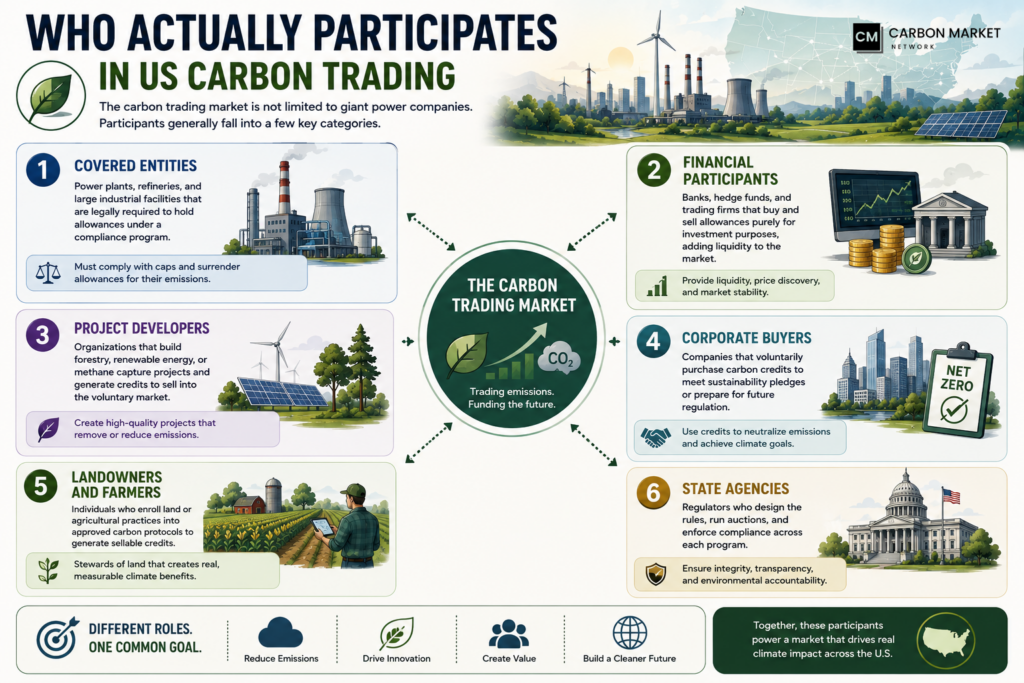
The carbon trading market is not limited to giant power companies. Participants generally fall into a few categories.
- Covered entities: Power plants, refineries, and large industrial facilities that are legally required to hold allowances under a compliance program.
- Financial participants: Banks, hedge funds, and trading firms that buy and sell allowances purely for investment purposes, adding liquidity to the market.
- Project developers: Organizations that build forestry, renewable energy, or methane capture projects and generate credits to sell into the voluntary market.
- Corporate buyers: Companies that voluntarily purchase carbon credits to meet sustainability pledges or prepare for future regulation.
- Landowners and farmers: Individuals who enroll land or agricultural practices into approved carbon protocols to generate sellable credits.
- State agencies: Regulators who design the rules, run auctions, and enforce compliance across each program.
Benefits of US Carbon Trading
Carbon trading offers several practical advantages over simple, blanket pollution rules.
- Cost efficiency: Companies that can cut emissions cheaply do so first, while companies facing higher costs can buy allowances instead, lowering the overall cost of hitting a climate target.
- Predictable emissions caps: Because the total number of allowances is fixed and shrinks over time, regulators know emissions will decline on a defined schedule.
- Revenue generation: California’s cap and trade auctions have collected billions of dollars over the life of the program, funds that are directed toward projects intended to reduce emissions further.
- Flexibility for businesses: Companies can choose the compliance strategy that fits their operations, whether that means investing in cleaner technology, buying allowances, or a mix of both.
- Market-driven innovation: A rising carbon price creates a real financial incentive to develop cleaner processes and technologies.
Challenges and Criticism of Carbon Trading in the US
No system is perfect, and US carbon trading faces real, well documented criticism.
- Allowance oversupply: RGGI’s early years suffered from an oversupplied market caused by a shift from coal to natural gas combined with weak economic activity, which kept allowance prices low and reduced the program’s short-term impact.
- Consumer cost concerns: Cap and trade programs are sometimes criticized as an indirect tax on gasoline and other fuels, since some compliance costs get passed on to consumers.
- Fragmented national approach: Without a single federal program, companies operating across multiple states face different rules, different prices, and different compliance obligations depending on location.
- Offset quality concerns: In the voluntary market, a widening gulf between climate ambition and actual market action has emerged, driven partly by concerns over the quality and durability of some carbon credits.
- Revenue volatility: Auction revenues can decline when regulations shift or when demand for allowances weakens, creating budget uncertainty for the public programs that rely on that money.
- Market transparency: A large share of voluntary carbon market transactions still happen privately, which limits transparency and can make it harder for buyers to compare prices and verify quality.
These challenges do not mean carbon trading fails as a concept. They highlight areas where program design, oversight, and quality standards genuinely matter.
Practical Takeaways for Businesses and Investors
If your business touches carbon trading in any way, here are actionable steps worth taking.
- Identify your exposure. Determine whether your facilities fall under a mandatory program like RGGI, California, or Washington based on location and emissions volume.
- Track the compliance calendar. Compliance periods, auction dates, and reporting deadlines vary by program, so build a calendar specific to each jurisdiction you operate in.
- Model your allowance needs early. Forecast expected emissions well ahead of each compliance deadline so you are not forced into last-minute allowance purchases at unfavorable prices.
- Vet voluntary credits carefully. Prioritize credits with strong third-party verification, clear permanence guarantees, and transparent project data over the cheapest option available.
- Watch linkage developments. If you operate in Washington, California, or another state exploring linkage, monitor how a shared market could change allowance supply and pricing.
- Diversify offset strategy. Combine direct emissions reductions with a mix of high-quality credits rather than relying entirely on offsets to hit climate targets.
- Stay close to state rulemaking. State agencies regularly update caps, offset limits, and price containment mechanisms, and early awareness gives your business time to adjust.
The Future of Carbon Trading in the United States
Several clear trends are shaping where US carbon trading goes next.
More state linkage. Washington’s move toward joining the California-Quebec market suggests other states could eventually follow, gradually building a larger, more liquid regional carbon market without federal legislation.
Tighter voluntary market standards. Independent certification bodies and rating agencies are pushing the voluntary carbon market toward higher quality thresholds, rewarding projects that deliver durable, verifiable results.
Growing role of carbon removal. Carbon dioxide removal remains a small slice of the voluntary market today, but demand projections suggest it could grow substantially as companies work toward long-term net-zero commitments.
Compliance markets gaining ground. Compliance programs already represent a meaningful and growing share of total carbon market demand, a trend expected to continue as more jurisdictions consider mandatory carbon pricing.
Continued state-level experimentation. With no federal cap and trade system on the horizon, expect individual states to keep refining their own programs, adjusting caps, offset rules, and price controls based on real-world results.
Carbon trading in the United States is not standing still. It is evolving state by state, market by market, moving toward a system that is larger, more connected, and gradually more disciplined.
Frequently Asked Questions About US Carbon Trading
What is US carbon trading in simple terms? US carbon trading is a system where companies buy and sell permits to emit carbon dioxide, under a total limit set by a state or regional government. It uses market forces to make emissions reductions happen where they are cheapest.
Does the United States have a national carbon trading market? No. The United States does not have a single federal cap and trade program. Carbon trading happens through state and regional programs such as RGGI, California, and Washington, along with a separate voluntary carbon market.
What is the difference between a carbon allowance and a carbon credit? An allowance is issued by a regulator under a mandatory compliance program and represents permission to emit one ton of carbon dioxide. A carbon credit is generated by a voluntary project, such as reforestation, and represents one ton of emissions avoided, reduced, or removed.
Which states have carbon trading programs? The Regional Greenhouse Gas Initiative covers a group of Northeastern and Mid-Atlantic states. California and Washington each run their own separate cap and trade programs, with Washington working toward linking its market with California and Quebec.
Is carbon trading the same as a carbon tax? No. Carbon trading fixes the total amount of emissions allowed and lets the market set the price. A carbon tax fixes the price per ton of emissions and lets the total emissions level vary based on how much companies choose to pollute.
How do companies buy carbon allowances? Covered companies buy allowances mainly through quarterly public auctions run by the relevant state agency. Allowances can also be bought and sold directly between companies on the secondary market.
Can regular investors participate in carbon trading? In some compliance markets, financial participants without a direct emissions obligation can bid at auctions or trade allowances on the secondary market, subject to program rules. The voluntary carbon market is generally more accessible to a broader range of buyers and investors.
Why do carbon credit prices vary so much? Prices depend heavily on project type, verification standard, permanence, and location. Nature-based credits typically trade at lower prices than high-durability removal credits backed by strong independent verification.
Is US carbon trading effective at reducing emissions? Programs like RGGI and California’s cap and trade system have been credited with real emissions reductions in the power sector, though critics point to periods of allowance oversupply and inconsistent voluntary market quality as ongoing challenges.
Final Thoughts
US carbon trading is not one single system. It is a growing network of state programs, regional partnerships, and voluntary markets, all working to put a real price on carbon emissions.
RGGI proved the model could work at a regional level. California scaled it up across a much larger, more diverse economy. Washington is now working to join forces with California and Quebec, building toward an even bigger shared carbon market.
Alongside these compliance programs, the voluntary carbon market continues to grow, giving companies a way to fund real climate projects even without a legal mandate.
Understanding US carbon trading is no longer optional for businesses operating in regulated states, or for any company serious about its climate strategy. Whether you are managing compliance obligations, evaluating carbon credits, or simply trying to understand a topic that shapes energy prices and corporate strategy, the fundamentals in this guide give you a solid foundation to build on.
The carbon trading market in the United States will keep evolving. Staying informed today puts you well ahead of the curve tomorrow.
If you want to keep learning about carbon markets, ESG strategy, and sustainability trends, explore more resources on Carbon Market Network.