Carbon Market Network


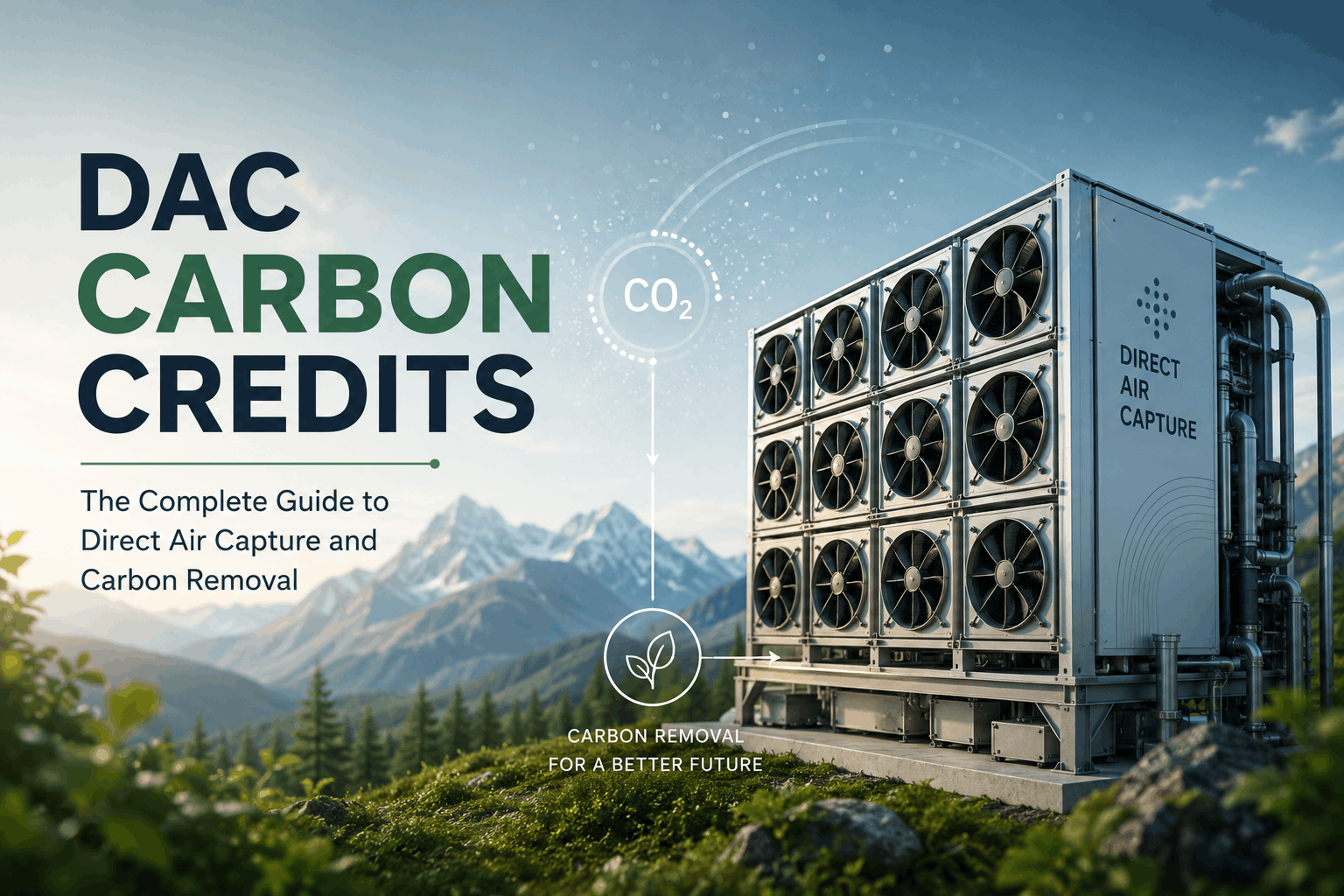
Imagine a machine that pulls carbon dioxide straight out of the sky, the same air you are breathing right now, and locks it away underground forever. That is not science fiction. It is happening today, and it is called direct air capture.
DAC carbon credits have become one of the most talked about topics in climate finance. Companies like Microsoft, JPMorgan, and Stripe are paying premium prices for them. Governments are building tax incentives around them. And climate scientists say the world will need hundreds of millions of tons of this kind of removal to hit net-zero targets.
But what exactly are DAC carbon credits? Why do they cost so much more than a typical tree-planting credit? And are they actually worth the investment?
This guide breaks down everything you need to know about DAC carbon credits. You will learn how the technology works, what drives the price, who the major players are, how credits get verified, and how your organization can buy them with confidence.
Let’s get into it.
What Are DAC Carbon Credits?
DAC carbon credits are a type of carbon removal credit generated when a direct air capture facility pulls carbon dioxide out of the atmosphere and stores it permanently.
Each credit typically represents one metric ton of CO2 that has been physically removed from the air and locked away, usually deep underground in geological rock formations.
This makes DAC carbon credits fundamentally different from most carbon credits on the market. Many traditional credits are based on avoided emissions, such as protecting a forest that might otherwise be cut down. DAC credits are based on actual removal. The carbon was in the atmosphere, and now it is not.
Here is the simplest way to think about it:
- Avoidance credits stop future emissions from happening.
- Removal credits take existing CO2 out of the air.
- DAC credits are removal credits with permanent, engineered storage.
Because DAC does not depend on soil health, weather, or land management the way forestry projects do, it is considered one of the most durable and measurable forms of carbon removal available.
Carbon Market Insider Newsletter
Weekly insights on carbon markets, climate policy, carbon credits, and sustainability.
Why DAC Credits Are Different From Nature-Based Credits
Nature-based credits, like reforestation or soil carbon projects, are valuable and affordable. But they carry risks. A forest can burn down. A farm can change hands. Carbon stored in soil or trees is not always permanent.
DAC credits avoid most of these risks because the captured CO2 is injected into stable rock formations or converted into solid minerals. Once stored this way, it stays put for centuries, in many cases much longer.
This permanence is exactly why buyers with strict net-zero commitments are willing to pay a premium for DAC carbon credits.
How Direct Air Capture Actually Works
Direct air capture, often shortened to DAC, uses large fans and chemical processes to separate carbon dioxide from ordinary air.
This is a genuinely difficult engineering challenge. Carbon dioxide makes up only a tiny fraction of the atmosphere, roughly four parts in ten thousand. That means a DAC plant has to move enormous volumes of air to capture a relatively small amount of CO2.
There are two main technology approaches used across the industry today.
Liquid Solvent DAC
In this method, large fans pull air through structures where it meets an alkaline liquid solution, often a potassium hydroxide solution.
The CO2 in the air reacts chemically with the liquid and gets absorbed. The solution is then heated at high temperatures to release a pure stream of CO2, which gets compressed and prepared for storage.
This approach tends to work best at very large, centralized industrial facilities.
Solid Sorbent DAC
This method uses solid filter-like materials that chemically bind with CO2 as air passes through them.
Once the material becomes saturated with captured CO2, it gets heated or exposed to a vacuum, which releases the concentrated CO2 for storage. The filters are then reused for another capture cycle.
This approach is often used in smaller, modular, container-based units that can be stacked and scaled gradually.
What Happens After the CO2 Is Captured
Once carbon dioxide is captured, it needs somewhere permanent to go. There are two common storage pathways.
- Geological storage. The captured CO2 is injected deep underground into porous rock formations. In some cases, it reacts with basalt rock and turns into solid stone within a few years.
- Mineralization. Some newer DAC technologies use natural materials like limestone to bind CO2 into stable mineral form, which can then be reused or stored.
Both approaches are designed to keep carbon out of the atmosphere for hundreds to thousands of years, which is a core reason DAC credits are viewed as high-permanence removal.
Why DAC Carbon Credits Cost So Much
If you have shopped around for carbon credits before, DAC pricing might come as a shock. While many nature-based credits sell for under thirty dollars a ton, DAC carbon credits regularly sell for several hundred dollars a ton, and some contracts run even higher.
Here is a simple comparison to put things in perspective.
| Credit Type | Typical Price Range (per ton) | Permanence | Measurability |
|---|---|---|---|
| REDD+ forest protection | Very low to moderate | Lower, reversal risk exists | Moderate |
| Afforestation and reforestation | Low to moderate | Moderate | Moderate |
| Biochar | Moderate | High | High |
| Enhanced rock weathering | Moderate to high | Very high | High |
| Direct air capture (DAC) | High to very high | Very high | Very high |
Several factors explain why DAC sits at the top of this pricing table.
- Energy intensity. Pulling CO2 out of a highly diluted gas mixture takes a large amount of electricity and heat, often over a thousand kilowatt-hours per ton captured.
- Early-stage technology. Most DAC plants operating today are first-of-a-kind or early commercial facilities, so they have not yet benefited from mass manufacturing efficiencies.
- High capital costs. Building a large DAC facility requires massive upfront investment in fans, chemical processing units, and storage infrastructure.
- Limited supply. There are still relatively few operational DAC facilities worldwide compared to the huge and growing demand from corporate buyers.
Industry analysts generally agree that costs need to fall closer to two hundred dollars a ton, and eventually lower, before DAC becomes accessible to a much wider range of buyers. Several developers say that goal is achievable as facilities scale up and technology matures, though it will likely take considerable time and continued investment.
DAC vs Other Carbon Removal Methods
DAC is just one tool in the broader carbon removal toolbox. Understanding how it compares to alternatives helps buyers build smarter, more balanced portfolios.
| Method | How It Works | Typical Strength | Typical Limitation |
|---|---|---|---|
| Direct air capture | Chemically extracts CO2 from ambient air | Extremely durable, precisely measurable | High cost, energy intensive |
| Bioenergy with carbon capture (BECCS) | Captures CO2 from burning biomass for energy | Produces energy while removing carbon | Land and biomass supply constraints |
| Enhanced rock weathering | Spreads crushed rock on land to absorb CO2 naturally | Uses natural chemical processes, scalable | Slower removal timeline, verification is evolving |
| Biochar | Converts biomass into stable carbon-rich material | Affordable, improves soil health | Storage duration shorter than geological methods |
| Afforestation and reforestation | Plants trees to absorb CO2 through growth | Low cost, delivers co-benefits like biodiversity | Reversal risk from fire, disease, and land use change |
Most sustainability experts recommend a blended approach. This means combining a smaller share of expensive, highly durable DAC credits with a larger share of more affordable nature-based or biochar credits, creating a portfolio that balances cost with permanence.
Who Is Buying DAC Carbon Credits
DAC credits are largely purchased through long-term offtake agreements rather than one-off spot purchases. This gives project developers the revenue certainty they need to build and finance expensive new facilities.
Major categories of buyers include:
- Big technology companies. Cloud computing and AI companies have enormous energy footprints and have become the single largest source of demand for DAC credits, often signing multi-year contracts covering hundreds of thousands of tons.
- Financial institutions. Global banks have signed offtake deals to secure future removal credits as part of their own net-zero commitments and client advisory services.
- Coalitions of corporate buyers. Several buyer coalitions pool funding from multiple companies to advance-purchase carbon removal, helping smaller or newer DAC developers secure financing.
- Airlines and aviation-linked buyers. Because aviation emissions are hard to eliminate directly, some airlines and related industries look to durable removal credits like DAC to address unavoidable emissions.
- Government procurement programs. Some national governments have launched pilot programs to become early buyers of carbon dioxide removal, sending a strong demand signal to the market.
This demand pattern matters. Because so much DAC volume gets locked into multi-year contracts, spot availability for smaller buyers remains limited, which also helps keep prices high.
Leading DAC Companies and Projects
A handful of companies are driving the DAC industry forward, each using a slightly different technology approach.
| Company | Technology Approach | Notable Project Location | Status |
|---|---|---|---|
| Climeworks | Solid sorbent, modular collector units | Iceland | Operating multiple commercial facilities |
| 1PointFive (Occidental) | Liquid solvent, large centralized plants | United States | Large-scale facility under construction and ramping up |
| Heirloom | Mineralization using limestone | United States | Pilot and early commercial phase, scaling rapidly |
| CO280 | Retrofitting pulp and paper facilities for capture | North America | Advancing offtake agreements with corporate buyers |
| Deep Sky | Developer and infrastructure platform for multiple DAC technologies | Canada | Facility development in progress |
Climeworks currently operates some of the largest functioning DAC plants in the world, using geothermal energy and geological storage to keep its carbon footprint low. Its facilities inject captured CO2 into basalt rock formations, where it mineralizes into stone over a period of years.
1PointFive, a subsidiary of an American energy company, is building what is designed to be one of the largest single DAC facilities on the planet, aiming for hundreds of thousands of tons of annual capture capacity using liquid solvent technology.
Heirloom takes a different approach, using natural limestone that absorbs CO2 as it weathers. This method is generally considered more energy efficient, and the company has stated a goal of pushing costs down significantly as it scales.
How DAC Carbon Credits Get Certified
Not all carbon credits are created equal, and buyers should always check certification before purchasing. Independent verification is what gives a DAC credit real credibility.
Several respected standards and registries are active in verifying carbon removal credits, including DAC specifically.
- Puro.earth focuses specifically on engineered carbon removal methods, including DAC, biochar, and enhanced weathering.
- Isometric is a newer registry built specifically around rigorous, science-based verification of durable carbon removal.
- Gold Standard certifies a range of carbon projects and has expanded its methodologies to cover removal-based credits.
- Verra is one of the largest global registries and has been developing removal-specific methodologies as demand grows.
Buyers should also look for alignment with the Core Carbon Principles set by the Integrity Council for the Voluntary Carbon Market. These principles set a baseline for additionality, permanence, robust monitoring, and transparent reporting.
Questions to Ask Before Buying a DAC Credit
- Is the credit verified by an independent third-party registry?
- How is the storage location monitored, and for how long?
- What is the source of energy powering the DAC facility?
- Is the developer transparent about actual captured tonnage versus projected tonnage?
- Does the contract specify delivery timelines and any risk of non-delivery?
The Real Benefits of DAC Carbon Credits
Despite the high price tag, DAC carbon credits offer a set of benefits that are hard to find elsewhere in the carbon market.
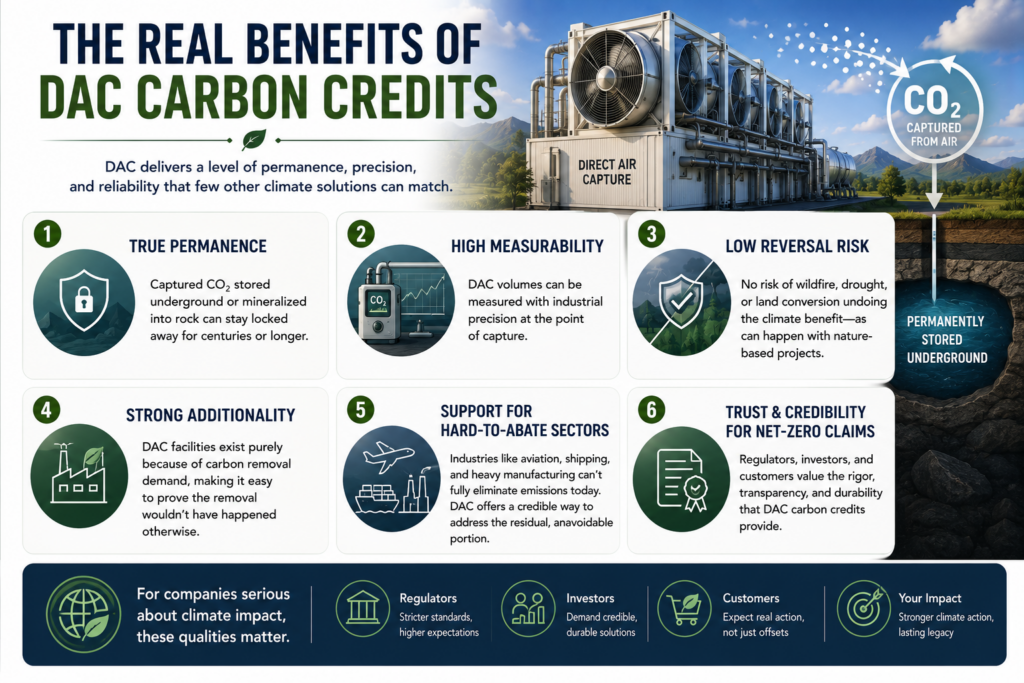
- True permanence. Captured CO2 stored underground or mineralized into rock can stay locked away for centuries or longer.
- High measurability. Unlike forest-based credits, which rely on estimates and modeling, DAC volumes can be measured with industrial precision at the point of capture.
- Low reversal risk. There is no risk of wildfire, drought, or land conversion undoing the climate benefit, the way there can be with nature-based projects.
- Strong additionality. DAC facilities exist purely because of carbon removal demand, which makes it easy to demonstrate that the removal would not have happened otherwise.
- Support for hard-to-abate sectors. Industries like aviation, shipping, and heavy manufacturing often cannot fully eliminate emissions with current technology. DAC offers a credible way to address the residual, unavoidable portion.
For companies making public net-zero claims, these qualities matter. Regulators, investors, and customers are increasingly scrutinizing carbon claims, and DAC credits hold up well under that scrutiny compared to lower-quality alternatives.
Challenges and Criticism of DAC Carbon Credits
DAC is not without its critics, and it is worth understanding the honest limitations of the technology.
- High cost limits accessibility. At current price levels, only large corporations with substantial sustainability budgets can realistically buy DAC credits at scale.
- Energy demand is significant. DAC facilities require large and consistent supplies of electricity and heat. If that energy comes from fossil fuel sources, it can significantly reduce the net climate benefit.
- Scale remains small. Global DAC capacity today captures a tiny fraction of what climate models say will eventually be needed for meaningful impact.
- Some critics argue DAC risks distracting from emissions reduction. The technology should support, not substitute for, cutting emissions at the source.
- Long-term verification is still developing. Because large-scale geological storage monitoring is relatively new, some standards and methodologies are still being refined.
The reasonable takeaway most climate experts share is that DAC should be treated as a tool to address genuinely unavoidable, residual emissions, used alongside deep emissions cuts rather than as a substitute for them.
Where DAC Facilities Are Being Built Around the World
DAC is not confined to one country. Facilities and pilot projects are spreading across several regions, each with its own advantages.
- North America currently leads global deployment, thanks to generous tax incentives, abundant land, and access to suitable geological storage sites.
- Iceland has become a hub for DAC because of its abundant geothermal energy and volcanic basalt rock, which is ideal for permanent mineral storage.
- Europe is investing heavily in regulatory infrastructure and research, with several pilot facilities operating alongside a growing certification framework.
- The Middle East has attracted interest from energy companies looking to pair DAC with existing oil and gas infrastructure and low-cost solar power.
- Asia Pacific is in earlier stages of DAC development, though several governments have signaled interest in carbon removal research and pilot funding.
This geographic spread matters for buyers. A facility powered by clean geothermal or solar energy delivers a much stronger net climate benefit than one relying on a fossil-heavy electricity grid.
Common Myths About DAC Carbon Credits
There is a lot of confusion around direct air capture. Here are some common myths, compared with the facts.
| Myth | Reality |
|---|---|
| DAC can single-handedly solve climate change | DAC is one tool among many. Deep emissions cuts remain the top priority. |
| DAC credits are unregulated and unverifiable | Reputable registries like Puro.earth and Isometric apply rigorous, science-based verification standards. |
| All carbon capture technology is the same as DAC | DAC pulls CO2 from open air. Point-source capture pulls CO2 from industrial exhaust before it disperses. |
| DAC will always be too expensive to matter | Costs are already falling for some developers, and further declines are expected as the industry scales. |
| Captured CO2 just gets released again later | When stored geologically or mineralized, captured CO2 is designed to remain locked away for centuries or longer. |
DAC and Corporate Net-Zero Strategy
Many companies now separate their climate commitments into two distinct categories: reducing emissions and removing carbon. This distinction matters because it prevents companies from using cheap credits as a substitute for real operational change.
A typical net-zero roadmap generally follows this order of priority.
- Reduce emissions first. Improve energy efficiency, switch to renewable power, and redesign supply chains wherever possible.
- Address unavoidable emissions. For the portion of emissions that cannot currently be eliminated, use high-quality removal credits.
- Prioritize durable removal for long-term claims. Many corporate sustainability teams now reserve DAC credits specifically for balancing residual emissions that are expected to persist for decades, since the permanence of DAC storage matches the long timeline of the problem.
This layered approach is becoming the standard among companies with credible, third-party-reviewed climate targets, and it explains why DAC demand keeps growing even at a premium price point.
Policy Support Driving the DAC Market
Government policy plays an outsized role in whether DAC becomes commercially viable, and two policy frameworks currently shape the global landscape.
United States Tax Incentives
In the United States, a federal tax credit provides substantial financial support for every ton of CO2 permanently stored using direct air capture technology. This incentive has become one of the most important financing tools for DAC developers, since it can often be transferred or sold to third parties, helping smaller companies access capital even without a large existing tax liability.
The federal government has also run pilot procurement programs, acting as an early buyer of carbon removal to help create demand certainty for the young industry.
European Union Regulatory Framework
The European Union has taken a more regulatory approach, establishing a formal Carbon Removal Certification Framework. This framework creates standardized rules for verifying, certifying, and eventually integrating removal credits, including DAC, into broader climate policy and compliance systems.
Other regions are watching these two models closely, and additional government incentive programs are expected to emerge as the technology matures and costs decline.
How to Buy DAC Carbon Credits: A Step-by-Step Guide
If your organization is considering purchasing DAC carbon credits, here is a practical roadmap to follow.
- Define your carbon removal goals. Decide what portion of your net-zero strategy will rely on removal credits versus direct emissions reductions.
- Set a realistic budget. Because DAC is priced at a premium, many organizations start with a small allocation and grow it over time.
- Research verified suppliers. Look at developers with strong track records, transparent reporting, and third-party certification.
- Check registry and certification status. Confirm the credits are listed with a reputable registry and meet recognized quality principles.
- Review contract structure. Understand delivery timelines, pricing terms, and what happens if a facility underperforms its projected capture volume.
- Diversify your portfolio. Combine DAC with other credit types to balance cost, permanence, and overall climate impact.
- Report transparently. Clearly communicate what share of your climate strategy comes from removal credits versus source reductions, to maintain credibility with stakeholders.
Working with a knowledgeable carbon markets advisor or platform can simplify this process significantly, especially for organizations new to procurement.
The Future of DAC Carbon Credits
The direct air capture industry is still young, but momentum is building quickly. Facility capacity is expanding, more technology pathways are being tested, and policy support continues to grow across multiple regions.
Cost is the central challenge the industry must solve. Most experts expect prices to decline gradually as facilities scale up, supply chains mature, and companies gain operational experience running these complex systems.
At the same time, demand keeps climbing. As more corporations adopt science-based net-zero targets, and as regulators tighten rules around greenwashing, the market is shifting toward higher-quality, more durable credits. That trend favors DAC over time, even at a premium price.
Expect to see continued innovation in energy efficiency, new storage methods, and modular manufacturing approaches designed to bring costs down the way early solar technology did decades ago. Whether DAC follows that same steep cost curve is still an open question, but the direction of travel points toward a larger and more accessible market in the years ahead.
Frequently Asked Questions About DAC Carbon Credits
What does DAC stand for in carbon credits?
DAC stands for direct air capture, a technology that removes carbon dioxide directly from the surrounding atmosphere using chemical processes.
Are DAC carbon credits legitimate?
Yes. DAC credits are considered among the highest-integrity carbon credits available because the removal is directly measurable and the storage is highly permanent, especially when verified by reputable registries.
Why are DAC carbon credits so expensive?
DAC is expensive because the technology is energy intensive, capital costs are high, and most facilities are still early-stage. Prices are expected to fall as the industry scales.
How long does captured CO2 stay stored?
Captured CO2 stored through geological injection or mineralization is generally expected to remain locked away for centuries, and in many cases much longer.
Can individuals buy DAC carbon credits? Some DAC companies offer smaller subscription-style purchase options for individuals, though most volume is sold through large corporate contracts.
What is the difference between DAC and carbon capture and storage?
Carbon capture and storage, often called CCS, captures emissions directly from industrial exhaust streams before they enter the atmosphere. DAC pulls CO2 out of the open air after it has already been emitted.
Is DAC better than planting trees?
Neither is strictly better. DAC offers superior permanence and measurability, while tree planting is more affordable and delivers additional ecosystem benefits. Many experts recommend using both as part of a balanced climate strategy.
Which companies are buying the most DAC carbon credits?
Large technology companies, financial institutions, and corporate buyer coalitions currently represent the largest share of DAC credit purchases, typically through multi-year offtake agreements.
Does DAC use a lot of water?
Some DAC methods do use water in the capture process, though the amount varies significantly by technology. Developers are actively working on water-efficient designs, and some newer approaches even produce water as a byproduct.
Can DAC credits be used for compliance markets?
In most regions, DAC credits are currently used in voluntary carbon markets. However, new regulatory frameworks are beginning to create pathways for removal credits to count toward official national and regional climate targets.
How is a DAC facility different from a power plant with carbon capture?
A DAC facility processes ordinary ambient air from anywhere on the planet, so it can be built independent of any emissions source. A power plant with carbon capture only captures emissions from its own exhaust stream, so it must be attached directly to that facility.
Key Takeaways on DAC Carbon Credits
Before wrapping up, here is a quick summary of the most important points covered in this guide.
- DAC carbon credits represent verified, permanent removal of carbon dioxide from the atmosphere, not just avoided emissions.
- Prices remain high today due to energy intensity, capital costs, and the early stage of the technology, though costs are expected to decline over time.
- Major buyers include large technology companies, financial institutions, and buyer coalitions, mostly through long-term offtake agreements.
- Independent certification through registries like Puro.earth, Isometric, Gold Standard, and Verra is essential for verifying credit quality.
- DAC works best as part of a diversified carbon removal portfolio, paired with more affordable methods like biochar or nature-based credits.
- Government incentives, particularly in the United States and European Union, continue to shape where and how quickly DAC scales globally.
Final Thoughts
DAC carbon credits represent one of the most promising, and most expensive, tools in the fight against climate change. The technology delivers something rare in the carbon market: precise, measurable, and highly durable removal of carbon dioxide from the atmosphere.
Yes, the price tag is steep today. But as facilities scale, technology improves, and policy support strengthens, DAC carbon credits are positioned to play a growing role in serious net-zero strategies around the world.
For organizations serious about credible, high-integrity climate action, understanding DAC carbon credits is no longer optional. It is quickly becoming a core part of the conversation around how the world tackles its hardest, most unavoidable emissions.
For more updates, guides, and resources on carbon markets, explore Carbon Market Network.