Carbon Market Network


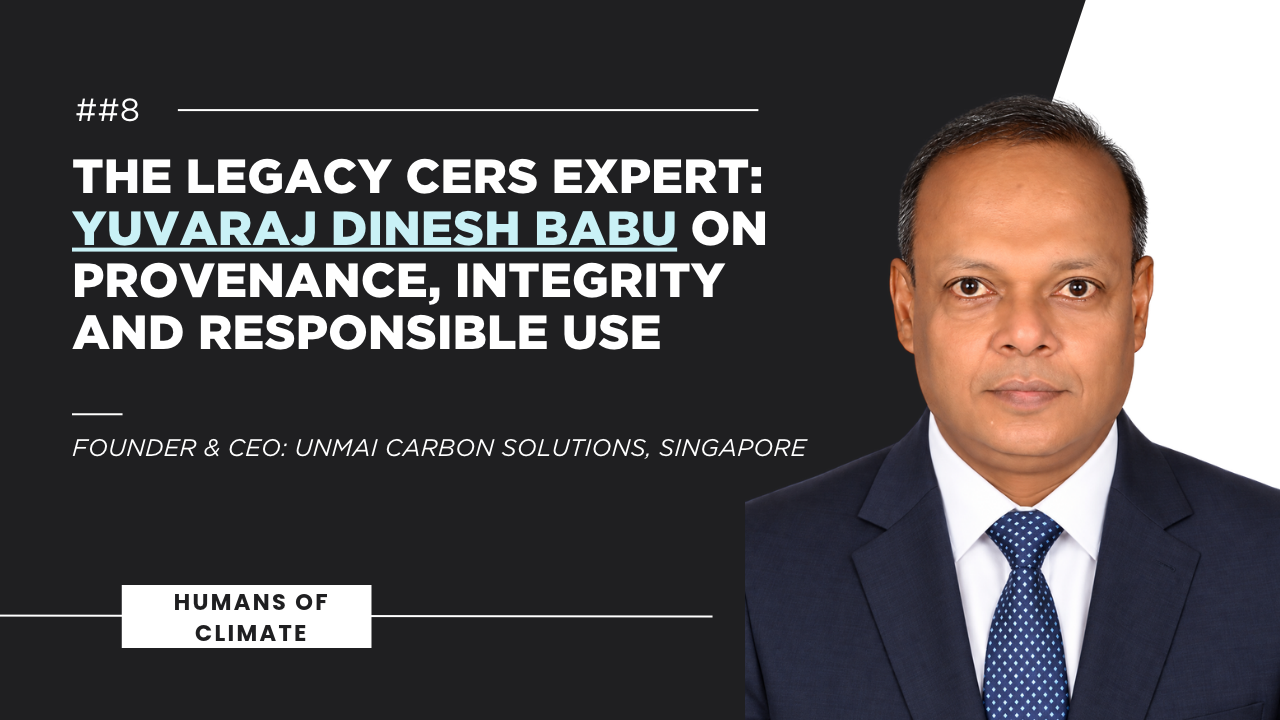
Yuvaraj Dinesh Babu, Founder and CEO of UNMAI Carbon Solutions Singapore (UNMAI), describes his work in carbon markets through a lens of transparency and market integrity. With more than two decades of experience across carbon markets, climate finance and carbon data infrastructure, he has worked across carbon exchanges, registries and climate programmes.
That experience informs the question he is now trying to answer: what happens to the Certified Emission Reductions (CERs) under the Clean Development Mechanism (CDM) moves towards closure? For Dinesh, the answer cannot simply be to find another place for old credits to sit. The more difficult question is how their history, identity and limitations can be carried forward once the system that originally issued them is no longer operating.
UNMAI’s proposed Legacy CERs pathway is built around that distinction. The process begins with voluntary cancellation of the original CER on the CDM Registry, followed by the creation of a separate digital representation linked to its original provenance.
But Dinesh’s argument goes beyond the mechanics of cancellation and reissuance. His position is that the future of Legacy CERs will depend on three things: transparent provenance, rigorous integrity assessment and responsible use.
“When a registry closes, the credits issued under it risk losing their documentation and their credibility. The future of Legacy CERs depends on transparent provenance, rigorous integrity assessment and responsible use. Without those, there is little basis for confidence.”
It is a deliberately measured proposition. Rather than beginning with price or liquidity, Dinesh begins with trust where a credit came from, what can be established about it, and what a buyer can legitimately do with it.
The Evolution of the CDM and the Legacy CER Challenge
For Dinesh, the Legacy CER question cannot be separated from the history of the CDM itself.
The mechanism was established in 1997 under the Kyoto Protocol and subsequently generated billions of Certified Emission Reductions from thousands of projects. UNMAI’s analysis identify more than 2.1 billion CERs issued between 2005 and 2011 across more than 8,200 projects. The market later experienced a significant decline, while uncertainty around the future of the mechanism increased following the Paris Agreement. The adoption of Article 6.4 rules in 2021 further narrowed the pathway available to existing projects.
“These units were issued in good faith under the rules of the time, and those rules have since changed. Approximately 1.27 billion CERs now have no route to transition, the Legacy CER question is the outcome of that trajectory, not a new development.”
UNMAI estimates that around 1.27 billion CERs are stranded and not eligible for transition, covering more than 2,000 projects across more than 40 countries. Its materials estimate that approximately USD 6.4 billion in value could be extinguished.
The numbers explain the scale of the problem. But Dinesh’s focus is on what happens next.
Rather than treating these units as a homogeneous pool, he argues for understanding their individual status first where they were issued, when they were issued and where they currently sit.
“Holders should first establish exactly what they hold: when it was issued, and whether it sits in a holding account or a pending account. That determines which options remain available, and some of those windows close within weeks.”
That distinction becomes important because not every CER is facing the same deadline or has the same available pathway.
Understanding the Different Categories of CERs
The term “Legacy CER” can make the units sound like one category. UNMAI divides the relevant CERs into four broad categories based on their issuance period and current status.
- The first includes units issued during the first Kyoto commitment period, up to 31 December 2012.
- The second covers units issued between 1 January 2013 and 31 December 2020, including eligible Glasgow CERs.
- The third category concerns CERs from CDM activities that have transitioned to Article 6.4 and were issued from 1 January 2021.
- The fourth concerns units remaining in pending accounts because relevant fees were unpaid, as well as certain units transferred to country registries but not yet retired.
For Dinesh, this classification determines what options are available to a holder.
“Without clear categories, both sides are poorly served. A holder may miss a deadline that applies to them, and a buyer may assume a unit carries rights that it does not.”
The underlying point is straightforward: before asking whether a CER has future value, the holder needs to establish exactly what the unit is and what regulatory position it occupies.
Carbon Market Insider Newsletter
Weekly insights on carbon markets, climate policy, carbon credits, and sustainability.
The Regulatory Timeline and Available Pathways
The urgency comes from the deadlines.
UNMAI’s materials identify four broad pathways. Eligible units can be submitted for transition to Article 6.4, with the relevant request deadline identified as 25 October 2026. Holders can also pursue voluntary cancellation and reissuance through the Legacy CERs pathway, with the cancellation deadline identified as 25 November 2026. The CDM Registry’s relevant operations then cease on 31 December 2026. For certain CERs remaining unpaid in pending accounts, UNMAI identifies 1 July 2027 as the administrative cancellation date.
Dinesh’s advice to holders is therefore likely to be less about choosing quickly and more about understanding the consequences of each route.
“Of the four routes available, three close on the holder, and only voluntary cancellation is a decision. Developers who intend to pursue it should treat 25 November as the working deadline, since that is the date to which the registry guarantees processing. Anything submitted after it carries no such assurance ahead of 31 December.”
The distinction is particularly important for voluntary cancellation.
Once a CER is cancelled on the CDM Registry, that cancellation is final. The Legacy CER created afterwards is not the same UNFCCC unit continuing under another name. It is a separate voluntary-market instrument linked to the cancelled CER through its provenance record. For Dinesh, that distinction is central to the credibility of the entire model.
The Legacy CER Cancellation and Reissuance Process
The first step is voluntary cancellation of the original CER on the CDM Registry. The cancellation provides documentary evidence of the units being cancelled, including their serial ranges.
The second step involves submitting that evidence and the relevant project documentation to the Legacy CERs Platform. UNMAI proposes verifying the cancelled units against registry records and creating a one-to-one digital representation linked to the original provenance.
The third step is optional tokenisation.
UNMAI proposes that the resulting digital representations could be tokenised, with information such as the project ID, host country, activity type and vintage associated with the digital representation. Tokenisation is not required for the underlying Legacy CER to exist or to be traded.
“The original CER cannot continue beyond the registry’s closure. Cancellation produces a certificate with the serial ranges, and the Legacy CER is anchored to that evidence. It is a clean break, with a documented link.”
The proposed marketplace would allow Legacy CERs or their digital representations to be transferred until retirement. Retirement would generate a certificate and create an archived record intended to prevent the same unit from being claimed twice.
The important distinction is that the platform does not recreate the original compliance instrument.
UNMAI’s strategy explicitly states that the platform is not a route to revalidate old CERs for compliance use. The Legacy CER is a distinct voluntary-market instrument rather than a UNFCCC unit.
The Three Principles Underpinning Legacy CERs
This is where Dinesh’s argument becomes clearer.
The cancellation process answers the question of how a CER can be given a new form. His three principles address whether that new form can be trusted.
“Legacy CERs’ future depends on transparent provenance, rigorous integrity assessment and responsible use.”
The three ideas are closely connected.
Provenance establishes where the unit came from.
Integrity assessment provides a framework for understanding its quality.
Responsible use establishes what the resulting instrument can legitimately be used for and what claims can be made around it.
These principles also correspond with UNMAI’s broader T³I framework: Truth, Transparency, Traceability and Integrity.
For Dinesh, the challenge is therefore not simply extending the life of an old credit. It is creating enough information around that credit for someone else to understand what they are buying.
“Liquidity without trust amounts to transactions without conviction. If buyers cannot determine what they are purchasing, they will not pay for quality, and the market will not mature.”
Provenance and Traceability as the Foundation
Dinesh places provenance at the beginning of the process because every subsequent claim depends on it.
UNMAI describes its Digital Twin Pathway as a mechanism for extending the utility of stranded CERs while preserving their provenance from the original UNFCCC record.
That means the connection between the original CER and the resulting Legacy CER needs to remain visible.
The cancellation evidence provides the starting point. The Legacy CER receives a unique identifier linked to the original record, while the proposed digital representation can carry information including the project ID, host country, activity type and vintage.
“Provenance is more than a document on file. It is a clear, continuous link between the Legacy CER’s unique identifier and the original UNFCCC record. A buyer should not have to reconstruct the lineage of a credit.”
This is where Dinesh’s experience with carbon-market data infrastructure becomes particularly relevant. The question is not simply whether information exists somewhere. It is whether the information can be accessed, understood and traced.
A credit may have a long history. A buyer should not have to reconstruct that history themselves.
Assessing Integrity and Differentiating Quality
If provenance answers the question of where a credit came from, integrity assessment asks what can be established about its quality.
UNMAI is developing an Integrity Ranking intended to differentiate eligible Legacy CERs based on project-level characteristics and available evidence. The methodology is still being developed, and the ranking is described as an optional buyer service.
Dinesh’s position here is therefore not simply that Legacy CERs should be ranked. It is that the basis for any ranking needs to be credible.
“A ranking is only as credible as its basis. It should allow buyers to look beyond vintage and price, and its method must be transparent enough to be questioned. As an optional buyer service, it has to demonstrate its value.”
For buyers, that could mean moving beyond questions of vintage and price to ask what is known about the underlying project, what documentation exists and what evidence supports the assessment.
The methodology will ultimately determine whether the ranking adds meaningful information or simply another label.
Potential Market Participants and Liquidity Pathways
The next question is who would actually want to buy a Legacy CER.
UNMAI identifies several potential pathways: insetting, corporate purchases supported by an integrity-ranking framework, and retail trading through optional tokenisation. Project developers may also retire units against their own emissions and voluntary objectives.
“The natural buyers are those who already value provenance: ESG-oriented corporates, companies pursuing insetting, and project developers retiring units against their own emissions. They will expect documented evidence”
UNMAI’s strategy identifies ESG-oriented buyers who place value on provenance as one potential market.
That creates a more specific proposition than simply trying to sell Legacy CERs to the entire carbon market.
The buyer who values provenance will also want to understand the evidence behind the unit. That brings the three parts of Dinesh’s argument back together: provenance creates the record, integrity assessment helps interpret it, and responsible use defines what can subsequently be done with it.
Responsible Use and Voluntary-Market Positioning
Of the three principles, responsible use may be the one with the clearest implications for how the market communicates Legacy CERs.
Dinesh is clear that cancellation and reissuance should not be confused with restoring the original CER’s compliance status.
“Language must be precise. A Legacy CER should not be described as the original CER continuing under another name, and tokenisation should never be presented as creating a new compliance credit.”
UNMAI’s strategy states that the platform is not intended to revalidate old CERs for compliance use. The original cancellation is final, while the resulting Legacy CER is a separate voluntary-market instrument.
That distinction matters because the language surrounding a carbon instrument can influence how buyers understand its value and permitted use.
A Legacy CER should not be represented as though it were still the original UNFCCC unit. Nor should tokenisation be presented as creating a new compliance credit.
The final stage is retirement. Once retired, the unit is removed from circulation, with the proposed platform providing a retirement certificate and archival record.
“Before retiring a unit, a buyer should confirm three things: that it can be traced to its cancellation evidence, what evidence supports its quality, and that the intended claim is consistent with a voluntary-market instrument. Retirement is final.”
Regulatory, Market, Legal and Technology Risks
The regulatory question is whether the UNFCCC will recognise the transition from an original CER to a Legacy CER. The proposed approach is therefore to clearly position the resulting instrument within voluntary markets rather than present it as a compliance unit.
There is also a market question. If buyers do not see meaningful differences between Legacy CERs, there may be limited willingness to pay for quality or provenance.
Then comes the legal question around voluntary or administrative cancellation and the permitted uses of the resulting instruments.
And finally there is the technology layer. Blockchain and tokenisation are presented as optional components, with third-party validation and cross-verification identified as potential safeguards.
“The principal risk is that buyers see no meaningful difference between units. If that occurs, there is no incentive to pay for provenance or quality. We address it through quality disclosure and an integrity ranking directed at buyers who value provenance.”
That caution is consistent with his wider position. A platform can preserve a record. It cannot, by itself, determine how the market will value that record.
Building a Credible Second Life for Legacy CERs
Ultimately, Dinesh sees the CDM Registry closure as more than an endpoint.
The immediate deadlines determine what holders can do with their existing CERs. But what happens afterwards will depend on whether the voluntary-market instruments created around cancelled CERs can establish their own credibility.
“It means that the work behind these projects is not lost with the closure of a registry, and equally that it is not overstated. If provenance, integrity and responsible use are right, Legacy CERs can earn credibility on their own terms.”
The proposed Legacy CER pathway therefore rests on a relatively simple proposition: cancellation creates a clean break with the original unit, while provenance creates a documented connection to its history. For project developers approaching the November deadline, Dinesh’s advice is ultimately about making an informed decision about what happens to their CERs.
For buyers, the questions are different: Where did this unit come from? What evidence supports its quality? And what can I responsibly claim after using or retiring it?
Those questions bring the conversation back to the three principles at the centre of Dinesh’s argument.
Provenance. Integrity. Responsible use.
And, for Dinesh, the future of Legacy CERs depends on getting all three right.
Quick Takes
One misconception about Legacy CERs he would love to retire:
That the closure of the registry leaves these units without any value. Their value depends on whether their origin and quality can be demonstrated, and that is what this pathway is designed to preserve.
One question every project developer should ask before 25 November:
What exactly do I hold, and which route is genuinely open to me?
One thing a Legacy CER should never be used to claim:
That tokenisation has created a new compliance credit.
One thing buyers should ask to see before purchasing a Legacy CER:
The cancellation certificate with its serial range, and the provenance record linked to it.
One part of the CDM story people tend to forget:
That it was among the first large-scale efforts at project-level carbon accounting, on which much of today’s market was built.
One carbon-market process overdue for more transparency:
The step between retirement and the public claim. Stakeholders should be able to see what was retired and what was stated about it.
One technology he is watching most closely:
Digital registry infrastructure, provided it makes provenance easier to verify rather than more complex.
One idea in carbon markets he thinks is overhyped:
That a token creates trust on its own. It is an optional layer; what sits behind it is what matters.
One region or market that could surprise the world in carbon credits:
Southeast Asia, where Article 6 frameworks are developing rapidly.
One word that describes the future of Legacy CERs:
Credible

Yuvaraj DINESH Babu Nithyanandam
Yuvaraj DINESH Babu Nithyanandam, Founder & CEO of UNMAI Carbon Solutions, Singapore, brings over 30 years of international experience in carbon markets, climate finance, clean energy, decarbonization and digital carbon infrastructure. He previously led Climate Action Data Trust and held senior roles at Global Carbon Market Utility, Infrablocks, Asia Carbon Group and The Carbon Ratings Agency. At EY, he led the World Bank’s $12.93 million SUPRABHA programme across 17 Indian states; at Nexant, he led USAID’s $22 million PACE-D programme. His expertise spans policy, innovative financing, programme management, registries and capacity building, with earlier experience at IREDA, TERI and entrepreneurial ventures.