Carbon Market Network


You have a carbon project to verify. Buyers want proof. Auditors want clean data. Every vendor you meet claims to be the most transparent option on the market.
So how do you compare them?
This guide helps you do exactly that. We look at seven active blockchain MRV platforms: Hedera Guardian, Regen Network, ixo, TraceX, DOVU, Carbonmark Direct and Open Forest Protocol.
These blockchain MRV platforms look alike on the surface. Under the hood, they play very different roles. Some are open-source engines that registries build on. Some are field apps with a blockchain audit trail. Others pair verification with a marketplace.
You will learn what each platform does, who it suits and where it falls short. You will also get a simple, step-by-step method for choosing the right one.
A quick note on method. We built this comparison from public documentation, product pages and announcements. Treat it as a strong starting point, then request a demo and test any shortlisted platform with your own project data.
New to the basics? Start with our complete guide to dMRV, then come back here.
What Are Blockchain MRV Platforms?
Blockchain MRV platforms are software systems that measure, report and verify climate outcomes, then record the evidence on a blockchain.
The goal is simple. Anyone who buys, audits or regulates a carbon credit should be able to see how that credit came to exist.
Carbon Market Insider Newsletter
Weekly insights on carbon markets, climate policy, carbon credits, and sustainability.
MRV and dMRV in Plain Words
MRV stands for monitoring (or measurement), reporting and verification. It turns a real-world climate action into a credit people can trust.
Traditional MRV leans on site visits, spreadsheets, PDF reports and periodic audits. It works, but it is slow and expensive. It also leaves room for gaps and errors.
Digital MRV, or dMRV, replaces much of that manual work. It uses mobile apps, sensors, satellite data and software checks to collect and validate evidence continuously.
Blockchain adds one more layer. It keeps a shared record that is extremely hard to change after the fact.
What the Blockchain Actually Does
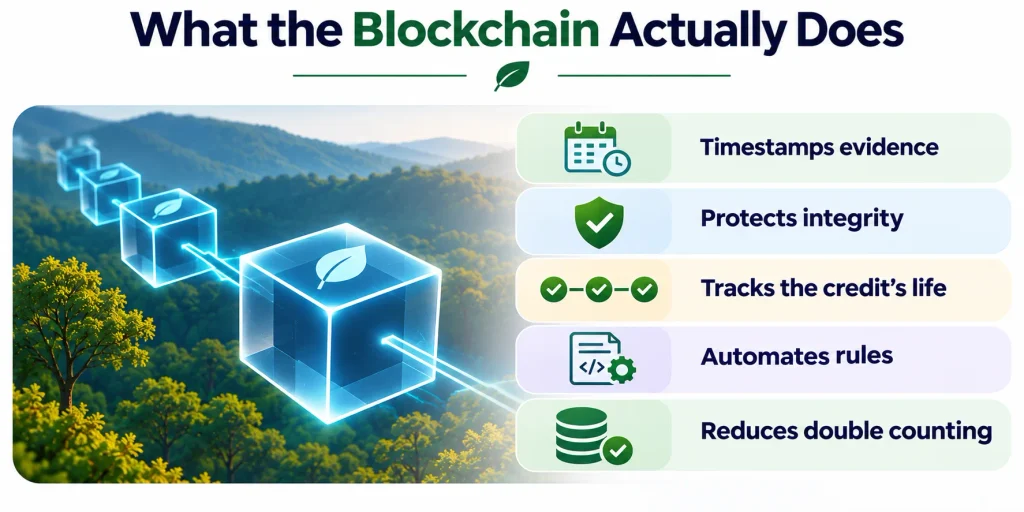
In blockchain-based dMRV, the ledger handles a few specific jobs:
- Timestamps evidence. It proves a data record existed at a certain moment.
- Protects integrity. Changing an old record leaves visible traces.
- Tracks the credit’s life. It follows a credit from issuance to transfer to retirement.
- Automates rules. Smart contracts can issue or retire credits when set conditions are met.
- Reduces double counting. One shared record makes it harder to sell the same tonne twice.
What the Blockchain Does Not Do
Here is the part vendors rarely stress. A blockchain cannot tell you whether the data is true.
If a sensor drifts, a baseline is flawed or a methodology is weak, the ledger simply stores the problem permanently. Experts describe this as a flawed method made immutable.
Researchers at the Cambridge Centre for Carbon Credits reached a similar view after building a prototype carbon marketplace on a blockchain. The ledger was not the hard part. Data quality and governance were.
So when you compare blockchain MRV platforms, look past the word “blockchain.” Focus on how each platform captures data, checks it and brings in independent verification.
How a Blockchain dMRV Workflow Runs
Most platforms follow a similar path, even when the tools differ:
- Register the project and link it to a methodology.
- Capture data in the field through apps, sensors, satellites or devices.
- Validate the data with automated checks and anomaly detection.
- Anchor the evidence on a blockchain with a timestamp.
- Verify independently through an auditor, a validator network or an approved oracle.
- Issue the credit through a registry or a smart contract.
- Track transfers and retirement on the same shared record.
Traditional MRV vs Blockchain-Based dMRV
| Area | Traditional MRV | Blockchain-based dMRV |
|---|---|---|
| Data collection | Manual surveys, spreadsheets, PDFs | Apps, sensors, satellites, automated feeds |
| Verification rhythm | Periodic, often yearly or longer | Can run continuously or at high frequency |
| Audit trail | Scattered across files and emails | One timestamped, shared record |
| Double counting risk | Depends on registry controls | Lower, because each credit has a visible history |
| Reporting effort | Heavy and repetitive | Largely automated |
| Transparency | Limited to what the project shares | Open or permissioned access to the evidence |
Why Blockchain MRV Platforms Matter Right Now
Carbon markets have spent several years rebuilding trust. Investigations into credit quality shook buyer confidence. Since then, buyers have become pickier. They want to know where a credit came from and how anyone checked it.
Blockchain MRV platforms answer that demand directly. They make the evidence visible instead of asking buyers to take a seller’s word for it.
The biggest shift is who now adopts the technology. Registries and standard setters lead the way, not just crypto startups.
- Verra and Hedera Guardian. Verra built Guardian into its Project Hub and described itself as the first standard setter to do so. The ALLCOT mangrove restoration project in Senegal was the first to use it.
- High-frequency issuance. Verra approved the first credits under its dMRV pilot, from a solar farm in the Comoros. Credits can now arrive monthly or bi-monthly. Projects can request 80 percent of approved credits right away, while Verra holds back 20 percent as a safeguard.
- Approval of dMRV providers. The Global Carbon Council created a formal approval process for dMRV solution providers and has approved its first one.
- Serious investment. TÜV SÜD launched a decarbonization centre of excellence in Singapore, with more than 24 million US dollars committed to an end-to-end dMRV ecosystem.
The Verra pilot does not depend on one blockchain. Still, it shows where the market is heading. Digital data flows straight into issuance, and the audit trail travels with it.
The first wave of crypto carbon projects taught a hard lesson. Putting weak credits on a blockchain does not make them strong. The platforms that remain focus on data quality and work with registries instead of around them.
How We Compared the Top Blockchain MRV Platforms
We asked eight questions about every platform:
- What does it actually do: data capture, verification, registry, marketplace or all four?
- Which blockchain does it run on?
- Which project types does it serve best?
- How does it connect to carbon standards and registries?
- Who performs the independent verification?
- Is the technology open or proprietary?
- How hard is it to start, and what does the first step cost?
- What proof of real-world use exists?
One more point. These seven products are not identical. Guardian is infrastructure. Regen is a registry. TraceX is software. Carbonmark Direct is an issuance and marketplace layer.
So the best pick depends on your role in the carbon value chain.
Quick Comparison: Top 7 Blockchain MRV Platforms
| Platform | Main role | Blockchain | Best for | Access model |
|---|---|---|---|---|
| Hedera Guardian | dMRV policy engine | Hedera | Registries, standard bodies, methodology builders | Open source, self-hosted |
| Regen Network | Registry, ledger and marketplace | Regen Ledger (Cosmos SDK) | Regenerative agriculture and biodiversity | Public ledger, open registry process |
| ixo | Verifiable claims and oracle protocol | ixo Layer 1 chain | Clean cooking and impact programs | Open protocol |
| TraceX | dMRV software | Blockchain-backed audit trail | Agroforestry and smallholder projects | Commercial software |
| DOVU | Carbon operating system and marketplace | Hedera | Agricultural and land-based credits | Managed service on open-source Guardian |
| Carbonmark Direct | On-chain issuance and marketplace | Polygon and Base | New carbon removal technologies | Onboarding through Carbonmark |
| Open Forest Protocol | Open MRV and nature standard | Open blockchain (launched on NEAR) | Forest and agroforestry restoration | Open, no upfront cost for developers |
The Top 7 Blockchain MRV Platforms Compared
1. Hedera Guardian: Best Open-Source Engine for Digitizing Methodologies
| Detail | Summary |
|---|---|
| Type | Open-source policy workflow engine for dMRV |
| Blockchain | Hedera |
| Best for | Registries, standard bodies, methodology developers |
| Standout | Built into Verra’s Project Hub |
Guardian works like shared plumbing for the whole space. It is open source under the Apache 2.0 license, and a community of more than 100 contributors builds on it. Hedera also presents it under the name Sustainability Studio.
At its core sits a policy workflow engine. A policy is a methodology turned into running software. It holds data forms, approval steps for each role, calculations and dMRV connections.
Guardian logs key steps on the Hedera network. It records messages through the Hedera Consensus Service and mints tokens through the Hedera Token Service. Anyone can trace a token back through the documents that produced it.
How it works:
- A registry or developer imports or builds a policy for a methodology.
- Project proponents submit documents and monitoring data through role-based forms.
- Validators and verifiers review and approve at set checkpoints.
- The registry role approves issuance.
- Guardian mints tokens and links each one to its full evidence trail.
Where it is in use:
- Verra uses Guardian in its Project Hub and has committed to digitizing more methodologies, with bounties of up to 5,000 US dollars for open-source contributors.
- The ALLCOT mangrove project in Senegal submitted its documents through a digital version of the VM0033 methodology.
- EcoRegistry runs on Hedera with Guardian and serves standards and countries. Hedera’s case study reports more than 200 registered projects.
Strengths:
- Free to run, with no license fees.
- Large, shared library of digitized methodologies.
- Strong registry adoption.
- Very low energy use per transaction, according to Hedera.
Limits to watch:
- It is a framework, not a finished product for a farmer or a cookstove company.
- You need a technical team or an implementation partner.
- You still need your own data capture layer, such as apps, sensors or satellite feeds.
Best for: registries, standard bodies, large developers and tech teams that want to build on open infrastructure.
2. Regen Network: Best for Regenerative Agriculture and Biodiversity Credits
| Detail | Summary |
|---|---|
| Type | Ecological registry, ledger and marketplace |
| Blockchain | Regen Ledger, a public proof-of-stake chain built on the Cosmos SDK |
| Best for | Regenerative agriculture, biodiversity, community-led land projects |
| Standout | Its own credit classes and methodologies for nature |
Regen Network took a different route from most. It built its own blockchain and its own registry, then wrote methodologies for ecological outcomes that big standards cover only partly.
Three modules on Regen Ledger do the heavy lifting:
- Ecocredit module. Issues, transfers and retires carbon and biodiversity credits.
- Data module. Timestamps information and lets several parties attest that it is valid.
- Groups module. Creates on-chain joint accounts with voting rules.
The Regen Registry sets the credit protocols. The Regen Marketplace app lets users register projects, buy, sell and retire credits, and join governance.
Regen also supports progressive attestations. Land stewards can enter data earlier in a project and track progress, instead of waiting for one big report at the end.
The network has moved beyond carbon too. One pilot funds jaguar habitat protection across 10,000 hectares of Ecuadorian forest.
Strengths:
- Purpose-built for ecological and community-led projects.
- Public ledger with open data modules.
- Supports biodiversity credits, not only carbon.
Limits to watch:
- Regen runs its own registry. Buyers who only purchase from the largest standards may need extra convincing.
- You must learn the Regen Registry process and credit classes.
- It suits land-based projects far better than industrial ones.
Best for: regenerative farming groups, land stewards and biodiversity projects that want a native, open home for their credits.
3. ixo: Best for Automated Verification of Impact Claims
| Detail | Summary |
|---|---|
| Type | Protocol and platform for verifiable impact claims |
| Blockchain | ixo’s own Layer 1 chain |
| Best for | Clean cooking and device-based impact programs |
| Standout | AI oracles and zero-knowledge proofs |
ixo starts from claims, not reports. A claim is a signed record that something happened, such as a stove being used or a tree being planted.
Oracles then evaluate each claim. Approved claims can trigger credentials, token minting or payments. ixo calls the resulting assets Impact Credits.
The main building blocks:
- Mobile capture. Field teams record claims with the ixo Impact Wallet.
- Device connections. Smart devices and IoT sensors feed continuous data.
- Oracle layer. Automated agents check claims against transparent rules.
- Credential layer. Results become verifiable credentials that anyone can check.
The WISP agent shows how far this goes. Built with Giza’s zero-knowledge machine learning, it records the model version and an execution proof for every evaluation. An independent party can replay the result and audit it.
ixo’s best-known carbon use case is clean cooking. Emerging Cooking Solutions built its dMRV system on the ixo platform, and ixo says the UC Berkeley Carbon Trading Project cited that system as one of few clean cooking examples producing high-quality credits.
ixo also reports ISO/IEC 27001 certification, and it keeps upgrading its chain.
Strengths:
- Strong fit for device-based data like stoves and meters.
- Automated, near real-time claim evaluation.
- Privacy-friendly verification through zero-knowledge proofs.
Limits to watch:
- Most major standards still require accredited verification bodies. Check how oracle outputs fit your chosen standard.
- The concepts take time to learn.
- Buyers may ask more questions about automated verification.
Best for: clean cooking developers, impact program managers and teams that want automated, programmable verification.
4. TraceX (Trace Carbon): Best for Agroforestry and Smallholder Projects
| Detail | Summary |
|---|---|
| Type | Commercial dMRV software with a blockchain audit trail |
| Blockchain | Blockchain-backed ledger for monitoring and issuance records |
| Best for | Agroforestry, nature-based and agri-linked carbon projects |
| Standout | Offline-first farmer app and deforestation-rule tools |
TraceX is a software company based in India. It grew out of farm-to-fork traceability and now serves carbon projects too. Trace Carbon is its dMRV product.
That background shows. TraceX is strong at first-mile data from farmers, plots and nurseries.
What you get:
- An offline-ready mobile app for field agents and farmers.
- Polygon mapping of farmland, plus satellite and IoT inputs.
- Methodology templates aligned to Verra, Gold Standard and Article 6 reporting.
- A blockchain audit trail for monitoring events, data submissions and credit records.
- A due diligence portal where buyers check provenance and retirement.
- Tracking of co-benefits such as livelihoods and biodiversity.
It also offers biochar dMRV. The system captures batch-level data, from biomass weighing to lab results, in one audit-ready timeline.
Customers include The Sustainability Foundation, a tree-planting nonprofit, and VNV Advisory, which tracks multi-party sustainability programs.
Strengths:
- Practical for smallholders and remote regions.
- One platform for traceability, deforestation compliance and carbon.
- Strong data capture and reporting workflows.
Limits to watch:
- It is commercial software, so you get less visibility into the technical stack.
- Reported savings, such as lower verification costs and faster timelines, come from the vendor. Test them on your own project.
- It is not a registry. Credits still issue through a standard.
Best for: agroforestry developers, agri-businesses and NGOs that need dependable field data and clean reporting.
5. DOVU: Best for Tokenized Agricultural and Land-Based Credits
| Detail | Summary |
|---|---|
| Type | Carbon market operating system and marketplace |
| Blockchain | Hedera, with Guardian |
| Best for | Agricultural carbon and land-based credits |
| Standout | Managed services plus open developer tools |
DOVU moved from Ethereum to Hedera to cut costs. According to Hedera’s case study, minting a land NFT costs about one dollar, and a transaction costs under a cent. Those fees make small carbon payments practical.
DOVU OS is its core product. It is a modular platform built on Hedera and powered by Guardian. It handles onboarding, workflows, verification, tokenization and matching between credit suppliers and buyers.
For measurement, DOVU uses satellites, AI and heatmaps. It follows W3C standards for decentralized identifiers and verifiable credentials, then anchors the results to Hedera tokens.
What that means in practice:
- Projects onboard through DOVU OS.
- Guardian workflows manage roles, approvals and evidence.
- Credits mint on Hedera as tokens with a traceable history.
- Buyers purchase through the marketplace, and developers can build on open APIs.
The largest example is a nine-year exclusive agreement with Veteran’s Carbon Holdings. DOVU plans to tokenize 1.1 billion US dollars in assets across 2.5 million acres of US farmland. The estimated carbon capture is 41 million tons, and 55 percent of revenue goes back to farmers.
Those figures come from Hedera’s case study and describe plans and estimates. Confirm current progress before you rely on them.
Strengths:
- Managed service, so you do not run the infrastructure yourself.
- Guardian’s audit trail combined with market access.
- Very low transaction fees.
Limits to watch:
- It ties you to the Hedera ecosystem.
- Large deals are projections, not delivered results.
- Buyers will ask which standard recognizes the credits and who verifies the data.
Best for: landowners, farming programs and developers who want tokenization and a marketplace without building their own stack.
6. Carbonmark Direct: Best for On-Chain Issuance of New Carbon Removal Credits
| Detail | Summary |
|---|---|
| Type | On-chain credit issuance and marketplace |
| Blockchain | Polygon and Base |
| Best for | Novel removal technologies and non-traditional projects |
| Standout | Issuance in weeks and fractional retirement |
Carbonmark runs an open, blockchain-powered marketplace for carbon credits. Carbonmark Direct is its issuance framework for developers.
Developers issue credits straight onto public blockchains as ERC-20 tokens. Each token carries metadata such as the methodology, location and verification details.
The target audience is clear. Carbonmark Direct serves developers whose methods traditional registries do not recognize yet, such as ocean alkalinity enhancement, direct air capture, bioenergy with carbon capture and enhanced rock weathering.
How issuance works:
- Register your interest and submit the onboarding form.
- Provide project documents and your data sources.
- Complete independent verification.
- Set up a Carbonmark wallet.
- Issue credits on chain, tied to a public blockchain address.
- List, manage and retire credits through the platform or its API.
Carbonmark says the process takes up to three weeks from application and documents. A Hashlock audit reviewed its smart contracts. Buyers can also retire credits in fractions as small as one kilogram.
The dMRV piece comes from partners and project systems. Sensor data, satellite imagery and partner dMRV platforms feed the record that smart contracts use.
Real examples:
- Limenet brought ocean alkalinity credits to market two weeks after independent verification by RINA, with real-time data on Polygon.
- Xworks issued a first batch for plastic recovery in the Netherlands. Its dMRV platform records material flow, and validator attestations are hashed and stored.
- UNLP in Argentina brought credits from a public university afforestation project on chain.
Strengths:
- Fast path to market for new methods.
- Public, traceable records for every credit.
- Fractional retirement and API access.
Limits to watch:
- Credits outside the big registries need extra buyer due diligence on the methodology and the verifier.
- Carbonmark is an issuance and marketplace layer. It does not replace your field data tools.
- Quality still depends on the underlying dMRV partner.
Carbonmark also says it is working to bring similar benefits to credits at registries that support blockchain interoperability, such as EcoRegistry and ICR.
Best for: developers of new removal technologies who want transparent, programmable credits without waiting for a legacy methodology.
7. Open Forest Protocol (OFP): Best for Forest Restoration and Community Projects
| Detail | Summary |
|---|---|
| Type | Open MRV system and digital standard for nature-based credits |
| Blockchain | Open blockchain, launched on NEAR |
| Best for | Forest restoration, agroforestry and community projects |
| Standout | Independent validator network and no upfront cost for developers |
Open Forest Protocol began as a blockchain platform for forest MRV. It has since grown into a digital standard for nature-based carbon credits.
The idea is simple. A project registers, collects data and submits it. An open network of independent validators then checks that data before credits are issued.
OFP says developers pay nothing upfront. The system is open source, and OFP calls its credits Open Carbon Credits.
At mainnet launch, 46 project partners in 35 countries had committed 435,000 hectares of natural forest. OFP has also partnered with Kanop on project verification.
A newer product, NatureGrid, targets day-to-day monitoring. It pairs an offline-ready mobile app for field teams with a web dashboard that combines ground data and remote sensing. A 14-day free trial is available.
OFP also separates commercial and public-interest roles. According to its investor materials, a company called Open Forest AG accelerates the work, while the Swiss non-profit Open Planet Foundation acts as independent steward.
Strengths:
- Low barrier to entry for small and community projects.
- Open verification through independent validators.
- Clear focus on forests and agroforestry.
Limits to watch:
- It centers on nature-based projects, mainly forests.
- It is a newer standard, so check buyer acceptance for your market.
- NatureGrid pages focus on monitoring. Ask how much of the verification path sits on chain for your use case.
Best for: forest restoration teams, agroforestry projects and community groups that want open, low-cost verification.
Side-by-Side: How These Blockchain MRV Platforms Differ
| Platform | Data capture | Verification approach | Asset or credit layer |
|---|---|---|---|
| Hedera Guardian | Role-based forms, workflows and dMRV endpoints | Verifiers and registry roles approve inside each policy | Tokens minted on the Hedera Token Service |
| Regen Network | Project data and attestations through the data module | Regen Registry review under published credit protocols | Ecocredits for carbon and biodiversity |
| ixo | Impact Wallet, IoT and smart devices | Automated oracles, including AI and zero-knowledge proofs | Impact Credits |
| TraceX | Offline mobile app, polygon mapping, IoT and satellite data | Audit-ready data shared with verification bodies | Credit records on a blockchain ledger |
| DOVU | Satellites, AI and heatmaps | Guardian-enabled workflows | Tokenized credits on Hedera |
| Carbonmark Direct | Partner dMRV systems, sensors and satellite data | Independent verifier or validator attestations | ERC-20 tokens on Polygon and Base |
| Open Forest Protocol | Mobile app and remote sensing | Network of independent validators | Open Carbon Credits |
Which Blockchain MRV Platform Fits Your Project?
| Your situation | Explore first | Why |
|---|---|---|
| You run or advise a registry or standard | Hedera Guardian | Open engine for digitizing methodologies and issuance |
| You steward land and want biodiversity credits | Regen Network | Native ecological registry and ledger |
| You distribute stoves or other devices | ixo | Device data with automated claim checks |
| You manage smallholders or agroforestry | TraceX | Offline capture and strong field workflows |
| You hold large farmland portfolios | DOVU | Managed tokenization on Hedera |
| You develop new carbon removal technology | Carbonmark Direct | On-chain issuance for methods outside traditional registries |
| You restore forests or run community projects | Open Forest Protocol | Validator network and no upfront cost |
Most teams shortlist two platforms. Run the same sample dataset through both and compare the results.
Real-World Examples of Blockchain MRV Platforms in Action
| Example | Platform | What happened |
|---|---|---|
| ALLCOT mangrove project, Senegal | Hedera Guardian | Submitted project documents to Verra’s Project Hub through a digital VM0033 workflow |
| EcoRegistry | Hedera Guardian | Stores issuance data on Hedera and serves standards and countries |
| Jaguar habitat pilot, Ecuador | Regen Network | Funds forest protection across 10,000 hectares |
| Emerging Cooking Solutions | ixo | Runs a clean cooking dMRV system on the ixo platform |
| The Sustainability Foundation | TraceX | Moved from quarterly reporting to monthly verified milestones |
| Veteran’s Carbon Holdings | DOVU | Signed a nine-year agreement to tokenize land-based assets on Hedera |
| Limenet, Italy | Carbonmark Direct | Took ocean alkalinity credits live two weeks after RINA verification |
| Xworks, Netherlands | Carbonmark Direct | Issued a first batch for plastic recovery, backed by material flow data |
| UNLP, Argentina | Carbonmark Direct | Brought university afforestation credits on chain |
| Forest partners in 35 countries | Open Forest Protocol | Committed 435,000 hectares at mainnet launch |
Benefits and Limits of Blockchain-Based dMRV
| Benefit | What to remember |
|---|---|
| Tamper-evident records | The ledger cannot prove the field data was right |
| Faster verification and issuance | Standards must accept the digital workflow |
| Lower double counting risk | Registry rules still apply to on-chain credits |
| Automation through smart contracts | Contracts need security audits |
| Easier buyer due diligence | Public data can raise privacy questions |
| Shared, interoperable records | Each platform defines its own data formats |
Five Risks to Watch
- Bad data at the source. A tampered sensor or a careless survey still produces a clean-looking record. Independent verification stays essential.
- Standard acceptance. Always confirm that your registry or standard accepts the platform’s outputs for your methodology.
- Privacy and data ownership. Guardian and ixo use verifiable credentials and permissioned data stores for sensitive information. Ask every vendor what goes on chain and what stays off.
- Vendor lock-in. Ask how you can export your data and move to another system.
- Rules for on-chain credits. Registries set their own policies on tokenized credits. Check them before you issue anything.
How to Choose the Right Blockchain MRV Platform
Use this seven-step process to narrow your list:
- Define your project type and methodology. A cookstove program and a mangrove project need very different data.
- Confirm your standard or registry. Find out what it accepts, and ask whether it already works with digital tools.
- Map your data sources. List stoves, farms, trees, sensors and satellites, and note who collects each.
- Decide how open you need the system to be. Open source gives control. Managed software gives speed.
- Understand who verifies the data. Name the auditor, validator network or oracle, and check that your standard accepts it.
- Check data ownership, export and pricing. Price your costs at ten times your current volume.
- Run a small pilot. Test one site or one batch before you scale.
Questions to Ask Every Vendor
| Question | Why it matters |
|---|---|
| Which registry or standard has accepted your outputs? | Credits need market acceptance |
| Who verifies the data, and how? | The ledger does not verify anything by itself |
| What happens to my data if I leave? | Lock-in is expensive |
| How does the platform work offline? | Field connectivity is often poor |
| What sits on chain and what stays off chain? | It affects privacy, cost and auditability |
| How do you audit your software or smart contracts? | Security protects everyone in the chain |
| What does it cost as I grow? | Small pilots can hide large bills |
Trends Shaping Blockchain MRV Platforms
- Registries lead adoption. Verra built Guardian into its Project Hub, and other registries run on blockchain infrastructure too.
- High-frequency issuance. Monthly or bi-monthly credits are moving from pilot to practice, and Verra is extending its pilot to carbon capture and storage and clean cookstoves.
- Automated verification. Oracles, anomaly detection and zero-knowledge proofs now check data that humans once reviewed by hand.
- Programmable credits. Smart contracts can update tokens with new data and split them into very small units.
- Interoperability. Platforms increasingly connect to existing registries instead of competing with them.
- Banks joining in. JPMorgan’s blockchain unit Kinexys has announced a partnership with S&P Global and carbon registries to tokenize credits at the registry level.
- Compliance demand. Article 6 and national schemes need machine-readable data, and deforestation rules push the same way.
Common Mistakes to Avoid
- Choosing a platform because of its blockchain name instead of its data quality.
- Skipping the question of which standard accepts the platform.
- Assuming that on chain means verified.
- Forgetting weak connectivity in the field.
- Trusting vendor statistics without testing them on your own project.
- Ignoring data export and ownership terms.
- Scaling before running a pilot.
Conclusion: Choosing Among Blockchain MRV Platforms
Blockchain MRV platforms have grown up. The speculation has faded, and the platforms that remain solve real problems: messy field data, slow verification and weak audit trails.
The seven platforms in this guide cover different layers of the stack. Guardian gives registries open infrastructure. Regen offers a native home for ecological credits. ixo automates claim verification. TraceX captures field data. DOVU tokenizes farmland credits. Carbonmark Direct issues new removal credits on chain. Open Forest Protocol opens up forest verification.
Key takeaways:
- Match the platform to your role and project type.
- Check standard and registry acceptance first.
- Treat the blockchain as the record, not the proof.
- Keep independent verification in the loop.
- Pilot with real data before you scale.
Start with a shortlist of two. Request demos, ask the vendor questions above and test with your own data. The right blockchain MRV platform is the one your standard, your auditors and your buyers will accept.
Want to see how these tools sit in the wider market? Browse our list of the top digital MRV companies in the world.
Frequently Asked Questions About Blockchain MRV Platforms
What are blockchain MRV platforms?
They are software systems that measure, report and verify climate outcomes, then record the evidence on a blockchain. The shared record makes credits easier to trace and audit.
What is the difference between MRV and dMRV?
MRV is the general process of monitoring, reporting and verifying emissions or removals. dMRV does the same work with digital tools such as apps, sensors, satellites and automated checks.
Do you need blockchain for dMRV?
No. Verra’s dMRV pilot sends data directly into its own platform without relying on one blockchain. Blockchain helps most when many parties need to trust one shared record.
Which blockchain is best for carbon credit verification?
No single chain wins. Among these seven platforms, Hedera has the deepest registry adoption through Guardian. Others use Cosmos-based, Polygon, Base or NEAR infrastructure. Pick based on your standard, your partners and your data needs.
Do Verra and Gold Standard accept blockchain-based dMRV?
Verra has integrated Hedera Guardian into its Project Hub and runs dMRV pilots. Gold Standard has published work on digital MRV and blockchain. Acceptance still depends on the methodology, so confirm current rules with the standard.
How much do blockchain MRV platforms cost?
It varies. Guardian is open source, though you need resources to implement it. Open Forest Protocol says developers pay nothing upfront, and NatureGrid offers a 14-day free trial. Other vendors usually quote after a demo or onboarding call.
Can small projects use blockchain MRV platforms?
Yes. Open Forest Protocol, TraceX and Regen Network all serve smallholders and community-led projects. Check each platform’s onboarding steps and local support first.
Do blockchain MRV platforms prevent carbon credit fraud?
They make tampering and double counting harder to hide. They cannot catch bad inputs on their own, so pair them with strong data capture and independent verification.