Carbon Market Network


That sounds like a joke, but it is one of the most important and rapidly evolving corners of the carbon market. Livestock methane carbon credits give farmers, ranchers, and agribusinesses a real financial reward for reducing the methane their animals produce. At the same time, they give companies a credible, measurable way to reduce their emissions footprint.
This guide breaks everything down clearly. You will learn where livestock methane comes from, why it matters so much for the climate, how carbon credits work in this space, which standards and registries govern it, and what the challenges and opportunities look like right now.
Whether you are a farmer exploring new income streams, a corporate sustainability manager building a credible offset portfolio, or simply someone curious about how agriculture fits into climate solutions, this article is for you.
Why Livestock Methane Is Such a Big Climate Problem
Before you understand the credits, you need to understand the problem they solve.
Methane (CH4) is a greenhouse gas far more potent than carbon dioxide (CO2). Over a 20-year period, methane is more than 80 times more powerful at trapping heat than CO2. Over a 100-year window, it is still around 27 to 30 times more potent.
The good news is that methane has a shorter lifespan in the atmosphere, roughly 12 years compared to centuries for CO2. This means that cutting methane now delivers fast, near-term climate benefits.
Agriculture is one of the largest sources of methane globally. The Food and Agriculture Organization (FAO) estimates that livestock methane, mainly from enteric fermentation and manure management, accounts for about 32 percent of all human-caused methane emissions.
Every year, close to 600 million tonnes of methane enter the atmosphere. Human activities cause around 60 percent of this. And livestock are among the top contributors.
With approximately 1.5 billion cattle on the planet, and global demand for meat and dairy products expected to keep rising, addressing livestock methane is not optional. It is essential.
Carbon Market Insider Newsletter
Weekly insights on carbon markets, climate policy, carbon credits, and sustainability.
The Two Main Sources of Livestock Methane
Livestock methane comes from two primary places. Understanding both is critical to understanding how carbon credits get generated.
Enteric Fermentation
This is the big one. It accounts for around 73 percent of all livestock methane emissions.
Ruminant animals like cattle, sheep, goats, and buffaloes have a specialized digestive system. Their stomachs contain a compartment called the rumen, where microbes break down tough plant material through fermentation. This process naturally produces methane, which the animal then releases mainly through burping.
Cattle emit an average of around 220 pounds of methane per year through this process alone. That is a significant contribution per individual animal, and the numbers add up quickly at scale.
Enteric fermentation is harder to address than manure emissions because it happens inside the animal itself. But several promising solutions now exist, which we cover in depth below.
Manure Management
Manure accounts for around 7 to 9 percent of livestock methane emissions.
When manure decomposes in oxygen-free (anaerobic) environments, such as open lagoons, storage tanks, or tightly packed piles, microorganisms break down the organic matter and release methane into the air.
The type of storage and the climate both influence how much methane escapes. Warm, wet conditions in open lagoons produce far more methane than dry lot storage or composting.
Manure-based methane is actually easier to address than enteric emissions, because you can physically capture it using technology. This is where anaerobic digesters have become so important.
What Are Livestock Methane Carbon Credits?
A carbon credit represents one metric tonne of carbon dioxide equivalent (CO2e) reduced, avoided, or removed from the atmosphere.
When a farmer takes measurable, verified action to reduce methane from their livestock operation, that reduction can be quantified and turned into credits. Those credits can then be sold on voluntary or compliance carbon markets to companies seeking to offset their greenhouse gas emissions.
Each livestock methane carbon credit equals one tonne of CO2e in emission reductions. Because methane is so much more potent than CO2, reducing a relatively small amount of methane can generate a substantial number of credits.
For example, Bovaer (3-NOP), a feed additive approved by the US FDA, reduces enteric methane emissions in dairy cows by approximately 30 percent. For a single dairy cow emitting around 220 pounds of methane per year, a 30 percent reduction represents a meaningful amount of CO2e avoided, which can translate into credits sold on carbon markets.
The entire system creates a direct financial reward for methane reduction. Farmers earn income. Buyers get verified emission reductions. The climate benefits from real action.
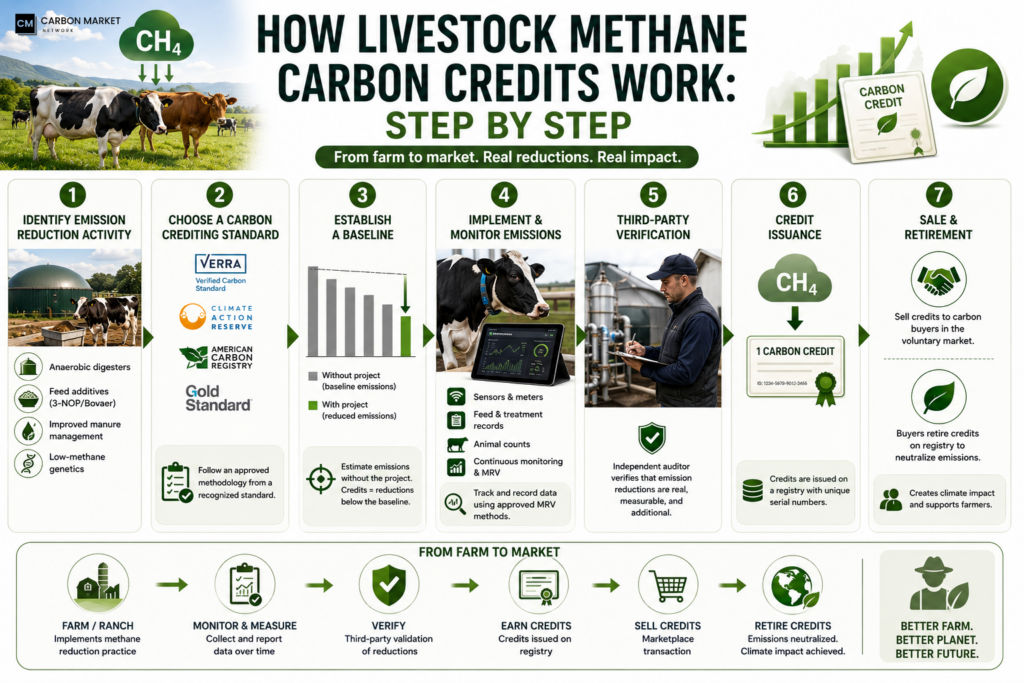
How Livestock Methane Carbon Credits Work: Step by Step
Here is a practical walkthrough of the process from farm to market.
Step 1: Identify the emission reduction activity
The farmer or project developer identifies which methane-reduction practice they want to implement. Common options include:
- Installing an anaerobic digester to capture manure methane
- Using enteric methane-reducing feed additives like 3-NOP (Bovaer)
- Changing manure management practices to reduce anaerobic decomposition
- Breeding or sourcing lower-methane livestock genetics
Step 2: Choose a carbon crediting standard
The project must follow an approved methodology from a recognized crediting body. Major options include Verra (Verified Carbon Standard), the Climate Action Reserve (CAR), the American Carbon Registry (ACR), and Gold Standard. Each has specific livestock-related protocols.
Step 3: Establish a baseline
Before credits can be issued, the project must establish a baseline. This is an estimate of what methane emissions would have been without the project intervention. Credits are only issued for reductions below this baseline.
Step 4: Implement the practice and monitor emissions
The farmer implements the chosen practice and tracks emissions over time using approved monitoring, reporting, and verification (MRV) methods. This may involve continuous sensors, gas meters, feed records, animal counts, and more.
Step 5: Third-party verification
An independent, accredited auditor reviews the monitoring data and confirms that the reductions occurred as claimed. This step is non-negotiable for any high-quality credit.
Step 6: Credit issuance
Once verification is complete, the crediting body issues serialized carbon credits onto a registry. Each credit has a unique identifier and can be tracked.
Step 7: Sale and retirement
The farmer or project developer sells the credits to buyers in the voluntary or compliance carbon market. When a buyer uses a credit to offset their emissions, it gets retired from the registry so it cannot be used again.
The Major Standards and Registries for Livestock Methane Credits
Not all carbon credits are created equal. The standard and methodology behind a credit determine its quality, price, and credibility. Here are the major players in the livestock methane space.
Verra (Verified Carbon Standard)
Verra runs the world’s largest voluntary carbon crediting program. By the mid-2020s, it had certified over 2,000 projects across more than 80 countries, issuing more than 1 billion Verified Carbon Units (VCUs).
Each VCU represents one metric tonne of CO2e reduced or removed. Verra has multiple methodologies applicable to livestock, and several companies are actively working toward Verra protocol validation for enteric methane-reducing interventions like feed additives.
Climate Action Reserve (CAR)
CAR is one of the most established registries for livestock methane in North America. It has a dedicated US Livestock Protocol that covers dairy and swine manure digester projects.
Under the CAR protocol, only methane avoidance (destroying methane that would otherwise have been emitted) is credited. Dairy operations under this protocol can typically generate two to four offset credits per cow per year through anaerobic digestion.
CAR has been designated as CCP-Eligible by the Integrity Council for the Voluntary Carbon Market (ICVCM), meaning its projects meet the Core Carbon Principles for high-quality credits.
American Carbon Registry (ACR)
ACR certifies a wide range of projects, including livestock methane reduction through improved manure management and feed interventions. ACR credits can be converted to Verra’s VCUs, giving them flexibility across markets. ACR has also been designated CCP-Eligible by the ICVCM.
Gold Standard
The Gold Standard emphasizes high-integrity credits tightly linked to the UN Sustainable Development Goals. It applies to livestock and agricultural methane projects where co-benefits such as improved community health, water quality, and biodiversity are important to the buyer.
Athian
Athian is a newer, specialized livestock carbon insetting marketplace. It is specifically built for the animal agriculture value chain, connecting farmers who reduce enteric methane with food companies seeking to address their Scope 3 emissions. The first verified transaction on Athian’s platform involved a Texas dairy farmer generating nearly 1,150 metric tonnes of CO2e reductions through enteric methane reduction using a feed management product.
| Registry / Program | Focus Area | Credit Type | Geographic Reach |
|---|---|---|---|
| Verra (VCS) | Broad, including livestock | VCUs | Global |
| Climate Action Reserve | Dairy & swine manure digesters | CRTs | Primarily US, Mexico |
| American Carbon Registry | Livestock methane, forestry, more | ERTs | US and global |
| Gold Standard | High co-benefit projects | VERs | Global |
| Athian | Enteric fermentation (livestock insetting) | Insetting credits | US (expanding) |
The Key Technologies That Generate Livestock Methane Credits
The specific technology a farmer uses determines how credits are generated and verified. Here are the main approaches available today.
Anaerobic Digesters for Manure Methane
Anaerobic digesters are tanks or covered lagoons where manure breaks down in a controlled, oxygen-free environment. Instead of releasing methane into the atmosphere, the system captures it as biogas.
That biogas can then be used for heat, electricity, or converted into renewable natural gas (RNG) for fuel. The captured and destroyed methane generates carbon credits.
Anaerobic digestion represents the most mature and financially proven pathway for livestock methane credits. Large dairy operations using RNG production for California’s Low Carbon Fuel Standard (LCFS) have reported revenues of up to $400 to $450 per cow per year in carbon revenue. In smaller operations, typical credit generation runs to two to four credits per cow per year under the CAR livestock protocol.
Anaerobic digesters do require significant upfront capital investment. Government grant programs and cost-share funding have helped reduce these barriers in several countries.
Feed Additives to Reduce Enteric Fermentation
This is the fastest-growing area in livestock methane carbon credits, and it has seen major milestones recently.
3-NOP (Bovaer) is the most widely approved enteric methane-reducing feed additive in the world. Developed by DSM-Firmenich and marketed in many markets by Elanco, it works by inhibiting the specific enzyme in the rumen responsible for producing methane.
Key facts about Bovaer and 3-NOP:
- Reduces enteric methane emissions in dairy cows by approximately 30 percent
- Reduces methane in feedlot beef cattle by approximately 45 percent
- Available in over 65 countries, with approvals from the EU, US FDA, Canada, Australia, Brazil, Japan, and others
- Takes effect within 30 minutes of feeding
- Approved as safe for animals, with no negative impact on milk or meat quality
In December 2025, Japan’s J-Credit Scheme approved a new methodology that specifically allows Bovaer-driven methane reductions to generate tradeable credits.
Red seaweed (bromoform) is another promising feed additive under development. Studies have shown significant methane reductions, though it faces regulatory and scalability challenges compared to 3-NOP.
Essential oils and plant-based blends such as Agolin Ruminant, a blend of essential oils, have also been certified for methane reduction and have supported livestock insetting projects that have delivered close to $3 million in payments to US dairy farmers in aggregate.
Improved Manure Management Practices
Beyond digesters, simpler manure management changes can also reduce methane and potentially generate credits.
These include:
- Covering manure storage lagoons to prevent uncontrolled methane release
- Moving from liquid/slurry storage to dry lot management where feasible
- Optimizing the timing of manure application to land to reduce anaerobic decomposition
- Composting manure under aerobic conditions, which produces far less methane than anaerobic lagoons
For smaller farms that cannot afford a full digester, these practices offer a more accessible entry point into the carbon credit system.
Genetic Selection and Breeding
Selective breeding for low-methane animals is a longer-term intervention. Research has shown that methane emissions vary meaningfully between individual animals, and some of this variation is heritable.
Breeding programs that select for animals with naturally lower methane output can compound reductions over time without ongoing input costs. This approach is particularly relevant for pasture-based systems where feed additives are harder to administer consistently.
Who Buys Livestock Methane Carbon Credits?
Understanding who buys these credits helps explain why the market is growing.
Food companies and retailers are among the most motivated buyers. Livestock methane falls squarely within Scope 3 emissions for companies in the beef, dairy, and food supply chain. These companies face growing pressure from investors, regulators, and consumers to address their agricultural supply chain emissions. Livestock methane carbon credits offer a credible, quantifiable way to do this.
Athian’s insetting model, for example, keeps the carbon value inside the animal protein value chain. Dairy Farmers of America, the largest US milk marketing cooperative, purchased the first verified livestock insetting credits through Athian.
Large multinationals with net-zero targets also purchase livestock methane credits as part of diversified carbon portfolios. The Oxford Offsetting Principles, which many large companies follow, suggest a portfolio approach where near-term high-impact emission reductions like methane destruction are used now while durable removal credit supply scales up.
Compliance market participants in jurisdictions like California can use California Air Resources Board (CARB)-approved livestock offset credits to meet obligations under the state’s Cap-and-Trade program. Biogas from manure digesters also qualifies under California’s Low Carbon Fuel Standard, creating an additional revenue pathway.
What Makes a High-Quality Livestock Methane Credit?
Not all livestock methane credits are equal. Buyers and sellers should know the key quality indicators.
Additionality
A credit is additional if the emission reduction would not have happened without the carbon finance. Good news here: livestock methane credits generally perform well on additionality. Anaerobic digesters and feed additives are not yet standard practice for most farmers without financial incentives, so the carbon credit genuinely enables the action.
Measurability and Quantification
The credit must be based on real, measured reductions. For manure digesters, gas meters track biogas flow and methane concentration directly. For enteric methane from feed additives, quantification is more complex because you are measuring changes in emissions from living animals. Methodologies use a combination of emission factors, feed records, animal counts, and in some cases direct measurement via respiration chambers or GreenFeed devices.
Permanence asks whether the emission reduction will stick. For manure methane, destruction of methane in a digester is permanent. For enteric methane reductions from feed additives, the reduction only continues as long as the farmer keeps using the additive, which means the crediting period ties to ongoing use.
Third-Party Verification
All high-quality credits require independent third-party verification by an accredited body. Buyers should always confirm this has occurred.
Environmental and Social Co-Benefits
The Environmental Defense Fund (EDF) and others note that all crediting programs need to improve social safeguards, particularly to ensure that smallholder and small-to-medium farming operations can participate equitably and that communities near large operations are protected from local air and water pollution.
The Role of MRV: Measuring What Matters
Monitoring, reporting, and verification (MRV) is the backbone of any carbon credit. In the livestock sector, MRV is both critical and challenging.
For manure methane projects, MRV is relatively straightforward. Gas flow meters, methane concentration sensors, and operating logs provide solid data. The Climate Action Reserve’s Livestock Protocol gives detailed guidance on monitoring equipment calibration and reporting frequency.
For enteric methane, MRV is harder. You cannot directly meter what a cow breathes out in a pasture setting. Current approaches rely on:
- Approved emission factors combined with animal counts and feed data
- Periodic direct measurements using GreenFeed units or SF6 tracer gas methods
- Statistical models validated against direct measurement data
The Clean Air Task Force and others have highlighted that better MRV systems for enteric methane are urgently needed to build buyer confidence and enable more project types. Research and development in this area is growing, including satellite-based atmospheric monitoring and IoT-enabled farm sensors.
The FAO launched a technical consultation process in late 2025, convening an international expert panel to develop science-based guidelines for MRV in livestock carbon markets. A second consultation was planned for 2026.
The Global Policy Context Driving Demand
Livestock methane carbon credits do not exist in a vacuum. They sit within a fast-changing global policy environment.
The Global Methane Pledge
Launched at COP26 in 2021, the Global Methane Pledge has now been signed by more than 150 countries. The commitment is to reduce global methane emissions by 30 percent from 2020 levels by 2030.
Meeting the pledge would avoid more than 0.2 degrees Celsius of warming and prevent more than 180,000 premature deaths annually by 2050.
The IPCC has gone further, recommending a 40 to 45 percent reduction in global methane by 2030 to keep warming below 1.5 degrees Celsius.
However, a Global Methane Status Report released at COP30 in late 2025 confirmed that the world is not yet on track. Methane emissions from livestock and agriculture remain one of the hardest sectors to address within national climate strategies.
National Policies Emerging
Several countries have started taking concrete steps:
- Denmark requires all dairy farms with more than 50 cows to use methane-reducing feed additives. Cost reimbursements for farmers who enrolled were part of the policy.
- California (USA) runs a Cap-and-Trade compliance offset protocol for livestock projects and has invested hundreds of millions in dairy digester programs through the Dairy Digester Research and Development Program.
- Japan approved a new J-Credit methodology in December 2025 allowing Bovaer-driven methane reductions to generate tradeable credits.
- New Zealand has enacted policy to price methane emissions from cattle and sheep starting in 2026.
- The EU has broad net-zero targets and emerging Carbon Removal Certification frameworks that will shape how agricultural emissions credits function across member states.
Article 6 of the Paris Agreement
The finalization of rules under Article 6 at COP29 and COP30 has opened pathways for internationally traded carbon credits, including from agricultural methane reduction. This creates new opportunities for livestock carbon projects in lower-income countries where most of the world’s ruminant livestock population is found.
Real-World Examples of Livestock Methane Carbon Credits in Action
Athian and Elanco: First Verified Livestock Insetting Transaction
Texas dairy farmer Jasper DeVos used a feed management product from Elanco that reduces enteric methane. He generated nearly 1,150 metric tonnes of CO2e reductions, which were verified and sold as the first credits on Athian’s insetting marketplace. Dairy Farmers of America purchased these credits. If the entire US dairy industry adopted the same approach, it could avoid an estimated 4.7 million metric tonnes of CO2e annually.
ANAVRIN: Essential Oils in Europe and South America
A European agri-innovation company developed ANAVRIN, a blend of essential oils, tannins, and bioflavonoids designed to reduce enteric methane in ruminants. Pilots launched first in Italy and Spain, with subsequent launches planned for Brazil, Costa Rica, Argentina, Chile, and Australia. The company is working toward Verra protocol validation and is building MRV infrastructure to support credit issuance.
California’s Dairy Digester Program
California has invested approximately $289 million in grants and incentives to fund more than 233 dairy and livestock methane reduction projects. These projects generate credits under California’s Cap-and-Trade program, its Low Carbon Fuel Standard, and the federal Renewable Fuel Standard. Anaerobic digesters converting manure to RNG have been particularly lucrative under the LCFS due to the negative carbon intensity scores assigned to this fuel pathway.
Japan’s J-Credit Scheme: Bovaer Approved
In December 2025, Japan’s J-Credit Scheme Steering Committee approved a methodology covering the use of 3-NOP and cashew nut shell liquid as GHG reduction agents in livestock production. This marked a significant expansion of market-based mechanisms for livestock methane in one of Asia’s largest beef markets.
How Much Do Livestock Methane Carbon Credits Cost?
Credit prices vary significantly depending on the type of project, the crediting standard, and the market.
| Credit Type | Approximate Price Range | Notes |
|---|---|---|
| Generic avoidance credits (low integrity) | Under $1 per tonne | Low demand from quality-focused buyers |
| Livestock manure digester credits (CAR/VCS) | $15 to $30+ per tonne | Varies by market conditions |
| Enteric methane credits (feed additives) | Methodology-dependent | Market still developing |
| High-integrity methane credits with co-benefits | $20 to $50+ per tonne | Growing buyer interest |
| Compliance credits (California Cap-and-Trade) | Market price varies | Linked to allowance prices |
| RNG from manure under California LCFS | Up to $400 to $450 per cow annually | Revenue, not just credit price |
Dairy operations with anaerobic digestion producing RNG for California’s LCFS have achieved some of the highest financial returns in the agricultural carbon credit space.
For enteric methane credits from feed additives, the economic math is still developing. One study found that CO2e needs to be priced at around $109 per tonne to maintain cost neutrality for farmers using 3-NOP without other incentives. This highlights why government subsidies, voluntary market demand, and supply chain insetting arrangements are all important complements to standalone credit revenue.
Key Challenges in the Livestock Methane Carbon Market
The market is growing, but it faces real challenges that buyers, farmers, and policymakers need to understand.
MRV Complexity for Enteric Emissions
Measuring what comes out of a cow’s mouth is harder than measuring what comes out of a pipe. Enteric methane MRV still relies heavily on models and emission factors, which introduces uncertainty. Better direct measurement tools and approved methodologies are still needed, especially for pasture-based systems.
Economic Viability for Farmers
Feed additives like 3-NOP reduce methane effectively, but their cost can exceed the carbon revenue earned at current credit prices for many farmers. Without policy support, subsidies, or supply chain insetting arrangements, widespread voluntary adoption remains challenging.
For anaerobic digesters, high capital costs create barriers for small and medium operations, even though large operations have found them financially rewarding.
Methodology Maturity for Enteric Projects
While manure digester methodologies are well established, enteric methane credit methodologies are still maturing. Several organizations are working toward validated protocols for feed additive projects, but fewer options exist today compared to the digester space.
Smallholder Participation
Most livestock in the world is raised by smallholder and small-to-medium farmers, particularly in lower-income countries. These producers often lack the technical capacity, capital, or market access to participate in carbon credit programs. Building inclusive models that enable smallholder participation is both a social equity issue and a market development priority.
Integrity and Greenwashing Risks
As with all carbon markets, the livestock methane space carries risks of over-crediting or weak methodologies. Buyers should always ask for credits that have been verified by accredited third parties under credible standards. The ICVCM’s CCP label, which has been granted to projects under Verra (https://verra.org/), CAR, ACR, and others, is one useful quality signal.
Opportunities and the Road Ahead
Despite the challenges, the livestock methane carbon credit market is expanding rapidly, and the opportunities are substantial.
Growing demand from food companies: Scope 3 supply chain emissions are under increasing scrutiny. Food and beverage companies with livestock-heavy supply chains face rising investor and regulatory pressure. Livestock methane credits, especially through insetting models, offer them a direct, credible way to take action.
Advance Market Commitments (AMCs): An emerging model in which buyers commit upfront to purchase credits from projects that meet defined emission reduction criteria. AMCs de-risk investment in new methane-reducing technologies and help pull solutions to market faster, particularly in the beef sector where progress has lagged behind dairy.
Technology improvements: Better sensors, satellite-based monitoring, and AI-driven MRV tools are reducing the cost and complexity of measuring enteric methane. As these tools gain approval within crediting methodologies, more project types become viable.
Policy tailwinds: Countries implementing agricultural methane policies, from Denmark’s feed additive mandates to New Zealand’s emissions pricing, create new demand and compliance pathways that support credit development.
FAO technical guidelines: The FAO’s expert consultation process, which began in late 2025 and is delivering guidelines into 2026, will provide a science-based, internationally recognized framework for livestock carbon market participation. This should improve consistency and buyer confidence globally.
The insetting model: Insetting, where carbon value stays within the agricultural supply chain rather than being sold to unrelated buyers, is gaining traction. It aligns the interests of farmers, food companies, and climate outcomes in a way that traditional offsetting sometimes does not.
Should Farmers Consider Livestock Methane Carbon Credits?
The short answer is yes, it is worth exploring. But the right path depends on the type and size of the operation.
Large dairy operations with open manure lagoons are the most obvious candidates for anaerobic digestion projects. Revenue potential is high, methodologies are mature, and government programs can help with capital costs.
Medium to large operations using or considering feed additives should explore carbon insetting programs and voluntary market platforms like Athian. The revenue per head may be modest at current credit prices, but it improves the overall economics of adopting methane-reducing practices.
Small and smallholder operations face more barriers but should watch for aggregation programs and cooperative models that pool multiple farms into a single credit project, reducing per-farm transaction costs.
For all farmers, the key steps are:
- Document your current emissions baseline as carefully as possible
- Identify which methane reduction practices apply to your operation
- Explore the available crediting standards and methodologies for your region
- Engage with an experienced carbon project developer or aggregator
- Evaluate government programs and cost-share opportunities alongside carbon revenue
- Ensure any program you join uses third-party verification and a reputable registry
Livestock Methane Carbon Credits and Net Zero: The Bigger Picture
Livestock methane carbon credits are not a substitute for deep systemic change in food systems. But they are a powerful near-term tool.
Because methane’s atmospheric lifetime is so much shorter than CO2’s, reducing it now delivers measurable climate benefits within years, not decades. This makes high-integrity livestock methane credits a valuable part of any corporate net-zero portfolio strategy.
The Oxford Offsetting Principles suggest a phased approach: prioritize high-impact methane and other short-lived greenhouse gas reductions now, while progressively shifting portfolios toward durable removals as technology and supply scale up. This means the window for livestock methane credits to play a meaningful role is wide open.
Research from Nature Communications has also shown that combining enteric methane interventions with improved animal genetics, feed quality, and land-based carbon sequestration can create pathways to genuinely profitable net-zero farm operations. The credits make the financial case stronger.
Frequently Asked Questions About Livestock Methane Carbon Credits
What is a livestock methane carbon credit? A livestock methane carbon credit is a tradeable certificate representing one metric tonne of CO2-equivalent emission reductions achieved by reducing methane from livestock, either from the animals’ digestive process (enteric fermentation) or from their manure.
How do farmers earn livestock methane carbon credits? Farmers earn credits by implementing verified methane-reduction practices such as installing anaerobic digesters, using approved feed additives like Bovaer (3-NOP), or changing manure management systems. The reductions must be measured, monitored, and independently verified under an approved crediting standard.
Which carbon standard should I use for a livestock methane project? In the US, the Climate Action Reserve (CAR) Livestock Protocol is well established for manure digester projects. Verra’s VCS and the American Carbon Registry (ACR) also have methodologies applicable to livestock methane. The best choice depends on your project type, location, and target market.
Is enteric methane from cattle belching eligible for carbon credits? Yes. Enteric methane credits are an emerging and growing area of the market. Platforms like Athian and methodologies under development (including toward Verra protocol validation) specifically target feed additive-driven reductions in enteric methane.
How much money can a dairy farmer make from livestock methane carbon credits? This varies widely. Large dairy operations with anaerobic digesters producing renewable natural gas have reported revenues of $400 to $450 per cow annually in high-value markets like California’s LCFS. For enteric methane credits from feed additives, revenue is more modest and depends on credit prices, though combining credits with cost-share funding programs improves the financial case significantly.
What is insetting in the context of livestock methane? Insetting is a model where the carbon value generated by a farm’s emission reductions stays within that farm’s supply chain. Rather than selling credits to unrelated buyers, food companies purchase inset credits from their own supplier farms, helping them address Scope 3 emissions directly. Athian’s marketplace operates on this insetting model.
Are livestock methane credits high quality? Quality varies. The Environmental Defense Fund’s review found that livestock methane credits generally perform well on additionality and permanence compared to some other credit types. However, credit quality depends heavily on the methodology, MRV robustness, and verification process used. Always look for credits verified under credible standards and seek those with the ICVCM’s Core Carbon Principles (CCP) label where possible.
What is the difference between enteric fermentation and manure methane credits? Enteric methane credits come from reducing what the animal naturally emits during digestion (mainly through burping). Manure methane credits come from capturing or avoiding methane released when manure decomposes. Manure digester credits are more methodologically mature; enteric credits are a growing frontier.
How does the Global Methane Pledge affect livestock methane carbon markets? The Global Methane Pledge, signed by over 150 countries, commits to a 30 percent reduction in global methane emissions by 2030. This policy context creates regulatory and voluntary demand for livestock methane reductions, supports government programs that de-risk credit projects, and elevates the importance of this credit type within corporate sustainability strategies.
Can small farmers access livestock methane carbon credit programs? It is more challenging for small farmers due to transaction costs and capital requirements. However, aggregation programs that pool multiple small farms and platforms designed for mid-size dairies are emerging. Government cost-share programs in several countries also help reduce financial barriers.
Conclusion
Livestock methane carbon credits sit at the intersection of agricultural innovation, carbon market development, and urgent climate action.
The science is clear: methane from livestock is a major climate problem, and cutting it quickly delivers near-term climate benefits that CO2 reductions alone cannot match. The technology is increasingly ready: anaerobic digesters, feed additives like Bovaer, improved manure management, and genetic selection all offer measurable pathways to reduce emissions.
The market is developing fast. Registries, standards, insetting platforms, and government programs are all expanding the opportunities for farmers to earn real revenue from real reductions.
The challenges are real too. MRV complexity, economic viability without policy support, and ensuring smallholder access all require continued attention and investment.
But the direction is clear. Livestock methane carbon credits will only grow in importance as corporate net-zero commitments deepen, agricultural methane policy advances, and buyers seek high-integrity, near-term climate impact in their offset portfolios.
For farmers, the question is not whether livestock methane credits are worth understanding. It is which pathway makes the most sense for your operation, and when to start.
Ready to go deeper? Explore the full range of agricultural carbon market topics and voluntary carbon market resources at Carbon Market Network.