Carbon Market Network


Your coffee cup might be part of a climate solution you have never heard of.
When a coffee brand plants trees on the very farms that grow its beans, that is not a random sustainability gesture. It is a structured climate strategy called carbon insetting, and it is quietly reshaping how companies think about their emissions.
If you have heard the term “carbon insetting” and wondered how it is different from carbon offsetting, or whether it actually works, you are in the right place. This guide breaks it down in plain language, with real examples, practical steps, and honest answers about where the challenges lie.
By the end, you will understand exactly what carbon insetting means, how businesses use it, and why it is becoming one of the most talked about strategies in corporate climate action.
What Is Carbon Insetting?
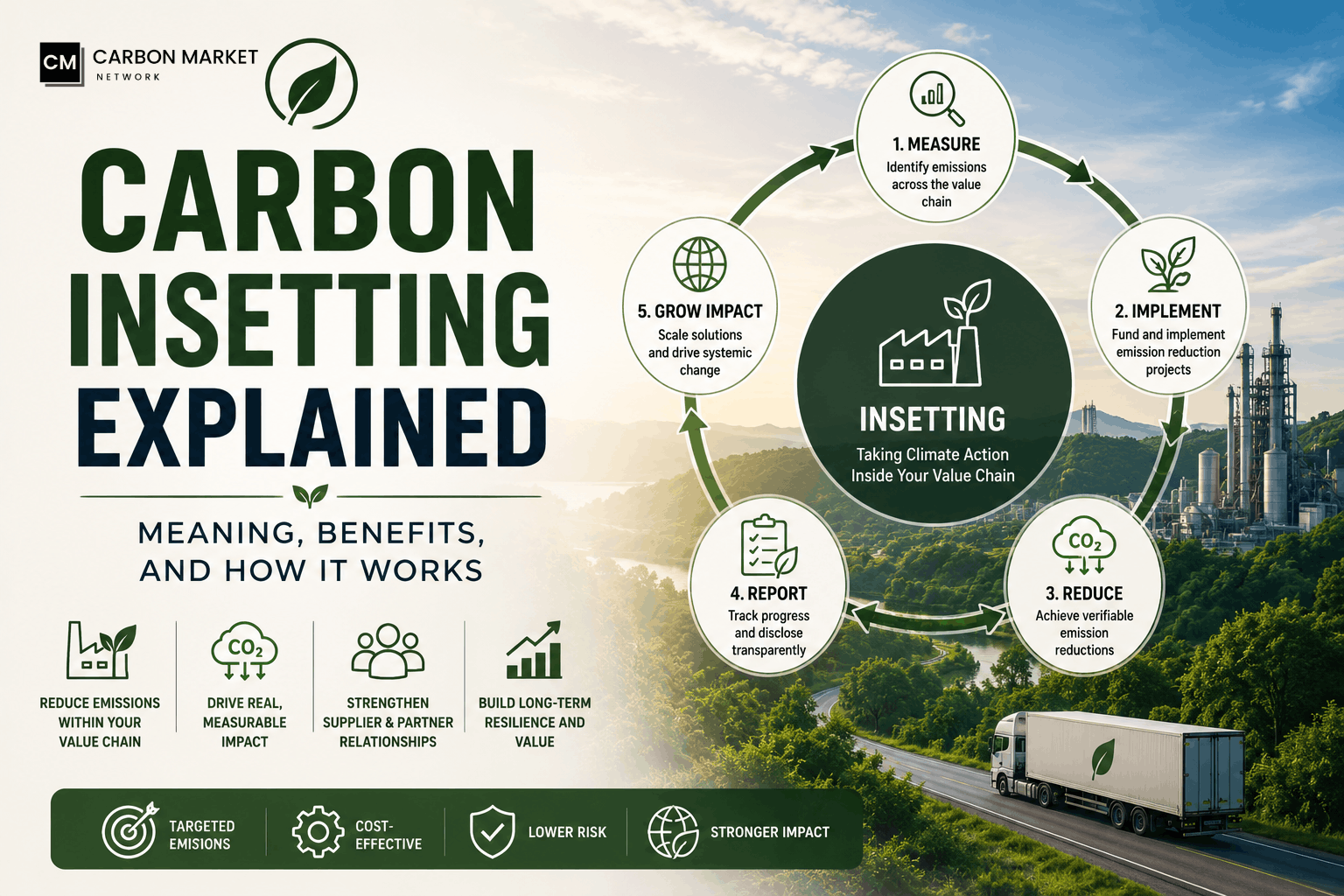
Carbon insetting is a climate strategy where a company reduces or removes greenhouse gas emissions from inside its own value chain, rather than paying for a project somewhere unrelated.
In simple words, insetting means a business fixes emissions problems in its own backyard. It works directly with its suppliers, farmers, factories, and logistics partners to cut carbon pollution at the source.
This is different from buying a generic carbon credit from a stranger’s project on the other side of the world. With insetting, the company has skin in the game. It funds, supports, or partners on projects that touch the exact products and suppliers it depends on every day.
A simple way to remember it: insetting looks inward, offsetting looks outward.
Carbon Market Insider Newsletter
Weekly insights on carbon markets, climate policy, carbon credits, and sustainability.
The Core Idea Behind Carbon Insetting
Most large companies do not pollute mainly through their own factories or offices. Their biggest emissions usually come from their supply chain, things like farming, raw material processing, transport, and packaging.
These supply chain emissions are known as Scope 3 emissions, and for many companies they make up 70 percent or more of their total carbon footprint.
Carbon insetting exists because traditional carbon offsetting does very little to fix this specific problem. Insetting was designed to target Scope 3 emissions head on, right where they happen.
Instead of treating emissions reduction as someone else’s job, insetting brings that responsibility back inside the company’s own network of suppliers and partners.
Carbon Insetting vs Carbon Offsetting: What Is the Real Difference?
This is the question almost everyone asks first, and it deserves a clear answer.
Carbon offsetting means a company pays for an emissions reduction or removal project that has nothing to do with its own business. A fashion brand might fund a wind farm in a country where it has no suppliers at all. The link between the brand and the project is purely financial.
Carbon insetting means the emissions reduction project sits inside the company’s own value chain. The same fashion brand, using insetting, might instead invest in regenerative cotton farming with the actual farmers who grow its cotton.
Here is a simple comparison table to make the difference crystal clear.
| Feature | Carbon Insetting | Carbon Offsetting |
|---|---|---|
| Project location | Inside the company’s own value chain | Anywhere in the world, often unrelated |
| Relationship to business | Directly tied to suppliers, farmers, or operations | No direct business connection |
| Main emissions target | Scope 3 (supply chain) emissions | Any scope, often used for residual emissions |
| Control and oversight | Higher, since the company works directly with partners | Lower, since projects are run by third parties |
| Community impact | Usually benefits the company’s own supplier communities | May or may not benefit the company’s own network |
| Common approach | Regenerative agriculture, agroforestry, renewable energy in sourcing regions | Forest conservation, methane capture, renewable energy credits |
| Reporting standard | Still evolving, guided by frameworks like GHG Protocol and WBCSD | More established, with registries like Verra and Gold Standard |
Think of it this way. Offsetting is like paying someone else to clean up a park across town. Insetting is like cleaning up your own backyard, the one your business actually depends on.
Both approaches aim to reduce net emissions, but insetting focuses on doing more good within the value chain, while offsetting focuses on compensating for pollution somewhere else entirely.
Why This Distinction Matters for Businesses
Scope 3 emissions are the hardest part of any climate strategy to fix because they happen outside a company’s direct control.
A food company does not own the farms that grow its wheat. A car manufacturer does not own the mines that produce its steel. This is exactly why insetting has become so important. It gives companies a structured way to actually influence emissions in places they do not directly control but heavily depend on.
Offsetting was never designed to solve this problem. It was designed to compensate for emissions that could not be avoided at all. Insetting fills a very different gap, one focused on active, hands on emissions reduction inside the supply chain itself.
How Does Carbon Insetting Actually Work?
Carbon insetting is not just a donation or a marketing claim. It follows a structured process, even though industry standards are still maturing.
Here is a step by step breakdown of how a typical insetting project comes together.
Step 1: Identify Emissions Hotspots
The company first analyzes its Scope 3 emissions to find out exactly where most of the pollution is coming from.
This usually means asking questions like:
- Which raw materials contribute the most emissions?
- Which suppliers or regions are the biggest sources?
- Which farming or production practices are driving the footprint up?
For a chocolate company, this might reveal that cocoa farming and deforestation are the biggest emissions sources. For a clothing brand, it might point to cotton farming or dyeing processes.
Step 2: Choose the Right Insetting Intervention
Once the hotspot is identified, the company selects a practical solution that fits that specific part of the supply chain.
Common insetting interventions include:
- Agroforestry, where trees are planted alongside crops like cocoa, coffee, or tea
- Regenerative agriculture, which improves soil health so it stores more carbon
- Renewable energy, installed at supplier factories or farms
- Sustainable fuel switching, especially in shipping, aviation, and logistics
- Low carbon materials, such as recycled steel or low carbon cement in manufacturing
- Efficient irrigation and precision farming, which cuts emissions from fertilizer and water use
Step 3: Partner Directly With Suppliers
This is what makes insetting unique. Instead of buying a credit from a stranger, the company works hand in hand with the actual farmers, factories, or logistics partners in its supply chain.
This often includes training programs, technical support, and financial incentives so suppliers can actually afford to change their practices.
Step 4: Set Up Measurement and Verification
For an insetting project to be credible, the company needs solid data. This is where measurement, reporting, and verification, often shortened to MRV, becomes essential.
Companies typically use a mix of:
- Field measurements, such as soil sampling
- Satellite monitoring, to track tree cover and land use changes
- Digital MRV tools, which combine sensors, software, and remote sensing for faster, more accurate tracking
Without strong data, an insetting claim cannot be trusted, and this is one of the biggest challenges the industry is still working through.
Step 5: Share the Benefits Fairly
A well designed insetting project does not just benefit the company. It also creates value for farmers and local communities.
A common model here is payment for ecosystem services, where farmers receive yearly payments simply for maintaining trees or sustainable practices on their land. This gives farmers a real financial reason to stick with the program long term.
Step 6: Report the Results Transparently
Finally, the company reports its insetting results as part of its broader climate disclosures, ideally following recognized frameworks such as the Greenhouse Gas Protocol and guidance from bodies like the World Business Council for Sustainable Development.
Transparent reporting builds trust and helps prevent accusations of exaggerated claims or greenwashing.
Why Are Companies Turning to Carbon Insetting?
Carbon insetting is gaining momentum for several practical reasons, not just because it sounds good on a sustainability report.
1. It Directly Tackles Scope 3 Emissions
Since Scope 3 emissions dominate most corporate footprints, especially in food, agriculture, fashion, and manufacturing, insetting gives companies a direct lever to pull instead of relying entirely on distant offset projects.
2. It Builds Supply Chain Resilience
Farmers who adopt regenerative practices often see healthier soil, better water retention, and more stable yields over time. This means insetting is not just good for the climate. It is also good for the reliability of the raw materials a company depends on.
3. It Strengthens Supplier Relationships
Insetting requires companies to work closely with suppliers, often for the first time in a structured way. This builds trust, improves data sharing, and creates longer term, more stable sourcing relationships.
4. It Offers More Control and Credibility
Because the company is directly involved in the project, it has far more visibility into whether the emissions reduction is real. This is harder to achieve with an offset purchased from an unrelated third party project.
5. It Protects Against Rising Carbon Prices
Voluntary carbon credit prices have historically trended upward over time. Companies that build their own insetting programs create an internal source of emissions reductions, which can offer more price stability than relying solely on the open market.
6. It Aligns With Science Based Targets
Frameworks from the Science Based Targets initiative (website) encourage companies to prioritize direct emissions reductions within their own value chain first, and only use external credits for genuinely unavoidable, residual emissions. Insetting fits neatly into this “reduce first” philosophy.
Real World Examples of Carbon Insetting
Seeing how real companies apply insetting makes the concept much easier to grasp.
Cocoa and chocolate industry: Major cocoa processors have partnered with global food brands to roll out large scale agroforestry projects across cocoa growing regions. These programs plant shade trees among cocoa crops, which sequesters carbon while also protecting farmers from extreme heat and improving long term soil fertility. Some of these projects have achieved independent third party certification for their carbon removal claims, an important step toward credibility.
Coffee industry: Several major coffee brands run agroforestry programs with coffee farmers across multiple countries, planting native trees alongside coffee plants. This improves water retention, boosts biodiversity, and helps sequester carbon directly in the soil and biomass, all while creating new income opportunities for farmers through the sale of fruit or timber from the planted trees.
Fashion and luxury goods: Some global fashion houses have launched insetting programs across their natural material supply chains, covering materials like cotton, leather, and flowers, aiming to embed climate action directly into raw material sourcing.
Consumer goods and agriculture: Several large consumer brands support climate smart farming projects for crops like rice and cocoa across different regions, helping suppliers cut methane and other emissions while improving farming resilience.
Shipping and logistics: In the shipping and aviation sectors, companies are adopting sustainable fuels and using a mechanism called book and claim, which allows the environmental benefit of low carbon fuel use to be allocated to specific customers, even when their exact cargo did not travel on that specific low carbon shipment.
These examples show that carbon insetting is not limited to agriculture. It is expanding into construction, finance, shipping, and manufacturing as more industries look for credible ways to influence emissions inside their own value chains.
Where Can Carbon Insetting Be Applied?
Carbon insetting is most common in industries with agricultural or land based supply chains, but its use is spreading fast.
| Industry | Typical Insetting Activity |
|---|---|
| Food and beverage | Agroforestry, regenerative farming, soil carbon programs |
| Fashion and textiles | Sustainable cotton farming, natural fiber sourcing improvements |
| Cosmetics | Regenerative sourcing of botanical ingredients |
| Construction | Low carbon cement, recycled steel, sustainable timber |
| Shipping and aviation | Sustainable fuels, book and claim mechanisms |
| Finance | Decarbonizing investment portfolios through supported projects |
| Automotive | Low carbon steel and aluminum sourcing from suppliers |
The Benefits of Carbon Insetting
Carbon insetting offers a wide range of advantages beyond simple emissions accounting.
- Direct emissions impact: Reductions happen exactly where the company’s footprint is largest.
- Stronger supplier partnerships: Long term collaboration replaces one off transactions.
- Improved farmer and community livelihoods: Payments for ecosystem services and training create real economic value.
- Better data visibility: Companies gain deeper insight into their own supply chains.
- Enhanced brand credibility: Genuine, verifiable action tends to resonate more with increasingly climate conscious consumers.
- Long term supply security: Healthier farms and ecosystems mean more resilient sourcing for years to come.
- Alignment with global climate frameworks: Supports science based target commitments and net zero roadmaps.
The Challenges and Criticisms of Carbon Insetting
No honest guide to carbon insetting would be complete without addressing its limitations. This is still a maturing field, and it faces real scrutiny.
1. No Single Universal Standard
Unlike carbon offsetting, which has established registries and methodologies, carbon insetting does not yet have one universally accepted definition or accounting standard. Different companies apply the term differently, which can create confusion.
2. Risk of Double Counting
Because insetting projects happen within complex, multi party supply chains, there is a real risk that the same carbon benefit gets claimed by more than one party, for example both the farmer’s country and the buying company.
3. Data and Verification Challenges
Collecting reliable data from farms, smallholders, and remote supply chain partners is genuinely difficult. Without strong measurement, reporting, and verification systems, insetting claims can be hard to trust.
4. Permanence Concerns
Nature based insetting projects, like tree planting, face the same permanence risks as similar offset projects. Trees can be cut down, burned, or lost to disease, which can reverse the claimed carbon benefit.
5. Weaker Independent Oversight
Because insetting projects are often run internally by the company itself, they can lack the same level of independent third party scrutiny that established carbon credit registries provide. Some researchers argue this makes certain insetting claims harder to verify than conventional offset credits.
6. Complexity and Cost
Running insetting programs requires significant investment in supplier relationships, monitoring technology, and long term commitment, which can be a barrier for smaller companies.
Understanding these challenges is not a reason to dismiss insetting. It is a reason to demand transparency and rigor from any company that claims to be doing it well.
How Companies Can Get Started With Carbon Insetting
If you are exploring insetting for your own organization, here is a practical starting framework.
- Map your full value chain emissions, especially Scope 3, to understand where the biggest opportunities lie.
- Engage suppliers early and involve them in designing solutions, rather than imposing requirements from the top down.
- Start with a pilot project in one region or with one supplier group before scaling up.
- Invest in proper measurement tools, including field data collection and satellite monitoring where relevant.
- Build in fair compensation for farmers and suppliers through mechanisms like payment for ecosystem services.
- Align with recognized frameworks, such as the Greenhouse Gas Protocol and guidance from the Science Based Targets initiative.
- Report transparently, including both successes and setbacks, to build long term credibility.
A common piece of advice from experienced practitioners is simple: start small, show real progress, and let early success encourage other suppliers to join voluntarily.
The Role of Technology in Modern Carbon Insetting
Technology has become the backbone of credible insetting programs, and this is one area that has evolved quickly.
Early insetting projects often relied on manual record keeping, occasional farm visits, and rough estimates. That approach simply cannot deliver the level of trust that today’s climate disclosures demand. Companies, investors, and regulators now expect data that can stand up to scrutiny.
Here is how technology is changing the way insetting projects are measured and managed.
Satellite monitoring allows companies to track changes in tree cover, land use, and vegetation health across thousands of hectares without needing to physically visit every farm. This makes it possible to detect deforestation risks or confirm that planted trees are actually surviving over time.
Digital MRV platforms combine remote sensing, sensor data, and farmer reported information into a single system. This helps companies calculate carbon sequestration more accurately and update those estimates as conditions change on the ground.
Soil sampling and analysis remains an essential ground truth check. Even with satellites and sensors, physical soil tests confirm how much organic carbon is actually being stored, since this cannot be measured from space alone.
Mobile data collection tools let field teams and even farmers themselves log practices, planting activity, and yields directly from their phones, which speeds up reporting and reduces errors compared to paper based systems.
Blockchain and traceability systems are being explored by some companies to prevent double counting, since they can create a transparent, tamper resistant record of which carbon benefits have already been claimed and by whom.
Together, these tools are helping insetting mature from a promising idea into a genuinely measurable, defensible climate strategy, though the industry still has work to do before consistent standards apply everywhere.
Book and Claim: A Growing Insetting Mechanism
One newer mechanism worth understanding is called book and claim. It is increasingly used in sectors like shipping, aviation, and energy, where physically tracking a specific low carbon product all the way to a specific customer is often impractical.
Here is a simple example of how it works. A shipping company introduces sustainable fuel into its fleet. Instead of requiring that fuel to be used on one exact vessel carrying one exact customer’s cargo, the environmental benefit of that fuel use gets recorded in a central system.
Customers who want to support low carbon shipping can then purchase that recorded environmental benefit, even if their specific cargo travelled on a conventional fuel vessel. The total emissions reduction across the system remains accurate, while giving customers flexibility and giving fuel suppliers a viable market for their lower carbon products.
This approach is gaining traction because it solves a real logistical problem. Physically segregating low carbon fuel to specific shipments across a global supply chain is often not feasible. Book and claim allows the climate benefit to reach customers without requiring that level of physical complexity, as long as the accounting remains transparent and well governed.
Critics point out that book and claim systems need strong oversight to avoid inconsistencies between companies, since each provider may currently apply slightly different rules. This is an area where broader industry alignment is still developing.
Carbon Insetting and Scope 3 Emissions
It is worth spending a little more time here because this connection is the entire reason insetting exists.
Scope 3 emissions cover everything in a company’s value chain that it does not directly own or control, including:
- Purchased goods and raw materials
- Transportation and distribution
- Processing of sold products
- Use of sold products
- End of life treatment of products
For companies in food, agriculture, fashion, and retail, these indirect emissions often dwarf their direct operational emissions. Carbon insetting gives businesses a practical, hands on way to influence this normally hard to reach category of emissions, rather than treating it as someone else’s problem.
Carbon Insetting and the Bigger Climate Picture
Agriculture, forestry, and land use together contribute roughly a quarter of global greenhouse gas emissions. This makes the sectors where insetting is most common, food, farming, and natural materials, genuinely important battlegrounds in the fight against climate change.
The broader guidance from climate science is fairly consistent. Companies should prioritize direct emissions reductions within their own value chain first, and only use external offset credits for the emissions that genuinely cannot be avoided using current technology and practices.
Carbon insetting fits directly into this “reduce first, then compensate” approach, which is increasingly seen as the more credible path toward real net zero progress, rather than relying heavily on outsourced climate action.
How to Measure the Success of a Carbon Insetting Program
Companies often ask how they can tell if an insetting program is actually working, beyond simply counting the number of trees planted or hectares covered. A few indicators tend to matter most.
- Tonnes of carbon dioxide equivalent sequestered or avoided, calculated using verified measurement methods rather than rough estimates.
- Survival rate of planted trees or restored land, since planting alone means little if the trees do not survive long term.
- Farmer participation and retention rates, which show whether the program is genuinely valuable enough for suppliers to stay involved year after year.
- Yield and income changes for participating farmers, since a program that hurts farmer livelihoods is unlikely to remain sustainable.
- Third party verification status, which indicates whether an independent body has reviewed and confirmed the claimed carbon benefits.
- Consistency of reporting over multiple years, since carbon sequestration through nature based methods needs to be tracked over long periods, not just measured once.
A program that performs well across these indicators is far more credible than one that only reports a single, impressive sounding headline number.
Carbon Insetting, Carbon Removal, and Carbon Neutrality: How They Connect
These terms often get mixed together, so it helps to separate them clearly.
Carbon insetting is a strategy, a way of organizing where and how emissions reduction work happens within a value chain.
Carbon removal is an outcome, referring specifically to activities that pull existing carbon dioxide out of the atmosphere, such as reforestation or soil carbon storage. Insetting projects often aim to achieve carbon removal, but not every insetting activity results in removal. Some insetting projects focus purely on avoiding future emissions, such as switching a supplier to renewable energy, which prevents new emissions rather than removing existing carbon from the air.
Carbon neutrality is a broader claim, meaning a company’s total emissions have been balanced out through a combination of direct reductions, removals, and in some cases, external offsets. Insetting can contribute meaningfully toward carbon neutrality goals, but on its own, it is rarely enough to get a large company all the way to net zero.
Understanding these distinctions helps prevent confusion when reading corporate sustainability reports, since companies sometimes use these terms loosely or interchangeably.
Key Takeaways
- Carbon insetting means reducing or removing emissions from inside a company’s own value chain, rather than buying credits from unrelated external projects.
- It mainly targets Scope 3 emissions, which often make up the majority of a company’s total carbon footprint.
- Common insetting activities include agroforestry, regenerative agriculture, renewable energy at supplier sites, and sustainable fuel adoption.
- Real companies across cocoa, coffee, fashion, and shipping are already running large scale insetting programs.
- The approach still faces challenges, including inconsistent standards, double counting risks, and data verification difficulties.
- Insetting works best as part of a broader climate strategy that prioritizes direct reductions first, with offsetting reserved for truly unavoidable, residual emissions.
Frequently Asked Questions About Carbon Insetting
What does carbon insetting mean in simple terms?
Carbon insetting means a company reduces its carbon emissions by working directly with its own suppliers, farmers, or partners, instead of paying for a separate, unrelated project elsewhere.
Is carbon insetting the same as carbon offsetting?
No. Offsetting funds projects outside a company’s value chain, while insetting focuses on projects inside the company’s own supply chain, usually involving its direct suppliers or sourcing regions.
Which industries use carbon insetting the most?
Food and beverage, agriculture, fashion, cosmetics, and shipping are among the industries using insetting most actively, largely because their supply chains involve farming, land use, or fuel intensive logistics.
Does carbon insetting actually reduce emissions, or is it just marketing?
When done properly, with strong measurement and independent verification, insetting can lead to genuine emissions reductions. However, without rigorous data and oversight, claims can be exaggerated, so transparency and third party verification matter a great deal.
Can small businesses use carbon insetting?
Yes, though it is more commonly associated with large companies that have complex, multi tier supply chains. Smaller businesses can still apply insetting principles by working directly with their own suppliers on practical, smaller scale sustainability improvements.
What is payment for ecosystem services in carbon insetting?
It is a mechanism where farmers or landowners receive regular payments in exchange for maintaining practices that support carbon storage, such as keeping trees planted on their land, rewarding them for the ongoing environmental benefit they provide.
Does carbon insetting replace the need for carbon offsetting?
Not entirely. Most climate frameworks recommend using insetting and other direct reduction strategies first, then using offsetting only for emissions that genuinely cannot be eliminated through current means.
Final Thoughts
Carbon insetting represents a meaningful shift in how businesses approach climate action. Instead of outsourcing responsibility to unrelated projects, it brings decarbonization back to where a company’s biggest impact actually lies, inside its own value chain.
It is not a perfect or fully standardized solution yet. Data challenges, inconsistent definitions, and verification gaps are real issues that the industry is still working through. But the core idea behind carbon insetting, doing more good within your own supply chain instead of simply compensating for harm elsewhere, is a genuinely powerful one.
As more companies face pressure to tackle their Scope 3 emissions, expect carbon insetting to keep growing, not as a replacement for offsetting, but as a serious, hands on complement to it. For businesses willing to invest in their suppliers, their data, and their long term relationships, carbon insetting offers a credible path toward real, lasting climate impact.
For more insights on carbon markets, environmental finance, and sustainability mechanisms, explore the resources at Carbon Market Network.