Carbon Market Network


One week, carbon prices in Europe jump on a policy rumor. The next week, a new methodology reshapes how forestry credits get verified. A month later, another country launches its own emissions trading system seemingly overnight.
Carbon markets move fast, and they rarely wait for anyone to catch up.
The fastest way to stay ahead is simple. Read the right carbon market newsletter instead of chasing scattered headlines across dozens of websites.
This guide rounds up the top carbon market newsletters worth subscribing to right now. You will find free and paid options, daily and weekly formats, and picks built for complete beginners as well as seasoned trading desks.
By the end, you will know exactly which carbon market newsletter, or combination of newsletters, deserves a spot in your inbox.
Why You Should Follow a Carbon Market Newsletter
Carbon markets do not run through one single website or government office. Information sits scattered across registries, exchanges, regulators, NGOs, and private data providers.
A good carbon market newsletter pulls these pieces together so you do not have to. Here is why that matters.
- No single source covers everything. Compliance market rules sit with regulators, voluntary credit data sits with registries, and pricing often sits with private data providers. A newsletter brings the important pieces into one place.
- Markets move quickly. Carbon prices can swing within days based on policy announcements, court rulings, or shifts in corporate demand. A newsletter keeps you current instead of finding out weeks later.
- Newsletters save real time. Instead of reading dozens of articles, you get a curated summary written by someone who already did that work for you.
- Context builds over time. Reading the same newsletter regularly helps you understand why something matters, not only that it happened.
- Better decisions follow better information. Whether you trade credits, develop projects, or advise clients, your decisions only improve with reliable, current information.
Carbon Market Insider Newsletter
Weekly insights on carbon markets, climate policy, carbon credits, and sustainability.
What Makes a Great Carbon Market Newsletter
Not every carbon market newsletter deserves a spot in your inbox. Before you subscribe to anything, check it against these basics.
- A predictable schedule. Daily, weekly, or monthly all work fine, as long as the newsletter actually arrives on time, every time.
- Balanced coverage. Strong newsletters cover both compliance markets, such as the EU Emissions Trading System or California’s cap and trade program, and voluntary carbon markets, instead of ignoring one side completely.
- Plain language. Carbon markets already carry enough jargon. A great newsletter explains terms instead of assuming you already know them.
- Real expertise behind it. Newsletters written by practitioners, registries, or established data providers tend to hold up better than ones written purely to chase clicks.
- Useful context, not just headlines. The best issues explain why a development matters, not just that it happened.
- A fair price for what you get. Free works great when it delivers real value, and paid tiers only earn their keep when they add data or features you actually use.
- Global reach, with room for regional depth. Carbon markets operate worldwide, so a newsletter that only covers one country gives you a narrow view of a global system.
With those basics in mind, here is the full list of top carbon market newsletters worth subscribing to today. The first pick covers the widest ground in the simplest language, which makes it the natural place to start.
Top Carbon Market Newsletters to Subscribe To
1. Carbon Market Insider by Carbon Market Network
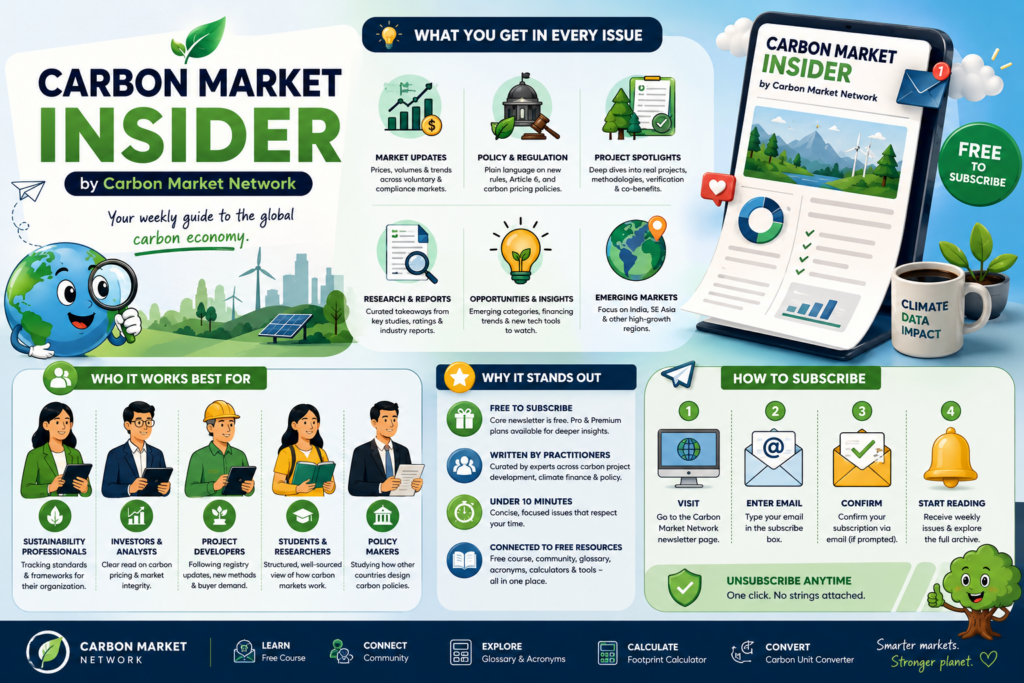
Carbon Market Insider, published by Carbon Market Network, leads this list for a simple reason. It covers the full carbon market picture in language that actually makes sense.
Most carbon market newsletters specialize narrowly. Some focus only on pricing data. Others stick to policy alone. Carbon Market Insider takes a wider view, which makes it a strong starting point whether you are brand new to carbon markets or already work in the field.
What you get in every issue
The newsletter organizes its coverage around six clear areas:
- Market updates. Carbon credit prices, trading volumes, and shifts across both voluntary and compliance carbon markets around the world.
- Policy and regulation. Plain language summaries of new rules, Article 6 progress, and national carbon pricing policies that affect how markets actually operate.
- Project spotlights. Deep dives into real carbon offset and removal projects, including their methodologies, verification standards, and co-benefits.
- Research and reports. Curated takeaways from the most relevant studies, ratings, and reports published across the carbon and climate sector, so you do not have to read entire reports yourself.
- Opportunities and insights. Emerging project categories, financing trends, and new technology tools worth watching before they go mainstream.
- Emerging markets coverage. Dedicated attention to fast growing carbon markets in India, Southeast Asia, and other high growth regions, alongside the usual coverage of Europe and North America.
Who it works best for
Carbon Market Insider works well for readers at every level, including:
- Sustainability professionals tracking standards and reporting frameworks relevant to their organization
- Investors and analysts who want a clear read on carbon credit pricing and market integrity
- Project developers following registry updates, new methodologies, and buyer demand
- Students and researchers who want a structured, well sourced view of how carbon markets actually work
- Policy makers studying how other jurisdictions design and run their carbon pricing systems
Why it stands out
A few things set this newsletter apart from the rest of the list.
It costs nothing to subscribe. Carbon Market Network also offers optional Pro and Premium plans for readers who want deeper research, tools, and resources, but the core newsletter stays free with no catch.
The Carbon Market Network team writes and curates every issue, with contributions from people who actually work across carbon project development, climate finance, and policy. That is different from a newsletter written purely by journalists summarizing press releases.
Each issue takes under ten minutes to read, so it respects your time instead of demanding it.
It also connects to a much larger free resource library. Carbon Market Network runs a free carbon market course, a community space, a glossary, an acronyms page, and free tools including a carbon footprint calculator and a carbon unit converter. If a newsletter issue sparks a question, the answer usually sits one click away on the same site.
How to subscribe
Getting started takes less than a minute:
- Visit the Carbon Market Network newsletter page.
- Enter your email address in the subscribe box.
- Confirm your subscription if prompted by email.
- Start receiving weekly issues, and browse the full archive of past issues anytime you want to catch up.
You can unsubscribe with one click at any time, with no strings attached.
2. CP Daily by Carbon Pulse
Carbon Pulse built its reputation as one of the most established names in carbon market journalism, and its free daily newsletter, CP Daily, reflects that experience.
Every issue rounds up more than 30 carbon and climate related stories, along with relevant reports, events, and job listings.
Carbon Pulse also runs paid subscription tiers, including Carbon Pulse Premium and Net Zero Pulse, for readers who want deeper analysis and full article access. A separate free newsletter, Nature & Biodiversity Pulse, covers nature and biodiversity markets twice a week.
This newsletter works best for traders, brokers, and policy professionals who want fast, frequent updates, especially on the EU Emissions Trading System and North American compliance markets.
3. Ecosystem Marketplace Updates by Forest Trends
Ecosystem Marketplace, an initiative of the nonprofit Forest Trends, has tracked environmental markets for close to two decades.
Subscribers receive updates on new research, data, and insights covering carbon, water, and biodiversity markets. The organization also publishes the annual State of the Voluntary Carbon Market report, one of the most cited sources of data on voluntary carbon credit pricing, volume, and trends.
Because Ecosystem Marketplace operates as a nonprofit with no trading stake in the market, its newsletter and reports carry a level of independence that purely commercial sources cannot always match.
This option suits researchers, students, and anyone who wants rigorously sourced voluntary carbon market data.
4. Network Connection by IETA
The International Emissions Trading Association, known as IETA, represents companies and organizations active in carbon markets across more than 60 countries.
Its monthly newsletter, Network Connection, discusses a new emissions trading topic each issue, highlights how IETA members are building carbon markets globally, and flags upcoming events such as IETA’s climate summits.
Because IETA sits close to international climate negotiations and policy discussions, this newsletter gives readers an industry association view of how carbon market rules actually get shaped.
It fits best for policy professionals, corporate sustainability teams, and anyone tracking how international carbon trading frameworks evolve.
5. Fastmarkets Carbon Newsletter
Fastmarkets, a price reporting agency, publishes a free weekly carbon newsletter packed with pricing intelligence.
Each issue delivers independent carbon price assessments across major voluntary credit categories such as REDD+, ARR, and IFM, along with CORSIA pricing, ratings based assessments, and curated issuance and retirement data. Readers also get weekly analysis on Article 6 and the EU Carbon Border Adjustment Mechanism.
This newsletter suits readers who want serious pricing data without committing to a full paid data platform.
6. AlliedOffsets Newsletter
AlliedOffsets built its business around carbon market data, tracking tens of thousands of projects across pricing, buyers, transactions, and brokers.
The company offers a free weekly pricing newsletter built around its own pricing benchmarks, plus a separate newsletter called Carbon Policy Currents that focuses on regulatory developments. AlliedOffsets also releases free downloadable reports covering market trends and carbon removal growth throughout the year.
This option works well for analysts, project developers, and anyone who wants pricing benchmarks alongside the news.
7. Carbon Herald Newsletter
Carbon Herald focuses specifically on carbon removal and carbon management, rather than carbon trading broadly.
Alongside daily news coverage and a podcast, Carbon Herald publishes a weekly roundup newsletter covering carbon capture technology, removal project funding, and the people and organizations driving large scale climate impact.
If your interest leans toward direct air capture, biochar, enhanced rock weathering, and other carbon removal technologies rather than credit trading mechanics, this newsletter fits that focus well.
8. CarbonCredits.com Newsletter
CarbonCredits.com positions itself as a source for carbon news, live pricing, and carbon credit investment opportunities.
Its email newsletter reaches a large base of investors, analysts, fund managers, and energy market professionals with regular updates on carbon credit pricing and investment focused news.
This newsletter suits retail and accredited investors who approach carbon credits primarily through an investment lens rather than a policy or project development one.
9. Carbon Market Watch Newsletter
Carbon Market Watch, a nonprofit watchdog organization, sends a monthly newsletter covering campaign updates, policy analysis, and event invitations.
The organization keeps a close, often critical eye on carbon market integrity, covering issues like Emissions Trading System reform, Article 6 negotiations, and quality concerns within the voluntary carbon market.
This newsletter works well for readers who want a civil society perspective alongside the more commercial and industry focused sources on this list.
10. Energy Transition Highlights by S&P Global Commodity Insights
S&P Global Commodity Insights, through its Platts brand, publishes a weekly newsletter called Energy Transition Highlights.
Editors curate developments across renewables, energy storage, and carbon pricing every week, giving readers a broader energy market lens alongside carbon specific updates.
This newsletter fits well for energy sector professionals who want carbon market news placed in context next to the wider energy transition.
11. ICAP Quarterly Newsletter
The International Carbon Action Partnership, known as ICAP, brings together governments and jurisdictions that run emissions trading systems around the world.
Its quarterly newsletter shares updates on ICAP’s work, alongside its flagship annual Status Report, which tracks every operating, developing, and proposed emissions trading system globally.
This newsletter suits readers who want a government level, worldwide view of how compliance carbon markets are expanding and evolving.
12. Honorable Mentions for Institutional Traders
A few carbon market intelligence providers sit firmly at the institutional end and deserve a mention, even though their core offerings live behind paid subscriptions.
Argus Carbon delivers daily pricing and a weekly global report covering compliance and voluntary markets across multiple regions.
Quantum Commodity Intelligence runs a dedicated carbon platform and newsletter built around daily price assessments for hundreds of carbon credit types.
Both work best for trading desks, banks, and large corporations that need granular, real time pricing data rather than a general news roundup.
Carbon Market Newsletters Compared at a Glance
Use this table to compare the top carbon market newsletters side by side before you decide where to subscribe.
| # | Newsletter | Publisher | Frequency | Cost | Best For |
|---|---|---|---|---|---|
| 1 | Carbon Market Insider | Carbon Market Network | Weekly | Free, with optional paid tiers | Beginners through professionals wanting full market coverage |
| 2 | CP Daily | Carbon Pulse | Daily | Free, with paid premium tiers | Traders and policymakers wanting fast updates |
| 3 | Ecosystem Marketplace Updates | Forest Trends | Periodic | Free | Independent voluntary carbon market data |
| 4 | Network Connection | IETA | Monthly | Free | Policy and industry association perspective |
| 5 | Fastmarkets Carbon Newsletter | Fastmarkets | Weekly | Free | Carbon pricing intelligence |
| 6 | AlliedOffsets Newsletter | AlliedOffsets | Weekly | Free | Data driven pricing and policy tracking |
| 7 | Carbon Herald Newsletter | Carbon Herald | Weekly | Free | Carbon removal and carbon management news |
| 8 | CarbonCredits.com | CarbonCredits.com | Daily and weekly | Free | Carbon credit investors |
| 9 | Carbon Market Watch Newsletter | Carbon Market Watch | Monthly | Free | NGO and market integrity perspective |
| 10 | Energy Transition Highlights | S&P Global Commodity Insights | Weekly | Free | Energy sector professionals |
| 11 | ICAP Newsletter | ICAP | Quarterly | Free | Global compliance market policy tracking |
| 12 | Argus Carbon and Quantum Commodity Intelligence | Argus Media and Quantum | Daily | Paid | Institutional traders and large corporations |
Free vs Paid Carbon Market Newsletters: What’s the Real Difference
Looking at the table above, you probably noticed that almost every recommended carbon market newsletter is free. That is not an accident.
Most carbon market organizations use a free newsletter to build trust and reach. They then offer paid tiers or full platforms for readers who need more.
| Free newsletters typically include | Paid tiers typically add |
|---|---|
| Curated news and analysis | Real time or historical price data feeds |
| Policy and regulation summaries | Proprietary forecasts and modeling |
| Project and methodology updates | Full article archives instead of summaries |
| General pricing trends | Dedicated analyst access or custom reports |
| Job listings and event discounts |
For most readers, a strong free newsletter such as Carbon Market Insider or CP Daily covers everything you need. Paid tiers earn their cost once you have a specific business reason, such as active trading, compliance reporting, or investment decisions, that justifies the extra spend.
How to Choose the Right Carbon Market Newsletter for You
The right carbon market newsletter depends entirely on what you actually do with the information. Use this quick guide to match your role to a starting point.
| If you are a… | Start with… |
|---|---|
| Complete beginner | Carbon Market Insider |
| Trader or broker | CP Daily, Fastmarkets Carbon Newsletter |
| Investor | CarbonCredits.com, Carbon Market Insider |
| Policy professional | IETA Network Connection, ICAP Newsletter |
| Project developer | AlliedOffsets Newsletter, Carbon Market Insider |
| Carbon removal specialist | Carbon Herald |
| Researcher or student | Ecosystem Marketplace, Carbon Market Insider |
| NGO or integrity focused reader | Carbon Market Watch |
Notice that Carbon Market Insider appears across several rows. That happens because it covers enough ground to work as a solid anchor newsletter no matter which group you fall into.
Step by Step: How to Build a Reliable Carbon Market News Routine
Subscribing to a single newsletter is a good start, but a real routine keeps you genuinely informed. Follow these steps to build one.
- Pick one broad newsletter as your anchor. Something like Carbon Market Insider works well here, since it covers both compliance and voluntary markets without heavy jargon.
- Add one specialist newsletter based on your role. A trader might add CP Daily, a policy professional might add IETA’s Network Connection, and a project developer might add the AlliedOffsets newsletter.
- Create a dedicated folder or label in your inbox. This keeps newsletters separate from work email, so they do not get buried.
- Set a fixed time each week to actually read what arrives. Even fifteen minutes on the same day every week beats letting issues pile up unread.
- Cross check major news across at least two sources. Before treating a big price move or policy announcement as confirmed, see whether a second newsletter backs it up.
- Follow linked social accounts for updates between issues. Many newsletters share breaking news on social platforms before the next scheduled issue goes out.
- Review your newsletter list every few months. Your needs change as you gain experience, so what worked when you started might not stay the best fit later.
Real World Examples: How Professionals Use Carbon Market Newsletters
Seeing how others actually use these newsletters makes the value easier to picture.
A corporate sustainability manager preparing a net zero strategy update scans the policy and regulation section of Carbon Market Insider each week. She then brings any relevant Article 6 or national carbon pricing news into leadership discussions.
A forestry project developer checks the AlliedOffsets weekly pricing newsletter before deciding when to bring a new batch of credits to market, comparing current prices against recent trends.
An individual investor cross references pricing alerts from CarbonCredits.com with broader policy coverage from Carbon Pulse before deciding whether a carbon credit linked investment still makes sense.
A graduate student researching carbon markets uses Ecosystem Marketplace’s data and reports as a primary source, then reads Carbon Market Insider’s project spotlights to understand how individual projects work in practice.
None of these examples require reading every carbon publication available. They simply require picking the right combination of carbon market newsletters for the job at hand.
Common Mistakes to Avoid When Following Carbon Market Newsletters
- Relying on just one newsletter for everything. Most newsletters specialize in either pricing, policy, or project news. Combining two or three gives you a fuller picture.
- Treating every price swing as a long term trend. Carbon prices move on short term news constantly. Wait for a pattern before drawing conclusions.
- Mixing up voluntary and compliance market news. A policy change in one rarely affects the other directly, so keep the two separate in your thinking.
- Subscribing to paid tiers before testing the free option. Most providers, including Carbon Market Insider, let you browse a public archive before you commit to anything paid.
- Letting issues pile up unread. An unread newsletter delivers zero value. If you consistently skip an issue, consider whether it still fits your routine.
The Future of Carbon Market Newsletters
Carbon market newsletters keep evolving alongside the markets they cover. A few clear directions stand out.
Coverage of carbon removal and engineered carbon dioxide removal keeps expanding, as more newsletters add dedicated sections for direct air capture, biochar, and similar technologies alongside traditional offset projects.
Credit quality and ratings keep gaining more space in newsletter coverage, since buyers increasingly care about a project’s integrity and not only its price.
More jurisdictions keep launching or expanding emissions trading systems, which means compliance market coverage keeps growing to match.
Newsletters increasingly link out to live dashboards, calculators, and data tools instead of standing alone as plain text emails, blending news with interactive resources.
Whatever changes come next, the core value of a strong carbon market newsletter stays the same. It turns a fragmented, fast moving market into something you can actually follow.
Final Thoughts on the Top Carbon Market Newsletters
Carbon markets will keep moving fast, with or without you watching closely. The difference comes down to whether you have reliable information when decisions actually need to get made.
The top carbon market newsletters on this list each bring something different to the table, from daily pricing data to policy deep dives to investor focused updates.
If you only pick one place to start, Carbon Market Insider by Carbon Market Network gives you the broadest, clearest view of carbon markets without burying you in jargon, and it costs nothing to try.
From there, layer in a specialist newsletter that matches your specific role, whether that means trading, policy, project development, or investing.
Subscribe today, build a simple reading routine, and let the right carbon market newsletter do the heavy lifting of keeping you informed.
Frequently Asked Questions About Carbon Market Newsletters
What is the best carbon market newsletter for beginners?
For most beginners, Carbon Market Insider by Carbon Market Network works well because it explains both compliance and voluntary markets in plain language and skips heavy jargon. It also links to a wider library of guides and tools if you want to go deeper.
Are carbon market newsletters free to subscribe to?
Most of the well known carbon market newsletters, including Carbon Market Insider, CP Daily from Carbon Pulse, the IETA Network Connection, and the Fastmarkets Carbon Newsletter, are free. A few providers offer paid tiers on top of their free newsletter for deeper data, forecasts, or real time pricing.
How often should I read carbon market news?
Weekly works well for most readers. If your job involves trading, compliance reporting, or active investing, a daily newsletter such as CP Daily gives you a tighter feedback loop.
What is the difference between voluntary and compliance carbon market newsletters?
Voluntary market newsletters focus on carbon credits that companies buy outside of any legal requirement, covering project types, registries, and credit quality. Compliance market newsletters focus on government run systems, such as the EU Emissions Trading System or California’s cap and trade program, where companies must legally hold allowances. Many newsletters, including Carbon Market Insider, cover both sides.
Can I subscribe to more than one carbon market newsletter?
Yes, and it often makes sense to combine a broad newsletter with a specialist one. For example, you could pair Carbon Market Insider for general coverage with Carbon Herald if you specifically follow carbon removal technology.
Do paid carbon market newsletters offer better information than free ones?
Not necessarily better, just different. Paid options usually add real time trading data, historical price archives, and proprietary forecasts. Free newsletters often do an excellent job covering news, policy, and context, which is what most readers actually need.
How do I unsubscribe from a carbon market newsletter?
Every reputable newsletter, including Carbon Market Insider, includes an unsubscribe link at the bottom of each issue. Clicking it removes you immediately, with no extra steps required.
Which carbon market newsletter covers Article 6 and international carbon trading rules best?
IETA’s Network Connection and the ICAP quarterly newsletter both focus heavily on policy and international trading rules such as Article 6, since both organizations work directly with governments on these frameworks. Carbon Market Insider also covers Article 6 developments as part of its policy and regulation section.