Carbon Market Network


You want to understand carbon markets. You have a commute, a lunch break, or a quiet hour. And you don’t want to wade through dense reports or paywalled research.
That’s exactly what carbon market podcasts are for.
Podcasts have become one of the best ways to stay current with the fast-moving world of carbon credits, emissions trading systems, and climate finance. They bring together policymakers, project developers, carbon credit buyers, registry experts, and researchers in conversations you can actually learn from.
Whether you are a complete beginner or a working professional in sustainability, this curated list of the top carbon market podcasts will help you find the right show for your needs.
Why Podcasts Are a Powerful Tool for Learning Carbon Markets
Carbon markets move fast. New regulations, new Article 6 rules, shifting voluntary market standards, and emerging carbon removal technologies all demand constant learning.
Podcasts give you access to real experts without the jargon overload. You hear directly from the people shaping these markets, in plain language, in real time.
Here is why more people in climate and sustainability are turning to podcasts:
- On-demand learning that fits around a busy schedule
- Direct access to carbon market experts, policymakers, and project developers
- Fresh perspectives on topics like carbon credit integrity, net zero, and ETS reform
- Breadth of topics from REDD+ to biochar to Article 6 of the Paris Agreement
Carbon Market Insider Newsletter
Weekly insights on carbon markets, climate policy, carbon credits, and sustainability.
Who Should Listen to Carbon Market Podcasts?
These shows are not just for specialists. They are useful for a wide range of listeners.
Beginners and students who want to understand how carbon markets work will find approachable entry points in several shows.
Corporate sustainability professionals will get actionable insights on how large companies set net zero targets and use carbon credits.
Policy professionals and researchers will appreciate the deep dives into compliance markets, ETS design, and international carbon pricing.
Project developers and carbon consultants will stay updated on registry standards, MRV, and high-integrity project frameworks.
Investors and finance professionals will find growing coverage of climate finance, carbon credit quality, and green asset markets.
The Top Carbon Market Podcasts Worth Your Time
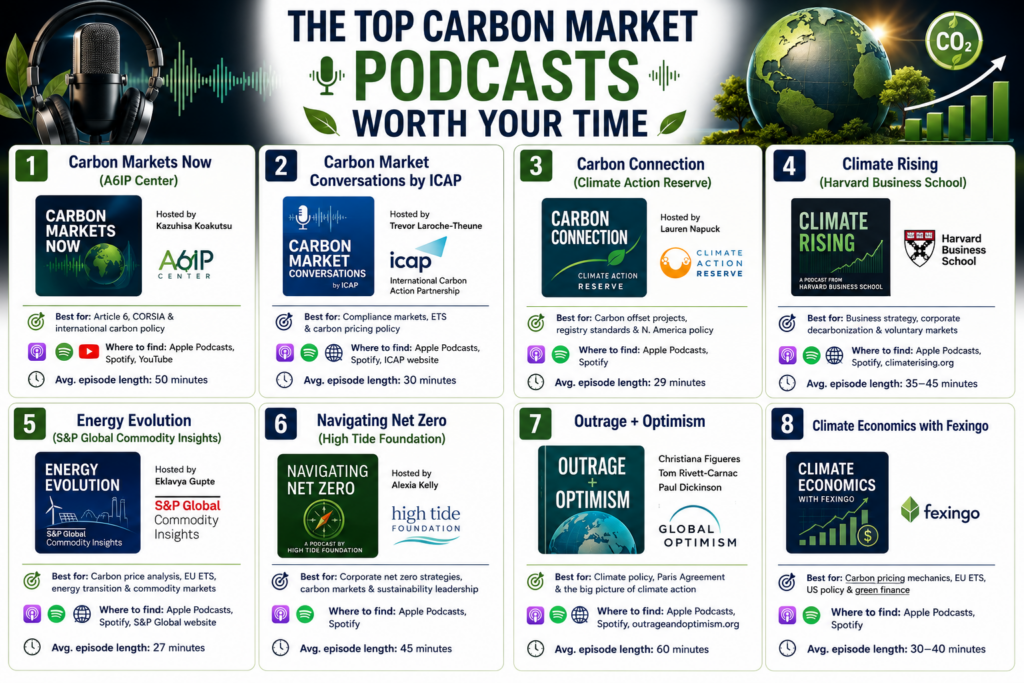
1. Carbon Markets Now (A6IP Center)
Best for: Understanding Article 6, CORSIA, and international carbon market policy
Where to find it: Apple Podcasts, Spotify, YouTube
Average episode length: 50 minutes
This is one of the most policy-focused carbon market podcasts available today. Carbon Markets Now is hosted by Kazuhisa Koakutsu, Director of the Article 6 Implementation Partnership (A6IP) Center, and dives deep into the evolving landscape of Article 6 of the Paris Agreement, market-based mechanisms, and real-world initiatives driving decarbonization.
The podcast tackles some of the most complex issues in global carbon markets with clarity and depth. Topics covered include CORSIA in aviation, carbon credit quality, nature-based solutions, technology-based carbon dioxide removal, and the role of digital infrastructure in tracking carbon credits globally.
The podcast series includes episodes on carbon credit quality and rating agencies featuring Sylvera and BeZero Carbon, high integrity carbon markets explained by VCMI and ICVCM experts, CORSIA with guests from IATA and EDF, nature-based solutions with Conservation International, and technology-based CDR with Puro.earth and ClimeFi.
Carbon Markets Now was named a Top 50 Net Zero Podcast by Feedspot, recognizing its growing influence in the global climate community.
Why listen: If you want to understand international carbon market policy at the highest level, this show is essential. It brings in experts from the World Bank, ICVCM, VCMI, and leading carbon credit rating agencies.
2. Carbon Market Conversations by ICAP
Best for: Compliance markets, emissions trading systems, and carbon pricing policy
Where to find it: Apple Podcasts, Spotify, ICAP website
Average episode length: 30 minutes
This podcast comes directly from the International Carbon Action Partnership, one of the most respected institutions in global carbon market governance. Carbon Market Conversations gives insight into all things emissions trading and carbon pricing, hosted by Trevor Laroche-Theune, who meets with climate experts and practitioners to discuss the latest ETS developments and their impacts.
The podcast aims to shed light on the latest developments in emissions trading and carbon pricing, providing valuable perspectives for both newcomers to the conversation and seasoned practitioners in the field.
Episodes take listeners through key developments in Europe, North America, Latin America, and Asia-Pacific. The show has covered India’s Carbon Credit Trading Scheme, Brazil’s developing ETS, China’s national carbon market, and the crucial role of carbon pricing revenues in advancing climate action.
ICAP notes that 36 emissions trading systems are now in force, covering nearly ten gigatonnes of CO2 equivalent emissions, and these systems have raised over $300 billion since 2007.
Why listen: If you work in policy, government, or compliance markets, this is the podcast for you. It is authoritative, well-structured, and consistently covers the developments that matter most for ETS practitioners worldwide.
3. Carbon Connection (Climate Action Reserve)
Best for: Carbon offset projects, registry standards, and climate policy in North America
Where to find it: Apple Podcasts, Spotify
Average episode length: 29 minutes
The Climate Action Reserve presents the Carbon Connection podcast featuring interviews with partners who share insights and expertise in various climate sectors and topics across the carbon market.
Hosted by Senior Business Development Manager Lauren Napuck, Carbon Connection covers topics from carbon credit buyers and Scope 3 emissions to COP negotiations and registry protocol development.
The show has tackled topics including how credit buyers prioritize quality in their sustainability strategies, the nuances of Scope 3 emissions and carbon credits, biochar offset protocols, carbon project co-benefits for local communities, and the implications of climate-related disclosure requirements for corporations.
The Climate Action Reserve is described as the most experienced and trusted offset registry to serve the carbon markets.
Why listen: This podcast gives you a registry-level view of the voluntary carbon market. It is particularly useful for project developers, verifiers, and sustainability teams who want to stay current with evolving protocols and buyer expectations.
4. Climate Rising (Harvard Business School)
Best for: Business strategy, corporate decarbonization, and voluntary carbon markets
Where to find it: Apple Podcasts, Spotify, climaterising.org
Average episode length: 35 to 45 minutes
Climate Rising is one of the most respected climate-focused business podcasts in the world. It brings business and policy leaders and Harvard Business School faculty together to share insights about what businesses are doing, can do, and should do to confront climate change.
The show regularly features episodes that go deep into carbon markets. Guests have included Amazon’s Head of Carbon Neutralization Science and Strategy, who discussed the company’s approach to high-integrity carbon credits and the launch of the Abacus carbon credit label. The show has also featured the CEO of Key Carbon on climate finance and voluntary markets, and the co-founder of Calyx Global on rating carbon credits.
One episode features a panel discussion exploring the role of voluntary carbon markets in mobilizing finance for decarbonization, ensuring the integrity of carbon credits, and scaling high-quality projects, covering emerging standards, innovative financial products, and how companies can leverage voluntary carbon markets to achieve net-zero goals.
Why listen: If you want to understand how major corporations use carbon markets as part of their net zero strategies, Climate Rising gives you that inside view. It bridges finance, policy, and business strategy in a way few podcasts do.
5. Energy Evolution (S&P Global Commodity Insights)
Best for: Carbon price analysis, EU ETS, energy transition, and commodity markets
Where to find it: Apple Podcasts, Spotify, S&P Global website
Average episode length: 27 minutes
Energy Evolution features interviews, analysis, and reporting from S&P Global Energy on energy and commodities’ transition to a cleaner future. Host Eklavya Gupte speaks with policymakers, industry professionals, and in-house experts worldwide on topics related to decarbonization, climate, emerging fuels and energy sources, and the outlook for commodity markets from oil to power to metals.
The show is particularly strong on EU carbon market dynamics. A recent episode examined what was driving turbulence in European carbon markets, featuring a carbon price reporter who explained political pressure dragging EU Allowance prices down, and an EU policy director at the International Emissions Trading Association who broke down ETS reforms under consideration.
Energy Evolution has covered how environmental commodity markets are being reshaped by geopolitics and policy, and how biomethane and renewable energy certificates are evolving in Europe amid regulatory shifts.
Why listen: For anyone who follows carbon pricing in commodity markets, especially the EU ETS, this is one of the most data-grounded and analytically rigorous shows available. Ideal for finance professionals, commodity traders, and policy watchers.
6. Navigating Net Zero (High Tide Foundation)
Best for: Corporate net zero strategies, carbon markets, and sustainability leadership
Where to find it: Apple Podcasts, Spotify
Average episode length: 45 minutes
Navigating Net Zero features conversations with practitioners and experts who are working through the complex realities of corporate decarbonization and sustainability. It demystifies and highlights the challenges, opportunities, and real-world experiences faced by the people leading their institutions’ net-zero journeys.
Hosted by internationally-renowned climate change expert Alexia Kelly and brought to you by the Carbon Policy and Markets at the High Tide Foundation, the show hopes to inspire action from this generation of climate leaders and the next.
The show covers carbon markets with a strong focus on how companies actually use them. Episodes have explored carbon credit quality and the future of verified carbon markets, climate communication challenges, the newly launched Task Force for Corporate Action Transparency, and what leading sustainability professionals at companies like Microsoft, Amazon, and Fortune 500 firms actually experience on the ground.
Why listen: If you want to understand how sustainability leaders inside major companies think about carbon markets, net zero commitments, and climate integrity, this podcast gives you candid, experience-driven conversations that you rarely find elsewhere.
7. Outrage + Optimism
Best for: Climate policy, Paris Agreement, and the big picture of global climate action
Where to find it: Apple Podcasts, Spotify, outrageandoptimism.org
Average episode length: 60 minutes
Outrage + Optimism is one of the most widely followed climate podcasts in the world. It is hosted by Christiana Figueres, Tom Rivett-Carnac, and Paul Dickinson, and describes itself as a show about solving the climate crisis and remaking the world.
Christiana Figueres and Tom Rivett-Carnac co-founded Global Optimism and were responsible for the political strategy that led to the unanimous signing of the Paris Agreement. That background gives the show an unmatched level of insider knowledge on how climate negotiations and climate finance actually work.
While not exclusively a carbon market podcast, it covers carbon pricing, international climate agreements, and corporate climate strategies regularly. It brings in world leaders, scientists, campaigners, and business executives in a format that is accessible and emotionally engaging.
Why listen: This podcast gives you the largest context for carbon markets. It helps you understand why these markets exist, what they are trying to achieve, and what is at stake globally. A perfect companion to the more technical shows on this list.
8. Climate Economics with Fexingo
Best for: Carbon pricing mechanics, EU ETS, US climate policy, and green finance
Where to find it: Apple Podcasts, Spotify
Average episode length: 30 to 40 minutes
Climate Economics with Fexingo breaks down the real economics behind carbon pricing, green policy, and the hidden costs of sustainability. Each episode examines a specific mechanism, from EU ETS permit prices to the impact of US Inflation Reduction Act subsidies on corporate balance sheets, and traces how these policies ripple through energy markets, manufacturing, and consumer prices.
Recent episodes have explored the rise of carbon removal investment trusts, a new financial structure that bundles carbon removal credits into tradable securities. The show discussed the first such trust launched by a major asset manager, which raised $500 million for direct air capture and biochar projects, and how these vehicles could solve liquidity and scale problems in the voluntary carbon market.
The show serves investors, policy analysts, and business leaders who need to understand climate-related financial risk without the activism or greenwashing.
Why listen: This is one of the most economics-focused carbon market podcasts available. It is excellent for anyone who wants a quantitative, market-oriented understanding of how carbon pricing works in practice and what it means for real businesses.
Quick Comparison: Top Carbon Market Podcasts at a Glance
| Podcast | Host / Publisher | Focus Area | Best For | Episode Length |
|---|---|---|---|---|
| Carbon Markets Now | A6IP Center | Article 6, CORSIA, CDR | Policy professionals | ~50 min |
| Carbon Market Conversations | ICAP | Compliance markets, ETS | ETS practitioners | ~30 min |
| Carbon Connection | Climate Action Reserve | Offset protocols, registry | Project developers | ~29 min |
| Climate Rising | Harvard Business School | Corporate net zero, VCM | Business leaders | ~40 min |
| Energy Evolution | S&P Global | EU ETS, commodities | Finance professionals | ~27 min |
| Navigating Net Zero | High Tide Foundation | Corporate sustainability | Sustainability teams | ~45 min |
| Outrage + Optimism | Global Optimism | Paris Agreement, big picture | General audience | ~60 min |
| Climate Economics with Fexingo | Fexingo | Carbon pricing economics | Economists, investors | ~35 min |
How to Get the Most Out of Carbon Market Podcasts
Listening to podcasts is easy. Getting real value from them takes a little more intention.
Start with a specific topic. Rather than just picking a show at random, identify what you actually want to understand. Is it how the EU ETS works? How companies use carbon credits for net zero? How Article 6 affects project developers? Letting your question guide your choice will help you learn faster.
Take notes or use transcripts. Many of these podcasts offer episode show notes or full transcripts on their websites. Use them. Jot down names, frameworks, organizations, and concepts you want to research further.
Follow the guests. Carbon market podcasts frequently feature the same ecosystem of experts. When you hear a guest who explains something well, look them up. They often write, present, or publish regularly.
Cross-reference episodes. Several shows have covered the same topics from different angles. For example, Article 6 has been examined from a policy angle on Carbon Markets Now and from a corporate angle on Climate Rising. Listening to both gives you a richer picture.
Create a listening habit. Commit to one episode per week on a specific topic. Over a few months, you will build genuine literacy in carbon market dynamics that no quick search can replicate.
What Topics Do Carbon Market Podcasts Cover?
The best carbon market podcasts cover a wide and growing range of subjects. Here are the most common topic areas you will encounter across these shows.
Compliance carbon markets and ETS: These episodes explain how cap-and-trade systems work, cover developments in the EU ETS, California, China, and emerging systems in Latin America and Asia.
Voluntary carbon markets: Topics include carbon credit standards, registry protocols, Verra, Gold Standard, Climate Action Reserve, buyer strategies, and credit integrity.
Article 6 of the Paris Agreement: This is one of the fastest-growing topic areas. Episodes cover the rules for internationally transferred mitigation outcomes (ITMOs), the Article 6.4 mechanism, and how bilateral carbon market agreements work.
Carbon credit quality and ratings: Shows regularly feature experts from organizations like BeZero Carbon, Sylvera, and Calyx Global who explain how carbon credits are rated, what additionality means, and how to avoid low-quality credits.
Carbon removal: Topics include direct air capture, biochar, enhanced weathering, nature-based solutions, and how these approaches are finding their way into both voluntary and compliance markets.
Corporate net zero strategies: Episodes explore how companies set science-based targets, what role carbon credits play in corporate climate strategies, and how to assess the credibility of corporate climate claims.
CORSIA and aviation: The aviation sector’s use of carbon markets is covered regularly, particularly on shows like Carbon Markets Now and Energy Evolution.
Climate finance: Carbon credit finance, green bonds, transition finance, and the role of multilateral development banks in scaling carbon markets all appear frequently.
How Carbon Market Podcasts Connect to the Bigger Picture
Understanding carbon markets through podcasts is not just about picking up vocabulary. It is about seeing how interconnected these systems are.
A single episode about the EU ETS connects to geopolitics, industrial competitiveness, energy prices, and corporate strategy. An episode on Article 6 connects to how developing countries finance their climate transitions and how international aviation manages its emissions. An episode on carbon credit quality connects to questions of additionality, permanence, and the very credibility of the net zero movement.
The best carbon market podcasts help you see those connections clearly. They are run by people who have spent years in these systems and who can explain the nuance in a 30 to 60 minute conversation that would take you days to find in reports.
Emerging Podcast Topics to Watch in Carbon Markets
The carbon market landscape continues to evolve rapidly, and the podcasts covering it are evolving with it. Here are the topic areas that are generating the most discussion right now.
Article 6 implementation: With the Paris Agreement rulebook increasingly in operation, podcasts are diving into how governments and project developers are navigating Article 6.2 and 6.4 in practice.
Digital MRV and carbon market infrastructure: Episodes are exploring how satellite monitoring, blockchain, and AI-powered verification tools are changing how carbon credits are measured and tracked.
Carbon credit rating agencies: The rise of firms like BeZero, Sylvera, and Calyx Global is generating rich discussion about how ratings affect prices, demand, and market credibility.
Carbon removal at scale: Technology-based CDR, from direct air capture to ocean-based removal, is moving from niche to mainstream. Podcasts are covering how these approaches intersect with compliance and voluntary markets.
Convergence of voluntary and compliance markets: As Article 6 mechanisms mature, the line between voluntary and compliance carbon markets is blurring. This is one of the most consequential conversations happening across multiple shows right now.
Tips for Finding New Carbon Market Podcasts
The ecosystem of carbon market podcasts is growing. Here is how to discover shows beyond this list.
Search specific keywords. On Apple Podcasts or Spotify, search terms like “carbon credits,” “emissions trading,” “voluntary carbon market,” “net zero,” and “climate finance” will surface both established shows and newer entries.
Check institutional websites. Organizations like ICAP, Climate Action Reserve, the A6IP Center, Verra, and Gold Standard often publish their own podcasts or appear as guests on others. Following their communications will alert you to new audio content.
Follow carbon market professionals on LinkedIn. When experts appear on podcasts, they typically share the episode. Following people active in carbon market work will surface shows you might not discover through search alone.
Use podcast aggregators. Platforms like Feedspot maintain regularly updated lists of the top carbon and climate podcasts. These are useful for discovering shows outside the mainstream directories.
FAQ: Top Carbon Market Podcasts
What is the best podcast for understanding carbon markets as a beginner?
For beginners, Carbon Connection from the Climate Action Reserve is a great starting point. It uses accessible language, covers practical topics like carbon offset protocols and buyer perspectives, and features guests who explain concepts clearly. Climate Rising from Harvard Business School is also excellent for beginners who approach carbon markets from a business or corporate sustainability angle.
Which podcast covers the EU ETS and compliance carbon markets best?
Carbon Market Conversations by ICAP is the most focused and authoritative podcast for compliance carbon markets and ETS policy. Energy Evolution by S&P Global Commodity Insights also covers the EU ETS regularly with strong analytical depth, particularly on carbon pricing dynamics.
Are there podcasts that cover Article 6 of the Paris Agreement?
Yes. Carbon Markets Now by the A6IP Center is the most dedicated show on this topic. It covers Article 6.2 bilateral agreements, the Article 6.4 mechanism, CORSIA, and the intersection of international carbon markets with nature-based solutions and CDR.
Is there a podcast that covers both voluntary carbon markets and climate finance?
Climate Rising from Harvard Business School is probably the strongest on this combination. It regularly features guests from carbon market finance companies, carbon credit rating agencies, and corporate sustainability teams who discuss how voluntary markets and climate finance intersect.
How do I find the most recent episodes of these podcasts?
All of the podcasts in this list are available on Spotify and Apple Podcasts. Most also have dedicated websites where show notes, transcripts, and episode archives are available. Searching the podcast name directly in any major podcast app will take you to the latest episodes.
Can I learn about carbon markets just by listening to podcasts?
Podcasts are an excellent learning tool but work best alongside other resources. Pair podcast listening with reading from resources like the ICAP ETS Status Report, Verra and Gold Standard documentation, and publications from Carbon Market Network to build a well-rounded understanding.
Are there any podcasts that cover carbon markets in the context of business strategy?
Yes. Navigating Net Zero with Alexia Kelly and Climate Rising both focus heavily on how businesses navigate carbon markets as part of their broader climate strategies. Outrage + Optimism also regularly addresses the role of corporate action and carbon markets in the global climate response.
Final Thoughts
Carbon markets are one of the most complex and consequential systems in global climate action. They sit at the intersection of policy, finance, science, and business. Keeping up with them requires good sources, and the podcasts on this list are among the best available.
From ICAP’s authoritative takes on ETS policy to Harvard Business School’s business-oriented deep dives, and from the A6IP Center’s Article 6 expertise to S&P Global’s commodity market analysis, there is a podcast on this list for every kind of listener.
The top carbon market podcasts give you access to the conversations that are shaping the future of climate finance, carbon credit integrity, and global decarbonization. All you need to do is press play.
For more resources on carbon markets, carbon credits, and climate finance, explore Carbon Market Network.