Carbon Market Network


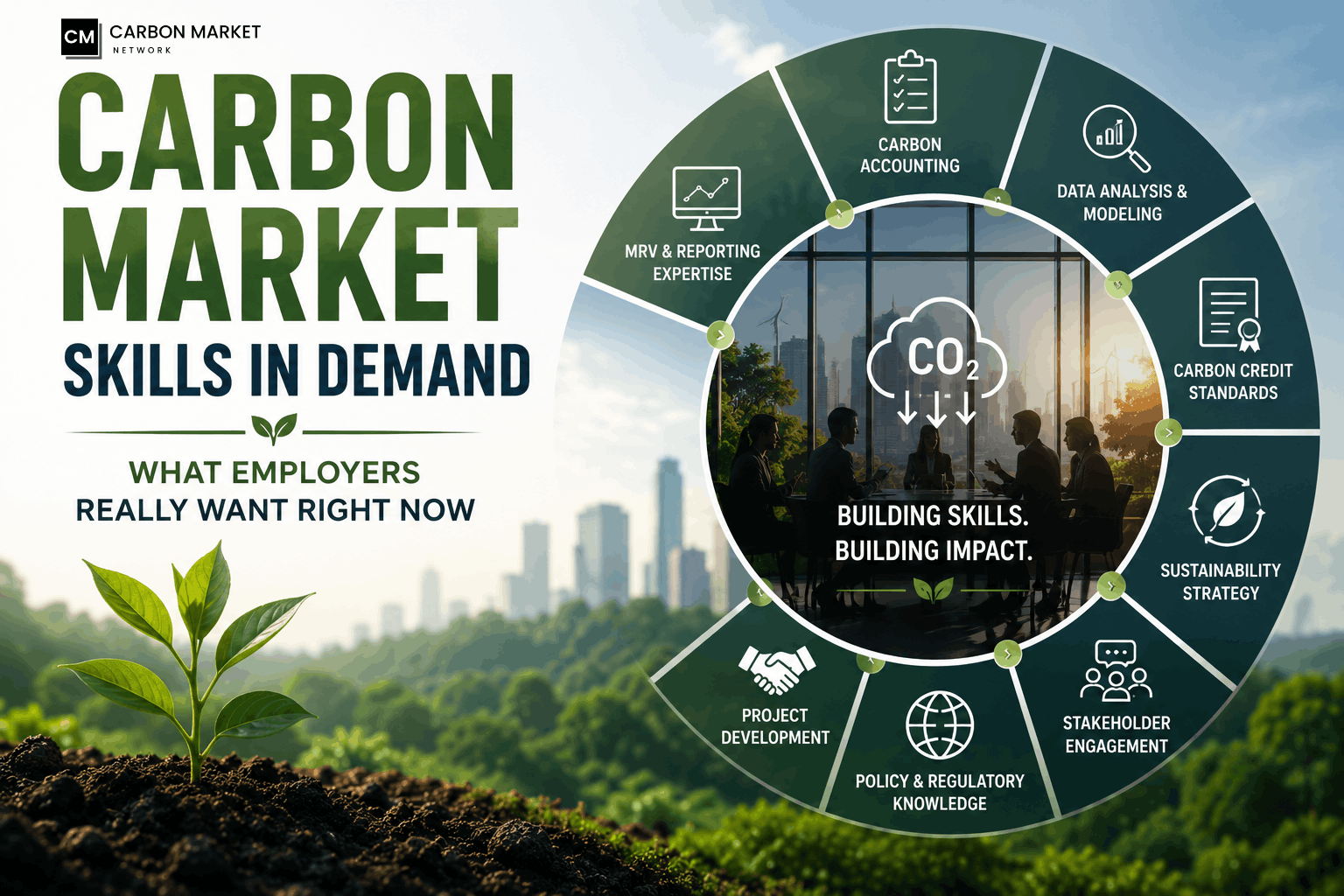
Carbon markets are no longer a quiet corner of environmental policy. They have grown into a global industry worth billions of dollars, and that growth has created a hiring boom.
Companies, governments, and project developers all need people who understand how carbon credits work. But here is the catch. Demand for talent is growing faster than the supply of qualified professionals.
That gap is good news for you. If you understand which carbon market skills are in demand, you can position yourself for a fast-growing, well-paying, and genuinely meaningful career.
This guide breaks down exactly which skills matter, why they matter, and how you can start building them today. Whether you are a student, a career switcher, or a working professional looking to move into climate work, you will find a clear roadmap here.
Why Carbon Market Skills Are Suddenly in High Demand
A few forces are driving this surge in hiring, and understanding them helps you see where the real opportunities sit.
Regulatory expansion. Compliance carbon markets, such as emissions trading systems, are expanding into new sectors and new countries. Every new regulation creates a need for compliance specialists.
Corporate net-zero commitments. Thousands of companies have made public climate pledges. Meeting those pledges requires people who can measure emissions, buy credible carbon credits, and report progress accurately.
Article 6 and international carbon trading. The Paris Agreement’s Article 6 framework has opened the door to country-to-country carbon trading. This has created fresh demand for professionals who understand international carbon accounting rules.
Stricter quality standards. Buyers and regulators now demand higher integrity in carbon credits. This has increased demand for verification, monitoring, and data science professionals who can prove that a credit represents a real, additional, and permanent emissions reduction.
Technology adoption. Satellite monitoring, remote sensing, and digital measurement, reporting, and verification (dMRV) tools are transforming how carbon projects are tracked. This has opened an entirely new category of technical roles.
Together, these forces mean one thing. Carbon market skills in demand today span far more than climate science. They now include finance, law, data science, technology, and communication.
Carbon Market Insider Newsletter
Weekly insights on carbon markets, climate policy, carbon credits, and sustainability.
The Big Picture: Carbon Market Career Categories
Before diving into specific skills, it helps to understand the broad categories of carbon market careers. Most roles fall into one of these buckets.
| Career Category | What They Do | Typical Backgrounds |
|---|---|---|
| Carbon Project Development | Design, implement, and manage carbon projects on the ground | Environmental science, forestry, agriculture, engineering |
| MRV and Verification | Measure, report, and verify emissions reductions | Environmental science, data science, auditing |
| Carbon Trading and Finance | Buy, sell, and structure carbon credit transactions | Finance, economics, commodities trading |
| Policy and Regulatory Affairs | Shape and interpret carbon market rules | Law, public policy, international relations |
| Carbon Accounting and ESG Reporting | Track corporate emissions and disclosures | Accounting, sustainability, finance |
| Technology and Data | Build tools for monitoring, registries, and analytics | Software engineering, data science, remote sensing |
| Consulting and Advisory | Guide companies through carbon strategy | Sustainability, management consulting, environmental science |
Each of these categories rewards a different mix of skills. Let’s go through the ones that matter most right now.
1. Carbon Accounting and GHG Measurement
Carbon accounting sits at the foundation of every carbon market activity. Without accurate measurement, nothing else works.
This skill involves calculating greenhouse gas emissions using recognized methodologies, most commonly the GHG Protocol.
Why This Skill Is So Valuable
Every company with a climate target needs to measure its emissions before it can reduce them. That includes:
- Direct emissions from owned operations (Scope 1)
- Indirect emissions from purchased energy (Scope 2)
- Emissions across the value chain, including suppliers and customers (Scope 3)
Scope 3 accounting is especially in demand because it is the hardest to measure and often makes up the largest share of a company’s total footprint.
How to Build This Skill
- Learn the GHG Protocol Corporate Standard from the ground up.
- Practice building emissions inventories using real or sample company data.
- Get comfortable with emission factors, activity data, and calculation tools.
- Learn how carbon accounting software platforms work, since most companies now use software rather than spreadsheets alone.
Real-World Example
A mid-size manufacturing company preparing for a sustainability disclosure needs someone who can pull data from suppliers, apply the right emission factors, and produce an auditable inventory. This is carbon accounting in action, and it is one of the fastest-growing job categories in the entire climate space.
2. Monitoring, Reporting, and Verification (MRV)
MRV is the backbone of trust in carbon markets. It answers a simple but critical question: did this project actually reduce emissions the way it claims to?
What MRV Professionals Actually Do
- Design monitoring plans for carbon projects
- Collect and analyze field data
- Prepare verification reports for third-party auditors
- Ensure projects follow the rules of their chosen carbon standard, such as Verra or Gold Standard
Digital MRV (dMRV) Is Reshaping the Field
Traditional MRV relied heavily on manual site visits and paperwork. That is changing fast.
Digital MRV uses satellite imagery, sensors, drones, and machine learning to monitor projects remotely and continuously. This lowers costs and increases transparency.
Professionals who combine environmental science knowledge with basic data skills, such as working with satellite data platforms or geographic information systems (GIS), are extremely well positioned right now.
Skills to Build
- Field data collection and sampling methods
- Familiarity with major carbon standards and their methodologies
- Basic GIS and remote sensing tools
- Report writing for technical and non-technical audiences
3. Carbon Project Development
Project developers are the people who actually build carbon projects, whether that means planting trees, distributing clean cookstoves, capturing methane from landfills, or protecting a wetland.
Core Responsibilities
- Identifying suitable project sites and activities
- Selecting the right carbon standard and methodology
- Managing community and stakeholder engagement
- Coordinating with verifiers and registries
- Overseeing long-term project monitoring
Why Employers Want This Skill Set
Every carbon credit starts as a project on the ground. As demand for high-quality credits grows, developers need people who understand both the technical side of a project and the human side, including community relationships and land rights.
Practical Tip
If you want to break into project development, start by studying one project type deeply, such as improved cookstoves, reforestation, or biochar. Depth in one methodology often opens doors faster than shallow knowledge across many.
4. Carbon Trading and Market Analysis
This is where finance meets climate. Carbon traders and market analysts buy, sell, and price carbon credits, often across both compliance and voluntary markets.
What This Role Requires
- Understanding of supply and demand dynamics across carbon markets
- Ability to read regulatory signals and predict price movements
- Comfort with trading platforms and contract structures
- Strong negotiation skills
Compliance vs Voluntary Markets
| Feature | Compliance Market | Voluntary Market |
|---|---|---|
| Who participates | Companies legally required to reduce emissions | Companies and individuals acting voluntarily |
| Example | Emissions trading systems set by governments | Corporate net-zero pledges |
| Price drivers | Government caps and policy | Buyer demand and credit quality |
| Regulation level | Heavily regulated | Lightly regulated, standards-driven |
Traders who understand both markets, and how policy shifts affect pricing in each, are especially valuable.
How to Get Started
Many carbon traders come from commodities or financial trading backgrounds. If you already have finance experience, layering on carbon market knowledge through dedicated courses can be a fast path into this field.
5. Climate Policy and Regulatory Expertise
Carbon markets exist because of policy. Someone has to design the rules, interpret them, and help organizations comply.
Where This Skill Is Used
- Government agencies designing emissions trading systems
- Law firms advising clients on compliance obligations
- Companies managing regulatory risk
- International organizations negotiating carbon trading frameworks under Article 6
Skills That Matter Here
- Strong understanding of how emissions trading systems and carbon taxes work
- Ability to read and interpret legal and regulatory text
- Awareness of how national policies interact with international frameworks
- Clear written and verbal communication for non-expert audiences
Why This Skill Is Rising in Value
As more countries link their carbon markets or set up new ones, the rules keep evolving. Professionals who can track and translate these changes into practical guidance are always in short supply.
6. ESG Reporting and Sustainability Disclosure
ESG reporting has moved from a nice-to-have to a legal requirement in many jurisdictions. This has created massive demand for people who can turn raw sustainability data into clear, compliant reports.
Core Tasks
- Collecting environmental, social, and governance data across a company
- Mapping that data to reporting frameworks
- Preparing disclosures for regulators, investors, and customers
- Coordinating with auditors on assurance requirements
Skills to Develop
- Familiarity with major disclosure frameworks and standards
- Strong Excel or data management skills
- Project management, since ESG reporting involves coordinating many departments
- Attention to detail, since errors in disclosures can carry real financial and legal consequences
7. Data Science and Technology Skills
This is one of the fastest-growing skill areas in carbon markets, and it is often overlooked by newcomers who assume the field is only for environmental scientists.
Where Tech Talent Fits In
- Building dMRV platforms that use satellite and sensor data
- Developing carbon registries and blockchain-based tracking systems
- Creating AI models that detect deforestation or predict carbon sequestration
- Building tools that help companies calculate their carbon footprint automatically
Skills in Highest Demand
- Data analysis using tools like Python or SQL
- Machine learning fundamentals, especially for satellite image analysis
- GIS and remote sensing
- API integration for connecting climate data across platforms
Why This Matters
As carbon markets scale, manual verification cannot keep up with demand. Technology is the only way to monitor thousands of projects accurately and affordably. People who combine climate knowledge with technical skills are rare, and that rarity translates into strong career opportunities.
8. Communication, Stakeholder Engagement, and Storytelling
Carbon markets involve a wide range of stakeholders, including local communities, investors, regulators, and the general public. Someone needs to explain complex ideas clearly to all of them.
Where This Skill Shows Up
- Writing accessible reports and public communications
- Presenting carbon project results to investors or partners
- Managing relationships with local communities affected by a project
- Handling media inquiries about carbon credit quality and integrity
Why It Is Undervalued and In Demand
Many technical professionals struggle to communicate their work clearly. Carbon markets have also faced public scrutiny over credit quality, which makes clear, honest communication more important than ever. Professionals who can bridge technical accuracy and plain language stand out immediately.
9. Legal and Contract Expertise
Every carbon transaction involves a contract, and every carbon project involves legal considerations around land rights, ownership, and liability.
Common Responsibilities
- Drafting and reviewing carbon credit purchase agreements
- Advising on emissions trading compliance
- Structuring international carbon trading deals under Article 6
- Managing intellectual property and data rights for MRV technology
Skills That Matter
- Contract law fundamentals
- Understanding of carbon credit ownership and transfer mechanics
- Familiarity with international climate agreements
- Risk assessment and due diligence
10. Project Management
This might be the most underrated skill in the entire industry. Carbon projects and carbon market initiatives involve many moving parts, tight timelines, and multiple stakeholders.
What Strong Project Managers Bring
- Ability to coordinate across technical, legal, and community teams
- Skill in tracking milestones against carbon standard requirements
- Budget management across multi-year project timelines
- Risk management, since carbon projects face weather, political, and market risks
Almost every carbon market team needs at least one person who can keep the project on track. If you are strong at organization and follow-through, this is a highly transferable skill into the sector.
Skills Comparison Table: What Different Roles Actually Need
| Role | Primary Skill | Secondary Skill | Typical Entry Point |
|---|---|---|---|
| Carbon Accountant | GHG Protocol and emissions calculation | Data management | Accounting or environmental science |
| MRV Specialist | Field monitoring and verification | GIS and remote sensing | Environmental science |
| Project Developer | Stakeholder management | Methodology knowledge | Forestry, agriculture, engineering |
| Carbon Trader | Market analysis | Negotiation | Finance or economics |
| Policy Analyst | Regulatory interpretation | Written communication | Law or public policy |
| ESG Reporting Analyst | Data collection and disclosure | Project management | Sustainability or finance |
| Climate Tech Developer | Data science or software engineering | Domain knowledge | Computer science |
| Carbon Consultant | Cross-functional communication | Strategic thinking | Any of the above, with experience |
Certifications and Learning Paths Worth Considering
You do not need a specific degree to enter carbon markets. What matters is demonstrated knowledge. Here are practical ways to build credibility.
Start with foundational courses. Free and low-cost online courses on carbon market basics, carbon accounting, and GHG measurement give you a strong starting point.
Check out this free course on carbon credits: https://carboncreditcourse.com/
Pursue standard-specific training. Learning the methodologies used by major carbon standards, such as Verra or Gold Standard, helps you speak the language of project developers and verifiers.
Consider specialized certifications. Programs focused on GHG management, sustainability reporting, or climate finance can add credibility, especially if you are switching careers.
Build a portfolio. Whether it is a sample carbon footprint calculation, a mock verification report, or a written analysis of a policy change, having tangible work to show is often more persuasive than a certificate alone.
Follow industry news consistently. Carbon markets change quickly. Following credible carbon market publications and organizations keeps your knowledge current, which matters enormously in interviews.
A Step-by-Step Roadmap to Building In-Demand Carbon Market Skills
If you are starting from scratch, here is a practical sequence to follow.
- Learn the fundamentals. Understand how carbon credits are created, verified, and traded before specializing.
- Identify your entry angle. Match your existing background, such as finance, science, law, or technology, to the carbon market category that fits best.
- Pick one specialization first. Trying to learn everything at once slows you down. Go deep on one skill area before broadening out.
- Get hands-on practice. Use public data sets, sample projects, or volunteer opportunities to apply what you are learning.
- Build your network. Join industry groups, attend webinars, and connect with professionals already working in the field.
- Apply strategically. Target entry points like sustainability consulting, ESG research, or junior analyst roles, which often serve as stepping stones into more specialized carbon market careers.
- Keep learning. Carbon markets evolve constantly, and staying current is itself a career skill.
Common Mistakes to Avoid
Trying to be an expert in everything. Carbon markets are broad. Depth in one area, combined with general awareness of the rest, is far more valuable than shallow knowledge across all of it.
Ignoring the technology shift. Assuming carbon market careers only need environmental science backgrounds means missing out on the fast-growing technology and data roles.
Underestimating soft skills. Technical knowledge alone does not build trust with communities, investors, or regulators. Communication and negotiation skills matter just as much.
Waiting for the perfect qualification. Many successful carbon market professionals started with short courses and hands-on projects rather than waiting for a formal degree.
The Future of Carbon Market Skills
A few trends are likely to shape which skills matter most in the coming years.
Integrity will keep rising in importance. As buyers demand higher-quality credits, skills in verification, data transparency, and impact measurement will grow more valuable.
Technology will keep expanding its footprint. Expect satellite monitoring, artificial intelligence, and automated reporting to become standard tools, not niche add-ons.
Cross-border trading will require new expertise. As international carbon trading frameworks mature, professionals who understand multiple regulatory systems will be especially valuable.
Sector-specific knowledge will matter more. Generic carbon market knowledge will remain useful, but deep expertise in specific sectors, such as agriculture, forestry, or industrial decarbonization, will command a premium.
Soft skills will not go out of style. No matter how advanced the technology becomes, someone still needs to explain results clearly and build trust with stakeholders.
Frequently Asked Questions
What is the most in-demand skill in carbon markets right now?
Carbon accounting and MRV skills are consistently among the most requested, since every organization needs accurate measurement before it can trade, report, or reduce emissions.
Do I need a science degree to work in carbon markets?
No. Carbon markets hire professionals from finance, law, technology, communications, and project management, as well as environmental science. What matters most is relevant knowledge and practical skills.
Which pays more, carbon trading or carbon project development?
Trading roles, especially in compliance markets, often pay more due to the financial expertise required. Project development roles vary widely depending on region, project scale, and experience level.
Can I work in carbon markets remotely?
Many roles in analysis, consulting, policy, and project support offer remote or hybrid arrangements. Field-based roles in MRV and project development typically require site visits.
How long does it take to become job-ready in carbon markets?
With focused effort, most people can build foundational knowledge and a specialization within a few months of consistent learning, especially if they already have a related background such as finance, science, or law.
Is the carbon market industry stable long term?
Carbon markets are tied to global climate policy and corporate sustainability commitments, both of which continue to expand. While the industry faces periodic scrutiny over credit quality, the long-term trend points toward growth and stricter standards, which increases demand for skilled professionals.
Final Thoughts
Carbon markets are entering a new phase, one defined by higher standards, greater technology use, and expanding regulation. That means the skills in demand are shifting too, from purely technical environmental knowledge toward a broader mix of data, finance, policy, and communication expertise.
The good news is that this field remains genuinely open. You do not need a perfect background to get started. You need curiosity, a willingness to specialize, and consistent effort to stay current.
Whether you choose to build expertise in carbon accounting, MRV, trading, policy, or climate technology, the demand for skilled carbon market professionals shows no sign of slowing down. Start with one skill, build real experience, and let your expertise compound from there.
For more insights on carbon markets, environmental finance, and sustainability mechanisms, explore the resources at Carbon Market Network.