Carbon Market Network


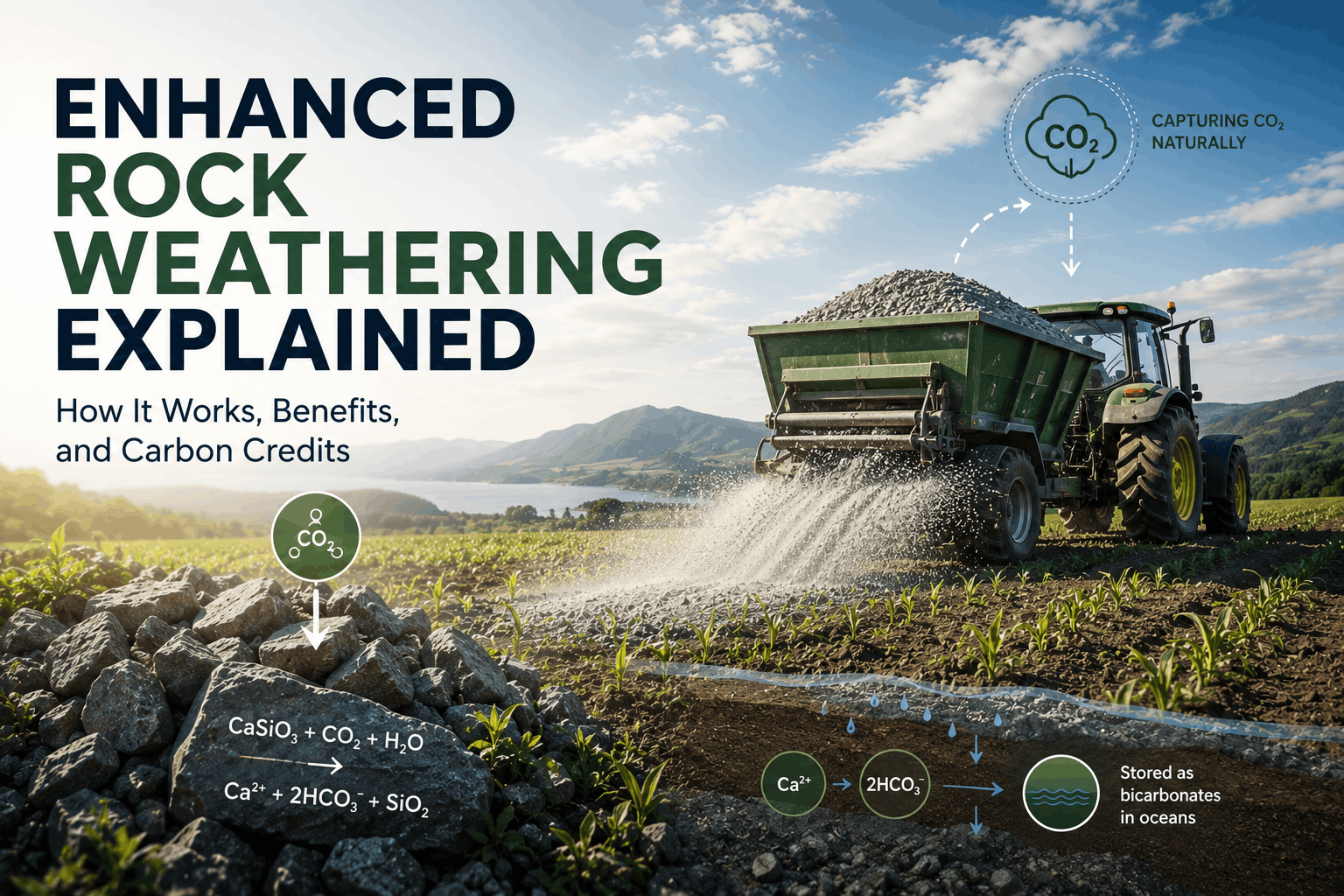
Imagine spreading crushed rock on a farm field and, in doing so, pulling carbon dioxide right out of the atmosphere. It sounds almost too simple. But enhanced rock weathering is doing exactly that, and scientists, farmers, and climate investors around the world are taking serious notice.
Enhanced rock weathering (ERW) is one of the most talked-about carbon dioxide removal (CDR) technologies today. It is natural, it is scalable, and it comes with farming benefits that farmers actually want. Whether you are new to carbon markets, a climate-curious reader, or someone exploring carbon credit opportunities, this guide breaks everything down in plain language.
What Is Enhanced Rock Weathering?
Enhanced rock weathering is a process that speeds up the Earth’s natural rock weathering cycle to capture and store carbon dioxide from the atmosphere.
In nature, rain absorbs carbon dioxide from the air and forms a weak acid called carbonic acid. This acid slowly breaks down silicate rocks over thousands of years, converting CO2 into stable bicarbonate ions that eventually wash into rivers and oceans, where the carbon stays locked away for tens of thousands of years.
Enhanced rock weathering takes this same natural process and dramatically accelerates it.
Instead of waiting thousands of years, ERW crushes silicate rocks into fine powder, massively increasing their surface area, and spreads that powder on agricultural land. The increased surface area means the rock reacts with CO2 much faster, pulling it out of the atmosphere in years rather than millennia.
The result is the same: CO2 gets converted into stable bicarbonate and stored safely, mostly in the ocean, for over 100,000 years.
Carbon Market Insider Newsletter
Weekly insights on carbon markets, climate policy, carbon credits, and sustainability.
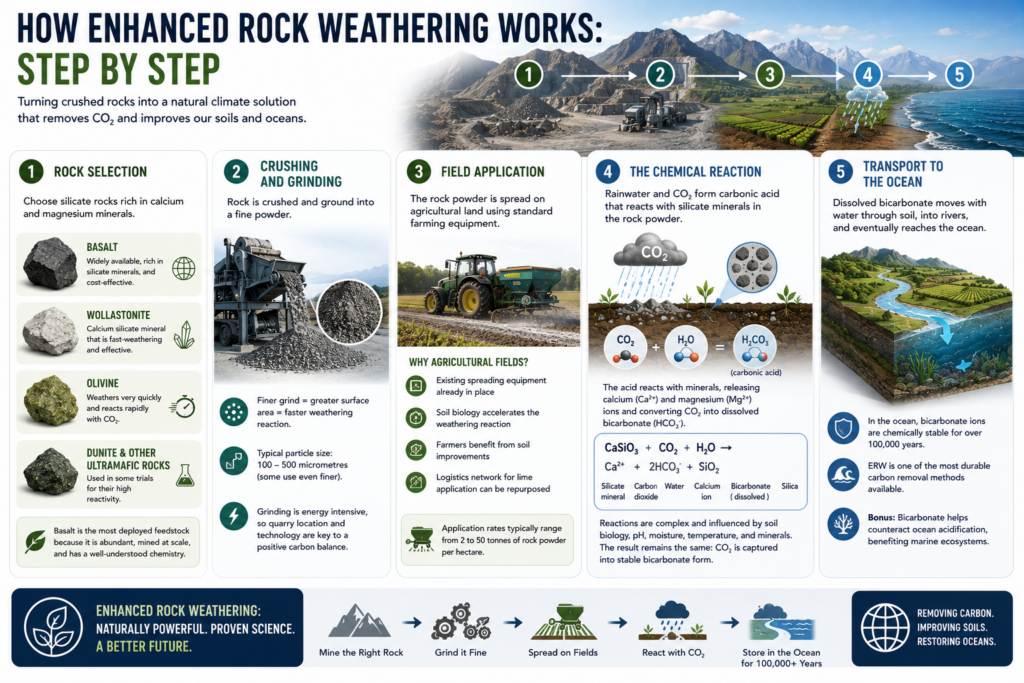
How Enhanced Rock Weathering Works: Step by Step
Understanding the ERW process is easier when you follow it from the quarry to the ocean.
Step 1: Rock Selection
Not every rock works for enhanced rock weathering. The best feedstocks are silicate rocks, especially those rich in calcium and magnesium minerals.
The most commonly used rocks include:
- Basalt: widely available, rich in silicate minerals, and relatively inexpensive
- Wollastonite: a calcium silicate mineral that is fast-weathering and effective
- Olivine: weathers very quickly and reacts rapidly with CO2
- Dunite and other ultramafic rocks: used in some trials for their high reactivity
Basalt is by far the most deployed feedstock because it is abundant globally, mined at scale, and has a well-understood chemical profile.
Step 2: Crushing and Grinding
The rock gets crushed and ground into a fine powder. This step is critical.
The finer the grind, the greater the surface area, and the faster the weathering reaction happens. A typical ERW deployment uses rock powder ground to a particle size of around 100 to 500 micrometres, though some projects use even finer material.
Grinding is also one of the main energy costs in ERW, which is why the choice of rock quarry location and grinding technology matters a lot for the overall carbon balance of a project.
Step 3: Field Application
The rock powder gets spread on agricultural land, typically cropland, using standard farming equipment like the lime spreaders that farmers already use.
Agricultural fields are the preferred application site for several reasons:
- They already have spreading equipment in place
- Soil biology accelerates the weathering reaction
- Farmers benefit from soil improvements (more on this below)
- The logistics network for lime application can be repurposed
Application rates typically range from 2 to 50 tonnes of rock powder per hectare, depending on the project, rock type, and target carbon removal amount.
Step 4: The Chemical Reaction
Once the rock powder is on the field, the process becomes chemistry.
Rainwater mixes with CO2 in the air to form carbonic acid. This mild acid reacts with the silicate minerals in the rock powder. The reaction releases calcium and magnesium ions and converts CO2 into dissolved bicarbonate (HCO3-).
The simplified chemistry looks like this:
CaSiO3 (silicate mineral) + CO2 + H2O → Ca2+ + 2HCO3- + SiO2
Calcium silicate reacts with carbon dioxide and water to produce dissolved calcium, bicarbonate, and silica.
In practice, the reactions are more complex and depend on soil biology, pH, moisture, temperature, and the specific minerals present. But the end result is the same: CO2 gets captured into stable bicarbonate form.
Step 5: Transport to the Ocean
The dissolved bicarbonate moves through the soil with water, drains into streams and rivers, and eventually reaches the ocean.
In the ocean, the bicarbonate ions are chemically stable for extremely long timeframes. Researchers estimate that the carbon stored this way remains in the ocean for over 100,000 years, making ERW one of the most durable carbon removal methods available.
As a bonus, the bicarbonate actually helps counteract ocean acidification, meaning ERW delivers a secondary benefit to marine ecosystems.
What Rocks Are Best for Enhanced Rock Weathering?
The choice of rock feedstock significantly affects how much CO2 gets removed, how fast, and at what cost.
| Rock Type | Weathering Speed | CO2 Removal Potential | Key Advantage |
|---|---|---|---|
| Basalt | Medium-Fast | High | Abundant and widely available |
| Olivine | Fast | High | Very reactive, quick CO2 capture |
| Wollastonite | Fast | High | Low energy to grind, fast reaction |
| Dunite | Medium | Medium-High | Magnesium-rich, strong alkalinity |
| Steel Slag | Fast | Medium | Industrial byproduct, low cost |
Basalt remains the front-runner for large-scale deployment because of its combination of cost, availability, and performance. Olivine is faster-weathering but raises some environmental questions around nickel content in certain geological sources. Wollastonite performs very well but is less globally abundant. Steel slag (an industrial byproduct) is a promising low-cost alternative being actively researched.
The Climate Case for Enhanced Rock Weathering
How Much CO2 Can ERW Remove?
The numbers are genuinely significant. Research published in Communications Sustainability projects that ERW could remove between 0.35 and 0.76 gigatons of CO2 per year by 2050, rising to between 0.7 and 1.1 gigatons per year by 2100, under optimistic adoption scenarios.
Other peer-reviewed estimates put the upper ceiling for global ERW deployment at 2 gigatons of CO2 per year, equivalent to roughly 5% of current global fossil fuel emissions.
A gigaton is one billion tonnes. To put that in perspective, the entire global aviation industry emits roughly 0.9 gigatons of CO2 per year. ERW’s potential ceiling is larger than that.
Why ERW Storage Is Durable
One of the biggest questions about carbon removal is: how long does the carbon stay stored?
With tree planting, carbon can be released in decades through deforestation, disease, or wildfire. With ERW, the carbon converts into dissolved bicarbonate ions that flow into the ocean and remain stable for over 100,000 years.
This is what makes ERW a “durable” carbon removal pathway. It does not depend on ongoing land management to keep the carbon locked away. Once the weathering reaction completes, the carbon is effectively gone from the atmosphere for geological timescales.
ERW and the Carbon Budget
The Paris Agreement target of limiting global warming to 1.5°C requires both rapid emissions cuts and large-scale carbon removal. Modelling from the Open University found that global ERW deployment at 2 gigatons of CO2 per year approximately doubles the probability of meeting the 1.5°C target.
ERW alone will not solve climate change. No single technology will. But as part of a portfolio of carbon removal methods, it plays a meaningful and scalable role.
The Agricultural Co-Benefits of Enhanced Rock Weathering
Here is where ERW gets especially interesting. Most carbon removal technologies offer no benefits to landowners. ERW is different.
When silicate rock weathers in agricultural soil, it releases nutrients that crops actually need.
Soil pH Improvement
Many agricultural soils, especially in humid regions, tend to become acidic over time due to nutrient leaching and farming practices. Acidic soils hurt crop yields and require regular lime applications.
ERW raises soil pH naturally as the silicate minerals dissolve. In many cases, crushed basalt can substitute for or supplement traditional agricultural lime, reducing farmers’ input costs.
Nutrient Release
As silicate rocks weather, they release:
- Calcium: essential for cell wall structure in plants
- Magnesium: critical for chlorophyll production and photosynthesis
- Potassium: key for water regulation and overall plant health
- Silicon: improves plant resilience to pests, diseases, and drought
- Micronutrients: iron, manganese, zinc, and others that support enzymatic activity
Research published in PLOS ONE, co-authored by scientists at UNDO and Newcastle University, found that basalt amendment led to higher nutrient concentrations in crops including tissue calcium, grain and tissue potassium, and indications of improved crop yield, even during an unusually dry growing season.
Crop Yield Improvements
A synthesis of peer-reviewed papers found significant yield increases in 19 out of 34 studies examining silicate rock soil amendments. The effects tend to be strongest on highly weathered, acidic soils in tropical regions, but temperate soils also show benefits, particularly in nutrient-poor conditions.
Higher yields from the same land area means less pressure to convert forests or natural habitats to farmland, which has its own knock-on benefits for biodiversity and carbon storage.
Reduced Nitrogen Leaching
Research has shown that basalt amendment can reduce nitrogen leaching from soils. Nitrogen leaching causes environmental problems in waterways (eutrophication and algal blooms) and represents a direct economic loss for farmers who pay for nitrogen fertilizers. Less leaching means cleaner water and better fertilizer efficiency.
Soil Free of Charge
Companies like UNDO supply and spread silicate rock to farmers free of charge, because the carbon credit revenue funds the operation. For farmers, this means real agronomic benefits at zero cost, which is an unusual proposition in agriculture.
Enhanced Rock Weathering and Carbon Credits
ERW has found a home in the voluntary carbon market, with companies developing and selling verified carbon removal credits to corporate buyers.
How ERW Carbon Credits Work
An ERW project developer spreads crushed rock on farmland, measures how much CO2 gets removed through a rigorous scientific monitoring process, and then issues verified carbon removal credits based on the confirmed amount of CO2 captured.
These credits can then be purchased by companies seeking to offset their emissions, fund carbon removal, or contribute toward net-zero targets.
Key Registries and Standards
Two registries dominate the ERW carbon credit market for verified, high-integrity credits:
- Puro.earth: has an established ERW methodology and was among the first to issue ERW credits at commercial scale
- Isometric: known for its scientific rigour, requiring detailed measurement protocols and conservative accounting
Both registries require third-party verification and conservative crediting, meaning they intentionally issue fewer credits than the central removal estimate suggests, to account for natural variability and measurement uncertainty.
Leading ERW Companies
Several companies have moved from field trials to commercial carbon credit operations:
UNDO spreads crushed basalt and other silicate rocks on agricultural land in Canada, the UK, and elsewhere. UNDO became one of four global winners of the $100 million XPRIZE Carbon Removal competition. The company has enriched over 54,000 acres of farmland and removed roughly 69,000 tonnes of CO2. UNDO has a longstanding partnership with Microsoft, including multiple ERW carbon removal agreements.
Eion deploys olivine on farmland across the US and internationally. Eion uses a patented soil fingerprinting method to directly measure carbon removal and was the first ERW company to deliver verified credits to Stripe. Frontier, the carbon buying consortium backed by Stripe, Alphabet, Shopify, Meta, and McKinsey, signed $33 million in offtake agreements with Eion to remove 78,707 tonnes of CO2 across a multi-year delivery schedule.
Lithos Carbon uses novel soil models and machine learning to maximise CO2 removal on agricultural fields. Lithos became the largest ERW developer by issued credits, issuing a landmark 5,160 registry-certified tonnes, marking the largest single ERW delivery on record at that point. Lithos has since partnered with Climeworks to bring verified ERW credits to market.
ZeroEx operates in Germany and Brazil, uses self-integrating accumulators (SIAs) for precise field measurement, and sources rock powder from mining by-products. ZeroEx’s Project Earthstone in Brazil, a collaboration with Anglo American, targets removal of up to 15 million tonnes of CO2. The project is verified under both Puro.earth and Isometric standards.
InPlanet is the leading ERW developer in South America, working with farmers in Brazil and signed a pre-purchase agreement with Frontier on behalf of Stripe and Shopify.
What Corporate Buyers Are Purchasing ERW Credits
The buyer side of the ERW market includes some of the world’s largest technology companies, which have made large advance purchase commitments to help fund the early scaling of the sector:
| Company | ERW Partners | Notes |
|---|---|---|
| Microsoft | UNDO, Lithos, Eion | Multiple agreements including debt-financed structures |
| Stripe | Eion, InPlanet | Early adopter through Frontier consortium |
| Shopify | Eion, InPlanet | Part of Frontier buying group |
| Alphabet (Google) | Frontier consortium | ERW among portfolio of CDR methods |
| Meta | Frontier consortium | Part of $33M Frontier/Eion deal |
The Challenges Facing Enhanced Rock Weathering
ERW is genuinely promising, but honest coverage requires acknowledging the real challenges the sector faces.
1. Measuring Carbon Removal Is Hard and Expensive
The biggest challenge in ERW is MRV: measuring, reporting, and verifying the amount of CO2 actually removed.
Unlike direct air capture, where you can measure CO2 captured at the machine, ERW happens across vast agricultural fields, through soil, waterways, and eventually the ocean. Tracking how much carbon was removed requires complex geochemical sampling and analysis.
Current MRV costs can reach up to $275 per tonne of CO2 removed, which is a significant portion of total project costs. At those MRV costs, ERW struggles to compete economically.
Researchers are actively developing cheaper proxy methods. These include:
- Low-cost water sensors measuring alkalinity and electrical conductivity in field drainage
- Soil pore water analysis using centrifugation-based extraction methods
- Trace element fingerprinting in soil to track the weathering signal
- Machine learning models combining soil sampling with predictive modelling
- Drone and satellite tools to understand in-field variability at lower cost
Progress is being made. Studies show that sensor-based proxies could significantly reduce MRV costs, though they require site-specific calibration to remain reliable.
2. Supply Chain and Logistics
Getting rock from a quarry to a farm field involves mining, grinding, transporting, and spreading. Each of those steps has an associated carbon cost.
A recent UK study found that expanding individual quarries to up to 20 times their current average size, and prioritising supply timing and location, could increase carbon removal efficiency by 20%, cut transport demand by 60%, and reduce the number of operating quarries fourfold.
Proximity to rock sources matters enormously. Projects that limit trucking distances to 100 kilometres or less dramatically improve the net carbon balance. At greater distances, transport emissions can eat into the carbon removal benefit.
3. Heavy Metal Concerns
Some silicate rocks contain trace amounts of heavy metals like nickel, chromium, and cobalt. When rock weathers, these metals can be released into the soil.
Research to date suggests that for most approved feedstocks under normal soil conditions, heavy metal concentrations remain within acceptable limits and are often incorporated into newly formed secondary minerals rather than becoming plant-available. However, this remains an area of active monitoring.
Best practice in the sector requires:
- Rock feedstock testing before deployment
- Ongoing soil monitoring during and after application
- Selecting rock sources with low heavy metal profiles
No peer-reviewed field trial to date has found harmful heavy metal accumulation in crops grown on basalt-amended fields, but continued long-term monitoring is important.
4. Soil Carbon Interactions
ERW increases soil pH, which can affect soil organic carbon dynamics. Research shows that rising pH can stimulate microbial activity, potentially accelerating the decomposition of existing soil organic matter.
Some studies suggest that ERW’s inorganic carbon removal benefit could be partially offset by losses in soil organic carbon, though this varies significantly by soil type, climate, and rock type. This area of research is evolving rapidly.
5. Cost at Scale
Current ERW credits typically trade at premium prices in the voluntary carbon market, reflecting the genuine costs of rigorous MRV and supply chain management. Long-term, industry analysts estimate that ERW could reach $100 to $150 per tonne of CO2 removed as the sector scales, MRV costs fall, and logistics networks optimise.
Getting to that price point requires:
- Limiting transport distances
- Reducing MRV costs through better proxy methods
- Optimising application rates and timing
- Using rock dust from mining byproducts to cut raw material costs
Enhanced Rock Weathering vs Other Carbon Removal Methods
How does ERW compare to other ways of removing CO2 from the atmosphere?
| Method | Durability | Co-benefits | Cost Range | Scalability |
|---|---|---|---|---|
| Enhanced Rock Weathering | 100,000+ years | Soil health, crop yield | $100-300/tonne | High (gigatons) |
| Direct Air Capture | Permanent | None | $300-1000+/tonne | Medium |
| Reforestation / Afforestation | Decades | Biodiversity | $5-50/tonne | High (but land-constrained) |
| Biochar | 100-1000 years | Soil health | $50-200/tonne | Medium |
| Ocean Alkalinity Enhancement | 10,000+ years | Ocean deacidification | $50-200/tonne | High |
| BECCS | Variable | None directly | $100-300/tonne | Medium |
ERW sits in a strong position among these options. It combines genuine durability with tangible agricultural co-benefits, has a credible pathway to gigaton scale, and operates at costs that could become competitive over time.
It is not a replacement for emissions cuts. But as a complement to decarbonisation, ERW is one of the most attractive carbon removal methods available.
Where Does Enhanced Rock Weathering Work Best?
ERW is not equally effective everywhere. Geography and climate matter a great deal.
Warm, humid tropical regions are ideal. Higher temperatures and greater rainfall accelerate weathering rates, meaning more CO2 gets captured per tonne of rock applied. Countries in sub-Saharan Africa, Southeast Asia, Brazil, and South and Central America have particularly favorable conditions.
Research published in Communications Sustainability found that while high-income countries lead in early deployment, countries like Brazil and India are projected to overtake them by mid-century, driven by accelerated uptake and favorable biophysical conditions.
Temperate agricultural regions like the UK, Germany, parts of the US Midwest, and Canada are also viable, though weathering rates are slower. These regions benefit from strong existing farming infrastructure and proximity to industrial rock quarries.
Key factors for effective ERW deployment:
- High mean annual temperature
- High rainfall (or adequate irrigation)
- Acidic or neutral soils (rather than strongly alkaline)
- Strong agricultural infrastructure for spreading and logistics
- Proximity to suitable rock quarries
How Farmers Get Involved in Enhanced Rock Weathering
For farmers, ERW offers something rare: a way to participate in carbon markets while also improving their land.
Most ERW project developers recruit farmers through partnerships with agricultural cooperatives or direct outreach. The typical model works like this:
- The ERW company sources and grinds the rock at a quarry.
- The company arranges delivery to the farm.
- The farmer applies the rock powder using existing equipment, or the company’s contractors spread it.
- The company handles all the MRV: soil sampling, analysis, and verification.
- The company sells the resulting carbon credits and may share revenue with the farmer, or simply provides the soil amendment free of charge.
This makes ERW relatively low-burden for farmers. They do not need to navigate carbon markets themselves. They receive better soil and often better yields. The carbon credit revenue funds the whole operation.
The Role of Policy in Scaling Enhanced Rock Weathering
The ERW sector’s leaders are consistent on one point: voluntary carbon markets have kickstarted the industry, but compliance markets will scale it.
UNDO CEO Jim Mann put it clearly: “While stronger standards, lower costs, more field data, and larger buyers all have their part to play, policy remains the critical unlock. Compliance carbon markets, not voluntary, will ultimately drive scale, unlock supply constraints, and move the entire industry forward.”
Several policy developments are shaping the ERW landscape:
- Carbon farming frameworks in the EU and other jurisdictions are beginning to include inorganic carbon removal pathways
- Government R&D funding has increased in the UK, US, and Europe to accelerate field trials and MRV tool development
- Carbon border adjustment mechanisms are creating incentives for industrial decarbonisation that could include CDR purchasing requirements
- The XPRIZE Carbon Removal competition awarded $100 million across four winners, including UNDO, helping validate and fund ERW commercialisation
The Enhanced Weathering Alliance, an initiative of the Carbon Business Council, maintains an active global map of ERW initiatives, reflecting a sector gaining genuine traction across multiple continents.
The Science Is Still Evolving
It is worth being honest about where the scientific consensus on ERW stands.
The core chemistry of rock weathering is well-understood and not in dispute. What remains actively debated and researched includes:
- The actual in-field carbon removal rates under varying conditions and at large scale
- How much bicarbonate successfully reaches the ocean versus what gets lost in transit
- The net effect on soil organic carbon when ERW raises soil pH
- Long-term heavy metal accumulation under sustained application
- How variability across fields and seasons affects credit accounting
A recent years PNAS study raised questions about whether ERW’s carbon removal benefit has been overstated in some scenarios, noting that MRV costs and the complexity of in-field measurement create real challenges for scaling ERW primarily through carbon markets.
A separate body of research continues to find positive results. Field trials in the US, UK, Australia, and Brazil have demonstrated measurable carbon removal. The number of peer-reviewed publications on ERW is growing exponentially.
The honest picture is that ERW is a scientifically credible and promising CDR method that is still building its evidence base at scale. The early commercial credits being issued today are intentionally conservative, reflecting genuine scientific care rather than inflated claims.
Enhanced Rock Weathering and Ocean Health
The connection between ERW and ocean health is an underappreciated dimension of this technology.
As the bicarbonate produced by ERW flows into the ocean, it contributes to ocean alkalinity. This is beneficial because ocean acidification, caused by the ocean absorbing excess CO2 from the atmosphere, is a serious threat to coral reefs, shellfish, and marine ecosystems broadly.
By adding alkalinity, ERW can help counteract ocean acidification at local and potentially regional scales. Marine organisms that build shells from calcium carbonate, including oysters, mussels, and corals, benefit from higher alkalinity conditions.
This dual benefit, carbon removal plus ocean deacidification, makes ERW one of the few CDR methods that delivers benefits in multiple Earth system domains simultaneously.
FAQs About Enhanced Rock Weathering
What is the difference between natural rock weathering and enhanced rock weathering?
Natural rock weathering is the same process but happens over thousands to millions of years. Enhanced rock weathering accelerates it by crushing rocks into fine powder, increasing the surface area available for chemical reactions, and applying the powder to agricultural land where warm temperatures, moisture, and soil biology speed the process up further.
How permanent is the carbon storage in ERW?
Very permanent. The CO2 captured through ERW converts into dissolved bicarbonate ions that reach the ocean and remain stable for over 100,000 years. This makes ERW one of the most durable carbon removal methods available, far more so than tree planting.
Can enhanced rock weathering harm farmers’ fields?
When using properly tested feedstocks and appropriate application rates, field trials to date have not found harmful effects on crops or soils. Some silicate rocks contain trace heavy metals, which is why reputable ERW projects test their rock sources thoroughly and monitor soil health during and after application. No peer-reviewed study has found harmful heavy metal accumulation in crops from basalt-amended fields.
How is carbon removal from ERW measured?
MRV (measurement, reporting, and verification) for ERW involves geochemical sampling of soil pore water, drainage water, and soil solids to track the weathering signal and bicarbonate export. Methods include trace element fingerprinting, alkalinity measurements, and machine learning models. This is currently expensive but improving rapidly as the sector develops cheaper sensor-based approaches.
Is enhanced rock weathering better than planting trees for carbon removal?
They serve different purposes and have different strengths. Tree planting is low cost and provides biodiversity benefits, but stores carbon for only decades and faces risks from fire, disease, and deforestation. ERW stores carbon for over 100,000 years and delivers agricultural co-benefits, but currently costs more. A balanced carbon removal portfolio includes both.
Who buys ERW carbon credits?
Major technology companies including Microsoft, Google (Alphabet), Stripe, Shopify, and Meta have purchased or pre-purchased ERW carbon removal credits through direct agreements and through buying consortiums like Frontier. These early buyers fund the scale-up of the technology.
How does enhanced rock weathering affect soil pH?
ERW raises soil pH by neutralising acidity as the silicate minerals dissolve. For acidic agricultural soils, this is beneficial and can substitute for or supplement traditional lime applications. For already-alkaline soils, ERW is less appropriate and could potentially cause issues, which is why reputable project developers conduct soil assessments before deployment.
What is the cost of ERW carbon credits?
ERW credits currently trade at premium prices reflecting the genuine costs of rigorous MRV and supply chain management. Industry analysts project that at scale, ERW could reach $100 to $150 per tonne of CO2 removed, which would make it competitive among high-durability carbon removal methods.
Conclusion: Why Enhanced Rock Weathering Deserves Serious Attention
Enhanced rock weathering is not a magic bullet. No single technology is. But it is one of the most compelling carbon removal pathways available today, combining genuine scientific credibility, permanent CO2 storage, and real agricultural benefits into a single deployable approach.
The core chemistry is solid. The co-benefits for farmers are real and measurable. The carbon credit market is already functioning, with major buyers and rigorous registries giving the sector credibility. And the research community is rapidly building the evidence base and MRV tools needed to validate and scale the technology.
The challenges are also real. MRV remains expensive. Supply chains need optimising. The scientific evidence at commercial scale is still accumulating. Policy support, especially from compliance markets, needs to catch up.
But enhanced rock weathering is on a trajectory from promising to proven. The companies building this sector, the scientists running field trials, and the farmers applying rock dust to their fields are laying the groundwork for a carbon removal method that could pull gigatons of CO2 from the atmosphere every year while making farming more productive.
For anyone interested in carbon markets, climate technology, or the future of food and farming, enhanced rock weathering is a space worth watching closely.
Explore more on carbon removal methods, carbon credits, and climate finance at carbonmarketnetwork.com.