Carbon Market Network


If you have been reading about climate policy in India and come across the term “CCTS,” you are not alone in wondering what it means.
Carbon markets are growing fast, and India is now at the centre of one of the most significant developments in this space. Understanding the CCTS full form is the first step to understanding how India is building its own carbon market.
This article breaks it all down in simple terms. No jargon, no confusion.
What Is the CCTS Full Form?
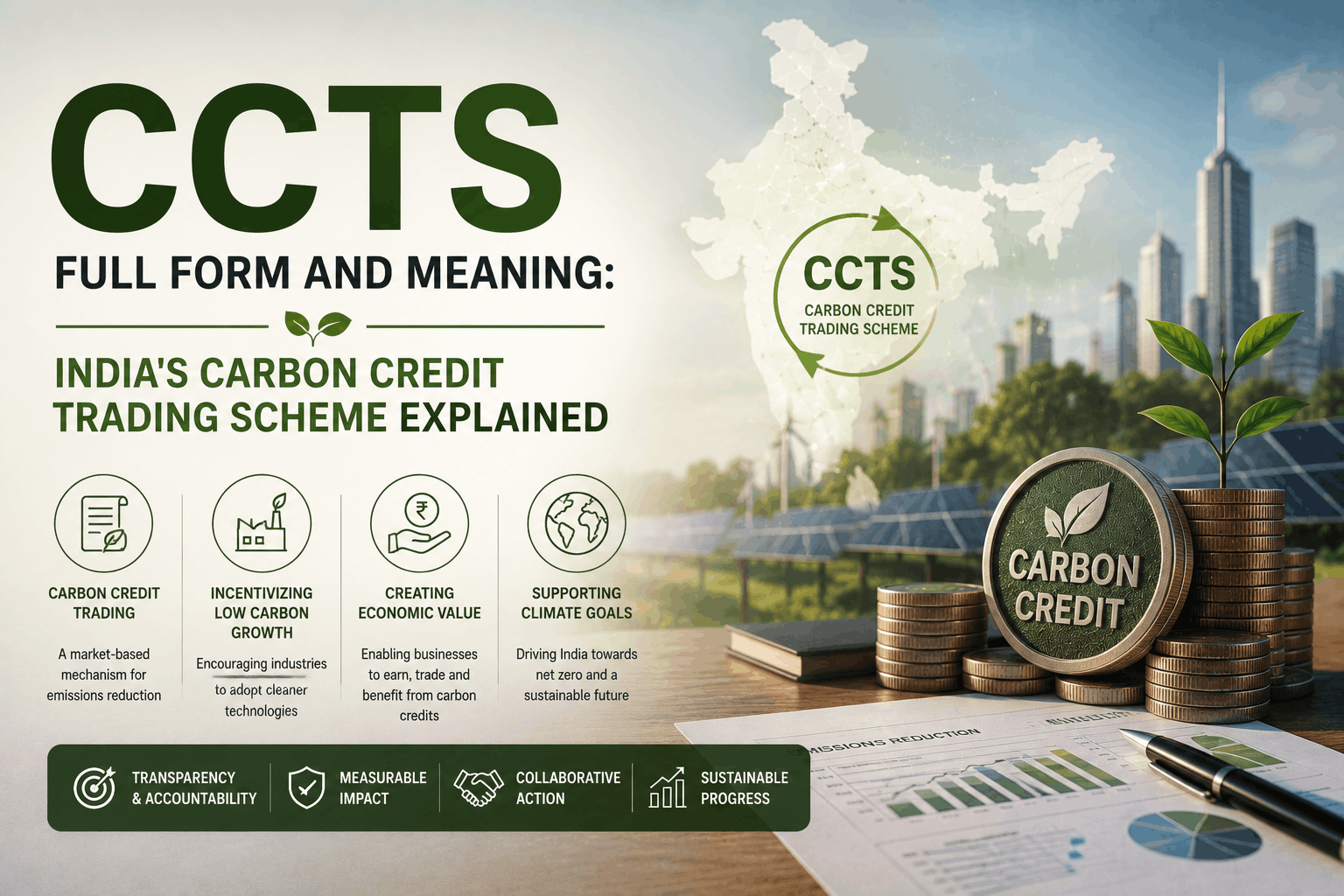
CCTS full form is Carbon Credit Trading Scheme.
The CCTS is India’s official, government-mandated scheme for trading carbon credits among industrial entities. It is the foundation of what is now known as the Indian Carbon Market (ICM).
The scheme was officially notified by the Central Government on 28 June 2023, under the Energy Conservation (Amendment) Act, 2022.
In simple words, the CCTS is India’s answer to the question: “How do we make industries reduce their carbon emissions while still growing the economy?”
The answer is a market mechanism. Industries that pollute less earn tradeable certificates. Industries that pollute more must buy those certificates. This creates a financial incentive to reduce emissions.
Carbon Market Insider Newsletter
Weekly insights on carbon markets, climate policy, carbon credits, and sustainability.
CCTS Meaning: Breaking It Down Word by Word
Let us understand what each word in the CCTS meaning actually stands for.
| Word | What It Means |
|---|---|
| Carbon | Carbon dioxide (CO2) and other greenhouse gases (GHGs) that cause climate change |
| Credit | A unit of measurement representing one tonne of CO2 equivalent (tCO2e) reduced or removed |
| Trading | The buying and selling of these credits on regulated exchanges |
| Scheme | A government-designed framework that sets the rules, timelines, and procedures |
So, when someone says “CCTS India full form,” they are referring to this structured, government-backed plan that allows Indian industries to trade pollution credits.
Why Was the CCTS Introduced in India?
India is one of the world’s largest emitters of greenhouse gases. At the same time, India has made ambitious climate commitments under the Paris Agreement, including reaching net zero by 2070 and reducing the emission intensity of its GDP by 45% by 2030 compared to 2005 levels.
The CCTS was introduced to help India reach these targets without hurting economic growth.
Here are the main reasons behind its introduction:
- Climate commitments: India needed a domestic tool to meet its Nationally Determined Contributions (NDCs) under the Paris Agreement.
- Economic efficiency: A market mechanism is cheaper than direct government mandates for achieving emission reductions.
- International pressure: The EU’s Carbon Border Adjustment Mechanism (CBAM), which became fully operational from 2026, puts tariffs on carbon-heavy imports. Indian exporters need to show decarbonisation to stay competitive.
- Transition from PAT: The Perform Achieve and Trade (PAT) Scheme, which focused on energy efficiency, needed to evolve into something more comprehensive. CCTS is that evolution.
The Legal Foundation of CCTS India
The CCTS did not appear out of nowhere. It has a strong legal backbone.
Step 1: The Energy Conservation Act, 2001
This was the original law governing energy efficiency in India. It created the Bureau of Energy Efficiency (BEE) and established frameworks like the PAT Scheme.
Step 2: The Energy Conservation (Amendment) Act, 2022
India’s Parliament amended the original Act in 2022. This amendment specifically empowered the Central Government to establish a carbon credit trading scheme. It created the legal authority for everything that followed.
Step 3: The Carbon Credit Trading Scheme, 2023
In June 2023, the Central Government exercised that authority and notified the CCTS. This gazette notification (G.S.R. 234(E)) is the founding document of India’s carbon market.
This three-step legal architecture gives the CCTS a solid foundation. It is not a pilot or an experiment. It is binding national law.
Who Runs the CCTS? Key Institutions You Need to Know
The CCTS is not run by a single body. It involves a chain of institutions, each with a specific role.
| Institution | Full Name | Role in CCTS |
|---|---|---|
| MoP | Ministry of Power | Selects sectors and notifies obligated entities |
| MoEFCC | Ministry of Environment, Forest and Climate Change | Notifies binding GHG emission intensity targets |
| BEE | Bureau of Energy Efficiency | Administrator of CCTS; sets procedures, approves methodologies, manages verification |
| GCI / Grid-India | Grid Controller of India | Operates the official registry where Carbon Credit Certificates (CCCs) are issued and tracked |
| CERC | Central Electricity Regulatory Commission | Regulates trading on power exchanges; notified the trading regulations in March 2026 |
| NSCICM | National Steering Committee for Indian Carbon Market | Provides policy direction and oversight |
These institutions work together to ensure the scheme functions correctly from rule-making all the way down to the actual exchange of certificates.
How Does the CCTS Work? A Step-by-Step Explanation
Now that you know what the CCTS full form is and who manages it, let us understand how it actually works in practice.
Step 1: Sectors and Entities Are Identified
The Ministry of Power, in consultation with BEE, identifies which industrial sectors and specific facilities must participate in the scheme. These are called obligated entities.
Step 2: Emission Intensity Targets Are Set
The MoEFCC notifies a specific Greenhouse Gas Emission Intensity (GEI) target for each obligated entity. This is not a cap on total emissions. Instead, it is a cap on emissions per unit of production (for example, tonnes of CO2 per tonne of cement produced).
The baseline for the current compliance cycle is FY 2023-24 data.
Step 3: Companies Measure and Report Emissions
Obligated entities must track their actual GHG emissions throughout the year. They follow a “Gate-to-Gate” boundary principle, covering both direct and indirect emissions. All data must be verified by a BEE-accredited third-party verification agency.
Step 4: Carbon Credit Certificates Are Issued
At the end of the compliance year, the results are calculated:
- If a company’s actual emission intensity falls below its target, it earns Carbon Credit Certificates (CCCs). One CCC = one tonne of CO2 equivalent reduced beyond the target.
- If a company’s actual emission intensity is above its target, it has a shortfall and must surrender CCCs equivalent to that shortfall.
Step 5: Trading Happens on Power Exchanges
Companies with surplus CCCs can sell them to companies with deficits. This trading happens on regulated power exchanges, not in informal over-the-counter (OTC) deals.
CCC trading is expected to go live around October 2026, once the first round of compliance filings (due by 31 July 2026) is assessed.
Step 6: Targets Get Tighter Over Time
The scheme does not stay static. BEE will notify progressively stricter targets through 2030, pushing industries to continuously decarbonise.
What Is a Carbon Credit Certificate (CCC)?
Since the CCTS revolves around CCCs, it is worth understanding exactly what they are.
A Carbon Credit Certificate (CCC) is the official trading instrument of India’s carbon market.
One CCC = one tonne of CO2 equivalent (tCO2e) reduced or removed beyond the notified target.
Key features of a CCC:
- Issued by: Grid Controller of India (Grid-India), through the official registry
- Traded on: Regulated power exchanges (no OTC trading allowed initially)
- Banking: Unlimited banking of CCCs is allowed. You can carry them forward to future compliance years.
- Borrowing: Not allowed. You cannot use future credits to cover current year shortfalls.
- Price: Expected to range between Rs. 250 to Rs. 1,500 per tonne initially, depending on sector-specific demand and supply dynamics.
Think of a CCC as a currency note, but instead of representing rupees, it represents one tonne of avoided carbon emissions.
Which Sectors Are Covered Under CCTS?
The CCTS currently covers nine major industrial sectors in India. These were selected based on their contribution to India’s industrial GHG emissions and because they already had data systems from the PAT Scheme.
| Sector | Sub-sectors Covered |
|---|---|
| Aluminium | Primary and secondary aluminium smelting (includes PFC emissions) |
| Cement | OPC and PPC clinker production and grinding |
| Chlor-Alkali | Chlorine and caustic soda production |
| Fertilizer | Urea, ammonia, and other nitrogen-based fertilizers |
| Iron and Steel | Integrated steel plants, sponge iron, and secondary steel |
| Pulp and Paper | Paper mills and pulp manufacturing units |
| Petrochemicals | Olefins, aromatics, and derivative chemicals |
| Petroleum Refining | Oil refining operations |
| Textiles | Composite units, spinning, fibre, and processing |
The first compliance cycle began from FY 2025-26 (April 2025), covering approximately 490 entities across these sectors. More sectors, including power generation, will be added in future phases.
Emission Intensity Targets for the First Compliance Cycle
The targets for the first two compliance years have already been notified. Here is a broad picture:
| Sector | Approximate GEI Reduction Target (FY 2025-26) |
|---|---|
| Cement | 0.85% to 7.6% (OPC and PPC units) |
| Aluminium | 1.9% to 7.06% |
| Pulp and Paper | Up to 7.5% over two years |
| Chlor-Alkali | 1.32% to 4.53% |
| Other Sectors | 2% to 8% depending on sub-sector |
Targets become stricter in FY 2026-27, increasing to 2% to 8% reductions from the FY 2023-24 baseline.
The Two Mechanisms Under CCTS
The CCTS India full form includes two distinct pathways. Understanding both is crucial.
1. The Compliance Mechanism (For Obligated Entities)
This is the mandatory, legally-binding part of the scheme.
Who it covers: Large industrial installations in the nine notified sectors that exceed specific production and energy consumption thresholds.
How it works: BEE notifies each obligated entity’s annual GHG emission intensity target. Entities that perform better than their target earn CCCs. Entities that miss their target must purchase CCCs to cover the shortfall.
What happens if you do not comply: Obligated entities that fail to surrender the required CCCs face penalties under the Energy Conservation Act.
Important note: Targets are set at the installation level, not the corporate level. A company with four cement plants has four separate compliance obligations.
2. The Offset Mechanism (For Non-Obligated Entities)
This is the voluntary, project-based part of the scheme.
Who it covers: Any entity that is NOT covered under the compliance mechanism. This includes NGOs, renewable energy developers, farmers, startups, waste management firms, and more.
How it works: Non-obligated entities can register a carbon reduction or removal project on the Indian Carbon Market (ICM) portal. Once the project is verified and approved, CCCs are issued for the emissions reduced or removed.
Registrations opened on: 1 January 2025 for project registrations. BEE formally opened registrations for non-obligated entities on 6 June 2025.
This mechanism is particularly exciting because it opens the carbon market to a much wider group of participants, including rural communities, MSMEs, and project developers.
Approved Offset Methodologies Under CCTS
BEE approved the first eight methodologies for the Offset Mechanism in March 2025. These methodologies define which project types qualify, how emissions are calculated, and how credits are issued.
| Methodology | Description |
|---|---|
| Grid-Connected Renewable Energy | Solar, wind, small hydro, and biomass power displacing grid electricity |
| Green Hydrogen Production | Hydrogen produced via electrolysis using renewable energy |
| Industrial Energy Efficiency | Fuel switching and efficiency improvements in manufacturing |
| Landfill Methane Recovery | Capturing methane from municipal solid waste landfills |
| Mangrove Afforestation and Reforestation | Planting mangroves on degraded coastlines |
| Offshore Wind | Wind energy generation at sea |
| Compressed Biogas (CBG) | Biomethane production from organic waste |
| Livestock and Manure Management | Reducing methane from agriculture |
Phase II of the Offset Mechanism will add more sectors including fugitive emissions, construction, solvent use, and Carbon Capture, Utilisation, and Storage (CCUS).
CCTS vs. PAT Scheme: What Changed?
Many people ask how CCTS differs from the PAT Scheme that existed before it. Here is a clear comparison.
| Feature | PAT Scheme | CCTS |
|---|---|---|
| Full Form | Perform Achieve and Trade | Carbon Credit Trading Scheme |
| Focus | Energy efficiency only | Greenhouse gas emissions (broader scope) |
| Trading Unit | Energy Savings Certificates (ESCerts) | Carbon Credit Certificates (CCCs) |
| Coverage | 13 sectors | 9 sectors currently, expanding |
| Measurement | Energy consumption intensity | GHG emission intensity |
| Gases Covered | Not applicable | CO2, methane, PFCs, and other GHGs |
| International Linkage | None | Designed with Paris Agreement Article 6 linkage in mind |
| Status | Being phased out for covered sectors | Replacing PAT from FY 2025-26 onwards |
The seven sectors that have already transitioned from PAT to CCTS are aluminium, cement, chlor-alkali, pulp and paper, petroleum refining, petrochemicals, and textiles. The transition began from FY 2026.
PAT experience gives companies a head start with data systems and exchange-based trading. But CCTS demands a higher level of complexity, including fuel-specific emissions factors, process emissions, and third-party GHG verification (not just energy audits).
CCTS and India’s International Commitments
The CCTS does not exist in isolation. It connects directly to India’s global climate commitments.
Paris Agreement and India’s NDCs
India committed under the Paris Agreement to reduce the emission intensity of its GDP by 45% by 2030 (compared to 2005 levels). The CCTS is one of the key tools to achieve this.
Article 6 of the Paris Agreement
Article 6 allows countries to trade emission reductions across borders, known as Internationally Transferred Mitigation Outcomes (ITMOs). India is actively exploring bilateral agreements under Article 6.2, most notably with Japan through the Joint Crediting Mechanism (JCM), signed in January 2022. Around 15 JCM projects are registered in India across renewable energy, waste management, and industrial efficiency.
The CCTS is designed with international carbon market linkage in mind, recognising that India’s emissions reduction potential is a significant opportunity in global carbon finance.
CBAM: The European Pressure Point
The EU’s Carbon Border Adjustment Mechanism (CBAM) imposes financial obligations on carbon-heavy goods imported into Europe. Indian exporters in sectors like steel, aluminium, and cement face this cost on their European sales.
If India’s CCTS results in a credible, verifiable domestic carbon price, Indian exporters may be able to offset some of their CBAM liability. This creates a strong commercial incentive for Indian industries to embrace the CCTS, beyond just regulatory compliance.
How Does CCTS Affect Indian Businesses?
The CCTS affects Indian businesses differently depending on their size and sector. Here is a breakdown.
For Large Obligated Industries
If your facility is on BEE’s notified list, the CCTS is a legal obligation. You must:
- Set up a monitoring, reporting, and verification (MRV) system for GHG emissions.
- Submit your Action Plan to BEE by April 2026.
- Get your FY 2025-26 emissions data third-party verified.
- Submit your Form A compliance filing by 31 July 2026.
- Buy or sell CCCs on the power exchange, expected from around October 2026.
Non-compliance means financial penalties under the Energy Conservation Act.
For Non-Obligated Businesses and Project Developers
If your business is not in the nine covered sectors, you have a different opportunity. You can register as a non-obligated entity and develop an offset project under one of the approved methodologies. This means you can generate CCCs and sell them to obligated entities who need to cover shortfalls.
This opens the carbon market to renewable energy companies, waste management firms, agri-entrepreneurs, NGOs working on mangrove restoration, and many more.
For Small Businesses and Farmers
The Offset Mechanism is particularly exciting for smaller players. Farmers who adopt sustainable agricultural practices, communities that restore coastal mangroves, or small biogas plant operators can all potentially earn CCCs. India’s Power Ministry has stated that the scheme is designed to empower MSMEs and farmers, not just large industry.
For Investors and Financial Institutions
CCCs will trade on India’s regulated power exchanges. As the market matures, it is expected to attract institutional investors, green bonds, and climate finance instruments. Early movers in this space are likely to benefit from lower-cost entry and higher liquidity in the long run.
Key Milestones in India’s CCTS Journey
Here is a timeline of the most important events in the development of India’s Carbon Credit Trading Scheme.
| Milestone | What Happened |
|---|---|
| 2001 | Energy Conservation Act passed; BEE established |
| 2012 | PAT Scheme launched under NMEEE |
| 2022 | Energy Conservation (Amendment) Act passed; CCTS legally authorised |
| June 2023 | CCTS officially notified (Gazette Notification G.S.R. 234(E)) |
| December 2023 | BEE publishes the official CCTS document |
| July 2024 | BEE publishes Detailed Procedure for Compliance Mechanism (Version 1.0) |
| January 2025 | ICM project registrations officially open |
| March 2025 | BEE releases Offset Mechanism procedure; 8 methodologies approved |
| October 2025 | First four sectors (aluminium, cement, chlor-alkali, pulp and paper) notified with targets |
| January 2026 | Remaining three sectors (petroleum refining, petrochemicals, textiles) notified with targets |
| March 2026 | CERC notifies trading regulations for CCC buying and selling on power exchanges |
| April 2026 | India’s Carbon Market Portal launched at Prakriti 2026 |
| July 2026 | MRV reporting deadline for FY 2025-26 compliance filings |
| October 2026 | CCC trading expected to begin on power exchanges |
The Indian Carbon Market Portal: Your Gateway to CCTS
India’s Carbon Market Portal was officially launched at Prakriti 2026, an international conference on carbon markets held in New Delhi. This portal is the operational hub for the CCTS.
Through the portal, obligated entities can:
- Register and access their compliance account
- Submit MRV data
- View their CCC holdings
Non-obligated entities and project developers can:
- Register offset projects
- Submit Project Design Documents (PDDs)
- Track credit issuance
The portal is run by Grid-India (Grid Controller of India) and serves as the single source of truth for all carbon credit transactions in the Indian Carbon Market.
Other Full Forms of CCTS: Is There Any Confusion?
The abbreviation CCTS is sometimes used in other contexts. Here is a quick clarification so you are never confused.
| CCTS Full Form | Context |
|---|---|
| Carbon Credit Trading Scheme | India’s official carbon market scheme (this article) |
| Certificate of Competency for Teaching Skills | Education and training sector |
| Cargo Community Tracking System | Logistics and freight |
| Community College Technology Systems | Education administration |
When you see CCTS in the context of Indian climate policy, business compliance, or sustainability, it always refers to the Carbon Credit Trading Scheme. The CCTS meaning in India’s environmental and business context is unmistakable.
Why the CCTS Matters for India’s Climate Future
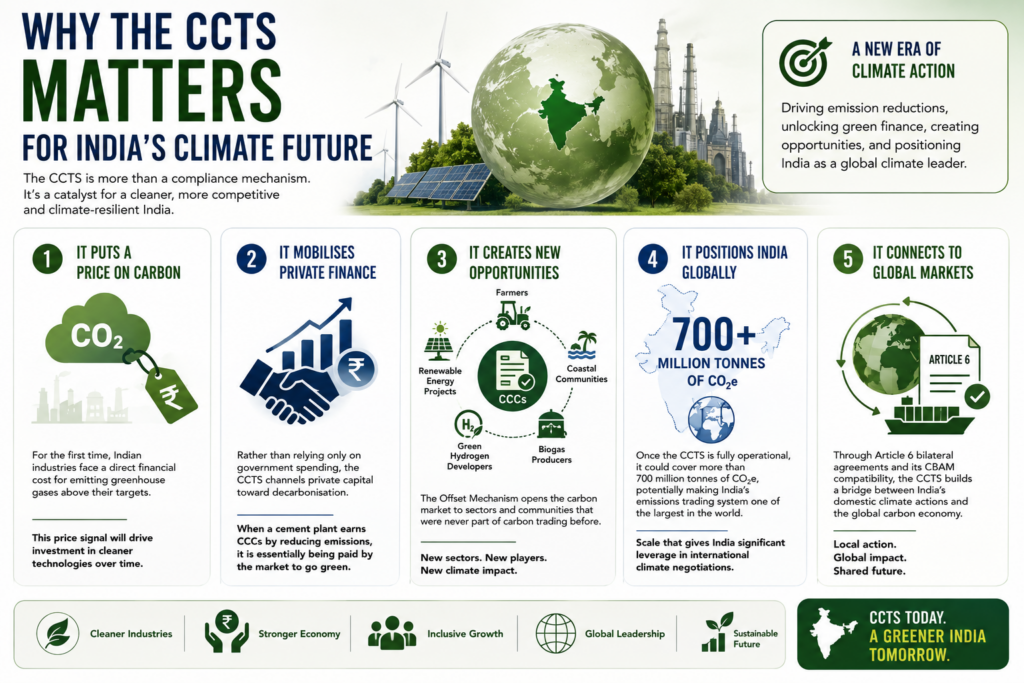
The CCTS is more than just a compliance mechanism for large factories. It represents a fundamental shift in how India approaches climate action.
It puts a price on carbon. For the first time, Indian industries face a direct financial cost for emitting greenhouse gases above their targets. This price signal will drive investment in cleaner technologies over time.
It mobilises private finance. Rather than relying only on government spending, the CCTS channels private capital toward decarbonisation. When a cement plant earns CCCs by reducing emissions, it is essentially being paid by the market to go green.
It creates new opportunities. The Offset Mechanism opens the carbon market to sectors and communities that were never part of carbon trading before. Farmers, coastal communities, green hydrogen developers, and biogas producers all have pathways to earn carbon revenue.
It positions India globally. Once the CCTS is fully operational, it could cover more than 700 million tonnes of CO2 equivalent, potentially making India’s emissions trading system one of the largest in the world. This scale gives India significant leverage in international climate negotiations.
It connects to global markets. Through Article 6 bilateral agreements and its CBAM compatibility, the CCTS builds a bridge between India’s domestic climate actions and the global carbon economy.
Common Misconceptions About CCTS
Let us clear up a few things that often cause confusion.
Misconception 1: CCTS is a carbon tax.
Wrong. A carbon tax directly charges industries per tonne of emissions. CCTS does not charge a fixed fee. Instead, it sets emission intensity targets and allows market prices to determine the cost of non-compliance through CCC trading.
Misconception 2: CCTS means companies cannot grow.
Wrong. CCTS targets are set as emission intensity per unit of output, not total emissions. A steel plant can produce more steel as long as it improves its efficiency per tonne. Growth is allowed; inefficiency is not.
Misconception 3: Only large companies are affected.
Partly wrong. The compliance mechanism covers large obligated entities. But the offset mechanism opens the door to anyone, including small farmers, NGOs, and startups, to participate and earn carbon revenue.
Misconception 4: CCCs can be traded informally.
Wrong. All CCC trading must happen on BEE-designated, CERC-regulated power exchanges. Over-the-counter (OTC) trading is barred, ensuring price transparency and market integrity.
FAQ: CCTS Full Form and Meaning
Q1. What is the CCTS full form?
CCTS stands for Carbon Credit Trading Scheme. It is India’s official government-mandated scheme for trading greenhouse gas emission credits among industrial entities, notified in June 2023.
Q2. What is the CCTS meaning in India?
In India, CCTS refers to the Carbon Credit Trading Scheme, which is the country’s primary compliance carbon market. It sets GHG emission intensity targets for large industries and allows them to trade Carbon Credit Certificates (CCCs) based on their performance against those targets.
Q3. What is CCTS India full form in the context of carbon markets?
CCTS India full form is Carbon Credit Trading Scheme. It is the scheme established under the Energy Conservation (Amendment) Act, 2022 to create India’s domestic carbon trading market, known as the Indian Carbon Market (ICM).
Q4. Who is responsible for administering CCTS?
The Bureau of Energy Efficiency (BEE), under the Ministry of Power, is the main administrator of CCTS. Grid-India operates the registry, and CERC regulates the trading on power exchanges.
Q5. What is a Carbon Credit Certificate (CCC)?
A CCC is the official trading instrument under CCTS. One CCC represents one tonne of CO2 equivalent reduced or removed beyond the notified emission intensity target. CCCs are issued by Grid-India and traded on regulated power exchanges.
Q6. When did CCTS become operational?
The first compliance period began in April 2025 (FY 2025-26). Project registrations for the offset mechanism opened in January 2025. CCC trading on power exchanges is expected to begin around October 2026.
Q7. Which sectors are covered under CCTS?
Nine sectors are currently covered: aluminium, cement, chlor-alkali, fertilizer, iron and steel, pulp and paper, petrochemicals, petroleum refining, and textiles. More sectors will be added in future phases.
Q8. Can small businesses or farmers participate in CCTS?
Yes, through the Offset Mechanism. Non-obligated entities including farmers, NGOs, renewable energy developers, and startups can register offset projects on the ICM portal and earn CCCs based on approved methodologies.
Q9. How is CCTS different from the PAT Scheme?
The PAT Scheme focused on energy efficiency and issued Energy Savings Certificates (ESCerts). CCTS is broader, covers GHG emissions (not just energy use), issues Carbon Credit Certificates (CCCs), and is designed with international carbon market linkage in mind. CCTS is replacing PAT for covered sectors from FY 2026 onwards.
Q10. What happens if an obligated entity does not comply with CCTS?
Obligated entities that fail to surrender the required CCCs face financial penalties under the Energy Conservation Act, 2001. Compliance is legally binding, not voluntary.
Conclusion: CCTS Is India’s Carbon Market in Action
The CCTS full form, Carbon Credit Trading Scheme, is more than just an acronym. It represents India’s most serious effort to build a functioning, scalable, and internationally credible carbon market.
For large industries, it is a compliance mandate that demands action. For entrepreneurs and project developers, it is an opportunity to generate carbon revenue through verified emission reductions. For India as a nation, it is a strategic tool to meet climate goals, protect export competitiveness, and position the country as a global carbon market leader.
The CCTS meaning goes beyond any definition. It is the infrastructure through which India plans to decarbonise its economy while staying economically competitive.
Whether you are a factory manager, a sustainability professional, a policy researcher, or simply someone curious about climate policy, understanding CCTS is essential. India’s carbon market is no longer a future concept. It is happening right now.
Want to learn more about India’s carbon market? Explore more resources on Carbon Market Network to stay updated on CCTS, carbon credits, and the Indian Carbon Market.