Carbon Market Network


Your business emits carbon. You may not know exactly how much. That gap is no longer just an environmental concern – it is a financial and legal risk.
Regulations like the EU’s Corporate Sustainability Reporting Directive (CSRD), California’s SB-253, and the Carbon Border Adjustment Mechanism (CBAM) are now forcing companies to measure, report, and verify their greenhouse gas (GHG) emissions with the same rigor as financial accounts. Investors are demanding it. Supply chain partners are requiring it. And auditors are checking it.
Spreadsheets cannot keep up. That is exactly why the market for carbon accounting software has exploded.
But with so many platforms available, choosing the right one can feel overwhelming.
This guide reviews the 18 best carbon accounting software tools, covering their features, strengths, best-fit use cases, and pricing.
Whether you run a small business or a global enterprise, you will find the right tool here.
What Is Carbon Accounting Software?
Carbon accounting software is a digital platform that helps organizations measure, track, manage, and report their greenhouse gas (GHG) emissions.
Think of it as the equivalent of financial accounting software, but for carbon. Instead of tracking money in and out, it tracks CO2e (carbon dioxide equivalent) emissions across every part of your business.
Most platforms organize emissions into three categories defined by the Greenhouse Gas Protocol (GHG Protocol):
- Scope 1: Direct emissions from sources you own or control like company vehicles, on-site furnaces, manufacturing processes.
- Scope 2: Indirect emissions from the electricity, heat, or steam you purchase.
- Scope 3: All other indirect emissions across your value chain like business travel, supply chain, product use, and disposal. These often represent 70–90% of a company’s total footprint.
Good carbon accounting software automates data collection, applies verified emission factors, generates audit-ready reports, and helps you build a roadmap to net zero.
Carbon Market Insider Newsletter
Weekly insights on carbon markets, climate policy, carbon credits, and sustainability.
Why Does Your Business Need Carbon Accounting Software?
The shift from voluntary to mandatory emissions reporting is now well underway. Here is why companies of all sizes are investing in dedicated software.
Regulatory compliance is no longer optional. The CSRD requires large companies operating in the EU to disclose detailed emissions data. California’s SB-253 mandates Scope 1 and 2 reporting starting in 2026 for companies with over $1 billion in annual revenue. The EU’s CBAM entered its definitive phase in January 2026, making carbon intensity a real cost on imports.
Investors are watching. According to Morgan Stanley, 88% of individual investors – especially high-net-worth ones – say they are “very” or “somewhat” interested in sustainable investing. Emissions data is now part of investment decisions.
Supply chains demand it. 90% of the FTSE 100 include ESG criteria in procurement tenders. If you cannot demonstrate your carbon footprint, you risk losing contracts.
Manual tracking is too slow and error-prone. Relying on spreadsheets or consultants for one-off annual reports leaves you exposed. You need continuous, reliable, auditable data – not a once-a-year exercise.
Strategic decarbonization requires data. You cannot reduce what you have not measured. Carbon accounting software turns emissions data into actionable insights and decarbonization roadmaps.
Key Features to Look for in Carbon Accounting Software
Before we dive into individual platforms, here is what separates a good tool from a great one.
GHG Protocol alignment. The platform must calculate emissions in line with the internationally recognized GHG Protocol standard. Any tool that does not follow this framework will produce unreliable, non-comparable data.
Full Scope 1, 2, and 3 coverage. Scope 3 is where most of your emissions likely live. Choose a platform that handles it well, including supplier engagement and procurement-level data.
Regulatory reporting readiness. The best tools generate reports aligned with CSRD, SBTi, CDP, TCFD, ISSB, SEC climate rules, and ISO 14064, so you do not have to manually reformat data for each framework.
Audit trail and data transparency. Auditors and regulators need to trace every emissions figure back to its source. Look for platforms with full data lineage, calculation logs, and evidence attachment.
Data integrations. The best platforms connect with ERP systems (SAP, Oracle), energy management tools, travel booking software, and finance systems to automate data ingestion.
Emissions factor library. A large, up-to-date library of verified emission factors – from DEFRA, US EPA, IPCC, and others – ensures calculation accuracy across regions and activities.
AI and automation. Leading platforms now use AI for anomaly detection, data cleaning, report drafting, and gap identification.
Supplier engagement tools. For Scope 3, you need a way to collect data from hundreds or thousands of suppliers. Supplier portals and automated questionnaires are critical.
Scalability. Your platform should grow with you, from a single site today to a multi-national operation tomorrow.
Decarbonization planning. The best tools go beyond measurement. They offer scenario modeling, hotspot analysis, and reduction roadmaps.
The 18 Best Carbon Accounting Software Platforms in 2026
1. Watershed
Best for: Large enterprises and companies with ambitious, board-level climate commitments
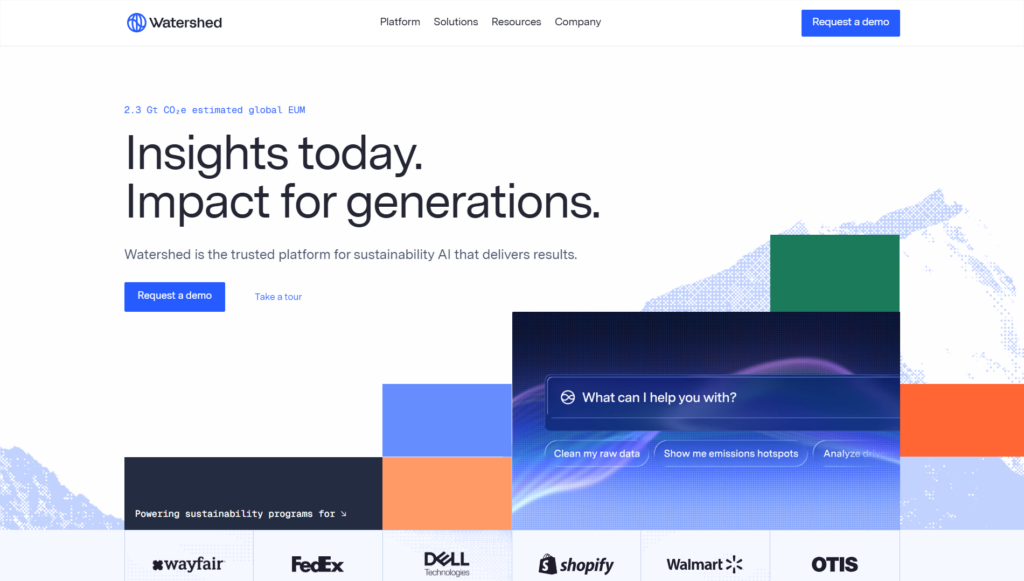
Watershed has quickly become one of the most respected carbon accounting platforms in the world.
It was named a Leader in the Verdantix 2026 Green Quadrant for Enterprise Carbon Management Software, earning top marks for data acquisition, carbon calculation methodologies, and net-zero strategy support.
Watershed’s foundation is a proprietary carbon data engine backed by over 500,000 emissions factors, benchmarks, and methodologies.
The platform covers Scope 1, 2, and 3 emissions in full, including lifecycle analysis (LCA) for specific products. Its acquisition of VitalMetrics further strengthened its emissions database.
Key features:
- Over 60 pre-built integrations with ERP systems (SAP, Oracle), travel tools (Concur, Navan), and cloud providers
- AI agents that automate data cleaning and deliver actionable insights up to 80% faster
- Dedicated toolsets for CSRD, SEC climate rules, CDP, and ISSB disclosures
- Carbon removal marketplace for high-quality offset purchases
- Full data lineage and audit trail for every calculation
- Tools for supplier engagement and supply chain decarbonization
Notable clients: Airbnb, Stripe, Walmart, FedEx, BlackRock, Spotify, Celonis
Pricing: Custom-quoted; enterprise packages typically start at around $50,000 per year. Pricing is based on organizational complexity, number of entities, data sources, and the level of advisory support required.
Drawback: The cost and complexity make it best suited for mid-to-large organizations with dedicated sustainability teams and mature data infrastructure.
2. Persefoni
Best for: Financial institutions, large enterprises, and organizations requiring investor-grade reporting accuracy
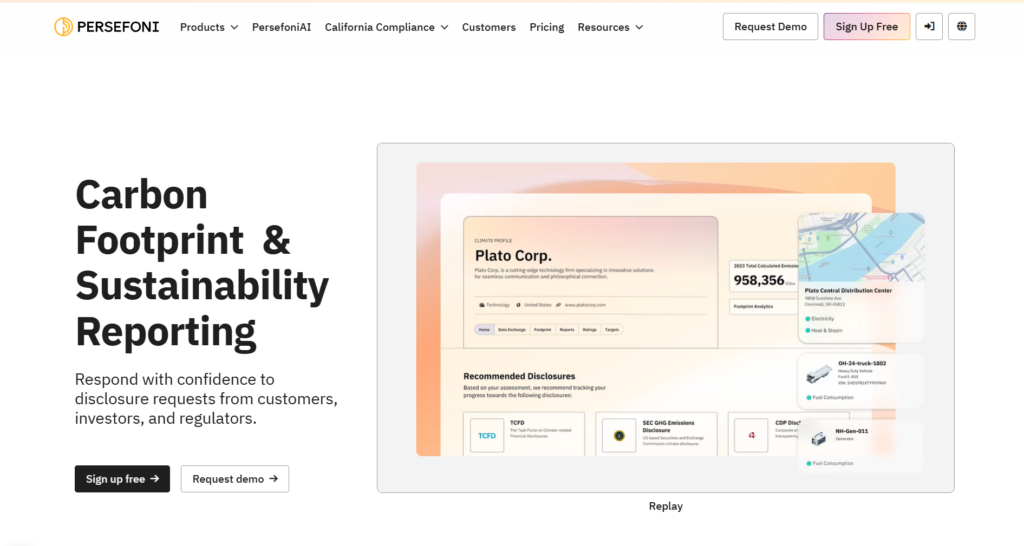
Persefoni describes itself as a “climate-native ERP for emissions and disclosure.” It is particularly powerful for financial sector companies that need to calculate financed emissions – the carbon footprint of a loan or investment portfolio – under frameworks like PCAF (Partnership for Carbon Accounting Financials).
The platform’s standout feature is its Footprint Ledger, which provides complete data lineage and transparency for every calculation. You can trace any emissions figure directly back to its source data and emission factor.
This makes it exceptionally audit-ready.
Persefoni’s AI tool (PersefoniGPT) is embedded into the platform to detect statistical anomalies, answer technical carbon accounting queries, and support disclosure preparation.
Key features:
- GHG Protocol and PCAF-aligned calculation engine
- Portfolio analytics dashboard for PE and VC firms (emission intensity, asset class breakdowns)
- Supplier portal for free Scope 3 data collection from supply chain partners
- XBRL tagging workflows for SEC registrants
- Regulatory reporting for TCFD, CSRD, ISSB, and SEC climate rules
- Strategic partnerships with Deloitte, Bain & Company, and other major consulting firms
Notable clients: Citi, Bain and Company, Dropbox, Xerox, Aramark, TPG, Euronext, The New York Times
Pricing: Not publicly disclosed. Free plan and paid Pro and Advanced tiers available. Schedule a demo for custom pricing.
Drawback: Can be complex and costly for smaller organizations without in-house ESG expertise.
3. Sweep
Best for: Large, decentralized enterprises that need cross-functional emissions accountability and strong Scope 3 supplier coverage
Sweep is a European carbon and ESG management platform that treats carbon reduction as a team sport. Its platform assigns emissions ownership across departments and business units, which creates accountability and drives behavioral change throughout the organization.
Sweep’s “Sweep Trees” feature visually maps emissions across business units, making it easy to see who owns what. T
he platform was named a Leader in the Verdantix 2026 Green Quadrant and recently expanded into North America with a new Denver office.
Key features:
- Assigns emissions ownership across teams, departments, and external partners
- Powerful scenario modeling and forecasting tools
- One-click reporting for CDP and other frameworks
- Supplier surveys and questionnaires for Scope 3 data collection
- CSRD-aligned data collection workflows
- AI-powered data management and emissions hotspot identification
- Member of the World Bank’s Carbon Pricing Leadership Coalition
Notable clients: L’Oreal, SSE, Lacoste, University of West London, Wickes, Mobilize Financial Services
Pricing: Custom-quoted based on organization size and requirements.
Drawback: More focused on internal engagement and operational tracking than on audit-grade financial-level reporting. May require change management effort when assigning emissions ownership across large organizations.
4. Normative
Best for: Enterprises with complex global supply chains and high Scope 3 exposure
Normative is widely regarded as a pioneer in automated, science-based carbon accounting, particularly in Europe.
Based in Stockholm, it was one of the first platforms to offer a fully automated, standards-driven approach to GHG measurement.
Its Carbon Network is a standout feature – it facilitates supplier-specific data capture, allowing companies to collect primary emissions data from their vendors rather than relying on less accurate spend-based estimates.
Normative also provides a free carbon calculator for small suppliers, making it easier for enterprises to bring their entire supply chain into the data ecosystem.
Normative’s methodology is particularly rigorous. In one verified engagement with a higher education organization, Normative delivered carbon calculations that were 72% lower than those produced by an industry-accepted tool, a significant finding that illustrates the risk of using less accurate methods.
Key features:
- Science-based carbon accounting engine aligned with GHG Protocol
- Carbon Network for supplier-specific Scope 3 data capture
- Direct integration with procurement systems
- Hotspot analysis and science-based target (SBTi) tools
- Climate strategy advisors available as part of the service
- Free calculator for small suppliers via the SME Climate Hub
Notable clients: Hertz, Nordea, Topps Tiles, Flying Tiger Copenhagen, Hitachi Rail, Vodafone, Zurich, LucaNet
Pricing: Custom-quoted; contact for a demo and tailored proposal.
Drawback: Focused primarily on carbon emissions rather than broader ESG metrics. Less suitable for companies looking for a single platform covering social and governance data alongside carbon.
5. Greenly
Best for: SMBs, mid-market companies, and European businesses seeking accessible, all-in-one ESG coverage
Greenly is a Paris-based platform designed to make carbon accounting simple and accessible.
With over 3,000 customers and a focus on ease of use, it is one of the most approachable platforms for companies that do not have a dedicated sustainability team.
The platform covers the full ESG spectrum, including GHG assessment, Life Cycle Analysis (LCA), and ESG management.
Its EcoPilot AI gives users on-demand climate expertise and handles repetitive data management tasks.
Greenly integrates with over 100 enterprise software platforms covering cloud data, accounting systems, and electricity providers.
It recently launched a CBAM solution to help EU importers navigate the new carbon border tax, and it is particularly strong for CSRD compliance readiness.
Key features:
- Automated data collection and supplier data retrieval
- Library of over 300,000 emission factors
- AI-powered anomaly detection for data quality assurance
- CBAM solution for EU importers
- Integration with 100+ enterprise tools
- Comprehensive Scope 3 measurement and reporting
- Supports CDP, CSRD, TCFD, and SBTi frameworks
Pricing: Starter plan from approximately $99/month for smaller companies. Essential plan from around $7,950/year for larger organizations. Enterprise pricing available on request.
Drawback: May be less suited to large, highly complex multinational enterprises with thousands of data sources. Expert support can vary depending on company size and tier.
6. Plan A
Best for: European businesses focused on decarbonization strategy and regulatory compliance
Plan A is a Berlin-based sustainability platform with a decarbonization-first philosophy.
Unlike platforms that focus primarily on measurement and reporting, Plan A is designed to guide companies through active emissions reduction – from data mapping to scenario modeling to ROI calculations on reduction investments.
The platform is TÜV Rheinland certified and SOC 2 and GDPR compliant, making it a strong choice for companies that need third-party validation of their methodology.
Its AI tools help with data mapping, convention memorization, and anomaly detection.
Key features:
- TÜV-certified carbon accounting methodology
- AI-guided data mapping and anomaly detection
- Decarbonization scenario modeling with ROI projections
- Full Scope 1, 2, and 3 coverage
- Customizable dashboards for visual emissions analysis
- Support for CSRD, SBTi, CDP, and other frameworks
Notable case study: AMPECO used Plan A to achieve an ambitious target of 50% Scope 1 and 2 emission reductions by using the platform’s customizable dashboards to identify hotspots like cloud usage optimization.
Pricing: Starts from approximately $3,000–$5,000 per year for SMBs; enterprise pricing on request.
Drawback: Primarily suited to European regulatory environments. May require onboarding support for companies new to structured carbon accounting.
7. IBM Envizi (Environmental Intelligence Suite)
Best for: Large enterprises, utilities, and organizations with complex infrastructure and heavy emissions profiles
IBM’s Environmental Intelligence Suite, anchored by the Envizi platform, is an enterprise-grade tool built for heavy emitters.
It aggregates utility data, asset data, and operational activity into audit-ready emissions inventories and supports regulatory filings.
What sets IBM apart is the integration with its broader AI and hybrid-cloud stack.
The suite includes climate risk analytics, weather forecasting, and geospatial analytics that help companies assess climate-related risks to their operations, not just their emissions footprint.
Key features:
- Utility, asset, and activity data aggregation into GHG inventories
- Climate risk analytics powered by AI
- Geospatial analytics for climate risk assessment
- Integration with IBM’s broader enterprise and consulting ecosystem
- Audit-ready reporting for multiple regulatory frameworks
- Strong performance for Scope 3 with supplier engagement portals
Pricing: Enterprise pricing; contact IBM directly for a quote.
Drawback: Can be less intuitive compared to newer, purpose-built carbon accounting tools. May require more configuration and dedicated IT resources. Less suitable for SMBs or companies without existing IBM infrastructure.
8. Salesforce Net Zero Cloud
Best for: Companies already using Salesforce’s ecosystem and looking for integrated sustainability management
Salesforce Net Zero Cloud brings carbon accounting into the world’s most widely used CRM platform. If your company runs on Salesforce, adding sustainability tracking becomes seamless.
The platform leverages Tableau for powerful analytics dashboards and connects with the AppExchange ecosystem for additional apps.
Net Zero Cloud allows companies to measure Scope 1, 2, and 3 emissions, set science-based targets, manage carbon offsets, and monitor progress toward sustainability goals – all from within the Salesforce interface.
Key features:
- Scope 1, 2, and 3 emissions measurement
- Science-based target setting and monitoring
- Carbon offset management
- Scenario planning and forecasting tools
- Tableau-powered analytics dashboards
- Seamless integration with Salesforce CRM, ERP connections, and AppExchange
Pricing: Requires a Salesforce subscription plus additional licensing. Can be costly for non-Salesforce users due to the base infrastructure cost.
Drawback: More configuration-heavy than standalone carbon accounting platforms. Best value for organizations already deeply invested in Salesforce. Less cost-effective for companies not already using Salesforce products.
9. Microsoft Cloud for Sustainability (Sustainability Manager)
Best for: Organizations already using Microsoft’s enterprise ecosystem – Azure, Dynamics 365, Teams
Microsoft’s Cloud for Sustainability brings emissions and ESG data management into the Microsoft ecosystem.
Its core product, Sustainability Manager, connects carbon accounting data across the value chain and integrates with other Microsoft sustainability tools and the Dynamics 365 platform.
For organizations already running on Microsoft infrastructure, this is a highly practical choice. It reduces data silos, connects operational data directly to sustainability reporting, and supports carbon budgeting across business units.
Key features:
- Integration with Dynamics 365, Azure, and Microsoft’s broader suite
- Carbon budgeting and tracking across business units
- Supply chain data integration
- ESG data centralization
- Alignment with GHG Protocol and major reporting frameworks
Notable clients: Widely adopted across Microsoft’s global enterprise customer base
Pricing: Requires existing Microsoft licensing; additional modules priced separately. Contact Microsoft for specific quotes.
Drawback: Best suited for organizations already in the Microsoft ecosystem. Change management can be challenging when assigning emissions workflows across large organizations.
10. Sphera
Best for: Manufacturing, industrial, and chemical companies requiring advanced Life Cycle Assessment (LCA)
Sphera is one of the most technically advanced carbon accounting platforms on the market, particularly for companies that need detailed product-level footprinting and life cycle assessments.
It specializes in Scope 3 value chain emissions and uses physical quantities and industry-specific emission factors rather than high-level financial estimates.
Sphera pairs its software with sustainability consulting services, offering methodological expertise alongside the platform.
This combination is especially valuable for complex industrial operations where emissions arise from highly specific chemical or manufacturing processes.
Key features:
- Advanced LCA capabilities for product carbon footprints
- Industry-specific emission factors for manufacturing and chemicals
- Scope 3 value chain carbon accounting
- Sustainability consulting services embedded in offering
- Hotspot identification and reduction scenario modeling
Pricing: Enterprise-level custom pricing; contact for a quote.
Drawback: The platform’s complexity can limit accessibility for non-technical users. It is best suited for large industrial operations, not for SMBs or service-sector companies.
11. Emitwise
Best for: Companies with complex, data-sparse supply chains that need AI to fill in the gaps
Emitwise, founded in 2019, has carved out a niche in Scope 3 supply chain emissions using machine learning.
Its platform transforms incomplete supplier data into accurate emissions estimates – a critical capability for companies whose supply chains span thousands of vendors across many countries.
Emitwise’s ML algorithms solve the persistent problem of data gaps in Scope 3 accounting, making it possible to build a credible emissions inventory even when some suppliers cannot provide activity-level data.
Key features:
- Machine learning-powered Scope 3 estimation from incomplete data
- Supplier engagement and data collection workflows
- Emissions hotspot identification across value chains
- Alignment with GHG Protocol and CSRD frameworks
- Regular emissions factor updates and methodology transparency
Pricing: Custom-quoted enterprise pricing.
Drawback: Primarily focused on supply chain emissions. Companies looking for a comprehensive all-in-one platform covering Scope 1 and 2 in equal depth may need to evaluate whether Emitwise meets all their needs.
12. KEY ESG
Best for: Organizations needing an all-in-one sustainability management platform with strong audit readiness
KEY ESG is a comprehensive sustainability management platform that puts carbon accounting at its core.
The platform covers Scope 1, 2, and 3 emissions and is built with a focus on audit readiness and regulatory compliance in 2026.
Its emissions factor library is one of the largest available, with over 70,000 factors from DEFRA, the US EPA, and Climatiq – all aligned with the GHG Protocol.
This gives companies high confidence in the accuracy of their calculations across different regions and activity types.
Key features:
- Full Scope 1, 2, and 3 coverage with GHG Protocol alignment
- 70,000+ emission factors from DEFRA, EPA, and Climatiq
- Audit-ready data collection and reporting
- ESG data management beyond carbon (social and governance metrics)
- Support for CSRD, ISSB, SBTi, and EU Taxonomy reporting
- User-friendly interface designed for non-technical sustainability teams
Pricing: Subscription-based; contact for a tailored quote based on organization size and requirements.
Drawback: Better suited to organizations seeking broad ESG coverage. Companies needing deep, niche-specific LCA capabilities may prefer platforms like Sphera.
13. Coolset
Best for: Mid-sized companies that need structure, speed, and clarity without enterprise-level complexity
Coolset has earned a strong reputation for being the go-to platform for mid-market companies that need to get their carbon accounting in order quickly and efficiently. It is particularly popular in Europe, where CSRD compliance pressure is most acute.
The platform combines structured data collection, automated calculations, and clear reporting outputs — making it accessible for sustainability managers who are not data scientists. Coolset offers fast implementation timelines, which is a significant advantage for companies facing near-term compliance deadlines.
Key features:
- Fast onboarding and implementation
- CSRD-aligned reporting workflows
- Scope 1, 2, and 3 calculation and tracking
- Clear, visual dashboards for non-technical users
- Supplier data collection tools
- Science-based target integration
Pricing: Approximately €6,000–€20,000 per year for mid-market companies; enterprise pricing available.
Drawback: Less suited to very large, complex multinational organizations that require enterprise-grade integrations and deeply customized workflows.
14. Pulsora
Best for: Companies needing a powerful, all-in-one carbon and ESG management platform with strong decarbonization strategy tools
Pulsora offers a comprehensive platform that connects carbon accounting with strategic decarbonization planning.
It is designed for companies that want to do more than just report. They want to use their emissions data to drive real business decisions and chart a credible path to net zero.
The platform covers full Scope 1, 2, and 3 measurement, regulatory reporting, and includes tools for scenario modeling, reduction planning, and stakeholder communication.
Its strength lies in connecting the data layer to the strategy layer in a single platform.
Key features:
- Full Scope 1, 2, and 3 carbon accounting
- Scenario modeling and net-zero pathway tools
- Regulatory reporting aligned with CSRD, ISSB, SBTi, and TCFD
- Supply chain engagement features
- Audit-ready data management and documentation
- Stakeholder reporting and communication tools
Pricing: Custom-quoted; contact for pricing based on company size and scope.
Drawback: Newer entrant compared to some established platforms; may have fewer integrations than longer-established tools.
15. SINAI Technologies
Best for: Companies that need to combine rigorous carbon accounting with internal carbon pricing and financial modeling
SINAI is a differentiated platform because it uniquely combines carbon accounting with a Marginal Abatement Cost Curve (MACC) engine.
This means companies can not only measure their emissions but also model the financial cost of reducing them across different decarbonization pathways.
The platform is TÜV-certified and designed for audit readiness. It is particularly well suited for companies that want to integrate carbon pricing into their business strategy – a growing need as carbon taxes and compliance markets expand globally.
Key features:
- TÜV-certified carbon accounting methodology
- MACC engine for decarbonization investment modeling
- Full Scope 1, 2, and 3 coverage
- Internal carbon pricing tools
- Audit-ready reporting and data transparency
- Support for CSRD, TCFD, SBTi, and CDP
Pricing: Enterprise pricing; contact for a custom quote.
Drawback: The financial modeling depth adds complexity that may be more than smaller companies need. Best value for organizations with a dedicated sustainability and finance team working closely together.
16. Minimum
Best for: Enterprise organizations seeking a sophisticated, data-driven approach to disclosure-ready carbon accounting
Minimum is a London-based platform built for large enterprise-level organizations that want a highly sophisticated and data-driven approach to carbon accounting.
Its feature set is geared toward gaining high-level insights from complex datasets and meeting the most stringent disclosure requirements.
Minimum is particularly suited for organizations that are under intense scrutiny from investors, regulators, and auditors and need a platform that can stand up to the most rigorous examination.
Key features:
- Enterprise-grade carbon accounting and data management
- Disclosure-ready outputs for major regulatory frameworks
- Deep integration capabilities with enterprise IT infrastructure
- High-level emissions insights and analytics
- Designed for large organizations managing complex, multi-site operations
Pricing: Enterprise pricing; contact for a custom quote.
Drawback: Designed specifically for large enterprises; overkill for SMBs or companies just beginning their carbon accounting journey.
17. SageEarth (formerly Spherics)
Best for: Small businesses and SMBs already using Sage accounting software
SageEarth started as Spherics, a carbon accounting tool based in Bristol, UK, and was acquired by ERP giant Sage in 2022.
The platform offers a fast, affordable, and accessible way to calculate your carbon footprint by connecting directly with your accounting software.
Once connected, SageEarth reads your financial data and uses it to estimate your emissions using spend-based methodology.
You can then add more granular activity data to improve accuracy over time. It is an excellent entry-level option for small businesses that want to get started without a large upfront investment.
Key features:
- Direct integration with Sage accounting software
- Spend-based carbon footprint calculation
- Option to add activity-based data for improved accuracy
- Simple, user-friendly interface
- Affordable pricing suitable for small businesses
- Carbon reduction plan guidance
Pricing: Affordable SMB pricing; typically positioned as a low-cost entry-level solution. Contact Sage for current pricing.
Drawback: Spend-based methodology is less accurate than activity-based calculation. Not suitable for large enterprises or companies facing stringent audit requirements. Limited Scope 3 depth compared to enterprise platforms.
18. Seedling
Best for: Small and mid-market businesses (up to 1,000 employees) that need an easy-to-use, affordable platform
Seedling is built specifically for smaller organizations that do not have a full-time sustainability expert on staff. While most carbon accounting platforms target large enterprises, Seedling fills an important gap by offering an affordable, accessible, and practical tool for SMBs.
The platform guides users through the carbon accounting process step by step, making it possible to build a credible emissions inventory without deep technical knowledge.
Seedling also offers support for Carbon Reduction Plans (CRPs), which are increasingly required for UK public sector procurement (PPN 06/21).
Key features:
- Purpose-built for small and mid-market businesses
- Step-by-step guided carbon accounting process
- Carbon Reduction Plan (CRP) support for UK procurement
- Free business carbon calculator tool
- Simple, affordable pricing
- Suitable for companies without in-house sustainability expertise
Pricing: Affordable SMB pricing; contact for current plans and pricing.
Drawback: Not designed for large or complex organizations. Limited advanced features compared to enterprise platforms like Watershed or Persefoni.
Quick Comparison: Best Carbon Accounting Software by Use Case
| Use Case | Best Platform |
|---|---|
| Large enterprise with board-level climate programs | Watershed |
| Financial institutions and financed emissions | Persefoni |
| Complex global supply chains (Scope 3) | Normative |
| Cross-functional team accountability | Sweep |
| SMBs and mid-market (accessible, affordable) | Greenly or Seedling |
| European CSRD compliance focus | Plan A, Greenly, or Coolset |
| Manufacturing and industrial LCA | Sphera |
| Already using Salesforce | Salesforce Net Zero Cloud |
| Already using Microsoft/Dynamics | Microsoft Cloud for Sustainability |
| Already using Sage accounting | SageEarth |
| Internal carbon pricing + financial modeling | SINAI Technologies |
| Mid-market companies needing fast implementation | Coolset |
| AI-powered Scope 3 from incomplete data | Emitwise |
| Broad ESG + carbon + audit readiness | KEY ESG |
How to Choose the Right Carbon Accounting Software for Your Business
With so many options, here is a clear step-by-step process to find the best fit.
Step 1: Identify Your Regulatory Requirements
Start by understanding what regulations apply to you. Are you subject to CSRD? Do you need to file under California’s SB-253? Are you a UK company covered by SECR? Your compliance obligations will narrow your software shortlist significantly.
Step 2: Assess Your Emissions Complexity
A company with ten employees and one office has very different needs from a multinational manufacturer with a 2,000-supplier chain. Map out your Scope 1, 2, and 3 emission sources before evaluating software. This gives you a clear picture of the data management challenge you face.
Step 3: Clarify Your Budget
Carbon accounting software pricing ranges from a few hundred dollars per year for entry-level SMB tools to over $100,000 annually for enterprise platforms with advisory services. Know your budget before entering demos – it will save time on both sides.
Step 4: Check Integrations with Your Existing Systems
The best software is one that connects seamlessly with your ERP, finance, energy management, and travel booking tools. Manual data entry creates errors and slows down your team. Prioritize platforms with pre-built integrations for the systems you already use.
Step 5: Evaluate Scope 3 Capabilities
If supply chain emissions are significant for your business, and they almost certainly are, dig deep into how each platform handles Scope 3. Does it offer a supplier portal? Does it use primary or spend-based data? How often are emission factors updated?
Step 6: Test the User Experience
Request a demo from your top three platforms. Pay attention to how intuitive the interface is, how easy data upload is, and how quickly you can generate a report. A powerful platform that your team refuses to use is worthless.
Step 7: Verify Audit Readiness
Ask specifically about audit trails, data lineage, and third-party verification support. Can the platform generate ISAE 3000/3410-compliant outputs? Does it maintain calculation logs and evidence attachments? Audit-readiness is non-negotiable as disclosure requirements tighten.
Step 8: Look for Decarbonization Planning Tools
The goal is not just measurement – it is reduction. Choose a platform that helps you identify emissions hotspots, model reduction scenarios, set science-based targets, and track progress over time.
Understanding Scope 1, 2, and 3 Emissions: A Quick Explainer
If you are new to carbon accounting, here is a simple breakdown of the three emission scopes.
Scope 1 — Direct emissions come from sources your company owns or controls directly. Examples: company vehicles, on-site diesel generators, manufacturing furnaces, refrigerant leaks. These are usually the easiest to measure.
Scope 2 — Indirect energy emissions come from the electricity and heat you buy from external providers. When your lights are on and your factory is running, the power plant generating that electricity is emitting CO2 on your behalf. Scope 2 can be reduced by switching to renewable energy contracts.
Scope 3 — Value chain emissions cover everything else. This is the carbon embedded in the products and services you buy (upstream) and in the use and disposal of your products (downstream). Scope 3 typically represents 70–90% of a company’s total carbon footprint. It is the hardest to measure and the most important to tackle.
Good carbon accounting software must handle all three scopes. For most companies, getting Scope 3 right – especially supplier emissions – is the biggest challenge.
Carbon Accounting Software vs. ESG Software: What Is the Difference?
People often confuse carbon accounting software with ESG (Environmental, Social, and Governance) software. They overlap, but they are not the same.
Carbon accounting software focuses specifically on measuring, tracking, and reporting GHG emissions. It follows the GHG Protocol and is typically used by sustainability or environmental teams.
ESG software covers a broader range of metrics – environmental (including carbon), social (diversity, labor practices, safety), and governance (board structure, anti-corruption, risk management). ESG platforms aggregate and report on all three pillars.
Many platforms today offer both. Greenly, KEY ESG, and Plan A, for example, cover ESG management alongside core carbon accounting. Persefoni and Watershed are more focused on carbon and climate disclosure, with ESG elements as add-ons.
If you only need to manage carbon for compliance, a dedicated carbon accounting platform is often the better choice. If you need to report on the full range of ESG metrics to investors, a broader ESG platform may suit you better.
The Role of AI in Modern Carbon Accounting Software
Artificial intelligence is transforming carbon accounting in several important ways.
Automated data ingestion. AI tools now use OCR (optical character recognition) to extract data from energy bills, invoices, and utility statements automatically, eliminating manual data entry.
Anomaly detection. AI flags unusual spikes or drops in emissions data that might indicate data entry errors or calculation mistakes. Platforms like Persefoni, Greenly, and Plan A all embed this capability.
Emissions factor matching. AI matches your business activities to the right emission factors from large databases, reducing human error in calculations.
Report drafting. Platforms like Watershed use AI to pre-populate regulatory disclosure reports and draft narrative sections, cutting reporting time dramatically.
Supplier gap estimation. When supplier data is unavailable, AI models (like those used by Emitwise) estimate emissions based on industry averages, procurement data, and ML models trained on comparable companies.
AI does not replace human judgment, but it makes carbon accounting faster, more accurate, and more accessible for teams without deep technical expertise.
Common Mistakes Companies Make with Carbon Accounting Software
Avoid these pitfalls when implementing a carbon accounting platform.
Choosing a tool before understanding your data. Many companies select software based on marketing or peer recommendations without first mapping their emission sources. Always complete a data readiness assessment first.
Ignoring Scope 3. Some companies focus exclusively on Scope 1 and 2 because they are easier to measure. Scope 3 is where most of your emissions live, and regulators and investors are increasingly focused on it.
Underestimating implementation time. Budget 3–6 months for a full rollout. You need to connect data sources, onboard your team, and validate your baseline emissions before you can start reporting with confidence.
Buying the most powerful tool when you need the simplest. A small company does not need a $100,000 enterprise platform. Start with a tool that matches your current complexity, then upgrade as you grow.
Forgetting to verify emission factors. Outdated or incorrect emission factors produce inaccurate calculations. Make sure your platform updates its factor library regularly and is transparent about its methodology.
Treating carbon accounting as a one-time exercise. Carbon accounting is an ongoing process. Your emissions change every year. Your platform needs to support continuous monitoring, not just an annual snapshot.
Carbon Accounting Regulations You Need to Know in 2026
The regulatory landscape is the primary driver of software adoption. Here are the key frameworks to understand.
CSRD (EU Corporate Sustainability Reporting Directive): Requires large EU-based companies and non-EU companies with significant EU operations to disclose detailed sustainability information, including full GHG emissions data. Reporting began for the largest companies in 2025 and will expand to more entities through 2026 and 2027.
California SB-253 (Climate Corporate Data Accountability Act): Requires companies with over $1 billion in annual revenue doing business in California to file verified Scope 1 and 2 GHG emissions starting in 2026 (Scope 3 follows in 2027).
EU CBAM (Carbon Border Adjustment Mechanism): Entered its definitive phase on January 1, 2026. EU importers of certain carbon-intensive products must now pay for the carbon embedded in those imports — making accurate carbon measurement a direct cost issue.
SEC Climate Disclosure Rules (US): US public companies face increasing pressure to disclose climate-related financial risks and emissions data in line with TCFD and ISSB frameworks.
ISSB/IFRS S2: The International Sustainability Standards Board’s climate disclosure standard is becoming the global benchmark for emissions reporting, adopted across markets in the UK, Canada, Australia, Japan, and many emerging markets.
SBTi (Science Based Targets initiative): Not a regulation, but increasingly required by investors and major corporate customers. Companies must verify their emission reduction targets are aligned with climate science to earn SBTi validation.
CDP (Carbon Disclosure Project): A voluntary but widely influential disclosure system used by over 18,000 companies. Many supply chain requirements are tied to CDP disclosure. Watershed has been designated as an accredited global gold software solutions provider by CDP.
How Much Does Carbon Accounting Software Cost?
Carbon accounting software pricing varies enormously based on company size, complexity, and the features you need.
Free or very low cost tools: Basic calculators and entry-level tools for micro-businesses. Examples: Normative’s free SME calculator, SageEarth’s basic tier.
SMB-focused platforms ($1,000–$10,000/year): Tools like Seedling, SageEarth, and the lower tiers of Greenly and Coolset. These are right for companies with fewer than 500 employees and straightforward emissions profiles.
Mid-market platforms ($10,000–$50,000/year): The majority of quality platforms in this range – Plan A, Normative, Sweep mid-tier, KEY ESG. These suit companies with 500–5,000 employees and moderate Scope 3 complexity.
Enterprise platforms ($50,000–$200,000+/year): Watershed, Persefoni, IBM Envizi, Sphera. These are for large organizations with complex multi-entity operations, supply chain emissions programs, and board-level climate commitments.
Always look beyond the subscription fee. Hidden costs can include implementation and onboarding fees, advisory services, supplier portal access, additional regulatory reporting modules, and data integration work. Budget 20–30% on top of the listed subscription cost for a full first-year deployment.
Frequently Asked Questions (FAQs)
What is carbon accounting software?
Carbon accounting software is a digital platform that helps organizations measure, track, manage, and report their greenhouse gas (GHG) emissions. It automates data collection, applies verified emission factors, and generates audit-ready reports aligned with frameworks like the GHG Protocol, CSRD, and CDP.
What is the best carbon accounting software for small businesses?
For small businesses, Greenly (Starter plan), Seedling, SageEarth, and Coolset are the best options. They are affordable, user-friendly, and do not require a dedicated sustainability team to operate. Normative also offers a free carbon calculator for very small companies.
What is the best carbon accounting software for large enterprises?
Watershed, Persefoni, and Sweep are the leading enterprise platforms in 2026. Watershed leads for companies with ambitious climate programs and complex supply chains. Persefoni leads for financial institutions and investor-grade reporting. Sweep excels at decentralized organizations that need cross-functional emissions accountability.
What is the difference between Scope 1, 2, and 3 emissions?
Scope 1 covers direct emissions from sources you own (vehicles, furnaces). Scope 2 covers indirect emissions from purchased electricity and heat. Scope 3 covers all other indirect emissions across your value chain — typically 70–90% of a company’s total footprint.
Is carbon accounting software required by law?
It depends on your location and company size. In the EU, the CSRD is already mandatory for large companies. In California, SB-253 requires Scope 1 and 2 reporting for large businesses from 2026. In the UK, SECR applies to large companies and listed businesses. Regulatory requirements are expanding fast, and most mid-to-large companies globally will face mandatory disclosure requirements within the next few years.
How accurate is carbon accounting software?
Accuracy depends on the quality of your input data and the methodology used. Activity-based data (actual energy consumption, fuel use, distances traveled) produces more accurate results than spend-based estimates. Leading platforms use verified emission factors from trusted sources (DEFRA, EPA, IPCC) and include AI-powered anomaly detection to flag data quality issues.
What is the GHG Protocol?
The Greenhouse Gas Protocol is the most widely used international accounting tool for understanding, quantifying, and managing greenhouse gas emissions. Developed by the World Resources Institute and the World Business Council for Sustainable Development, it provides the framework that underpins most carbon accounting software.
Can carbon accounting software help with CDP reporting?
Yes. Most leading platforms generate outputs aligned with CDP disclosure requirements. Watershed is an accredited CDP gold solutions provider, and platforms like Greenly, Persefoni, Normative, and Sweep all support CDP reporting directly within their interfaces.
How long does it take to implement carbon accounting software?
For most organizations, a full implementation takes 3–6 months. This includes connecting data sources, validating your baseline emissions, training your team, and completing your first full reporting cycle. Simpler tools for smaller businesses can be set up in a few weeks.
What is Scope 3 carbon accounting, and why is it so hard?
Scope 3 covers all indirect emissions in your value chain — what your suppliers emit, what your customers emit using your products, and what happens to your products at end of life. It is difficult because it requires data from hundreds or thousands of external organizations. The best platforms address this through supplier portals, automated questionnaires, and ML-based estimation for data gaps.
Final Thoughts: Choosing the Best Carbon Accounting Software for Your Business
The best carbon accounting software is not the most expensive tool or the one with the most features. It is the one that fits your organization’s size, complexity, regulatory requirements, and sustainability ambitions — and that your team will actually use.
If you are a small business just starting out, begin with Seedling, SageEarth, or Greenly. They are affordable, accessible, and get you up and running quickly.
If you are a mid-market company facing CSRD or CSRD-adjacent requirements, look closely at Plan A, Coolset, Normative, or KEY ESG. They balance capability with usability and are priced for organizations that are serious about compliance but not yet at enterprise scale.
If you are a large enterprise with board-level climate commitments and complex supply chains, Watershed, Persefoni, or Sweep are the market leaders. They offer the depth, auditability, and decarbonization strategy tools that serious climate programs require.
The carbon accounting market is evolving fast. Platforms are adding AI capabilities, expanding their emissions factor libraries, and deepening their regulatory reporting toolsets every quarter. Whatever platform you choose, the most important step is to start now.
The companies that build strong carbon data foundations today will be best positioned to meet the regulatory requirements of tomorrow, and to build the sustainable businesses that the world’s investors, customers, and employees increasingly demand.
This article was last updated in April 2026. Pricing and features are subject to change. Always verify current pricing and capabilities directly with software vendors before making purchasing decisions.